Alejandro III de Macedonia construyó un imperio que se extendía por todos los rincones del globo, desde el tranquilo y calmo reino de Macedonia hasta el mundo helénico, Persia y, en última instancia, hasta la India. Él confiaba en detenerse sólo al llegar al océano Pacífico, pero todo se acabó antes, con su prematura muerte a los treinta y tres años. De esto hace a dos milenios, pero las historias de su vida, tanto de hechos reales y como lengendarios, han mantenido a Alejandro, conocido por "el Magno" siempre vivo a lo largo de la historia de las civilizaciones, pues su legado es eterno. Pero ¿quién fue realmente Alejandro en su tiempo? Han sido muchas las teorías y estudios sobre el personaje, pero al fin, en este ensayo biográfico, Anthony Everitt lo juzga conforme a los criterios de su época, considerando todas las posibles contradicciones. Podemos, ahora sí, conocer al príncipe macedonio: naturalmente curioso y fascinado por la ciencia y la exploración, fue un hombre que disfrutaba de las artes y que usaba la gran epopeya de Homero, la Ilíada, como biblia. A medida que conquistaba más y más tierras y veía su imperio crecer, Alejandro mostró respeto por las tradiciones de sus nuevos súbditos y un juicio cuidadoso al gobernar sobre tan vastos territorios. Pero también su vida tuvo un lado oscuro: conquistador empedernido que construyó el imperio más grande de la historia hasta el momento, también glorificó la guerra y fue conocido por cometer actos de notable crueldad. He aquí la biografía definitiva del más grande estratega de la historia.
Anthony Everitt is a British academic. He studied English literature at the University of Cambridge. He publishes regularly in The Guardian and The Financial Times. He worked in literature and visual arts. He was Secretary-General of the Arts Council of Great Britain. He is a visiting professor in the performing and visual arts at Nottingham Trent University. Everitt is a companion of the Liverpool Institute of Performing Arts and an Honorary Fellow of the Dartington College of Arts. Everitt has written books about Roman history, amongst which biographies of Augustus, Hadrian and Cicero and a book on The Rise of Rome. He lives in Wivenhoe near Colchester.
Many of you won't know this. I have been campaigning with Alexander the Great since August 2019.
Mr. Everitt, an academic historian, author and professor has written an intelligent, thoughtful and balanced ancient historiobiography on this most powerful, complex and volatile kings. Firstly, Mr. Everitt sets the scene into the sociocultural environment of Alexander's time. He then, with gusto, takes us through his life and at many junctures explains his conjecture and hypotheses without taking us away from this most exciting and fascinating period. Whilst reading this, I felt like I was one of his honored companions walking alongside him and finding out more and more about him, his psychology, his intelligence, his kindness alongside his megalomania and cruelty.
As interesting as the battles were from Greece, to Egypt, to Asia Minor, to Persia and India and back to Babylon again ; what I was most intrigued was by his political and philosophical views, his spirituality and all of the intrigues. I was most fascinated by his mother Olympias and his training with Ancient Greek philosophers. I was fascinated by his pansexuality and his love for women, men and eunuchs. I was confused by his rages and volatility. I was amazed at his courage and his erudition. I am certain that if I was among his entourage I would be one of his biggest fanboys !
Thank you to Netgalley, the author and Random House for an advanced ecopy in exchange for a review. This book was released to the general public in August 2019.
Here is a fresco of Alexander with his three main loves, his wife Rhoxane, his lifelong companion/lover Hephaiston and the beautiful eunuch Bagoas !
Author, Anthony Everitt’s, Alexander the Great – His Life and His Mysterious Death, is amazing. He has written a book that reads like a novel – Everitt presents a rollicking story of life in antiquity including warfare, geopolitics, riches, violence, realpolitik and uber skull-duggery.
Alexander came to power following the assassination of his father, Philip II of Macedonia in 336 BCE. His father was also military leader of great note – so this desire to conquer must’ve been in the familial blood. His relationship with his Mother Olympias, a significant figure herself, was solid for the duration of Alexander’s life. Soon after he grabbed his father’s throne – he campaigned in the Balkans, Thrace, Illyria, Thebes – and he led the League of Corinth (the Greek states – except Sparta) with the lofty ambition of invading Persia – ruled by the Great King Darius. He also dropped into Egypt and nipped over to India ……..a step too far?.
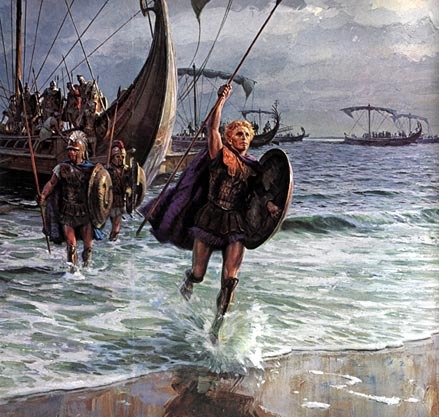
Alexander believed he was related to Zeus and Achilles – the latter being an idol of his. Apparently he didn’t go anywhere without Homer’s, The Iliad. Alexander sailed with sixty fighting ships to the land of Troy, where he flung his spear from the ship and fixed it in the ground, and then leapt ashore himself the first of the Macedonians, signifying that he received Asia from the gods as a spear-won prize. (Diodorus XVII. 17)
I would have loved to have seen this – imagine!! Yes he may have said, “get that ginger bastard with the glasses and the dodgy knee” – but it would be worth the risk!!
The author includes some fantastic, informative maps, of signiciant battles such as The Battle of Gaugamela, and The Battle of Granicus River as well as others. These maps include the locations of infantry, cavalry, mercenaries – the Generals. It’s fascinating – it puts you right there..
This never-ending war certainly presented logistical challenges. Imagining feeding 40, 50, 60 thousand or more troops? This lot pretty much devastated farmlands of the countryside they were progressing through – you can imagine it. He also struck an unusually low casualty rate amongst his troops. This was probably due to a combination of Alexander’s brilliant leadership but also his troops were battle hardened – many left over from the reign of his father King Phillip II. Hardened old codgers.
But it wasn’t all beer and skittles – many were sick of this ongoing campaign, even though Alexander paid them well, looked after them, they wanted to go home. So mutinous actions did foment from time to time. Conspirators were dealt with ruthlessly.
Alexander was brutal (Impaling makes me a little twitchy) – he could flatten a city, kill everyone, sell captors into slavery - but he could also conduct a softer take-over and use local administrators to keep the place running pretty much as it was before. He had the insight to make sure local populations were needed to maintain the Empire.
The author, quite naturally, ends the book detailing (as much as he can) with the death of this gigantic figure. He discusses some of the theories surrounding his death and pros and cons of various theories. He died at 32 years of age, and what an impact he made.
I’d still rather have a beer and veggie burger with Ragin’ Trajan, but I’d SMS Alexander if Trajan was unavailable.
5 Stars
I need to mention, the last one hundred or so pages contains a glossary and a timeline of significant events, he details his sources – this makes interesting reading too. This author explains the challenges of sourcing material, particularly contemporary sources – and his reasoning for questioning, or advocating for various material used.
I have been fascinated by Alexander the Great for years . . . So much accomplished in such a few years only to have empire collapse immediately upon his death.
I don’t know enough about ancient history or Alexander to really judge the scholarship and interpretations in this book. But it is thoughtful and well-sourced. It also reads easily.
Several things surprised me . . . I knew the Greeks had fought the Persians to a stand off in years past but I had thought of those as David/Goliath type battles. But instead, The Greeks were a rival power through their trading networks and colonies. By the time of Alexander, many soldiers in the Persian military were Greek mercenaries.
The Persian Empire was not inefficient nor poorly led; King Darius had the misfortune to come up against a military genius. I had no real conception of the size of Alexander’s conquests or the lengthy histories of some of the civilizations he encountered. His lust for conquest greatly expanded geographic knowledge of the time, exploring was part of what he loved about his wars.
I didn’t come away with any real sense of Alexander (or his family or generals) as a person I could understand. But maybe they lived in a world too different from ours or maybe we just don’t have the primary sources that could help with that.
Enjoyed this and would be interested in reading another Alexander biography. Also now am interested in reading about the Silk Road trading route since Alexander was plundering around all along it.
Author does a good job of outlining the different theories of cause of death for Alexander and makes a good case for the natural one that he thinks is most plausible.
Alexander the Great. Hero to some (the Macedonians) and demon to others (Persians). No matter your outlook, it is undeniable that he had an enormous impact on the world. Anthony Everitt writes a wonderful tome detailing his life.
Starting from the beginning, Alexander's complex childhood is explained. The court politics of the Macedonian Court was rather rough and tumble. Alexander's father, Phillip of Macedon, is a great battle king but is also a wily diplomat. The complex nature of his court and his eventual relationship issues with Alexander's mother, Olympias, will lead to conflict with his son.
Upon Phillip's assassination, Alexander is proclaimed King. The book then takes us through Alexander's epic war against the Persian Empire. The military aspects are well explained, as well as Alexander's thinking. Everitt's Alexander is a Globalist leader, one who wishes to join together the great empire and cultures of Hellenistic Greece with the Persian Empire. This caused some friction with his more conservative commanders.
The entire scope of Alexander's genius and his ambition are on full display. He was truly a man before his time and his achievements have lasted well past his demise. A superb book that is full of fascinating details and stories. If there is one book you wish to read about Alexander, then let it be this one.
Anthony Everitt's new biography of Alexander the Great is excellent, though I think it is probably less revisionist or groundbreaking than the description would indicate. Though the title makes much of Everitt's examination and theories about Alexander's death, this book is really more of a traditional biography than an in-depth forensic study of the circumstances of Alexander's passing. That's fine, because it is an interesting, well-researched, and well-written study of one of the most fascinating figures in human history.
Everitt does a good job of setting the stage for Alexander's life by thoroughly introducing Macedonia and Philip. Alexander is a complex figure, but Everitt has some insightful thoughts about his motivations, personality, strengths and weaknesses. Everitt discusses Alexander's sexual proclivities at length without being overly lurid or sensational. Everitt includes in his book many of the myths that have grown up around Alexander's career, while offering insight as to which aspects of these stories may be truthful and which are less likely. The ending of this book particularly shines; the author considers the many plans that Alexander had in place when he died (conquering Arabia, fighting Carthage, controlling the Mediterranean, circumnavigating Africa), and speculates about how history could have changed if Alexander had lived to old age.
If you are interested in history or biography, this book is worth your time. I received a digital copy of this book for free from the publisher and was not required to write a positive review.
I always like reading a book about Alexander the Great, this one is a good one because it takes you from his childhood and the culture (Macedonia) that made someone like him possible, it focuses on his dad and Mom and his companions through childhood all the way to adulthood, it is a very in-depth study of the life of the Man who conquered the whole known world before age 32. While this book doesn’t give us anything groundbreaking new on Alexander, it does do a good job of summarizing the man and the times he lived on, if you are into ancient history or would like to know more about Alexander then this is the book for you .
I’m afraid that this book was not for me. It was well written but I’m just not interested in military history. The planning and execution of military campaigns bore me. Unfortunately, that is what most of the book is about. The author also has an excessive interest in Alexander’s sex life (or lack thereof). I read until about the 40% point and then started to skim until the last 2 chapters that covered Alexander’s death and its aftermath. If you are really interested in the subject of this book I suggest that you skip the audiobook because the audiobook does not include the glossary, timeline, sources and endnotes which comprise 25% of the book. I received a free copy of this book from the publisher.
Different eras view Alexander III of Macedon differently. Though always honored as a hugely successful military leader and conqueror, in the ancient world, he got mixed press, seen as a blend of virtues and faults. In the Middle Ages, and really until the twentieth century, he was usually regarded as among the greatest men of history, and surrounded by myths exaggerating his accomplishments. More recently, without detracting from his military abilities, he has been classed as a killer mad for power. Anthony Everitt, British writer of slick popular histories, tries to move the needle back toward a favorable view of Alexander. But revisionist popular history is a difficult genre to pull off well, and Everitt does not succeed.
The general frame of the book is a recitation of Alexander’s career, from his youth in Macedon, to the assassination of his father Phillip, to his marching into Asia to defeat the Great King, the Achaemenid Darius III. As is well known, after conquering Persia, Alexander marched onward, ultimately reaching, and conquering, Northwest India (today’s Afghanistan and Pakistan). Along the way, he had various adventures and challenges, including defeating attempts at mutiny and assassination. At India he stopped, though whether he wanted to continue is uncertain, and died suddenly during his return. Alexander’s successors, his generals fighting over his conquests, remade the Middle East, a topic excellently covered in James Romm’s "Ghost on the Throne," but not one Everitt covers; he ends his book with Alexander’s death.
The reader learns something about Alexander, I suppose, at least if he knows nothing to begin with, but it’s not a particularly enjoyable ride. Everitt’s writing is choppy and bounces around in time; at the beginning of the book he describes Alexander’s death, then ends the book without even a summary reminder of the details, even though he’s trying to spin up the old question of whether Alexander was poisoned (he thinks not—despite the breathless title, Everitt sheds no new light on the question). Far too much modern slang is used, much of it British slang opaque to Americans. Moreover, rather than admitting the problem that there exist today zero contemporaneous, or even near-contemporaneous, sources for Alexander’s life, Everitt repeatedly substitutes melodramatic fan fiction and identifies it as fact.
The author is most famous for his 2003 biography of Cicero, which was excellent, followed by a 2006 biography of Augustus, which I have not read. In 2009, he offered a biography of the Emperor Hadrian, which got less attention, and now this book, which has gotten even less. I can’t directly speak to "Hadrian," but what really cripples "Alexander" is its ham-handed efforts to be a revisionist history. The author has two main projects, both requiring that Alexander be cast in a positive light, thus requiring withdrawing the focus of modern scholarship on his mass killing. The first project is to defend Alexander against the common ancient criticism that as he made conquest after conquest, he abandoned his roots, “going native” and engaging in practices despised by the Greeks, such as self-deification and a variety of “effeminate,” “Eastern” practices. The author instead tries to interpret Alexander as a crusader against racism, as embodied by the conservative Macedonian warriors, even though the concept of racism itself is a wholly modern concept, and Everitt’s execution of this defense is just clunky. The second project, since Everitt is obsessed with homosexuality, is to attempt to prove that Alexander is, and should be, an wonderful “gay icon.” Forcing these modern fascinations into the book, and Alexander into a shape wholly alien to the ancient world, ruins what would otherwise have been a serviceable, if easily forgotten, biography.
Although he tries to conceal the sparsity of the sources and their contradictions of his claims, if you pay attention Everitt relies nearly exclusively on two obvious sources and one less obvious. The first obvious one is Plutarch, who wrote nearly five hundred years after Alexander, and famously covered him in his "Parallel Lives," comparing and contrasting him to Julius Caesar. The second is Lucius Flavius Arrianus, known to us as Arrian, who also wrote nearly five hundred years after Alexander. The less obvious source is Quintus Curtius Rufus, a mysterious Roman of uncertain date (maybe around A.D. 50, thus four hundred years after Alexander) who wrote one book, on Alexander, much of which is missing and is, as Everitt says, “tendentious and moralizing,” not to mention highly suspect as to its accuracy. All these sources are very thin and, as typical of the Ancient World, unreliable at best as to most specific incidents. I have multiple copies of each of these books, and I reviewed them while reading Everitt’s book, and while writing this review. Everitt uses them appropriately when discussing Alexander’s military campaigns, or the disputes among his lieutenants. But he uses them mendaciously to advance his revisionist projects.
Now, “the past is a foreign country; they do things differently there.” We are well-informed (though not by this book) about the Classical Greek institution of male homosexuality, or rather pederasty. This had nothing to do with the modern belief that some people are born homosexual. Greek non-slave men (citizens, all of whom by definition were also warriors) frequently engaged in highly formalized homosexual relations during, and only during, a defined period of early life, prior to marriage and procreation. In a society where women were mostly regarded with contempt and the need to bind men to each other for success in battle was primary, the Greeks found that pederasty—the temporary sexual domination of a puberty-age boy by an older man in his twenties—was a desirable social structure, as odd as it appears to us. As Paul Rahe says in "The Ancien Régime in Classical Greece," “Strange though it may seem, the Greeks regarded the homoerotic passion linking a man with a boy as the cornerstone of political liberty. . . . Throughout much of the archaic period and the entire classical age, pederasty was one of the means by which martial communities of ancient Hellas sought ‘to remove the causes of faction’ and to promote civil courage ‘by giving to every citizen the same opinions, the same passions, and the same interests.’ ”
None of this had anything to do with modern homosexuality. There is no reason to think any more than the same tiny fraction of men who are homosexual today were homosexual then. Most normal men are viscerally repelled by male homosexual acts, which they find disgusting. (And as Jonathan Haidt has pointed out, disgust is a perfectly reasonable and very common basis for moral beliefs.) Still, we know that this disgust can be overcome, temporarily, by certain groups of men under certain circumstances having nothing to do with “gay pride.” This appears to be what happened in Ancient Greece. The best example of such an overcoming, though, is not Ancient Greece; it is modern prisons. In the movie The Shawshank Redemption, when the newly imprisoned Tim Robbins is being eyed by a group of men, and asks “I don’t suppose it would help if I told them that I’m not homosexual?”, Morgan Freeman responds, “Neither are they.” On a semi-consensual level more similar to the Greek, certain military cultures engage in moderately frequent homosexual behavior—the classic modern example is the National Socialist SS, and more broadly the pre-war Prussian military. Maybe it has something to do with spending all your time with men, exalting masculine virtues, and having contempt for women, yet needing a substitute for women. Beats me; fortunately I have never been in any of prison, the SS, or Ancient Greece.
Nowadays, of course, most or all the Greek behavior endorsed by Everitt would be considered criminal child sexual abuse. It is undeniably true that throughout history, including today, a standard, perhaps the standard, ideal manifestation of male homosexual activity has been the grooming of attractive pubescent boys for homosexual domination. Milo Yiannopoulos, because he was already a target, was deplatformed and made an unperson for admitting this inconvenient truth. Why this is a male homosexual ideal, I have no idea. Maybe it is a way of making the teenager a substitute woman; the Greeks were very emphatic that the dominated boy be “beardless”; it was considered disgusting and beyond the pale for two “bearded” men to engage in homosexual activity. It doesn’t really matter why; the facts speak for themselves, and Greek practice is one of those facts.
As to Alexander, the opinion of the Ancient World was not that he was a homosexual, but that his sexual interests sublimated into a desire for power, and that as a result he simply wasn’t very sexually active, especially for a dominant alpha male. Plutarch devotes an entire chapter of his analysis of Alexander to his disinterest in sex, claiming “And he used to say that sleep and sexual intercourse, more than anything else, made him conscious that he was mortal, implying that both weariness and pleasure arise from one and the same natural weakness.” Plutarch, like all ancient writers, was not shy about identifying the sexual desires of those he was writing about. Everitt doesn’t deny any of this. After nodding to it, he simply ignores it, to turn to spinning his fantasies, which, like all modern attempts to rewrite Alexander, mostly revolve around Alexander’s close lifelong friend Hephaestion.
Everitt conveniently ignores that none of the sources on which he relies suggest in the slightest that Alexander and Hephaestion were lovers. As the British academic Richard Stoneman notes in his discussion of Alexander attached as an Appendix to the recent heavily annotated Landmark edition of Arrian, “Only twice in the entire ancient record is [Hephaestion] referred to as a lover, and both times by sources who seem not to have had any privileged information.” Strong friendships between men that today would be looked at askance because of the rise of open homosexuality are historically the rule, so this is really no surprise. Still, Everitt sums up his lurid fancies, “The ancient world was in no doubt that Alexander was ruled by Hephaestion’s thighs.” That is simply a lie. And all evidence to the contrary Everitt simply ignores or waves away. So, for example, Alexander, after defeating Darius, adopted the custom of having a harem of 365 concubines. Everitt, though, assures us that “from what we know of his sexual interests,” of course he ignored them all, even though nothing of the sort is implied in the ancient sources.
On the other hand, of Everitt’s sources, both Curtius and Plutarch suggest that Alexander had a sexual relationship with a Persian eunuch, Bagoas (though Stoneman notes he may be imaginary). Everitt, no surprise, droolingly refers to him repeatedly as “lovely Bagoas,” and tries to interpret a famous painting of Alexander’s wedding to the Bactrian princess Roxana as including Bagoas in the picture as “Alexander’s other love interest,” although nobody in history before Everitt has made that interpretation of the painting. But forced sex with a eunuch, beautiful or not, isn’t the image of gay pride that Everitt is going for, so Bagoas plays second fiddle in Everitt’s fantasies. Moreover, both Plutarch and Curtius view this “relationship” as a mark of Alexander’s degeneration and subjection to, as Curtius says, “a male whore’s judgment.” Since Everitt’s other project is to show that Alexander was not degenerate at all, rather enlightened, it is little surprise he prefers to focus his imagination on Hephaestion.
Trying to reinforce his tale, Everitt tries to redefine what is known about Greek male homosexuality. For example, he claims that all the Greeks saw the relationship between Achilles and Patroclus in the Iliad as that of homosexual lovers, skipping over that is nowhere implied in the Iliad (written at a time before formalized pederasty was introduced), is not often suggested even among later Greeks, and doesn’t even make any sense in the later Greek framework, since Achilles and Patroclus were the same age (as were Alexander and Hephaestion). He then uses this fantasy, combined with his (not coincidental) emphasis throughout the book on Alexander’s supposedly basing his life on the Iliad, to claim that both Achilles and Alexander both only “mimicked pederasty” while really living the lives of modern proud gay men. This culminates in the wild claim that Alexander was “determined to live his life as one of a loving and inseparable male couple.” It is all so tiresome, when we are in no actual doubt about Ancient Greek practices, which did not include such relationships.
Similar drivel about how the far-seeing Alexander tried to combat the racism of his generals pervades the book as well; I just don’t feel like subjecting you or me to a lengthy exegesis about it. On the plus side, however, not a single word is said about Donald Trump or any aspect of present political battles, and I am thankful to Everitt for that. When I started writing this review, I thought I was going to write about what a modern Alexander might look like, or, more broadly, what would be the characteristics of a similar successful man, of unbridled power, discipline, and luck, in the present day, but I think that topic will wait for another time.
Oh, I suppose homosexuals, like all cultural subgroups, need myths and heroes. It’s therefore no wonder that Alexander has been reimagined into a homosexual icon, and that similar ludicrous claims are now made for scores of other famous men throughout history. Those with an inferiority complex always try to rewrite history in their favor; this is just another example (and, I believe, Everitt borrowed much of his unsupported certainty from Robin Lane Fox’s 1974 biography of Alexander). Then why do I care, you ask? Because this sort of thing is propaganda, a distortion of reality, designed to pretend that the modern exalted position of homosexuals in some Western countries has historical precedent, rather than being the wholly new thing it is. Whether that position deserves to be an exalted one, and related questions, such as whether Drag Queen Story Hour is harmless fun or an abomination that should be put down with fire and sword, we can discuss another day (hint: the answers are “no” and “yes ”), but I’d like my history to be straight, no pun intended. That’s not what we get here.
A serviceable biography of Alexander, probably best as an introduction.
As expected, there’s not much new material, but Everitt provides a great overview of Alexander’s life and career. He ably fleshes out Alexander’s gifts, strengths, weaknesses and personas, his generosity and his cruelty. He does a good job fleshing out Alexander’s reckless courage.
The narrative is well-written, engaging and flows well for the most part, although it can bog down at times, get a bit choppy or repetitive at others. Also, Everitt sometimes writes about an event as if it actually happened, then tells you later that it probably didn’t happen, which can get annoying. Everitt’s coverage of the battles can get pretty dry as well.
There is little on Alexander’s personal life, although Everitt does seem obsessed with Alexander’s supposed homosexuality. He spends some time on Alexander and Hephaestion, but he never mentions the fact that none of the sources he cites refer to them as lovers. He also writes that Alexander completely ignored the harem of concubines he took after the death of Darius; I don’t know where he got that idea, either. Elsewhere he writes that Greeks viewed the story of Achilles and Patroclus (from the Iliad) as a story of homosexual love; this, again, sounds like something Everitt just made up. A lot of his discussion of Alexander’s alleged male lovers sounds like speculation. Everitt also promotes Alexander as an opponent of racism, and describes how Alexander supposedly battled his generals on the subject; a lot of this sounds just as sketchy.
Still, a balanced, insightful and mostly well-researched work.
How many more books about Alexander the Great could I possibly read? Well... all of them, duh. The topic never ceases to fascinate me. This 2019 publication offers a detailed, interesting, well-written biography that strives for a balanced view, discussing successes and flaws without ever veering into hagiographic or vilifying extremes. I thoroughly enjoyed reading it, though it didn't teach me anything I didn't already know. Everitt's version of what lies behind Alexander's death subscribes to a solid, but hardly new theory that simply cannot be proven this long after the fact. For the most part, his conclusions regarding the various controversial aspects of Alexander's story presented in this study seem generally sound, though I don't subscribe to all of them. For example, his suggestion that Alexander never actually meant to go any further in India than he did and in fact deliberately provoked a mutiny to give him a reason to turn around is one I don't find convincing. All in all, this was a very good though not groundbreaking read.
Alexander the Great remains fascinating for a number of reasons, but I think the root of his hold on our collective imagination is in the way his legend straddles the border of myth and historical fact.
Tutored by Aristotle- a direct link to Socrates- Alexander is the pent up energy, or life-force, of Greek thought embodied in a conquering king. Or, at least, it’s fun to think of him that way.
Alexander modeled himself on Hercules and Achilles and Everitt does a good job of elucidating the extent that Alexander went out of his way to imitate his heroes. Almost like a child at play, which was of course deadly to the world at large.
Deadly and world shattering. But also world making. We live in Alexander’s wake. He lived the life of a Greek Hero, or that of a King with the energy and resources to play act as one, which led him to accomplish great and horrific things in the real world. He thought of himself as a god and behaved accordingly. This is all a long winded way of trying to adumbrate the essence of his lingering appeal.
Also, it’s just an entertaining story, and Everitt does a remarkable job in telling it. I particularly enjoyed the fresh perspective he brings to an old story, rearranging the facts to shed new light on events. I suppose this could be dismissed as “revisionism” but I think it is necessary to revisit old things anew and see them from a different angle.
It is a book that is well worth your while. I wasn’t sure how high to rank it, but it has been three days since I finished and I am still thinking about it, reevaluating the legend in light of Everitt’s retelling. This is one of the joys of books and so I feel confidant in my five star review.
This book by Anthony Everitt very well puts together the life of Alexander of Macedonia. He comes across as a great general and a leader who can be generous and chivalrous at most of the times as well as cruel at others. The author shows Alexander’s impulsive courage as his great strength, though he got into trouble a couple of times because of this.
He is most remembered for his conquest of Persia. For the Greeks and the Macedonians, Asians were the "barbarians", and vice-versa. We see him waging battles and wars and continuously winning. He was incredibly lucky in some battles and survived attempts on his life at other times. What is less appreciated is the role of his father, Philip, in getting a great army together which enabled Alexander to start on his conquest.
Everitt seems too keen with his homosexuality. Some of the conclusions and assumptions drawn by him are not very convincing. And the biggest of them all is the mystery of his untimely death. This is the third biography that I have read by this author and the one on Cicero was the best. The downside of these biographies is that there are very few evidences left and we are quite dependent on the ancient historians like Plutarch, Arrian, Appian, etc. to provide the details real or imagined.
Nonetheless, Alexander the Great will always remain an enigma, because his great achievements make it hard to separate myths from the facts which turn him into a demi-god for centuries to come.
A well-written narrative describing the remarkable life of Alexander 'the Great', conqueror of Persia and India, founder of Hellenistic civilization, and hero of both Caesar and Pompey. A great introduction to this historical figure.
Alexander the Great is probably the most famous man from Antiquity. His life and deeds have been told and retold for over 2000 years. Yet none of the sources written about his life and campaigns during his life and right after his death have survived to present day. The only sources we have were written hundreds of years later.
The thing I most appreciate about Everitt's interpretation is he attempts to explain Alexander's actions in a pragmatic way, Alexander wasn't truly bent on endless conquest or believed he was invincible. Everitt tries to be as unbiased as possible when discussing Darius III and the Persians. For the Persians were still formidable and not in a deep decline as is often espoused. Nor was Darius a coward and a weak king.
If you have any interest in ancient history or the Greeks as a civilization this is an easy recommendation. Everitt isn't dry as he details events, and tackles misconceptions as they arise.
Nothing dry in THIS history book! I love the way Everitt tackles his subject matter: First off, he starts with the unusual death of Alexander, so odd and peculiar on so many fronts that he sent me on an Internet chase of similar occurrences. Second, the author often imagines what it must have been like to have been an Athenian, and there again he pulls the reader in, for the competitiveness between Greece and all those who fought it or lived under it was palpable. "Anyone who was not Greek was a barbarian" made me chuckle. The question of whether Macedonians were Greek or barbarian is relevant to current arguments of social acceptance. It is interesting to realize that young Alexander himself was discriminated against for his Macedonian blood.. The author offers as example the time when Alexander, then a youth, had trouble qualifying for the footrace in the Olympics Games because "only Hellenes were allowed to compete." Discrimination is something most readers can understand and relate to. I like this author very much for his talent in explaining the basic gift of each individual he mentions who is of secondary or tertiary tier to the main character of interest (Alexander). For example, when he first mentions Euripides, it is in the context of his presence at the court of Archelaus, "an effeminate homosexual who ran a relaxed and open court," which description helps the reader understand the context of Plato's Symposium, which Everitt also explains. The upshot is that people in royal circles of ancient Greece were as finicky and likely to be offended if one moved out of what was politically correct as people are today. The sign of a good book is that I end up wanting it in paperback or hardback even while I am reading the digital version. That is how I feel about this one! Thank you, #NetGalley and #RandomHouse
I learned a lot from reading this book because I really didn't know that much about Alexander the Great. I believe the author spent a lot of time researching and trying to piece together the life of Alexander although much information is lost to time. The story was told in such a way that it didn't seem like I was just reading a history book. Alexander was barbaric in some cases and conciliatory in others. What an enigma. I highly recommend this book to those who are interested in historical figures. Thank you, #Random House and #Net Galley, for an advanced copy of this book.
Alexander the Great: His Life and His Mysterious Death by Anthony Everitt is a biography of the famous conqueror. Mr. Everitt is an English writer, professor, and former Secretary-General of the Arts Council of Great Britain.
Alexander the Great is one of those enigmatic figures which have captured the public’s imagination for centuries. In his book, Alexander the Great: His Life and His Mysterious Death author Anthony Everitt paints of picture of his subject with all his strengths and weaknesses, showing a flawed human and not a godlike figure – as Alexander himself would have liked us to see. The book shows the several personas of Alexander, his flaws and capabilities committing both acts of enormous kindness and generosity, as well as incredible cruelty.
This book is well researched and gives out relevant background for the reader to understand the times and the man. There is a lot of cultural information on the time which Alexander grew up in, the Greeks, Babylonians and, of course, the Macedonians.
I learned a lot from the book, it was interesting, surprising and brought up several points which I found fascinating. The author provided details about Alexander’s personal life, and tries to figure out how he died. Mr. Everitt offered some opinions, but mostly stayed with the facts and offered supporting evidence.
At times, however, the book felt bogged down, almost as if the author abandoned the readability of the book in favor of that of an academic article. I didn’t mind finding out what type of soldiers were on the battle field, who the commanders were and their relationship to Alexander (mostly close childhood friends or accomplished leaders), but some of it felt out of place, almost as if the author wanted to include this information but couldn’t quite figure out how.
This book is a raw portrait of this legendary king. While certainly not a definitive biography, it doe keep the reader engaged throughout.
This one started off strong. It felt like I was reading fiction. Then about 75% in I got lost and felt bored. Finally got into in again towards the end. I’m not sure if it was the actual material or I was just in a weird funky mood. Still enjoyed overall.
This new book on Alexander the Great gives a decent overview of his life and military career for new reader, but isn't one I'd necessarily recommend for readers interested in more in-depth analysis. The writing is often choppy and repetitive. Everitt starts with Alexander's death and analyzing it before going back to start the real story, but then expects us to remember what he wrote 400 pages later and the end analysis of Alexander's death is the one place where a little repetition in the writing would have been helpful. Everitt has an annoying habit of telling you something happens and then telling you it didn't actually happen as he does his analysis, which I found hard to keep up with. So much of the writing on Alexander's military exploits read like a Wikipedia recitation of how many of each type of soldiers there were at every battle, who was in charge, and what they were to do, that I found it more boring than battlefield strategies should be.
Overall on okay book for those being exposed to Alexander for the first time, but not designed to keep the reader or the historian's overall interest. Any book where I'm relieved that I've finally finished the book I kind of feel like I have to take at least one star out of the rating. I hope others like it better.
I received this book from NetGalley in exchange for an honest review
I'm a history buff and always found Alexander the Great fascinating. This well researched novel answered all of my questions plus providing surprising details about his personal life. The book starts out with his father and mother in historical context. The wars are covered in details with maps.
Very informative gem for anyone wanting to learn about Egypt, Cleopatra, Alexander and the lengthy historical significance. The references, notes, and addendum by the author makes the book even more credible. I also want to say, the writing style was easy to read and follow.
Thank you Netgalley and the publisher for an eread ARC of this fascinating historical novel.
There are several myths regarding the Macedonian, Alexander III or better known as Alexander the Great. From his childhood to his conquest that extended across the Middle East past Pakistan along the edges of India, and past Afghanistan into parts of Tajikistan and the edge of Turkmenistan and Kyrgyzstan along with the Nile valley of Egypt. The myths and rumors surrounding his death and his relationships with various 'close' companions.
Everitt goes into all of that. Takes resources from the time - such that have survived the millenia - as well as resources within the next few hundred years including Herodotus and Plutarch and tries to fill in some of the gaps. Alexander was supposedly a copious letter writer - none survive. The Persian empire was renowned for its record keeping - nothing about Alexander time as a ruler survives. He brought a secretariat to record his day-to-day activities as well as a publicist - which was considered too haliographic to be true.
What I did take away was that Alexander was an exceptional strategist. Rarely did armies 'stumble across each other - one side attempted to pick a site that worked for their battle-plans or at least, worked against their foes. Alexander would watch how his opponents were setting up their cavalry, their infantry, the archers and javelin throwers and figure out the best plan to counter his opponent's force. And it worked in many of his encounters.
Dominating Alexander's life was pothos - a yearning for the unknown, that which is elsewhere or unattainable. According to Everitt, it was this yearning that drove him further and further all in an attempt to at first, gain revenge on the insult the Persian empire inflicted on his homeland a hundred years before and then to provide a set of border areas to protect his new, extended empire. Even at the time of his death, he was planning an expedition into Arabia in order to provide a protected sea trade route between India and Egypt.
As for the theory that Alexander was poisoned, the author proposes an alternative after examining the poison theory. Rumored to be poisoned, not one but at least twice - once by a cup of wine and later, by a feather dipped into the same poisoned wine - Everitt finds fault with the theory. It took him 13 days to die. Most poisons either require repeated doses and no one person out of his entourage - that would perform the duties of wine-pourer - would be at his side for that entire time which means multiple conspiracy members. But Alexander was good to his men. Rewards - even though he pushed them hard - were plentiful to all.
It was far more likely that Alexander contracted a highly virulent strain of malaria. The symptoms correspond. He was exploring a swampy, marsh area outside Babylon in the days before he was struck down and during the summer months, mosquitoes are quite common and ravenous. Even to today.
Admittedly, there is a vast amount of information available and it makes for interesting reading. The actual manuscript ends at page 388 followed by a glossary of terms, a timeline, background and sources and the index ends on page 464.
Definitely recommended for those interested in ancient history, military strategy especially during ancient times and of course, Alexander of Macedonia.
A good and interesting biography of a great conquerer.
His death is pretty interesting. I agree with Everitt that it was natural rather than a plot. Alexander’s claim to divinity seems tied to it. His mother claimed that Alexander was fathered by Zeus and considering her involvement in Dionysian orgiastic cults, I would say that she truly believed that though he was actually fathered by another member of these cults. But Everitt did a good job showing how Alexander seemed to use his supposed divinity politically while in conquest but seemed to start believing in it when he returned home and started ruling. It’s interesting that these rulers who profess their divinity tend to die of stomach pains and I can’t help but see a connection to the Jealousy ritual in Leviticus.
The good news is that this is an eminently readable narrative of Alexander with several interesting nuggets of information. The bad news for me is that while Mr. Everitt is well-read, he’s not a historian. As a result, he shades into bias, often cheerleading for his subject and bending over backwards to excuse Alexander’s foibles. I think a casual reader will enjoy the book, but students of History would be best off with a more critical treatment of Alexander. While there is definitely good in the man’s life, he was also deeply flawed and Everitt doesn’t seem ready to address that. And while I agree with his analysis of Alexander’s “mysterious” death, I was surprised it was treated so briefly when it’s part of the subtitle of the book.