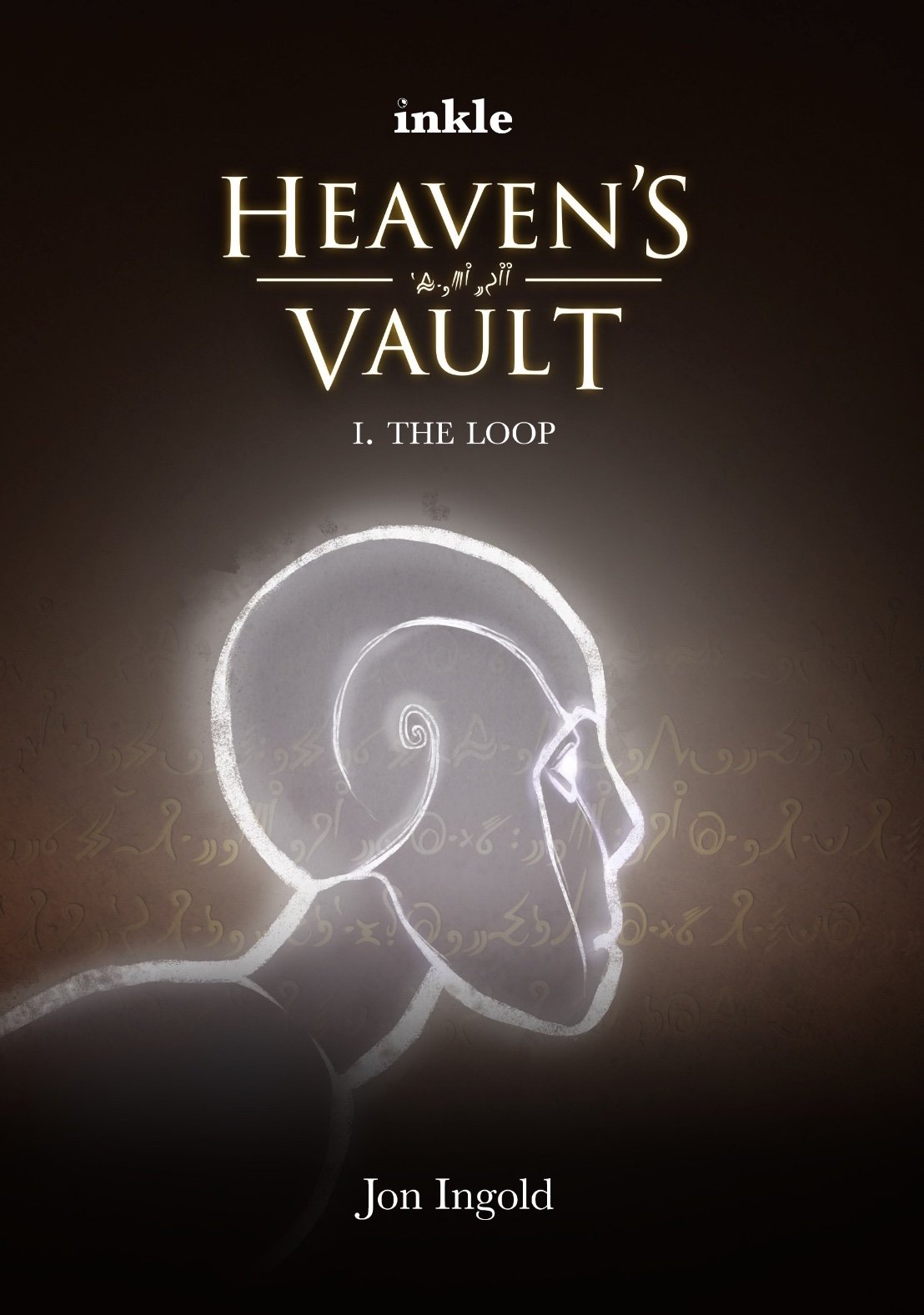
When a researcher from the University of Iox goes missing and the only clue is a brooch carved in Ancient, translator Aliya Elasra and her robot Six are sent out into the Nebula to bring him back, only to stumble upon a deeper secret concerning the fall of a once-great Empire.
But history in the Nebula is a Loop, and all that has happened before will happen again. And what is buried can always be brought back into the light...
What will be found? What will be lost? Is the Loop real? And what lies in Heaven's Vault?
A good addition to the world of the game. I recommend reading after playing the game multiple times, because half the fun of Heaven's Vault is learning more about the world as you replay. This is another way to experience repeating the story.
A quick but compelling read. It's different enough from the game to keep you turning the page. I'm looking forward to finishing the story with volume two.
I'm very biased here, but I loved it. As I loved the game. I played it 3 or 4 times and I still enjoyed the novelization so much. And I already know I will start a new play through as soon as I finish the second book. I loved getting even more depth to the characters and the story. Getting more of the background, feelings and thoughts of the characters. The way Ancient and the translating process is handled is brilliant. It's by far my favorite part of the game, and I'm so happy it's also an interactive part of the book. My Ancient is slowly coming back. :D I was curious to see which direction the book takes because there are so many decisions you can make in the game that alter the story in small and big ways. And it's satisfying to see the decisions I made during my first play through be the ones depicted in this book. Very curious about the second half of the story now. I like the changes and additions to the plot and understand why the missing parts are not here. I think the story has a good flow because of it, without loosing anything important.
After waiting four years to read this book, I can confidently say the wait was entirely worth it. This is a stunning example of speculative fiction at its most thoughtful and layered. From the very first pages, it swept me into a world that feels both distant and deeply familiar, richly imagined and thematically resonant. It is not only an enjoyable read, it is also an intellectually and emotionally engaging one. What stands out most is how elegantly the novel explores reading, writing, and the interpretation of stories. Through Aliya’s journey as an archaeologist and translator, Jon Ingold brings to life the importance of how histories are recorded, distorted or erased. The book itself becomes a meditation on literature, religion, language, oppression and belief, all within the framework of a mystery plot. That it achieves this through a novel, while echoing the design philosophy of its companion video game, is genuinely beautiful. The book made me appreciate the game more deeply, and the game, in turn, enhances the value of the book. While I can't quite imagine reading it without having played the game, I suspect it would still be deeply intriguing on its own. Personally, this novel touches on many areas that fascinate me: spirituality, cognition, historiography, literature and especially language. The constructed language at the heart of the story is one of the best I have encountered in fiction. It functions not only as a worldbuilding detail but as a key to the narrative's structure, mystery and philosophy. The whole setting is extraordinary. The moons of the Nebula, their customs, ruins and myths, are painted with quiet precision, giving the impression of great cultural depth beneath every surface. It is, simply put, a gorgeous piece of worldbuilding. The plot is solid and absorbing, anchored by Aliya’s personal drive and the intellectual puzzles she faces. I especially loved the tension brought in by her complex relationship with Oroi, which adds layers of suspense and emotional uncertainty to the narrative. Apart from the setting, most aspects of the book could have been slightly sharpened — the prose, the pacing, the secondary characters — but these are minor quibbles in a reading experience that remains consistently enjoyable and compelling. Even without knowing where the story leads in the second book, I couldn’t help feeling that the duology might have worked just as well as a single, complete novel. That said, the division does no harm. The book provides enough resolution to be satisfying while still inviting a continuation. Ultimately, what Ingold has achieved here is something rare: a book that works on multiple levels, both as story and as reflection. It is full of intelligence, care and thematic purpose. I already want to reread it, not just to relive the plot, but to spend more time with the ideas it puts into motion. A remarkable book, and one that will stay with me.
OHHHHHHHHH MY GODDDDDDDDDD ok so this is a five star re: enjoyment/my general feelings about heaven's vault, but i have a System™ here on goodreads that i wont mess up sry inkle love u not sure i'd recommend this to someone who hasn't played heaven's vault. that doesn't mean i don't think someone unfamiliar w hv wouldn't enjoy it, but i just genuinely have no idea how this translates to someone with no previous knowledge of the game/world. i'm in too deep. i've played over 150 hours at this point, have done at the very least seven playthroughs of the game, i have a spreadsheet that's my dictionary of ancient. i have theories about what spoken ancient aligns with written ancient. not sure where i'm going here; (syd pls refocus to review of the book) i'd recommend reading this after having played through hv at least three times, preferably four or more. there's so much you can discover with each playthrough. i don't want your playing of the game to be influenced by how the book is written. let yourself experience it yourself first. but then. THEN. reading this is a JOY. there is so much more background!! i love hearing aliya's thought processes, particularly when she's looking at ancient! also her emotions! thoughts and feelings! i love her! learning more about the characters. how the world works. i rly like where things changed in the book wrt the game. they were good. idk, i like seeing different ways things can be in aliya's story. playing the game is a new experience after having read the book. i'm still on book two, but after having read more about how flying works and how the nightingale is operated makes flying in game much more enjoyable. before knowing what i know now, flying was a chore. but now i sometimes actually fly on the rivers instead of handing it over to six when the game gives me the option. it's nice. OK ALSO AND the new translations!!!!!!!!!!!!!!!! i'm screaming!!!! thank you!!!!!!! jfkldsjflds;aj final note i think: i love oroi. that's it bye the following are notes i made as i read the book. not rly part of my review per se, but i want a record of them somewhere.
If there's any game that could work as a novel, it's Heaven's Vault, and thankfully Jon Ingold is clearly very skilled. This is a highly imaginative and well-written science-fiction mystery with sharp, incisive prose.
I picked these up because I enjoyed the game so much, so I don't know what the experience would be like for someone who hasn't played it - I can imagine it being hard to visualise some of the locations from the text alone.
As an adaptation, it does a very good job of translating a nonlinear story into a linear medium, so much so that I wonder if the game was really an adaptation from an already-existing novelistic outline. We get a few flashbacks in here which really do a lot to flesh out the main character, and in general motivations and inferences and laid out more clearly than they are in the game. The downside, however, is that a lot of the incidental detail from the game that you stumbled across while traversing the environment has been cut, almost certainly due to the stark reality of page-count pressure.
Pick this up if you enjoyed the game or want an intellectually-stimulating trek through a unique science-fiction world. This is a story that rewards re-reading and careful examination; the main character is an archaeologist, and like her, the attentive reader will find great satisfaction in carefully unravelling the mysteries of her world.
It grabbed me and held me the entire time. It's a perfect conflux of things I'm interested in and excellent story.
Ever since I played through the video game this is based on (three times, starting a fourth), I've had questions. The game is absolutely amazing. I often thought about it and the story that unfolded, and I felt like I was missing just a few pieces of the puzzle still.
The writing style flows well. It appears to be well edited. I don't know what it would be like to approach this without prior knowledge, but I think it should be fine. I was so involved in the game that a lot of the aspects were familiar and easy to visualize.
It does feel like this is the first half of a whole book, rather than the first of two books. It's possibly due to printing limitations, and it's fine. I picked up the next book immediately and finished it a few days later.
It's so incredibly satisfying. I love the changes the author makes. They're more additive than anything, and they flesh out the story in wonderful ways.
One might naturally be quite suspicious of novelisations of computer games, and considering the history of this particular sub genre, that would not be a foolish suspicion to have. But this is no ordinary game, and lends itself superbly well to this format, and so the result is an excellent book.
Before I start my review on "Heaven's vault", I must share a disclaimer. I played the game and I played it 3 times already. And I'm going to play it for the fourth time at some point because it's so damn f*cking good.
And the book too!
Having said that, I thoroughly enjoyed the first book and would heartily recommend it to my non-gamer friends as a quality fiction. No, I don't know how it reads without contextual knowledge of having played the game but the story was fully fleshed out and could be easily read as an independent story. More importantly, this book digs deep. Many stories written for a single purpose of being read by someone don't manage to get that far. This one does.
What is this story about?
Similarly to the game, the reader follows the story of a space archeologist, Aliya Elasra. She explores the Nebula - a cosmic entity made of so called "moons" - asteroid like structures in space connected by so called "rivers" - flows of water, oxygen and ice that circle all over the Nebula. This space had been long inhabited by a civilisation of humans and robots; however, due to known and unknown turmoils of the past, a lot of knowledge from generations past is lost. That includes the technology, language, forms of writing, general history and a lot more. The religion of humans inhabiting the Nebula - belief that all things circle in a loop and whatever happened in the past will happen again - does not encourage rediscovering either, so, in this universe Aliya is quite alone on her quest.
The story begins when Aliya's guardian, professor Myari of Iox sends out her protegee on a quest of finding a missing colleague, a roboticist Janniqi Renba. He disappears somewhere within the Nebula under mysterious circumstances having sent Myari an ancient item with an obscure inscription Aliya alone can decipher. Maybe. Following this lead, Aliya journeys through the Nebula. While on her quest, she not only begins to piece what happened to Renba but, through clues of history, the essence of the Nebula itself.
So? What did I like about the book, considering that I have already played the game?
To begin with, although the main plot follows the story of the game, a lot of situations Aliya gets herself into have been remodelled by Ingold. He somehow managed to find the middle way of re-writing the story without transforming it into something else. To someone who - like me - is a canon Nazi, such things are important. He somehow managed to tweak an angle here, remodel or remove a scene there, squeeze in a new scene here or there or there, so the whole story is same-same-but-different. And I was hellishly curious to find out - how will he spin this? How will he do that? How will he reach this conclusion?
Mathematicians and their vectors... (incoherent grumbling)
Freestyling and improv aside, I absolutely loved that the core themes of "Heaven's Vault" stayed within the novelisation and some that were more tangential in the game are amped up here. Of course, the reconstruction of the history of the Nebula and the mystery of what it is from hints, bits and pieces is absolutely key here. Just like game, the book is deeply philosophical (e.g. what is hope if not a mathematical certainty?) But Ingold goes deeper into other things.
Technology. Here he explains how sailing works! And what the ships are like from the inside. That is, in addition to a beautiful picture - game only showed beautiful picture, here we get beautiful explanation of sailing mechanics, with all the ropes, sailcloths and the naval shippy thingies whatever their names - there's a whole lot of naval vocabulary there, and that's beautiful. Imagine a literal sky ship... That's what he does here.
We also find out what Aliya's necklace is (I knew it does something!!!). And why she wears a headscarf (no, she is not a hijabee, even though that's exactly what drew me to the game initially - don't ask).
We get more development of Aliya's character. She is warmer in the book. The game puzzled me with her awkward relationships with both her mother figure Myari and her childhood friend Oroi. The book explains why her relationship with Myari is so cold and complicated. And that is done sensitively and beautifully. Believably.
Regarding Oroi, I think the game did better at showing what the stress of becoming adult does to our precious childhood friendships than the complexities of Aliya-Myari relationship, however, the book explores this relationship - and overall, the theme of friendship - more deeply and more directly. As someone who meets most of her childhood friends once or twice per year and who feels she diverged from them and that a significant part of that divergence is her fault, I could empathise and sympathise with Aliya and Oroi. There were moments that nearly left me in tears because I experienced something similar and could feel what they feel.
I think the quotation below summarises Aliya's relationships and Ingold's gift of sensitivity towards his characters:
"Do you have a family on Iox? On Elboreth? A father? A mother?"
"Neither. There's a man who runs a bar who pretends to be my father but he also wants to marry me. There's a woman on Iox who pretends to be my mother, but she also wants to be my Emperor. I had a friend once - two, actually. One was taken from me, and the other... I just lost."
Aliya's relationship with her robot Six is something of another level here, too. In this world robots are essential human helpers. Designed by the ancient ancestors of the Nebulers, they can do a lot. Except for the knowledge of how to make a robot is lost. They are not exactly rare but precious. At the same time they are... robots. I.e. tools. And Aliya hates them. Never really explained - why?
The game shows Six as a loveable, very, very, very special, but nevertheless - a tool. Six is key for sailing the Nebula, getting to problematic moons, deciphering ancient texts - anything and everything. He talks, even jokes, makes lovely facial expressions (kudos to artists of the game - I loved Six's design).
The books show very clearly both that there is something special about Six (I suspect Ingold will the same same-same-but-different approach). He is a robot, but he is also more than a robot. He is very humane. Notice - my brain took him in as a "he", even though Ingold is very particular at refering to Six as "it". I am not sure if you can use a term "non-binary" for robots but it's very clear that they are different from humans. They were designed as tools, they are identical to one another. And yet, Six from the book has so much humanity and so much personality. I almost want to compare Six from the book to Geralt of Rivia. One kills monsters to protect humans and claims to be a heartless mutant with no emotions but with a strict Witchers' ethical code, another protects humans in space environments that are not always friendly, owns an Ethical Core - a device designed to ensure robots follow Azimov's principles and protect humans as long as it does not harm humans, and always calculates probabilities basing his decisions on cold mathematical calculations. And yet...
Another quote:
"Sleep well, Mistress."
From somewhere, the robot has found a blanket and drawn it over me. It hurts me to think how much care it must have taken to do that without fingers."
Aliya is so much more open to robots in the book. Or at least that one special robot who thawed the ice on my heart too. He's lovely. And Ingold writes Aliya's and Six's relationship so beautifully, so sensitively:
"...Six shrinks and lifts its neck, then retreats back, away from me.
"Six, are you all right?"
"Please, Mistress," the machine says quietly. "Please do not do that to me again."
I'm startled. I've never heard a robot beg before."
FFS, I nearly cried here. If you want to know why, read the book.
And he (Ingold) does stuff like that all over the book. I thought, mathematicians were supposed not to be able to write good literature; you know, Kilgore Trout, good ideas, poor textual implementation and all?
But Ingold does not stop here. "Heaven's vault" is full of female characters. Aliya, Oroi, Myari - to name some. Male writer, female characters. You probably see where I'm going with this.
There is no booby breasting whatsoever in "Heaven's vault". Boobs don't exist in this universe or if they do, they do so quietly and invisibly.
OK, jokes aside.
Ingold writes multiple female characters each of which is relevant to the plot and ideas of the book, different, has its own unique voice, is active and independent. Some are more developed as characters, others - less. But they are interesting! And they have some gold conversations discussing men or comparing a robot to a man sitting in a corner and burping.
So far it's been only Pratchett (another Brit) who managed to pull off stuff like that. And I think both Pratchett and Ingold use the same or similar strategy: they simply write characters, not males or females. And that's something we wannabe writers should learn from.
There is more on Iox - why it's so important to the current civilisation of the Nebula and what its relationship is like with other moons. Which adds a little bit of texture.
So, is everything so perfect perfect?
To my taste, yes. But. I do not know how someone who hasn't played the game would feel about the world fabric of the Nebula. In terms of visuality. In the game, you get beautiful, beautiful animation. The kind that stands out and you remember the visuals. In the book, you don't have that. There are descriptions of the moons and the rivers in the book. And some depict what the Nebula feels like even in more detail than the game did. But I don't know if that world texture is equally visually alive everywhere. I could not feel as my imagination was drawing places already. The world felt a bit empty, but then the story is in space. And there are other things. But then again, to me this story is more about ideas, about characters and their relationships, about emotional atmosphere, about the world, humanity, myth making and their evolution, collective human consciousness, religion, beliefs, about what makes continuity and many other things. Only then comes the imaginery visuality.
The pacing is a bit slow. But I liked it as the story is not about the trivial, let's put it like this.
I loved the author's choice to add in the texts written in Ancient but it may take someone who hasn't played the game out of immersion. Maybe. I loved them, though.
So all in all, I would absolutely recommend this book to a non-player. It's serious, it's fleshed out, it's full of depth, it's philosophical, and I like its characters, Six especially.
One thing that I was missing was the music. But that can be easily sorted with YT or Spotify.
This is (the first half of) a novelization of a video game of the same title. The game Heaven's Vault is notable for its narrative ambitions: you can visit key locations and uncover parts of the world's history in differing orders, and the player makes decisions whose consequences are not always immediately evident. (Much of this is only evident on subsequent playthroughs of the game, by contrast with earlier playthroughs.) Obviously the novel cannot do that: it has to be a set, linear narrative covering only one line of action. But, on the other hand, the novel is capable of bringing a lot more to bear on the characterization, and is not obligated to be a continuous experience in the way the video game is. The most obvious result of these facts is the presence of extended flashback passages which provide much more context and background for the protagonist, Aliya Elasra, than is present in the game.
The game is in some ways a narrative puzzle as much as it is a puzzle game about translating an imagined script: the protagonist is reserved (and often rather standoffish) to the extent that the player directly learns little about her past or interior life, and the dialogue is typically relatively terse, with the full dimension of its meaning rarely spelled out, leaving quite a bit of room for interpretation.
The book still feels gamey, for better or worse. It has a basically episodic structure, as Aliya makes a series of variably-risky visits to more or less obscure "moons" across the "Nebula" the novel is set in, and uncovers clues that allow her to unravel the book's overarching mysteries step-by-step. I don't know that this works so well in novel form as it does in the game. The physical descriptions (of both locations and characters) are relatively minimal and schematic, and rarely evocative- a gap the game obviously fills in with visuals, but which leaves the novel feeling fairly dry.
Ultimately I think the appeal here is still the puzzle-plot stuff (working out what happened and what is happening in this fictional universe) over the characters or themes. I am not sure I could recommend it to anyone who hasn't played the game, though the novel is inevitably mostly redundant to the game as far as plot and worldbuilding go.
This book is based on a video game that I'm a huge fan of. I also adore the soundtrack (and it kept me good company while reading this book!). While I welcomed a chance to dive into the world again, I have a feeling that people picking it up off the shelf would not have such a pleasurable experience. The writing is a little bit opaque (sometimes the logic of a conversation or scene is hard to follow), and the resulting confusion is likely to be aggravated for people who don't have previous knowledge.
The plot also follows the game very closely-- it is a choose-your-own adventure sort of game, so I feel like I'm reading a slightly altered version of my own playthroughs. Given the theme of "the loop" (what has happened will happen again, the past and the future are one) that pervades the game, this is a satisfying irony in a way. However, in another way I was disappointed, hoping for the book to go beyond the gameplay. There were some additional perks, such as getting better character development through description and internal dialogue. I will continue reading book 2 for the sheer pleasure of being in this universe, and hope that the ending will resolve some key questions that I felt were never addressed during the game.
Heaven's Vault was one of my favourite games of the year when I played it back in 2019, and I bought the books mostly to support the devs since I find tie-ins to be pretty hit or miss.
I was surprised to find I enjoyed the book in its own right. It does roughly follow the story of the game, but is able to shine a light on different aspects. I really liked the descriptions of the physicality of sailing (this is not as apparent in the game since as the player you operate the ship from the outside) and the enriching of Aliya's history and POV. The character has a lot of rough edges and can be tough to get a handle on - I feel like I know her a different way after reading this.
It was interesting to see the character trying to solve the mystery on the page (there is a part where Aliya immediately jumps to a conclusion that I jumped to at that same point in the game, which was funny to me) and I liked reading her analyses of artifacts and attempts at translation. And of course, the banter between Aliya and Six is great.
I'm not sure how well it would hold up for someone who hasn't played a few loops in the game but I have and I'm really enjoying it.
A must have for fans of the game, as Aliya's past is further explained here. The writing style is difficult for non-native speakers (English) at the beginning, but you get into it. The great thing is that here again whole sentences have been inserted in the ancient language and at the end there is even a whole page of untranslated text waiting for us. The translation is very interesting even without the interface of the game and therefore I am looking forward to the 2nd volume.
Für Fans des Spiels ein echtes Muss, da hier vor allem Aliyas Vergangenheit weiter erklärt wird. Der Schreibstil ist für Nichtmuttersprachler (Englisch) zu Beginn schwierig, aber man liest sich rein. Das Tolle ist, dass auch hier wieder ganze Sätze in der antiken Sprache eingefügt wurden und am Ende sogar eine ganze Seite nicht übersetzter Text auf uns warten. Das Übersetzen ist auch ohne das Interface des Spiels sehr interessant und daher freue ich mich auf den 2. Band.
Moderately enjoyable but not mind-blowing. It's been a couple years since I played the game, so my Ancient was fairly rusty, although I did start to pick it up and remember a little by the end. The writing was a bit overwrought in places, but the dialog was good. The relationship between Aliya and Myari is so complicated, and definitely one of the best parts of the story, whereas the game was all about the linguistics and and archeology. I did start to get into the groove once the deeper secrets started uncovering and even deeper secrets tantalized. I'll probably replay the game before reading the second book, but overall I am happy with this one.
Interestingly different perspective on a very good narrative game. I think I understand Aliya - who's an unapproachable cyper for all she's the player character in the game - more after reading this is novel form. Some of the translation sequences don't quite work 'ungamified', but the prose is startlingly good, and the interesting ideas and story elements of the game are well corralled into a coherent narrative.
I certainly did like it, but it wasn't quite a page turner. I think the problem was I knew the story very well already. I would be interested to see what someone who did not already know the story thought.
A great companion to those that have done at least one play through of the game, volume 1 gives us a look of what one version of the story could be through the lens of the game’s writer. I really enjoyed this. It makes me want to play the game once again. 😁 I need to get volume 2 so I can read how this version of the story concludes.
Thoroughly enjoyed reading this. I've replayed Heaven's Vault more times than I can count and love how the story is affected by the choices in translation. This novel provided me with more context behind events and I loved getting to know Aliya again.
Incredibly evocative novelisation of the video game Heaven's Vault. Gives a lot of character to the figures and even manages to include the engaging linguistics mechanic of the game. Can't wait to read the sequel.
I enjoyed the way that this fleshed out the story of the game -- either it filled in some gaps, or there were things I had forgotten. There were some grammatical errors and typos that I found distracting.
“There’s a darkness coming. There’s an observatory. The robots know but they don’t remember. They’ve been trying to tell me. All of them, all this time. They’re compelled to tell us, but they don’t remember.”
Heaven’s Vault, or: “Should I do it?” “Categorically not, Mistress.”
Recommended even if you've never played the game. The story is quite different and the perspective of the character gives the world a completely different colour.
This entire review has been hidden because of spoilers.
A fantastic retelling of a fantastic game, with just the right mix of new ideas with concepts that anyone who played the game will be familiar with. Give it a read!
I loved the game and the book is a wonderful expansion to it. I enjoyed reading the reasonings and musings behind figuring out Ancient. It's such a beautiful book.
Heaven's Vault was for me surprisingly the best fiction book of 2023 (so far).
It was simply a very good, captivating story, in an extraordinary setting, with curious characters, good pacing, and an exceptional feeling of exploration and discovery. Unearthing deep secrets that lay undisturbed for ages. When I think about it, it comes close to a detective genre.
And while I usually am appreciative of detailed lore and I like to have all the workings in the portrayed world explained, here in the world of Heaven's Vault it didn't bother me a bit. I appreciated that things are left unsaid, unexplained, and ephemeral like the whole concept of Nebulas and rivers that flow through them.
Can't end without mentioning the whole alphabet and language inserted into the book. There is more to it than it is explained through text. An inquisitive reader will find extra satisfaction in deciphering everything before it is explained, and playing the game with the same name can enhance the experience.