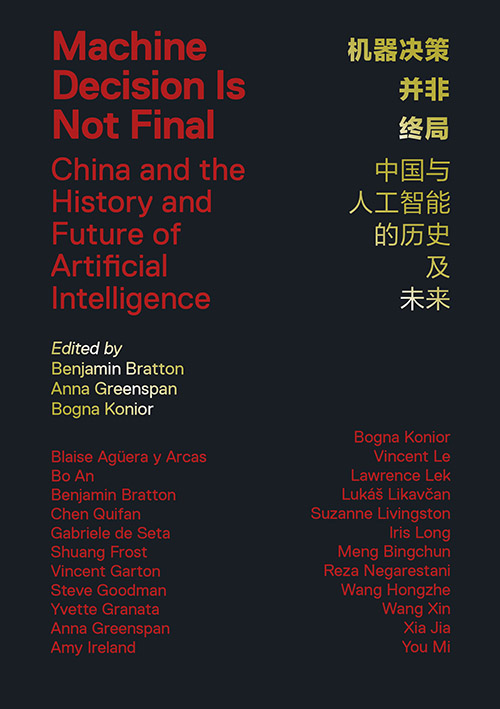
Contributors: Blaise Agüera y Arcas, Bo An, Benjamin Bratton, Chen Quifan, Gabriele de Seta, Shuang Frost, Vincent Garton, Steve Goodman, Yvette Granata, Anna Greenspan, Amy Ireland, Bogna Konior, Vincent Le, Lawrence Lek, Lukáš Likavčan, Suzanne Livingston, Iris Long, Meng Bingchun, Reza Negarestani, Wang Hongzhe, Wang Xin, Xia Jia, You Mi.
An interdisciplinary, cross-cultural collection that decenters familiar narratives to provide a fresh perspective on what artificial intelligence is today, and what it might become.
Historians, media theorists, science-fiction writers, philosophers, and artists from China and elsewhere re-examine the nation’s intense engagement with AI, moving beyond the clichés that still dominate the contemporary debate.
Visions of the contested future of AI veer between common planetary goals and a new Cold War as culturally-specific models of intelligence, speculative traditions, and thought experiments come up against the emergence of novel forms of cognition that cannot be reduced to any historical cultural tradition.
This uniquely-positioned volume provides expert insight into this tension, using China as a touchstone for rethinking ‘artificiality’ and ‘intelligence’ as sites of difference in a way that is already present in the difficulty of precisely translating the Chinese term 人工智能.
Tracking the history of Chinese AI from the pre-Cultural Revolution to the post-Deng Xiaoping eras right up to contemporary debates surrounding facial recognition, the writers in this collection draw on a mixture of speculative thought experiments and cutting-edge use cases to offer singular views on topics including AI and Chinese philosophy, AI ethics and policymaking, the development of computational models in early Chinese cybernetics and the aesthetics of Sinofuturism.
Spanning borders between different worlds, histories, futures, and foundational models, Machine Decision is Not Final is not only a timely reappraisal of the stakes of AI development, but a tool for constructing more global imaginaries for the future of AI.
Benjamin H. Bratton is a theorist whose work spans philosophy, computer science, and design. He is Associate Professor of Visual Arts and Director of the Center for Design and Geopolitics at the University of California, San Diego. He is also Visiting Professor of Critical Studies at SCI-Arc (the Southern California Institute of Architecture) and Professor of Digital Design at the European Graduate School in Saas-Fee, Switzerland.
MDINF is at its strongest when it sticks to things it can genuinely illuminate: the cultural weather around Chinese AI, the long shadows of Qian Xuesen and cybernetics; and the ways SF writers, artists, and internet users metabolize automation. The chapters on linguistic framing, early technoscience, and even the Guizhou cloud build-out provide a much needed assessment of Chinese “vibes” on ai at a deeper cultural level. I believe these were the more fundamental aims of the authors. It can however sometimes read as if ancient philosophy, Legalist metaphysics, or Daoist non-action are quietly steering how Chinese engineers build models today—I don’t think the labs at Tsinghua, Baidu, Alibaba, or SenseTime are subtly incorporating the Daodejing into their conception of AI while debugging distributed training. I wish it spent more time covering cultural navigation of forces shaping Sino-AI like compute shortages, provincial subsidy games, enterprise demand, and U.S. export controls; but I suppose that's not really the aim anyway. This is a beautifully written & culturally rich map of China’s imagination of AI, just not the map you’d want if you were trying to better understand how AI is currently being developed or governed there.
many of these authors could probably produce interesting, insightful, novel work on AI if they actually read arXiv papers (or at least followed AI twitter), but unfortunately, it’s quite clear that they don’t. eg one chapter philosophizes its way into reinventing sandbagging and deceptive alignment. another extracts the idea of instrumental convergence (and kinda mesa-optimizers, or a conflation of the two) from Nietzsche while somehow also citing Bostrom’s discussion of instrumental convergence from Superintelligence and not realizing that this is the same thing. some of the reasoning is quite poor, and much of the writing is of the typical horrendously (unnecessarily) obscurantist critical theory type. a few of the chapters have some real 干货 about eg Qian Xuesen and some current developments on the ground. would have been great to have a lot more of this.
A bit of a mixed bag, although I’m still glad I read it. The good parts are really good: you can find some genuinely interesting takes, discover thinkers and perspectives you would probably have trouble coming across on your own, even if you’re already decently versed in philosophy and cultural theory. For me, that is a huge part of the appeal of books like this.
The highlights are definitely Bogna Konior’s excellent introduction and her essay on dark forest theory, even though I have some reservations about the theory itself; Shuang L. Frost’s chapter on linguistics and meaning; Yvette Granata’s interesting twist on Roko’s Basilisk and the concept of “anti-Electra”; and the chapters by Bo An, You Mi, and Hongzhe on the history of Chinese cybernetics, especially their focus on Qian Xuesen and related figures.
The book also picks up some steam toward the end, with several strong essays on the debate between neorationalism and orthogonalism, as well as some very interesting insights into Neo-Confucianism from Reza Negarestani, Anna Greenspan, and Vincent Lee. These are the parts I would recommend most strongly.
Because it is a collection of essays, there is inevitably some repetition, and I found that the more narrative or storytelling-heavy sections slowed the book down quite a bit and disrupted the pacing. The essays I haven’t mentioned here still offer some ideas worth chewing on, but for me they were not quite as strong as the chapters above.
definitely the most comprehensible series of texts in the current discourse on the synergies between artificial intelligence, philosophy, religion, art and culture, and generally the human vs machine dichotomy. it narrates, often artistically, the predominant mythologies and cosmologies that live in chinese culture, and how chinese ai, and chinese views upon it, because of those beliefs and histories, differ from those in the west.
more than anything mdinf has made me aware of how technology is collectively built upon collectively maintained belief systems. this goes further than the immediate link between, say, capitalism, and immense investments in ai because it can make a profit. ai is more than an expression of the human culture that built it. it is the next curve in the intelligence spiralling upward, into whatever the next dimension is. i do not yet dare say i understand this fully, nor will i probably ever, but i do believe this book has shown me a path to a more fulfilled understanding.
of many beautiful passages;
beyond the human mind, there is an infinity of cognitive and experiential possibilities, and ai is already there, interfacing with worlds beyond our world and pulling the familiar apart. [...] it is a system which has no constructed laws beyond those of the cosmos itself, no central deity, no fixed destination. it is pure, exploratory, generative becoming.
A fascinating read that illuminates the differences Western and Chinese philosophies of AI, while highlighting some of the inherent contradictions in the discourse of the former. There are many thought-provoking chapters here - I particularly enjoyed the ones focused on language and the Dark Forest theory - although some may not be as accessible to readers not well-versed in Kantian philosophy. I also think that despite its broad scope, it does very little to address some of the issues that have been exemplified by the current rise of LLMs, as in the value of human work and creativity; instead it focuses more on questions of what intelligence really is and our relation to it. Therefore, it provides impulses to the current debate, but (perhaps purposefully) distances itself from it.