rating: 4.5 stars
Five abbreviated quotes appear on the first page of the book. I didn't notice them until I was reading one of the last chapters, so maybe Ron Carlson's comment meant more to me than if I'd read it first:
If Thoreau had not gone to the woods, but had instead invited a sparrow into his house, he might have written this book instead of Walden.
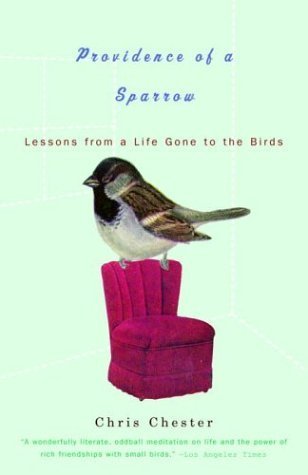
That pretty much sums up the story. This is an account of the behaviors and life of house sparrows, one in particular, and insights into a man who took the time to raise a nestling who had fallen from the nest.
Many years ago, my sister called me about three nestlings they had acquired along with a load of firewood. By the time I got to them, two had died, but the third one was still breathing. I put it in a small plastic tub, nestled in a cloth and ensconced in a gym bag with a hot water bottle. As soon as the little body had warmed up, I fed it some canned dog food. Thus began an odyssey that lasted a couple of months. For the first couple of weeks, this bag was at my side pretty much full time, whether I was at work or visiting a friend. The lumpy baby, which I named Emily, grew into a lovely male house sparrow. Unlike Chris Chester, I was a lousy observer and I focused from the beginning on raising the bird so it could be released (which it was, after a brief stay with a rehabilitator).
These quotes give insight into house sparrows, the story, and the author's view on life:
p 9: It's difficult for me to understand the vehemence with which these birds are detested. Since my association with B began, I find it increasingly difficult to hate much of anything.
p 66: House sparrows mate for life and are monogamous.
p 146: House sparrows are powerful flyers capable of speeds approaching 50 miles an hour.
My favorite passages describe interactions with the birds. (B and Baby are both rescued house sparrows.)
p 202: B, I've discovered is right-handed--winged, sided, or however you'd describe such a preference in birds. He's been exceptionally playful today because he'd like me to ignore Baby. Whenever I rise to answer his summons, B shows up with a bribe - caps, paper, sticks, a pushpin that held one corner of the wall calendar in place. I'm amazed that I've never noticed before that B arcs to the left when he pounces on a cap. If he's holding one in his beak and flicks it toward me, he does so right to left. I'm fascinated enough by this that I keep throwing caps all over the room to see if he'll make an exception. So far, out of twenty throws, he has not.
On page 281, Chris Chester states one of my own observations:
Firework season is hard on our birds; on most animals, I suspect ... [it] destroys the sleep, if not the health, of countless birds and other woodland creatures.
I understand that China has banned fireworks because they cause so much air pollution.
I'm a bird watcher and feeder, and can attest to the fact that the population of house sparrows in our neighborhood has dropped drastically. I never encouraged them to hang around (my bird boxes all have openings that are too small for them to use), since they are an introduced species. But on page 282, CC writes that 'house sparrow numbers are declining in England.' Now I wonder about the status of their numbers everywhere. Could house sparrows be an indicator of environmental health?
I need to add that there is profanity, more than I think was necessary, but this is one man's memoir, and he needs to write in his own style, so I just cringed my way past the words I didn't like. And, I don't know about other readers, but it took me several chapters to get into the book. I think that's because I was expecting the story to focus entirely on the sparrows. I missed the fact that it was also a memoir.
CC has a dry sense of humor. It reminds of of Jon de Vos who used to write columns for The Middle Park Times in Grand county, Colorado.