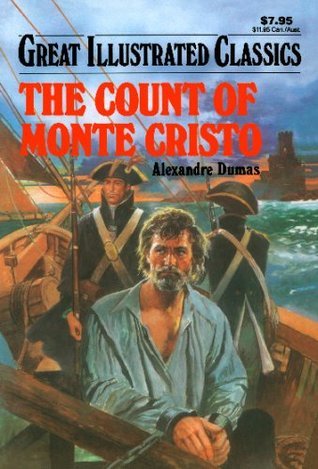
A young sailor returns home from a dangerous voyage. His father and his sweetheart are waiting for him. But an act of jealous treachery changes his life forever! An unexpected meeting changes everything and the man who was once an unknown sailor emerges as The Count of Monte Cristo, mysterious, rich, and powerful enough to take the ultimate revenge against his enemies. Retail price: $9.95 US, $11.95 Can/Aust
3.5stars? I listened to the "abridged" version, because reading a 1000 page book does not appeal to me. \_("-)_/ Uhm, a lot of people died, don't ask me who because I lost track and I should probably re-read it, but I got the overall gist of it, so I likely won't be doing so anytime soon. *Very different from the movie as far as the ending goes*
Dumas in full flow of inspiration is a glorious thing to witness. I know that he had a team working with him for the grunt work and help in developing the plots, but to produce this, the first two Musketeers novels and La Reine Margot (plus others) in a 12 month span around 1844-1845 is stupendously productive - and we don’t consider Rembrandt or Titian somehow lesser artists because they had a team working under their instructions (or a film director, to take a more modern comparison).
For all its ridiculous length, this was a gripping read. To savour it and stop myself growing tired, I read it one volume at a time, leaving space between to read other novels. And o never grew bored. Like the Musketeer novels, there’s a period between the middle of volume 3 and early in volume 4 where the pace slows and Dumas allows time for the romance of the youngsters to blossom in between the gloriously deranged plans for revenge, but they just finish in time for the denouement to develop - and what a denouement it is.
The story itself is as epic as anything I’ve read, and yet it’s an entirely human plot - the crimes that lead to Edmond Dantès’ false imprisonment are as minor and as everyday as you can imagine: a jealous love-rival (Fernand), a man who believes he’s been unjustly overlooked for promotion (Danglars), and a man who wishes to protect his good name from being linked to revolt (de Villefort). Of themselves, these motives could have amounted to nothing, but the combination of the three and their doubling down when they have the chance to put them right, leads to a revenge of operatic proportion over the course of the following 24 years.
Alexandre Dumas' The Count of Monte Cristo is truly a piece of art. I read this novel for school requirement, but that did not diminish the amount of excitement I have about finishing this book. Between analyzing the plot twists, character traits, side stories, goods and evils, and at times the meaning of life, I can truly say that reading this novel has changed my own perspective. Though frustrated by choices many of the characters make, I looked forward to each new chapter and each new development. The writing is eloquent and smooth, and the plot is fast and ever-changing. As soon as you read of a character's history, relationships and decisions click in to place, and everything connects. As my reading came to a close, I found myself wanting more and becoming almost nostalgic when the ending related to the innocent beginning. I will definitely recommend this to others in the future and I'm glad I had the chance to read this novel.
I really liked this book. I've heard So STINKIN MUCH ABOUT IT that I had to read it for myself. I'm so glad I finally did.
~My thoughts~ 1. This is a historical goodie! *not true story, btw* 2. It was a relish of the moral JUSTICE. After Edmund Dantes is attacked by three mongrels who ruin his life, he finally gets revenge. 3. It was an easy fun read. 4. I love the illustrations 5. Characters were well developed and the plot flowed nicely. 6. I recommend this to kids, I would recommend a less abridged version to teenagers+adults. 7. I WANNA WATCH THE MOVIE NOW!
Let me know in the comments below if you think the movie is worth watching! Thanks, Amy
This is my favorite novel by Alexandre Dumas, and this condensed adaptation is very good; it's fast-paced, easy to understand, and great for all readers, young and old.
The Count of Monte Cristo, taking place in Europe in Napoleonic times, was more than just a story of adventure, revenge, murder, and lust, but also a story of forgiveness.
Edmund Dantes' life was looking up, he was engaged and had a promising career when his life seemed to shatter. After being arrested for treason when a letter was found in his possession that was from the usurper, Dantes was questioned by the public prosecutor, Villfort. In order to save his father, Villfort declared Dantes guilty and was sent to the Chateu d'If, a prison on an island. At the Chateu d'If, Dantes learned everything he would ever need for his revenge from an old Priest. The Priest also shared with him a letter that told of buried treasure on the isle of Monte Cristo.
Dantes escaped and went to the isle of Monte Cristo, finding the treasure and the means to fund his revenge. He then would go on to travel all of Europe, constantly changing his name and appearance, meticulously and systematically taking revenge on almost all from his past life, who themselves had changed in order to escape their past lives. And in the end, when revenge was taken, when murder had been committed, when lust had been fulfilled, and when he thought that his only purpose was for God's revenge, he finally got to be happy with the one he came to love.
I liked the book, The Count of Monte Cristo, for its intriguing episodes, and their inconceivable outcomes. I would definitely recommend this book to anyone who wants to improve their vocabulary and learn some French words as well, plus it's a great story that is completely unpredictable. My favorite quote is at the very ending of the book, in the letter Dantes left he reflects on what he has done, "Until the day when God will deign to reveal the future to man, all human wisdom is contained in these two words,—‘Wait and hope.’” I felt like Dantes finally understood that he was still under God and not at the same level with him, making him uncertain about what he did and what life has in store. Dantes has no other choice but to "'Wait and hope.'"
The ultimate tale of revenge. This timeless classic never gets old no matter how many times you read it. The characters come to life off of the pages as you read and the story unfolds in such a creative way. I'm a big fan of classics and this story lives up to what it means to be a true classic.
I have always wanted to know this story. However, the original text is such a huge under taking. This condensed version accomplished what I wanted: learn the story of the Count of Monte Cristo & provide a fun read.
This book has three distinct parts: pre-imprisonment, imprisonment and post-imprisonment. Pre-imprisonment is a good introduction to all the characters, especially Dantes who is just a lovely guy. Pretty much everyone likes him and he's happy living a simple life as long as he can support himself and his father and marry Mercedes.
During his imprisonment you see him harden and change. He goes through believable cycles of hope and despair, even going so far as trying to starve himself at one point. Escape and the return to those he loves is the one thought in his mind for most of the fourteen years of his imprisonment, even when he is befriended by the Abbe Faria, who is quite clearly a 'good guy'. The Abbe sets out to pass on his vast wealth of knowledge, and Dantes proves an apt pupil. It is also the Abbe who passes on the secret of a vast fortune he has discovered.
While these two sections are very good, they are basically quite a long pre-amble section which is giving the tools for Monsieur le Comte de Monte Cristo to get his revenge. Though for all this they are probably some of my favourite parts, possibly because they are very easy to read.
We rejoin the story nine years after Dantes' escape, and his transformation into the Count of Monte Cristo is complete. He is well established in society, has furthered his education and established a coterie of servants (and slaves) about him. And this is where the fun begins. You know who he's going to go after, but he sets in motion these incredibly complex events to try and bring about their downfall without the least suspicion falling on him, and while you know this is what he is doing at the start it is very difficult to see how his actions will lead to this.
One thing I particularly like is that not everything goes to plan. Things go wrong with what the Count planned through information he doesn't know (though he does seem to know pretty much everything), unexpected relationship and pleas. But similarly there are some lucky coincidences that make things easier. At least I think they were coincidences...you never quite know with the Count. He could just be that good. Which is actually one thing that's a little annoying - he is amazing at, like, everything.
And then there's the characters. In the 23 years between his imprisonment and his arrival in Paris to gain his revenge (isn't it lucky they all live in the same city now?) they've got married and had children and lost spouses and remarried and had more children who are now engaged to people (sometimes each other). There are an awful lot of names thrown at you in quite a short space of time, and an awful lot of relationships established. I found it quite confusing at first, and still had blank moments towards the end of the book, having to work hard at who someone's father was, what he'd done to Dantes and how his downfall was being brought about. And it was at this point that my reading of the book fell off for a week or so.
The end of the story, though, is rather wonderful. Seeing the consequences of some of his actions shocks the Count into change, and there is a happy ending for some (though nowhere near all) of the characters, often in spite of the actions taken by Monte Cristo. The ending - sailing away into the sunset - was a little cliched, but it was a nice end to a rather amazing book.
Though a little dry in places, the story is amazing and generally easy to read. It might take a while, but I'd definitely recommend it.
The story itself is excellent, but this adaptation rushes through Edmond’s revenge so quickly that it feels almost unnecessary. With better pacing this would have been a much better adaptation.
Owen’s Review: 3/5 peanut butter sandwiches - I’d like to avoid spending years and years in prison, but finding secret treasure on deserted islands sounds pretty cool.
i feel like there is so much more to the story then what i've read but i'm thinking that someday i will be reading the 1000 version :p not today though ..
The count of monte cristo is a awesome book! I recommend reading it because there is adventure and treasure! I hope you enjoyed the book as much as I did! Have a wonderful and happy day!
This entire review has been hidden because of spoilers.
Target audience: The target audience of the book is the general public, although, due to the political elements present in the novel, Dumas might have targeted the French public in particular.
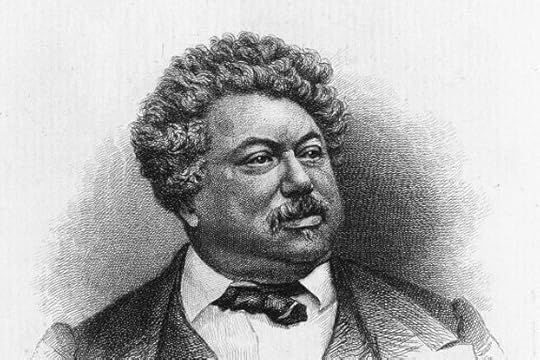
About the author: According to Wikipedia, Alexandre Dumas was a 19th-century French writer. His works have been translated into nearly 100 languages, and he is one of the most widely read French authors. Many of his historical novels of high adventure were originally published as serials. In addition to The Count of Monte-Cristo, he is also known for The Three Musketeers or The Knight of Sainte-Hermine. His novels have been adapted since the early twentieth century for nearly 200 films. Prolific in several genres, Dumas began his career by writing plays, which were successfully produced from the first. He also wrote numerous magazine articles and travel books; his published works totaled 100,000 pages.
Structure of the book: The book has a total of 117 chapters. This is why sometimes is in one piece, while other times you can find it split in a various number of volumes.
Overview / Plot summary (a few spoilers): Alexandre Dumas is one of my favorite French writers. He is one of the most widely read French authors for a reason. I loved all of his works including Georges, The Conspirators, and The Regent's Daughter. I am glad he escaped his life as a clerk. The world would be empty without his work. Few romantic authors could capture the world as it was the way he did. I would have loved to read some of his works in the original serial form as they were published in the newspaper. If you have seen the movies, but did not read the book, I have to warn you that there are some differences. And, between the two movies and the book, I personally prefer the book. The action takes place in 19th-century France, shortly after the French Revolution and the exile of Emperor Napoleon Bonaparte. Edmond Dantes is introduced as a clever, handsome, ambitious young man. He is living an almost perfect life: he is about to become a captain and marry his fiancée Mercedes. Unluckily for Dantes, during his final voyage he had to stop on the island of Elba – where Napoleon was exiled – in order to deliver a letter to General Bertrand. The year was 1815, when France was torn apart by the rivalries and fights between the Bonapartist and the royalist factions. Dantes was not interested in politics, but his act could have been easily interpreted by the royalists as a manifestation of his Bonapartist allegiance. Dantes indeed ended up being convicted for treason. But this thing did not happen because he was believed to be a real Bonapartist, but because his alleged friends - Fernand Mondego and Dantès' colleague Danglars - were jealous on his job and his beautiful woman. This was a wonderful way for the author to enliven the plot. It was only after Dantes was imprisoned that the true plot of the story begins. Dantes was put into a dungeon where the rest of the word promptly forgets about him. This is the lowest point of Dantes’ life. Dumas here makes a wonderful job and the reader can truly feel the character’s pain. Dantes had everything lost it all – a feeling that I am sure many people (more or less) can relate to. This is for Dantes the journey where he rediscovers/reinvents himself and manages to reverse his poor fate. This theme of falling apart can be found in many stories as well, and for some reasons I associate it with Jesus’s descent in Hell after his death as a man, and his comeback on earth strengthened, changed, as a god. Dantes is able to run away from the prison house years later, shrewder and tough-minded and ready to retaliate against the people who betrayed him. This is how Dantes becomes Dantes 2.0, or the Count of Monte-Cristo. And the Count of Monte-Cristo is in fact the mirror image of Dantes. Dantes was a loving, honest, poor family guy; on the contrary, the Count of Monte-Cristo is a rich, cunning, revengeful and isolated man. The amazing part in this novel is the level of complexity and subtlety of Dantes’s plans. He spends multiple years putting his plans into action, integrating himself into the lives of all of his enemies, even bonding with their children. So, this novel is all about revenge. We as readers are aware from the beginning that revenge is bad business – it has the potential to overwhelm your being and give you nothing in return. But does revenge makes a person automatically bad, even if those punished are evil persons and deserved to be punished? So one question the authors make you wonder about is if Dantes will ever discover that it is better to have fun and enjoy his life rather than punish those around him. Paying back those who wronged regarding his person does not fix anything. He can never reclaim the time spent imprisoned. Moreover, Dantes also realizes that he cannot punish the evil without also hurting the innocent people around them.
Quote:Moral wounds have this peculiarity - they may be hidden, but they never close; always painful, always ready to bleed when touched, they remain fresh and open in the heart.
Strong points: The Count of Monte Cristo has many positive features. The parts of the novel I relished the most was the level complexity involved with Dantes’ schemes, and the manner in which Dumas used the proper pace to allow them to unfold. This is due to the fact that he is a serial writer, he had a reason to draw everything out in order to make them suspenseful. He does this perfectly. If you need a great novel to read for yourself, this is a great choice. It is rather hard to put down.
Weak points: First, if you watched the modern version of the movie, then the novel might seem a little too long. And second, Dumas treats Dantes as some kind of “avenging angel” who is able to punish evil. The Count of Monte Cristo, or Dantes 2.0, is a sort of god-like creature among the mortals. Yes, he treats people well when the good is in need, even when it does not help his plans for revenge. But can actions that could result in human beings annihilated, even if these people deserve it, really be the work of (a good) God?
My book group is reading the real book, and I just couldn’t face such a long book right now, after reading David Copperfield and Lonesome Dove. I do feel a little guilty, but this children’s abridged edition had the most delightful illustrations!
Such a great and quick alternative to the original. Read it in a few hours and absolutely loved it! I’m hoping to read the big scary long original version eventually but this was a great place to start and get into it!
What can you say about this classic - it's got it all and on a basic visceral level clear to all ages and intellect. Thoroughly enjoyed rereading this children's classic adventure\ suspense\ romance\ thriller.
"The Count of Monte Cristo" is a political satire graphic novel. The story takes place in France during the Napoleonic Wars around the year 1815. The story follows a particular character named Edmond Dantes. When Edmond becomes the captain of a ship, three acquaintances of his become very jealous of his successes. One of the acquaintances, Fernand, wants to marry Edmond's fiance as well. The three create an elaborate plan to get Dantes arrested and out of their lives. They write a letter to a government official claiming Dantes is a supporter of Napoleon. Dantes is arrested on his wedding day and is imprisoned for 7 years. Dantes builds a great hatred towards the four that falsely imprisoned him and swears to get revenge on them. While in prison, Dantes meets Abbe Faria, a older prisoner in a nearby cell. Abbe Faria tells Dantes he can find a vast treasure on the island of Monte Cristo. One day, Dantes makes a plan to escape. When Abbe Faria dies, Dantes hides in his body bag and is thrown out to sea. Dantes is rescued by a passing ship. Coincidentally, the ship stops for repairs on the island of Monte Cristo. While on the island, Dantes searches for the treasure and manages to find it. With his new-found treasure, Dantes purchases the title of "Count" and renames himself "The Count of Monte Cristo". 'The Count' spends the rest of his life trying to get revenge on the four men that falsely imprisoned him. I really liked the complex layers the story had. It was hard to tell if Dantes's intentions were 'good' or 'evil'. Dantes's intentions seem good when he states "I am the servant of providence, and it is my duty to deliver punishment to those who do wrong". The fact that Dantes wants to punish those who did wrong seems reasonable. However, the lengths and means to which he goes to in an effort to prove a point are extreme. After making this seemingly good statement, Dantes then says "If the hands of fate see it fit to snatch away the life of an innocent, then so be it!" Dantes willingness to sacrifice innocent people makes him not as righteous. Edmond Dantes character reminded me of Light Yagami's character in the manga series "Death Note". In "Death Note", Light creates a new identity for himself, Kira, so he can kill criminals using the Death Note. This reminded me of Dantes because Dantes creates a new identity for himself as the Count of Monte Cristo. Maybe both Dantes and Light thought that having another identity wouldn't bring shame or dishonor upon their original names/beings. I would recommend this book to anyone who likes stories where a character goes to great lengths to see their enemies brought to justice.
Dumas is another author whose works I have heard much about but really haven't explored. Since most of them are Classics they are the types of books that I shove away since I don't feel like challenging myself to figure out what the author is saying and/or to keep all the crazy plot tracks straight.
In this particular edition you get a very frank and straightforward story to read. Unfortunately I did some more research afterwards and was really quite surprised to see how much of the story was actually removed to be able to make this more accessible to children. So is the story lacking?
For an adventure tale that makes for a quick read it will do the trick but shouldn't be relied on if you looking for a complete read. The characters aren't as built-up nor as numerous while at times it does seem quite linear more than it would have with any original telling.
Like many of the Illustrated Classic types this book does have nice sketch drawings on every other page. As a result the book can be used as miniature coloring book if you want to add some color.
As an introductory book it was a good read but for those who want more of a handful the original shouldn't be overlooked.
I read this book last summer and I absolutely loved it. It is a super long read (1400+ pages I think?), but it is totally worth it. Dumas plays the long game here and sets up loads and loads of intricately woven plot lines that at the time seem insubstantial or negligible, but in the end all get woven together to form an incredible tapestry. It easily has the most satisfying ending that I have ever read. The character's are pretty great too. Monte Cristo always seems aloof and high class throughout the entire book, but knowing what he is hiding adds meanging to what he says and does. His every move is carefully calculated, and the book ends up having a very strong psychological aspect as you come to realize how much of a master Monte Cristo is at manipulating people. At times you can track the outcomes of his actions four of five major events back in the book and it is almost astounding that he could make such brilliant manoeuvres. It really is a masterpiece of classical fiction.
The sure sign of a great master - of the arts - is that he can evoke powerful emotions through his illustration. Monseuir Dumas does so brilliantly in The Count of Monte Cristo. He paints most imaginative visions, and yet suspends disbelief. He tells... like the ancient storytellers who enraptured audiences through their refined narration.
Oh, how I crave to be an apprentice to this great artist!
The translation does have its flaws...some words, such as 'toilet,' appear ludicrously employed. Perhaps the usage of the times then. The linearity of the narration is noticeable, as is a penchant for the religious and the supernatural. Cultural aspects of the times, too, perhaps, or what readers appreciated then. A tendency to engage a reader solely in conversation gives way to lengthy reflection in latter parts of the work. Yet, from a master, these are but his distinction.
I recommend this book to everyone; but only if you have a week to kill. Don't start reading this book if you have other work to do because the other work will languish. The Count of Monte Cristo can be a daunting book if one judges by the size of it (more than a thousand pages) but I promise you that you will lament that there isn't more pages when you reach the end of this epic tale. This book is the ultimate love and revenge book and never has an author made revenge more sweet. It is also a powerful love story that spans a generation and concludes with another of my favorite themes, redemption. This book is a grand journey through the social circles of southern Europe in the time of Napoleon and it never disappoints or fails to educate. I was hooked by page 3. Another one that I can't wait to share with my daughter.
This book was well written, intriguing, and just great. It will definitely go down as one of my favorite books. If you're a person who preferes books in which the lead is a near-to-perfect being, this book might not be for you. Although Dantes (the main character), is someone to root for - especially in the beginning - his quest for revenge is the main theme of the book, and dims ones good feelings towards him. But (slight spoiler alert!) he does sort of learn his lesson in the end. He at least realizes that he took things way too far. Great book: I recommend it.
Revenge is the sweetest thing. This book really exemplar that statement.
"There is neither happiness or misery in the world; there is only the comparison of one state with another, nothing more. He who has felt the deepest grief is best able to experience supreme happiness. We must have felt what it is to die, that we may appreciate the enjoyments of living. Live, then, and be happy, beloved children of my heart, and never forget that until the day when God shall deign to reveal the future to man, all human wisdom is summed up in these two words...Wait and Hope"
I'm studying English preparation so I read a lot of level books. This was absolutely my favorite. It was very gripping and I never got bored. Her language was fluent. I haven't read the long text of Monte Cristo before, but if its shortened version is this beautiful, I can't imagine how beautiful the long text is. If you are new to English, I highly recommend it.
Everyone in the book group had a different version. The author was paid by the word and the work was serialized. If someone published the whole thing it would be way too long so each editor cuts it down to size, so each edition is unique.