

What do you think?

Flying Blind: The 737 MAX Tragedy and the Fall of Boeing
'The astoundingly well reported and beautifully told story of the downfall of what was once a great American company. A must-read' Bethany McLean, bestselling author of The Smartest Guys in the Room
'Compelling and richly reported, Flying Blind is about so much more than the sad decline of Boeing and the tragic mistakes that led to the 737 Max disaster. It's also the urgent story of how the almighty profit motive supplanted a culture of engineering excellence in boardrooms across America' Brad Stone, bestselling author of The Everything Store
The definitive exposé of how Boeing put profit before passengers, leading to the devastating loss of life in the 737 MAX crashes and the downfall of an American business giant
In examining the history of the 737, Flying Blind explores how Boeing's new management degraded a highly-regarded plane with cost-focused mandates and skimped on testing in the race to match a competing plane from Airbus. How Boeing outsourced software work to poorly paid graduates in India and convinced the US Federal Aviation Authority to put the MAX into service without requiring pilots to undergo simulator training, and how ultimately these failures resulted in the deaths of 346 Boeing passengers.
Framed around the 737 MAX crashes, Flying Blind is the definitive exposé that for the first time tells the larger, decades-long story of how a corrupt corporate culture paved the way for a cataclysm that cost lives.
'Vividly written and meticulously researched, Flying Blind is a story everyone - every consumer, every citizen, every worker in every industry - needs to read' Diana B. Henriques, New York Times bestselling author of The Wizard of Bernie Madoff and the Death of Trust
'A gripping narrative and required reading for anyone who wants to understand how one of America's mightiest corporations veered so badly off course' Sheelah Kolhatkar, New Yorker staff writer and bestselling author of Black Edge
'Compelling and richly reported, Flying Blind is about so much more than the sad decline of Boeing and the tragic mistakes that led to the 737 Max disaster. It's also the urgent story of how the almighty profit motive supplanted a culture of engineering excellence in boardrooms across America' Brad Stone, bestselling author of The Everything Store
The definitive exposé of how Boeing put profit before passengers, leading to the devastating loss of life in the 737 MAX crashes and the downfall of an American business giant
In examining the history of the 737, Flying Blind explores how Boeing's new management degraded a highly-regarded plane with cost-focused mandates and skimped on testing in the race to match a competing plane from Airbus. How Boeing outsourced software work to poorly paid graduates in India and convinced the US Federal Aviation Authority to put the MAX into service without requiring pilots to undergo simulator training, and how ultimately these failures resulted in the deaths of 346 Boeing passengers.
Framed around the 737 MAX crashes, Flying Blind is the definitive exposé that for the first time tells the larger, decades-long story of how a corrupt corporate culture paved the way for a cataclysm that cost lives.
'Vividly written and meticulously researched, Flying Blind is a story everyone - every consumer, every citizen, every worker in every industry - needs to read' Diana B. Henriques, New York Times bestselling author of The Wizard of Bernie Madoff and the Death of Trust
'A gripping narrative and required reading for anyone who wants to understand how one of America's mightiest corporations veered so badly off course' Sheelah Kolhatkar, New Yorker staff writer and bestselling author of Black Edge
319 pages, Kindle Edition
First published November 30, 2021
Ratings & Reviews
Friends & Following
Create a free account to discover what your friends think of this book!
Community Reviews
Displaying 1 - 30 of 479 reviews

November 24, 2023
I don't think I'll ever step foot on a Boeing MAX again after reading this.
Additional thoughts -
1. The failure that caused the crashes is absolutely appalling. It was a series of bad engineering decisions made to shave a few dollars and some design and training time off of the MAX development. It absolutely boggles the mind that it was designed this way and no one foresaw it could lead to the failures that it did.
2. This is what happens when a company decides to focus solely on short-term gain (stock performance) instead of quality and innovation. Corporate culture comes from the top down. And it's just Boeing's luck that it had a string of executives who all slavishly subscribed to Jack Welch's philosophy. [start vent] Welch is pretty much the scourge of capitalism, single-handedly ushering in an era of business that exist solely for the purpose of boosting stock prices. Forget innovation, R&D, sustainability, the future of the company, being a positive force in the community, or any loyalty to its customers and its employees. None of that matters, according to Welch. And his influence was huge, as is evidenced by Boeing's executive team. [end vent]
3. So the FAA and Boeing were pretty much in bed together even though one was tasked with overseeing the safety and flight-readiness of the other? What a joke.
4. When hundreds of people die due to a company's willful concealment and negligence, how is it that no one ends up standing trial and going to jail for it? It seems like it would be a pretty good deterrent if we can throw CEOs in jail, especially when it's clear that they encouraged these decisions despite knowing the risks. Bet they would think twice before saving a few dollars at the expense of people's lives if their asses were on the line.
5. Only 3 stars because I had hoped for more about the plane crashes, but this book spends the majority of time on the history of Boeing. Recommend if you're wanting to learn more about Boeing's corporate history and how they run their business (terribly, as it were).
~~~~~~~~~~~~
✧ Connect with me ✧ Instagram ✧
Additional thoughts -
1. The failure that caused the crashes is absolutely appalling. It was a series of bad engineering decisions made to shave a few dollars and some design and training time off of the MAX development. It absolutely boggles the mind that it was designed this way and no one foresaw it could lead to the failures that it did.
2. This is what happens when a company decides to focus solely on short-term gain (stock performance) instead of quality and innovation. Corporate culture comes from the top down. And it's just Boeing's luck that it had a string of executives who all slavishly subscribed to Jack Welch's philosophy. [start vent] Welch is pretty much the scourge of capitalism, single-handedly ushering in an era of business that exist solely for the purpose of boosting stock prices. Forget innovation, R&D, sustainability, the future of the company, being a positive force in the community, or any loyalty to its customers and its employees. None of that matters, according to Welch. And his influence was huge, as is evidenced by Boeing's executive team. [end vent]
3. So the FAA and Boeing were pretty much in bed together even though one was tasked with overseeing the safety and flight-readiness of the other? What a joke.
4. When hundreds of people die due to a company's willful concealment and negligence, how is it that no one ends up standing trial and going to jail for it? It seems like it would be a pretty good deterrent if we can throw CEOs in jail, especially when it's clear that they encouraged these decisions despite knowing the risks. Bet they would think twice before saving a few dollars at the expense of people's lives if their asses were on the line.
5. Only 3 stars because I had hoped for more about the plane crashes, but this book spends the majority of time on the history of Boeing. Recommend if you're wanting to learn more about Boeing's corporate history and how they run their business (terribly, as it were).
~~~~~~~~~~~~
✧ Connect with me ✧ Instagram ✧

March 14, 2022
“It was 6:20 a.m. when Lion Air 610 departed the runway. The nose gear had barely left the ground when [Captain Bhavye] Suneja’s control column began shaking, the cue for a potential stall. Two alerts signaling bad altitude and airspeed readings blinked on. Flight data recorders don’t pick up the expressions on pilots’ faces, or the stab in their spines, when they sense their docile machine might kill them. Harvino, the copilot, immediately asked the captain if he planned to turn around. Suneja suggested they get clearance to a holding point to buy some time. ‘Flight control problem,’ Harvino radioed. As Suneja steered toward the new heading, the nose mysteriously dipped. He squeezed a switch on the control column under his thumb to push it back up. The nose lifted, but then dipped again. For eight minutes, the tug-of-war continued. The blue expanse of Jakarta Bay filled the windows…”
- Peter Robison, Flying Blind: The 737 MAX Tragedy and the Fall of Boeing
The 189 passengers and crew filing into Lion Air Flight 610 early on the morning of October 29, 2018, had little cause for concern. The skies over Pangkal Pinang, Jakarta were blue, the weather forecast was clear, and the plane they were flying – a Boeing 737 MAX 8 – was quite new, the fourth-generation entry in a durable line of aircraft that had been flying since 1967. Nevertheless, thirteen minutes after takeoff, Flight 610 went nose-first into the Java Sea, killing all aboard.
Boeing was quick to point to pilot error, and to note Lion Air’s questionable safety history. CEO Dennis Muilenburg did such a good job of deflecting blame that Boeing’s stock price actually soared, even as its planes plummeted.
Four months later, it happened again.
***
In Flying Blind, Peter Robison tells the story of how Boeing changed from a great American company that embodied innovation, expertise, and consumer trust, into just another modern corporation being used as an ATM machine for the benefit of the board, the officers, and its shareholders. Unfortunately, this is a familiar tale of late stage capitalism, filled with perverted organizational cultures, cost cutting, and deregulation. Most of the time, the victims of such business practices are the company’s workers, who end up getting fired to raise stock prices and assure their boss’s generational wealth can stretch to at least the fourth generation.
This time, though, three-hundred-and-forty-six people died tremendously horrifying deaths, all so that Boeing could curry favor with Wall Street analysts and CNBC. Robison gives you a front-row seat to this ugly transformation with a crisply paced, well-sourced narrative that will leave you infuriated.
***
Losing market share to Airbus, Boeing had two options. First, they could design a new, ultramodern plane, likely at a cost of around $20 billion. Second, they could spend a fraction of that amount to churn out another iteration of their workhorse 737.
Ultimately, Boeing went through door number two.
Part of the redesign involved larger, more efficient engines mounted on the front of the wing. This allowed for pretty significant cost savings, as less jet fuel was needed. The problem – as it turned out – was that these front-mounted engines could push the nose upwards under certain conditions, leading to a stall.
To forestall – literally – this event, Boeing came up with the “Maneuvering Characteristics Augmentation System,” or MCAS. Tied to the angle-of-attack indicator, the MCAS would automatically push the nose back down if the angle-of-attack became too extreme.
Though sound in theory, the MCAS had some practical issues, both in design and execution. For one, the MCAS operated on only a single input, the angle-of-attack sensor. When you have a single point of failure – a probe vulnerably mounted outside the plane – and that single point fails, you have trouble. On Lion Air 610 – and the subsequent crash of Ethiopian Airlines 302 – the angle-of-attack sensor was mis-calibrated, leading the MCAS to keep pushing the nose down, while the pilots tried to pull up. In a very real sense, a computer overrode the humans, fatally hewing to its own calculations.
There was a workaround to this, but initially, Boeing did not even tell pilots that the MCAS system had been installed, because telling pilots would have been an admission that further training was required. For Boeing, training meant costs, and costs had to be avoided. After the first crash, instead of fixing the MCAS, Boeing gave pilots a procedure to follow if the MCAS failed again. The procedure, though, had to be completed within ten seconds, something that even test pilots – sitting in a simulator, ready for trouble – struggled to complete.
(Side note: Though Robison does not explore this issue, I find the technology-vs-human angle to be fascinating. It is almost the exact opposite scenario of Air France 447, in which an outside mounted sensor – a pitot tube – failed, and the pilots overrode the autopilot, took the plane outside its envelope, and caused a perfectly functioning aircraft to stall, and then drop over 30,000 feet like a stone, right into the Atlantic).
***
While the flaws in the Boeing 737 MAX were technical, Flying Blind is mostly about human greed. A Bloomberg business reporter, Robison begins with a gripping recounting of the doomed Lion Air flight, then provides an overview of the chain of shortsighted decisions leading to the bottom of the Java Sea.
Following this prologue, Robison circles back to William E. Boeing and the founding of his eponymous company. In better days, Boeing had a reputation as an engineering firm, willing to spend an extra dollar – or few million dollars – to make a safer aircraft.
Robison identifies the turning point as Boeing’s 1997 merger with McDonnell-Douglas. This marriage of storied companies resulted in the rise to power of Harry Stonecipher, a Jack Welch protégé. Stonecipher and his McDonnell Douglas crew – referred to as “hunter killer assassins” – decided that Boeing was bloated and inefficient. He culled and slashed, boosting the stock price while getting rid of longtime employees, outsourcing supplies, moving plants to non-union states, and putting important aeronautical decisions into the hands of guys with MBAs. He also made everyone send emails in “all-caps,” which is just unspeakable. Helped along by a neutered FAA – which began paying bonuses to regulators who helped their “clients” meet deadlines – the stage was set for the inevitable.
The fallout from the two crashes is also covered in depth. Boeing very well might have escaped after the Lion Air crash, taking advantage of their low-income victims to pay off the families. The second crash, though, killed people who had access to microphones, including a woman related to Ralph Nader himself. Wielding bullhorns instead of slings, numerous Davids went after Goliath, with some success.
Of course, this is not a fairy tale. When Dennis Muilenburg finally got axed, he received over $60 million in parting gifts, which does not exactly feel like justice.
***
Flying Blind does a good job of combining mechanical explanations, solid business writing, and interpersonal drama. Reading it, I felt like I understood the nature of the engineering issues related to non-redundant systems, the concept of stock-buybacks, and also the personal motives of culpable Boeing officers, who decided it was more important to keep their jobs than blow the whistle. The momentum Robison builds eventually falters a bit towards the end, as the MAX disasters get overwhelmed by the COVID-19 pandemic.
Of course, it’s hard to fault Robison for failing to find the right literary conclusion, when there is none to be found in reality. None of the responsible parties went to jail. The man most blameworthy left with a severance sufficient to spend a few dozen lifetimes on a tropical island. Congress managed to tweak the law so that the FAA no longer works for airplane manufacturers, but corporatism is still alive and well.
***
When big businesses are critiqued, the inevitable response is that a “corporation is not a charity.” That is absolutely true. In point of fact, I would go so far to say that a corporation is not anything. It is a figment of our collective imaginations. It is a legal fiction. It does not inhere in the natural world; its existence is not prescribed on a stone tablet given to us by an ancient prophet.
Despite being nothing more than a construct, a 21st century American corporation is imbued with all the constitutional rights of a person, and none of its individual responsibility. Meanwhile, the men and women controlling this made-up entity are almost entirely shielded from both criminal and civil liability. Until this is changed – which requires not a pitchfork, but a pen – planes will continue to crash for avoidable reasons; rivers, fields, and skies will continue to be polluted; important regulations will continue to be removed; politicians will continue to be purchased; and once-solid companies will continue to be gutted for short-term gain.
- Peter Robison, Flying Blind: The 737 MAX Tragedy and the Fall of Boeing
The 189 passengers and crew filing into Lion Air Flight 610 early on the morning of October 29, 2018, had little cause for concern. The skies over Pangkal Pinang, Jakarta were blue, the weather forecast was clear, and the plane they were flying – a Boeing 737 MAX 8 – was quite new, the fourth-generation entry in a durable line of aircraft that had been flying since 1967. Nevertheless, thirteen minutes after takeoff, Flight 610 went nose-first into the Java Sea, killing all aboard.
Boeing was quick to point to pilot error, and to note Lion Air’s questionable safety history. CEO Dennis Muilenburg did such a good job of deflecting blame that Boeing’s stock price actually soared, even as its planes plummeted.
Four months later, it happened again.
***
In Flying Blind, Peter Robison tells the story of how Boeing changed from a great American company that embodied innovation, expertise, and consumer trust, into just another modern corporation being used as an ATM machine for the benefit of the board, the officers, and its shareholders. Unfortunately, this is a familiar tale of late stage capitalism, filled with perverted organizational cultures, cost cutting, and deregulation. Most of the time, the victims of such business practices are the company’s workers, who end up getting fired to raise stock prices and assure their boss’s generational wealth can stretch to at least the fourth generation.
This time, though, three-hundred-and-forty-six people died tremendously horrifying deaths, all so that Boeing could curry favor with Wall Street analysts and CNBC. Robison gives you a front-row seat to this ugly transformation with a crisply paced, well-sourced narrative that will leave you infuriated.
***
Losing market share to Airbus, Boeing had two options. First, they could design a new, ultramodern plane, likely at a cost of around $20 billion. Second, they could spend a fraction of that amount to churn out another iteration of their workhorse 737.
Ultimately, Boeing went through door number two.
Part of the redesign involved larger, more efficient engines mounted on the front of the wing. This allowed for pretty significant cost savings, as less jet fuel was needed. The problem – as it turned out – was that these front-mounted engines could push the nose upwards under certain conditions, leading to a stall.
To forestall – literally – this event, Boeing came up with the “Maneuvering Characteristics Augmentation System,” or MCAS. Tied to the angle-of-attack indicator, the MCAS would automatically push the nose back down if the angle-of-attack became too extreme.
Though sound in theory, the MCAS had some practical issues, both in design and execution. For one, the MCAS operated on only a single input, the angle-of-attack sensor. When you have a single point of failure – a probe vulnerably mounted outside the plane – and that single point fails, you have trouble. On Lion Air 610 – and the subsequent crash of Ethiopian Airlines 302 – the angle-of-attack sensor was mis-calibrated, leading the MCAS to keep pushing the nose down, while the pilots tried to pull up. In a very real sense, a computer overrode the humans, fatally hewing to its own calculations.
There was a workaround to this, but initially, Boeing did not even tell pilots that the MCAS system had been installed, because telling pilots would have been an admission that further training was required. For Boeing, training meant costs, and costs had to be avoided. After the first crash, instead of fixing the MCAS, Boeing gave pilots a procedure to follow if the MCAS failed again. The procedure, though, had to be completed within ten seconds, something that even test pilots – sitting in a simulator, ready for trouble – struggled to complete.
(Side note: Though Robison does not explore this issue, I find the technology-vs-human angle to be fascinating. It is almost the exact opposite scenario of Air France 447, in which an outside mounted sensor – a pitot tube – failed, and the pilots overrode the autopilot, took the plane outside its envelope, and caused a perfectly functioning aircraft to stall, and then drop over 30,000 feet like a stone, right into the Atlantic).
***
While the flaws in the Boeing 737 MAX were technical, Flying Blind is mostly about human greed. A Bloomberg business reporter, Robison begins with a gripping recounting of the doomed Lion Air flight, then provides an overview of the chain of shortsighted decisions leading to the bottom of the Java Sea.
Following this prologue, Robison circles back to William E. Boeing and the founding of his eponymous company. In better days, Boeing had a reputation as an engineering firm, willing to spend an extra dollar – or few million dollars – to make a safer aircraft.
Robison identifies the turning point as Boeing’s 1997 merger with McDonnell-Douglas. This marriage of storied companies resulted in the rise to power of Harry Stonecipher, a Jack Welch protégé. Stonecipher and his McDonnell Douglas crew – referred to as “hunter killer assassins” – decided that Boeing was bloated and inefficient. He culled and slashed, boosting the stock price while getting rid of longtime employees, outsourcing supplies, moving plants to non-union states, and putting important aeronautical decisions into the hands of guys with MBAs. He also made everyone send emails in “all-caps,” which is just unspeakable. Helped along by a neutered FAA – which began paying bonuses to regulators who helped their “clients” meet deadlines – the stage was set for the inevitable.
The fallout from the two crashes is also covered in depth. Boeing very well might have escaped after the Lion Air crash, taking advantage of their low-income victims to pay off the families. The second crash, though, killed people who had access to microphones, including a woman related to Ralph Nader himself. Wielding bullhorns instead of slings, numerous Davids went after Goliath, with some success.
Of course, this is not a fairy tale. When Dennis Muilenburg finally got axed, he received over $60 million in parting gifts, which does not exactly feel like justice.
***
Flying Blind does a good job of combining mechanical explanations, solid business writing, and interpersonal drama. Reading it, I felt like I understood the nature of the engineering issues related to non-redundant systems, the concept of stock-buybacks, and also the personal motives of culpable Boeing officers, who decided it was more important to keep their jobs than blow the whistle. The momentum Robison builds eventually falters a bit towards the end, as the MAX disasters get overwhelmed by the COVID-19 pandemic.
Of course, it’s hard to fault Robison for failing to find the right literary conclusion, when there is none to be found in reality. None of the responsible parties went to jail. The man most blameworthy left with a severance sufficient to spend a few dozen lifetimes on a tropical island. Congress managed to tweak the law so that the FAA no longer works for airplane manufacturers, but corporatism is still alive and well.
***
When big businesses are critiqued, the inevitable response is that a “corporation is not a charity.” That is absolutely true. In point of fact, I would go so far to say that a corporation is not anything. It is a figment of our collective imaginations. It is a legal fiction. It does not inhere in the natural world; its existence is not prescribed on a stone tablet given to us by an ancient prophet.
Despite being nothing more than a construct, a 21st century American corporation is imbued with all the constitutional rights of a person, and none of its individual responsibility. Meanwhile, the men and women controlling this made-up entity are almost entirely shielded from both criminal and civil liability. Until this is changed – which requires not a pitchfork, but a pen – planes will continue to crash for avoidable reasons; rivers, fields, and skies will continue to be polluted; important regulations will continue to be removed; politicians will continue to be purchased; and once-solid companies will continue to be gutted for short-term gain.

August 11, 2023
Narrative nonfiction corporate thriller about Boeing and the two tragic crashes of 737 MAX 8 planes within five months of each other which resulted in the death of 346 people.
Peter Robison does a masterful job of thoroughly researching how such a storied company as Boeing changed its culture and veered its focus from safety and an environment where employees could push back and ask questions to a culture focused on profits, reducing costs and cutting corners. Stock buybacks enhanced the wealth of shareholders and executives but left Boeing unable to be innovative and instead to do software enhancements to their planes.
The change in Boeing company culture started in 1997 after the acquisition of McDonnell Douglas. One journalist who visited Boeing in 1998 described the culture as a company at war with itself. The merger was privately described as hunter killer assassins (McDonnell Douglas) meeting Boy Scouts (Boeing).
Highly recommend!
Peter Robison does a masterful job of thoroughly researching how such a storied company as Boeing changed its culture and veered its focus from safety and an environment where employees could push back and ask questions to a culture focused on profits, reducing costs and cutting corners. Stock buybacks enhanced the wealth of shareholders and executives but left Boeing unable to be innovative and instead to do software enhancements to their planes.
The change in Boeing company culture started in 1997 after the acquisition of McDonnell Douglas. One journalist who visited Boeing in 1998 described the culture as a company at war with itself. The merger was privately described as hunter killer assassins (McDonnell Douglas) meeting Boy Scouts (Boeing).
Highly recommend!

February 10, 2022
Flying Blind is gripping: a tale of Boeing's corporate greed and putting shareholder returns ahead of safety, and the wrenching story of the 737Max and two cataclysmic plane crashes. It is first-rate reporting and riveting writing. Also? Boeing's rise and fall mirrors all too well so much of the ethical problems that dog so many American companies these days.

December 20, 2021
Not very insightful, I can't say I learned much, but the story of modern Boeing needs to be told. Robison doesn't dig too deeply, though, and some of his conclusions are rather questionable (e.g., blaming stock buybacks for American inequality).
> The Boeing team working to recertify the plane grumbled that while Canadian regulators held their feet to the fire on the final design changes, Air Canada pilots had continued flying the plane without passengers to keep their licenses current.
> Meant to cost $2.5 billion—a simple derivative of a model updated a dozen times since the 1960s—the MAX easily exceeded the $20 billion Boeing might have spent on an all-new program. The direct cost was $21 billion, including compensation to customers, aircraft storage, pilot training, and settlements to the families. Through the end of 2020, more than six hundred MAX orders had been canceled, a loss of another $33 billion at typical selling prices.
> The amount of the criminal penalty was only $243.6 million, which, as the complaint noted, was about what it would have cost Boeing to let MAX pilots train in a simulator in the first place.
> The Boeing team working to recertify the plane grumbled that while Canadian regulators held their feet to the fire on the final design changes, Air Canada pilots had continued flying the plane without passengers to keep their licenses current.
> Meant to cost $2.5 billion—a simple derivative of a model updated a dozen times since the 1960s—the MAX easily exceeded the $20 billion Boeing might have spent on an all-new program. The direct cost was $21 billion, including compensation to customers, aircraft storage, pilot training, and settlements to the families. Through the end of 2020, more than six hundred MAX orders had been canceled, a loss of another $33 billion at typical selling prices.
> The amount of the criminal penalty was only $243.6 million, which, as the complaint noted, was about what it would have cost Boeing to let MAX pilots train in a simulator in the first place.
December 2, 2021
As a frequent traveller this book fascinated me. I'm obsessed with planes and which ones I;m flying. I like the A380 and a 777 when it's done right. This book is truly. terrifying read. This book gives a detailed account a about the airplane industry and its foundations as well as in depth look at Boeing. I was rivited from page one and it's funny but sad to say, "this book could save your life." Most of us know about the two 737MAX's that went down but this books tells you how it all could have been prevented. It's a story about greed, cronyism, and just plain stupidity. To think that this info about the plane would not get out is just crazy. The whistleblowers at Boeing should be commended and the people resposible should go to jail and not get golden parchutes. Every person who is thinking of getting on a 737MAX should read this very important book. I will say it's one of my favorite books of 2021. Thank you to the publishers and Netgalley for the advanced copy.

March 28, 2022
My husband worked for Boeing before and after it merged with McDonnell Douglas, and he spoke frequently of the deterioration of the Boeing culture. This book validates everything he said--about safety, Boeing management, the FAA, ethics, and the emphasis on the stock price. It was fascinating to hear the names that he had mentioned over the years, and to learn the parts they played in the big picture. Ultimately, each player had a responsibility to speak up to prevent the design flaw and its cover-up that resulted in two catastrophic crashes of the 737 Max. My husband spoke up about the 787 Dreamliner, and it cost him his job.
Anyone connected with Boeing should read this book. I listened to the audio, which was also very good.
Anyone connected with Boeing should read this book. I listened to the audio, which was also very good.

December 6, 2021
FLYING BLIND |
Learning about the early years at Boeing that were defined by great innovation and competition, during a time period where it was understood that greater and better products would nudge out lesser products and be championed by forward thinking leaders who had to anticipate market growth 40-50 years in the future was truly enlightening.
In contrast, reading about the downfall of that same company was devastating.
Boeing faced strong competition from Airbus and McDonell and Douglas and then against the merged MCDonell Douglas. In an attempt to minimize competition and gain capital assets, Boeing agreed to a merger with McDonell Douglas, which in addition to being a horrible cultural fit, decidedly brought in all the worst from a failing company. Cut-throat and overly focused on financials, Boeing changed course, adopting GE style management, like cutting 10% of staff every year, no matter the current year's success, and striving towards more financially minded efficiencies like outsourcing which limits the amount of control a company has in fully knowing the product they're making, no matter the cost. The cost as we all know was the failure that was the 737 MAX 8, resulting in 346 deaths.
The original 737 was created as a response to Douglas's DC9 with no vision for that model to be a long term winner. Over the course of 50+ yrs, rather than creating a new product line that met current demands, Boeing continuously modified the 737 creating more and more derivatives.
Reading this book was fascinating to learn about Boeing, but it was as much about generalized corporate values (greed) of "too large to fail companies." When leadership only concentrates on $ (bottom line, stock price, lining their own pockets with dividends from buybacks), ethical concerns get sidelined or completely ignored. From a consumer standpoint, you assume these companies are making, at a bare minimum, safe products since it impacts us all, and you assume there are safeguards in place from independent entities that are empowered and capable of testing against transparent requirements. It really shouldn't be shocking anymore.
Learning about the early years at Boeing that were defined by great innovation and competition, during a time period where it was understood that greater and better products would nudge out lesser products and be championed by forward thinking leaders who had to anticipate market growth 40-50 years in the future was truly enlightening.
In contrast, reading about the downfall of that same company was devastating.
Boeing faced strong competition from Airbus and McDonell and Douglas and then against the merged MCDonell Douglas. In an attempt to minimize competition and gain capital assets, Boeing agreed to a merger with McDonell Douglas, which in addition to being a horrible cultural fit, decidedly brought in all the worst from a failing company. Cut-throat and overly focused on financials, Boeing changed course, adopting GE style management, like cutting 10% of staff every year, no matter the current year's success, and striving towards more financially minded efficiencies like outsourcing which limits the amount of control a company has in fully knowing the product they're making, no matter the cost. The cost as we all know was the failure that was the 737 MAX 8, resulting in 346 deaths.
The original 737 was created as a response to Douglas's DC9 with no vision for that model to be a long term winner. Over the course of 50+ yrs, rather than creating a new product line that met current demands, Boeing continuously modified the 737 creating more and more derivatives.
Reading this book was fascinating to learn about Boeing, but it was as much about generalized corporate values (greed) of "too large to fail companies." When leadership only concentrates on $ (bottom line, stock price, lining their own pockets with dividends from buybacks), ethical concerns get sidelined or completely ignored. From a consumer standpoint, you assume these companies are making, at a bare minimum, safe products since it impacts us all, and you assume there are safeguards in place from independent entities that are empowered and capable of testing against transparent requirements. It really shouldn't be shocking anymore.

Did Not Finish
April 19, 2023DNF. An important topic, but I don't like the writing style of this. Way too many quotes on every page.

December 24, 2024
I didn't follow the news closely during the 737 MAX plane crashes of 2018 and 2019 so I was looking forward to reading this book.
It's hard to think of an epithet for Boeing that doesn't sound disrespectful to the 346 people who died in the Boeing plane crashes in 2018 & 2019.
Boeing is in free fall? Boeing is a train wreck?
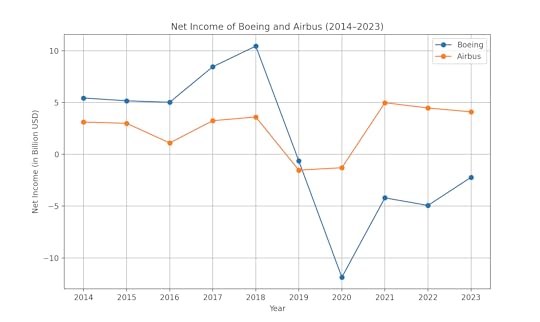
But that's pretty much what Boeing has been since 2019
Boeing went from being just around 20% more profitable than their only competitor (Airbus) in 2014 to two times more profitable in 2018.
Since then, Airbus managed to ride out the ripple effects of the 737 MAX crashes in 2018-2019 and the Covid impact on airline travel in 2020 with minimal loss and went back to their usual, consistent profitability from 2021.
Boeing? They are approaching their fifth straight unprofitable year with no path towards profitability.
The first half of the book is mostly a recounting of Boeing's history in terms of its prominent senior management.
The narrative that the books goes for is splitting Boeing into two eras - the engineering led, pre-1997 merger with McDonnell Douglas era and the era after that led by bean counters and men of low professional (and even personal, the book takes a brief digression into the affairs of the top execs lol) integrity.
To be honest, I found the book's narrative not entirely convincing - proverbial boogeymen of dividends, buybacks, executive compensation, layoffs, outsourcing and even off the cuff remarks by execs in question are brought up as self evident basis of poor management and safety compromises.
While the above may be true, the book is completely absent of any supporting data points which compare these numbers in pre-merger and post-merger eras.
However, where the book excels is in recapturing the events leading up to plane crashes and all the subsequent proceedings involving Boeing, the regulators, the airlines, the pilots, the general public and others.
If you have followed those events extensively, I think there won't be anything much new but otherwise it is a good read.
And finally, it's hard not to be stupefied at the completely ridiculous obsession at Boeing with juicing out every single fraction of a cent of extra cost savings.
It's like, you guys were already so successful, profitable and part of a duopoly that would held for decades and yet its CEOs seemed Infatuated with seeing just how much more their earnings could grow.
If it's not a Boeing, I'm not going? Nah, if it's Boeing, I'm f**king cancelling.
John Oliver segment on Boeing - https://youtu.be/Q8oCilY4szc?si=OSXif...
Al Jazeera's very prophetic documentary on Boeing and the Dreamliner issues - https://youtu.be/rvkEpstd9os?si=JGzlc...
It's hard to think of an epithet for Boeing that doesn't sound disrespectful to the 346 people who died in the Boeing plane crashes in 2018 & 2019.
Boeing is in free fall? Boeing is a train wreck?
But that's pretty much what Boeing has been since 2019
Boeing went from being just around 20% more profitable than their only competitor (Airbus) in 2014 to two times more profitable in 2018.
Since then, Airbus managed to ride out the ripple effects of the 737 MAX crashes in 2018-2019 and the Covid impact on airline travel in 2020 with minimal loss and went back to their usual, consistent profitability from 2021.
Boeing? They are approaching their fifth straight unprofitable year with no path towards profitability.
The first half of the book is mostly a recounting of Boeing's history in terms of its prominent senior management.
The narrative that the books goes for is splitting Boeing into two eras - the engineering led, pre-1997 merger with McDonnell Douglas era and the era after that led by bean counters and men of low professional (and even personal, the book takes a brief digression into the affairs of the top execs lol) integrity.
To be honest, I found the book's narrative not entirely convincing - proverbial boogeymen of dividends, buybacks, executive compensation, layoffs, outsourcing and even off the cuff remarks by execs in question are brought up as self evident basis of poor management and safety compromises.
While the above may be true, the book is completely absent of any supporting data points which compare these numbers in pre-merger and post-merger eras.
However, where the book excels is in recapturing the events leading up to plane crashes and all the subsequent proceedings involving Boeing, the regulators, the airlines, the pilots, the general public and others.
If you have followed those events extensively, I think there won't be anything much new but otherwise it is a good read.
And finally, it's hard not to be stupefied at the completely ridiculous obsession at Boeing with juicing out every single fraction of a cent of extra cost savings.
It's like, you guys were already so successful, profitable and part of a duopoly that would held for decades and yet its CEOs seemed Infatuated with seeing just how much more their earnings could grow.
If it's not a Boeing, I'm not going? Nah, if it's Boeing, I'm f**king cancelling.
John Oliver segment on Boeing - https://youtu.be/Q8oCilY4szc?si=OSXif...
Al Jazeera's very prophetic documentary on Boeing and the Dreamliner issues - https://youtu.be/rvkEpstd9os?si=JGzlc...

November 27, 2022
* today's rendition of "man's religion is greed" and "i hate capitalism" comes from Boeing and the 2 crashes that happened in 2018/2019, because they essentially lied about a software and its importance in the aircraft, citing "pilot error"
* fuck offfffffffffff
* the book explores how Boeing went from a company that always, always valued safety over anything else, always valued its engineers and their expertise, to a company that wanted to make all that sweet sweet cash, at the expense of its customers, their safety, its employees and any ethics or morality
* did they get away with it? of course, all they ended up paying were fines that amounted to what it would have cost to roll out a stable aircraft and train the pilots that were supposed to pilot it - the bonus of actually doing that would have been the preventable deaths of almost 350 people
* but we don't care about that in these corporations, do we? 😃
* all we care about is increasing production, often by stretching employees' capabilities so incredibly thin, decreasing costs, increasing share values, bypassing any regulatory practices, lying about safety and waiting for that $$$ to drop
* i'm just... disgusted is an understatement
* fuck offfffffffffff
* the book explores how Boeing went from a company that always, always valued safety over anything else, always valued its engineers and their expertise, to a company that wanted to make all that sweet sweet cash, at the expense of its customers, their safety, its employees and any ethics or morality
* did they get away with it? of course, all they ended up paying were fines that amounted to what it would have cost to roll out a stable aircraft and train the pilots that were supposed to pilot it - the bonus of actually doing that would have been the preventable deaths of almost 350 people
* but we don't care about that in these corporations, do we? 😃
* all we care about is increasing production, often by stretching employees' capabilities so incredibly thin, decreasing costs, increasing share values, bypassing any regulatory practices, lying about safety and waiting for that $$$ to drop
* i'm just... disgusted is an understatement

January 16, 2022
Robison did yeoman work telling not just the story of an air disaster but the story of a corporate disaster, a once-proud company pushed into the hands of knaves and greedheads who set about destroying its good name. To the bitter end, these men (I believe all men) refused to recognize how their hubris led to the deaths of 346 people, the destruction of hundreds of billions in wealth, and the fabric of an entire industry. They should teach this one in classes about the modern culture of American business.
December 20, 2021
It was just an ok book for me. Driven largely by the clear political bias the author has. I just never fully trusted what lens I was reading through. Whether I agree with his politics or not I would have at least liked not knowing what they were.
Greed, chasing the bottom line, and cutting for profit are exceptionally common themes in stories like these.
Would I recommend the book? No, probably not.
Greed, chasing the bottom line, and cutting for profit are exceptionally common themes in stories like these.
Would I recommend the book? No, probably not.

July 19, 2024
Flying Blind is a story about 347 murders. 346 of those were human beings, smashed to pieces as the out of control jetliner they were flying in impacted the ground at incredible speed. Those murders only happened because the Boeing company had first been killed, its once world-class engineering culture hollowed out by glossy-eyed executives worshipping the Cult of Shareholder Value. This book is the gripping true crime thriller of how that happened.
The proximate causes of the two crashes, the Indonesian Lion Air and Ethiopia Air Lines, is a simple and stupid engineering failure. A piece of software in the new 737 MAX, deemed MCAS, took control of the airplane from the pilots on the basis of a single malfunctioning angle-of-attack sensor and flew the airplanes into the ground.
But MCAS only existed because of a series of horrendous decisions made by Boeing executives. The 737 MAX is an update of a 60 year old airplane, and MCAS compensates for aerodynamic changes caused by bigger and more efficient engines which are positioned in front of, rather than below the wing, allowing Boeing to argue to the FAA and airlines that the MAX was essentially the same airplane as the prior 737-800, and could enter into service without significant pilot training.
No responsible engineer or regulator would have approved the design, an obvious single point of failure, but there were no such people left. Building airplanes is a hard, complex business. Boeing had traditionally been focused on engineering first, with robustly tested designs evaluated in a tight loop between various flight groups, test pilots, and training. But the 737 MAX was developed after decades of cost-cutting by GE and McDonnell-Douglas heritage executives.
Reporting lines went right to management, who didn't want to hear bad news, anything that would jeopardize schedules, and who didn't understand aviation and didn't care to. Internal warnings that the MAX was flawed went unheeded. FAA regulators, who were supposed to approve the plane, were actually reporting to Boeing rather than their own chain of command, with performance incentives to approve the MAX and no power to stop it going into service.
The lessons of this book are twofold. First, the red tape of regulations are written in blood. Second, corporate American management in the style of GE's Jack Welch is mere pillaging of productive assets. In the years prior to the 737 MAX, Boeing made over $25 billion in stock buybacks, enough to easily fund R&D on a true next-generation single aisle jetliner. The shortcuts made in developing the MAX (and I've barely scratched the surface) were ultimately far more costly than doing it right.
If you fly, you've likely been on a 737 and will likely be on a MAX at some point. But more to the point, what happened to Boeing is what's happened to America, where a bunch of sociopaths in suits are willing to cause a little bit of harm to millions of people to make themselves a dollar. Utopian me says that we need a way to effectively punish management which is incompetent to the point of murder. Pragmatic me will settle for a ban on stock buybacks, which are clearly market manipulation and allowed only by a quirk of Reagan-era deregulation which can be reversed.
The proximate causes of the two crashes, the Indonesian Lion Air and Ethiopia Air Lines, is a simple and stupid engineering failure. A piece of software in the new 737 MAX, deemed MCAS, took control of the airplane from the pilots on the basis of a single malfunctioning angle-of-attack sensor and flew the airplanes into the ground.
But MCAS only existed because of a series of horrendous decisions made by Boeing executives. The 737 MAX is an update of a 60 year old airplane, and MCAS compensates for aerodynamic changes caused by bigger and more efficient engines which are positioned in front of, rather than below the wing, allowing Boeing to argue to the FAA and airlines that the MAX was essentially the same airplane as the prior 737-800, and could enter into service without significant pilot training.
No responsible engineer or regulator would have approved the design, an obvious single point of failure, but there were no such people left. Building airplanes is a hard, complex business. Boeing had traditionally been focused on engineering first, with robustly tested designs evaluated in a tight loop between various flight groups, test pilots, and training. But the 737 MAX was developed after decades of cost-cutting by GE and McDonnell-Douglas heritage executives.
Reporting lines went right to management, who didn't want to hear bad news, anything that would jeopardize schedules, and who didn't understand aviation and didn't care to. Internal warnings that the MAX was flawed went unheeded. FAA regulators, who were supposed to approve the plane, were actually reporting to Boeing rather than their own chain of command, with performance incentives to approve the MAX and no power to stop it going into service.
The lessons of this book are twofold. First, the red tape of regulations are written in blood. Second, corporate American management in the style of GE's Jack Welch is mere pillaging of productive assets. In the years prior to the 737 MAX, Boeing made over $25 billion in stock buybacks, enough to easily fund R&D on a true next-generation single aisle jetliner. The shortcuts made in developing the MAX (and I've barely scratched the surface) were ultimately far more costly than doing it right.
If you fly, you've likely been on a 737 and will likely be on a MAX at some point. But more to the point, what happened to Boeing is what's happened to America, where a bunch of sociopaths in suits are willing to cause a little bit of harm to millions of people to make themselves a dollar. Utopian me says that we need a way to effectively punish management which is incompetent to the point of murder. Pragmatic me will settle for a ban on stock buybacks, which are clearly market manipulation and allowed only by a quirk of Reagan-era deregulation which can be reversed.

December 29, 2021
Primarily a history of Boeing and Boeing managers, which has been done before, I expected more insight and opinion on the MAX crashes.

December 14, 2021
Zoširoka kniha o tom, prečo padajú Boeingy 737 Max.
tl;dr Boeing bola kedysi firma inžinierov, ktorí chceli vyrábať lietadlá, ale potom to chytili do rúk profesionálni manažéri, ktorí začali optimalizovať a optimalizovať a akcie pekne rástli, lebo optimalizovali, a inžinieri začali hovoriť, že to už je priveľa optimalizácie a začnú tie lietadlá čoskoro padať, až nakoniec naozaj začali padať. Pre väčšinu ľudí asi priveľa detailov čítať toto na stovky strán, mňa to bavilo a konečne som to aj technicky pochopil, prečo vlastne padali.
tl;dr Boeing bola kedysi firma inžinierov, ktorí chceli vyrábať lietadlá, ale potom to chytili do rúk profesionálni manažéri, ktorí začali optimalizovať a optimalizovať a akcie pekne rástli, lebo optimalizovali, a inžinieri začali hovoriť, že to už je priveľa optimalizácie a začnú tie lietadlá čoskoro padať, až nakoniec naozaj začali padať. Pre väčšinu ľudí asi priveľa detailov čítať toto na stovky strán, mňa to bavilo a konečne som to aj technicky pochopil, prečo vlastne padali.

February 8, 2022
Honestly, I thought it was "okay". But I gave it another start because I think this type of writing is important.
It's a pretty classic story of how the corporate culture operates, where a company's true priorities are, and the impact that has on the rest of us.
I appreciate that the author cited his sources (in most cases, anyway) and tried to stick to the facts of the story.
I didn't appreciate that I had to get about 8 or 9 chapters into the book before it started to even discuss the "fall of Boeing" or the "737 MAX tragedy". There was far more history about Boeing's early days than I felt was necessary. There already exists an entire library of books about Boeing's history.
I also wasn't agreeable to, what I assume were, the authors attempts to relate or personalize the people in the book with useless information. The book read more like filler than it did as value-added in any way. I had the sense that the author was being paid by the word, or was somehow otherwise invested in stretching out the points he was making.
For example: "Peter Morton, a pilot himself, was lean and five foot six. He had a baritone voice, and hearing it frequently created the impression of listening to an audio book, with his fully formed sentences..."
Who cares? Maybe it's just me, but I expected the book to focus a lot more on the fall of Boeing and the 737 MAX tragedy than on Peter Morton's baritone voice and Jim McNerney's "chiseled jaw and hooded eyes".
In retrospect, I suppose if the author had just laid out the facts and details of the story it wouldn't have made much of a book at all.
It's a pretty classic story of how the corporate culture operates, where a company's true priorities are, and the impact that has on the rest of us.
I appreciate that the author cited his sources (in most cases, anyway) and tried to stick to the facts of the story.
I didn't appreciate that I had to get about 8 or 9 chapters into the book before it started to even discuss the "fall of Boeing" or the "737 MAX tragedy". There was far more history about Boeing's early days than I felt was necessary. There already exists an entire library of books about Boeing's history.
I also wasn't agreeable to, what I assume were, the authors attempts to relate or personalize the people in the book with useless information. The book read more like filler than it did as value-added in any way. I had the sense that the author was being paid by the word, or was somehow otherwise invested in stretching out the points he was making.
For example: "Peter Morton, a pilot himself, was lean and five foot six. He had a baritone voice, and hearing it frequently created the impression of listening to an audio book, with his fully formed sentences..."
Who cares? Maybe it's just me, but I expected the book to focus a lot more on the fall of Boeing and the 737 MAX tragedy than on Peter Morton's baritone voice and Jim McNerney's "chiseled jaw and hooded eyes".
In retrospect, I suppose if the author had just laid out the facts and details of the story it wouldn't have made much of a book at all.

March 28, 2022
Flying Blinded by Indignation
For the same reason my 16 month old loves to point out every plane in the sky, I’m fascinated by the aviation industry. Skunkworks was the first book I read, and after reading Freedom’s Forge and Losing the Signal, Flying Blind felt like a perfect fit. However, the narrative ends up becoming just another superficial journalist book. Specifically, it suffers from a lack of norming and indignation at satisficing.
Making new airplanes at the level of safety the world has come to expect is hard. Doing it continuously as a large organization is harder still. The 737 Max during its most dangerous period had 2 fatal accidents, a rate of 4/1,000,000, about 20x other 737s (ouch), but still a non-trivial standard to achieve.
Obviously Boeing messed up the rollout of both the 787 as well as the 737 max, but after reading this book I expected a company in shambles trying to pick up the pieces. Instead Boeing’s market cap is still more than Airbus, about 35% off its peak, and roughly the same as it was in 2018. Not a great investment, but not nearly the disaster story painted by the author. The narrative of the teddy bears of Boeing engineering being swallowed up by the hunter-killer drones of McDonnell Douglas would have been enough for a think piece editorial, but I was hoping for more from a book.
26th book of 2021
For the same reason my 16 month old loves to point out every plane in the sky, I’m fascinated by the aviation industry. Skunkworks was the first book I read, and after reading Freedom’s Forge and Losing the Signal, Flying Blind felt like a perfect fit. However, the narrative ends up becoming just another superficial journalist book. Specifically, it suffers from a lack of norming and indignation at satisficing.
Making new airplanes at the level of safety the world has come to expect is hard. Doing it continuously as a large organization is harder still. The 737 Max during its most dangerous period had 2 fatal accidents, a rate of 4/1,000,000, about 20x other 737s (ouch), but still a non-trivial standard to achieve.
Obviously Boeing messed up the rollout of both the 787 as well as the 737 max, but after reading this book I expected a company in shambles trying to pick up the pieces. Instead Boeing’s market cap is still more than Airbus, about 35% off its peak, and roughly the same as it was in 2018. Not a great investment, but not nearly the disaster story painted by the author. The narrative of the teddy bears of Boeing engineering being swallowed up by the hunter-killer drones of McDonnell Douglas would have been enough for a think piece editorial, but I was hoping for more from a book.
26th book of 2021
January 15, 2022
I was really looking forward to this book, and I'm not sorry I read it, but I was a bit disappointed. The style is not the detached, pure history that I was hoping for. There's a lot of good information, but I did find one or two factual errors and at various times the tone becomes a bit petty as the author's bias leaks in.
There are occasional cultural references that may not mean anything to future readers, and a few snide comments and salacious info about characters that are really ancillary to the story.
Also, I was hoping for a lot more detail on the tragic design and decision making and who was involved. To be fair, this information may not be currently (or ever) available.
But my primary complaint is the overall flow. Topics that could be covered in a sentence or two are given two paragraphs, and the story tends to jump around in the timeline too much. I also think there's far too much emphasis on the details of how certain characters became said characters.
In short, it has somewhat the aspect of a polemic and opinion piece. Not that I don't agree with many of the author's views, but I was looking for a cool presentation of fact.
There are occasional cultural references that may not mean anything to future readers, and a few snide comments and salacious info about characters that are really ancillary to the story.
Also, I was hoping for a lot more detail on the tragic design and decision making and who was involved. To be fair, this information may not be currently (or ever) available.
But my primary complaint is the overall flow. Topics that could be covered in a sentence or two are given two paragraphs, and the story tends to jump around in the timeline too much. I also think there's far too much emphasis on the details of how certain characters became said characters.
In short, it has somewhat the aspect of a polemic and opinion piece. Not that I don't agree with many of the author's views, but I was looking for a cool presentation of fact.
February 1, 2022
A meticulously documented tale well told. Blatant corporate malfeasance resulted in horrific tragedy. Excellent explanation of the way in which Boeing’s corporate culture radically changed from engineer-driven to quarterly profit-driven. The human toll of the air disasters makes you want to find one person to blame, but Flying Blind makes clear that the 737 problems weren’t caused by one person: they were allowed to occur in a company that has gotten far too embedded and entwined with the FAA - and the few brave engineers who tried to speak up were given short shrift.
I certainly hope it isn’t just business as usual for Boeing after the disastrous 737 crashes, though it’s probably too optimistic to hope that these air disasters will bring lasting change.
I certainly hope it isn’t just business as usual for Boeing after the disastrous 737 crashes, though it’s probably too optimistic to hope that these air disasters will bring lasting change.
This entire review has been hidden because of spoilers.

May 9, 2026
If it’s Boeing I ain’t going
June 24, 2025
This is why working in this industry makes me scared of flying 😃

December 14, 2021
This book is a relatively comprehensive account of the events surrounding the two crashes and subsequent worldwide grounding of the Boeing 737 Max 8 airplane. It is well written and engaging. I literally had trouble putting the book down, although I am not sure why. The book places the story of the Max in the broader context of Boeing and its corporate evolution from an engineering driven firm to one driven by cost-cutting and shareholder value (and executive bonuses)., via a corporate takeover as a result of a large merger. So it is the story of a firm, focused around a corporate catastrophe. The story is rich and involves several distinct storylines that come together around the Max crashes and their aftermath - none of them are particularly positive or upbeat and all are geared towards greater appreciation of the value of flying other planes - or even driving. This is not much of a holiday book - unless one is a fan of Die Hard 2.
I would like to say that the book locates blame in one or a few persons but it is clear that the crisis was a team effort. Nor was the crisis solely an airline industry event. The management behaviors associated with it were common among US firms at the time, although the shadow of GE under Jack Welch does look large. The Max crisis does show how all the various threads in the story managed to come together to a devastating effect. Does the book have continuing relevance? It likely does, although COVID-19 has reduced popular demand for flying and channelled concerns about flying into different directions. I still will check and see what type of plane I am going to fly on going forward.
This book is a good example of a business case history in book form and well worth reading for those with an interest in such cases.
I would like to say that the book locates blame in one or a few persons but it is clear that the crisis was a team effort. Nor was the crisis solely an airline industry event. The management behaviors associated with it were common among US firms at the time, although the shadow of GE under Jack Welch does look large. The Max crisis does show how all the various threads in the story managed to come together to a devastating effect. Does the book have continuing relevance? It likely does, although COVID-19 has reduced popular demand for flying and channelled concerns about flying into different directions. I still will check and see what type of plane I am going to fly on going forward.
This book is a good example of a business case history in book form and well worth reading for those with an interest in such cases.

October 16, 2022
For a short book it felt like a chore. I’m not sure if this was originally planned as a long read for Bloomberg or Wired or something, but it seemed to me to be padded to death. I really struggled to stay engaged.
We learn the backstory of figures that appear for a single chapter. There is a lot of inside-baseball HR stuff that is completely irrelevant - stories of affairs and multiple marriages, people leaving the regulator to go to private industry like it’s some cloak-and-dagger stuff, and there is a lot of implied sketchiness that isn’t fairly interrogated (one person moved jobs and the author suggests ‘it looked like a possible conflict of interest’). Not exactly damning stuff.
Truth is though the story has been told a million times before: good company focused on doing things well gets co-opted by overconfident finance guys who think that knowing Jack Welch makes them Jack Welch, put profit ahead of everything else. Mayhem ensues. Nothing really changes. Lather rinse repeat.
We learn the backstory of figures that appear for a single chapter. There is a lot of inside-baseball HR stuff that is completely irrelevant - stories of affairs and multiple marriages, people leaving the regulator to go to private industry like it’s some cloak-and-dagger stuff, and there is a lot of implied sketchiness that isn’t fairly interrogated (one person moved jobs and the author suggests ‘it looked like a possible conflict of interest’). Not exactly damning stuff.
Truth is though the story has been told a million times before: good company focused on doing things well gets co-opted by overconfident finance guys who think that knowing Jack Welch makes them Jack Welch, put profit ahead of everything else. Mayhem ensues. Nothing really changes. Lather rinse repeat.

December 16, 2021
Awesome reporting on the 737Max tragedy but a lot more than that – succinctly documents the typical crapification of a once good-to-great company down the rabbit hole of stock buybacks, executive excess, outsourcing and other related negligence to a shell of what it once was. Naturally it would be with a great amount of unease to find out that travel would be on a Max . And of course documents the senseless life lost in this debacle.

March 2, 2022
Flying blind was a good book. It examined how Boeing went from a power house company to a company in trouble. I did not know much about the aviation industry until I read this book. A must read for anyone who likes non fiction

December 18, 2022
I’ve been craving a good investigative journalism piece, but this didn’t do it for me. I was disappointed in the overall flow of the book and the author couldn’t help but add some personal biases. I wish the timeline of the Boeing saga and culture collapse was better laid out.

March 16, 2024
super impressive journalism about the pure inhumanity and vileness of Boeing’s execs, airline CEOs, FAA regulators, and (almost always!) conservative lawmakers

February 13, 2022
Amazing book. Amazing story.
This is a review of the downfall Boeing and events within the company that led up to the 737 Super Max software issues that caused plane crashes and exposed a rotted out company culture.
The book goes back and gives a great history of Boeing and it’s inner-workings, culture, and management practices. Much built upon an engineering background of innovation, testing, and safety. But as the company grew and the marketplace became more competitive things changed.
Boeing bought / merged with McDonnell Douglas and as Boeing was the bigger/buyer, somehow the McDonnell Douglas guys maneuvered into control and quickly changed the priorities and culture within the new company.
Interesting backstory of new managements adherence to GE’s (jack Welch’s) style and many of Welch’s minions involved in Boeing. The priorities of Cuts, profit focus, highly stressful, high performance metrics hit or you’re gone.
The new Boeing changed priorities to profit, streamlining, shareholder value by cutting employees, breaking off subsidiaries such as training, parts, and even design to outside contracting firms. Many firms winning contracts that had no experience but merely the lowest bid.
A great review of the progression of the airplane maker competition between Boeing, Europe’s Airbus, and others. Pressure to cut costs, cut corners to save time to market and/or cost to customers.
The priority of cost cutting caused shortcuts in training of pilots, training manuals, testing of new cockpit controls, etc. Internal objections were either swept under the rug, or highly discouraged. The software changes and certain possible aids cost extra.
Also a frightening look at the FAA’s failed methods of review and inspection of plane controls, parts, systems. How basically the inspectors report to Boeing and their bonus’ depend on Boeing.
Great book. I didn’t like how he tried to tie all this to Trump or these business leaders’ faith. He conveniently pointed out every Republican connection , but not that this rot of the company started in the 90’s. Seemed like a stretch.
This is a review of the downfall Boeing and events within the company that led up to the 737 Super Max software issues that caused plane crashes and exposed a rotted out company culture.
The book goes back and gives a great history of Boeing and it’s inner-workings, culture, and management practices. Much built upon an engineering background of innovation, testing, and safety. But as the company grew and the marketplace became more competitive things changed.
Boeing bought / merged with McDonnell Douglas and as Boeing was the bigger/buyer, somehow the McDonnell Douglas guys maneuvered into control and quickly changed the priorities and culture within the new company.
Interesting backstory of new managements adherence to GE’s (jack Welch’s) style and many of Welch’s minions involved in Boeing. The priorities of Cuts, profit focus, highly stressful, high performance metrics hit or you’re gone.
The new Boeing changed priorities to profit, streamlining, shareholder value by cutting employees, breaking off subsidiaries such as training, parts, and even design to outside contracting firms. Many firms winning contracts that had no experience but merely the lowest bid.
A great review of the progression of the airplane maker competition between Boeing, Europe’s Airbus, and others. Pressure to cut costs, cut corners to save time to market and/or cost to customers.
The priority of cost cutting caused shortcuts in training of pilots, training manuals, testing of new cockpit controls, etc. Internal objections were either swept under the rug, or highly discouraged. The software changes and certain possible aids cost extra.
Also a frightening look at the FAA’s failed methods of review and inspection of plane controls, parts, systems. How basically the inspectors report to Boeing and their bonus’ depend on Boeing.
Great book. I didn’t like how he tried to tie all this to Trump or these business leaders’ faith. He conveniently pointed out every Republican connection , but not that this rot of the company started in the 90’s. Seemed like a stretch.

April 4, 2022
First of all: I absolutely recommend this book. Robison writes quickly, fluently, and easily; it's a page-turner of a book, as interesting - more interesting - than any novel, which says a lot for a book theoretically premised on the failure of a tiny system called MCAS.
In a six-month time period, from October 2018 to March 2019, two Boeing 737-Max planes crashed, killing a total of 346 people. When the first plane crashed, news emerged that a little system called MCAS - ("what's MCAS?" FAA "regulators" - ha - asked themselves) had been the cause. Boeing stood behind its plane, and implied instead that poor airmanship and poor training on the part of a "non-Western" airline had caused the crash. Then in March 2019 came the second crash. This time the pilots had the checklist. They knew what to do if the MCAS was erroneously triggered. And yet the plane still crashed.
In retrospect, by Robison's telling, this ending looks almost inevitable. At its inception, Boeing was a pioneer, an engineering company to its bones: all-American, perfectionist, a little maverick - a titan. If something was wrong, the company fixed it, no questions asked. Safety and perfection, good sound design - that was Boeing. In a world of Douglases and McDonnells and de Havillands that made mistakes, and prioritized money over engineering integrity, Boeing did things right, and while the others rose and then fell and then fell some more, Boeing continued to rise.
But then, in Robison's telling, things began to change. Economic deregulation, stock buybacks, stockholder value above all else - at some point in the second half of the 20th century, Boeing lost its way. Boeing bought McDonnell-Douglas, but McDonnell-Douglas values devoured Boeing from the inside out. Then came the inevitable fall from grace, except it was hidden, because stock prices rose and rose and rose. A succession of short-sighted CEOS and chairmans came next, all of whom prioritized stock price and price-cutting and outsourcing, against the advice of longtime engineers, over everything else. Cheaper is better. Why design a new plane when it's easier to just update the new one? So many corners were cut in everything that it's a wonder there were any corners left at all. They sold real estate; they sold factories; they farmed everything out to the cheapest possible subsidiaries. You could, Robison seems to argue, say they'd sold the Boeing soul.
So, why MCAS? The TL;DR.
Boeing had to compete with a new Airbus plane, but didn't wish to spend the money to develop an entirely plane - far too expensive. So they made the decision to just update the aging 737, long overdue for an overhaul. They made it lighter and stuck some more powerful engines on the plane. The heavier engines, though, made the plane prone to pitch-ups during tight turns. Instead of creating a hardware fix, Boeing decided on a shortcut (surprise!) : a software fix - the Maneuvering Characteristics Augmentation System, already added in a weaker form to the inspiringly-named and utterly uninspiringly-designed 767 Dreamliner (yes, of the lithium battery fires). MCAS automatically pitches the nose of the plane back down at high altitudes by the tune of about .6%.
Along the way, though, engineers discovered the pitch-ups happened more frequently than they anticipated. So they increased the extent to which MCAS could pitch the nose down, and they allowed it to happen at lower altitudes too - a point at which there would be no room for pilots to maneuver. Crucially, they made it override normal pilot controls; even more crucially, they created a single point of failure: a tiny angle of attack sensor. And worst of all, they eliminated the error messaging about a faulty angle of attack system - "AoA disagree," a disagreement between one sensor on the captain's side, versus the copilot's side - except for customers who purchased an upgraded package. Cost-cutting at its worst. One tiny, tiny sensor goes wrong, and thus begins a whole, horrible chain of events. They launched the MAX, assured airlines no additional simulator training was needed ($$$), and didn't even bother mentioning MCAS in the new guides, except in the index.
There's something exquisitely and horrifically tragic about this fast-paced, engagingly-written account. It's Shakespearian; Icarus falling with his dripping wax-wings. Boeing is American ingenuity and something historic, one of the last great American titans. But Robison here rips off the curtain to show us that Boeing has lost itself - and too many lives along the way. Robison is bipartisan in his critique: the FAA has been rendered spineless, and Boeing has been seen as too big to fail, by both Republican and Democratic presidents, although President Trump gets the brunt of his criticism.
His bias is perhaps a little too clear: there are no counter-narratives in this book, no "other side" to the clear story he lays out - perhaps my only criticism of this book. But then, does there need to be another story, a counter narrative, in a story that has a body count like this one? This book runs rife with sickening choices, egotism, and massive payouts - golden parachutes, millions and millions of dollars for men (and women) who effectively allowed 346 people to be flown into the ground.
In the wake of the crashes, Congress held hearings, but Robison argues that no one was ever truly punished. A few low-level enablers were sent packing; Boeing paid minimal fees to the tune of a few million - not even the amount they would have paid for the training Boeing claimed wasn't needed; and CEO Muilenberg was fired (with $62M in compensation - not much of a loss). The FAA, which had evolved into a rubber-stamping "regulatory" body that actually just reported to Boeing, with officials actually being rewarded for approvals rather than catching errors, was lightly updated - but not really. In short: a couple surface-level changes were made, but no real change. The same horrible circumstances that led to the crashes are still very much in place.
Robison tells a story of industry gone wrong; short-term false profits prioritized above human life. One engineer messages his colleague, "Would you put your family on a Boeing 737-MAX?" The answer is, of course, no. But 346 people did get on 2 737 MAX planes. The message here seems to be: they still could.
In a six-month time period, from October 2018 to March 2019, two Boeing 737-Max planes crashed, killing a total of 346 people. When the first plane crashed, news emerged that a little system called MCAS - ("what's MCAS?" FAA "regulators" - ha - asked themselves) had been the cause. Boeing stood behind its plane, and implied instead that poor airmanship and poor training on the part of a "non-Western" airline had caused the crash. Then in March 2019 came the second crash. This time the pilots had the checklist. They knew what to do if the MCAS was erroneously triggered. And yet the plane still crashed.
In retrospect, by Robison's telling, this ending looks almost inevitable. At its inception, Boeing was a pioneer, an engineering company to its bones: all-American, perfectionist, a little maverick - a titan. If something was wrong, the company fixed it, no questions asked. Safety and perfection, good sound design - that was Boeing. In a world of Douglases and McDonnells and de Havillands that made mistakes, and prioritized money over engineering integrity, Boeing did things right, and while the others rose and then fell and then fell some more, Boeing continued to rise.
But then, in Robison's telling, things began to change. Economic deregulation, stock buybacks, stockholder value above all else - at some point in the second half of the 20th century, Boeing lost its way. Boeing bought McDonnell-Douglas, but McDonnell-Douglas values devoured Boeing from the inside out. Then came the inevitable fall from grace, except it was hidden, because stock prices rose and rose and rose. A succession of short-sighted CEOS and chairmans came next, all of whom prioritized stock price and price-cutting and outsourcing, against the advice of longtime engineers, over everything else. Cheaper is better. Why design a new plane when it's easier to just update the new one? So many corners were cut in everything that it's a wonder there were any corners left at all. They sold real estate; they sold factories; they farmed everything out to the cheapest possible subsidiaries. You could, Robison seems to argue, say they'd sold the Boeing soul.
So, why MCAS? The TL;DR.
Boeing had to compete with a new Airbus plane, but didn't wish to spend the money to develop an entirely plane - far too expensive. So they made the decision to just update the aging 737, long overdue for an overhaul. They made it lighter and stuck some more powerful engines on the plane. The heavier engines, though, made the plane prone to pitch-ups during tight turns. Instead of creating a hardware fix, Boeing decided on a shortcut (surprise!) : a software fix - the Maneuvering Characteristics Augmentation System, already added in a weaker form to the inspiringly-named and utterly uninspiringly-designed 767 Dreamliner (yes, of the lithium battery fires). MCAS automatically pitches the nose of the plane back down at high altitudes by the tune of about .6%.
Along the way, though, engineers discovered the pitch-ups happened more frequently than they anticipated. So they increased the extent to which MCAS could pitch the nose down, and they allowed it to happen at lower altitudes too - a point at which there would be no room for pilots to maneuver. Crucially, they made it override normal pilot controls; even more crucially, they created a single point of failure: a tiny angle of attack sensor. And worst of all, they eliminated the error messaging about a faulty angle of attack system - "AoA disagree," a disagreement between one sensor on the captain's side, versus the copilot's side - except for customers who purchased an upgraded package. Cost-cutting at its worst. One tiny, tiny sensor goes wrong, and thus begins a whole, horrible chain of events. They launched the MAX, assured airlines no additional simulator training was needed ($$$), and didn't even bother mentioning MCAS in the new guides, except in the index.
There's something exquisitely and horrifically tragic about this fast-paced, engagingly-written account. It's Shakespearian; Icarus falling with his dripping wax-wings. Boeing is American ingenuity and something historic, one of the last great American titans. But Robison here rips off the curtain to show us that Boeing has lost itself - and too many lives along the way. Robison is bipartisan in his critique: the FAA has been rendered spineless, and Boeing has been seen as too big to fail, by both Republican and Democratic presidents, although President Trump gets the brunt of his criticism.
His bias is perhaps a little too clear: there are no counter-narratives in this book, no "other side" to the clear story he lays out - perhaps my only criticism of this book. But then, does there need to be another story, a counter narrative, in a story that has a body count like this one? This book runs rife with sickening choices, egotism, and massive payouts - golden parachutes, millions and millions of dollars for men (and women) who effectively allowed 346 people to be flown into the ground.
In the wake of the crashes, Congress held hearings, but Robison argues that no one was ever truly punished. A few low-level enablers were sent packing; Boeing paid minimal fees to the tune of a few million - not even the amount they would have paid for the training Boeing claimed wasn't needed; and CEO Muilenberg was fired (with $62M in compensation - not much of a loss). The FAA, which had evolved into a rubber-stamping "regulatory" body that actually just reported to Boeing, with officials actually being rewarded for approvals rather than catching errors, was lightly updated - but not really. In short: a couple surface-level changes were made, but no real change. The same horrible circumstances that led to the crashes are still very much in place.
Robison tells a story of industry gone wrong; short-term false profits prioritized above human life. One engineer messages his colleague, "Would you put your family on a Boeing 737-MAX?" The answer is, of course, no. But 346 people did get on 2 737 MAX planes. The message here seems to be: they still could.
Displaying 1 - 30 of 479 reviews