Un conmovedor relato sobre las decisiones que dan forma a nuestras vidas.
Julien y François son dos jóvenes promesas del piano cuya senda vital transcurrirá en paralelo de la mano de la música. Cuando un concurso para pianistas los enfrenta, la vida de ambos cambia para siempre. Años más tarde, un Julien anciano relata su vida a una periodista componiendo, como en una partitura, una compleja historia donde el éxito, la rivalidad y la redención plantearán la cuestión que le atormenta: ¿ha sido toda su vida un fraude?
i enjoyed uncovering the life of our main character who is a pianist, alongside the journalist. his life is full of unfortunate events, fame, fortune, and quite a bit of regret. though the ending can be predicted early on, it's still an enjoyable story full of beautiful illustrations.
‘But… how can someone be happy while trying to be someone else? You end up being a secondary character in your own life.’
Uh, holy shit. I’m typing this during the “I’m not crying, you’re crying” moments immediately upon finishing Ballad for Sophie, a graphic novel about the life of a fictional famous pianist superstar. Beginning in a small village in 1933 France, young, wealthy Julien Dubois first hears François Samson, the impoverished son of a janitor, perform piano in a competition and their brief meeting kicks off a sweeping, emotional epic as their lives are irrevocably intertwined. Told as a series of interviews to a young journalist as Julien, now a recluse, is dying from cancer, this is a visually stunning tale of of jealousy, war, fame, shame and—of course—music. Written by Filipe Melo, gorgeously illustrated by Juan Cavia with background art by Juan Cruz Rodriguez, and translated from the Portuguese by Gabriela Soares, the writer and illustrators backgrounds in cinematography and directing are evident as reading this feels as close to viewing a big budget blockbuster film in a theater. It relies on a lot of musician bio-pic tropes, though being couched in the familiar also allowed it to extract an incredible amount of emotion. It gave me chills at times, pulled the heartstrings like it was conducting an orchestra, had a few good laughs, but what resonates most is the tenderness amidst it all.
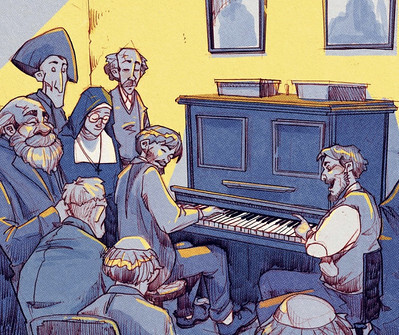
This truly felt like a historical fiction film epic. The story follows Julien, though he insists to the journalist that he does not want to be the subject of her article, as he traces the path of his life, always living with an aware that François Samson is somewhere out there. And making music he believes is impossibly good. When his mother bribes the judges to allow Julien to win despite François being the clear victor, it sets up a jealousy where Julien just wants to beat him honestly. While their lives go in different directions, Julien always has François at the back of his mind like an itch he cannot scratch. Even as an old, weed smoking, former musician who hasn’t touched a piano in years, he still listens to François every day. François (left) and Julien at two different, fateful meetings
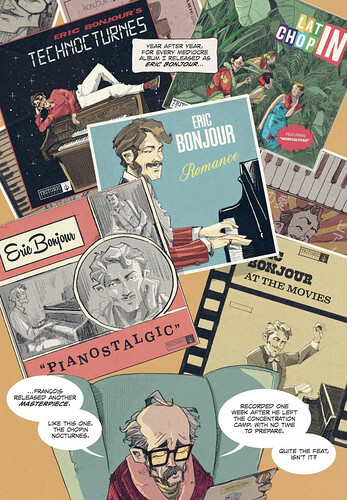
This book gives the scenes a moment to breathe, taking place over many decades and keeping a steady and engaging pace. We watch a young Julien living on the streets and bonding with the other unhoused people during the war, and then using his mother’s connections to give up his self-hood and identity to become Eric Bonjour, a multi-million record selling artist. But does fame satisfy a true artist when they are merely a puppet on the strings of corporate record labels?
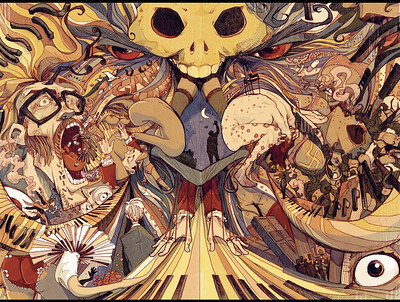
The book does tend towards a lot of clichés, such as Julien diving into ye ole spiral of sex, drugs, and rock’n’roll, the affair, the abusive producer (who is drawn as a big evil goat because that is how Julien remembers him), and the twist ending, though it also is part of what makes it seem like such a big Hollywood-style narrative. The familiar territory embeds it into the whole cannon of music films, making it a cozy place to nestle within and harmonize with the emotions the art and writing is able to extract. Also it gives the artist the opportunity to do a few pretty impressive drug scenes:
But most importantly, it makes your impression of Julien a roller coaster of emotion, which, obviously, the journalist is also experiencing. After the life of the streets scenes full of camaraderie, we watch Julien discover ‘suddenly, in this story, the villain…was me.’ Melo’s biggest achievement is creating flawed characters that, even in their darkest moments, we can still empathize with. Is there a redemption arc coming, we must ask ourselves, and why does Julien seem so content in his dying days? There are also some extremely touching moments in this book, and Melo does well by creating moments that are somehow both tender and dark or upsetting at the same time. Don’t say “aww” too soon on this one…
Ballad for Sophie took hold of me and I could not put it down. This is a big, epic tale and I love the framing of how, despite Julien being the center of the story, he is the secondary character for much of the tale with the mystery of François always on slow burn. Someone else is always making anything happen for him too, and must learn to embrace himself and find his own sense of self-agency. It’s a moving story with extraordinary artwork that helps make everything resonate and it seems only a matter of time before this is picked up for a miniseries or film. It’s also one of the few times I’ve found a graphic novel to have a lot of really quotable lines. You’ll laugh, cringe and cry at this one, and even the pretty glaring moments of cliche are more or less excusable in the context of the full effect. Ballad for Sophie is a hit for sure.
São quase quatro da manhã e terminei de ler “Balada para Sophie” na mesma noite em que comecei. Sinto que li uma das histórias mais bonitas do mundo, e a prová-lo estão ainda aqui umas quantas marquinhas de lágrimas na beira do lençol.
Esta é a terna história de um pianista, que está a ser entrevistado por Adeline, não obstante o facto de se ter recusado a essa entrevista e só ter cedido após a rapariga ter ficado a dormir uma noite na soleira da sua grande mansão.
“Balada para Sophie” é uma incursão na vida de Dubois, mas também de personagens como o gato Maurice, o pássaro Tin-Tin, a querida governanta ou a própria Adeline.
Muitas vezes achei que aqueles desenhos tinham magia, pois olhava para a mesma página e de cada vez que mexia os olhos via coisas distintas, descobria pormenores, encontrava mais texto dentro daqueles traços.
E depois há a expressão das personagens, majestosamente transmitida através do olhar; há o sentido de humor, o abordar inocente de temas tão particulares, numa história que nos envolve desde o primeiro balão.
Que bom, que bom saber que este livro está escrito e desenhado, que vou poder voltar a esta história as vezes que me apetecer, que vou sempre poder ouvir a balada e aprender que os pianos podem voar.
Que bonita obra, cheia de uma entrega e de uma sinceridade impressionantes. Feito para os cinco sentidos (não é que até o papel do livro tem um cheiro de sonho?).
In just a few minutes, it was clear that Francois Samson possessed "supernatural talent" and was arguably the greatest pianist of all time. He played with intensity, making intricate music come alive thus captivating audiences far and wide. Samson's life and that of Julien Dubois would change forever after a piano competition in Cressy-La-Valoise in 1933.
Julien Dubois, now a bitter, old, reclusive maestro, lived in a magnificent mansion. He no longer "tickled the ivories". He shunned journalists. A pesky intern from "Le Monde" slept on his front steps after being escorted from the maestro's house. Adeline Jourdain piqued his interest when she recognized a recording of Chopin's E Minor Prelude played by Francois Samson. Maestro agreed to be interviewed. The story that unfolded was one of hatred, envy, regret and redemption told by a sickly gentleman who often interjected fact with fancy.
It started with a piano competition. Julien Dubois, a wealthy heir, was schooled in piano by his mother, an overly critical taskmaster who made him practice up to ten hours a day. It was expected that he would win the contest. A last minute entry, the theatre cleaner's son Francois was a self taught pianist who practiced in the theatre's upstairs dressing rooms. He was dirty, skinny and needed a new pair of shoes. Ten year old Francois Samson played encore after encore of Chopin Etudes from memory. He should have won. The jury, the host and the critics had been bribed. Julien was angry. He had wanted to beat Francois fair and square.
A second opportunity went awry. The year 1940. The Germans arrived in Paris. Suddenly, people would mysteriously disappear. While Julien and his mother entertained the Germans in their salon with piano music and sing-alongs, Francois's music, accompanied by vocalization of his principles, caused him to be sent to Auschwitz where he conducted an orchestra of prisoners playing marches for those going to work camps.
After the war, while Francois Samson was continuing to make a splash in the classical music world, at the expense of Julien's dignity, one song changed everything. Julien was transformed into Eric Bonjour, superstar. Julien did not deserve or ultimately desire his ill-gotten rewards. He was yet to hurt someone who believed in him more than he believed in himself. He would commit the ultimate betrayal. Was redemption even possible before it was too late?
"Ballad for Sophie" was penned by a dynamic duo of Portuguese graphic novels. The exemplary story written by Felipe Melo was breathtakingly illustrated by Juan Cavia. Kudos to this talented team!
Thank you IDW Publishing/Top Shelf Productions via Edelweiss for the ARC in exchange for an honest review.
I had no expectations for this one, going in, though I have been reading a lot of pretty depressing books lately, and was happily surprised by the kind of romantic setting, and the elaborate tale: In 1933, there's a competition for young pianists, rich Julien and poor Francois, the janitor's son. One is brilliant, a prodigy, who plays with soul, and the other is technically proficient. The two emerge as Number 1 and 2; one heads for fame, the other to a kind of long struggle, but their fates are tied forever.
35 years later, one of them, the bitter victor, is interviewed by a young journalist, who tells the truth of his life. There's nothing really very surprising in the plot until a twist near the end, but it is really engaging and bound to be popular in this time of dystopia and despair. Accomplished, elegantly, by an emerging star of Portuguese comics, Filipe Melo and Argentinian Juan Cavia. I like the touches of magical realism in it: A step-father always seen as a goat, and flying pianos (when truly passionate music is being rendered by a pianist). I seem to be a sucker for winding, tragically romantic tales; who knew?! Oh, sure, we know this kind of story, maybe, from classic French films and novels, but why be so cynical? Why not just give in and embrace it?!
Oh! And the book comes with romantic sheet music of "The Ballad for Sophie" supposedly created by one of the story's pianists for this mystery woman of the tale, Sophie, here performed on the piano by one of the actual composers, Felipe Melo:
Foi a minha primeira novela gráfica há muito tempo e não podia ter gostado mais 🥹 Foi tão bom que literalmente li o livro todo de uma só vez. Recomendo imenso!
A minha opinião em vídeo em Livros à Lareira com chá: https://youtu.be/6PbteIhtvrs Este livro é do mais belo que já li. Faltam me as palavras, o meu coração está num misto de emoções. Obrigada Inês do blogue Livros e papel, obrigada pelo livro e pela história que ficará para a vida 🥰🥰🤍❤
"É curioso, com o passar dos anos, os dias duram menos. Passa tudo a correr. Aprendemos a aproveitar melhor cada bocadinho. Aliás, o único conselho que posso dar ao mundo é...vivam cada dia como se tivessem cancro! Ficava toda a gente com as prioridades no sítio. Aliás, devia ser o meu epitáfio. Tratem lá disso, por favor."
Este livro é só a coisa mais linda que eu vi este ano! Com excelentes ilustrações e uma história, não muito fofinha, triste até, mas que nos aquece um bocadinho o coração e nos faz acreditar que no fim tudo dá certo, ou quase!
Só não leva cinco estrelas porque a história foi um pouco previsível, mas não deixa de ser um excelente livro.
Arte excecional, acompanhada de um enredo simplesmente delicioso, com os clichés apenas necessários para tornar uma leitura confortável e sem grandes surpresas
After hearing Ariel rave about this book on the Books Unbound podcast for months on end I decided to read it since it is available through Kindle Unlimited. I prefer reading comics and graphic novels physically but since they're so expensive I can rarely justify a purchase nowadays. However, Ballad for Sophie was so impressive, especially its art, that I'm now definitely considering buying a physical copy – if I ever see it for a good price.
In this story, we follow Sophie, a young journalist hopeful who wants to interview the infamous showman Julien Dubois. Living reclusively for many decades now, Dubois doesn't give any interviews. Sophie is persistent enough to gain his respect and access to his home and story. Over the course of some days, Dubois opens up and tells her his story, beginning in 1933 in the small French village of Cressy-la-Valoise, where a local piano contest brings together two brilliant young players – Julien himself, the privileged heir of a wealthy family, and François Samson, the janitor's son – and ending in the present, in 1997, where Julien has become an eccentric, bitter old man.
Dubois takes Sophie not only on his life's journey, but also that of François. World War II shaped the trajectory of these two men's lives in very different ways. Dubois' mother, sympathising with the Nazis that took over the town, led a fairly comfortable life during the war, only to loose everything in 1945, being labelled a "Nazi whore" and harassed by the other villagers. François, who publicly spoke out against antisemitism and Nazism at a piano competition ("Sie können unser Land besetzen, aber nie unsere Seele besetzen."), is taken to a concentration camp. In the 60s and 70s, both men make a name for themselves as piano players. Whereas François' talent is largely overlooked, Dubois becomes a mainstream attraction and makes millions under the pseudonym Eric Bonjour.
But somehow Dubois is never satisfied. He follows François' career closely and feels like he will never be as good as him. Trapped in gagging contracts, Dubois numbs himself with drugs, alcohol and sex. ("Those days, I was so busy trying to commit the longest suicide in history … that I didn't even notice the bruises on my mother's face.") His downward spiral culminates on the day after François dies. Dubois shoots himself in the hand so that he never has to play the piano again.
Many other things happen in this story, like Julien's affair with François' wife Anne-Marie, and the reveal at the end that Sophie is his daughter.
Personally, I think the story (plot-wise) is a mixed bag. Overall, it's coherent and engaging but sometimes it felt overly simplified and convenient. It's a bit cliché. However, Cavia's art is so magnificent that it still makes for a wonderful reading experiences. The way he illustrates this story is so clever, vibrant and fun – I am absolutely obsessed and would love to see more from him. The colors are vibrant, the detail is breathtaking, the ideas he has are original.
I especially loved how magical realism was shown through the illustrations, e.g. Julien's first piano teacher (and the later lover of her mother and his manager) is drawn as a goat, not as a man, because "that's how I remember him." It's a brilliant choice because it underlines the menace and inhumanity of this man. Another example are the choice of the levitating piano, first when François plays at the competition and later when Sophie plays "Ballade pour Sophie". These shots are wonderful and I love how magical they are. They symbolism (the flying piano as the pinnacle of celestial music and the perfect moment) is clear.
And the ending absolutely wrecked me. Dubois final letter to his new-found daughter actually brought a tear to my eye. He signs it off with: "And now forgive me, but it's time to say goodbye. After all, I have a long journey ahead of me. Avec Amour, Julien Dubois." And that's so poignant because "Avec Amour" is Eric Bonjour's most famous and Julien's most hated song. And he is finally able to take that phrase back and direct his love to his daughter. BESTIES? Do you hear me sobbing? And to top it all off, he wrote her her own ballad and when Sophie sits down to play it for the first time, she is also levitating with the piano. STOP IT!
So yeah, it's definitely an engaging story that can tear at your heart strings. Even though the plot is sometimes thin, Cavia's beautiful art style will definitely keep you invested until the story picks up again. // Plot: 3 stars | Art: 5 stars
I think this is my favorite graphic novel, ever. So full of life, intricate details, stunning artwork, and a gorgeous story to match, I had tears in my eyes by the end of it.
The slow unfolding of Julien’s life was masterful and the art, overall, was breathtaking. I wish I could have stayed in this world forever.
What a beautiful, heartbreaking story.
(Also, listen to the ballad on Spotify afterwards. It’s beautiful)
This is almost always the book I recommend on the “I am not a robot” question. I do not always have the opportunity to recommend it though, and this one truly deserves to be massively read.
We were in the middle of the pandemic when Filipe Mello and Juan Cavia published this book. Luckily, I have quit quarantine and sterilizing boxes after their arrival, and I immediately open the package. Inside was the most beautiful book I read in a while, and I went through it in one sitting. Since then, I keep offering this book to friends and family, so you can see how much I love it.
Both Filipe Melo and Juan Cavia have background in cinematography, which turns the experience of reading their books pretty similar to watching a beautiful movie. As Filipe is also a musician, this book has its own score at the end, and let me tell you, it is so beautiful that it was one of the musics I selected for my wedding. It's true I love everything this Duo puts together, but they truly shine in this one.
Ballad for Sophie is a hauntingly beautiful tale of love, rivalry, jealousy, music, fame and redemption. If I can persuade you to read a book, please let it be this one.
Quem é que decide o que temos ou não direito de fazer? A nós mesmos, ao próximo… Muitas vezes vivemos cada dia como um prolongamento do anterior e em antecipação ao próximo, muitas vezes enfiados nas nossas cabeças, nas nossas ambições, no que achamos urgente atingir, no que achamos que pode ficar para depois. Balada para Sophie é uma espécie de quinta-essência por variadíssimas razões. Muitas delas já foram apontadas noutros textos: Filipe Melo escreveu um argumento sublime, provocando o subconsciente, incandescendo o consciente, tudo envolto numa beleza triste e enternecedora; Juan Cavia na sua arte deu uma vida e um assombro perfeitos a esta dinâmica que flui entre a memória e oblívio.
Honestamente não vou falar sobre os personagens em particular porque já existem vários textos (incluindo a sinopse) que se dobram sobre a análise dos mesmos, e porque o que ainda estou a exorcisar (no bom sentido) é uma sensação de quarto escuro em que nos enfiamos nas nossas lutas interiores e em que a sensação de entitlement e o sentido de obrigação digladiam até nos exaurir, movendo um véu que consegue ser tão ténue.
Confesso, com embaraço, que é a primeira vez que vivo algo composto por Filipe Melo e Juan Cavia. Digo viver em vez de ler porque é uma preciosidade rara encontrar arte e texto conjugados e entrelaçados de forma tão visceral. A experiência tomou de assalto todos os meus sentidos, incluindo os interiores – a dor, a compaixão, a desilusão, o amor, a carência, o arrependimento, a saudade, a esperança e por fim a surpresa, sem ser realmente uma surpresa.
Enquanto estive nos Estados Unidos, antes de a pandemia nos mandar a todos para casa, tive o privilégio de assistir a algumas óperas, incluindo La Traviata (que por alguma razão me veio à cabeça a certa altura). Não sei se vocês já assistiram a alguma ópera, mas para mim é uma experiência incrível. E refiro isto porque quando fechei Balada para Sophie pensei, na minha ignorância sobre a tangibilidade das adaptações, que daria uma das mais belíssimas óperas de sempre. Não um filme, não uma curta, uma ópera com todo o ambiente onírico que esta consegue evocar.
Tendo em conta toda a sua musicalidade e movimento e a composição de Filipe Melo em piano para Balada para Sophie, houve parte de mim que se transportou para uma qualquer sala a projectar a arte gráfica de Juan Cavia animada por figuras de uma performance intensa e hipnotizante. E o fim! O fim deste livro…! A ironia da vida. O universo a manifestar as suas subtilezas mais brutais.
Resumindo e concluindo: sinto que poderia ficar horas a escrever sobre o livro. Sobre os seus pontos de luz e de escuridão, sobre o incrível trabalho gráfico que nos suga e subjuga intensificando as emoções provocadas pela narrativa, sobre a magia que existe à sua volta, incluindo os seus abismos… Existem muitos adjectivos positivos que podem ser atribuídos a Balada para Sophie. No entanto, fundamentalmente considero que este é um livro que coloca a nu o ser humano e a sua complexidade.
Vocês sabem que eu quando gosto mesmo muito de um livro escrevo coisas talvez sem sentido porque ainda sai tudo muito de coração nos dedos. Já passaram duas semanas desde que terminei a leitura de Balada para Sophie, já lhe quis pegar novamente, mas opto por o manter por perto. Não sei se para me recordar, se para me alertar. O que sei é que se junta a A Ridícula Ideia de Não Voltar a Ver-te e a Nem Todas as Baleias Voam como obras que irei para sempre recomendar.
Dito isto, encontrem Balada para Sophie, comprem/aluguem/o-que-for, percam-se nele. Vale completamente a pena. E, honestamente, vale o dinheiro (comprei o meu, não foi oferecido). Deixo-vos com um vídeo que encontrei de Filipe Melo a tocar o tema que compôs e cujas pautas se encontram no final da obra. Parabéns, Filipe Melo e Juan Cavia, sem dúvida que esta é mais uma obra que vos torna imortais.
Esta banda desenhada é qualquer coisa especial! Não é apenas as ilustrações belissimas que tornam esta uma das melhores banda desenhadas que já li, é todo o argumento que nos leva a refletir a importancia da música nas nossas vidas e como certas pessoas tem a capacidade de transformar nossas vidas.
Cada vez gosto mais de ler banda desenhas, novelas gráficas e mangas. Principlamente BDs como este que tem o poder de tocar o nosso coração.
Devorei este livro, o que quase que é injusto devido à beleza das páginas, sinto que vou lê-lo muitas mais vezes, de tão bonito que é, fiquei com o coração quentinho
Feliz porque este livro é mais uma obra brilhante desta dupla. A sério, é uma leitura obrigatória para qualquer pessoa que goste de ler, quer aprecie romances gráficos ou não. Vai, compra-o. Lê-o. Agora.
Triste porque vejo muito do que está neste livro refletido nas nossas próprias vidas. As pessoas desistem da felicidade demasiado facilmente, e isso é profundamente triste—afinal, só temos uma oportunidade para acertar.
Irritado porque gostava que a personagem principal tivesse feito escolhas diferentes. Não consigo deixar de imaginar como a vida dele poderia ter sido diferente com apenas algumas decisões diferentes.
No geral, adorei esta experiência. Trabalho incrível, pessoal!
6 estrelas!
--
EN I'm sad, I'm annoyed, and I'm happy.
Happy because this book is yet another brilliant work by this duo. Seriously, it’s a must-read for anyone who loves reading, whether you enjoy graphic novels or not. Go buy it. Read it. Now.
Sad because I see so much of what’s in this book reflected in our own lives. People give up on happiness far too easily, and that’s deeply tragic—after all, we only get one chance to get it right.
Annoyed because I wish the main character had made different choices. I can’t stop wondering how different his life could have been with just a few alternate decisions.
Overall, I loved this experience. Incredible job, guys!
Ballad for Sophie ilk olarak bir kitapçı ziyaretinde portekizce baskısıyla dikkatimi çekti. Dürüst olmak gerekirse kapağı biraz kapalı kutu olsa da sayfalarında gezinirken çizimlere aşık oldum.
Hikayenin açılışı ünlü ve huysuz- insanlara kapalı bir hayat yaşayan piyanistin kapısında beliren genç bir gazeteci ve onun röportaj yapma çabasıyla gerçekleşiyor. Açıkçası öykünün sizi sürprizlerle şok etme gibi bir gayesi bulunmuyor. Zira anlatacağı gerçekler öyle büyük ki sizi şaşırtmak en son düşüneceği şey olabilir. O yüzden okurken elbette sona dair bazı tahminlerde -erken bir noktada- bulunabiliyorsunuz. Ancak bu içinizdeki heyecanın hiçbir şekilde düşürmüyor çünkü çoktan kocaman bir hayatla sarmalanmış oluyorsunuz.
1933 yılında başlayan ve Cressy’de bir yarışmada karşılaşan iki piyanist çocuğun yıllara yayılan hayranlık, kıskançlık ve suçlulukla sarmalanmış rekabetlerinin hikayesini 1997 yılına kadar takip ediyorsunuz. Ancak basit gibi görünen bu hikayede; İkinci Dünya Savaşı ortamı, toplama kamplarında kurulan orkestralar, işgal birlikleriyle yapılan iş birlikleri -savaşın ardından iş birliği yapan erkekler taraf değiştirebilirken kadınların ödedikleri bedeller-, insanlar arasında kurulan bağların gerçek dünyadaki yansıması, hayatta sizin seçiminiz olmayan hataların sonuçlarının sizi nerelere götürebileceğine ve de çıkmazdaki bir aşka kadar okurken boğazınızın düğümleneceği sayısız detay okuyorsunuz. Bu kadar karanlık bir öykünün beni nasıl böylesine kendinize bağladığına gelecek olursak; böyle büyük büyük konulardaki- acılardaki konuşmalar ve anlatım tamamen doğal bir akışta ilerliyor. Birkaç karakter dışında bütün karakterlerle -kötü görünse de- bağ kurabiliyor neyi neden yaptığını anlayabiliyorsunuz. Sanırım bu kitabın beni bu kadar büyülemesinde ve bir grafik romanla böylesine duygusal bir yük yaratabilmesinde en büyük etken bu. Bir diğer etken ise çizimler pek tabii. Kitabı alma sebebim bu çizimler olduğunu en başta söylemiştim ama hikaye ile birleştiğinde bambaşka bir güce kavuşuyorlar. Karakterlerin sadece yüz ifadeleriyle değil duruşları ve vücut dilleri ile de size gerçek duygularına ya da kimliklerine dair ipuçları veren; şimdiki zaman ile geçmişi -dönemlerine uygun şekilde- farklı çizgilerle yansıtan Juan Cavia’ya da ayrıca hayran oldum.
Açıkcası ben çok sevdiğim kitapları anlatmakta gerçekten çok zorlanıyorum. Sanki asla yeterince doğru şeyleri söyleyemiyor gibi hissediyorum. O yüzden özetle; Ballad for Sophie ( Sophie’nin Baladı) oldukça sorunlu ve kendi elinde olmayan koşullar içine sıkışmış bir hayat hakkında bir yandan sizi sarıl sarmalarken diğer yandan da kalbinizi sızlatacak çok güzel bir kitap. Lütfen okuyun, tavsiyedir. Kitabın sonunda da kitaba ismini veren bestenin kaydına ulaşabileceğiniz bir Spotify kodu bulunuyor. Bitirdiğinizde onu dinlemeyi unutmayın.
Son zamanlarda artık evdeki kitap yükünü hafifletmek adına daha çok e-kitap satın alıyorum ama bu sefer e-kitap aldığıma pişmanım. Dönüp dönüp çizimlerine bakmak için basılı halini de alacağım.
grafik romanla alakam olmadığı için @merixien olmasa hayatta radarıma girmeyecek bir kitaptı bu. iyi ki girmiş. neredeyse 20 yüzyıl tarihi gibi bir grafik roman. huysuz julien dubois hayatını genç gazeteci adeline’e anlattıkça hiç susmasın istiyoruz neredeyse. bu arada evdeki kahya kadından tutun da kedi maurice’e kadar her bir yan karakter bazen kısa bölümlerle anlatılmış. film gibi bir duygu yaratıyor bu okurken. çok sevdim. şimdi övünmeyeyim ama benim oğlan da piyanoda doğal yetenekti, tabii asla buradaki ezeli rakip françois samson gibi değil ama keçi lakaplı piyano hocasının söylediği şey çok doğru. doğal yetenek tembellik, depresyon ve yalnızlık demek biraz, çalışma hırsı olan onu geçip gidebilir. kimsenin mükemmel olmadığı, hele ana karakter julien’in hata üstüne hata yaptığı bir hikaye bu, o yüzden de çok gerçek. flea olsun. napolyon olsun öyle çeşitli ve hakiki karakterlerden oluşuyor. ve arkada tüm gerçekliğiyle 2. dünya savaşı var. julien’in annesinin almanlarla işbirliği yapan, hatta kendini peşkeş çeken bir kadın olması, julien onun yaptıklarını anlattıkça gazeteci kızın bazen o kadar da değildir demesi, ve julien’in annesinin tam bir cadı olduğunu söylemesi ne kadar güzel mesela. anlatılmayan kötü annelerle dolu ortalık çünkü. kısacası sondaki romantik tesadüfleriyle bile çok sevdiğim, arada hatta böyle çok sevdiğim yeşilçam filmi tadı aldığım, yaşanamayan aşka üzüldüğüm, bir şekilde herkesi sevip anladığım, çok dokunaklı ve tekrar ediyorum çok “hakiki” bir hikaye. hayat gibi. çizimlerin ustalığına da, hele uyuşturucu saykodelikliğine bayıldım. oğlana getirmiştim, ona vermeden okudum. sondaki şarkıyı dinledim. şu hayatta en çok özlediğim şey oğlanın evde piyano çalması, onu tekrar hatırladım 🥲







![Profile Image for s.penkevich [hiatus-will return-miss you all].](/_next/image?url=https%3A%2F%2Fi.gr-assets.com%2Fimages%2FS%2Fcompressed.photo.goodreads.com%2Fusers%2F1735525095i%2F6431467._UX200_CR0%2C11%2C200%2C200_.jpg&w=128&q=75)


