What do you think?
Rate this book


624 pages, Hardcover
First published November 16, 2021
It may be worth noting that no king of Greece died quietly in office before 1947: Otto was driven out, George I was assassinated in 1913, Constantine was exiled twice, and Alexander’s brief reign ended with a monkey bite. George II, who managed it, is said to have remarked that “the most important tool for a king of Greece is a suitcase.”I saw a single paperback copy of this book on sale at the small retail store (which otherwise was mostly devoted to sunscreen and snacks) downstairs at Athens airport, while on vacation in September 2023. I was waiting for a domestic flight to an island. At the moment, I was already foolishly carrying around in my suitcase more reading than I could possibly do, but I scribbled down the title and (somewhat to my surprise) found upon returning home that my local public library had a copy. Not only that but the library, perhaps recognizing that this book is a little dense, allowed me to instantly check this book out again after I used all my authorized renewals and appeared to make a personal appeal directly to a librarian, who may just have wanted to get rid of me. She told me, incredibly, that copies of this excellent book were even at that moment standing, unappreciated, on the shelves of two separate branch libraries nearby, so she'd have no problem reissuing the copy I had in hand right away.
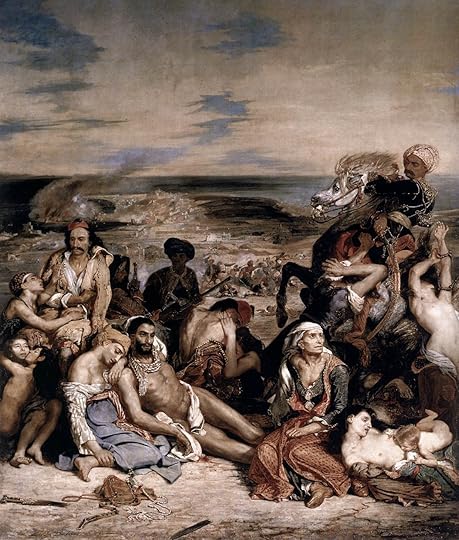
a country’s ability to influence others without resorting to coercive pressure. In practice, that process entails countries projecting their values, ideals, and culture across borders to foster goodwill and strengthen partnerships.Some of the cleverer Greek leaders realized that Greece, instead of an Ottoman backwater, could be rebranded as the birthplace of European, religious, and cultural life and, as such, something worth fighting for. This led to an early appearance of another familiar attribute of modern political life: the mobilization of public opinion (through fund-raising and agitation) to prod reluctant governments and politicians into intervention in far-off lands. Activity outside the direct theater of war was often motivated by concerns for suffering non-combatants, a new idea then and a problem sadly too familiar to us today. The author contends that the aftermath of the Greek Revolution also marked the first appearance of both internationally-coordinated anti-piracy initiatives as well as efforts to reunite families. Finally, post-revolution national rebuilding marked an early instance of soldiers working in a country after the fighting had completed “for what we now call peacekeeping” and infrastructure renewal, including roads and bridges but also in some cases completely redesigning leveled towns from the ground up.
spent the first night with his men under the columns of the Parthenon, overwhelmed by the significance of the moment. He watched the sun set over the mountains of the Peloponnese and as the moon rose he saw before him, in a kind of reverie, the ghosts of Perikles, Socrates, Euripides, and Demosthenes. The next morning he was startled awake by the appearance of a stocky elderly Chiot sailor who introduced himself as kapetan Dimitris and said that he had come up from Piraeus with his son. In broken Italian, the son explained that the father had brought the Greek flag with him. [The soldiers] stood at attention and saluted with their swords as the old man raised it high amid a great shout of “Long live Greece, long live the king!”This serious but well-written book is well worth the effort it takes to read it, and also worth pestering your librarian about, even if you never get to the many, many places where the actual fighting of the Greek Revolution took place.