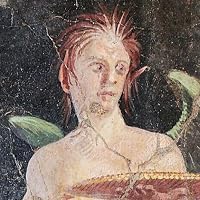
A new star has appeared in the heavens of the Kenocosm. This is supposed to be impossible, as such a novelty could only come from beyond the Great Engine, the highest, all-encompassing celestial sphere governing the clockwork cosmos constructed by the Great Artisan. Beyond this machine universe and its demiurge there is nothing, and to speculate to the contrary is at best to entertain childish delusions and at worst to unleash a dangerous pneumopathological contagion threatening the mental and spiritual sanity of the Kenogaian people and necessitating aggressive psychotherapeutic and pharmacological intervention. All things in heaven and on earth have been meticulously catalogued and regimented by the proper authorities, the highest of which is, of course, the Artisan himself. To look at the sky and contemplate a fathomless beyond can only invite disorder and a corrective visit from the world government panopticon; hence why stargazing is practically illegal and telescopes are contraband.
Valentine Ambrosius, a renegade academic exiled to the rustic backwater of Oreiotopia, has one nonetheless—a telescope, that is—and he divulges to his thirteen-year-old son Michael not only the existence of the star, but the unnerving fact that it is getting closer, descending through each of the celestial spheres in turn and soon to breach even the sublunary realm. After Valentine is arrested by the Lupine Brethren—a clerical order of, erm, dimwitted werewolves who have taken to prowling the countryside, as if in expectation—Michael watches the sky alone in his father’s observatory. Upon a numinous eve, a beam of light descends from the star into the woods near Michael’s home, and a plucky, iridescent bird alights on the telescope and cries, “Go! Go at once! Find the child! Protect him!”
So begins David Bentley Hart’s gnostic fantasia, modeled on the Hymn of the Pearl—a Syriac spiritual allegory appearing in (though likely predating) the Acts of Thomas, an apocryphal third century text—and drawing inspiration from the likes of Phillip Pullman, Jorge Luis Borges, and Lewis Carroll. This mysterious child is Prince Oriens, a noble scion of the Pleroma—the true world beyond the Kenocosm—who has undertaken a desperate mission to rescue his sister Aurora from the enchantment of a wicked sorcerer, the demiurge, who has taken her captive, uses her dreams to conjure the Kenocosm, and populates this samsaric, illusory world with sparks of life he has stolen from the Pleroma but cannot himself create. To reach Kenogaia, Oriens has had to travel through the seven cosmic realms, in each one enveloping his true, ethereal self in another soul (or body) acclimated to it, each successive layer denser, more opaque, and more lethargic than the last, presenting an ever-greater danger that he himself could become imprisoned in the dark dream and forget his true origin and purpose. Armed only with an invisible pouch of jewels from his supercelestial home—each of which emits some of the light of the Pleroma, temporarily weakening the illusion, dispelling fear, and disarming the cosmic archons, but the effect of which only lasts for a short time in this fallen realm before the jewel disappears—Oriens, aided by Michael and his friend Laura, must overcome the powers of this aion, awaken Wisdom from her troubled sleep, and rescue all spiritual beings, including those opposing him, from their imprisonment in the house of delusion.
The novel operates in three distinct registers. It is on one level an adventure story, featuring some of Hart’s briskest and most demotic prose, albeit infused with an unmistakably Hartian vocabulary and peppered with unsubtle knockdowns of some of Hart’s intellectual bugbears: infernalism, facile theodicies, the use of technical jargon by dense people to signify nothing in particular (i.e. analytic philosophy), and fundamentalisms of both the religious and materialistic variety, all of which are combined in the authorities of Kenogaia. It is also, like the Hymn of the Pearl, a mythic symbol of a spiritual reality which Hart takes to be essentially true—more true than the reality we think we know: “Myth is the true, if symbolic, memory of the immemorial; history is the false, if factual, memory of the unforgettable.”
The “gnostic” theme here is in no wise at odds with what we now think of as more “mainstream” antique Christian (or pagan) thought. As Hart has explained elsewhere, it is difficult to draw a hard and fast categorical distinction between Gnosticism and early Christianity; the basic structure and captive condition of the cosmos is roughly the same on both sides of the arbitrary divide. In John’s Gospel, Satan is the “archon of this world,” whom the supercelestial Christ has come to overthrow by introducing the illuminating light of the Logos, freeing a captive humanity from the darkness of ignorance. In the writings of Paul, Christ has overcome the angelic powers of the intermediate heavens who stand between us and the highest God. In Colossians, Christ is able to reconcile the cosmos to God precisely because the divine pleroma dwells in him. In Ephesians, resurrection is portrayed as an awakening from sleep, implying that the fleshly mortal body and the lower realm from which it is made comprise an insidious dream world. For Origen, we fall away from the Logos into various material bodies in a primordial act of forgetting, and the uniqueness of Christ consists in the fact that he never forgot who he truly is. When Origen’s Christ descends into our world, he first, like Oriens, passes through the angelic realms, becoming and remaining the Angel of Great Counsel as well as the Son of Man. Christ, like the “Gnostics,” Oriens, and the sparks of life taken captive in the Kenocosm, has multiple souls or bodies which enclose in layers of increasing density a rational or spiritual core. Hart has taken to task those Christian cultural commentators, usually of a right-wing persuasion, who apply the “gnostic” label as an epithet for political movements and social phenomena they oppose. I myself have been guilty of this in the past, but in my defense so has Hart: I recall him once dismissing the concept of aerial tollhouses, fashionable within some corners of the American Orthodox world, as “Orphic Gnostic nonsense”; an association I found a bit rude to Orphics and Gnostics.
In the third register, Kenogaia is about the end of childhood, and the struggle to remember or access one’s inner child, entombed, like the divine spark, in the samsaric accretions that gather around it from the onset of puberty: the search for an escape hatch from the often dolorous confinements of adulthood. When I was about eleven years old, I went through a period in which I was quite consciously mourning the end of my childhood. I had a conscious sense that a secret world—a world more real than the one into which I felt myself being pulled by new feelings of inadequacy and desire—was being closed off to me, and I would never be able to go back. I spent my evenings after school watching Winnie the Pooh and other shows I had not bothered with since I was very small, and if you had asked me why I would have told you that I wanted to remain a child for just a little longer. I saw in adults a certain stability and strength, but also a troubling aloofness. The transition to adulthood seemed to involve a kind of amnesia, which I was determined to avoid but ultimately could not—at least not completely. Soon I felt anxious to fit in with my peers, I became awkward around girls (actually, around everyone), terrorists started flying airplanes into skyscrapers, and hair began growing on new parts of my body. The Pleroma discretely disappeared from view.
In exploring the connection between childhood, gnosis, and memory, pairing elements of a bildungsroman with cosmological fantasy, Kenogaia has some common ground with, of all things, Stephen King’s It. While I’m sure Hart would be flattered by the comparison, the parallels, while intriguing, are somewhat superficial. No one in Kenogaia has his arm ripped off by an evil clown, nor is there any initiatory group sex in a sewer. Surely Hart would not hesitate to add these things in a second edition, but I find the novel rather charming in its current state.