This is an EXACT reproduction of a book published before 1923. This IS NOT an OCR'd book with strange characters, introduced typographical errors, and jumbled words. This book may have occasional imperfections such as missing or blurred pages, poor pictures, errant marks, etc. that were either part of the original artifact, or were introduced by the scanning process. We believe this work is culturally important, and despite the imperfections, have elected to bring it back into print as part of our continuing commitment to the preservation of printed works worldwide. We appreciate your understanding of the imperfections in the preservation process, and hope you enjoy this valuable book.
Castilian author who arranged the modern version of the chivalric romance Amadis of Gaul, written in three books in the 13th century by an unknown author.
Montalvo added a fourth book of his own and also wrote a sequel, Las sergas de Esplandián (The Exploits of Esplandián or The Adventures of Esplandián) (oldest known printing, 1510), in which he tells the life and wandering of Amadis' eldest son.
He is also known for coining the name of California.
Eto knjige koju sam želela da pročitam još otkako sam prvi put čitala Don Kihota, kakve radosti kad se pojavila na srpskom! Prevod Biljane Isailović je odličan i vrlo tečan. Treba (valjda) naglasiti da je ovo osavremenjena i jezički dosta sažeta verzija, a takođe treba naglasiti da zbog toga svi dugujemo veliku zahvalnost adaptatoru, ne, ozbiljna sam. Kad se ima u vidu da je ovo bio najbolji-od-najboljih viteških romana, pa... razumem Servantesa u potpunosti i to je sve što ću reći :D Ne, zapravo, reći ću još i da sam se prilikom čitanja više puta prisećala kako Tven u "Jenkiju na dvoru kralja Artura" ZASLUŽENO masakrira ovakve knjige. "A onda su zašli u gustu šumu i naišli na gospu kraj izvora koji je čuvao zli vitez/džin/zmaj" pa tako pedesetak puta. I ma koliko ja volela taj topos, negde četrdeseti put stvarno mi je došlo da poželim da ih zmaj sve pojede. Ako to izuzmemo... pa... ovo jeste beskrajno zabavno, nazire se nekakav osnovni zaplet od početka do kraja (a ne kao npr. kod Malorija), nema potrage za Gralom i arturijanskih vitezova (fala Bogu na osveženju), ima retkih ali uspelih maštovitih delova sa čudovištima, čarolijama, bizarnim slikama (dete rođeno sa natpisom na grudima, pola crvena slova pola bela) i... tako... ako želite da vidite kako izgleda prava, ali *prava* priča o vitezu bez mane i straha, bajnim gospama (ali ništa čednost), ranorenesansnom poimanju geografije... e... samo napred. Neće vam biti dosadno. Malo upozorenje: mnogo se gine. Mnogo. (Ali sve negativci.) Iznenadiće vas koliko je konja pobijeno i koliko se brutalno realistično opisuju smrtne rane. A zahvaljujući tome što se tada niko nije baktao jelovnikom likova, menjanjem tačke gledišta i opisima morske bolesti na desetak strana, u Amadisu je skrcano mnogo više pogibija po strani nego u čitavom Martinu.
Quieran vuestras mercedes conocer por esta esforzada recensión de la importancia del Amadís de Gaula para la literatura. Para la industriosa industria de la edición. Para la cultura del pueblo. Para la literatura de fantasía.
Desde que leyera la magnífica introducción al Amadís hecha por el bachiller Arturo Souto el joven quedé enamorado con la idea de este libro. Pero yo medroso de carecer de entendederas para una obra de cinco siglos no llegaba al atrevimiento de leerla. Hasta que hallé una edición con el castellano actualizado que esclareció para mí lo que antes eran temores. Huelga decir, mercedes, que mi idilio con esta obra se mantiene lozano y puro.
Ésta es la historia del mejor caballero del mundo. La historia de un fermoso doncel, nacido prodigiosamente, señalado por el sino para triunfar en los hechos de armas que a él le acaeciesen y siempre fiel al amor cortesano a su dama, la sin par Oriana. Amadís es un héroe perfecto, modelado de la forma que Maese Campbell señalara que son todos los héroes del mundo. Amadís sueña con fe lo imposible. Amadís vence al invicto rival. Amadís sufre el dolor insufrible. Amadís tiene ideales por los que moriría. Amadís ama con pureza y bondad. Amadís sería capaz de defender la virtud aunque debiera el infierno pisar.
La novela de caballerías resulta una iteración clave en la transmutación de las grandes épicas hacia la literatura popular. Por el contexto en el que fue escrita, también es un abandono a las formas del héroe medieval, el trágico y taciturno guerrero para sustituirlo por un dechado de hermosura que llora y se desvanece tanto como pelea y mata. También, es menester mencionar que el que el autor-refundidor de la obra, Garci Rodríguez de Montalvo, cambió por completo el final de la obra: de una tragedia a tono con la normalidad de la épica, fincó ésta es una conclusión más acorde a la sociedad de finales del S. XV que daba paso a la Edad Moderna.
Sepan vuestras reales mercedes que disfrutar de la experiencia de lectura de este clásico tiene sus más y tiene sus menos. Más allá del estilo digresivo (del que nos puede salvar una edición “afeitada” de los episodios que nada hacen por la trama) y de las expresiones en el castellano que escapa a nuestros siglos (que también puede ser salvo con una edición actualizada), algo que dificulta un poco la lectura es la repetición de episodios semejantes y la sarta de personajes nuevos carentes de personalidad (Souto llamase a sus nobles “Reyes de Baraja”). Esto es especialmente vero en las primeras aventuras de Amadís, llamado por entonces el Doncel del Mar. Es mi parecer que el libro no resulta disfrutable hasta la aparición del nefando enemigo de nuestro héroe, el oscuro hechicero Arcalaús. Y de ahí la novela se desliza con frenesí y pasión por episodios verdaderamente descollantes.
Para animar al lector diré que las escenas de batalla son tan vívidas y tan claras que la emoción con la que son contadas nos recuerda mucho a los descollantes combates que nos narra el caballero Brandón, el mormón originario de Yuta; pero hallo más parecido a la viveza y al llamado a la acción clara, pincelada y violenta de las historias del caballero de Tejas con su barbarísimo Conán. Ahora, que si buscamos en la ficción fantástica de nuestros días algo que nos recuerde de forma estilística el arte caballeresco debemos ir a la ficción de Don Martín, el avejentado y magnífico caballero nacido en la Nueva Bayona y avecindado en la misión de Santa Fe. La ficción de Don Martín cuenta desde una perspectiva realista un mundo parecido al ambiente en el que se escribiese el Amadís, pero no un mundo idealizado como el que éste retrata. Puesto que, el Amadís se escribió en un mundo en el que las caballerías iban muriendo ante la consolidación de los Estados Nacionales y el surgimiento de la burguesía y es una especie de -er- throwback a una edad de oro de la caballería que nunca existió. Don Martín nos cuenta en su Canción del Hielo y del Fuego un mundo en el que este ideal viene en picada sepultado ante los conflictos intestinos de un Reino, y en sus novelas de Dunk y Egg se retrata más o menos cómo habría sido el arte caballeresco en su edad de oro pero de una forma realista, aplicando la subversión que le caracteriza.
Sea cual fuere la conclusión, a este escribiente le parece que es más importante divertirse descubriendo las añejas raíces de esta obra y seguir con sus tallos y sus fojas a través de los siglos para traernos a la ficción de fantasía que conocemos el día de hoy. Antes quería creer que podía establecerse una relación clara entre las novelas de caballería y los portentos de la fantasía épica que comenzara en Oxenaforda, pero estaba errando el camino. La novela de caballerías llegó a nuestros días por otro camino. En concreto, es más fácil hallar su heredad en las historias llamadas de Espada y Hechicería.
La influencia comercial e histórica del Amadís es incalculable. Reyes y Emperadores trocaron fascinados con su lectura. Torvos inquisidores nunca la prohibieron por no considerar hereje el escapismo. Una caterva de imitadores creó todo un género a sus espaldas. En la secuela Montalvo se inventó el nombre de California. Extremeños conquistadores vinieron a la América enfebrecidos con su lectura y creyéndose Amadíses. Y un caballero de Alcalá, un veterano de guerra con la mano entelerida por luchar contra los infieles creó la que quizá sea la novela más acabada de todos los tiempos esencialmente como una parodia de este libro. Por si no lo sabéis, la sátira trata de un hombre apellidado Quijada o Quesada que vivía en un lugar de cuyo nombre el autor no quiso acordarse.
Por estas razones y por otras más que han sido escurecidas a mi memoria, debe ponerse al Amadís en alto escalafón para considerarse una de las novelas más importantes jamás escritas.
“-Mi amado hijo, cuando esta carta se escribió era yo en toda cuita y dolor, e agora soy en toda holganza e alegría, ¡bendito sea Dios!, e de aquí en adelante por este nombre os llamad. -Así lo haré –dijo él; e fué llamado Amadís, y en otras muchas partes Amadís de Gaula.”
El “Amadís de Gaula” escrito en 1510 en forma anónima y en plena ápoca medieval es uno de los más famosos libros de caballerías juntos con el “Orlando Furioso”, “Espejo de caballerías”, “Tristán el joven” o “Rosián de Castillas”. Su fama fue acrecentada por Miguel de Cervantes Saavedra en su inmortal “Don Quijote de la Mancha” a quien “se le secaron los sesos” de tanto leer estos libros. Si bien el Quijote instala el género de la novela, el Amadís también puede considerarse una novela en sí ya que consta de cuatro libros separados en capítulos en los cuales conocemos toda la historia de Amadís, quien primero es conocido como el Doncel del Mar y adentrándose en la historia irá cambiando su nombre también al de Beltenebros y El Caballero de la Verde Espada. Los personajes que lo acompañarán en su travesía y sus célebres batallas, su valiente hermano Galaor, el Rey Lisuarte, su amada Oriana (de quien Cervantes tomará la imagen para construir la ilusoria Dulcinea del Toboso para su Quijote) y por supuesto el villano, Arcalaus el encantador que hará la contraparte al Amadís y será un auténtico enemigo. Como todo libro de este tipo, está ambientado en un ambiente fantástico, con monstruos que también serán parte de las batallas del Quijote o de otros libros como “Gargantúa y Pantagruel” de Rabelais. Al final del siglo XV, Garci Rodríguez de Montalvo armó la edición definitiva y en cierto modo se adueñó de su autoría escribiendo el cuarto capítulo del Amadís, lo cual crea un halo de desconfianza hacia su persona. Volviendo al libro, lo más tormentoso ha sido leer esta historia en el idioma español del siglo XVI, el cual me dio verdaderos dolores de cabeza, a punto tal de parecer que lo leía en otro idioma. Pero independientemente de eso, ha sido muy placentero leer el “Amadís de Gaula”. Próximo paso: el “Orlando Furioso”.
Quel régal ce roman! Je comprends que Charles Quint et François Ier l'aient adoré. Écrit par l'espagnol Garci Rodríguez de Montalvo (†1504), cette version a été traduite en moyen français par Nicolas de Herberay des Essarts(14..?-1552). Elle parut en 1544, sous le règne de Henri II. Dans l'introduction, le traducteur se flatte d'avoir apporté des modifications par rapport à l'original castillan, et ce d'une façon assez plaisante: trouvant l’œuvre originale trop pleine de bondieuseries et de sermons ennuyeux, il aurait en quelque sorte amélioré le roman en remplaçant les discours moralisateurs par de belles scènes d'amour et de galanterie toute faites, selon lui, pour le goût du public françois. Pour justifier ses modifications, il prétend avoir mis la mains sur des originaux français que Montalvo aurait insolemment pillé! Mais j'ignore l'étendue réelle de ces changements, n'ayant pas lu l'original, et je doute quelque peu de l'existence de ces fameux originaux.
C'est en lisant le merveilleux Don Quichotte de Cervantès que j'ai connu ce roman, que je m'étais proposé de lire, après le Roland furieux de l'Arioste et La Jérusalem délivrée du Tasse. Ces trois romans étaient liés par la folie: celle du lecteur dans L'Ingénieux Hidalgo Don Quichotte de la Manche, celle du héros dans Roland, et celle de l'auteur avec le Tasse. Dans Amadis, il s'agit d'éduquer les jeunes nobles aux valeurs de leur ordre: l'honneur, la bravoure, la noblesse, l'amour courtois. On lit avec autant de plaisir ces beaux faits d'armes que ceux d'Héraklès ou de Thésée. Personne n'a moins de patience à souffrir une injure ou une injustice, et il n'est aucune arme l'effraie, sauf l'arc de Cupidon, lequel arrose généreusement les cœurs des chevaliers et de leurs belles. On retrouve tout le merveilleux avec nains, Géants, lions, mais aussi une géographie réaliste de l'Europe, que nos héros sillonnent de long en large, allant jusqu'à Constantinople où l'Empire grec existe encore.
Amadis, chevalier errant, met son bras au service des pucelles en détresse qui abondent de par le monde, mais son cœur a été ravi par la belle Orlane. Évidemment, leur amour est contrarié par les convenances, et l'éloignement attise d'autant le feu de leur amour, sauf quand une fâcherie met notre héros au désespoir. Parti dans un désert, un ermite le rencontrant lui donne le surnom de Beau Ténébreux. Il en gagne d'autres comme chevalier vert, ou chevalier grec, en fonction des péripéties qui lui commandent bien souvent de déguiser sa véritable identité.
J'ai de grosses réserves à faire sur cette édition: le livre est énorme, lourd, peu maniable, les lignes sont immenses et font regretter l'abandon du boustrophédon. Il n'y a presque aucune illustration. Surtout, l'éditeur a fait le choix de corriger à moitié l'orthographe originale, et de compléter par des mots - nécessaires selon lui à l'intelligence du texte pour le lecteur moderne - entourés non pas de crochets, mais de chevrons. Au final, on a l'impression de lire du Hyper Text Markup Language. C'est proprement horrible, j'aurais préféré de beaucoup un simple fac-similé. Maintenant, c'est l'une des seules éditions disponibles en français, hélas.
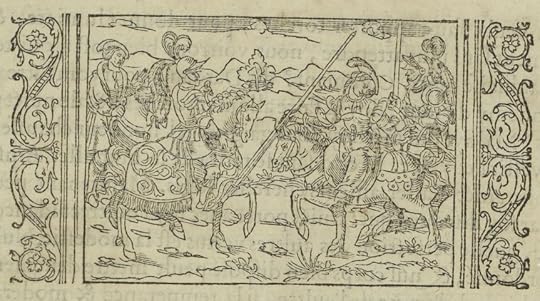
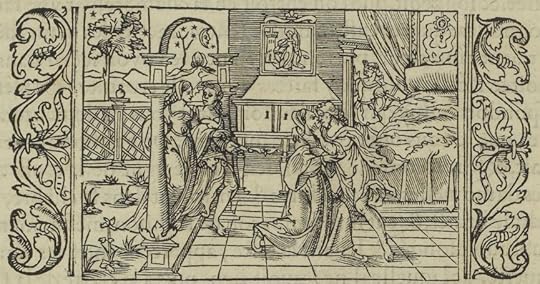
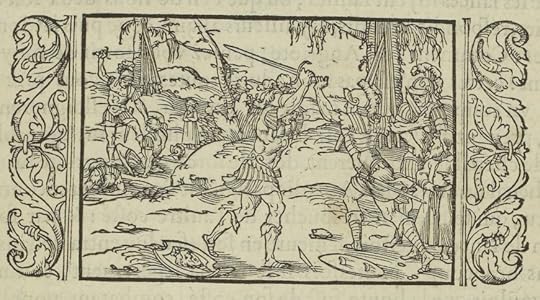
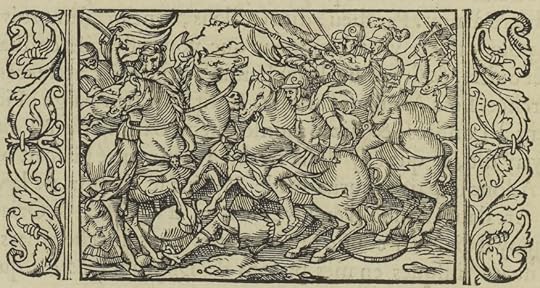
Aussi, parmi un véritable Océan de versions et d'éditions différentes, on peut trouver sur Gallica une heureusement très bien numérisée, laquelle est ornée d'illustrations dont voici quelques exemples. Je la recommande à de futurs lecteurs:
Ahora entiendo el porqué esta obra es la pieza cumbre de las novelas de caballería. Su lectura ha sido todo un viaje maravilloso, donde se pueden rastrear muchos elementos clave para la fantasía posterior. A su vez se puede apreciar la influencia de los clásicos grecolatinos y hay momentos donde se siente que uno lee un cuento de hadas.
Agora vos contaré cuánto gozo e alegría tove en leer estas fermosas páginas que del valeroso caballero Amadís de Gaula su historia albergan.
(Ahora en castellano actual). Nunca pensé lo muy cerca que podría estar de parecerme a Santa Teresa de Jesús, pues le encantaban las novelas de caballería, y aquí estoy yo ahora, reseñando esta novela que he tardado poco más de tres días en leer. Puedo entender que fueran estas novelas los «bestsellers» de la época. La historia es llana, y, aunque no divertida, me hacía gracia comprobar cómo se cumplen sin excepción todas las características que en la carrera me contaron sobre este tipo de literatura áurea. Me gustaría leerme alguna más porque me ha parecido una lectura muy rápida y fácil, a pesar de estar en castellano antiguo. Fascinante. (Para acabar, vuelvo a esforzarme en castellano antiguo, para intentar mostraros lo que me apasiona leer Siglo de Oro, y os recomiendo leer el Amadís por esta última razón):
A esta sazón, acordé de vos mostrar aquí todo lo que, para vuestro ánimo en leer de esta guisa, se fallare. E ansí, que todos los amadores del nuestro gran e maravilloso libro, que hobo escrito el buen e sabio poeta Miguel de Cervantes, puedan conoscer el génesis primo del más curioso caballero que nuestras tierras jamás hobieron, don Quijote de la Mancha, el caballero de la Triste figura.
A classic tale of knights, damsels and eh... knights and damsels :P . I was going to compare this to a soap until i realised it is, but a very particular kind of soap opera, namely WWE :). You see god decides all combats in this universe so the good guy is always guaranteed to win, only magic or traps capable of overruling god. At least on the page, between the pages good knights get beaten all the time, constantly having to be rescued from dungeons or avenged but if it happens on the page you always know who the winner is, apparently god only works with an audience :P . Also the combats themselves arn't all that well told, i miss the rhyming. The poetic epics have surprisingly better action sequences, Song of Roland, Idylls of the King, The Faerie Queene and Orlando Furioso i would all rate higher than this both in action and story. However its still entertaining and with enough variety to keep me interested.
There arn't any kick ass females like in some of the other works i've mentioned but there are a couple i liked, a good female sorceror which makes a change and my favourite the 'Damsel of Denmark' who's almost like an intelligence officer, constantly moving about delivering messages, sorting out problems and gathering intel.
The main characters Amadis and his lady seem a lot like the film version of Aragorn and Arwen. Except Aragorn doesn't burst into tears as much as Amadis ;) (Note, i say film version its not quite the same in the book with Aragorn mostly based on Sigurd the Volsung, aka Siegfried from Wagner's ring cycle). I preferred his brother Galour who is sneaky when he needs to be and is definitely not a one woman guy unlike weepy Amadis. There are a lot of characters and i couldn't always remember who was related to whom, like other soaps it gets very complicated. Amadis for example has a brother, a foster brother, a half-brother and a female cousin he sometimes calls his sister.
Finally the entire 4th volume, is one long battle and an almost as long ending, its very 'Return of the King' film version, just keeps going :lol . Still, i really expected to deduct a star from this for length versus entertainment but it actually managed to hold my interest better than expected. Not as good as the poetic epics but decent as long as you don't mind WWE style fight rules :) .
There's a fairly good Librivox version, it uses multiple readers and while most are fine to good occasionally a difficult to parse accent will turn up, but i still found it useful to supplement my reading.
An insanely long book, both in paper and in audio book form, but it’s really worth the read. It’s an excellent knight errantry tale, and one that has greatly influenced literature, but remains often unread itself. I happened upon it by accident, and proof listened the Librivox production. I’m so glad that I did. It’s really worth the time, and would especially encourage it for Arthurians, etc.
If you're a bloke, you've got five choices: king, knight, wizard, giant or dwarf. If you're a woman, you've got two: queen or damsel. There aren't any normal people in this immense narrative and there are pretty much no normal places in it either. Most of it takes place somewhere called "Britain" which is nothing like the Britain you or I know. This is an Iberian Britain, as if the Spanish Armada had not only been succesful but managed to travel through time to invade 500 years earlier and, on landing, immediately decided places like Essex would sould more elaborate as, say, Estraverion. Actually, they may have a point.
But, I digress. Amadis is a Knight of knights, a boy, then a youth, then a man who can do no wrong, who wins every battle (for there are many) and rights every wrong (for there are even more of these than battles). In fact, he's really boring and predictable most of the time. Occasionally, he decides he'd be better off under a pseudonym like Knight of the Green Sword or Beltenebros. But his contemporaries must
have been pretty dim not to realise Mr. Perfect when they met him, no matter what he might call himself.
There's more jousting here than you can shake a stick at (geddit???) so if that's your thing then you'll be delirious with ecstasy. Limbs, skulls, bones, vital organs - nothing is sacred as the swords of Amadis and his cohorts wend their righteously murderous way through various nations on escapades that are more morally justified than fighting National Socialism in Krakow in March, 1943.
And the women are so very fair and so unassailably pure and so very very incapable of anything other than relying on men for their existence while the men are either paragons of Amadis-like virtue or outright scoundrels who deserve (and often suffer) having their limbs separated from their bodies one by one.
But in my cynicism, let me not forget the awesome legacy that this work of literary art has bestowed upon the world. Yes, it inspired Cervantes to write the classic Don Quixote, but much, much more significantly for humanity, Monty Python and the Holy Grail might never have been made without it.
If you are interested in medieval romance there is no way to avoid this book. During the early modern period it was the European best-seller. At a time when Spain was the global superpower this book defined what chivalry was and imposed a very Spanish image on chivalric literature which before was heavily influenced by French and German tradition. At that time the moral code and social model favoured by chivalric romance was no longer viable, not even in Spain where it was most ardently defended even longer than in the rest of Europe. The feudal society was obsolete, an expanding urban society and centralized states were leaving less and less room for fantasies of giants, dragons and damsels in distress. At times it seems that all of them find their way into Amadis.
To a present-day reader the adventures of Amadis are ridiculous. The knights are more chivalrous and gallant than ever before, the villains more vicious and cruel, the damsels even more useless and unable to survive without help. There is magic around every corner and Europe is transformed into a bizarre Wonderland bearing only a slight correlation to reality.
If, however, you keep an open mind, you might be delighted by this in-your-face, over-the-top romance which was so successful and had such a presence that it inspired Cervantes to write his epic parody of chivalric romance, Don Quixote, which contains a copious amount of references and allusions to Amadis.
Despite all its deficits, I think it is worth the time to read it. If nothing else, it can be very diverting.
Possibly originating in the 13th century, this Spanish epic of the adventures of Prince Amadis and his love for Princess Oriana of England has its earliest surviving version from 1508. Says Wikipedia: "Historically, Amadís was very influential amongst the Spanish conquistadores. Bernal Diaz del Castillo mentioned the wonders of Amadís upon witnessing the wonders of the New World – and such place names as California and Patagonia come directly from the work."
After a few permutations, was turned into an opera by Handel.
Project Gutenberg has Vol 2- 4 of an English translation but is missing Vol 1, which is only on archive.org. There is also a librivox audio recording of the whole thing.
So you have read many great Arthurian romances and want to know what is the Spanish contribution to the genre. The greatest is Amadis of Gaul, a very long romance written in the late 15th century about the greatest knight in the world. It is actually one of the books that inspired that much more well known Spanish work: Don Quixote by Cervantes. But whereas Cervantes' work is a parody, Amadis of Gaul is the real thing. There are four books. The first tells of Amadis' birth and early exploits. The story moves quickly from adventure to adventure. It reminded me of the fast moving Orlando Furioso. In books two through four, the pace slows a bit , and the plot centers around the great falling out of Amadis with the king of Great Britain, Lisuarte. Although Amadis' father is the king of Gaul, it is at the court of King Lisuarte that the best knights are found. While estranged, Amadis travels the world, righting wrongs and making friends. All the while his heart aches for his love Oriana, Lisuarte's daughter, which he is having a clandestine relationship with. In good romantic fashion, this book throws it all at you: Amadis confronts giants, enchanters, rogue knights and monsters. There are also damsels. So many damsels! Some are resourceful, others wily and dangerous. Most others in need of a knight's help. And the damsels, including many of the knights, seem to sob and swoon a lot. Oriana is described as so beautiful and noble and perfect, but she spends so much time sobbing and swooning that sometimes I just had to role my eyes. But this is the style of the genre. Here, a woman is judged by how beautiful she is, and a man judged by how well he can kick your ass. Yes, it's a different world, and we have to scratch our heads a few times, but that also makes it a fun read. The old translation by Southy still holds up well. The kindle version has many typos, but it does not really interfere with the flow.
Lectura bastante lisérgica, pero tiene su gracia leer al menos una novela de caballerías en la vida. Uno de los mayores berceles de la época, con múltiples versiones, no se sabe ni siquiera en qué idioma se escribió originalmente. Bueno, sí, en gallego-portugués seguramente la versión más primitiva a la que luego se le añadieron cosas. Por eso si sabes gallego o portugués la mitad de las notas a pie de página en las que te aclaran algunos conceptos te sobran, porque los has entendido sin problemas.
Tal como nos cuenta Cervantes en El Quijote, no es mala ni mucho menos.
Eso sí, cuando uno ya lleva no sé ni cuántos gigantes muertos por un espadazo que lo cortó por la mitad e hipérboles y exageraciones que te cuesta imaginar incluso plasmadas en un anime, te preguntas cómo deberían de ser los malos y los que causaban la censura del clero o de otros escritores por disparatados y absurdos, y si serías capaz de leer la "droja dura" de los sucesores de Amadís.
A fun read in its quaint, and authentic, romance style of literature in the same vein as Chretien de Troyes, Geoffrey of Monmouth, and Sir Thomas Mallory. If you're a fan of the original Arthurian tales, then you'll love Amadis, a knight of European legend. This particular volume is a scanned copy of an older 19th century book that has hand written notes in the margins, blemishes, and other "artifacts" that testify to it's age and use.
Reason read: Reading 1001 botm (randomizer 2023/12). Chivalric Romance. Probably one of the first. All I can say is "what a complete bore". It was too long. I could have done 1 book or even 2 but 4 was just too much. I listened to recordings from Librovox.
It was alright. The constant reference to everyone as a dwarf, giant, or damsel was a little bit tiresome. It does get some bonus points for apparently being one of the originators of the genre.
Pretty fine, if you like medieval stories, it was written hundreds of years ago around the 1500´and full of fantastic adventures,and magic, like almost all medieval sotries.
The best thing about this book is that has many versions, with alternative endings, this due the fact that many autors claim the authory of the book and each of them rewrote his own version.
Es entretenido en el principio, mas luego se torna muy repetitivo. Aun así, tiene capitulos dignos de mención, como cuando cae Arkalaus o el rescate de Oriana.
Estamos ante LA novela de caballerías. 4 tomos de aventuras mágicas y exageradas en absoluta fidelidad al género. En el Amadís están las bellas más bellas, los bravos más bravos y la magia más mágica.
Me lo he leído en castellano de la época y es una delicia la capacidad de evasión que puede tener esta obra.
Tiene un comienzo delicioso, de los mejores inicios de libro que he visto nunca y quedo prendado de las diferentes fases, en forma de cambio de nombre, que sufre nuestro protagonista desde el Doncel del Mar hasta el Caballero de la Verde Espada, tiene perfecto sentido y planta la semilla de lo que en el futuro llamaremos "desarrollo de personaje" (pero no os confundáis, Amadís es plano por muchos nombres que tenga).
Tan plano es que todo lo hace bien y todas las batallas gana, es Mr. Perfecto. Y aunque para muchos eso pueda ser insoportable, es, en parte, lo que busco en una caballería: no pensar mucho y que ganen los buenos haciendo gala de exageradas virtudes, cortesía y educación muy por encima de las posibilidades de nuestro siglo.
Es buena lectura, de cultura general, y ha ayudado en mi cada vez más intenso proceso de quijotización. Y hablando del Quijote, me parece crucial leer Amadís para entender el Quijote; en la obra de Cervantes hay referencias a muchas caballerías, pero las del Amadís son las más importantes y evidentes, Alonso Quijano lo emula activamente.
Nota: 4.25 ⭐ ¡Gaula, Gaula, lean Amadís, y después el Quijote!
P.D: En el cuarto tomo Garci Rodríguez de Montalvo, el recopilador/editor de los tomos del Amadís, adulteró el desarrollo del 4° tomo y el final. Recomiendo investigar cómo era el final original, que es mucho más interesante y lo hace asemejarse al ciclo Artúrico (lo cual es MUY bueno).
Este libro esta contado en espaniol antiguo o al menos no contemporaneo y por momentos me resultaba dificil realmente entenderle. Pero lo mas pesado sin duda fue lo largo y monotona de su historia.
Basicamente es un caballero andante que triunfa sobre todo mal, vence a enanos, gigantes y otros caballeros y se enamora de la chica mas bella de todo el reino. ESto pareceria ser buena historia, pero el problema es que lo repite en mas de dos mil paginas y no le vi mucho sentido estar leyendo una y otra y otra vez lo mismo.
No dejo de destacar lo valiente y fuerte que resulta Amadis, y la buena suerte que lo socorre para ser rescatado de ninio y conocer a sus hermanos y amigos durante su trayecto, pero no hay giros en la trama sino que fue muy repetitiva.
Para ser una obra de caballeria clasica, cumple su mision, pero pienso que pudo haberse contado lo mismo en el 10% de su extension real.
The way the story began immediately gripped me - mother has a child out of wedlock in the 1500s and is afraid for her life, so she casts the child into the sea where he is found by a miracle and brought up to be the best knight the world has seen. The idea was brilliant, the execution, not so much.
This was a long book. It felt even longer than it was because of the run-on language. With that said, here's what I liked and what I did not like (spoilers ahead - quit reading now)
Things I liked: - The story overall was entertaining. Knight wandering around the world seeking adventure after adventure is bound to be exciting and this did not disappoint. Each quest was different in and of itself and they all contributed to the plot by the end. Props to the author for intertwining all of the stories. - The challenge of the Firm Island and the whole idea behind it. It was wildly interesting, though it was obvious that Amadis and Oriana would win in the end. Which reminds me: - THE ENDING. It was great. Having Oriana try the Forbidden Chamber challenge wrapped up the entire love story in a way that satisfied me. It was not anything like Tirant Lo Blanc where the title character was killed after his love affair finally became public and accepted. And for that I'm grateful, I couldn't handle another ending like that. It was refreshing to see more of a love story between Amadis and Oriana, rather than the whole affair revolving around sex. But that's just me. In retrospect though, if I put myself in Oriana's shoes, I don't think I would have waited around for four years to see if the man I loved would ever come back. To remain true after that, she must be a real gem.
Things I didn't like: - So many Dames and Damsels! I guess women weren't worth enough back then to give them names. - King Lisuarte. Everything he did pissed me off. He was an ungrateful pushover, who exiled Amadis, the best warrior on his court, just because some jealous idiot told him that Amadis was scheming to take over his empire. I can understand a brief falling out after this. But it lasted for the rest of the book! Even after Amadis had secretly came to the king's rescue in a battle where he would have been killed. Even when he made up with Amadis, I felt like he had to be told by someone else to do so. The guy didn't have any independence. And for a king, who is supposed to be a ruler of a country, this character trait fell short for me. - I got very very tired of knights granting favors before they even knew what the favor was. Didn't they know that always leads to trouble? - The style of the language itself. It was a bit of a slog to get through (hence the two-star rating). Here is an example of a run on sentence in this book: “Glad was the Greek Knight, and his companions, to hear of Florestan’s good fortune; but when he heard Miraflores mentioned, his heart leaped, and he immediately took Gandalin apart, and said to him, my true friend, you hear how it is, that if Oriana be thus given to another, both she and I must pass through death.”
I can definitely see why this book was an influence for Don Quixote. But the style of the language and the slow-moving story has caused me to drop the rating. I'm certainly not sorry I picked this up, but I'd in no way visit it again.
El Amadís de Gaula es una de las novelas de caballerías más reconocidas, recopilada por Garci Rodríguez de Montalvo. Se trata de una novela que ya iba corriendo desde hacía, aproximadamente, siglo y medio. Garci Rodríguez de Montalvo enmendó y reescribió, tomándose la licencia de cambiar algunos aspectos. Uno de los pocos que se salva de la quema de libros que se hace en El Ingenioso Hidalgo Don Quijote de La Mancha, 15, este libro está dividido en cuatro partes más extensas y, dentro de estas partes, en distintos capítulos algo más cortos. Según el argumento de Rodríguez de Montalvo, el libro trata sobre las aventuras de Amadís en su cometido como uno de los mejores caballeros andantes del mundo, los problemas que tiene y la justicia que imparte. Lingüísticamente el libro me ha encantado. La edición que me he leído está en castellano del siglo XV, y me ha gustado mucho (y costado un poquito) leer un castellano así de distinto del que usamos actualmente. El estilo cambia un poco en la cuarta parte, que es la de (supuesta) autoría del propio Rodríguez de Montalvo. La verdad es que el Amadís, pese a que tiene un valor histórico-literario-lingüístico que nadie pone en duda, como lectura se me ha hecho bastante... denso. Más de mil páginas de aventuras sin cesar, en las que se está constantemente en guerra, que acaba de matar a un gigante y, en la página siguiente, ya se encuentra a una dama en apuros a la que salvar de un malvado enano... necesito un respiro, por dios. Y aún doy gracias que lo he ido leyendo poco a poco.
Pese a que la parte argumental se me ha hecho pesada, me quedo con la parte lingüística de la obra, que es lo que me ha gustado.
É uma seleção de textos, embora as interligações previnam hiatos na história. se calhar até nos poupam a partes aborrecidas da história. É o estilo de romance de cavalaria em que as personagens são muito lamechas e, todavia, muito fortes e os heróis vencem tudo e todos iluminados por uma ideia do Bem e da Justiça de que têm o monopólio. Amadis é o filho secreto de um rei e de uma rainha, o rei Periom e a rainha Elisena. Salvo do meio do mar pelo cavaleiro Gandales que o cria como se fosse seu filho, juntamente com o verdadeiro filho Gandalim, chamando-lhe Donzel do Mar. Depois vai para a corte de Gaula e os pais descobrem que é seu filho por um anel e uma espada. Entretanto descobrem também Galaor, irmão de Amadis, também tirado aos pais e desparecido na infância. aventuras passadas e resumidas, vai para a corte do rei Lisuarte onde está a filha deste Oriana por quem se apaixona e se dedica como cavaleiro. Tudo isto passa-se na Grã-Bretanha. Há um feiticeiro mau, chamado arcalaus que está sempre a conspirar contra o rei lisuarte. Amadis vai tendo aventuras mas acontece uma peripécia em que oriana (o amor deles é secreto) o censura e ele desaparece do mundo e passa a chamar-se Beltenebroso. ela descobre-o e salva-o in extremis, estando na cabana de um eremita; ele recupera, há mais uma série de aventuras. zanga-se com rei lisuarte que intrigas tinham levado a pensar mal de amadis, apesar de ele sempre o ter servido fielmente. Mas depois reconciliam-se e finalmente casa com oriana, tornam-se reis e são felizes para sempre. No entretanto tinham desencantado uma ilha, pois dizia a profecia que para isso tinham de lá entrar o mais valente e leal cavaleiro e a mais linda e honesta dama. Eram eles; que surpresa e encanto!
Don Quixote the character often cites passages from Amadis of Gaul, so I was curious to read the original work itself. I have to say there is hardly a reason to read this book except to see what Miguel Cervantes wanted to parody. It is essentially a series of tales about a brave knight, his companions, and the men and especially fair damsels they come in contact with. The characters have little depth, and the incidents are predictable and repetitive. After I had finished the book I went back to read the translator's preface, where I was shocked to learn that the translation was actually an abridgement! It is hard to imagine that the book I read, at over a thousand pages, was trimmed of unnecessary details.
Caveat lector! Let the reader beware! Only the most foolhardy knights of reading should pursue this musty tome.
I listened to this tome on Libravox, but although I intended to listen to all four books, I became tired of it part way through Book Two, especially as I had Richard Ozman waiting to be listened to! It is a very old chivalric romance. I can see how the stories would have been popular at the time, with Amadis as the good-looking hero, who always wins his battles, remains chaste in his love until finally he isn’t, and who discovers his parentage only after becoming a knight himself. It could do either a modern translation, as I found this version archaic and somewhat repetitive. It is, however, an important book in the development of the novel
El Amadís de Gaula (1508) es una de las principales obras de la literatura medival en español, y que aunqe existen distintas teorías de quién pudo ser autor, se considera que fue escrita anonimamente. Fue aún más reconocido gracias a la pluma de Miguel de Cervantes Saavedra ya que es uno de los libros causantes de la locura de Don Alonso Quijano, porque son a este tipo de grandes personajes, como el Amadías, a quién trata de emular en sus aventuras el Quijote....