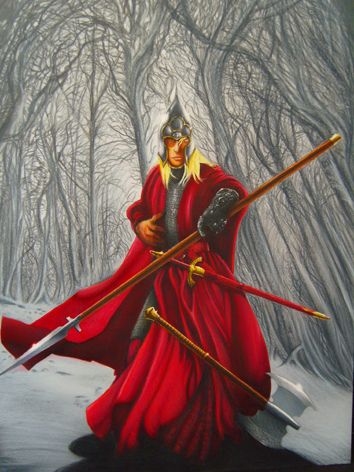
Prinz Corum, der Letzte der Vadagh, findet keinen Frieden.Von seinen Feinden gehasst und von seinen Freunden gefürchtet, wird er zum Führer im Kampf gegen die Chaosgötter. Auf der Suche nach der Stadt in der Pyramide dringt er bis in das Reich der Königin des Chaos vor.
Michael John Moorcock is an English writer primarily of science fiction and fantasy who has also published a number of literary novels.
Moorcock has mentioned The Gods of Mars by Edgar Rice Burroughs, The Apple Cart by George Bernard Shaw and The Constable of St. Nicholas by Edward Lester Arnold as the first three books which captured his imagination. He became editor of Tarzan Adventures in 1956, at the age of sixteen, and later moved on to edit Sexton Blake Library. As editor of the controversial British science fiction magazine New Worlds, from May 1964 until March 1971 and then again from 1976 to 1996, Moorcock fostered the development of the science fiction "New Wave" in the UK and indirectly in the United States. His serialization of Norman Spinrad's Bug Jack Barron was notorious for causing British MPs to condemn in Parliament the Arts Council's funding of the magazine.
During this time, he occasionally wrote under the pseudonym of "James Colvin," a "house pseudonym" used by other critics on New Worlds. A spoof obituary of Colvin appeared in New Worlds #197 (January 1970), written by "William Barclay" (another Moorcock pseudonym). Moorcock, indeed, makes much use of the initials "JC", and not entirely coincidentally these are also the initials of Jesus Christ, the subject of his 1967 Nebula award-winning novella Behold the Man, which tells the story of Karl Glogauer, a time-traveller who takes on the role of Christ. They are also the initials of various "Eternal Champion" Moorcock characters such as Jerry Cornelius, Jerry Cornell and Jherek Carnelian. In more recent years, Moorcock has taken to using "Warwick Colvin, Jr." as yet another pseudonym, particularly in his Second Ether fiction.
In addition to the Margravina, Corum is now accompanied by the Eternal Champion's eternal sidekick: Jhary al-Conel (Jerry Cornelius on other planes) and Jhary's spy and familiar: Whiskers, the little black-and-white cat with wings.
The structure and plot are unremarkable--a typical adventure quest with marvels along the way--but the incidents are vivid and well-imagined.
Moorcock’s second Corum book, published in 1971 is reminiscent of Jack Vance’s writing, more so than in the first book. This is high fantasy, something that Edgar Rice Burroughs could have written.
The ongoing theme, actually quite ubiquitous in Moorcock’s canon, of Law versus Chaos made me think a lot about how influential he was to Gary Gygax and the other makers of Dungeons and Dragons. Gygax and Dave Arneson first put out the TSR game in 1974 and Moorcock had already published some Elric stories and Corum by then. The anointed few who have sacred knowledge of D&D will be familiar with the alignment of the characters, being a combination of either lawful, chaotic, neutral, good or evil. He must have had some influence as the Deities & Demigods: Cyclopedia of Gods and Heroes from Myth and Legend edition from 1980 has a Melnibonean section that includes Elric and Arioch (though Corum is absent). Check out Wikipedia for some behind the scenes litigation about competing copyright claims.
** Reviewers note – in the AD&D alignment, yours truly would be Neutral Good.
Finally this very cool 1971 fantasy reminded me of the understated but groovy work of Black Sabbath bass player Geezer Butler on Nativity in Black. The Sabbath mythos is very much akin to Moorcock’s minimalistic but wildly fantastic narrative and is an under current of his edgy writing style. I recommend Black Sabbath to play in the background as you read and enjoy.
My first time reading this since my teenage years in the 1980s. While it wasn’t as powerful or as flawless as I recall it being, I still find myself powerfully moved by the struggle of Corum, the mythical hero who longs for the peace and innocence lost yet knows he will never truly find it; his life sacrificed to a legendary struggle which will never end and which will see him lose everything he loves — including himself.
The war between Law and Chaos amps up here. Also, our hero fights hordes of monsters and gods with his alien hand and his gem eye. You can't get much more swords and sorcery than that!
4.5 stars. I was very tempted to give this book 5 stars but I think I will wait until I read the last book in the Swords Trilogy, The King of the Swords, and give an overall rating to the whole trilogy. So far, the first two books have been excellent with this one being slightly better, in my opinion than the first, The Knight of the Swords.
This is extremely well-done, action-orientated, sword and sorcery fantasy that is a pleasure to read due to Moorcock's descriptive writing and imaginative settings. What places this trilogy a cut above other well written books is the "epic fantasy" aspect of the story that places it within the context of a much larger battle between the Lords of War and Chaos being waged across multiple planes of existence (i.e., part of the Eternal Champion sotryline).
Fast paced, fun to read, larger than life heroes and villians, imaginative settings, great world-building (times several) and a well thought out plot that never got convoluted despite the "plane" jumping nature of the story. Yeah, I guess I really liked it. Highly Recommended!!
The Queen of the Swords is the second book in the first of two Corum trilogies; I read it a long time ago, but remember it fondly. Corum is overshadowed by Dorian Hawkmoon and Elric (and Jerry Cornelius, of course) among Moorcock's characters, and the six books featuring him are frequently overlooked in discussions of the Eternal Champion multiverse tapestry. The first trilogy, particularly, establishes and explains a lot of the infrastructure of Moorcock's interlocked work, and the section where the four aspects of champion, echoed and mirrored in the books featuring the others' viewpoints, is especially evocative. The Knight, Queen, and King of the Swords tell the story of Prince Corum Jhaelen Irsei of the Vadhagh Folk, the Prince in thee Scarlet Robe, who accepts the Eye of Rhynn and the Hand of Kwll from the evil sorcerer Shool in order to seek vengeance for the horrors visited upon him by the Lords of Chaos. It's more elegant and poetic than much of Moorcock's heroic fantasy, with what feels to me to be something of a Welsh flavor, and features some of the best and most thoughtful conflict between Law and Chaos and Balance for which Moorcock is best known. The trilogies were combined in a pair of single volumes in later years.
As mentioned before...I read this book "back when" in 1970s. Once I ran across the Eternal Champion books by Michael Moorcock (and once I was out of the army and had the chance to search) I set out to find the entire series. Some I really liked (Corum, Elric, and Hawkmoon) others I didn't care for (The Dancers at the End of Time) others I completely and thoroughly detest (Behold the Man). This is one I like.
Here Corum, hoping to live in peace with his love (Rhalina) after the events in The Knight of the Swords finds that his life isn't to be an easy one...of course he finds later that it never will be. This is the book in which I was introduced to The Companion of Heroes, another part of the Eternal Champion Mythos, in this case Jhary-a-Conel. The Companion, like the Champion has many identities Timeras, Alnac Kreb, Jaspar Colinadous but also Moonglum and Oladahn. I like these books so in spite of not being able to "blanket endorse" Mr. Moorcock's books I will recommend this one (but I suggest you read the trilogy in order).
The plot in this book takes us far afield (again) and as in the first volume fantasy readers may feel "at home" or some of it may seem familiar, but at the time of it's publishing, it was not only an original idea but a very original tale. It holds up well. I like and recommend it.
Re-read, I read this first approximately 40 years ago. And now the time was ripe as the Great Old Gods might say.
I’ve kept this as a 5 although a part of me considered dropping it to a 4. It’s not as good as the first in the series, but Moorcock’s writing and his creation of worlds is superb.
Once again this is recommended with an accompanying and healthy dose of Zeppelin and Hawkwind (and maybe some Yes).
‘The Queen of the Swords’ continues the adventures of Corum and here the story flows much better than the first book; as also Moorcock’s writing becomes better, though it’s missing that “craziness” which I loved, but, nevertheless, it still remains quite entertaining.
In this book Moorcock builds the story a bit slower, giving more time for the characters to develop (though not as much as it needed), as also giving more time for the world-building and the exploration of the multi-verse with Corum having to face a new, and stronger and wittier, enemy. It’s a good story, though this time I felt it might have needed a little more time to develop more and that was one of the things that bothered me a bit. But it still continues to be an entertainingly quick story with lots of action and some nice ideas.
Definitely an enjoyable book that continues the grand adventures of prince Corum into unknown worlds.
This was basically the first Moorcock book that I ever read and it was given to me by a beautiful woman for my twenty second birthday. I am not sure if it really was a birthday present or if she realised that I liked these types of books and wanted to get rid of a bunch of them that were sitting on her bookshelf, but in a way the timing was perfect. The only problem with this girl was that she had a boyfriend (though the suggestion that was made was that she had become board with him, and that when she met me she decided that she wanted somebody a lot better, like, well, me. I didn't buy it though, because even though I may have seemed wonderful at the time, that wouldn't have lasted, and I have always made it a policy that I don't cut somebody else's lunch, even if they strip in front of me, which has happened on one occasion).
Anyway, enough bragging about my former life and more about what I thought about the book. As I said this was the first Moorcock book that I read and I loved it, probably because it had lots of battles between massive armies in some wonderful fantasy world. Personally, that is all that I can remember about the book, and that was all that really attracted me about the book as well. I never read the first one, and I wasn't all that impressed with the third one, so I guess I can say that this is one of those rare books that, while forming a part of a trilogy (and I suspect was written as part of a trilogy) you don't need to read the other ones to actually enjoy this book (which is something that I did).
As for the books that were given to me for my birthday, most of them ended up being parts of series and most of them, as far as I know, ended up not getting read. There are still some here, including one on dragons and a big and beautiful book on mythology, which I still have and I really should drag out one day and read, though it is not one of those read on the train type of books.
This birthday though was a pretty good birthday because my twenty first birthday was absolutely shocking. The only good thing about it was that some guy, when he found out it was my birthday, gave me some marijuana (and it was pretty bad stuff at that). So much for a wonderful twenty first birthday – it didn't happen for me. However, that was made up by my twenty fifth birthday when all my friends came around and gave me a twenty first birthday party. Also this birthday turned out to be full of surprises, and for a person that feels that he had been cursed not to be surprised because he opened his Christmas presents before Christmas to see what he got (when I was a kid), this was a pretty enjoyable day.
Prince Corum sought to slay the Prince of Swords known as the Chaos Lord Arioch for orchestrating the events that led to the deaths of his beloved family, the creation of the wicked Mabden race and the destruction of his beautiful home. Armed with cursed weapons that defied the laws of mortal powers, Corum managed to defeat the dark harbinger of doom, but his quest for revenge was far from over. The destruction of Arioch provoked the anger of Xiombarg, sister of the Chaos Lord and Queen of Swords. The Mabden that took the lives of Corum's family is also still on the loose. So, armed once more with cursed weapons and a lust for vengeance, Corum challenges Xiombarg to a battle of law against chaos along with his beloved Rhalina and a new mysterious companion named Jhary who has worn many names over countless centuries.
The second book of the Corum saga reminds me much of the second book in the Elric Saga, Sailor on the Seas of Fate. The reason for this is because it begins to go deep into the metaphysical elements of the multiverse, acknowledging all alternate forms of the Eternal Champion and reintroducing the eternal sidekick of heroes Jhary who will be a familiar face to those who have read other tales set in this universe. While Moorcock often falls short when it comes to solid prose and deep characters with realistic emotions, his imagination, philosophical musings and the wondrous lore of the bizarre and fascinating universe he's created is what always keeps me coming back. Especially being the fan of Dark Souls and other games of the sort I am.
His plots often feel like simple D&D adventures with lots of monster fights and side questing adventures, but the things going on in the background is what truly makes this universe feel captivating. Though I don't think the story in this one is quite as good as the first, I really enjoyed seeing Jhary back because he always adds a lot of much-needed humor and fun to an otherwise bleak and nihilistic universe. The battles, magic, dimension-hopping and monsters are always a treat as well.
-Para los interesados en este tipo de partidas, suben las apuestas.-
Género. Narrativa Fantástica.
Lo que nos cuenta. La sonrisa de Rhalina es un bálsamo para Corum pero su alma sigue llena de rabia y ansias de venganza, por lo que resuelve no retrasar más su búsqueda de Glandyth para ajustar cuentas. Cuando Jhary-a-Conel llega al castillo Moidel, Corum empieza a conocer más del Campeón Eterno a través de tiempos y espacios pero también recibe noticias de que su enemigo está encontrando aliados y que Xiombarg, la Reina de las Espadas, tiene un agente en este plano de la realidad para asegurar su victoria y la del Caos sobre Arkyn, la Ley y el propio Corum, su peón. Segundo libro de la Trilogía de las Espadas.
¿Quiere saber más de este libro, sin spoilers? Visite:
The book starts bumpy with re-introductions of the characters and events. I think it was originally serially published in a magazine. A bit of editing for the collected novel would have worked better.
The Eternal Champion’s companion is introduced bringing the reader deeper in the EC cycle.
There are some cool things in this book. I dug the armies of the Dog and Bear. Things get a bit science-fantasy, which I am a fan of. The power of the hand and eye are demonstrated a lot more.
There is a good deal of plane hopping, but it irons out well into a well told tale.
¡Qué poco me ha convencido esta continuación del primer libro! Me desconcierta que haya sido así, pues la primera parte de la trilogía me pareció bastante buena. Sin embargo, aquí cobra mucho protagonismo el Moorcock que menos me gusta, el que abusa de situaciones muy propias del surrealismo que no terminan de conectar entre sí lo suficiente como para tomarse en serio la lectura. Casi todo puede pasar y eso, para mí, actúa en su contra. Las mejores novelas del autor, en mi opinión, son las que contienen un poco de ambas partes, pues le dan ese toque tan característico del escritor.
La antagonista femenina, Xiombarg, no me ha causado la fascinación que otros enemigos del Multiverso sí han hecho. Además, leídos los libros de Elric, el constante conflicto entre la Ley y el Caos se torna repetitivo por necesidad. Confío, no obstante, en que la trilogía logre recuperarse de este bajón en su último libro.
Deeper into the Wells of Chaos we go. I feel Moorcock played heavier in the Tragedy department in this book. It never looked good for Corum and the Gang. A fun read none the less. Lots of Easter Eggs from the other Eternal Champion books and bigger talks and hints of the ever going struggle between Chaos, Law and the Cosmic Balance. All in all I had fun. Onto the last book of the trilogy!
Original 2002 review This is the second book in Michael Moorcock's Chronicles of Corum series. The book continues the adventures of Prince Corum first begun in The Knight Of Swords. In this book Prince Corum travels to a different plane to try and end the hegemony of The Queen of Swords, and thus save his own plane from the forces of Chaos. With him is the eternal companion of Champions, Jhary-a-conel and his winged cat. I don't know if this story was originally written for a magazine format, but it certainly reads like it. This is probably the weakest of the swords trilogy, and like all three books in the sword trilogy, the pace is breakneck. One has no time to appreciate the dangers Corum finds himself in, before he is immediately rescued and moved on to the next predicament.
“I thought Chaos all howling, random creativity,” said Corum. “This is worse.” “It is what becomes of a place when Chaos exhausts its invention,” Jhary told him. “Ultimately, Chaos brings a more profound stagnation than anything it despises in Law. It must forever seek more and more sensation, more and more empty marvels, until there is nothing left and it has forgotten what true invention is.”
The continuing saga of Corum Jhaelen Irsei, this time going head-to-head with Xiombarg, the Queen of the Swords. Man, I really love Moorcock’s imagination. His multiverse is a blast, and it only gets better the more you know about it (at least from my limited experience of reading through Elric of Melniboné and The Dancers at the End of Time, before this). Seeing Jhary-a-Conel pop up again (with his winged cat Whiskers) was great, especially with the nod to his time with Rackhir, Moonglum, and Elric in another life. That kind of crossover stuff really works for me. I also liked getting a clearer sense of what the six-fingered Hand of Kwll and the muti-faceted, jewel encrusted Eye of Rhynn are capable of, they feel bigger and stranger the more you see them in action.
It’s gritty, tense, and has some genuinely unsettling moments. I’m hooked on Corum at this point and ready to keep going.
Another installment of the eternal balance-war: law versus chaos. I was enamored at first but now my feelings have subsided. I should note, i love that fantasy doesn’t have to rely on the trope of good versus evil, and subsequently, good conquering evil. But here with the second installment of Corum, I find that I can’t allow my love for ‘law vs chaos’ to dismiss my negative feelings.
I was bored. My emotional investment in the characters is gone. There was nothing significant for me to creatively lift.
Corum #2 is the continued story of the tragic and tortured hero in thee scarlet robe—Corum. He rallies the remaining Bastions of law, or civilization, to fight against the vile and wretched armies of chaos. Michael Moorcock expands the lore of his universe… no perhaps it’s a multiverse. He’s set up a meta narrative, a universe with a certain narrative structure—one that is aware of that heroes are necessary but agents within the plot can act to aid them. There are smaller encounters that are resolved in clever ways, that was cool. Beyond that, the novel was shallow. So shallow that I felt as if I was swimming in a community kiddie pool.
Michael Moorcock’s The Queen of Swords, is the second book to feature Corum. It takes everything from the first book, The Knight of Swords and cranks the weirdness up making stranger landscapes, nastier gods, and a darker tone. Corum himself feels much more tragic and less a hero by choice and more a pawn of the cosmic forces, which makes the story hit harder.
Queen Xiomberg is a fantastic villain, eerie and powerful, genuinely unsettling. Moorcock’s writing has a dreamlike, mythic quality, often short snappy straight to the point, prose that is fast, vivid and never overstated.
As a middle book, it does its job perfectly, raising the stakes, deepening the themes, and it leaves you wanting to know what happens in the next volume.
The Queen of the Swords The Corum Series, Book # 2 By Michael Moorcock ISBN: 978-1783291670 Brought to you by Omar Author’s Website: http://www.multiverse.org/
Review
After the fight with the lord of Chaos Arioch who had control over five planes, one being where Corum is from- and the lord of law Arkyn returned to power, Corum has been trying to adapt to his life with Rhalina and the new hand and eye. From time to time, the hand moves without him moving it and it has saved his life before.
Now with the new task impose on him, which is to defeat the Lords of Chaos and restore the balance between Law and Chaos; the book starts with Corum and Rhalina riding near the woods of Model’s Mount. On their way back to the castle, they come across a giant, which Corum saw in the previous book. Rhalina calls him the “Wading One”, as they see him fish and inspect his catch before letting it go. She tells Corum that the myth says that he is looking for his soul. That night, during dinner, a man knocks on castle door asking for help as he was left on the shore by the Wading One, his name was Jhary-a-Conel. He claims to be a traveler that is destined to move “through all times and planes.” the-queen-of-swords
Jhary brings the news that Glandyth plans to attack Lywm-an-Esh, a continent where Mabdens have adopted the costumes of the Vadhagh and live peacefully. Corum, Rhalina, and Jharly embark on a journey to Lywm-an-Esh, and later to the next five planes domain by the Queen of Chaos Xiombarg to find allies to fight the power of Chaos in their planes.
I liked the character of Jhary-a-Conel, his way of talking was funny and if you know about the Eternal Champion you can see his given away information about the other planes or dimensions; also I liked his wing-cat Whiskers, the face that can be seen on the cover of the book.
“Have you no profession?” Corum asked him. “Well, I have some poetry and plays in my time, but my main profession could be that I am a friend of heroes…”
Corum is still bitter and on his quest to kill Glandyth-a-Krae. It seems that he is not going to be happy or content until that Mabden is dead, and I can see that Rhalina tries to be patient with his outburst from time to time. Over the course of the book we can see that they rely on one another in difficult moments, and try to embrace themselves when they fear death is near.
It seems that the goal for this series is to kill the Lords of Chaos and restore the balance to the powers of Law. An idea of the Michael Moorcock is that the Gods need the help of mortals to exist and do things on Earth.
“And the gods?” Corum asked him eagerly. “I think we create them. But I am not sure. Where primitives invent crude gods to explain thunder, more sophisticated people create more elaborate gods to explain the abstractions which puzzle them. It has often been noted that gods could not exist without mortals and mortals could not exist without gods”
I had some trouble with some names that Jhary mentions because if a person doesn’t have any knowledge about the other series of Michael Moorcock, then the name from other books won’t make sense.
If you are a fan of Michael Moorcock or the Corum Series or any other of his series, I recommend you read, the Queen of the Swords, the second book on the Corum Series. Here, our hero goes in quest to find allies over different planes and even finds people that he thought dead.
The Queen of Swords is the second volume of the First Trilogy The Chronicles of Corum, published on the British market in 1971 with the title "The Queen of the Swords" by Mayflower Books, and arrived in Italy in 1974, thanks to Sugar Publisher. This novel can be considered rightfully one sword and sorcery, with some contamination clockpunk, although I note that today's commentators and authors (especially Anglo-Saxon ones) tend to include many books of this genre in grimdark. The story is told in the third person and from the point of view of Corum Jhaelen Irsei, the Prince in the Scarlet Robe, last survivor of Vadhagh race, exterminated by bestial Mabden (humans). He is back to fight in the ranks of the Law against Chaos, as the incarnation of the Eternal Champion; in order to restore the balance between these two forces, under the control of the Cosmic Balance. In this case deals with Xiombarg, sister of Arioch and Chaos God who rules over one of the Fifteen Planes that compose the Multiverse. The Sovereign of the Sword is burned with hatred towards our, as they defeated his brother and him exiled from that dimension, restoring its place in Arkyn. But the Lord of the Law is still weak and does not hold the power to counteract the force of Chaos, therefore asks Corum of fulfilling a mission for him, venturing on Plan Xiombarg, a real infernal world and repulsive. As in the previous episode, the world building is extraordinary, as well as the ability of imagination of Michael Moorcock, who ferries us in strange worlds, ruled by gods blasphemous and inhabited by monstrous creatures. Just to name a few, we beastmen, undead, mounts with scaly skin and horns, with the body of bull sharks and wings, ice warriors, giant foxes, etc ... There are also battles and bloody clashes with whites in which we deal with hordes of Chaos and the soldiers of the Act, the circumstances in which not infrequently Corum resorts to black magic. This gives the gloomy to ours, thus avoiding the classic Manichaeism in which we have used many fantasy authors. The Queen of Swords is an exciting novel that brilliantly continues the cycle of Corum, introducing further complexity in the already vast and protean Multiverse.
The Queen of the Swords, the second of Moorcock's Corum series, is a similar story to the first. The Chaos-led Mabden are once again undertaking an invasion threatening Corum and those he loves. This is again inspired by one of the gods of Chaos, seeking to overcome toe forces of Law in Corum's world (in this case Xiombarg, Queen of the Swords and sister of Arioch, killed by Corum in the first book of the series).
Though Corum and his beloved Rhalina find new allies in this book, what really matters is the combat between Corum as manifestation of the Eternal Champion and the forces of Chaos, which here included a Chaotic equivalent of the Eternal Champion. The major new character is the Champion's companion, Jhary a-Conel, who makes his first entry into this series though he had already appeared elsewhere (in the Runestaff novels, for instance). The most interesting part of the novel is the journey undertaken by Corum, Rhalina and Jhary through the realms ruled by Xiombarg, where the triumph of Chaos has been so extensive that not only have normal physical laws been set aside but the creativity that is the positive side of Chaos has exhausted itself (needing to be rooted in the order of Law). This series sees the dichotomy between Chaos and Law which strongly interested Moorcock in the seventies perhaps most fully worked out, in a traditional swords and sorcery style setting.
Для Муркока это обычное дело — придумать бомбическую завязку нового цикла, нарисовать яркого героя, интересный мир, закрутить интригу... а потом начать конвейерно выпекать абсолютно безблагодатные сиквелы по принципу «мы ехали ехали по царствам Хаоса, бились бились со слугами Хаоса».
«Королева мечей», увы, ровно из этой категории — почти всю книгу принц Корум едет по землям Хаоса, время от времени на него набигают монстры или злодеи, а он всех их побеждает, причем _каждый раз_ одним и тем же заклинанием призыва мертвецов. Маркграфиня Ралина за всю книгу никак себя не проявляет, просто едет вслед за Корумом и иногда плачет.
Чтобы было не так скучно, автор щедро набрасывает всякой постмодернистской дичи, типа персонажа, который осознает, что он персонаж книги, или летающего говорящего кота. От этого, разумеется, становится только хуже.
I continue to be impressed by this series. As I stated in prior reviews, I don't consider myself a fantasy guy, but this series is really good. It's definitely hard fantasy, but done in a very interesting way.
In this volume Corum continues his war against the Chaos gods, picking up some new allies. His main adversary this time is the Queen of the Sword, and it looks like the next volume involves the king.
Just a great fantasy tale with plenty of exotic worlds, monstrous creatures, fabulous beings and magic.
Looking forward to the next volume and if the quality of this series holds I'll have to read some of Michael Moorcock.
Michael Moorcock was one of the leading proponents of New Wave science fiction in the 60s and 70s and his writing was certainly different from much of what had gone before. However, the Corum series is as close as he got to traditional fantasy, and there is an amount of sameness between this book and the first in this series. It is still classic Moorcock though, which makes it an enjoyable read in my opinion.
Note: Below, my review is split into two parts. The first gives my general thoughts on the book and series, and the second details spoilers and major plot points. Be warned.
This should be a relatively short review (at least for me).
Part One: Overview
I rounded up the star rating to four, because I considered this book to be better than the previous one. The Queen of the Swords picks up a few months after the previous book, and once the story gets going, it doesn't stop until the end. The second book of Corum does a great job of expanding the world, and is quite good at world building for such a short novel. The story increases the stakes in this middle volume, since now Corum and company are battling against the Queen of the Swords herself, a more powerful Goddess of Chaos than Arioch in the first book. And this conflict takes Corum, Rhalina and Jhary to the Five Planes that the Queen rules. And it is here that I must address something that I brought up in my review of The Knight of the Swords: this book, in regards to its imagery and settings, could well have been written by Edgar Rice Burroughs. I read another review that made the same comparison, so I know I'm not alone in drawing this parallel. Or parallels, since there are several. Once more, the settings are as alien as Burroughs's Barsoom, with some bizarre elements at which the reader can't help but be fascinated. I'll detail these elements in my spoiler section below. And more than its predecessor, The Queen of the Swords is much more action-driven, with Corum and his fellows going from battle to confrontation to showdown. We get to see more of Corum's Summoning power, which was one of the things I found most interesting in the first book.
Another parallel I'd like to draw is, surprisingly, to the young adult book series Deltora. Much like Corum, Deltora is almost insane in its settings. The creatures that Emily Rodda (the author of the Deltora series) describes and invents are so strange and bizarre in their own unique way that, even if they're grotesque and evil, I can't help but love them. Likewise, Moorcock does something similar in this book, bringing to light creatures that are as nonsensical and illogical, whose evolutionary history would drive Darwin to insanity, that I simply want to know more about them. Some of these creatures are named and even described to some extent, through Jhary who, being the Companion to Champions, has seen most of them before. This is perhaps what I liked most about this second volume in the Corum series: it doesn't shy away from the strange and even capitalizes on the fear of the unknown (more detail below). I've read primarily modern fantasy, and one thing I've noticed most authors do is try to normalize the fantastic, they attempt to make the awe-inspiring and uncanny more grounded. In short, modern fantasy mainly tries to mirror our world. The Corum books so far, as far as I can tell, turn our world on its head. Whereas humans are typically the good guys, the ones who know better and can fix whatever problems there exist (LOTR and the Barsoom series have humans dealing with the main conflict), here, humans are the problem. This isn't exactly a new concept, of course. Countless forms of media have utilized humans as the primary antagonists, a type of horde that consumes and destroys, but in most of these mediums there is usually one human who is good, one human who makes it worthwhile to save the rest. Corum's world doesn't work that way. While technically Rhalina and her people are of the Mabden race (humans), the barbarians and their atrocities make me want to side with Corum and his people almost exclusively. This theme isn't exactly dominant in this book, but it was a big part of the beginning of Knight.
I really don't have that much to say about Queen of the Swords, so I'll end the Overview here. It's a good piece of the Corum series, and I'm already looking forward to reading the third. It's a really fun, action fantasy with enough steampunk-like science fiction to make it uniquely its own.
Part Two: Spoilers
First, I'll address the parallels I found with the Barsoom series. Corum, much like John Carter, has certain enhanced abilities that give him status and power over most. Both encounter otherworldly creatures that couldn't even be found in Foster's Home for Imaginary Friends. Specifically, the creatures that chant and sing before they attack (these are maybe on the same level of strangeness as the Plant Men of Mars), and the Ghanh, which was described as a flying monster with the head of a shark. And both of them go into an ultimately alien world and both resolve most of their conflicts through fighting, though neither of them particularly enjoys bloodshed. Corum leaves his own Five Planes, recently released from the malicious rule of Arioch by Corum himself, and goes to the Queen of the Swords's realm. Unlike Corum's own world, however, the Queen's Five Planes are absolute chaos. The land is blasted and there is no clear measure of time, since the Queen stopped the sun in its tracks. In these Five Planes, two specific adventures were quite memorable to me: The Lake of Voices and the Plain of Blood.
In several works of fantasy, it's been said that a battle was so-and-so brutal, and that the ground was drenched in blood. But the assumption is usually that the fields eventually recuperated. In the Queen's realm, there is an entire desert of red dust that is actually the dried blood of the fallen mortals who died in battle. This was both harrowing and chilling. While it's mentioned that this was a full battle between Law and Chaos, I found myself intrigued to find out why this battle occurred at all. Through this plain runs a milk-white river, which is allegedly the blood of the gods who fought in the battle. Since they're gods, however, their spilled blood doesn't dry up.
The Lake of Voices is what firmly reminded of me Rodda's Deltora. While Deltora is aimed to a much younger audience and it clearly isn't as dark as Corum, it also has surreal elements of the inexplicable and the fantastic. This lake makes no splashing noises nor ripples, but rather it screams with the voices of all those claimed by the spirit who inhabits the lake. This particular chapter was chilling, since Jhary himself (who judging by his behavior in this book has seen enough to be okay with virtually anything) is disturbed and deeply affected by the screams and pleas of the voices in the lake (hence the name).
I cannot say much more about this book. Anything that drew my attention I have already discussed it (in more length and probably depth) in my review of The Knight of the Swords. Overall, I liked this second book a little more than the first if only because The Queen of the Swords was much easier to read and get through, and it is more fun because of the almost non-stop action.
Dvi trumpos knygos viename - "Kalavijų karalienė" ir "Kalavijų karalius".
Susiskaitė greitai, lyginant su Kalavijų Rikis patiko labiau, nes: 1. Buvo smagu rasti sąsajų su Elriko serija. Pradedant nuo Džerio ir Munglumo, baigiant gražiai įgyvendinta istorija apie Klajojantį bokštą - kur tas pats nuotykis aprašomas ir Korumo, ir Elriko knygose (iš skirtingų perspektyvų), tačiau abiems veikėjams jis yra skirtingų platesnių ir nesusijusių istorijų dalis. 2. "Kalavijų karaliaus" pabaiga suintrigavo. Atrodo, jau buvau pripratęs prie Korumo ir jo galimybių, o čia - op - ir jos smarkiai pasikeičia. Kaip čia toliau bus? Matyt, teks imti Korumo kronikos ir sužinoti :)
this is prbly closer to a 3.5 than a true 4 but i'm not 100% sure how much of that is just because it took me so much longer to read this than it really should have (not by any fault of the book itself, i just haven't been reading outside of work & we've been busy so i've read this like 15 pages at a time on my breaks lmfao). as always i'm obsessed w all the strange worlds & creatures moorcock has invented, the eye of rhynn and the hand kwll remain cool & horrifying as hell, & the final battle at the end of this, with xiombarg towering over the horizon, sword in hand, her voice shaking the earth, was so fun. i'll have to reread this at some point but like. at a more reasonable pace, lol, so i can decide how i actually feel about it. as it stands tho it is a michael moorcock sword & sorcery novel, and so i had a great time