

What do you think?

The Gospel of Wellness: Gyms, Gurus, Goop, and the False Promise of Self-Care
Journalist Rina Raphael looks at the explosion of the wellness industry: how it stems from legitimate complaints, how seductive marketing targets hopeful consumers–and why women are opening up their wallets like never before.
Wellness promises women the one thing they desperately desire: control.
Women are pursuing their health like never before. Whether it’s juicing, biohacking, clutching crystals, or sipping collagen, today there is something for everyone, as the wellness industry has grown from modest roots into a $4.4 trillion entity and a full-blown movement promising health and vitality in the most fashionable package. But why suddenly are we all feeling so unwell?
The truth is that deep within the underbelly of self-care—hidden beneath layers of clever marketing—wellness beckons with a far stronger, more seductive message than health alone. It promises women the one thing they desperately desire: control.
Vividly told and deeply reported, The Gospel of Wellness reveals how this obsession is a direct result of women feeling dismissed, mistreated, and overburdened. Women are told they can manage the chaos ruling their life by following a laid-out plan: eat right, exercise, meditate, then buy or do all this stuff. And while wellness may have sprung from good intentions, we are now relentlessly flooded with exploitative offerings, questionable ideas, and a mounting pressure to stay devoted to the divine doctrine of wellness. What happens when the cure becomes as bad as the disease?
With a critical eye, humor, and empathy, wellness industry journalist Rina Raphael examines how women have been led down a kale-covered path promising nothing short of salvation. She knows: Raphael was once a disciple herself—trying everything from “clean eating” to electric shock workouts—until her own awakening to the troubling consequences. Balancing the good with the bad, The Gospel of Wellness is a clear-eyed exploration of what wellness can actually offer us, knocking down the false idols and commandments that have taken hold and ultimately showing how we might shape a better future for the movement—and for our well-being.
Wellness promises women the one thing they desperately desire: control.
Women are pursuing their health like never before. Whether it’s juicing, biohacking, clutching crystals, or sipping collagen, today there is something for everyone, as the wellness industry has grown from modest roots into a $4.4 trillion entity and a full-blown movement promising health and vitality in the most fashionable package. But why suddenly are we all feeling so unwell?
The truth is that deep within the underbelly of self-care—hidden beneath layers of clever marketing—wellness beckons with a far stronger, more seductive message than health alone. It promises women the one thing they desperately desire: control.
Vividly told and deeply reported, The Gospel of Wellness reveals how this obsession is a direct result of women feeling dismissed, mistreated, and overburdened. Women are told they can manage the chaos ruling their life by following a laid-out plan: eat right, exercise, meditate, then buy or do all this stuff. And while wellness may have sprung from good intentions, we are now relentlessly flooded with exploitative offerings, questionable ideas, and a mounting pressure to stay devoted to the divine doctrine of wellness. What happens when the cure becomes as bad as the disease?
With a critical eye, humor, and empathy, wellness industry journalist Rina Raphael examines how women have been led down a kale-covered path promising nothing short of salvation. She knows: Raphael was once a disciple herself—trying everything from “clean eating” to electric shock workouts—until her own awakening to the troubling consequences. Balancing the good with the bad, The Gospel of Wellness is a clear-eyed exploration of what wellness can actually offer us, knocking down the false idols and commandments that have taken hold and ultimately showing how we might shape a better future for the movement—and for our well-being.
352 pages, Hardcover
First published September 20, 2022
About the author
Rina Raphael
4 books24 followersRina Raphael is a journalist who specializes in health, wellness, tech, and women’s issues. She was a features contributor for Fast Company magazine and has also written for the New York Times, the Los Angeles Times, CBS, NBC News, and Medium’s Elemental, among other publications. Her wellness industry newsletter, Well To Do, covers trends and news and offers market analysis. Raphael has spoken on the wellness industry at national conferences such as the Global Wellness Summit and the Fast Company Innovation Festival. Previously, she served as a senior producer and lifestyle editor at TODAY.com and NBCNews.com.
Ratings & Reviews
Friends & Following
Create a free account to discover what your friends think of this book!
Community Reviews
Displaying 1 - 30 of 418 reviews

September 5, 2022
Raphael is a journalist who specializes in health and women's issues, and in this book, she investigates the wellness and self-care movement.
Wellness calls with a stronger, more alluring message than health, concealed under layers of brilliant marketing.
It promises women control.
The Gospel of Wellness shows how women feel ignored, disrespected, and overwhelmed, leading to this preoccupation. Women are advised to eat healthy, exercise, meditate, and then purchase or do this things to control their mess. Wellness may have started with noble intentions, but we're now swamped with opportunistic services, dubious concepts, and rising pressure to stay loyal to it. When the remedy is worse than the sickness, what happens?
The premise of this book is great, the research is thorough and the author is dedicated to the message she wants to send.
Unfortunately, this book jumps all over the place, from discussing the downsides of exercise to the downsides of focusing on nutrition to the downsides of focusing on positive thinking. While there are some valid points made in this book, it's incredibly disjointed and difficult to follow. There are some good ideas here, but they're buried under poor organization and what sounds like a judgemental author to me.
While Raphael's criticisms of the industry are certainly valid, I found her tone to be deeply misogynistic and judgmental against ''privileged white women'' - which are also ignored by medical professionals unfortunately. Additionally, her lack of empathy is quite striking, particularly given that doctors do often fail to take women's concerns seriously. In my opinion, Raphael's book could have been much stronger if she had adopted a more balanced perspective and shown more empathy for all women who are often let down by the medical system.
It’s hard to strike the right balance between highlighting issues and addressing the people that propagate the issues further. Ms Gwyneth Paltrow is the problem, not your kind 40 year old neighbour who happens to go spinning in Lululemon clothes (this is the type of woman Raphael disdains openly and profoundly in her book).
Thank you to NetGalley and MacMillan Audio for an advanced version of this audiobook in exchange for an honest review.
Please note I edited my review after I listened to the audiobook a second time as I felt my initial assessment may have been unfair.
Follow me on Instagram!
Wellness calls with a stronger, more alluring message than health, concealed under layers of brilliant marketing.
It promises women control.
The Gospel of Wellness shows how women feel ignored, disrespected, and overwhelmed, leading to this preoccupation. Women are advised to eat healthy, exercise, meditate, and then purchase or do this things to control their mess. Wellness may have started with noble intentions, but we're now swamped with opportunistic services, dubious concepts, and rising pressure to stay loyal to it. When the remedy is worse than the sickness, what happens?
The premise of this book is great, the research is thorough and the author is dedicated to the message she wants to send.
Unfortunately, this book jumps all over the place, from discussing the downsides of exercise to the downsides of focusing on nutrition to the downsides of focusing on positive thinking. While there are some valid points made in this book, it's incredibly disjointed and difficult to follow. There are some good ideas here, but they're buried under poor organization and what sounds like a judgemental author to me.
While Raphael's criticisms of the industry are certainly valid, I found her tone to be deeply misogynistic and judgmental against ''privileged white women'' - which are also ignored by medical professionals unfortunately. Additionally, her lack of empathy is quite striking, particularly given that doctors do often fail to take women's concerns seriously. In my opinion, Raphael's book could have been much stronger if she had adopted a more balanced perspective and shown more empathy for all women who are often let down by the medical system.
It’s hard to strike the right balance between highlighting issues and addressing the people that propagate the issues further. Ms Gwyneth Paltrow is the problem, not your kind 40 year old neighbour who happens to go spinning in Lululemon clothes (this is the type of woman Raphael disdains openly and profoundly in her book).
Thank you to NetGalley and MacMillan Audio for an advanced version of this audiobook in exchange for an honest review.
Please note I edited my review after I listened to the audiobook a second time as I felt my initial assessment may have been unfair.
Follow me on Instagram!

November 29, 2022
I had a hard time choosing how to rate this. On the one hand, I wouldn't shut up about it. I talked about it incessantly to anyone who would listen.
On the other hand, I hated basically everything about it.
Are you in society? Things probably feel bad to you, yeah? Like life is hard, the world is literally on fire, and dear lord what kind of world are our children going to inherit? Yes, same! It's almost like everything sucks. But, you know, we still have to live. We still have to make it through. And so we come up with coping strategies. Vitamins. Steps. Meditation. Skin care. These are very normal coping mechanisms.
Did you know you should actually feel very very guilty for partaking in any of these things? Because Rina Raphael is out to make sure you do.
I don't do everything on her list of "Things White Women Do And They Suck Because Of It," but I do some of them. Because of the whole "the world is on fire" thing. So I'm having a hard week - a hard year - you know what, it's been a hard decade, and you're going to make me feel bad for the few endorphins I get from going into my basement gym and Pelotoning for 30 minutes?
No. You don't get to make me feel bad about that. It's all women's fault - AGAIN - for trying to do anything. No matter what we do, it's wrong.
This book legit brought on a bout of depression for me. I know the list of coping mechanisms I have aren't doing it for me, because life still sucks. But goddamnit, I'm trying. And this book made me feel like I should stop trying. Just sit down and cry because nothing you do is ever going to be good enough, no one will ever love you, and you are a silly goose for thinking someone ever could.
On the other hand, I hated basically everything about it.
Are you in society? Things probably feel bad to you, yeah? Like life is hard, the world is literally on fire, and dear lord what kind of world are our children going to inherit? Yes, same! It's almost like everything sucks. But, you know, we still have to live. We still have to make it through. And so we come up with coping strategies. Vitamins. Steps. Meditation. Skin care. These are very normal coping mechanisms.
Did you know you should actually feel very very guilty for partaking in any of these things? Because Rina Raphael is out to make sure you do.
I don't do everything on her list of "Things White Women Do And They Suck Because Of It," but I do some of them. Because of the whole "the world is on fire" thing. So I'm having a hard week - a hard year - you know what, it's been a hard decade, and you're going to make me feel bad for the few endorphins I get from going into my basement gym and Pelotoning for 30 minutes?
No. You don't get to make me feel bad about that. It's all women's fault - AGAIN - for trying to do anything. No matter what we do, it's wrong.
This book legit brought on a bout of depression for me. I know the list of coping mechanisms I have aren't doing it for me, because life still sucks. But goddamnit, I'm trying. And this book made me feel like I should stop trying. Just sit down and cry because nothing you do is ever going to be good enough, no one will ever love you, and you are a silly goose for thinking someone ever could.
September 5, 2022
Duplicate

September 28, 2022
The Gospel of Wellness by journalist Rina Raphael is a much-needed close up look at the $4.4 trillion wellness industry that is based largely on pseudoscience, consumerism, and a lot of wishful thinking. That is not to say that wellness isn't an important aspiration, but crafty entrepreneurs, stealthy marketers and opportunistic influencers are making BIG bucks by zeroing in on women's dissatisfaction, insecurity, and need for some semblance of control over their hectic lives.
Raphael examines a number of practices, products and issues that have cropped up as a result of the wellness trend, which has become so important in so many lives that it can be called the new religion. She looks at the phenomena of "wealthness" and the uber expensive, exclusive heath clubs, wellness retreats and overpriced exercise classes only accessible to the wealthy. She attends a Goop (founded by actress Gwyneth Paltrow) wellness gathering where pseudoscience and consumerism abound. She calls out "clean eating" and "clean beauty" for preying on the fears of consumers but lacking the science to back up its benefit. She also explores how the wellness movement got so big by shedding light on issues such as the gender disparity in clinical studies on women's heath and lack of access to care for underserved communities. She points out that people, especially women, have become alienated by the medical profession (don't trust or are not helped by their doctors) and now look to alternative medicine and healing advice and practices.
This important book helps women examine the wellness industry and their participation in it, and what might need to be discarded as well as what should be kept. It asks us to look at our problems and priorities and challenges us to admit what's truly working, and what might be hype or a downright waste of time and money. And it calls us to trade in the allure of marketing and influencers for legitimate science and our own common sense.
One small detraction was the book's organization, which hopped around with chapters on exercise, nutrition, social issues in a somewhat random order. I felt it would read smoother in sections on: physical wellness, mental/spiritual wellness and social issues and change. Additionally, Raphael does a great job covering a full menu of topics on wellness, but I wish she had addressed the issue of marketing alcohol to women as a wellness tool. We see it in social media, in advertising, in products glorifying drinking, in yoga studios, in health clubs and races and fun runs. Women are being sold the fact that alcohol can be a healthy way to deal with stress and parenting, and that is a huge myth that needs to be exposed and annihilated.
Overall, I strongly recommend this book to any woman looking to clarify her relationship with wellness and be enlightened by a close-up examination of the industry. Thank you to Goodreads and Henry Holt and Co. for an ARC of this timely and significant book.
Raphael examines a number of practices, products and issues that have cropped up as a result of the wellness trend, which has become so important in so many lives that it can be called the new religion. She looks at the phenomena of "wealthness" and the uber expensive, exclusive heath clubs, wellness retreats and overpriced exercise classes only accessible to the wealthy. She attends a Goop (founded by actress Gwyneth Paltrow) wellness gathering where pseudoscience and consumerism abound. She calls out "clean eating" and "clean beauty" for preying on the fears of consumers but lacking the science to back up its benefit. She also explores how the wellness movement got so big by shedding light on issues such as the gender disparity in clinical studies on women's heath and lack of access to care for underserved communities. She points out that people, especially women, have become alienated by the medical profession (don't trust or are not helped by their doctors) and now look to alternative medicine and healing advice and practices.
This important book helps women examine the wellness industry and their participation in it, and what might need to be discarded as well as what should be kept. It asks us to look at our problems and priorities and challenges us to admit what's truly working, and what might be hype or a downright waste of time and money. And it calls us to trade in the allure of marketing and influencers for legitimate science and our own common sense.
One small detraction was the book's organization, which hopped around with chapters on exercise, nutrition, social issues in a somewhat random order. I felt it would read smoother in sections on: physical wellness, mental/spiritual wellness and social issues and change. Additionally, Raphael does a great job covering a full menu of topics on wellness, but I wish she had addressed the issue of marketing alcohol to women as a wellness tool. We see it in social media, in advertising, in products glorifying drinking, in yoga studios, in health clubs and races and fun runs. Women are being sold the fact that alcohol can be a healthy way to deal with stress and parenting, and that is a huge myth that needs to be exposed and annihilated.
Overall, I strongly recommend this book to any woman looking to clarify her relationship with wellness and be enlightened by a close-up examination of the industry. Thank you to Goodreads and Henry Holt and Co. for an ARC of this timely and significant book.

September 8, 2022
The Gospel of Wellness by Rina Raphael is a look at the pros and cons (mostly cons) of the wellness industry. Raphael covers many different segments of the wellness industry from Bulletproof coffee and LuLu Lemon to Manifestation and Astrology.
The wellness industry developed partially to fill in the gaps that the medical establishment has left behind. Many people feel like doctors don’t listen to them, especially if they’re women, so they search for their own answers. While there is nothing wrong with looking for answers, the problem comes when there is money to be made. The wellness industry presents itself as an answer to problems, when in fact they are often offering pseudo-science packaged as answers - for a price.
This book provided an extensive overview of the many facets of the wellness industry. That being said, the book often felt scattered. I would have preferred her to zoom in on a few facets of the wellness industry and go in-depth. In addition, the author’s tone often comes across as condescending and pejorative. The main message of the book seems to be that everyone is trying to sell you something and anything you do for your health is just the illusion of control when in fact you have none. Well Rina, I’ll keep my lovely illusion of control, thank you very much.
Rating: 3/5
Genre: Non-Fiction
The wellness industry developed partially to fill in the gaps that the medical establishment has left behind. Many people feel like doctors don’t listen to them, especially if they’re women, so they search for their own answers. While there is nothing wrong with looking for answers, the problem comes when there is money to be made. The wellness industry presents itself as an answer to problems, when in fact they are often offering pseudo-science packaged as answers - for a price.
This book provided an extensive overview of the many facets of the wellness industry. That being said, the book often felt scattered. I would have preferred her to zoom in on a few facets of the wellness industry and go in-depth. In addition, the author’s tone often comes across as condescending and pejorative. The main message of the book seems to be that everyone is trying to sell you something and anything you do for your health is just the illusion of control when in fact you have none. Well Rina, I’ll keep my lovely illusion of control, thank you very much.
Rating: 3/5
Genre: Non-Fiction

October 5, 2022
Thank you to NetGalley for this ARC in exchange for an honest review!
The wellness industry is a phenomenon that has captured my attention since my early 20s. As a nursing student, I studied the effects of college on health lifestyle factors on students. These days, as an integrative health coach, there's a lot to love about wellness and a lot to despise, particularly following the past three years. The Gospel of Wellness details pieces of the industry and how it promises women more control in their lives, in a culture that is often dismissive. Raphael details areas of wellness, like nutrition, exercise, beauty products, etc., and how they have begun to fall short of their promises for healthier lives.
Overall, I agree with much of the messaging: much of wellness is built on pseudoscience, fear, and capitalism. However, I felt as though it diverged from the original thesis and the ideas were fairly disorganized, not really settling into an argument. Equating wellness to religion was an interesting theory, but I expected much more around the cultier aspects of wellness, not a judgement for those who find meaning and purpose outside of organized religion. I'm all for criticism of white women, but it often felt misplaced in the discussions, especially when I'm guessing that this is her intended audience as she makes zero mention of the rampant cultural appropriation, overt white supremacy, and ableism that plagues the industry.
There needs to be a bit more nuanced discussion on integrative wellness, which takes medicine and evidence based alternative therapies into consideration. We need all of it and dismissing all of health care or all of "wellness" and all that it entails can get us into trouble. While she did go into this a bit, it felt like the argument here could have been more organized and fleshed out.
I found that she had a much better argument against the toxic individualism and capitalism that plagues us versus the intense need we have in this divided society for more community care. The wellness industry really tends to uphold patriarchy, toxic diet culture, white supremacy and racism, and ableism, which depend on capitalism to uphold it. The book was at its strongest when it was criticizing big businesses and the anti-science movement that take advantage of the lack of access to health care providers that really listen. Raphael set up an admirable case for building community, but never really got there. I wish she went all in on what she really wanted to talk about, and went less judgy on the individuals who enjoy their Peloton and a little astrology. (Hi, it's me.)
This would be worth a read if you are in the wellness industry as a business owner like me! We all could use a bit of perspective. Also, if you enjoyed Cultish this might be a good one to check out.
The wellness industry is a phenomenon that has captured my attention since my early 20s. As a nursing student, I studied the effects of college on health lifestyle factors on students. These days, as an integrative health coach, there's a lot to love about wellness and a lot to despise, particularly following the past three years. The Gospel of Wellness details pieces of the industry and how it promises women more control in their lives, in a culture that is often dismissive. Raphael details areas of wellness, like nutrition, exercise, beauty products, etc., and how they have begun to fall short of their promises for healthier lives.
Overall, I agree with much of the messaging: much of wellness is built on pseudoscience, fear, and capitalism. However, I felt as though it diverged from the original thesis and the ideas were fairly disorganized, not really settling into an argument. Equating wellness to religion was an interesting theory, but I expected much more around the cultier aspects of wellness, not a judgement for those who find meaning and purpose outside of organized religion. I'm all for criticism of white women, but it often felt misplaced in the discussions, especially when I'm guessing that this is her intended audience as she makes zero mention of the rampant cultural appropriation, overt white supremacy, and ableism that plagues the industry.
There needs to be a bit more nuanced discussion on integrative wellness, which takes medicine and evidence based alternative therapies into consideration. We need all of it and dismissing all of health care or all of "wellness" and all that it entails can get us into trouble. While she did go into this a bit, it felt like the argument here could have been more organized and fleshed out.
I found that she had a much better argument against the toxic individualism and capitalism that plagues us versus the intense need we have in this divided society for more community care. The wellness industry really tends to uphold patriarchy, toxic diet culture, white supremacy and racism, and ableism, which depend on capitalism to uphold it. The book was at its strongest when it was criticizing big businesses and the anti-science movement that take advantage of the lack of access to health care providers that really listen. Raphael set up an admirable case for building community, but never really got there. I wish she went all in on what she really wanted to talk about, and went less judgy on the individuals who enjoy their Peloton and a little astrology. (Hi, it's me.)
This would be worth a read if you are in the wellness industry as a business owner like me! We all could use a bit of perspective. Also, if you enjoyed Cultish this might be a good one to check out.

October 5, 2025
3,5 ⭐️ Autorka całkiem kompleksowo podeszła do tematu i ciekawie było przyjrzeć się dokładniej współczesnemu wellnessowi.
Nie wciągnęła mnie tak, żebym nie mogła się od niej oderwać, ale to było całkiem ciekawe.
Nie wciągnęła mnie tak, żebym nie mogła się od niej oderwać, ale to było całkiem ciekawe.

December 12, 2022
I have really mixed feelings about this book. The premise was so promising: breaking down the mirage that is wellness to what is actually based on science and what is simply a business marketing scheme. However, this book was far too black and white to fairly represent every component it touched.
On certain subjects I agreed with her conclusions, gyms as communities and nutrition taking over entire lifestyles for example. As someone who comes from a scientific background and has an understanding of bias research methods, I appreciated the reality she brought forward with some brands and how this trend of wellness is being used by companies to increase profit.
However as someone with a chronic illness, I also felt that this book did little to provide information about methods that do have actual scientific evidence and help a good amount of people. For example: where was Integrative Health in this entire book? She talks about “alternative medicine” but in a way that states it is not legit and not medically sound. This is just not the case about many regulated medical fields that don’t fall within “the norm” meaning the majority of Americans don’t see this type of practitioner but in which these certified professionals combine Western and Eastern approaches to help a patient with their overall functional health. Instead, when it came to healthcare, it was all or nothing which is a dangerous way to look at a person’s wellbeing and ultimately what made me most skeptical about this book.
In essence it became the same as what was argued against: don’t drink the koolaid and read into the wellness world because it won’t be the answer to everything as promised. Of course it won’t! Anyone who sees things in such absolute terms is just naive. But balancing different ways to promote your health that isn’t all or nothing (including not just shunning wellness altogether and perhaps using a combination of means that work for you personally) is just as important! When it comes down to it, look into the science, look into multiple options, and make the best decision for you based on the most reliable information you can get your hands on. Be skeptical, but also be open to whatever works for you.
On certain subjects I agreed with her conclusions, gyms as communities and nutrition taking over entire lifestyles for example. As someone who comes from a scientific background and has an understanding of bias research methods, I appreciated the reality she brought forward with some brands and how this trend of wellness is being used by companies to increase profit.
However as someone with a chronic illness, I also felt that this book did little to provide information about methods that do have actual scientific evidence and help a good amount of people. For example: where was Integrative Health in this entire book? She talks about “alternative medicine” but in a way that states it is not legit and not medically sound. This is just not the case about many regulated medical fields that don’t fall within “the norm” meaning the majority of Americans don’t see this type of practitioner but in which these certified professionals combine Western and Eastern approaches to help a patient with their overall functional health. Instead, when it came to healthcare, it was all or nothing which is a dangerous way to look at a person’s wellbeing and ultimately what made me most skeptical about this book.
In essence it became the same as what was argued against: don’t drink the koolaid and read into the wellness world because it won’t be the answer to everything as promised. Of course it won’t! Anyone who sees things in such absolute terms is just naive. But balancing different ways to promote your health that isn’t all or nothing (including not just shunning wellness altogether and perhaps using a combination of means that work for you personally) is just as important! When it comes down to it, look into the science, look into multiple options, and make the best decision for you based on the most reliable information you can get your hands on. Be skeptical, but also be open to whatever works for you.

September 19, 2022
I feel I am the exact audience this book was written for. I am training to be a yoga teacher, take handfuls of supplements, have a particular dislike of doctors, and even have a crystal or too. I was very interested in the topic of this book, and found it to be written in an interesting and easy to ready way.
Unfortunately, I ultimately felt discouraged reading this book. The author spends a tremendous amount of time discussing and questioning many beliefs about health and stress management that have become commonly held. However, there were only a few pages offered at the end of the book with alternatives or other suggestions. I ended the book feeling frustrated. If traditional medicine fails women, and alternative practices are u founded, what do we do?
Unfortunately, I ultimately felt discouraged reading this book. The author spends a tremendous amount of time discussing and questioning many beliefs about health and stress management that have become commonly held. However, there were only a few pages offered at the end of the book with alternatives or other suggestions. I ended the book feeling frustrated. If traditional medicine fails women, and alternative practices are u founded, what do we do?

September 24, 2022
I'm not sure what I expected from this book, and yet I was left feeling slightly disappointed.
The Gospel of Wellness sets out to explore how and why American women have become semi-obsessed with wellness culture. Through a combination of investigative reporting and personal accounts, Rina Raphael touches on beauty, fitness, nutrition, "biohacking," and more.
The writing is clear and approachable, and it does a good job of summarizing each aspect of wellness culture. I particularly enjoyed the "flashback" sections as a way of seeing how these ideas and fixations are not new—they just have really great marketing behind them now.
One of the key takeaways from this book is how a lack of research and education into women's issues in particular is part of what's led to this boom in the wellness industry. Any time that point was made, though, I wanted Raphael to go deeper. Sure, we've replaced traditional products or modalities with ones that have even less research, but what can we do about that?
Or, when she makes the point that we're encouraged to "silence the mind" when we have legitimate complaints that deserve to be voiced and heard, I'm left wondering, okay, so what can we do about that? Talk to our friends? Write our representatives? Take another spin class?
I was also thrown by the fact that one chapter (rightfully!) discusses that the BMI is bullshit (my words, not hers), but then she goes on to mention obesity multiple times. What is considered "obese" if we're stepping outside of the (highly flawed) BMI? She never defines this.
By the end of the book, I was left wondering if I'm the right audience for this message. For one, not a lot of what was presented here was new to me (for example, the chapter on fitness was largely reminiscent of the similar chapter in Cultish). And then I was wondering if I missed what the message even was.
Not every book needs to be an indictment on capitalism, but it felt to me like this book would benefit from being an indictment on capitalism. After all, if marketing is the driving force behind the wellness industry, and if we're spending all this money in an effort to feel better but are opting for products and modalities that don't actually serve and support us, then isn't capitalism to blame here? At least in large part? I know that can make things feel even bigger and outside of our control (we can't simply choose to dismantle capitalism tomorrow, after all), but if we're going to go there, let's go there! Let's dismantle capitalism through our daily decisions. Let's question the whole system. Let's radicalize our lives.
This book does not advocate for that, though. At least not explicitly.
Instead, the message of the book seems to be that we need to decide why we are choosing what we're choosing, focusing on what feels good to us and is ideally/hopefully backed by research. If that's the case, then I already knew that and didn't need this book to tell me that. I suppose there's value in another person giving you permission to do that, and if the information in this book is new to someone, I can see how it would be life-changing.
I hope this book finds its audience and helps this industry be transformed (in any and all the ways that's possible).
Thanks to Macmillan Audio and NetGalley for sharing the ARC in exchange for an honest review.
The Gospel of Wellness sets out to explore how and why American women have become semi-obsessed with wellness culture. Through a combination of investigative reporting and personal accounts, Rina Raphael touches on beauty, fitness, nutrition, "biohacking," and more.
The writing is clear and approachable, and it does a good job of summarizing each aspect of wellness culture. I particularly enjoyed the "flashback" sections as a way of seeing how these ideas and fixations are not new—they just have really great marketing behind them now.
One of the key takeaways from this book is how a lack of research and education into women's issues in particular is part of what's led to this boom in the wellness industry. Any time that point was made, though, I wanted Raphael to go deeper. Sure, we've replaced traditional products or modalities with ones that have even less research, but what can we do about that?
Or, when she makes the point that we're encouraged to "silence the mind" when we have legitimate complaints that deserve to be voiced and heard, I'm left wondering, okay, so what can we do about that? Talk to our friends? Write our representatives? Take another spin class?
I was also thrown by the fact that one chapter (rightfully!) discusses that the BMI is bullshit (my words, not hers), but then she goes on to mention obesity multiple times. What is considered "obese" if we're stepping outside of the (highly flawed) BMI? She never defines this.
By the end of the book, I was left wondering if I'm the right audience for this message. For one, not a lot of what was presented here was new to me (for example, the chapter on fitness was largely reminiscent of the similar chapter in Cultish). And then I was wondering if I missed what the message even was.
Not every book needs to be an indictment on capitalism, but it felt to me like this book would benefit from being an indictment on capitalism. After all, if marketing is the driving force behind the wellness industry, and if we're spending all this money in an effort to feel better but are opting for products and modalities that don't actually serve and support us, then isn't capitalism to blame here? At least in large part? I know that can make things feel even bigger and outside of our control (we can't simply choose to dismantle capitalism tomorrow, after all), but if we're going to go there, let's go there! Let's dismantle capitalism through our daily decisions. Let's question the whole system. Let's radicalize our lives.
This book does not advocate for that, though. At least not explicitly.
Instead, the message of the book seems to be that we need to decide why we are choosing what we're choosing, focusing on what feels good to us and is ideally/hopefully backed by research. If that's the case, then I already knew that and didn't need this book to tell me that. I suppose there's value in another person giving you permission to do that, and if the information in this book is new to someone, I can see how it would be life-changing.
I hope this book finds its audience and helps this industry be transformed (in any and all the ways that's possible).
Thanks to Macmillan Audio and NetGalley for sharing the ARC in exchange for an honest review.

August 15, 2022
An entertaining, thorough, and compassionate examination of recent wellness trends and their appeal, especially to women. Each example - food, exercise, medicine, cosmetics - builds on a broader narrative of consumerism and the commodification of health. The book really comes together at the end, where Raphael contextualizes wellness initiatives as a symptom of a broader malady: our culture prioritizes individual fixes over community solutions because it's glamorous and profitable to sell us back the foundations of our health (sleep, movement, nutrition, etc) - for those who can afford it - which are being stripped away by larger forces in our society. What we really seek is moments of control in a life in which we lack time, resources, or autonomy, and buying an energy supplement makes us feel more empowered than lobbying for a community park.

July 10, 2025
Nic odkrywczego - komuś, kto sięga po tę książkę nie trzeba tłumaczyć, że kupno legginsów za 100 dolarów i pójście do butikowej, drogiej siłowni nie sprawia, że jesteś zdrowy, a oznaczenie „eko” niekoniecznie oznacza, że to lepszy wybór. 350 stron oczywistości, w dodatku z mocno zaznaczoną obecnością autorki w nienajlepszym stylu. Brakowało mi pogłębienia tematów poruszanych w książce, bo choć ciekawe, to tutaj potraktowane powierzchownie.

June 22, 2023
When I got my hands on “The Gospel of Wellness,” I was eager to delve into it, but it quickly became evident that this was an entertaining, but lightweight book. The first chapters featured earth-shattering revelations such as “a lot of people are stressed in today’s world,” and “people spend a lot of money on wellness products.”
However, I must say that Rina Raphael is a darn good writer. Her way with words made this book an effortless read. The narrative flowed smoothly. Her storytelling style is engaging, and she has a talent for painting a vivid picture, making you feel like you’re right there alongside her as she navigates the world of wellness.
But let’s address the elephant in the room: the content. While the writing was captivating, the content felt like, “Okay, we’ve been through this.” It’s far too simple and fundamental. The book deals with the exaggeration and false claims made by the wellness industry, and honestly, is anyone really surprised? We all know that marketers can hype things up, and I was hoping for some more groundbreaking revelations or insights.
Now, moving on to a significant part of the book that caught my attention, but for not necessarily the right reasons: the excessive focus on the pampered, spoiled, and filthy rich. It’s like the whole book is one big party thrown by the elite who have more money than they know what to do with. These are people who, let’s be honest, can afford to splurge on anything - be it the latest magic potion or a gold-plated yoga mat. While it's intriguing to have a peek into their world, it's not particularly relatable. I wish Rina Raphael had also ventured into the stories of everyday folks, who might not have wads of cash to throw around, yet get swindled by the glitzy promises of wellness.
Now, it’s not all bad. The book is sprinkled with some genuinely interesting anecdotes and interviews. Rina’s wit is a breath of fresh air and there are moments that will make you chuckle or shake your head in disbelief. And, I have to admit, it’s a little satisfying to see the behind-the-scenes shenanigans of those wellness gurus with their “miracle” products.
So, to wrap it up, “The Gospel of Wellness” is a decent pick for a lazy weekend. Rina’s writing style is a big plus, and while the content may not be earth-shattering, it’s an entertaining glimpse into a world that thrives on “wellness” (whatever that means these days). Just don’t expect it to change your life, and maybe don’t read it while sipping a $10 green juice.
However, I must say that Rina Raphael is a darn good writer. Her way with words made this book an effortless read. The narrative flowed smoothly. Her storytelling style is engaging, and she has a talent for painting a vivid picture, making you feel like you’re right there alongside her as she navigates the world of wellness.
But let’s address the elephant in the room: the content. While the writing was captivating, the content felt like, “Okay, we’ve been through this.” It’s far too simple and fundamental. The book deals with the exaggeration and false claims made by the wellness industry, and honestly, is anyone really surprised? We all know that marketers can hype things up, and I was hoping for some more groundbreaking revelations or insights.
Now, moving on to a significant part of the book that caught my attention, but for not necessarily the right reasons: the excessive focus on the pampered, spoiled, and filthy rich. It’s like the whole book is one big party thrown by the elite who have more money than they know what to do with. These are people who, let’s be honest, can afford to splurge on anything - be it the latest magic potion or a gold-plated yoga mat. While it's intriguing to have a peek into their world, it's not particularly relatable. I wish Rina Raphael had also ventured into the stories of everyday folks, who might not have wads of cash to throw around, yet get swindled by the glitzy promises of wellness.
Now, it’s not all bad. The book is sprinkled with some genuinely interesting anecdotes and interviews. Rina’s wit is a breath of fresh air and there are moments that will make you chuckle or shake your head in disbelief. And, I have to admit, it’s a little satisfying to see the behind-the-scenes shenanigans of those wellness gurus with their “miracle” products.
So, to wrap it up, “The Gospel of Wellness” is a decent pick for a lazy weekend. Rina’s writing style is a big plus, and while the content may not be earth-shattering, it’s an entertaining glimpse into a world that thrives on “wellness” (whatever that means these days). Just don’t expect it to change your life, and maybe don’t read it while sipping a $10 green juice.
February 10, 2023
Concept is interesting, unfortunately the book is laced with an undertone of misogyny that makes it hard to read. Everything is blamed on upper middle class women instead of the patriarchy and expectations on ALL women. Also makes suggestions that partaking in wellness activities are bad and you should feel bad.
It’s a shame because the book is such a good idea and rooted in reality, but it’s just badly written and presented. Some of the science she uses is even disproved. Wish I hadn’t wasted my time.
Edit to add bc it really bothered me: the talk abt doulas being bunk and then off handedly mentioning that black and indigenous women were big users of these services WITHOUT going into maternal mortality rates in the USA. Let’s actually think about why this might be. Or why alternative medicine may appeal to these people who have historically been excluded from access to western medicine or had their own indigenous medicine.
It’s a shame because the book is such a good idea and rooted in reality, but it’s just badly written and presented. Some of the science she uses is even disproved. Wish I hadn’t wasted my time.
Edit to add bc it really bothered me: the talk abt doulas being bunk and then off handedly mentioning that black and indigenous women were big users of these services WITHOUT going into maternal mortality rates in the USA. Let’s actually think about why this might be. Or why alternative medicine may appeal to these people who have historically been excluded from access to western medicine or had their own indigenous medicine.

September 17, 2022
An intriguing, albeit uneven, read on an important topic. It didn't center the role of capitalism (and socioeconomic class) nearly enough--it's woven into the fabric of wellness culture, so it deserves to be woven throughout this book. The last chapter could have been the lede, rather than the conclusion; it would have allowed for a more nuanced and well-organized book, rather than something that felt occasionally compelling, occasionally like journalism-lite. Nonetheless, a worthwhile read on a still-invisible sea that (mostly white, middle- and upper-class women) swim in.
*I received a free copy via Goodreads.
*I received a free copy via Goodreads.

October 11, 2025
Autorka meandruje z wnioskami, ale czasem zauważa przytomnie: „przyczyną traktowania wellnessu jak religii może być też to, że w zbudowanym przez nas społeczeństwie trudno znaleźć przejawy satysfakcjonującego życia.” Si. I ze wellness daje poczucie wspólnoty, tożsamości. Oh well. Kroczek jeszcze i dotarłaby do krytyki systemu. Bo krytykuje jego przejawy jak skrajny indywidualizm. Zauważa, że wellness to przywilej jednej klasy. Zabawne jak w pewnym momencie stwierdza: „nawet gdyby udostępnić najbiedniejszym członków społeczeństwa siłownię, parki czy cyfrowe urządzenia do pomiaru parametrów zdrowotnych, nie jest oczywiste, że będą mieli czas z nich korzystać.” Także tak.

September 8, 2022
I absolutely loved this book! It is everything I have been wanting over the last few years. We have all been stuck in this social media boom where now more than ever people are getting their wellness and even (gulp) medical advice from strangers online.
This book takes a deep dive into the world of wellness. Why are people seeking advice from the internet? The diet and exercise industry. Diet culture in America including so many new trends. Goop, the Kardashians, pesticides, GMO, crystals, astrology, essential oils, peloton, and much more!
The author, Rina Raphael, does spend a lot of time acknowledging and exploring our healthcare system and the reasons people are seeking alternative options. People are rushed through appointments and are left still in pain with no solution. Something she said that completely resonated with me was the following, I am paraphrasing because I listened to the audiobook. "If you believe in magic carpets that's totally cool, but if you are on a desert island and turn a lifesaving ship away because you're waiting for a magic carpet to come save your life that's not cool." It was something along those lines. This is the issue I have with wellness and healthcare right now. It's great to use crystals and look into alternative wellness avenues, but when I when I hear people saying they aren't going to listen to medical advice and instead believe an essential oil will cure their cancer, well that becomes a much bigger issue.
This book was fantastic! Thanks to NetGalley and Macmillan audio for letting me listen to an advanced copy of the audiobook!
This book takes a deep dive into the world of wellness. Why are people seeking advice from the internet? The diet and exercise industry. Diet culture in America including so many new trends. Goop, the Kardashians, pesticides, GMO, crystals, astrology, essential oils, peloton, and much more!
The author, Rina Raphael, does spend a lot of time acknowledging and exploring our healthcare system and the reasons people are seeking alternative options. People are rushed through appointments and are left still in pain with no solution. Something she said that completely resonated with me was the following, I am paraphrasing because I listened to the audiobook. "If you believe in magic carpets that's totally cool, but if you are on a desert island and turn a lifesaving ship away because you're waiting for a magic carpet to come save your life that's not cool." It was something along those lines. This is the issue I have with wellness and healthcare right now. It's great to use crystals and look into alternative wellness avenues, but when I when I hear people saying they aren't going to listen to medical advice and instead believe an essential oil will cure their cancer, well that becomes a much bigger issue.
This book was fantastic! Thanks to NetGalley and Macmillan audio for letting me listen to an advanced copy of the audiobook!

August 15, 2022
I received a copy of this book from the publisher in exchange for an honest review.
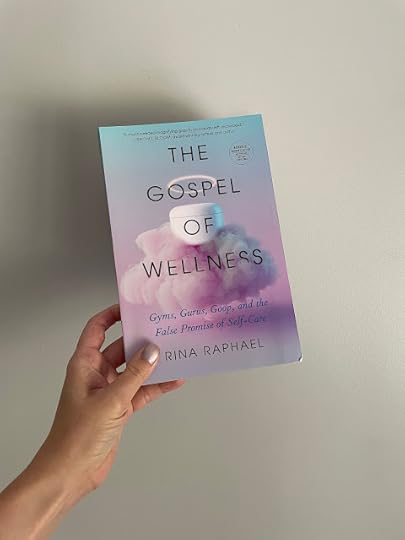
Wellness is not just a personal goal, it's a hyper-capitalistic, competitive industry. Companies and influencers are selling their goods, and consumers are trying it all, attempting to maximize their health or just trying to feel better. Rina Raphael points out endless inconsistencies, exploitations, and unequal access. She also provides detailed observations of the constant onslaught of products, treatments, and activities marketed to us every single minute of the day. Supported with cited research and a splash of personal insight, her work expands beyond the dreamy face cream cover to include sections on gyms, nutrition, medical care, New-Age spiritualism, and biohacking.
I found "The Gospel of Wellness" to be the perfect mashup of Leigh Stein's "Self Care" and Amanda Montell's "Cultish" and have added it to my Best Books of 2022 list.
Come chat with me about books here, too:
Blog | Instagram
Wellness is not just a personal goal, it's a hyper-capitalistic, competitive industry. Companies and influencers are selling their goods, and consumers are trying it all, attempting to maximize their health or just trying to feel better. Rina Raphael points out endless inconsistencies, exploitations, and unequal access. She also provides detailed observations of the constant onslaught of products, treatments, and activities marketed to us every single minute of the day. Supported with cited research and a splash of personal insight, her work expands beyond the dreamy face cream cover to include sections on gyms, nutrition, medical care, New-Age spiritualism, and biohacking.
I found "The Gospel of Wellness" to be the perfect mashup of Leigh Stein's "Self Care" and Amanda Montell's "Cultish" and have added it to my Best Books of 2022 list.
Come chat with me about books here, too:
Blog | Instagram

February 13, 2023
For fans of Maintenance Phase. IYKYK.

January 15, 2024
3.5 stars
It is hilarious to me that the two top-rated reviews complain about how this book is mean to white women when one of my major complaints is that it overly centers white women. On the positive side, she does provide space to discuss different impacts on women of color. On the less positive side, I don't think LGBTQ people even exist in this universe?
Anyway, I did find it an interesting read. The author is a member of the business press and that's the approach she takes. So while there were sections where I wanted her to get a little more critical of existing social structures or assumptions (for example, on p290 the idea that separating yoga from it's religious-cultural context is a good thing made me grimace), that's not her bag. I think her primary audience includes people who pay a lot of attention to pop culture, have an unflagging faith in the idea of progress/self-improvement, and aren't used to taking a critical approach to the messages they receive. (So, a big chunk of her target audience includes the reviewers offended at what I took to be compassionate "I'm right there with you" observations. Insert shruggie guy here.)
The good:
* She cites her sources.
* Each chapter is its own thing so if you want to read only certain parts or read it in a non-linear order, you can
* It's prompted me to do a little more digging into the organics industry to get a better grip on perceptions vs reality. (Of the many bogus wellness ideas that I've bought into over the years, this is the one I'm having the hardest time shedding.)
The less-good:
* I question some of her factoids (e.g., the claim that people in the US work longer hours than the rest of the industrialized world makes me wonder why she used Gallup data instead of OECD data, which has South Korea a lot higher on the list).
* The lack of narrative throughline made some of the chapter endings seem really abrupt and disorienting. (Some reviewers called it disorganized; I think the author did have an intentional organization structure but it's a pretty nonstandard one for books that aren't anthologies.)
It's a fast, easy read so I would recommend it to anyone still interested after the caveats I noted.
It is hilarious to me that the two top-rated reviews complain about how this book is mean to white women when one of my major complaints is that it overly centers white women. On the positive side, she does provide space to discuss different impacts on women of color. On the less positive side, I don't think LGBTQ people even exist in this universe?
Anyway, I did find it an interesting read. The author is a member of the business press and that's the approach she takes. So while there were sections where I wanted her to get a little more critical of existing social structures or assumptions (for example, on p290 the idea that separating yoga from it's religious-cultural context is a good thing made me grimace), that's not her bag. I think her primary audience includes people who pay a lot of attention to pop culture, have an unflagging faith in the idea of progress/self-improvement, and aren't used to taking a critical approach to the messages they receive. (So, a big chunk of her target audience includes the reviewers offended at what I took to be compassionate "I'm right there with you" observations. Insert shruggie guy here.)
The good:
* She cites her sources.
* Each chapter is its own thing so if you want to read only certain parts or read it in a non-linear order, you can
* It's prompted me to do a little more digging into the organics industry to get a better grip on perceptions vs reality. (Of the many bogus wellness ideas that I've bought into over the years, this is the one I'm having the hardest time shedding.)
The less-good:
* I question some of her factoids (e.g., the claim that people in the US work longer hours than the rest of the industrialized world makes me wonder why she used Gallup data instead of OECD data, which has South Korea a lot higher on the list).
* The lack of narrative throughline made some of the chapter endings seem really abrupt and disorienting. (Some reviewers called it disorganized; I think the author did have an intentional organization structure but it's a pretty nonstandard one for books that aren't anthologies.)
It's a fast, easy read so I would recommend it to anyone still interested after the caveats I noted.

August 26, 2025
Świetnie się łączy z „Doppelangerem” Naomi Klein i „Nienawiścią sp. z o.o.”, pogłębiając wątek tytułowy, który w wyżej wymienionych był co najwyżej wspomniany przez kilka rozdziałów/akapitów. Marzy mi się, by influencerzy przeczytali tę książkę i zaczerpnęli jedną myśl lub dwie, może przez chwilę zastanowili się, co pokazują światu i co z tego zabieramy my jako widzowie/fani/czytelnicy/szaraczki.

September 7, 2022
This book is fabulous. I was totally engrossed. I am wellness-curious, so many familiar brands surfaced, but I also learned so much. I will definitely be recommending this book to my crystal-having friends, and to really all women struggling with the demands of modern wellness.

November 14, 2025
Doskonały, wielowarstwowy reportaż o tym, co każdego dnia widzimy (zwłaszcza kobiety) na mediach społecznościowych, wśród przyjaciół, znajomych, rodziny, w bliższym i dalszym otoczeniu. Bo łatwo jest - i tak robi nie tylko nasz wujek Stefan, ale też mnóstwo polityków - sprowadzić każdy problem do prostego "No tak, te baby to takie głupie i..." (bo to zawsze są baby), ale ani niczego to nie rozwiązuje, ani nie oddaje złożoności problemu. (Nie mówiąc, rzecz jasna, o protekcjonalno-upupiającym stosunku do kobiet). Na szczęście można jednak rozmawiać o rzeczach tak, jak robi to Rina Raphael - wielowarstwowo, bez oceniania, z szerszym oglądem i dozą empatii (ale jednak bez nadmiernego rozgrzeszania). Jeśli chcecie świetnego, poszerzającego wiedzę o świecie, aktualnego reportażu, to to będzie świetny wybór.

January 2, 2023
I was hooked on this read from the very first chapter, and thought Raphael was on point with her thoughts about the wellness industry, its treatment of women, and the unhealthy obsession to look unrealistic. I loved the way she wrote the book, it is not pretentious or condescending, it is just a look into the industry and the way we can easily fall for some of these traps, and she covers everything from ‘clean eating’ to self care to beauty products and whether those ingredients are as harmful as others would have you think. Raphael is oftentimes speaking from personal experience, getting caught up in the same traps that a lot of us do, and after seeing the consequences began to research a number of these products and practices.
There is so much in here that is fascinating, I could go on and on (e.g., there is a lack of trust increasing between women and their doctors and so they are turning to alternative practices further feeding this industry, etc.) but I would recommend you read this one for yourself. I did the audiobook and followed along with the book and found it worked well that way. This was an important read that I learned a lot from, and am very glad I read this one.
Thank you to Henry Holt for the free copy to review.
There is so much in here that is fascinating, I could go on and on (e.g., there is a lack of trust increasing between women and their doctors and so they are turning to alternative practices further feeding this industry, etc.) but I would recommend you read this one for yourself. I did the audiobook and followed along with the book and found it worked well that way. This was an important read that I learned a lot from, and am very glad I read this one.
Thank you to Henry Holt for the free copy to review.

May 9, 2024
Great book critiquing the wellness movement. Wellness, just like a phone, is a product that can be sold. Individuals and companies alike profit off fear by making unsubstantiated claims, both about their products and the products of their competition.
A couple examples that Raphael shares using data and research are organic foods and products with “chemicals.” Many organic food brands are owned by large companies that can up-charge customers for the “organic” label so customers feel healthier. However, the data thus far has shown minimal differences in terms of nutrition and presence of pesticides between organic and not organic labels. Similarly, influencers sway people to buy products that “don’t have chemicals” or only have ingredients you can pronounce. The problem is: everything is made up of chemicals. In fact, many synthetic chemicals are more tested than natural ones. Some natural chemicals are more harmful than synthetic. There’s more nuance to the conversation than many would believe.
Sometimes the explanations were too long winded, while other topics I felt needed more exposition, but overall it was an educational read that challenged some of my personal views at times and I appreciated that. Give this a read if you are passionate about personal health!
A couple examples that Raphael shares using data and research are organic foods and products with “chemicals.” Many organic food brands are owned by large companies that can up-charge customers for the “organic” label so customers feel healthier. However, the data thus far has shown minimal differences in terms of nutrition and presence of pesticides between organic and not organic labels. Similarly, influencers sway people to buy products that “don’t have chemicals” or only have ingredients you can pronounce. The problem is: everything is made up of chemicals. In fact, many synthetic chemicals are more tested than natural ones. Some natural chemicals are more harmful than synthetic. There’s more nuance to the conversation than many would believe.
Sometimes the explanations were too long winded, while other topics I felt needed more exposition, but overall it was an educational read that challenged some of my personal views at times and I appreciated that. Give this a read if you are passionate about personal health!

April 30, 2023
Sorry to all the people in my life who are going to hear me reference this book constantly for a while. The author maybe tried to cover too much in one book, but the central premise & examples were worth the read.

December 8, 2022
This was a surprisingly enjoyable read for a depressing topic. A brilliant look into the history, lies, and manipulations of the wellness industry. I consider this an excellent recommendation for those newly interested in the topic and those who already consider themselves knowledgeable. I put myself in the latter category and while most of the big points weren't new to me, many of the specific references and some of the more nuanced details were revelations. Specifically the way 'wellness' is constantly being adapted and updated in our society to better prey on the fears, and even prejudices, of the population.
All in all, a long and worthwhile read for anyone effected by this industry. I'm so thankful to GR for the chance to review it.
All in all, a long and worthwhile read for anyone effected by this industry. I'm so thankful to GR for the chance to review it.

Read
December 21, 2022I could have done with less nasty critique and more nuance.
September 8, 2022
The Gospel of Wellness by Rina Raphael is a look at the pros and cons (mostly cons) of the wellness industry. Raphael covers many different segments of the wellness industry from Bulletproof coffee and Lululemon to Manifestation and Astrology.
The wellness industry developed partially to fill in the gaps that the medical establishment has left behind. Many people feel like doctors don’t listen to them, especially if they’re women, so they search for their own answers. While there is nothing wrong with looking for answers, the problem comes when there is money to be made. The wellness industry presents itself as an answer to problems, when in fact they are often offering pseudo-science packaged as answers - for a price.
This book provided an extensive overview of the many facets of the wellness industry. That being said, the book often felt scattered. I would have preferred her to zoom in on a few facets of the wellness industry and go in-depth. In addition, the author’s tone often comes across as condescending and pejorative. The main message of the book seems to be that everyone is trying to sell you something and anything you do for your health is just the illusion of control when in fact you have none. Well Rina, I’ll keep my lovely illusion of control, thank you very much.
I received this as a digital ARC through NetGalley.
The wellness industry developed partially to fill in the gaps that the medical establishment has left behind. Many people feel like doctors don’t listen to them, especially if they’re women, so they search for their own answers. While there is nothing wrong with looking for answers, the problem comes when there is money to be made. The wellness industry presents itself as an answer to problems, when in fact they are often offering pseudo-science packaged as answers - for a price.
This book provided an extensive overview of the many facets of the wellness industry. That being said, the book often felt scattered. I would have preferred her to zoom in on a few facets of the wellness industry and go in-depth. In addition, the author’s tone often comes across as condescending and pejorative. The main message of the book seems to be that everyone is trying to sell you something and anything you do for your health is just the illusion of control when in fact you have none. Well Rina, I’ll keep my lovely illusion of control, thank you very much.
I received this as a digital ARC through NetGalley.
December 29, 2022
I have trouble putting my finger on why this book kind of bothered me, and I see a lot of the other readers had a similar response. I am trying to interrogate my reaction. On the one hand, I agree with many of the author’s points, and even find many of them obvious (wellness is a bandaid/manipulation for how capitalist modernity is flawed, alienating, etc, and we need actual structural change and not individual solutions). On the other hand, I felt the author came across almost as judgmental or dismissive. I wonder, am I being defensive? But why is it bad that exercise and meditation helps my mental health a lot? That doesn’t seem like some weird trendy bs, and while the author says she isn’t trying to dismiss such coping mechanisms much of the book in fact does. She also talks about returning to orthodox Judaism practice in lieu of wellness, and organized religion as a better option, which tbh feels a little smug. As if organized religion doesn’t do f-ed up stuff, too! I wonder how much of my reaction is projecting, but I think others share my gut reaction
Displaying 1 - 30 of 418 reviews