Kjell Eriksson's next Ann Lindell book, The Deathwatch Beetle is an atmospheric thriller and a tender depiction of the countryside and the people of Roslagen.
Four years have passed since Cecilia Karlsson disappeared from the island of Gräsö in Roslagen. When Ann Lindell receives a tip that she has been seen alive she cannot help getting involved, even though she is no longer with the police.
The black sheep of the island, Nils Lindberg, has never forgotten Cecilia Karlsson, with whom he was in love as a teenager. And he carries a secret. He may not be completely sober all the time, but he has no doubt of what he saw out on the bay just before Cecilia disappeared. Cecilia's parents are desperate, not knowing what happened to their daughter. Yet their silent house contains many things that have been left unsaid.
While Ann struggles to put the jigsaw puzzle together, she is trying to establish herself in her new life together with her lover Edvard who, like herself, is marked by life. At the same time, someone is hiding in a cottage in a remote part of the island. Someone who is looking for revenge...
Karl Stig Kjell Eriksson is a Swedish crime-writer, author of the novels The Princess of Burundi and The Cruel Stars of the Night, the former of which was awarded the Swedish Crime Writers' Academy Best Swedish Crime Novel Award in 2002. They have both recently been translated into English by Ebba Segerberg.
A noir mystery from Sweden. This book is #12 in the author’s Ann Lindell detective series. It’s set on an island off the coast of central Sweden.
Four years ago a young man accidentally drowned. Or not. His body was never found. He was wealthy from starting his own business. Does a professional diver who never drank drown in a boat filled with empty booze bottles? Perhaps he’s still alive? A woman was seen in the boat with him that night.
About the same time, his young woman friend went missing. She’s probably dead too. Or not. Someone started a rumor that he saw the woman in Lisbon recently. But the guy who saw her is an alcoholic who has been in love with the missing woman all his life. How reliable is that report?
Retired detective Ann Lindell is intrigued. She obviously misses her police work because she can’t resist digging into this case. Or is there even a case here? As far as the police are concerned, there’s no actual crime to investigate. The missing woman’s parents reveal layer after layer of family dysfunction as Detective Lindell talks with them.
Ann has her own problems. She resists and then counts every glass of wine in her continuing fight against alcoholism. She has a fragile relationship with both her lover and her teenage son.
I liked the story and it kept my attention all the way to the end when there was still a bundle of mysteries to be solved in the last few pages. There’s a lot of local color about the real Swedish island of Graso, three hours north of Stockholm. It reminds me a lot of Maine – hardscrabble locals eking out a living from farming and by providing labor to the flood of summer tourists.
If you read this story, be aware that I found all the names a bit confusing at first. The author has a habit of referring to his characters alternately by first or last name, so initially you may be overwhelmed by all of the names. And the location of where the action is taking place I also found confusing at first. But if you stick with it, it all comes together. If not for those issues, I would have given this one a ‘5.’ However, that's just me. I should also say that most GR readers rated this book fairly low - only 3.4.
The author (b. 1953) has written a dozen mysteries in the Ann Lindell series and almost all are available in English. From info on GR it looks like #4, The Princess of Burundi, in his best-known book, but #6, The Cruel Stars of the Night is his most highly-rated book.
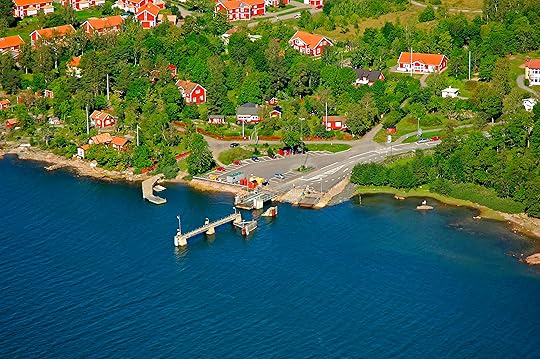
Top photo of Graso Sweden from marinas.com The author from scanmagazine.co.uk
I Have just read The Deathwatch Beetle by Kjell Eriksson.
This is an atmospheric thriller that takes place in Sweden, and the first book that I have read of the Ann Lindell Series, which is the 12th in the Series.
I did not feel that it hindered getting into the flow of the book by not reading any previous ones.
I enjoyed the storyline, and the main characters, and felt it was translated well. I will read more in the series.
Thank you to NetGally, Author Kjell Eriksson, and the Publisher St. Martin's Press for my advanced copy to read and review.
I tried to read this book. I really did. I have read others in the series and love the location setting, but this one did not hold my interested. The story line was convoluted and, to me, did not roll smoothly. I’m sure others would disagree with me but this is how I felt.
Award-winning Swedish author Kjell Eriksson joins the waves of writers living under the literary umbrella of Nordic Noir. His latest novel, THE DEATHWATCH BEETLE, is part of his popular Detective Ann Lindell series.
At the dark center of this novel is a disappearance of a young woman that took place four years earlier. Cecilia Karlsson vanished from the Island of Gräsö off the Swedish coast and has not been seen or heard from since. That is until rumors begin about alleged sightings of Cecilia. None of this is lost on Ann Lindell who cannot bear to have an unsolved cold case even though she is no longer a part of the police department.
The biggest question readers of this novel might have probably is not directly about Cecilia Karlsson but more likely the fact that they have never heard of a deathwatch beetle. I confess that I myself was not familiar with the deathwatch beetle, and I just cannot get enough of nature shows. Well, it is a real species described in the novel as wood-boring beetle that a character in the novel believes had that unique name as she hears one scratching inside the walls of her home.
Eriksson uses the deathwatch beetle as a metaphor throughout the novel which clearly ties things into the fun title of the novel. In the same chapter where the concept of the deathwatch beetle is revealed we later see a young woman leaving the cabin she was staying in and walking down to the nearby body of water. As she peers out over the islands that surround her, we learn that this is indeed Cecilia. She is the product of her rough upbringing and is thinking that now with someone named Olga having died she would have no further obstacles. What this means will become clear as we read more about the very much alive Cecilia.
As Ann Lindell returns from her retirement from the police force to continue to search for the recently espied Cecilia, she begins by piecing through the people in her life that were the closest to her. Of course, this must begin with her parents who still seem devastated by her absence, yet they live in a home that is full of secrets waiting to be discovered. Then there is Nils Lindberg who has carried a torch for Cecilia since High School. Now, the often-intoxicated Lindberg still pines for her, and he keeps a secret of what he witnessed just prior to her disappearance.
Ann and her lover, Edvard, are each invested in getting to the bottom of the mystery that is Cecilia and the answer may be the character living in a cottage on the same island where Cecilia is who may be bearing a grudge against her that has remained unspoken for years. We find that Cecilia is a game player and uses people as if they were mere Chess pieces in a game, she is playing with herself. All that may come to an end when someone she may have wronged appears to take their revenge on her.
The question that remains is whether or not Ann Lindell can locate Cecilia, learn her many secrets, and save her from her own past before it bores through the wall like a deathwatch beetle to claim her. THE DEATHWATCH BEETLE is a dark novel and Cecilia is not an easy character to like. It is the integrity of Ann Lindell that drives the novel as she is a believer in justice and happy, neat endings.
Award-winning Swedish author Kjell Eriksson joins the wave of writers living under the literary umbrella of Nordic noir. His latest novel, THE DEATHWATCH BEETLE, is the ninth installment in his popular mystery series featuring Ann Lindell.
At the book’s dark center is the disappearance of a young woman that took place four years earlier. Cecilia Karlsson vanished from the island of Gräsö off the Swedish coast and has not been seen or heard from since. That is, until rumors begin about alleged sightings of her. None of this is lost on Ann, who cannot bear to have a cold case hanging over her head, even though she is no longer a member of the police department.
Despite being a big fan of nature shows, I confess that I wasn’t familiar with the deathwatch beetle, which we learn is a species of woodboring beetle. Eriksson uses the deathwatch beetle as a metaphor throughout the story, making it a perfect title for the novel.
With this in mind, a young lady leaves her cabin and walks down to a nearby body of water. As she peers out over the islands that surround her, we find out that she is indeed Cecilia. The product of her rough upbringing, she is thinking that with the death of an individual named Olga, she would have no further obstacles. What this means will become clear as we read more about the very much alive Cecilia.
Ann returns from her retirement from the police force to continue her search for Cecilia. She examines the people in her life who were closest to her, beginning with her parents, who still seem devastated by her absence. Yet they live in a house that is full of secrets waiting to be discovered. Then there is Nils Lindberg, who has carried a torch for Cecilia since high school. Now, the often-intoxicated Nils still pines for her, and he keeps to himself what he witnessed just prior to her disappearance.
Ann and her lover, Edvard, are invested in getting to the bottom of the mystery that is Cecilia. We learn that she uses people as if they are mere chess pieces in a game she is playing with herself. This all could come to an end when someone she may have wronged appears to take revenge on her.
THE DEATHWATCH BEETLE is a dark novel, and Cecilia is not an easy character to like. It is the integrity of Ann Lindell that drives the book as she is a believer in justice and neat, happy endings.
Abandoning this one without a rating. Felt like I was watching puppets bobbing around a cardboard stage - name confusion, lots of details about setting and action but not enough about the people doing the actions, difficulty making connections between characters. I'm going to chalk this up to early summer mental confusion and maybe try again in the winter.
I disliked this book so much and have no idea why I continued reading it and finished it. There was no one appealing or likable among the characters and the story was not really told or set up in a way that made it accessible. Though the ending was not predictable - I didn't really care "who done it."
It seems a long time for Kjell Eriksson between books but it was worth the wait. It seems that he is an extraordinary kind of person who tells little of what you need to know, but leaves interesting options about people instead. Ann Lindell was brought into the mystery of Cecilla as a missing person by none other than her lover Edvard Risberg. He was her great torment but also her great love. They were previously lovers until Ann had a one night stand. We have many years since this happened but Ann ended up pregnant. As it happens she is on vacation from her job at a cheese factory and happily likes to explore this kind of happening. We come to the end of the story and find out that Cecilla's basic instinct was true to herself. She was exonerated from killing her lover at the time. If you read the story you will see how and why. I give Kjell at least 4 out of 5 stars in telling this story, lets see if he can pull you into it also.
Up front- I was a huge fan of Night of the Fire and was very much looking forward to this next Ann Lindell read. Regrettably I found it disappointing and even disorienting. While I thought it was meant to be the story of Ann's search for Cecilia a woman who went missing from Graso, it wasn't. Ann, a retired detective, is almost a background figure as Cecilia is living in plain sight more or less on Graso. I'm not sure if it's the translation which is awkward in spots or the plot but I found myself confused in spots as to what was happening. Why did Cecilia disappear? More importantly, why did she come back? Over to others but I had a hard time following this (and I read a lot of Scandinoir) and ultimately realized I didn't much care. Thanks to netgalley for the ARC. A very rare meh from me.
As a rule, I like Erikson's work, but this one tends to be tedious. I don't really like Ann Lindell as a character, but now that she's retired and sober, she's a more interesting character. The plot is weak and Lindell's detective work is unimaginative, boring and more the intrusions of a busybody than a necessary investigation. Lindell decides without motivation or justifiable cause to determine why a young woman ran away from home and more or less disappeared from Graso island four years previously. The young woman seems to be more or less associated with a death -- ruled a suicide -- a number of years previously. Ann finds the girl and proves that the death was actually a murder. It's a boring story, with uninteresting characters, far below his usual standard.
Ann Lindell is retired but can't help stopping by at the homes of various suspicious small town characters. One family is missing a daughter who disappeared four years before. The absent young woman's boyfriend has committed suicide. There are two would besuitors for the absent woman but they seem rather ineffectual. The woman's mother gives Ann cryptic information about abuse and Ann is a good former police person who stays in contact with the actual police. The absent woman's father is another story all together. Edvard, Ann's partner (sometimes) is also a great part of Ann's progress but the book doesn't get really thrilling until the end. A good solid read but lacking the immediacy of Eriksson's other works.
DNF at 50%. I just couldn’t get into this book enough to keep going. It was too plodding to set the scene and I never reached the heart of the mystery. So, I give up.
„Die Totenuhr” von Kjell Eriksson war für mich das erste und ganz sicher auch das letzte Buch seiner Reihe um Ann Lindell, die ehemalige Kriminalkommissarin. Der neunte Teil der Serie ist ein atmosphärischer Krimi, das ist für mich aber eines der wenigen positiven Dinge, die ich darüber sagen kann. Selten hat sich ein Buch für mich so zäh und mit so wenig Spannung gelesen und selbst der überraschende Schluss ließ mich völlig unbefriedigt zurück. Immer wieder war ich versucht, quer zu lesen, die verschiedenen Handlungsstränge und die Angst, etwas Wichtiges zu verpassen, hielten mich allerdings davon ab. Aber von vorn. Die ehemalige Kriminalpolizistin Ann Lindell hat sich mit ihrem Partner Edvard auf der Insel Gräsö an der schwedischen Küste niedergelassen. Dort möchte sie sich eine Auszeit nehmen, wird aber überraschend mit einem vier Jahre alten Fall konfrontiert. Damals verschwand Cecilia Karlsson von der Insel und ihr Schicksal ist bis heute ungewiss, sie wurde seither nicht mehr gesehen, ihre Leiche wurde allerdings auch nicht gefunden. Da um es bezüglich ihres Verschwindens sehr viele Rätsel gibt, macht Ann sich an die Ermittlungen. Auf einer so kleinen Insel wie Gräsö kennt jeder jeden und praktisch alle Bewohner tragen Geheimnisse mit sich herum. So kam nur einen Monat vor Cecilia deren Freund Casper Stefansson zu Tode und Gerüchten zufolge hatte die junge Frau etwas damit zu tun. Und plötzlich, zur Beerdigung ihrer Freundin Olga, wird Cecilia wieder auf Gräsö gesehen. Und dann überschlagen sich die Ereignisse und im Zentrum stehen Cecilia und ihre Familie. Ganz ehrlich – an diesem Buch konnte mich außer der bedrückenden Atmosphäre, der angenehmen Sprache und der gelungenen Übersetzung nichts begeistern. Vielleicht wäre es mir leichter gefallen, hätte ich die anderen Teile der Serie gekannt und hätte die Entwicklung der wiederkehrenden Charaktere miterlebt. So fand ich sie aber alle eher platt und farblos. Ann Lindell verkommt zur Nebenfigur und irgendwie hatte die Geschichte für mich keine richtige Hauptfigur. Außerdem ist Ann mir überwiegend auch nicht besonders sympathisch, aber als Ermittlerin scheint sie kompetent und zielstrebig, manchmal fast ein bisschen verbissen. Sie hat, wie alle anderen im Buch auch, mit einigen privaten Problemen zu kämpfen. Sie hat ihre Alkoholsucht überwunden, versucht in ihrem neuen Leben mit Käsemachen Fuß zu fassen, ist aber in den Augen vieler anderer nichts weiter als eine „ausrangierte Bullenfrau“. Den Spannungsbogen empfand ich als durchgehend eher flach, das Spannungsniveau nicht sehr hoch und die Geschichte über lange Strecken langatmig und langweilig. Für meinen Geschmack dauerte es viel zu lange, bis die Handlung Fahrt aufnahm und ich eine Ahnung davon bekam, wohin die Geschichte mich führen würde. Leider kam für mich die Totenuhr aus dem Titel (ein „klopfender“ Käfer, der zur Paarungszeit seinen Kopf auf Holz schlägt) als Metapher zu wenig zum Tragen. Und auch sonst fand ich die Handlung insgesamt sehr konstruiert und das nicht im positiven Sinne. Zwar führt alles am Ende zu einem stimmigen Schluss, der mich zwar überraschen, aber nicht begeistern konnte. Die psychologischen Elemente kommen für mich zu kurz und werden zu oberflächlich abgehandelt. Dysfunktionale Familien mit Eifersucht, Kontrollwahn und Ehedrama, Rachegelüste, Wirtschaftskriminalität, dazu Mord und Brandstiftung – eigentlich hat das Buch alles, was das Krimileser-Herz begehrt. Für mich hat der Autor das Potential allerdings zu wenig ausgeschöpft und es wäre viel mehr drin gewesen. Daher kommt das Buch für mich nicht über ein „unterhaltsam“ und „okay“ hinaus und ich vergebe drei Sterne.
All is not serene on the island of Graso, just off Sweden's coast. Family dramas mark the recent death of a favourite islander, Olga, past death of Casper, drowning suspected and the disappearance of Cecilia Karlsson a month after Casper died. Someone--Blixten-- has seen Cecilia on the island, and several times in Portugal, they are sure of it and ex cop Ann Lindell now living part time with her lover, Edvard on Graso, gets her interest in this puzzling story piqued and gets involved, off the record, but with input from the force, Brundin. This is a moody thriller about revenge, families, and past deeds. Cecilia aims to expose Adrian, Olga's son, of fraud; Cecilia's at odds parents--Rune and Gunilla, want to be done with each other but want Cecilia back, Rune does at any rate and is becoming unraveled, Gunilla, not so much; Casper's death is a shadow on Cecilia's heart and Blixten has always loved her and once they meet again on the island, he shows her how much; Ann and Edvard have an understanding after years of separation, things are working out; Ann's son Erik, much to her dismay, discovers his birth father. All this, the beautiful island setting, treed, meadowed, water life but marred by influx of folks from Stockholm moving into cottages enhances the moodiness, the hint of menace heightens after Adrian's garage is set on fire. Then Rune is found dead. It's been awhile since I've read this series, back when Ann was still a cop. Eriksson's writing is Scandi noir, keen, insightful, fluid and moving; I caught up easily on the years missed to find how interesting these characters still are and how much I want to read more on Ann, Edvard and hopefully Blixten. Maybe Ann will be a cop again but on Graso. That would be cool.
Described as an atmospheric thriller, I could agree with one part of that characterization. It was atmospheric.
My first experience with the series. This particular episode protagonist Ann Lindell has retired from the police force and lives on the island of Gräsö off the eastern coast of Sweden. When Lindell gets a tip that Cecilia Karlsson (missing for years) was sighted alive, she can’t resist pursuing the lead.
It’s an island. People know each other and there are secrets. Some not meant to be revealed. The opening scene hooks the reader then basically founders for the remaining portions of the book. Such a slow pace it was difficult to continue reading.
I’m not sure—is Ann still meant to be the main character? Not first person, but it often took me a couple pages to figure out who was making an appearance and his/her connection to the whole thing.
Ann didn’t come across in this episode as being a fully developed person, nor did I really engage in peripheral characters.
Granted, I came in on Book 9 of the series, having lost, I’m sure a large part of the development and her earlier experience as a police person. But was something lost in translation? This one lost my interest early on and it was never really regained. 2.5 stars
I received a complimentary review copy of this book from the author and publisher through @NetGalley that in no way influenced this review. These are my honest thoughts.
“The Deathwatch Beetle,” by Kiell Eriksson, translated by Paul Norlen, Minotaur Books, 288 pages, Nov. 23, 2021.
Cecilia Karlsson disappeared from the island of Gräsö in Roslagen four years ago.
Ann Lindell is no longer with the police force. She is visiting Edvard Risberg, who lives on the island. Folke Ahr, who is retired from homicide, was told that an old schoolmate saw Cecilia twice since her disappearance. Folke tells Ann.
The schoolmate, Nils “Blixten” Lindberg, has never forgotten Cecilia Karlsson. But Nils is an alcoholic, so Ann doesn’t know if his sighting can be believed.
Ann and Edvard go to talk to Cecilia’s parents. Her father, Rune, and mother, Gunilla, are internationally-known athletes. Cecilia's parents are desperate, not knowing what happened to their daughter. But something is wrong in this household.
To add to the mystery, Casper Stefansson disappeared a month before Cecilia did and before she disappeared her parents insinuated that Cecilia caused Casper’s death. Although some people believe Adrian Palm, Cecilia’s former boss, killed Casper.
The characters are good. Although the reader does find out early what happened to Cecilia, the identity of Palm’s assailant is a surprise. I enjoyed Kjell Eriksson’s last book, “The Night of the Fire,” more than this one, but “The Deathwatch Beetle” is still entertaining.
In accordance with FTC guidelines, the advance reader's edition of this book was provided by the publisher via Edelweiss in exchange for a review.
I really enjoyed this novel. It was fast paced and achingly human in some of the most frightening ways. I was a little disturbed by how monstrous Kunilla and Cecilia were as human beings, especially Kunilla who is an absolutely terrible human being with no redemptive arc to be seen. It was interesting to see the juxtaposition of bringing out the worst in Rune for Kunilla and an odd combination of the best and worst in Blixton for Cecilia.
Two monsters wreaking havoc on an island in Sweden. It almost sounds like a horror novel and in some ways it was--even Ann and Edvard's relationship is paper thin with no significant commitment (perhaps due to Ann having cheated on him years earlier resulting in her only son). It's easy to sense a somewhat off-putting theme, here, though I don't think it was intentional, and it was still a good read. I will be checking out more of this series.
Side note: when "The One and Only" Robban is listening to American Country music on page 36, the song "House and 90 Acres" by Chris Knight is alluded to with 2 references to the lyrics. This absolutely made my day as Chris Knight is one of the best singer/songwriters in the United States but isn't a radio artist. I'm glad to know the writer likes good music!
This entire review has been hidden because of spoilers.
Disappearances mark this #12 in the series-- including the disappearance of Ann Lindell's career as a homicide detective. The psychology of island relationships, rifts and unshakable connections, is the true subject, marking Cecilia who flees and her parents and longtime love who stay, the island natives and the interlopers like Ann trying to learn the culture. Very satisfying.
"She felt it in her body as an absence, that thing with context and common memories she'd always had so much trouble with. It was as if life has to start over, again and agin, and where the painful thing was to leave places, people and relationships, often for good. That was the one side, staggering ahead in life, but if you flipped the coin there was an inner warmth, which passed like a shiver through the body, admittedly far from what it once was, but still: We belong together, I exist here and now, for me and for others. There's still life. Still hope. A few steps more to let loose a little of the hope that after all there was a spark of light to brighten the future. A view over a future landscape." p. 263
Though Ann Lindell is no longer with the police -- she's now a cheesemaker, and she's taking a break from that to spend time on the island of Gräsö (Sweden) with her lover, Edvard -- she can't help but want to investigate when missing person Cecilia Karlsson surreptitiously returns to the island, four years after her boyfriend Casper's drowning and her concurrent disappearance. Ann works alongside the police to learn what Cecilia's parents, the old-fashioned Rune and the unsatisfied Gunilla, both of them former athletes, and her male admirers (Blixten, Adrian) know about her disappearance and her reappearance, though of course they all lie or withhold information from Ann, who keeps questioning whether she even wants to be involved, and yet she's drawn to the puzzle. Like others of Eriksson's novels, I'd say this is more literary novel than mystery. There is a mystery, several in fact, but the book is not really plot-driven; its center is the characters and their relationships, what's said or acknowledged and not said or acknowledged among them, their memories, their mixed feelings, their stumbling around in their own lives.
My thanks to NetGalley and the publisher for letting me read and review this book.
I like Scandinavian mysteries, so I was eager to read this book. Ann Lindell, who is an ex-policewoman, now cheesemaker, still likes to try to resolve old cases. In this one there is a missing woman and a cold-case of a presumed murder/disappearance of a man the woman had a relationship with. When the woman is sighted on the island, Ann jumps into the investigation, sharing information with Brundin, the local policeman. Many secrets are uncovered as well, resulting in more tragedy for the family and associates of the returning woman.
It was a good story, but I feel that it just took too long to work out all of the details and solve the cold-cases.
This book was a slow burn - a little too slow, honestly. The setting is incredible, and really part of the story. Ann Lindell, who is now retired from the police force, is looking into a missing person's case while on holiday with her boyfriend. The mystery part of the plot moves kind of slow, but I enjoyed getting to know Blixten, Cecilia, Rune and Gunilla. And it was difficult to predict the outcome, so that was enjoyable. The chemistry between Ann and Edward seemed off to me, which I didn't remember from earlier books. And I wasn't that interested in the plotline with Ann's son, Eric, though I have a feeling it may come into play in a future book.
If you're a fan of the series, this is worth checking out. However, the earlier books are better.
Boken är snabb i handlingen och den drivs hela tiden framåt vilket är väldigt positivt! Dessutom finns det ett gäng väldigt intressanta karaktärer. Dock känns boken lite hoppig då det inte alltid är en röd tråd genom dialogerna eller i stycket. Det beror nog mycket på att det kommer en del bakgrundsinformation mitt i dialogerna. Jag har lite svårt för det men vet också att väldigt många inte alls stör sig på det. Skulle fortfarande läsa del tre i serien däremot.
I read this book aa part of my mystery book club. I will not give a synopsis, only my opinion.
It truly took me forever to finish this book. I kept falling asleep if I read at bight. Other times I just wasn’t interested in picking up the book. It did not hold my attention.
I struggled with the flow of the story. I felt like I was picking the storyline out of a maze. I don’t know why it just felt so difficult to follow.
A decent story but you have to have read the earlier books in the series to have any idea about who Ann is and why she can't keep her nose out of the investigation. And the translation is rather stilted, or at least I assume it's the translation rather than the original. Bottom line: Doesn't live up to earlier books in the series.
I understand this is part of a long series. I haven't read any of the books so maybe that's why I can't get into this. Though in my opinion all books in a series should be able to stand alone.
Inte ens nyare böcker av Eriksson fångar mig. Grå tristess ligger som en filt över storyn, trots att den utspelar sig på en ö som lockar turister. Jag förstår mig inte på huvudpersonen och hennes kärlek och alla personer beter sig som kufar utan den minsta gnutta social kompetens.
Didn’t disappoint-quite a chronological gap from previous storyline but more atmospheric as a result. The isolated setting of Graso island lends an insularity that carries both threat and promise. Twists and and turns throughout.
I think he needs to find a better translator. I've read the Wallander series and never had any problems understanding....maybe a word or two felt wrong, but not when I read these books.
I can get the gist and think they are good, but wish there was a better translation.