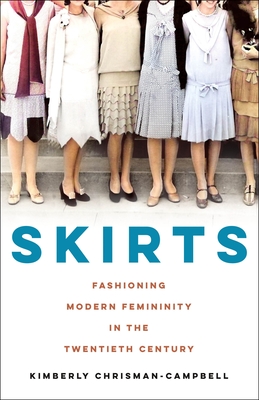
In a sparkling, beautifully illustrated social history, Skirts traces the shifting roles of women over the twentieth century through the era’s most iconic and influential dresses.
While the story of women’s liberation has often been framed by the growing acceptance of pants over the twentieth century, the most important and influential female fashions of the era featured skirts. Suffragists and soldiers marched in skirts; the heroines of the Civil Rights Movement took a stand in skirts. Frida Kahlo and Georgia O’Keeffe revolutionized modern art and Marie Curie won two Nobel Prizes in skirts. When NASA put a man on the moon, “the computer wore a skirt,” in the words of one of those computers, mathematician Katherine G. Johnson. As women made strides towards equality in the vote, the workforce, and the world at large, their wardrobes evolved with them. They did not need to "wear the pants" to be powerful or progressive; the dress itself became modern as designers like Mariano Fortuny, Coco Chanel, Jean Patou, and Diane von Furstenberg redefined femininity for a new era.
Kimberly Chrisman-Campbell's Skirts looks at the history of twentieth-century womenswear through the lens of game-changing styles like the little black dress and the Bar Suit, as well as more obscure innovations like the Taxi dress or the Pop-Over dress, which came with a matching potholder. These influential garments illuminate the times in which they were first worn―and the women who wore them―while continuing to shape contemporary fashion and even opening the door for a genderfluid future of skirts. At once an authoritative work of history and a delightfully entertaining romp through decades of fashion, Skirts charts the changing fortunes, freedoms, and aspirations of women themselves.
When I first saw the title of this book my eyes widened in wonder and I thought: "no way... there is no way an author can write an entire 272 page book about... skirts!" And so... my interest was piqued.
Oh my goodness! Wow... I was wrong. The author wrote a very thorough book about the role "skirts/dresses" have played in the twentieth century within a social and fashion-historical context. It is very clear that Chrisman-Campbell has thoroughly researched her subject. I liked her clean, matter-of-fact tone which was not bogged down by superfluous wording. It let her research shine and got her message across to the reader.
From era to era, "skirts" have prevailed, influenced and paved the way of fashion and stood the test of time, evolving and adapting in an effort to stay relevant. One of my personal favorite is the section on Coco Chanel. For me, she was an incomparable fashion influencer, as was her iconic little black dress which never faltered in its popularity to this day. The section about the "tennis dress" was an entire movement that could have had its own book. My "oh wow" senses kicked in during that discussion. To be honest, each chapter was fascinating as it was enjoyable to read about past celebrities/influencers as pertaining to their context with skirts/dresses.
I found this book to be thoroughly detailed in its execution, a "smart" book endowed with a plethora or facts that made for an entertaining read. You will have to pick up a copy to learn of all the juicy details.
Thank you to the author, St. Martin's Press and NetGalley for the lovely opportunity to read this ARC and submit an honest review.
Much like author Kimberly Chrisman-Campbell discusses in the preface to this book, I adore wearing dresses (and skirts, though I find them slightly more difficult because you then need the right top). She’s preaching to the choir when she talks about wearing them pretty much exclusively. For me as a trans woman, dresses are my way of embodying and expressing my femininity (they are not, of course, the only way to be feminine). I’ll talk more about that later in the review. For now, I’m happy that NetGalley and St. Martin’s Press provided the eARC! Skirts: Fashioning Modern Femininity in the Twentieth Century is a thorough overview of how skirts and dresses have evolved in response to our changing society and cultures. I learned a lot, and it gave me a lot to think about.
This book is not for the fashion faint of heart! Now, it’s ok if you are a fashion neophyte like me! I don’t know much about fashion. I recognized a couple of the bigger names dropped here—Chanel, Dior, Versace, et al—but Chrisman-Campbell demonstrates why she is the fashion historian and I am not with the effortless way she elucidates connections among fashion designers, fashion houses, and various other parts of the industry. I added a great many words to my vocabulary as I read. So unless you too have studied fashion history already, be prepared to be immersed in a whirlwind of new ideas and concepts.
The book is structured into ten chapters, each of which is named after a particular garment: the delphos, the wrap dress, the little black dress, the mini skirt, etc. Upon this structure, Chrisman-Campbell layers and drapes and pins on the development of milestones in dress and skirt fashion. Though the chapters are arranged in a loosely chronological way, Chrisman-Campbell continually revisits important touchstones in history, such as the two world wars, to connect their dramatic reshaping of Western society to the particulars of the garment she’s discussing at the time. Hence, Chrisman-Campbell spends much of the wrap dress chapter commenting on Diane von Furstenberg’s iteration of it, she does trace its origins to the taxicab dress earlier in the century, created in response to women needing to get in and out of their dresses more easily and with fewer hands to assist.
It’s somewhat of a truism that the world wars, particularly the Second World War, upended the social order. For that reason, much of what Chrisman-Campbell has to say might feel at first glance very obvious. What makes Skirts so enduringly edifying, then, are the particular facts that she brings to bear in each moment. It’s one thing for an historian (or even a grandstanding layperson holding court at a dinner party) to make sweeping proclamations about how the Second World War liberalized clothing customs or whatever. It’s another thing entirely to drill down into the details and the nuance—the way that hemlines fluctuated over the decades, for example. Shorter hemlines were a response to rationing of fabric during the war, and longer hemlines took over afterwards as a sign of prosperity, only to rise again as fashion designers carved out a new category, teenager. As Chrisman-Campbell tracks these decade-by-decade, sometimes year-by-year, changes, she names names and even goes so far as to cite specific shows, catalogues, or photographs that incited new fashion. It’s so much more complicated than “shorter hemlines correlate to women’s liberation.” It’s a complex ecosystem of designers, celebrity models, advertising campaigns, parties, entertainment media, and yes, the economy.
As the subtitle of the book suggests, and as Chrisman-Campbell refines in her introduction when she traces the metonymy of skirt, ultimately she is trying to unpack the complicated way in which skirts and dresses are linked to each era’s concept of femininity and women’s bodies. Women’s dress has historically been a tool for exclusion, for titillation, or even for asserting power. The shifting nature of what is acceptable, when, and where reveals a lot about how our society polices women’s bodies. There’s also a need to be intersectional in this conversation, for Black women, fat women, and disabled women receive more scrutiny and censure than white, able-bodied, or thin women.
Ultimately, I’m not sure how successful Skirts is at having that intersectional conversation. That probably means it’s not as successful as it should be. To her credit, Chrisman-Campbell signals that she is aware of the need for this intersectionality and brings it up on occasion. She mentions the misogynoir that Serena Williams has faced on the tennis court over. Later, she touches upon the queering of fashion, from dancehall and Pose to male celebrities like Kurt Cobain and Harry Styles wearing dresses. All in all, I think Chrisman-Campbell tries to be inclusive, but she could do more to acknowledge how the fashion industry has historically been white and cisnormative—partly because fashion was, until the middle of the twentieth century, very much a rich person’s game as well.
That’s the other area in which I was expecting more from this book: commentary. Each chapter is very illustrative and comprehensive in tracing influences, developments, etc. Yet Chrisman-Campbell mostly saves her editorializing for the introduction and conclusion. I can understand the possible reasoning behind this writing decision, yet for a book that seems to aim broader than an academic audience, it doesn’t do much to establish Chrisman-Campbell’s voice, as a writer, throughout. Consequently, I was less excited in the reading of the book than I was by how much I had anticipated reading it!
I was drawn to Skirts because I was drawn to skirts. Well, mostly dresses. I came out as transgender two-and-a-half years ago. Part of my social transition has involved redefining my wardrobe in a way that authentically represents my gender. For me in particular—not, I want to stress, for all trans women—this means dresses. I really identified with what Chrisman-Campbell says about how comfortable they are, how easy it is to slip into one before you go about your day … I love dresses. Embracing the dress was a way of embracing the womanhood that had, until recently, eluded me. Replacing my old wardrobe with a new one full of dresses was a transcendent experience: gone were a couple of mix-and-match separate sweaters and jeans and dress pants (for work); in came the dresses in a riot of colours and patterns and prints, particularly polka dot. I love polka dot. Also, because I’m a knitter, I have now knit myself two skirts, projects which have once more helped me connect with and reaffirm my femininity.
So reading this book was, for me, an important way of connecting with traditions of femininity that are my heritage but were denied to me as a result of being assigned male at birth. When I put on a dress in the morning to go to work—whether it’s a comfy wrap, slinky sheathe, flowing midi, etc.—I’m joining a long tradition of women embracing not just fashion as it exists in this moment in time but echoes of fashions past. (In my particular case, I have quite a late ’50s/early ’60s vibe in a lot of my wardrobe aesthetic—I adored hearing about how tights took over in the 1960s as hemlines rose again.) In an era where we are, hopefully, all starting to become more aware of the harms of fast fashion, learning about the history of our clothing is as important as understanding the present state of the fashion industry.
Skirts is therefore one of those books I would recommend in this way: if the description sounds like it’s a book for you, then it’s going to be a book for you. It is exactly what it says on the tin.
Originally posted on Kara.Reviews, where you can easily browse all my reviews and subscribe to my newsletter.
A highly interesting and detailed book about the history of women's fashions and the skirt in particular.
I really enjoyed how the author covered a range of periods and particular women/movements, from the post-war years to the early 70s when pants were becoming more popular to the present day, ending with the beginning of skirts being designed for men.
She talks about different fashion designers like DVF and her iconic wrap dresses to the changing trends from tennis outfits to little black dresses and fashion icons like Marilyn Monroe to Princess Dianna.
Much thanks to St. Martins Press for sending me a #gifted finished copy and @Libro.fm for an ALC copy in exchange for my honest review. This was a small but thought-provoking book I'd happily recommend.
I've long been interested in the evolution of fashion . . . until the 1930s, at which time my interest dwindles rapidly. Fashion as social expression as well as personal expression has always been interesting, while it can be a fraught subject. The history of twentieth century fashion especially, after Coco Chanel boosted women into modern times, while saddling them with a nearly inescapable ball and chain: to be chic, one must be thin. Oh, yes, and white.
So, reading this book, I think demands that the reader except that as the substrate, because these innate demands really are not examined here. Instead, there is a mostly readable, formidably researched look at fashion over the twentieth century.
I need to say at the outset the the ARC is seriously hampered by the lack of images. The book's marketing promises "lavish" illustrations. You'd think that the publishers who put out the ARC could see their way clear to include some B&W illos...but they didn't.
The result was, the vast amount of name-dropping of fashion designers caused my eyes to glaze over in places. I don't think that a fault. Someone more into twentieth century fashion will no doubt know who all those people are.
The amount of work that went into this book is impressive, and there are some fascinating ideas presented. Overall, the book is a good look at the "outer woman"--in other words, what she wears-- in white western fashion, without much delving into social history.
When I was a girl I loved my Barbie dolls. I should clarify, I loved my Barbie doll clothes. I loved those New Look inspired fashions with their bouffant skirts. I thought I would grow up and wear clothes like these.
As a girl, I wore dresses with crinolines and white gloves and a hat.
By the time I was entering my teen years, the Mod look and mini skirts were in. Mom bought me Go Go boots. I hated those white boots. I spent my teenage years in shifts and a-line dresses and pleated skirts with blouses, sweaters, and knit tops. The skirts kept getting shorter and I had to keep shortening my skirts. Mom gave me a girdle and garters and stockings when I started seventh grade. I was thrilled when Mom brought home pantyhose and tights to replace them!
As a young adult, I had maxi skirts and midi skirts and sun dresses and business suits with oxford cloth shirts. I don’t remember when I last wore a skirt. I think it was ten years ago at my father-in-law’s funeral.
My step-grandfather told me that when he was a boy, he would hang around at the trolley stop to watch the ladies board. Their hobble skirt showed their ankles, and they had to lift the skirt to go up the steps. I may have not loved mini skirts, but I sure am glad I didn’t have to wear a hobble skirt!
Skirts weaves a history of the Twentieth century’s changing dress styles with the rise of feminism and freeing women from constraints. Shorter skirts, from tennis champ’s Lenglen’s scandalous calf-length tennis skirt to the Mini skirt, allowed women to walk and run uninhibited. Short skirts required panty hose and tights, not girdles and garter belts. Dresses that skimmed the body didn’t need corsets.
Coco Chanel’s famous “little black dress’ was ground breaking not just because it exposed the legs and skimmed the body, but for returning black back to elegance, and by making fashion affordable through the use of less expense, commonly found fabrics. The ‘Taxi’ dress was so easy to put on, you could change in a taxi. The dress wrapped around the body, a precursor to Diane von Furstenberg’s 1970’s wrap dress. The ‘popover dress’ was made in studier fabrics and was inexpensive, at first worn to protect one’s clothing, then as an easy wear dress.
Fashion also responded to world events. WWII rationing resulted in shorter skirts using less fabric and masculine styles, and after the war was over, the New Look incorporated yards of fabric in full skirts, with tighter bodices hugging the waist, a return to femininity. The ‘Bar Suit’ was “designed for drinking cocktails,” its “inner construction that made the Dior shape prevail whatever the shape of the woman.”
Designers forged amazing manipulations of fabrics to create iconic styles. Fortuny’s pleated dresses, a mere tube of several pieces of silk fabric, was inspired by the ancient Greeks. The strapless dress, of which Barbie had many styles, was a ‘marvel of engineering,’ and became an eveningwear staple and deb favorite. Hollywood film stars wore many iconic strapless dresses on film.
Most of these fashions were copied and worn by ordinary woman. But not the ‘Naked Dress’ with “illusion” of nudity. They are more costumes than fashion, worn in the movies and to galas by movie and recording artists looking for publicity; these scandalous dresses garnered notice. They were made possible by the development of synthetic fabrics.
Mini skirts and midi skirts have their chapters, too.
And last, the author addresses the ‘Bodycon Dress,’ apparel that shows off the body, made of skintight, stretchy fabric. I see these dresses on the local news weather girl, but the idea goes back a long way. The ‘Sweater Girl’ of the 40s and 50s showed off her curves while covered up. Sheath dresses and straight skirts fall into this category, too. And, even the designer jeans of the 80s, and the tight fitness clothes that are still hip today. Every superhero has a body suit that shows off their figure.
Since few of us have perfect, prepubescent, or toned bodies, undergarment shapers have returned. But also, there is a push back for body acceptance.
Pantsuits and jeans and jeggings are common daily wear for most women. But now men have embraced the wearing of skirts. “The future of skirts?” the author asks, “It might just be male.”
Skirts is a fascinating, fun read.
I received a free egalley from the publisher through NetGalley. My review is fair and unbiased.
I found this interesting and very well researched although I felt a more appropriate name would have been Dresses but that is being picky. I think I prefer my nonfiction to be more people based rather than something as visual as fashion. I found myself really wishing for pictures of what someone wore to a Met Gala, what was a clover dress, etc. rather than just a description.
I would like to thank Netgalley and St. Martin's for providing me with a digital copy.
Skirts: Fashioning Modern Femininity in the Twentieth Century by Kimberly Chrisman-Campbell is a great historical account of the presence, evolution, and inspirations of the skirt/dress mainly in the 20th century. Fascinating.
It was very enlightening and fascinating to read the different faces and changes associated with the dress/skirt concept in the modern history. It discusses the societal shifts associated that helped bring each of the alterations and also what happened secondary to said changes.
I enjoyed all of the different examples the author gave, and she clearly has an interest and passion in this subject. Well researched. I would have liked visual aids for reference as well, though.
5/5 stars
Thank you NG and St. Martin’s Press for this wonderful arc and in return I am submitting my unbiased and voluntary review and opinion.
I am posting this review to my GR and Bookbub accounts immediately and will post it to my Amazon, Instagram, and B&N accounts upon publication on 9/6/22.
This was really interesting. I really liked how the chapters were broken up, but also referenced each other and other movements. I really liked the chapters on the Delphos, the Bar Suit, and the Midi skirt. I think this would be a good starting point for anyone interested in fashion history. You get a lot of big fashion history names, but there’s also a lot of modern references that could be a draw for people today that don’t know the historic heavies. There’s really something here for everyone.
I cannot, however, recommend the audiobook. The narrator couldn’t pronounce designers names or types of fabrics (Poiret, toile, etc.) (and I’m not an expert, so you know it’s bad), but also couldn’t always even pronounce common terms. I wish I’d noted what some of them were but think variability being said varability. It was incredibly frustrating.
TITLE: Skirts: Fashioning Modern Femininity in the Twentieth Century AUTHOR: Kimberly Chrisman Campbell PUB DATE: 09.06.2022 Now Available
My Thoughts:
Fashion historian Dr Kimberly Chrisman-Campbell’s SKIRTS is a fantastic and eye opening recounting of the way twentieth century women’s fashion evolved and revolutionized feminist movements throughout history. I loved the writing and the learning about the shifting roles of women through history in the eyes of fashion.
The actual history of various skirts/dresses (the LBD, the wrap dress, etc.) was interesting and quite readable. Unfortunately, this book was a letdown for me on two major fronts:
1.). There were absolutely zero photographs or images in the ARC. I'm hoping that's just an issue specific to the ARC since the blurb calls it "beautifully illustrated". It really, really needs visuals.
2.). More importantly, there was a lot of uncomfortable fat-shaming, body-shaming, and prescriptive ideas of femininity. While the author includes one token paragraph about "body positivity" in the section on Bodycon dresses, it comes after a long discussion of Spanx. The author states that she wholeheartedly agrees with a 60's assertion by Vogue that pants are a great thing "on the proper figure". Anyone want to hazard a guess as to what Vogue, and by extension, the author, deems a "proper figure" (hint: I'm sure it's very white and very thin)? There is absolutely no pushback on that idea or to the many, many quotes about trim figures, the ideal of slimness, and what's 'flattering". There's also no pushback on the idea that skirts are somehow essentially feminine. The premise is simply accepted without question.
Both of these issues made this, on the balance, more unpleasant than enjoyable to read and I wouldn't really recommend it.
Thanks to the publisher and NetGalley for the opportunity to read and review.
When you pick out your clothes in the morning how do you pick out your outfit? Do you pick it out based on the events of the day? Comfort? Or do you go into the morning looking for an outfit that will make you feel powerful and confident?
The book skirts was one that caught my interest from the beginning and this book did not disappoint. This book went from the Egyptian pleating styles and Grecian dresses to Dior’s New Look and then the feminists movements who went against the midi skirt.
This book was so interesting and if you love fashion and/or history this is a book I would for sure recommend.
This book did something I didn't think it could do. It captured my interest and kept me thoroughly entertained by a subject that, quite frankly, I had very little interest in, fashion. Those who know me as a teen know how I couldn't wait to get home and out of my "skirt" and into jeans to go horseback riding or any of the myriad of chores connected to being a horse-crazy girl. Let's face it, skirts don't lend themselves to mucking stalls, tending to fences, or even grooming beyond a tentative pat or two. I'm also the female adult who upon hearing of some hoopla over Kim Kardashian wearing an iconic Marilyn Monroe gown at a gala was bemused. Honestly? My reactions was, well, who cares?
I do love history, however, and this book delivers ample name dropping from the times of ancient Greeks until the uproar over Michelle Obama's bare arms. Did you know sleeveless dresses were still banned in the House of Representatives well into President Obama's term? I think I did hear that but somehow it never clicked. So, fashion and politics do collide, an idea that this book presents in an interesting way. I mean, come on. As late as 2022, the current year, we've heard outrage over the dress of not just Minnie Mouse but a certain colored M&M, so style choices haven't quite become passe.
The book presents its material in an orderly, interesting way. Beginning with the Delphos styling, which harked back to ancient Greece for inspiration, as the 20th century began, it takes us through the many styles, many borrowing or developing in direct conflict to the current style, until the early 21 century. It was great fun to hear historical names such as Josephine Bonaparte and Marie-Antoinette pop up, either from adopting or promoting design by usage. For instance, Isadora Duncan, famed dancer, performed in a Delphos gown and that Susan Sontag was actually buried wearing one.
I won't detail all the sections but they are titled the Delphos, Tennis Dress, Little Black Dress (don't we all own one of those?), Wrap Dress, Strapless Dress, Bar Suit (had no clue what that was until I read this), Naked Dress, Miniskirt, Midi Skirt, and the Bodycon Dress. Each style is described, including variations on it, and you'll probably realize that you have seen each at some point, even if, like me, you had no clue what they were called. Personalities of each time frame, including modern ones influenced by it's styles, are included. I might also note that men in skirts are included in the mix. I guess I was never enough of a Nirvana fan to see the photos of the late Kurt Cobain in skirts, such as on the cover of "The Face". Somehow, I never pictured him in anything but grunge but that is a whole other story.
Bottom line, against all expectations, I found this an intriguing, interesting read. Fashion has both shaped and been shaped by the times, times it has also had an impact on. Kudos to author Kimberly Chrisman-Campbell for doing such an excellent job making this until now uninteresting to me subject quite fascinating. She's even included a long bibliography and notes at the end.
Thanks #NetGalley and #StMartinsPress for opening my eyes to a part of history and my world that I've largely ignored.
As I was attempting to read this book a few things became abundantly clear, the main being the author is a disorganized mess while writing. The same paragraph would jump from the 1700s to 1942 and then 1840s then to another date and back to the 1700s and maybe add in a few more dates for good measure (if that sentence felt long, it was nothing compared to what was happening in the book). By the end of the weirdly long sentences that made everything feel overwritten, I would have lost her point and have to re-read large sections again just to go "oh, she thinks skirts are cool". There was so little that made it feel like this book had much to offer as a microhistory.
I would read parts out loud to my partner. They went "so this is TERFy bullshit" (the author talks about the bottom half being sexual in nature and then calling something a "sexual identity" when the point was about womanhood) and "does the author even know what she just wrote". It didn't take long for me to realize that this book read like second wave feminism and it just wasn't for me, despite this being a topic I really enjoy learning about.
Fashion can say a lot about the people that wear it and the places they occupy in time and space. As such, women starting to wear pants is a shorthand for progress in feminism - but, Kimberly Chrisman-Campbell argues, the evolution of skirts over the twentieth century too has plenty to say.
Like the author, I wear a lot of dresses and skirts, mostly because they are an easy way to look like you've made an effort, and also let you slouch and lounge around a lot better than pants too. As such, I'm a pretty receptive audience for the author's arguments about the lasting relevance of skirts.
The author follows trends in skirts and dresses throughout the twentieth century, discussing how they evolve shaped by the demands of the women wearing them, but at the same time shaping the attitudes of those same women too. In this story she encompasses the many forces that are involved in trend-making, from the fashion industry, popular art and cinema, globalization, world wars, and more. Yet even as fashion is treated seriously, it's also presented joyfully, going into rapturous detail over the beauty and artistry of the garments. I was constantly looking up described designs, and wishing illustrations were included in my ARC - they are there in the final published version.
However, I did feel that the author glossed over a pretty important factor in any discussion of fashion - the bodies that wear the clothes. Though discussed briefly in the final chapter of the book, for the most part Chrisman-Campbell doesn't talk about how the idealized beauty types of the era shaped and were shaped by fashion - and the bodies that most designers created their dresses for, thin and white, were not necessarily what most bodies looked like. Similarly, the designers and trend-makers discussed are generally wealthy and created clothing for wealthy women. By omitting discussion of where your average woman shopped and how she felt about what she wore, we end up up with a discussion that feels centered around a small and privileged segment of society instead.
Disclaimer: I received a copy of this book from NetGalley. This is my honest and voluntary review.
As a woman who wears skirts and dresses almost exclusively, "Skits" by Kimberly Chrisman-Campbell was an enjoyable and informative read. I was excited to learn the histories of my favorite vintage styles, many of which grace my work wardrobe today. This book is a fascinating history of women's fashions, including how they were, and still are, influenced by the political and social climates of the day. The author deftly tied in information about women's liberation movement, and finished the book with commentary and opinions on how modern fashion isn't only for slender, white women; indeed skirts need not be just for women at all! In a world where we are all encouraged to blend in, I loved reading about how fashion designers over the years gave women a way to stand out in skirts and dresses.
This book inspired me to search out fashions of which I was previously unaware, such as the Delphos dress (I must get my hands on one!) and the Bar Suit (gorgeous!). I already own many of the others detailed in the book, such as the wrap dress (I could absolutely live in DVF), mini skirts (so cute with tights), and the Bodycon Dress (great for all confident bodies!).
Because the advanced digital copy of this book I received from NetGalley did not contain the illustrations, I will certainly purchase a hard copy of this book, not only for the promised pictures, but because it is a book I will read again and again. Thank you to NetGalley, the publisher, and the author for sharing it with me!
Really mixed feelings on this. Each chapter is a terrific analysis of a particular type of female outfit — little black dress, strapless dress, miniskirt. The writing is sharp and sparkling. And I loved learning about each item. I hadn’t thought much about the evolution of the tennis dress and it was both fun and fascinating to read it.
But as a whole the book just didn’t gel for me. I struggled with trying to figure why she happened to choose the clothing items she did. Some seem fairly tied to a moment in time, others have endured. Some are about the skirt, while others (strapless dress, wrap dress) feel more about the bodice. Why devote an entire chapter to certain items but then devote only a portrait of a chapter to others that feel comparable (e.g. prairie dress)? Obviously not every item discussed is “just” a skirt and it’s hard to separate “dress” from “skirt” neatly, but then why title the book “skirts”? I really missed some kind of authorial narrative to tie together these different clothing items. There wasn’t much of an overall analysis bringing the book together. No, you don’t need to tie everything together to make a decent book but it would have been more satisfying to me if there had been insight deeper than just “different kinds of skirts fashioned different meanings of femininity in the 20th century”, which I assumed going in. I guess I do find value in her argument that “skirts tell us more about the history of femininity in the 20th century than pants-worn-by-women”.
An interesting social and fashion history, "Skirts" follows the history of ten skirts or dresses across the twentieth century. From the Tennis Dress to the Strapless Dress, the miniskirt to the Little Black Dress, the Wrap Dress to the Naked Dress: which design icons created the most iconic versions and why? What were they imagining the dress/skirt said about women and did women always agree with them? Some fashions, like the Delphos and similar dresses inspired by ancient Greek designs might stay largely in the realm of haute couture, but other skirts or the little black dress went from fashionable evening wear to everyday with ease. Author Kimberly Chrisman-Campbell includes interesting historical tidbits behind the fashions and her easy, relaxed writing style keeps the reader engaged throughout the book.
Discover the true origins of the poodle skirt, what the phrase "loose women" historically refers to, and more, from war time rations to post war reactions to modern day red carpet interpretations of dresses that have been morphing in and out of fashion for more than a century-and why- in this readable and interesting social history told through fashion's eyes.
I received an ARC of this book from NetGalley in exchange for an honest review
Thank you NetGalley and Tantor Audio for accepting my request to audibly read and review Skirts.
Author: Kimberly Chrisman-Campbell Narrator: Sarah Welborn Published: 09/06/22 Genre: Nonfiction
Wow. This was a whole lot more in-depth than I could have imagined. I enjoyed that differing opinions were given as to what is feminine. The thought behind Hillary Clinton and her power suits, Serena Williams demanding change in tennis wear, Kamala Harris and her pant suits were discussed. Skirt lengths and styles are explained through the ages. Yes, men vocalizing their opinions on respecting women in slacks is brought up. I did not see coming, the male species crying that if women could wear slacks that they could wear, and do skirts. I seriously could have done without that part.
The narrator was okay. She had a young magazine reading voice. After a while I wanted an older friendly voice.
The story is ambitious and I think thorough. It was rather long for me. However, I would pick this for a long family car ride. It provides laughs and subtle educational chats.
A travel through time looking at how skirts/dresses have changed and impacted fashion and society.
I like how this book focused on certain iconic garments (little black dress, mini skirt, poodle skirt, and even undergarments)and really got into the details. A lot of research definitely went into this. This book felt like a cross between fashion magazine, historical nonfiction, and feminist piece.
I did like how it got toward modern issues such as body positivity, gender roles, and equality near the end. Men can wear skirts too, just like women can wear pants.
This book was informative, but I wish the last couple chapters could have been a bigger portion. Who knows what skirts will look like in the future!
Thank you to the publisher and Netgalley for providing me a copy of this Audiobook for my honest review.
This book offers a thoroughly engrossing fashion history as it relates to femininity and feminism in the 20th century US. Each chapter focuses on a specific type of dress - starting with the tennis dress and ending with the bandage dress - to illustrate how ideas about womanhood have been expressed and shaped over time by that article of clothing. It's highly readable and informative, and the author's argument about womanhood and dress fashion is backed up by extensive research.
Thanks to Libro.fm, NetGalley, and the publisher for a review copy in exchange for an honest review.
Thanks to Netgalley and St. Martin's Press for a copy to review. I give this 3.5 stars rounded up for some impressive research.
This was a decent read, although I admit I think I was expecting something else - yes, it mentions in the subtitle that this is about the twentieth century, but I was still hoping for some more gender-critical commentary, I guess.
After all, what is "femininity" as a concept? And gendered clothing is a social construct to begin with. I admit it was a little iffy when early on in the book, the author mentions how wearing a skirt represents "sexuality", because no. But the book found its stride by diving right in to examining historic statement outfits that incorporated skirts, covering everyone from early-century debutantes, celebrities and suffragettes. Chrisman-Campbell made some interesting statements about how wearing pants was a reductive idea in feminism, and I found myself drawn in more.
I do think I'd have enjoyed this more as an audiobook, because there is really so much material, and passages turned dense and dry for me to get through. I found myself not eager to pick it up again when I set it down. At the same time, it shows an admirable amount of research and the author's capability with handling wide-spanning history of a field she's been a scholar in for years. There was such a comprehensive look at who wore what to which event throughout the 1900s, and little tidbits like the astronaut-inspired white dresses by Courrèges and how fashion reflected the various time periods were fascinating.
I think overall while I sort of side-eye the message of the book, there is validity in a lot of its analysis and it was interesting, if a lot to take in at times.
“In 1971, in the wake of the midi-skirt debacle, the media coined the term “fashion feminist” to describe a woman who dresses to please herself rather than a man, who followed her own inclinations rather than the dictates of Seventh Avenue.”
Non fiction isn’t my typical genre but I really enjoyed this comprehensive look at the progression of skirts and dresses through the twentieth-century.
Here are a few fun facts that jumped out at me:
- “Pants were tacitly banned from the floor of the United States Senate until 1993.”
- The dress Marylin Monroe wore to sing happy birthday to President Kennedy was called an “illusion dress because it “created the “illusion” of nudity.” It then gained fresh traction as the “naked dress”, thanks to an episode of Sex & the City in 1998 where Carrie wears a very skimpy slip dress on her first date with Big.
- When working out and going to the gym became more popular in the 1980s, clothing -including jeans and skirts- became tighter to show off all the hard work!
I did a combo of print and audio and while the audio is excellent I highly recommend a combo so you can see the fantastic pictures inside the book!
Thank you @stmartinspress for the #gifted advanced readers copy!
Thank you @netgalley and RB Media for the advanced listening copy!
Each chapter in this book covers the history of an iconic type of dress-tennis dresses, the little black dress, miniskirts, etc. Descriptions were detailed and the writing was clear. However, I was reading the ARC and the descriptions were so good that I really wanted to SEE things. I assume this is not the case in the published book, and I think seeing the skirts would be quite enjoyable.
My favorite chapter was about the tennis dress and how sports clothing evolved. There was a lot of talk about perfect figures because of course the fashion industry is a large part of this history.
All in all I learned things and and enjoyed the book!
Some writers of histories seem to think the material needs to be dry, boring, and complicated. Baffling. I love history but I hate those histories. History is fascinating, fun, and utterly captivating in the right hands. And Ms. Chrisman-Campbell has those right hands! By using women’s fashion through the decades, she gives a brilliant yet accessible history of the feminist movement from the late Victorian era through now.
The book does have B&W images throughout and a color photo insert, but be prepared to google a lot! I just had to know what a Taxi Dress was and see a Popover Dress–which came with a potholder–for myself. It starts off with the first tennis star who–shocker!–showed her ankles! And wore flexible, flat-soled shoes! And rolled her stockings down to just above her knee (which you could sometimes see when she was running full-out in her “short” skirt.) Many of these things became popularized in the general culture. From there we go to the original Chanel LBD which I didn’t realize was as old as the 1920s. It was the first designer dress which you didn’t need to wear a corset for–again, shocking!–and because of that she only made it in two sizes, as that really fit most people. Flapper-style dresses were boxy and not the least bit form-fitting after all.
This book takes us through the wars, with their rationing, and then to the 1950s. I had no idea that the super full circle skirts of the 1950s were a way of saying “Yay! No more rationing!” with your clothes. Also, I always thought of them as being hyper-feminine, and yet they’re also feminist in their own way as they’re much more free and women had much more movement compared to the fabric-saving pencil skirts of the 1940s.
Covering topics from the wrap dress and strapless ’50s debutants all the way up through Michelle Obama’s inaugural gowns and the Christian Siriano tuxedo dress that Billy Porter wore to the Oscars, fashion and women’s dresses in particular are a very interesting lens through which to watch the changing and growing feminist movement through the last century plus. I wish every history book was half as delightful as this one!
Skirts by Kimberly Chrisman-Campbell tries to explore the evolution of women's fashion and the meaning of wearing dresses/pantsuit/skirts. The author takes us into the glamor and fashion world of French couture, ateliers, UK fashion and Hollywood from the time period of just before the First World War to today's world. The things I liked: 1. It is a well researched book which gives us an insight on how fashion can influence the society that we are all a part of. 2. The Conclusion of the book where the author goes into the gender neutral dressing of today is my favorite part. The message that you are not defined by what you wear comes across strongly. The things which didn't work for me: 1.I love wearing dresses and skirts myself and it was a very interesting read but I didn't really read too much about the skirt evolution. What I read was how the hemlines of the dresses have changed throughout the 20th century. 2. The issue which I have with this book is that there are no pictures and hence the glamor of this book wears out quickly. 3. The other problem is this book somewhere manifests the idea that you need to look a certain way to wear these glamor pieces/styles. The designers quotes in some place don't really help. 4. The book takes into the world of glamor where women could and can afford these styles but did all the women afford these? A little bit insight into the normal fashion would have helped as well. Overall, the concept on how fashion influences women's outlook and how she is perceived due to her choices is good. But at the same time it could be a bit problematic with some the material included in the book. My rating is 3.5⭐️⭐️⭐️ Thank you St. Martin's Press for the copy.
I received an ARC of Skirts: Fashioning Modern Femininity in the Twentieth Century by Kimberly Chrisman-Campbell from NetGalley in exchange for an honest review, and this is an interesting look at femininity through garment structure, specifically skirts and skirted garments which have been so rigidly gendered in Western fashion convention, dating back centuries.
The structure of this book is interesting and creative--after a brief introduction, she approaches the path of the evolution of both femininity and associated fashion by devoting a chapter to an iconic silhouette of each decade, roughly aligned with an iconic skirted garment or design associated with the decade in question, beginning with Fortuny's "Delphos" and progressing through the bodycon dresses of the end of the century.
And yet, within each chapter, she explodes the restrictive chronology by detailing how, in actuality, the structural conventions and fit/form of whatever her focus is, are actually part of a timeless continuum, pointing out where else throughout history similar/influential fashions appeared.
This book is a really smart, contemporary, and subversively innovative look at a fascinating and timely topic. Highly recommended for anyone interested in deep dives into fashion, gender, and interrogative history.
Well y’all! Let me just say, this book was pretty dang good. And that is a shocker for me. I am not a nonfiction fan except for biographies. So, when I was sent this book for review, I just went…hmmmm. I mean, it is just a book about skirts. Since it was audible, I said…why not. And I am glad I did!
This is very well researched and I am amazed that one little change on a dress or a skirt could send the world into a tail spin. I loved learning all of this! Plus, this brought back quite a few memories from my early childhood. I never knew a lot of this while it was happening. So, I enjoyed learning and how some of these changes brought so much freedom!
The narrator, Sarah Welborn, is excellent, especially for a non fiction book. Very matter of fact and straight forward.
Need just a good book about the history of skirts…THIS IS IT! Grab your copy today!
I received this novel from the publisher for a honest review.
Skirts is a shockingly regressive pop history book that lazily argues for the inherent superiority of Western European culture.
I put off writing this review because my early impressions were so negative that I knew any review would just sound like a rant. But the longer I've thought about this book, the worse I've realized it is. This isn't an otherwise-fine book with some old-fashioned biases poking through. This is a book explicitly making the case for European cultural superiority and gender essentialism.
I think I was lured in by the subtitle. "Fashioning feminity" suggests that the author is going to examine feminity as a constructed cultural project and look at the role of the skirt in that project.
I was giving this book way, way too much credit. There is zero engagement with the actual concerns of social and material history here. This is essentially a coffee-table book of famous 20th-century dressed glued together with wild, unsourced, sweeping statements about social history.
A quick tour of the opening chapters of this book reads like a greatest-hits list of all the biggest problems in the field of fashion history. Let's take a look:
The unspoken "Western"
This book is exclusively concerned with American and Western European fashion. There’s no issue with making Europe your chosen scope of research, but that's not the case here. Like many dress historians, the author is not only disinterested in non-Western history, but feels that Western history is synonymous with *all* history. The title, subtitle, and description do not make any mention that the work is limited in scope to the US and Western Europe; apparently, it goes without saying that there's nothing else worth talking about.
The introduction offers one of the only mentions that non-Western people exist in the whole book: "In Eastern History, the story of skirts--and pants--as expressions of gender identity is more nuanced. By the twentieth century, however, the dictates of Paris couturiers were understood and heeded around the world"
I mean… yikes. Two issues. One-- this is not fully true. Two--To the extent that what she's describing *did* happen... what a jaw-dropping way to describe the cultural effects of global imperialism.
It is not an exaggeration to say that the book supports and agrees with the colonialist outlook that the suppression of non-Western modes of dress in the twentieth century reflects positive progress and modernization. People outside Western Europe apparently spontaneously abandoned their individual cultures, and they were right to do so. The subsequent chapters back this up. To this author, the pinnacle of taste and beauty is a slick French sensibility rooted in ancient Greek silhouettes. It isn't simply what the author prefers, it is better. Superior. No evidence is needed; the superiority of European habits is self-evident by their popularity.
Always/Never
Here’s a good tip for reading pop history: Search the book for the words “always” and “never.” Even in a simplified description of history (especially when simplified, actually!) authors should be making sweeping statements like that with extreme rarity.
Every single chapter of this book contains at least one out-of-pocket claim of a universal truth of history. Here’s one, again from the first chapter:
“...the primal appeal of enormous skirts, which emphasized (or at least gave the illusion of) a narrow waist and wide hips, telegraph both virginity and fertility, two qualities that have historically been universally valued in women."
Universally? UNIVERSALLY? If that’s your claim, I would expect an entire book on the history of the world backing it up. And then I would expect that book to be torn to shreds by scholars.
Why do we need to hear about your body-image issues
"Over time, my starving student figure settled into a curvier silhouette, and skirts were undeniably more flattering than the low-rise and "skinny" trouser styles then in fashion. At some point, I realized that I need never again worry about how my butt looked in pants
"I wholeheartedly agree with Vogue's 1964 stance that pants are a great thing "on the proper figure" and "on the proper occasion." If I had a different body or lifestyle, I'd wear them more often."
I'm not criticizing the author for having body-image issues. It is clear that society's standards did a number on her and I'm not blaming her for internalizing the fear of fatness that she grew up around. But I didn't sign up to read her memoir, and having her fear and hatred of fat sprung on me in the middle of a paragraph about fashion history is uncalled for. More importantly, she presents her subjective experience as somehow factual. Skirts were "undeniably flattering." In pants, she would "need" to worry about how her butt looked. Not everyone has the "proper figure" for pants. There's no hint anywhere that she is thinking critically about her feelings about her own body or other's bodies. And when you say something like "I wholeheartedly agree with Vogue's 1964 stance," you need to bring your grown-up thinking to the table.
Also it is Bad
The book more than earned one star by being shoddy history work that seeks to promote colonialist and racist ideas of superior European taste and beauty. But as a bonus, it is also Just Bad. The writing is not good. The paragraphs leap around in time and topic with no apparent direction. The topics chosen are poorly curated and boringly presented. The pictures (which were not present in the ARC!) add little. You’d be better off pulling up the Wikipedia page for each of the famous dresses listed in the table of contents.
Thank you to St. Martin's Press for the advance reader's copy of this title via Netgalley. The quotes used in this review were pulled from a finished copy of the ebook. No money changed hands for this review and all opinions are my own.
You don't have to be a fashionista to enjoy this interesting history about skirts. It is filled with fun facts and so much more. Yes, there is some gender issues discussed in this book, how could there not be. However, it is not a tirade about how the male gender used skirts to objectify and restrict women (both literally in their movements and their rights). The writer enjoys wearing skirts so there is also discussion about the positive things about skirts and how it has moved slightly beyond just women wearing them. She also explores how skirts, their lengths and designs have reflected the politics and economy of the times, and the impact of social and cultural events and movements.
This is very easy to read and goes by quickly. I quite enjoyed it. Have fun!
Thanks to the publisher and Netgalley for an ARC in exchange for an honest opinion.
The author, a fashion historian, curator and journalist, has penned a fabulous book with keen insights into how women and fashion, particularly skirts and dresses, evolved over the 20th Century. Remember the adage, "Clothes make the man"? They profoundly shape women's lives too and this intriguing book details that beautifully in text and photos.
From goddess dresses early in the century to tennis skirts, from wrap dresses to the Little Black Dress (think Diana's sultry revenge dress), SKIRTS captures the zeitgeist of each era through women's feminine and oft times feminist attire. Highly recommended for readers who love fashion and women's history.