

What do you think?

Taking Berlin: The Bloody Race to Defeat the Third Reich
From Martin Dugard, #1 New York Times bestselling coauthor of Bill O'Reilly's Killing series, comes a nonfiction thriller about the race between the Allies and Soviets to conquer the heart of Nazi Germany.
“ Gripping, popular history at its page-turning best.”—Alex Kershaw • “With the precision of a smart bomb, Martin Dugard puts the reader directly into the campaign to destroy Hitler.”—Bill O’Reilly • “ Spectacular . . . Taking Berlin is certain to be a massive hit with fans of both history and thrillers alike.” —Mark Greaney, bestselling author of the Gray Man series
Fall, 1944. Paris has been liberated, saved from destruction, but this diversion on the road to Berlin has given the Germans time to regroup. The American and British armies press on from the west, facing the enemy time and again in the Hurtgen Forest, during the Market Garden invasion, and at the Battle of the Bulge, all while American general George Patton and British field marshal Bernard Montgomery vie for supremacy as the Allies’ top battlefield commander.
Meanwhile, the Soviets begin to squeeze Hitler’s crumbling Reich from the east. Led by Generals Zhukov and Konev, the Red Army launches millions of soldiers, backed by tanks, artillery, and warplanes, against the Germans, leaving death and scorched earth in their wake, pushing the Wehrmacht back toward their fatherland. As both the Anglo-American alliance and the Soviets set their sights on claiming the capital city of Nazi Germany, Churchill seeks to ensure Britain’s place in a new world divided by Roosevelt’s America and Stalin’s Soviet Union.
With a sweeping cast of historical figures, Taking Berlin is a pulse-pounding race into the final, desperate months of the Second World War and toward the fiery destruction of the Thousand-Year-Reich, chronicling a moment in history when allies become adversaries.
“ Gripping, popular history at its page-turning best.”—Alex Kershaw • “With the precision of a smart bomb, Martin Dugard puts the reader directly into the campaign to destroy Hitler.”—Bill O’Reilly • “ Spectacular . . . Taking Berlin is certain to be a massive hit with fans of both history and thrillers alike.” —Mark Greaney, bestselling author of the Gray Man series
Fall, 1944. Paris has been liberated, saved from destruction, but this diversion on the road to Berlin has given the Germans time to regroup. The American and British armies press on from the west, facing the enemy time and again in the Hurtgen Forest, during the Market Garden invasion, and at the Battle of the Bulge, all while American general George Patton and British field marshal Bernard Montgomery vie for supremacy as the Allies’ top battlefield commander.
Meanwhile, the Soviets begin to squeeze Hitler’s crumbling Reich from the east. Led by Generals Zhukov and Konev, the Red Army launches millions of soldiers, backed by tanks, artillery, and warplanes, against the Germans, leaving death and scorched earth in their wake, pushing the Wehrmacht back toward their fatherland. As both the Anglo-American alliance and the Soviets set their sights on claiming the capital city of Nazi Germany, Churchill seeks to ensure Britain’s place in a new world divided by Roosevelt’s America and Stalin’s Soviet Union.
With a sweeping cast of historical figures, Taking Berlin is a pulse-pounding race into the final, desperate months of the Second World War and toward the fiery destruction of the Thousand-Year-Reich, chronicling a moment in history when allies become adversaries.
352 pages, Hardcover
First published November 1, 2022
About the author
Martin Dugard
54 books430 followersMartin Dugard is the New York Times #1 bestselling author of the Taking Series — including Taking Berlin (2022) and Taking Paris (2021).
Book Two in the Taking series is titled Taking Berlin, covering the final nine months of World War II in Europe. Taking Berlin goes on sale November 1, 2022.
He is also the co-author of the mega-million selling Killing books, the bestselling non-fiction series in history: Killing Lincoln, Killing Kennedy, Killing Jesus, Killing Patton, Killing Reagan, Killing England, Killing the Rising Sun, Killing the SS, Killing Crazy Horse, Killing the Mob, and the upcoming Killing the Killers.
Other works include the New York Times bestseller The Murder of King Tut (with James Patterson; Little, Brown, 2009); The Last Voyage of Columbus (Little, Brown, 2005); Into Africa: The Epic Adventures of Stanley and Livingstone (Doubleday, 2003), Farther Than Any Man: The Rise and Fall of Captain James Cook (Pocket Books, 2001), Knockdown (Pocket Books, 1999), and Surviving the Toughest Race on Earth (McGraw-Hill, 1998). In addition, Martin lived on the island of Pulau Tiga during the filming of Survivor's inaugural season to write the bestselling Survivor with mega-producer Mark Burnett.
Book Two in the Taking series is titled Taking Berlin, covering the final nine months of World War II in Europe. Taking Berlin goes on sale November 1, 2022.
He is also the co-author of the mega-million selling Killing books, the bestselling non-fiction series in history: Killing Lincoln, Killing Kennedy, Killing Jesus, Killing Patton, Killing Reagan, Killing England, Killing the Rising Sun, Killing the SS, Killing Crazy Horse, Killing the Mob, and the upcoming Killing the Killers.
Other works include the New York Times bestseller The Murder of King Tut (with James Patterson; Little, Brown, 2009); The Last Voyage of Columbus (Little, Brown, 2005); Into Africa: The Epic Adventures of Stanley and Livingstone (Doubleday, 2003), Farther Than Any Man: The Rise and Fall of Captain James Cook (Pocket Books, 2001), Knockdown (Pocket Books, 1999), and Surviving the Toughest Race on Earth (McGraw-Hill, 1998). In addition, Martin lived on the island of Pulau Tiga during the filming of Survivor's inaugural season to write the bestselling Survivor with mega-producer Mark Burnett.
Ratings & Reviews
Friends & Following
Create a free account to discover what your friends think of this book!
Community Reviews
Displaying 1 - 30 of 88 reviews

February 25, 2025
I love reading about WWII and there is an endless reading list about it. In this book Dugard examines the Allied victory over Nazi Germany from the D-Day invasion to the fall of Berlin in the spring of 1945. He profiles such amazing figures as Eisenhower, Patton, Bernard Law Montgomery and Winston Churchill. I especially enjoyed his pages on the intrepid Martha Gellhorn the third wife of Ernest Hemingway. Martha witnessed the actual D-Day invasion on June 6, 1944, and was a great wartime reporter.
I have read hundreds of books on this war but learned many new facts in the first chapters of this book. A great example was a full rendition of General Patton’s “speech “to his divisions ahead of D- Day made me proud of my country and the righteous war that had to be fought. Each chapter is written in a narrative style as if you are standing right next these people and listening to their thoughts and actions. It was especially interested when he describes the battles of Market Garden, the Hurtgen Forest battle and the Battle of the Bulge.
So many books on this subject are written in dull dry boring military battles where a reader gets lost in so many different generals, divisions, and plans. Who's on you're right and left flanks that you spend more time rereading nonsense. Now if you like that sort of thing more power to you but writing history is more than just facts, dates and rote learning. This book gets to the point. It commands your interest as it describes in vivid detail aspects of battles that are shocking and compelling and it never strays from the people it is about. You never get lost as you do in some of these mammoth WWII history books that describe these people and battles. This is the way history should be written. The only beef I have is that the book lacks a bibliography and footnotes are scarce, but illustrations are provided. This could be a problem for die hard WWII historians who need that source to back up their story. For me I didn't need it, the narrative backed it up.
I would be a liar if I did not confess to enjoying this book. It kept my interest and I recommend it to anyone interested in World War II. Awesome book.
I have read hundreds of books on this war but learned many new facts in the first chapters of this book. A great example was a full rendition of General Patton’s “speech “to his divisions ahead of D- Day made me proud of my country and the righteous war that had to be fought. Each chapter is written in a narrative style as if you are standing right next these people and listening to their thoughts and actions. It was especially interested when he describes the battles of Market Garden, the Hurtgen Forest battle and the Battle of the Bulge.
So many books on this subject are written in dull dry boring military battles where a reader gets lost in so many different generals, divisions, and plans. Who's on you're right and left flanks that you spend more time rereading nonsense. Now if you like that sort of thing more power to you but writing history is more than just facts, dates and rote learning. This book gets to the point. It commands your interest as it describes in vivid detail aspects of battles that are shocking and compelling and it never strays from the people it is about. You never get lost as you do in some of these mammoth WWII history books that describe these people and battles. This is the way history should be written. The only beef I have is that the book lacks a bibliography and footnotes are scarce, but illustrations are provided. This could be a problem for die hard WWII historians who need that source to back up their story. For me I didn't need it, the narrative backed it up.
I would be a liar if I did not confess to enjoying this book. It kept my interest and I recommend it to anyone interested in World War II. Awesome book.

May 27, 2024
I have mentioned before that WWII is not a serious interest of mine as far as history goes. For me the line between the good guys and the bad guys is just too clearly defined to offer any real drama. However saying that I will admit that I keep reading histories of that war. What is interesting is finding books that detail the logistics involved in modern warfare. What is also interesting is reading about the war from the POV of the frontline combatant. The stories of the average soldier or sailor is always interesting no matter what war, what side, or what era as these stories tell the reader what war is really like. Modern technology has made it possible to acquire such stories and preserve them for future generations. Histories that go into depth on tactics and strategy and the motivations of the big names in history just don't grab me and then I read this book thanks to the review of a GR friend, Michael.
This book covers the last year of WWII in Europe and is probably the clearest telling of that history that I have ever read. I chuckled to myself while I was reading the book thinking it should have a black and yellow cover because it reminded me of the old Cliff Notes pamphlets that were so popular among students when I was in high school. The reason for this memory is because the book covers the year in question through its highlights and very little more. It moves the action by not getting bogged down in detail that is better covered in other books previously written by other authors. Of course it mentions the major events and it does a great job doing so. For the first time I clearly understand the failure of Operation Market Garden as well as the origin and meaning of the well known phrase "A bridge too far". Market Garden probably gets the most attention of any of the events of that year including the Battle of the Bulge which gets a mention but not much more. You are probably wondering how is that possible when so much happened that year. You'd be correct but the purpose of the book was detailing the race to Berlin and not getting involved in things that didn't affect that race. True the book is thin on covering a lot things but I still felt I learned more from this book than I have from other books covering the same period and it was a far easier book to read. Enjoy.
This book covers the last year of WWII in Europe and is probably the clearest telling of that history that I have ever read. I chuckled to myself while I was reading the book thinking it should have a black and yellow cover because it reminded me of the old Cliff Notes pamphlets that were so popular among students when I was in high school. The reason for this memory is because the book covers the year in question through its highlights and very little more. It moves the action by not getting bogged down in detail that is better covered in other books previously written by other authors. Of course it mentions the major events and it does a great job doing so. For the first time I clearly understand the failure of Operation Market Garden as well as the origin and meaning of the well known phrase "A bridge too far". Market Garden probably gets the most attention of any of the events of that year including the Battle of the Bulge which gets a mention but not much more. You are probably wondering how is that possible when so much happened that year. You'd be correct but the purpose of the book was detailing the race to Berlin and not getting involved in things that didn't affect that race. True the book is thin on covering a lot things but I still felt I learned more from this book than I have from other books covering the same period and it was a far easier book to read. Enjoy.

November 23, 2022
"Three men decide the fate of the world. Literally, just three men. The whole world. Billions of people. Three men— one of them dedicated to his country, one obsessed with personal power, and one with two months to live..."
Taking Berlin was a decent book, but it ultimately fell a bit short of my expectations...
Author Martin Dugard is an American writer living in Rancho Santa Margarita, Orange County, California. He and his wife have three sons. Dugard began writing professionally in 1988.
Martin Dugard:

The book opens with a somewhat unorthodox prologue. Instead of giving the reader an overview of the book's contents or aims, or providing a bird's eye view of the macro picture, the author hits the ground running and jumps right in to telling the story. I didn't really like this formatting, and I feel that a prologue outlining some broad-based stats and overview would have been more apropos for opening a book of this nature.
Dugard writes in a very matter-of-fact, no-frills manner that proceeds at a quick pace. To be honest, I was not particularly a fan of this terse writing style, either... Fortunately, the narration of the audiobook version I have was well done. The writing proceeds in a chronological fashion; bouncing between different viewpoints of the major belligerents in the European Theater.
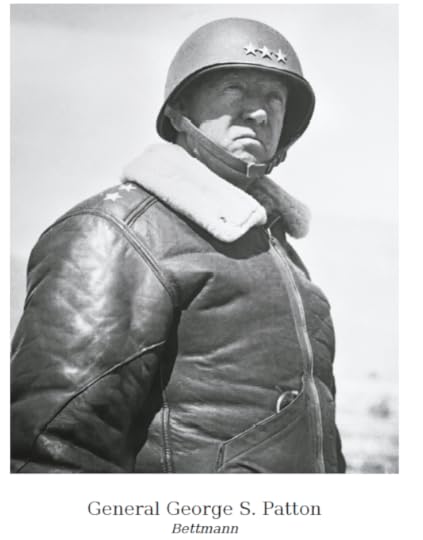
I did find the inclusion of many maps throughout and a picture section at the end there to be a valuable addition to the writing. I always appreciate supplemental material, especially in historical books. I'm including some of the pics here; mainly for my own future reference.
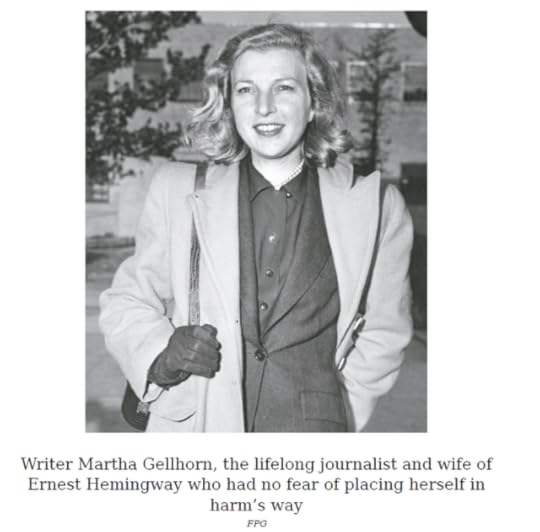
The Allied invasion of northern France on D-Day is depicted in this map:
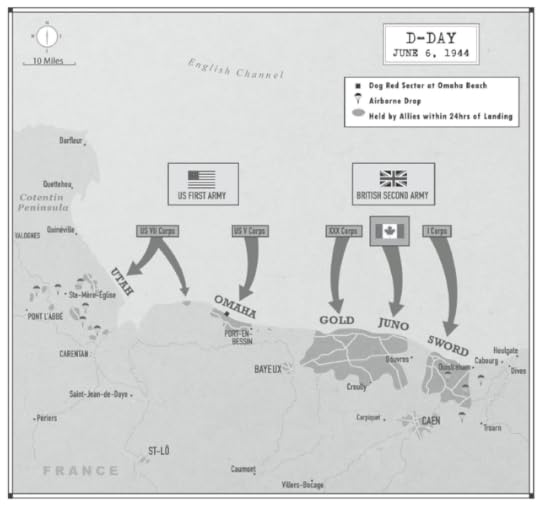
Some more of what is covered in these pages includes:
• The D-Day invasion
• The Allied liberation of Paris
• Germany's V1 and V2 Rockets
• The liberation of Holland
• Generalfeldmarschall Erwin Rommel; his desire to remove Hitler from power. His knowledge and complacency in the assassination attempt of July 20th.
• The Battle of the Bulge
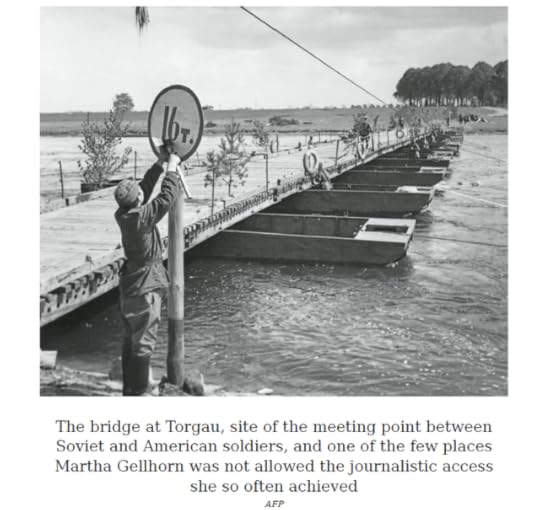
• Martha Gellhorn and Ernest Hemingway; their volitle relationship
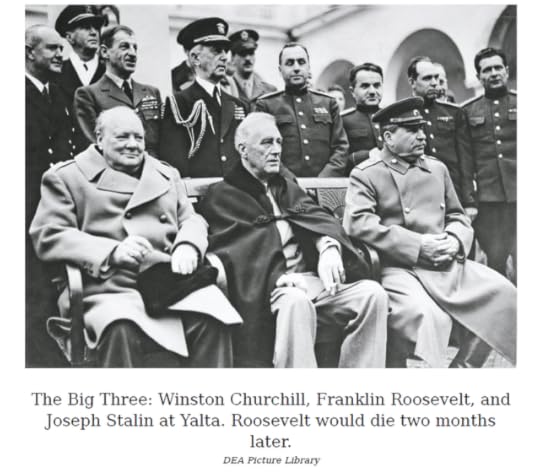
• The 1945 Yalta Conference
• The race between the West and the Red Army to take Berlin
Finally; unfortunately, and for reasons not known the author includes a bit of writing in the book's afterword that asserts that Vladimir Putin fixed the 2016 election to ensure a Trump win, writing "Putin had notably meddled in the 2016 United States presidential election, ensuring that a candidate favorable to his regime was elected."
The "Russiagate" conspiracy fiasco was a 4+ year fabrication with no merit. Aside from not being true, I'm not sure why it was included here in the first place, as it is not at all germane to the broader scope of this book...
**********************
I did enjoy Taking Berlin, but not as much as some of the other books about the Second World War I've read. There was something about the overall presentation of this book that just did not resonate with me as much as I'd hoped going in...
Thankfully it was not so long as to frustrate the reader.
3 stars.
Taking Berlin was a decent book, but it ultimately fell a bit short of my expectations...
Author Martin Dugard is an American writer living in Rancho Santa Margarita, Orange County, California. He and his wife have three sons. Dugard began writing professionally in 1988.
Martin Dugard:
The book opens with a somewhat unorthodox prologue. Instead of giving the reader an overview of the book's contents or aims, or providing a bird's eye view of the macro picture, the author hits the ground running and jumps right in to telling the story. I didn't really like this formatting, and I feel that a prologue outlining some broad-based stats and overview would have been more apropos for opening a book of this nature.
Dugard writes in a very matter-of-fact, no-frills manner that proceeds at a quick pace. To be honest, I was not particularly a fan of this terse writing style, either... Fortunately, the narration of the audiobook version I have was well done. The writing proceeds in a chronological fashion; bouncing between different viewpoints of the major belligerents in the European Theater.
I did find the inclusion of many maps throughout and a picture section at the end there to be a valuable addition to the writing. I always appreciate supplemental material, especially in historical books. I'm including some of the pics here; mainly for my own future reference.
The Allied invasion of northern France on D-Day is depicted in this map:
Some more of what is covered in these pages includes:
• The D-Day invasion
• The Allied liberation of Paris
• Germany's V1 and V2 Rockets
• The liberation of Holland
• Generalfeldmarschall Erwin Rommel; his desire to remove Hitler from power. His knowledge and complacency in the assassination attempt of July 20th.
• The Battle of the Bulge
• Martha Gellhorn and Ernest Hemingway; their volitle relationship
• The 1945 Yalta Conference
• The race between the West and the Red Army to take Berlin
Finally; unfortunately, and for reasons not known the author includes a bit of writing in the book's afterword that asserts that Vladimir Putin fixed the 2016 election to ensure a Trump win, writing "Putin had notably meddled in the 2016 United States presidential election, ensuring that a candidate favorable to his regime was elected."
The "Russiagate" conspiracy fiasco was a 4+ year fabrication with no merit. Aside from not being true, I'm not sure why it was included here in the first place, as it is not at all germane to the broader scope of this book...
**********************
I did enjoy Taking Berlin, but not as much as some of the other books about the Second World War I've read. There was something about the overall presentation of this book that just did not resonate with me as much as I'd hoped going in...
Thankfully it was not so long as to frustrate the reader.
3 stars.

March 28, 2024
A well written and brief history of the concluding months of WWII in Europe. The author, Martin Dugard covered all the well known events and battles from D Day, Market Garden, Battle of the Bulge, liberation of Paris, the discovery of the concentration camps and the final taking of Berlin by the Russian forces. Dugard writes with an easy flowing narrative. I found the book to be very informative and filled with interesting and surprising facts. The footnotes alone are just filled with nuggets of information.
I have enjoyed reading over a dozen histories by authors such as Martin Dugard, Bill O'Rielly (who co-authored many books with Dugard), and Brian Kilmeade. I love their style of writing history. To the point, drawing a clear picture without getting too deep into the weeds.
I have enjoyed reading over a dozen histories by authors such as Martin Dugard, Bill O'Rielly (who co-authored many books with Dugard), and Brian Kilmeade. I love their style of writing history. To the point, drawing a clear picture without getting too deep into the weeds.
September 29, 2022
An outstanding story regarding the three allied powers actions to defeat Germany and reach Berlin. The first hand accounts really enhance the story and the action that takes place. A must read for the history enthusiast.
Thank you to #NetGalley for the ARC in exchange for my honest review.
Thank you to #NetGalley for the ARC in exchange for my honest review.

May 18, 2024
There is could be titled “The Race to Berlin and Martha Gellhorn’s Wartime adventures”. There are a lot of story lines that are not completed, e.g. Col Browning. . .

July 24, 2022
Martin Dugard, the author of a number of books, principally in the area of popular history, has another hit on his hands. I am pleased to report that "Taking Berlin: The Bloody Race to Defeat the Third Reich" (graciously provided to me for review purposes in the form of an ARC by the publisher, Dutton Caliber of Penguin Group) is a marvelously engaging and engaged recounting of the events from D-Day to the collapse of Nazi Germany. Mr. Dugard's writing style, both anecdotal and well anchored in modern sources, is the kind of thing that creates its own audience. Focusing on the human side of the overarching story of the Third Reich's apocalyptic collapse, Dugard successfully paints a superb overview of the tale he is telling. While many books have covered the topic in far more detail, Cornelius Ryan comes to mind off hand, Dugard is tailoring his insightful and riveting narrative to a new generation of readers, lacking the context that so many of their predecessors brought to their reading as a consequence of their cultural background. I strongly recommend the book. I am very well versed in the material that Dugard is covering, and that said, even I learned some startling new perspectives as a result of my exposure to this text. Outstanding introduction to its subject!

January 31, 2023
An overview at the plans leading to the D-Day invasion and then the race between the Allied powers to gain control of Germany - freeing numerous towns and cities (and concentration camps that broke American hearts and increased their fervor) from the point of view of several prominent figures in the battles. The antagonism between Montgomery and Patton and the political juggling as Allied leaders maneuver and dance, conceding and cajoling even as they don't intend to follow through with the secret negotiations - Churchill and Stalin come to mind as they attempt to divide sections of Eastern Europe.
Interesting and certainly not as detailed as some books on these events are but it makes the final pushes into the hands of the general reading public rather than the dedicated historians and enthusiasts. And the additional people brought in - Martha Gellhorn's dedicated reporting and the Japanese-American 100th Infantry Battalion that contained several Congressional Medal of Honor winners for their avid participation in France and Italy.
But seriously, what is it about men and marking their territory - there were at least two instances where Dugard felt that it was important enough to include a couple generals urinating in the river as their troops passed across into the new territory. Ugh.
2023-013
Interesting and certainly not as detailed as some books on these events are but it makes the final pushes into the hands of the general reading public rather than the dedicated historians and enthusiasts. And the additional people brought in - Martha Gellhorn's dedicated reporting and the Japanese-American 100th Infantry Battalion that contained several Congressional Medal of Honor winners for their avid participation in France and Italy.
But seriously, what is it about men and marking their territory - there were at least two instances where Dugard felt that it was important enough to include a couple generals urinating in the river as their troops passed across into the new territory. Ugh.
2023-013

November 24, 2022
Very dry but 95% accurate.
I don't particularly like the style of his writing at all. Nor how he does summation. The last parts and afterword portions were barely 3 stars, IMHO.
But this is worth reading for Patton's speech before D-Day to the soldiers alone. That's 4.5 stars. He gets Eisenhower, Patton, Churchill quite well. Some others, IMHO, not so much. The graphics were maps that were very good but difficult to comprehend. Most of us are not generals.
I don't particularly like the style of his writing at all. Nor how he does summation. The last parts and afterword portions were barely 3 stars, IMHO.
But this is worth reading for Patton's speech before D-Day to the soldiers alone. That's 4.5 stars. He gets Eisenhower, Patton, Churchill quite well. Some others, IMHO, not so much. The graphics were maps that were very good but difficult to comprehend. Most of us are not generals.

May 30, 2023
Awesome book!

June 27, 2023
"War is a bloody, killing business. You've got to spill their blood, or they will spill yours. Rip them up the belly. Shoot them in the guts. When shells are hitting all around you and you wipe the dirt off your face and realize that instead of dirt it's the blood and guts of what once was your best friend beside you, you'll know what to do! I don't want to get any messages saying, 'I am holding my position.' We are not holding a goddamned thing. Let the Germans do that! We are advancing constantly and we are not interested in holding onto anything, except the enemy's balls. We are going to twist his balls and kick the living shit out of him all the time. Our basic plan of operation is to advance and to keep on advancing regardless of whether we have to go over, under or through the enemy. We are going to go through him like crap throught a goose; like shit through a tin horn!" - General George S. Patton, Jr.
This book was a fantastic read!
When Martin Dugard & Bill O'Reilly first came out with the first title in the Killing series, Killing Lincoln in 2011, I was immediately hooked. As a student of history and politics (although, I must admit that I do not care for O'Reilly's politics or Fox News at all), I really fell in love with their writing style, and have been hooked on the series and have purchased everyone since the first in 2011.
At the beginning of this year when I first came across the Taking series, with Taking Paris (2021) and Taking Berlin (2022) - which I don't know how I missed them over the past two years; but that is neither here nor there - I was skeptical because I saw Martin Dugard had written them; but I was worried they were a companion piece or exactly similar to Killing Patton (2015) or Killing the SS (2018). Similar to how O'Reilly does his companion pieces for kids, young adult readers, etc., on the Killing series. Upon further investigation I discovered that the titles are different from the Killing series and stand on their own.
One of the things I have found interesting with their books, or in this case Martin's book, is how he chooses which major/minor characters to focus on in the story. Whether they get a sentence, paragraph, a whole chapter, or a few chapters, is fascinating and is really what carries the narrative along. Mr. Dugard, if you're reading this, I would love to know how you choose who get mentioned in these books, based on your research, and the narrative you tell in these stories.
All that said, if you love history as much as I do, and if you love history on the Second World War, this is the book for you. You start with a week before the Allied invasion of France in June 1944, and run all the way up to the liberation of Berlin by the Allies in May 1945; similarly.
I highly recommened this book! I also can't wait to see if there will be a third in the series! I think Taking Stalingrad, Taking Rome/Sicily, Taking Tokyo, Taking Seoul, or even Taking Saigon would be great additions to this series!
This book was a fantastic read!
When Martin Dugard & Bill O'Reilly first came out with the first title in the Killing series, Killing Lincoln in 2011, I was immediately hooked. As a student of history and politics (although, I must admit that I do not care for O'Reilly's politics or Fox News at all), I really fell in love with their writing style, and have been hooked on the series and have purchased everyone since the first in 2011.
At the beginning of this year when I first came across the Taking series, with Taking Paris (2021) and Taking Berlin (2022) - which I don't know how I missed them over the past two years; but that is neither here nor there - I was skeptical because I saw Martin Dugard had written them; but I was worried they were a companion piece or exactly similar to Killing Patton (2015) or Killing the SS (2018). Similar to how O'Reilly does his companion pieces for kids, young adult readers, etc., on the Killing series. Upon further investigation I discovered that the titles are different from the Killing series and stand on their own.
One of the things I have found interesting with their books, or in this case Martin's book, is how he chooses which major/minor characters to focus on in the story. Whether they get a sentence, paragraph, a whole chapter, or a few chapters, is fascinating and is really what carries the narrative along. Mr. Dugard, if you're reading this, I would love to know how you choose who get mentioned in these books, based on your research, and the narrative you tell in these stories.
All that said, if you love history as much as I do, and if you love history on the Second World War, this is the book for you. You start with a week before the Allied invasion of France in June 1944, and run all the way up to the liberation of Berlin by the Allies in May 1945; similarly.
I highly recommened this book! I also can't wait to see if there will be a third in the series! I think Taking Stalingrad, Taking Rome/Sicily, Taking Tokyo, Taking Seoul, or even Taking Saigon would be great additions to this series!

July 3, 2025
I started this book before our trip to Germany but unfortunately I only got about 3/4 of the way through it before we left. I had it on audiobook only and I really couldn’t listen to anything on the trip so i finished upon my return. This is an engaging book with a lot of solid history about the taking of Berlin in April 1945. It goes into depth regarding the various generals leading the charge from America’s Patton and Bradley and Eisenhower to Britain’ s Montgomery. It profiles the political leaders - Churchill, Roosevelt, and Stalin - as well. It also focuses on the Soviet army and its progress from the east- the Soviets actually captured Berlin from the East as the Americans approached from the west, diverted somewhat by the liberation of Paris which allowed the Germans to retrench. Finishing the book after returning from Germany allowed me to put names and places together in a way I couldn’t before. A really interesting book.

April 1, 2025
Rating 4.25/5 (Not April Fools)
Taking Berlin by Martin Dugard is a thrilling account of the race for Berlin during World War II. It delivers a gripping experience that makes the history come alive in the present time. Dugard does an excellent job portraying historical events with accuracy while keeping the narrative engaging to the reader. His writing style immerses the reader and makes you feel like you’re alongside the soldiers like in a non-fiction action novel you’d get off the shelf. This makes learning about history easy and fun. The book additionally avoids watering itself down with endless detail, instead focusing on the most important events and portraying them clearly.
The main drawback for me was the frequent shifting between topics. The narrative constantly jumps between historical figures (for example, one chapter may be George Patton while the next is James Gavin while the next is Adolf Hitler). This makes it difficult to follow as you cannot fully grasp each individual’s role before the perspective shifts. This requires time to piece everything together.
Overall, Taking Berlin was a fantastic read that blended historical accuracy with an engaging narrative. Excellent choice for anyone desiring a historical read.
Taking Berlin by Martin Dugard is a thrilling account of the race for Berlin during World War II. It delivers a gripping experience that makes the history come alive in the present time. Dugard does an excellent job portraying historical events with accuracy while keeping the narrative engaging to the reader. His writing style immerses the reader and makes you feel like you’re alongside the soldiers like in a non-fiction action novel you’d get off the shelf. This makes learning about history easy and fun. The book additionally avoids watering itself down with endless detail, instead focusing on the most important events and portraying them clearly.
The main drawback for me was the frequent shifting between topics. The narrative constantly jumps between historical figures (for example, one chapter may be George Patton while the next is James Gavin while the next is Adolf Hitler). This makes it difficult to follow as you cannot fully grasp each individual’s role before the perspective shifts. This requires time to piece everything together.
Overall, Taking Berlin was a fantastic read that blended historical accuracy with an engaging narrative. Excellent choice for anyone desiring a historical read.

July 4, 2024
Learning history through the stories of folks that lived through it. Quick and engaging read.

July 13, 2023
Decent until the author mentions that Russia influenced the 2016 election

July 3, 2024
Pretty good book. Moves along and is interesting, but I must admit, I find it a little disconcerting that there are never any citations in the book. I'm sure he does research, but I guess he doesn't feel it necessary to prove most of the things he was saying. Didn't notice until in the afterward he mentions Russia having helped Donald Trump be elected in 2016. That is clearly a controversial and unproven statement, and he has no footnote for that. Dropped Dugard in my estimation a bit.

January 1, 2023
Fall 1944. Paris has been liberated, saved from destruction, but this diversion on the road to Berlin has given the Germans time to regroup. The American and British armies press on from the west, facing the enemy time and again in the Hürtgen Forest, during the Market Garden invasion, and at the Battle of the Bulge, all while American General George Patton and British Field Marshall Bernard Montgomery vie for supremacy as the Allies’ top battlefield commander. Dugard’s captivating nonfiction offers a fresh and welcome take on the last year of the Second World War, perhaps the most dramatic months in the past century. For military history buffs, a good read.

August 15, 2022
I received an ARC of “ Taking Berlin” by Martin Dugard from Net Galley. My thanks to the author, publisher and Net Galley.
“Taking Berlin” gives the reader a sort of Cliff’s Notes version of the Second World War in Europe from just before D- Day to the occupation of Berlin. In short chapters which usually feature a notable historical figure as a subject centerpiece, such as Ike, Patton, Rommel, etc. the reader follows wartime action. One of the characters is Martha Gelhorn, wife , at the time, of Hemingway and a war correspondent in her own right . She is someone I intend to read more about..
The writing is breezy and conversational, like a narration to a History channel documentary. Facts are presented in an readily understandable manner. The book is a decent primer for someone who knows a little of history of those times, and it could stoke up enough interest to lead a reader to read more widely . It is not for anyone who has read deeper historical accounts, and honestly, probably was not meant to be.
So taken for what it is, it is a good effort at a readable, smooth and light introduction to a deeply important era of recent history.
“Taking Berlin” gives the reader a sort of Cliff’s Notes version of the Second World War in Europe from just before D- Day to the occupation of Berlin. In short chapters which usually feature a notable historical figure as a subject centerpiece, such as Ike, Patton, Rommel, etc. the reader follows wartime action. One of the characters is Martha Gelhorn, wife , at the time, of Hemingway and a war correspondent in her own right . She is someone I intend to read more about..
The writing is breezy and conversational, like a narration to a History channel documentary. Facts are presented in an readily understandable manner. The book is a decent primer for someone who knows a little of history of those times, and it could stoke up enough interest to lead a reader to read more widely . It is not for anyone who has read deeper historical accounts, and honestly, probably was not meant to be.
So taken for what it is, it is a good effort at a readable, smooth and light introduction to a deeply important era of recent history.

August 7, 2024
aka: How the US Army, led by the indomitable General Patton, almost single-handedly defeats the German Nasties
Spoiler Alert: The Soviet Army Took Berlin
I did not realize Dugard is the co-author with former Faux News celeb Bill O'Reilly of the populist "Killing ... " series. Taking Berlin is NOT history, which requires careful citing of sources or at least a bibliography, and thoughtful analysis. This book is, as I saw somewhere, at best "narrative non-fiction." The year-long effort and sacrifice of the Soviet Army from the start of Operation Bagration to the fall of Berlin gets less notice than Nasty Minister of Propaganda's embellished and exaggerated exploitation of genuine Soviet atrocities in the first German village to be (briefly) captured by the Russians.
The Germans too are set out for "otherization:" "bullets fired by trained sadists deliberately taking aim at the dead and dying." Incongrous on its face, it gets worse. Dugard's chapter describes the actions of a US Army medic in rescuing wounded under fire, a feat which saw him awarded the Medal of Honor. The official US Army history of the action, in "Breakout and Pursuit," (B&P) notes that the German opposition, the 48th Division, was only able to mount "a feeble counterattack." (p 587, B&P). Earlier, B&P notes that the 48th was "far from impressive" and "without combat experience" (p 583). Wikipedia (I know, I know) says the 48th was formed in late 1942 in occupied Netherlands and "had a strong Polish representation throughout its ranks." Poland was of course the first country conquered by the Nasties in World War II.
Dugard likes to focus on a few individuals - 82nd Airborne Division commander General Gavin and his wartime lover journalist Martha Gellhorn predominate, along with Patton. One result is a focus on the 82nd during Operation Market-Garden ("A Bridge Too Far,) to the near-total exclusion of the 101st Airborne, and of the British 1st Airborne at the point of the spear in Arnhem. The massive Allied effort in the air gets reduced to a few fighter-bombers and C-47 transports. The US Navy is almost non-existent, the Royal Navy completely so. The Italian campaign gets fewer words than this review.
There are also dozens of niggling errors in the text, from anachronistic language to, e.g., exagerrating the top speed of the US P-47 fighter by a hundred MPH.
Intriguingly, the low ratings of this book quite largely take issue with a brief aside at the end of the book, where Dugard accurately notes Putin's 'meddling' in the 2016 US election, and how a named former US President "lauded" Putin's invasion of Ukraine.
Spoiler Alert: The Soviet Army Took Berlin
I did not realize Dugard is the co-author with former Faux News celeb Bill O'Reilly of the populist "Killing ... " series. Taking Berlin is NOT history, which requires careful citing of sources or at least a bibliography, and thoughtful analysis. This book is, as I saw somewhere, at best "narrative non-fiction." The year-long effort and sacrifice of the Soviet Army from the start of Operation Bagration to the fall of Berlin gets less notice than Nasty Minister of Propaganda's embellished and exaggerated exploitation of genuine Soviet atrocities in the first German village to be (briefly) captured by the Russians.
The Germans too are set out for "otherization:" "bullets fired by trained sadists deliberately taking aim at the dead and dying." Incongrous on its face, it gets worse. Dugard's chapter describes the actions of a US Army medic in rescuing wounded under fire, a feat which saw him awarded the Medal of Honor. The official US Army history of the action, in "Breakout and Pursuit," (B&P) notes that the German opposition, the 48th Division, was only able to mount "a feeble counterattack." (p 587, B&P). Earlier, B&P notes that the 48th was "far from impressive" and "without combat experience" (p 583). Wikipedia (I know, I know) says the 48th was formed in late 1942 in occupied Netherlands and "had a strong Polish representation throughout its ranks." Poland was of course the first country conquered by the Nasties in World War II.
Dugard likes to focus on a few individuals - 82nd Airborne Division commander General Gavin and his wartime lover journalist Martha Gellhorn predominate, along with Patton. One result is a focus on the 82nd during Operation Market-Garden ("A Bridge Too Far,) to the near-total exclusion of the 101st Airborne, and of the British 1st Airborne at the point of the spear in Arnhem. The massive Allied effort in the air gets reduced to a few fighter-bombers and C-47 transports. The US Navy is almost non-existent, the Royal Navy completely so. The Italian campaign gets fewer words than this review.
There are also dozens of niggling errors in the text, from anachronistic language to, e.g., exagerrating the top speed of the US P-47 fighter by a hundred MPH.
Intriguingly, the low ratings of this book quite largely take issue with a brief aside at the end of the book, where Dugard accurately notes Putin's 'meddling' in the 2016 US election, and how a named former US President "lauded" Putin's invasion of Ukraine.
February 11, 2024
Well, this was better than Taking Paris and I am glad he changed his writing style on the quick chapters that he had been doing with The Killing Series and Taking Paris. He let the story tell itself and it flowed a lot better. There were a lot of side notes that were good, and he didn't overdo it on them. But the story was really focused on events to getting to Berlin and was written with the last 9 months of the war happening.
One thing that you can note though is the title is 'Taking Berlin: The Bloody Race to Defeat the Third Reich.' I don't know if I agree with the title. There seemed to be a lot of underlining writing about the Soviets and Stalin and was it really a race to set up the next stages of the world with the Cold War and so forth. I don't think any of it was not true, just maybe a title like 'Taking Berlin: To Take Back Democracy.' Something like that.
One reason I had to knock off a star and probably should have been 2, but I enjoyed the book as a whole was his remarks that Russia interfered with our 2016 elections and alluded collusion to help their candidate, who they wanted to win get it. I assumed he meant Trump, because Trump was an outsider and Russia would have loved to see the clash of Democrats who just hate everything about him unfold for the next 4 years. Plus, they knew the Clinton's had a lot of money tied into Ukraine and wanted them not inferring with their invasion that happened after Trump left office. But it has been proven over and over there was no collusion with Trump and Russia. Also, Trump never said he wanted to end Churchill's "special relationship' with the downplaying the need for an Anglo-Amercian alliance. His feeling is that countries were not paying the same fees or even not paying at all for the UN alliance, and it wasn't fair. The US is paying the most and why don't they get more say in certain matters. I am not a Trump lover, but things need to be said or written correctly and fairly.
One thing that you can note though is the title is 'Taking Berlin: The Bloody Race to Defeat the Third Reich.' I don't know if I agree with the title. There seemed to be a lot of underlining writing about the Soviets and Stalin and was it really a race to set up the next stages of the world with the Cold War and so forth. I don't think any of it was not true, just maybe a title like 'Taking Berlin: To Take Back Democracy.' Something like that.
One reason I had to knock off a star and probably should have been 2, but I enjoyed the book as a whole was his remarks that Russia interfered with our 2016 elections and alluded collusion to help their candidate, who they wanted to win get it. I assumed he meant Trump, because Trump was an outsider and Russia would have loved to see the clash of Democrats who just hate everything about him unfold for the next 4 years. Plus, they knew the Clinton's had a lot of money tied into Ukraine and wanted them not inferring with their invasion that happened after Trump left office. But it has been proven over and over there was no collusion with Trump and Russia. Also, Trump never said he wanted to end Churchill's "special relationship' with the downplaying the need for an Anglo-Amercian alliance. His feeling is that countries were not paying the same fees or even not paying at all for the UN alliance, and it wasn't fair. The US is paying the most and why don't they get more say in certain matters. I am not a Trump lover, but things need to be said or written correctly and fairly.

February 10, 2024
Absolutely Outstanding ... This is one of the best World War II books I have read. It covers the advances by the Allied Forces in the European Theater from the invasion of Normandy on D-Day, June 6, 1944, to the final push by the Allied Forces to Berlin in May,1945. This narrative is well-written, and readers will come away with knowledge of the personalities of a few of the well-known leaders – Churchill, Eisenhower, Patton, Bradley, Gavin, Hitler, and Rommel, but will also learn about the lives and heroic actions of a few of the many not-so-famous enlisted soldiers and paratroopers in this war as the author gives them recognition. Another interesting character who shows up in several places, from Paris to Berlin, is a female war correspondent, Martha Gellhorn, who happens to be Earnest Hemmingway’s third wife. Threading Martha’s daring exploits into the story adds an interesting touch. Battle descriptions are graphic; the book is not for the faint of heart, but it is a must-read for history buffs. Absolutely outstanding! It certainly makes me want to read more of Martin Dugard’s works. - David B. Crawley, M.D. – Author of "Steep Turn: A Physician's Journey From Clinic to Cockpit" and “A Mile of String: A Boy's Recollection of His Midwest Childhood.”

November 3, 2025
3.5 stars rounded up
This is a perfectly serviceable work of popular history. In a sense, it's like reading the script for a World War II film. It's a straightforward narrative, devoid of footnotes, whose perspective is limited to a handful of individuals—Patton, General James Gavin, journalist Martha Gellhorn, Churchill and Stalin—whose stories are told in alternating chapters, much like the edits in a film.
Based on the title, I thought the book would concern itself with the Battle of Berlin, fought by the Soviets, while British and American troops halted at the Elbe river in accordance with an agreement between Stalin, Churchill, and Roosevelt. That battle is only mentioned in passing towards the end of the book; the main story covers D-Day through Paris through the Battle of the Bulge until the surrender of Germany. In other words, it's an overview of the American ground war in the European theater.
If you've watched Band of Brothers, or any World War II documentary, or read nearly any book on the subject, you already know this story. It's familiar. You'll learn very little you didn't know before. For me the only novelty was the inclusion of Martha Gellhorn, a name I'd heard in the context of her husband Ernest Hemingway, but I didn't know anything about her ballsy exploits as a journalist covering the war.
The book is a page-turner, eminently readable, but nothing you haven't seen before.
This is a perfectly serviceable work of popular history. In a sense, it's like reading the script for a World War II film. It's a straightforward narrative, devoid of footnotes, whose perspective is limited to a handful of individuals—Patton, General James Gavin, journalist Martha Gellhorn, Churchill and Stalin—whose stories are told in alternating chapters, much like the edits in a film.
Based on the title, I thought the book would concern itself with the Battle of Berlin, fought by the Soviets, while British and American troops halted at the Elbe river in accordance with an agreement between Stalin, Churchill, and Roosevelt. That battle is only mentioned in passing towards the end of the book; the main story covers D-Day through Paris through the Battle of the Bulge until the surrender of Germany. In other words, it's an overview of the American ground war in the European theater.
If you've watched Band of Brothers, or any World War II documentary, or read nearly any book on the subject, you already know this story. It's familiar. You'll learn very little you didn't know before. For me the only novelty was the inclusion of Martha Gellhorn, a name I'd heard in the context of her husband Ernest Hemingway, but I didn't know anything about her ballsy exploits as a journalist covering the war.
The book is a page-turner, eminently readable, but nothing you haven't seen before.

February 11, 2023
I don't think I had ever read a book about world war II before I read taking berlin. Probably the only generals I knew from world war II was George Patton JR. and Dwight Eisenhower.
From taking berlin I learned about Norman Cota, James Gavin. It was interesting in learning about them. I also liked learning about James Gavins relationship with Marth Gellhorn.
For me the most interesting reading was probably George Patton who I had heard about before but, knew next to nothing about.
Taking Berlin also talks about Marth Gellhorns efforts to cover world war II. I think for awhile she had credentials but, they were taken away and she still was able to cover the war. I had never heard about her before reading the book.
I had heard of D-day but most of the other battles I had never heard of before so it was enlightening reading about them.
What can I say about Taking Berlin except that I learned about things and people from world war II that I had not heard of.
One thing that surprised me was that George Patton died in a car accident in 1946. I thought he would have died in a battle.
From taking berlin I learned about Norman Cota, James Gavin. It was interesting in learning about them. I also liked learning about James Gavins relationship with Marth Gellhorn.
For me the most interesting reading was probably George Patton who I had heard about before but, knew next to nothing about.
Taking Berlin also talks about Marth Gellhorns efforts to cover world war II. I think for awhile she had credentials but, they were taken away and she still was able to cover the war. I had never heard about her before reading the book.
I had heard of D-day but most of the other battles I had never heard of before so it was enlightening reading about them.
What can I say about Taking Berlin except that I learned about things and people from world war II that I had not heard of.
One thing that surprised me was that George Patton died in a car accident in 1946. I thought he would have died in a battle.
February 5, 2023
Sometimes to tell historical tales, there are a couple of tracks. A writer can tell of historic events through key actions/locations/dates. Or, they can tell the tale through the lives of the individuals involved. For Taking Berlin, Dugard goes with the later. He covers the time between the Allied invasion of Europe in 1944 to the end of the war in 1945. In covering the war, he breaks the accounts up by offering biographical perspectives from players such as Patton, Eisenhower, Churchill, Bradley, Rommel, Gavin, Stalin and Gellhorn. An eclectic mix of political, military and other figures (Gellhorn being wife of Ernest Hemmingway and wartime correspondent).
It is a fast-moving and very readable account. The primary audience for this work will be those interested in the personalities associated with the war. The serious war scholar or one well-versed in the events and people of World War II will not take as much away from this book as other. The author is very much in Patton's camp that America could and should have made the run to Berlin to beat the Russians. He is mostly supportive of Eisenhower and the other figures in the book (even Stalin to an extent). Montgomery is not well-regarded here (very much the American perspective on the war). Agree or disagree, that is your role as the reader. Overall a decent read, but maybe not as informative as it could have been.
It is a fast-moving and very readable account. The primary audience for this work will be those interested in the personalities associated with the war. The serious war scholar or one well-versed in the events and people of World War II will not take as much away from this book as other. The author is very much in Patton's camp that America could and should have made the run to Berlin to beat the Russians. He is mostly supportive of Eisenhower and the other figures in the book (even Stalin to an extent). Montgomery is not well-regarded here (very much the American perspective on the war). Agree or disagree, that is your role as the reader. Overall a decent read, but maybe not as informative as it could have been.
January 1, 2023
Who’s the Talent?
With the same intense pace and suspense as the “Killing” series co-penned with media personality Bill O’Reilly, Martin Dugard takes us into the post-D-Day drive of the Allies and Soviet Union to take Berlin, defeat Nazi Germany, and end the war in Europe, with his compelling history, “Taking Berlin”. Dugard brings military tactics and strategy to life by humanizing the actors and action. It’s a pleasure to read and a challenge to put down. The only part that I thought could benefit from further exposition was the Battle of the Bulge, Hitler’s final grasp at victory. But after enjoying every page of this book, this reader finds himself asking what exactly O’Reilly brought to the “Killing” series. Did Dugard lead those efforts, or is O’Reilly also an effective mentor and developer of writing and research talent? The sole authorship by understudy Dugard loses nothing of its impact.
With the same intense pace and suspense as the “Killing” series co-penned with media personality Bill O’Reilly, Martin Dugard takes us into the post-D-Day drive of the Allies and Soviet Union to take Berlin, defeat Nazi Germany, and end the war in Europe, with his compelling history, “Taking Berlin”. Dugard brings military tactics and strategy to life by humanizing the actors and action. It’s a pleasure to read and a challenge to put down. The only part that I thought could benefit from further exposition was the Battle of the Bulge, Hitler’s final grasp at victory. But after enjoying every page of this book, this reader finds himself asking what exactly O’Reilly brought to the “Killing” series. Did Dugard lead those efforts, or is O’Reilly also an effective mentor and developer of writing and research talent? The sole authorship by understudy Dugard loses nothing of its impact.
June 13, 2023
Received a copy from Goodreads Giveaways.
It is a very easy read. It jumps around too much for me. Telling short stories about what went on during World War II. It doesn't touch much on the Title until the last chapters, and even that does not go into much detail. I felt let down.
Definitely a lot of research involved and it was interesting reading about untold heroics of everyday individuals and the sacrifices of many.
A couple of points troubled me: The one about Oscar Koch becoming a spy without further explanation. I did find out that he went to work for the CIA from another source. The other point was about Stalin knowing all about Operation Eclipse. Additional details on these suspicions would have been nice.
Just a light history lesson with too much emotion. Not for me. I gave it three stars because of the research involved.
It is a very easy read. It jumps around too much for me. Telling short stories about what went on during World War II. It doesn't touch much on the Title until the last chapters, and even that does not go into much detail. I felt let down.
Definitely a lot of research involved and it was interesting reading about untold heroics of everyday individuals and the sacrifices of many.
A couple of points troubled me: The one about Oscar Koch becoming a spy without further explanation. I did find out that he went to work for the CIA from another source. The other point was about Stalin knowing all about Operation Eclipse. Additional details on these suspicions would have been nice.
Just a light history lesson with too much emotion. Not for me. I gave it three stars because of the research involved.
April 29, 2025
I rarely write reviews longer than a sentence. However, this book is a combination of good and bad. On the good side, there are some poignant stories about leaders, battles, war criminals and heroes. Some, but not all, of the bad: (1) a weird and protracted detour into an affair between a journalist and the 82nd Airborne commander; (2) idolizing and deifying the 82nd commander with untrue assertions, such as he commanded the 82nd and 101st Airborne Divisions in the Battle of the Bulge - patently false as Gen McAuliffe of “Nuts!” fame commanded the 101st; and (3) gratuitously passing off as fact that Putin helped his favorite candidate Trump get elected in 2016 - irrelevant and debunked “history.” Why trash your book with such trash? If you’ve read Killing Patton, you’ve read 90% of this book. Three stars is generous.
This entire review has been hidden because of spoilers.
January 19, 2023
I enjoy M. Dugard’s books with Bill O’Reily and was looking forward to Taking Berlin. However Dugards writing style in Taking Berlin is different than the Bill O’Reily books. Taking Berlin didn’t seem to “ flow well”. Lots of short sentences or couple word description before the scene begins. To me it wasn’t a smooth reading style. Not enjoyable to me. The subject matter was good as I enjoy WW II history. Taking Berlin doesn’t provide much new material to an avid WW II reader but still fun to revisit key points in the war and those player’s pivotal to the moments. The information on Martha Gellhorn was interesting and has me wanting to read more on her WW II adventures. Just not my kind of writing style.
November 12, 2023
I was really excited to tackle this book after finishing Taking Paris (which I absolutely loved). However, I found this book a bit lacking in comparison to the first. I get that the subtitle was about defeating the Rhird Reich, but it seemed like a miss that nothing from the Soviet perspective was included (only British, American, and German). The Soviets actually entered Berlin after all, so to miss the event that actually titled the book. Regardless, this part of the war was more of a mystery to me, outside the Battle of the Bulge, so I enjoyed expanding my knowledge about the post Paris liberation part of the war. And, I still really enjoyed this tale and how reading about events I know will end a certain way can still be so thrilling!

October 3, 2024
I liked this one. It was a well told narrative, although the writer used some methods of description that I found annoying. Patton has been written about ad nauseum but i found the authors story of James Gavin to be interesting. It was funny to think about how he, the youngest allied commander in ww2, was played by an aging John Wayne in the film The Longest Day. At the end, the writer makes some frustrating comments about print is better than digital. I somewhat agree with that bias but I also found it dumb and pretentious. Just let people do what they want for themselves without denegrating their choice. It's really not that important of a point to make.
Displaying 1 - 30 of 88 reviews