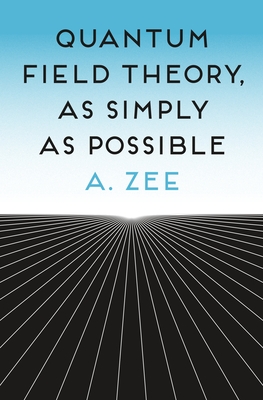
An exceptionally accessible introduction to quantum field theory
Quantum field theory is by far the most spectacularly successful theory in physics, but also one of the most mystifying. This venerable subject provides the crucial bridge between the long established quantum mechanics and the still hypothetical string theory. Quantum Field Theory, as Simply as Possible provides an essential primer on the subject, giving readers the conceptual foundations they need to wrap their heads around one of the most important yet baffling subjects in physics.
Quantum field theory grew out of quantum mechanics in the late 1930s and was developed by a generation of brilliant young theorists, including Julian Schwinger and Richard Feynman. Their predictions were experimentally verified to an astounding accuracy unmatched by the rest of physics. Quantum field theory unifies quantum mechanics and special relativity, thus providing the framework for understanding the quantum mysteries of the subatomic world. With his trademark blend of wit and physical insight, A. Zee guides readers from the classical notion of the field to the modern frontiers of quantum field theory, covering a host of topics along the way, including antimatter, Feynman diagrams, virtual particles, the path integral, quantum chromodynamics, electroweak unification, grand unification, and quantum gravity.
A unique and valuable introduction for students and general readers alike, Quantum Field Theory, as Simply as Possible explains how quantum field theory informs our understanding of the universe, and how it can shed light on some of the deepest mysteries of physics.
I'm a big sucker for anything cosmology or quantum, so when the cover of this book surfaced on my Twitter feed, I had to look it up. It promised to be a good balance between a pop-science book and a textbook. I was intrigued.
All I can say is that it's great. The writing style is fun, not dry. There are some formulas, but they're more for illustrative purposes.
What I liked about this book was the fact that it helped me build some simple mental models of what a quantum field is. How particles emerge from it. The author takes effort to link your school physics knowledge and use that to build out what's needed to comprehend and appreciate QFT.
Some other things I learned: * That E=mc^2 is a simplified formula. The 'real' version is E=m^2 + p^2. Can't wait for this come up in a pub quiz. * What does it mean when physicists say "unified theory." How electromagnetic, weak and strong interactions work and how they were unified. Also, where the formulas break down when trying to add gravity to a grand unified theory. * How Feynman diagrams work and how they translate to formulas. * That quantum black holes have little or nothing to do with cosmological black holes. * And much more I can't recall now.
The author also provides ample amount of end notes, and extensive bibliography, for further investigation, if you're so inclined.
Not sure I will apply this knowledge anywhere, but it tickled my curiosity and it was an enjoyable read. Win!
Excellent book! Fills the (large) gap between popular science books and text books, which was greatly needed in the area of quantum field theory. Written in an entertaining style that is neither dumbed down nor condescending, yet does not drown the reader in vague physics terms or unnecessary mathematics. Zee does not sacrifice details, but he never loses sight of the big picture. After reading this book, I feel I am ready to try Zee’s QFT Nut textbook!
Zee's laudable goal is to explain Quantum Field Theory to the lay public as "simply as possible". This calls to mind the words of Einstein which are often paraphrased as "Explanations should be as simple as possible, but no simpler." After reading the book my verdict is that Zee oversimplified QFT. Zee, like many theorists, is a fan of the path integral approach to QFT. The cornerstone of that approach is the Lagrangian density which is the expression that famously appears on T-shirts that claim to show all the laws of physics. The path integral is an extremely complex mathematical object, possibly not even well-defined for interacting fields. In practice, physicists resort to perturbation theory and renormalization when they need to make quantitative predictions. Sadly, Zee does not shed much light on the renormalization process. In the final section of the book, Zee effectively admits that he has oversimplified and strongly encourages the reader who wants a deeper understanding to read his textbook "Quantum Field Theory in a Nutshell". My copy has been gathering dust on my bookshelf for years. I'm now motivated to take another crack at it. In conclusion, the book is certainly worth reading, but don't expect to come away with anything more than a very cursory understanding of this very complex branch of theoretical physics.
Could use a better copy editor; lots of grammatical errors detract from the story.
Zee seems completely sold on the idea that the three non-gravitational forces have already been unified.
p. 130: "Even more importantly for the evolution of the universe a few minutes after the Big Bang, the electrons and the protons found each other to form neutral hydrogen atoms, thus making the universe (to first approximation) transparent to photons ..."
No, recombination occurred 378,000 years after the Big Bang, not a few minutes.
The job of science is to render transparent, that which God left opaque. The job of teaching, and of writing — same thing, really — is to make it transparent to me. In Quantum Field Theory, As Simply as Possible [QFT ASAP], does the author succeed?
tl;dr Yes.
No, I don't fully — understand it — understand it; but then that was not the expectation.
In his own book QED: The Strange Theory of Light and Matter [QED STLM], Richard Feynman precludes this expectation when he explicitly declares that he will describe quantum electrodynamics, but that the reader will not understand it. Okay. He then goes on to call his theory "absurd", to say the ideas of quantum mechanics are "crazy" — its very nature "peculiar".
Venerable chemistry professor Harry Sisler professed before an auditorium of undergraduates in 1986, that it is a central fact of modern physics that so many find disturbing, that so much of it is just not reasonable (emphasis his). Formidable physics professor Alan Jacobs advised a graduate student in his office (me) in 1990, that when doing physics, one must translate any problem into pure mathematics and then — while doing the mathematics — pretend that the physical world just does not exist (emphasis mine).
In the concluding chapter of QFT ASAP, A. Zee takes this one step further, declaring:
The classical world is an illusion.
Gobsmacked. Clearly that domain of Reality outside our Goldilocks existence, where the Firmament is not Newtonian, it is Lovecraftian — the underpinnings of necromancy — and were a man to truly and fully understand and embrace it, he would surely run screaming into the night in search of a cyclopean wall within a non-Euclidean space behind which to hide.
But, I digress.
It seems likely that QED STLM served as inspiration for QFT ASAP (at least in part). Zee contributes a foreword to the current edition of Feynman's book, which (alas) Feynman could not reciprocate. I myself read one soon after the other. It does not diminish Feynman's status as a larger-than-life figure, but Zee wrote the better book. (Gasp)
Zee invokes (with a megaphone) Feynman's words about mathematics being the native language of Nature and the importance of learning that language. Many do. Not to disagree, but many also fail to appreciate that the reader's native language is not mathematics, and so fail to make use of the full power of human words. These authors' efforts to bring an understanding of advanced physics within reach of those who have not (yet) paid their mathematical dues, are noble — God's work — a thing to be encouraged. Zee observes and remarks on how Feynman sometimes struggles to be clear without the use of clarifying mathematics. But then, Zee himself sometimes goes on to suffer the same struggle. It's good work, yes. But it's hard work.
It is noteworthy that in a number of places, Zee gives descriptions that are exceptionally clear, insightful, and illuminating. Yes, he introduced me to ideas that were new to me, thus sharpening my mental image of the natural world. But also, there were some things I half-understood, knew of without really knowing, that his description brought into sharp focus. This is why we read non-fiction.
In his foreword to QED STLM, Zee describes how Feynman's description of QED, though incomplete, is in no way incorrect. And in his own book, he addresses himself enough times to the "nit-pickers" — among whom I imagine he himself is chief — that I am confident the mental image I have been given, though it is only a sketch, is faithful to the full painting that it outlines. It is a minor point, but the chronological cast of characters and symbol definitions given in the backmatter are very nicely constructed.
As for the writing style, it is lively, conversational, fully caffeinated, frenetic, digressive — bordering on Charlie at the Murder Board. The author is opinionated (sometimes even catty), willing to venture to the edge of his subject, or to leave the subject entirely. He talks about the limits of what is known, what is not known, what is suspected. All of this is good. This could have been a sterile, bloodless slog through a barren land but was instead more of a Mad Hatter's Tea Party. And, everyone likes a tea party.
I save the quibble for last. The author makes extensive use of footnotes and endnotes, including footnotes that point to endnotes, though I don't think any of the endnotes contained footnotes. There is great stuff in there and I know the author used it, in part, to quarantine equations. But, the page-flipping was too much. It disrupted the book's flow and detracted from the reading. In particular, the cross-references, both internal to the book and external to the author's other books, were distractions for me. I'm sure they were difficult to compile. But, the cross-references should go. Reading the next book from this author, I will probably skip over any notes and accept the loss. Quibble concluded.
Quantum field theory is one of the most difficult subfields in physics. Not only does it require a very high level of mathematical skill, but it also demands a deep understanding of many areas of physics such as classical mechanics, quantum mechanics, special relativity, classical electrodynamics, and more. That is why you can find hundreds—if not thousands—of books on quantum mechanics that promise to make you an expert in quantum physics overnight, but you will not find such a book on quantum field theory written for ordinary people with no background in physics. And when I say that no such book on quantum field theory exists, I truly mean it.
Tony Zee’s book is the first book on this subject that genuinely attempts to explain quantum field theory to people who do not have a background in physics. It is not an easy book, because this is not an easy subject that can be discussed simply. For this reason, I believe Zee’s effort is highly commendable. Throughout the book, Zee honestly tells the reader that he has omitted many details because explaining many concepts without mathematics is extremely difficult and the book would be at least a thousands pages long—and I believe he is absolutely right in saying so. Quoting Feynman, he explains that without mathematics, you may perhaps grasp the general idea, but you will never fully see the true beauty of the universe.
Despite all other challenges, it is still a wonderful thing that now, at the very least, there exists a book in this difficult field that can be read by someone who has not formally studied physics. Reading it once may not provide complete understanding, because it remains a difficult subject and mathematical formulas are still present in many places. However, the good thing is that Zee makes a sincere effort to explain those formulas. I am fully convinced that even if a reader understands only thirty or forty percent of it, they will still gain a broad conceptual understanding of many ideas that exist on the frontiers of physics—or at the very least, become familiar with many important terms that can help them move further.
This book is valuable for both physicists and non-physicists alike. For physics students, it provides an intuitive foundation for their mathematical skills, and for non-physicists, it introduces them to many important ideas that they can pursue further if they wish.
In the end, I would simply say this: it is a beautiful subject, a beautiful effort, and a beautiful book. Reading it two or four times will not lessen the pleasure—it will only increase it.
I am truly grateful for "Quantum Field Theory, as Simply as Possible" by A. Zee. This exceptional book has left an indelible mark on my exploration of Quantum Mechanics.
What sets this book apart from popular science books on physics is its refreshing and captivating approach. Unlike others, it engages readers with its informative style, making complex concepts accessible and intriguing. As an individual with a background in electrical engineering and a strong mathematical foundation, I've struggled to find textbooks that cater to my thirst for a deeper understanding of the subject outside of formal courses. Thankfully, this book fills that void splendidly.
"Quantum Field Theory, as Simply as Possible" has proven to be a valuable stepping stone in my journey. Its entertaining yet educational style has propelled my understanding of intricate concepts in Quantum Field Theory. With such a fulfilling experience, I eagerly anticipate reading the author's other works, such as the QFT Nut or G Nut, hoping they maintain the same engaging approach that made this book exceptional.
In conclusion, I want to express my deepest appreciation and gratitude for "Quantum Field Theory, as Simply as Possible." A. Zee's book breathes new life into the realm of non-textbook physics literature. It is a unique and transformative reading experience that caters to individuals like myself, who seek to delve deeper into the subject matter. If you are passionate about Quantum Field Theory and desire an engaging journey, I wholeheartedly recommend this outstanding book.
Zee's "Simply" book is an excellent introduction to the conceptual basis of QFT and the new knowledge and understanding about fundamental natural law it has provided. Although I long ago took courses in quantum field theory, I still find that textbooks on this subject become bogged down with sophisticated mathematics to the extent that they somewhat obscure the underlying physics. Even though this book was over-simplified for a physicist, I chose to read it purely for the pleasure of having all the physical phenomena related to QFT laid out clearly with a minimum of mathematical distraction. Professor Zee is clearly a current expert in the field and this book is very authoritative and up-to-date. It's a good read for any physicist.
An original take on the “popular books on theoretical physics “ genre.
Parts I, II and III are really good: with a little bit of math (nothing crazy) the author tries really hard to take the eager reader by hand and walk him/her through the fundamentals leading to quantum field theory. I thought this was very successful.
From there, the book become a very good but much less original popular physics book. It abandons the strict language of the first three parts and starts to hand-wave as most of these kind of books aimed at the “public”. A bit disappointing. The last two chapters you can skip. Even more hand-waving and generic philosophy.
This book does what few QFT introductions manage: it stays readable while making the physics feel like it grows out of the equations rather than being added on afterwards. That is its real strength. It is still demanding, skips a lot of calculation, and is more a map than a course, but as a first conceptual pass it works.