A journal of formally promiscuous non-fiction. Tolka is a new, biannual literary journal of non-fiction; publishing essays, reportage, travel writing, auto-fiction, individual stories and the writing that flows in between.
Issue Two of Tolka features writing from a wide range of both emerging and established voices. The contents includes:
Niamh Campbell - How They Met Themselves Brenda Romero - Conception Jennifer Hodgson - An interview with Claire-Louise Bennett Nidhi Zak/Aria Eipe - Some Say the Devil is Dead Steven Methven - A Swiftish Life Brecken Hancock - Brave in Bed Liam Cagney - Club Oblivion Saskia McCracken - Sister; Worm Sonya Gildea - Quartets Stefani J. Alvarez, translated by Alton Melvar M. Dapanas - From The Ninety-Nine Names of Those I Love the Most Roisin Kiberd - Bezos in Space Lydia Hounat - These Mutilated Angels
Non-Fiction Shorts Review of the 2nd issue of Tolka Journal (December, 2021)
I was lucky enough to discover Tolka Journal from its very first issue. The variety of topics and story styles impressed me quite a bit and I subscribed to further issues immediately. This second outing stretches the boundaries of 'non-fiction' formats even further with such examples as telling a story via game play rules, prose poems and some imagined events (which definitely come across more as fiction). I enjoyed it quite a lot even if some of the themes were rather abstract and verged on experimental writing.
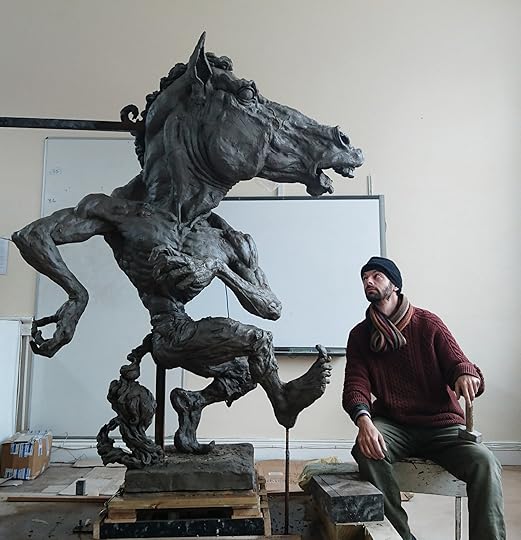
1. How They Met Themselves by Niamh Campbell. A childhood memory of meeting a drunk vagrant is imagined as if it were a time travel meeting with an ancestor. 2. Conception by Brenda Romero. The procedure of fertility clinics in various jurisdictions are written out as if they were part of a board game played with 4-sided & 6-sided dice. 3. An interview with Claire-Louise Bennett by Jennifer Hodgson. Interview questions related to the publication of Checkout 19 (UK August 2021, USA March 2022). 4. Some Say the Devil Is Dead by Nidhi Zakaria Eipe. Describing the controversies surrounding Roberto Cuoghi's Pazuzu (Italy, 2008) sculpture of an Assyrian demon god and of Aidan Harte's Púca (Irish for spirit) (Ireland, 2021) sculpture commissioned by Ennistymon, County Clare, Ireland but rejected because of its 'grotesque' nature.
Photograph of the artist Aidan Harte and his sculpture. Image sourced from Twitter.
This article also had interesting information which was new to me about the origin of the word grotesque which is from 'grottesca' (Italian: from the cave, from the grotto) used to describe paintings on the walls of the basement of an unfinished palace of the Emperor Nero. 5. A Swiftish Life by Steven Methven. Observation of the migration of swifts to Leipzig, Germany with the interposed true life story of Sarah Ann Henley (1862-1948) who survived a suicide jump off a bridge in Bristol in 1885 as the air currents lifted her up due to her crinoline dress and helped slow her fall like a parachute. 6. Brave in Bed by Brecken Hancock. The author spends a sleepless night while looking at their smartphone and fixating on stories about a condemned criminal who donated his body to science. 7. Club Oblivion by Liam Cagney. Reporting on the closing night party at the Cocktail d'Amore nightclub in Griessmühle, Berlin. The author has previously written about the club's 10th year anniversary in The Guardian December 10, 2019. 8. Sister; Worm by Saskia McCracken. The author works as a volunteer sorter for entries to an Arts Award competition for prison inmates while pondering the activities of earthworms. 9. Quartet by Sonya Gildea. An abstract stream-of-consciousness prose poem in 4 parts with a Coda. This one was difficult to follow but did seem to centre around visits to a bedside. 10. From The Ninety-Nine Names of Those I Love the Most: Four Dagli From Saudi Arabia by Stefani J. Alvarez translated from the original Filipino language by Alton Melvar M. Dapanas. The introductory note about the difficulties of translation was interesting. The very short stories (given in both Filipino and English) about an affair with a Saudi were not. 11. Jeff Bezos Talks to God by Róisín Kiberd. This one starts to enter into the fictional realm. Jeff Bezos' 11 minute sub-orbital space flight of July 20, 2021 is described and imagined as him seeking to talk to God. 12. These Mutilated Angels by Lydia Hounat. Walking home in the very early morning hours with an homage to the ambient electronic music of Burial's Ashtray Wasp.
Trivia and Link Tolka Journal are currently accepting submissions for the 3rd Issue which is expected to be published in Spring, 2022. The deadline for submission is Thursday January 27, 2022 and submissions can be made at their website here.
I edited my review of Tolka Journal Issue 1 in order to add links to some of the non-fiction stories that they have now made available to read online.
Hard to review such a collection of diverse stories. Some gripping , heartfelt descriptive writing , sprinkled with some non-fiction that went over my head.