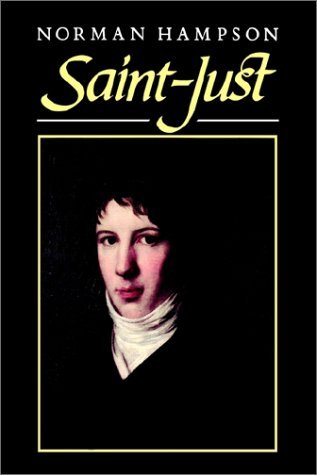
A politician in the midst of a revolutionThis book reveals the powerful political figure of Saint-Just and his role in French history. It follows his career during the French Revolution that broke out in 1789. He moved into politics in his twenties as a utopian. He spoke in favor of executing the king of France and was elected to the Committee of Public Safety, the revolutionary government, in 1793. The book looks at how his original desire to improve society became an obsession for scourging a country of its ills. The book traces the path of Saint-Just until his execution in 1794.
Norman Hampson was the Professor of History at the University of York from 1974 to 1989 and fellow of the British Academy in 1980. He specialised in the French Revolution and European Enlightenment. During the Second World War Hampson's service in the Royal Navy included two years as liaison officer with the Free French Navy.
Such a fascinating figure, such a dry as the desert read. I tried to read this years ago but gave up somewhere in the middle because it was such a slog. Hampson doesn't appear to even try to see his subject as a human being rather than just a collection of speeches and political ideas, leaving the reader with little more sense of Saint-Just's personality than they had going in.
Saint-Just is one of the most fascinating figures of the French Rev in my mind ~ and a rather shadowy one ~ but I wasn't thrilled with this biography. Though I generally liked where Hampson was coming from (i.e. S-J was a turkey of the first magnitude) yet by the time I'd finished reading it I felt I didn't know much more about him than I had done after reading Palmer's beautiful "Twelve Who Ruled"; the Twelve being the members of the infamous Committee of Public Safety of 1793-94, and S-J being only one of them, and not the one most focused on.
Hampson's style I found a little hard to get into, and rather than seeing S-J as a man ~ a man with friends (or not), relationships, daily interchanges, etc ~ I could only see him in terms of the vague "history" of his political thought and its contradictions, and clearly Hampson thinks very little of his thought altogether, as S-J in this light is seen as fairly changeable an immature. I'm starting another bio of S-J, and already am on my way to taking more notes on it in the first 30 pgs than I had throughout the whole of Hampson's work. To give it the benefit of the doubt, however, this might (italics needed on "might") be a work to return to as an interesting analysis once I feel I have a better grasp on the outline of S-J's life.