French literary figures, including Molière and Jean de la Fontaine, gathered at Auteuil, a favorite place.
People know and consider Molière, stage of Jean-Baptiste Poquelin, also an actor of the greatest masters in western literature. People best know l'Ecole des femmes (The School for Wives), l'Avare ou l'École du mensonge (The Miser), and le Malade imaginaire (The Imaginary Invalid) among dramas of Molière.
From a prosperous family, Molière studied at the Jesuit Clermont college (now lycée Louis-le-Grand) and well suited to begin a life in the theater. While 13 years as an itinerant actor helped to polish his abilities, he also began to combine the more refined elements with ccommedia dell'arte.
Through the patronage of the brother of Louis XIV and a few aristocrats, Molière procured a command performance before the king at the Louvre. Molière performed a classic of [authore:Pierre Corneille] and le Docteur amoureux (The Doctor in Love), a farce of his own; people granted him the use of Salle du Petit-Bourbon, a spacious room, appointed for theater at the Louvre. Later, people granted the use of the Palais-Royal to Molière. In both locations, he found success among the Parisians with les Précieuses ridicules (The Affected Ladies), l'École des maris</i> (<i>The School for Husbands</i>), and <i>[book:l'École des femmes (The School for Wives). This royal favor brought a pension and the title "Troupe du Roi" (the troupe of the king). Molière continued as the official author of court entertainments.
Molière received the adulation of the court and Parisians, but from moralists and the Church, his satires attracted criticisms. From the Church, his attack on religious hypocrisy roundly received condemnations, while people banned performance of Don Juan. From the stage, hard work of Molière in so many theatrical capacities began to take its toll on his health and forced him to take a break before 1667.
From pulmonary tuberculosis, Molière suffered. In 1673 during his final production of le Malade imaginaire (The Imaginary Invalid), a coughing fit and a haemorrhage seized him as Argan, the hypochondriac. He finished the performance but collapsed again quickly and died a few hours later. In time in Paris, Molière completely reformed.
Here is an author who knows how to write a play. When it comes to comedy, none amuses me the way he does. His wit and social satire brought forward through humorous dialogues and dramatic actions are so entertaining. His plays transport you to a theatre, and though you read it, you almost feel like watching it performed.
Moliere was a social critique who displayed his views through his satirical plays. Quite often he got into trouble for his bold presentation of society in its truthful light. In The Misanthrope, too, Moliere keeps true to his social criticism. But here, he goes one step further. In addition to his usual social critique, The Misanthrope questions the motives of those critics of society. Are they criticizing their fellow men out of a pure motive to rectify them, or are those criticisms the outcome of their egotism? I enjoyed this exposition into the human mind, which I've not encountered in-depth in other Moliere plays I've read.
The Misanthrope is a character-driven play which was another difference from other Moliere plays. We have a strong set of characters in this play, and they are quite interesting as well. The most interesting and dominant one is Alceste, the misguided misanthrope. His misanthropy is curiously compelling, and it binds and unites the acts and scenes of the play. Through Alceste, Moliere exposes the inner and outer contradictions of the human mind and shows that even the critics are sometimes driven by impure motives and that they too can be erroneous in their judgment.
Moliere's plays have a curiously uplifting effect. They are not deep in their stories, yet quite thought-provoking. He keeps to a lighter tone while creating something quite deep. I find this style of his very appealing.
I read Richard Wilbur's translation as always. I personally think that he brings out the essence of Moliere's plays brilliantly. Also, the fact that the translation was in verse doubled my enjoyment. Rhyming dialogues, wit, and humour! What more do you need? :)
This play was written in the 17th century and it is so contemporary, because of that feeling of rejection towards society and almost everything that surrounds it. And... the subsequent isolation that the person feels, of course.
It happens all the time. People who are sick of other people but then, they can't stand that deep loneliness they find. They were never ready for it, and they end up believing they are indeed cursed or something and kind of give up, accepting that miserable existence; very Harry Haller. They might accept it until they find that special someone that dislikes that side of the world, too. That "What! You too? I thought that no one but myself..." moment. Or they die alone, whatever comes first.
So, 17th century, today. No matter the time or place, some people feel like outsiders, and that brings, inevitably, alienation. That "other people" start to look at them like the personification of abnormality. Like human beings that just hate humanity for the hell of it. Like misanthropes. And that is the word that led me to this book. I wanted to read this one because I used to think I was one of them.
Back to the book. It is an insightful play about the essence of human nature, our virtues and flaws. Molière brilliantly portrayed the hypocrisy of its time through Alceste, the protagonist. A man with a profound existential conflict that fell in love with Célimène, a 17th-century French Holly Golightly. Oh, yes, that can't go wrong, right?
I really enjoyed reading this book. Funny stuff with actually some meaning.
Se a humanidade, de repente e sem aviso prévio, desatasse a dizer apenas a Verdade e nada mais que a Verdade, que efeitos sociais surtiria?
Será esse o caminho para a paz generalizada ?
Ou um rastilho para um conflito caótico? ...........
Nesta peça satírica, por intermédio das vozes de Alceste e Philinte, a Honestidade Radical é confrontada com a Hipocrisia Social!
Alceste defende a Verdade Absoluta! Incondicional! Custe o que custar , doa a quem doer , a Verdade tem que ser proferida.
Philinte é cauteloso e calculista. Há verdades melindrosas capazes de enfurecer os egos mais sensíveis e ele evita-as, procurando dar-se bem com todos. Sacrifica a Verdade em prol dum bem maior — Paz. Mas trata-se duma paz periclitante, erguida sobre alicerces de falsidade, capaz de ruir a qualquer instante!...
Se pensarmos como a verdade é muitas vezes ofensiva, é bem possível que uma prática repentina da verdade absoluta redundasse inicialmente num conflito generalizado. Porém, é inerente ao ser humano uma busca continua pela Verdade , um culto inato pelo Autêntico! Assim, após uma fase inicial de caos desordeiro , como é na Verdade que a Essência do Homem se revela, estariam criadas as fundações para uma Humanidade Autêntica, despida de máscaras sociais, onde cada um ocuparia o lugar certo no Grande Puzzle. A longo prazo, a resultante seria uma Paz e Harmonia naturalmente instituídas!...
Misanthropy can be defined as hating human beings for having the nerve to be human. The misanthrope, himself a member of the human species, sets himself up on a lofty pedestal from which he can look down and denounce the follies and weaknesses of his fellow humans. The misanthrope savours his sense of moral superiority, while offering no remedy, no suggestion for reform, no ideas for how to make things better for poor flawed humankind. The pose of the misanthrope is fundamentally self-aggrandizing and ultimately self-defeating – all of which Molière makes clear in his 1666 play The Misanthrope.
The 17th century was a landmark era for French drama, largely because of Molière. Where Jean Racine specialized in stark, classically influenced tragedy, Molière made the comedy of manners his true métier. The France of King Louis XIV – a place where the most appalling crimes and misdeeds could be committed under the cover of flawlessly polite conduct – was, arguably, the perfect place for a comedian of manners to perfect his craft: indeed, there was a persistent and longstanding rumour (albeit one unsupported by the facts) that Louis XIV once invited Molière to dine with him at Versailles!
In point of fact, dinner for two with France’s Sun King was not in the cards for Molière, whose interactions with the French Government were much more problematic than that. By the time Molière wrote The Misanthrope, two of his most recent plays, Tartuffe the Hypocrite (1664) and Dom Juan (1665), had been banned by the French royal government for supposed anti-clerical and anti-government attitudes. The Misanthrope avoids such potential troubles by keeping its satirical focus solely on the way in which people interact and treat one another in the Parisian high society of Molière’s time.
The misanthropic title character of Molière’s play is Alceste, a man who takes pride in rejecting the polite social conventions of the Paris of his time, and seems to embrace the isolation that results, insisting that “I would have people be sincere, and that, like men of honor, no word be spoken that comes not from the heart” (p. 1).
Alceste’s friend Philinte, a young man of good will, suggests that one should try to reciprocate shows of good feeling from others, but Alceste is unpersuaded, stating that “Preference must be based on esteem, and to esteem everyone is to esteem no one. Since you abandon yourself to the vices of the times, zounds! – you are not the man for me. I decline this over-complaisant kindness, which uses no discrimination. I like to be distinguished; and, to cut the matter short, the friend of all mankind is no friend of mine” (p. 1).
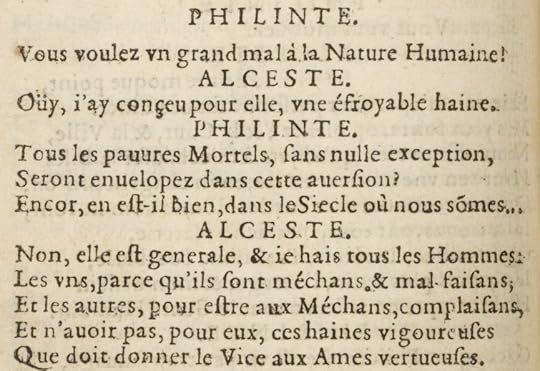
Alceste’s view of humankind is singularly grim – “Everywhere I find nothing but base flattery, injustice, self-interest, deceit, roguery. I cannot bear it any longer: I am furious; and my intention is to break with all mankind” (p. 2). And when Philinte, seeing the grossly essentialist quality of Alceste’s misanthropy, asks if there are no exceptions to Alceste’s harsh attitude toward human beings, Alceste insistently replies, “No, they are all alike; and I hate all men: some, because they are wicked and mischievous; others, because they lend themselves to the wicked, and have not that healthy contempt with which vice ought to inspire all virtuous minds” (p. 3).
Philinte, a voice of reason (and something of a choral figure), urges Alceste, in a spirit of Enlightenment rationality, to moderate this harsh outlook, stating that “Good sense avoids all extremes, and requires us to be soberly rational. This unbending and virtuous stiffness of ancient times shocks too much the ordinary customs of our own; it requires too great perfection from us mortals; we must yield to the times without being too stubborn; it is the height of folly to busy ourselves in correcting the world” (pp. 3-4).
In that connection, Philinte points out that Célimène, the beautiful young woman whom Alceste loves, has faults of her own, and asks, “How comes it that, hating these things as mortally as you do, you endure so much of them in that lady? Are they no longer faults in so sweet a charmer? Do you not perceive them – or if you do, do you excuse them?” Alceste replies that “I confess my weakness; she has the art of pleasing me. In vain I see her faults: I may even blame them; in spite of all, she makes me love her. Her charms conquer everything, and, no doubt, my sincere love will purify her heart from the vices of our times” (pp. 5-6). Here, one sees the arbitrary and illogical qualities of Alceste’s misanthropy: he can’t admit that he desires Célimène because she is beautiful, charming, and much-sought-after; rather, he must tell himself lies to the effect that his “sincere love” will somehow “purify her heart” in a sort of redemptive act.
Philinte points out that Célimène’s cousin Éliante, who also fancies Alceste, possesses qualities of stability and sincerity that Célimène lacks. When Philinte suggests that Éliante would be a better match for Alceste, Alceste replies that “It is true: my good sense tells me so every day; but good sense does not always rule love” (p. 6).
Alceste’s life of comfortable, smug, self-satisfied misanthropy becomes more complicated when Oronte, a well-connected nobleman who is one of Célimène’s other suitors, shares his new sonnet with Alceste. Alceste is cruelly dismissive of Oronte’s literary efforts – from his point of view, he is simply being “honest” – but he has now publicly insulted an aristocrat with powerful connections at the highest levels of the French court. Alceste’s arrogant decision to make an enemy of Oronte will have consequences for the misanthrope later on.
With all the build-up regarding Célimène’s beauty and her character flaws, the reader or playgoer is likely to be anxious to meet her – and she is indeed a tour de force of a character. As the first conversation of the play between Alceste and Célimène unfolds, one gets the sense that Alceste’s efforts to “correct” Célimène’s behaviour will be unavailing. When Alceste insists that “Too many admirers beset you; and my temper cannot put up with that”, Célimène blithely replies by asking, “Am I to blame for having too many admirers? Can I prevent people from thinking me admirable? And am I to take a stick to drive them away, when they endeavour by tender means to visit me?” (p. 13). Clearly, Célimène likes being admired; her vanity at being much-sought-after matches Alceste’s excessive self-regard at his supposed “honesty.” As for Alceste, the I-love-you-against-my-own-will quality of his expressed affection for Célimène makes it understandable why Molière gave this play the alternate title l'Atrabilaire amoureux (The Cantankerous Lover).
Clitandre and Acaste, two marquises who are also courting Célimène, come to visit. Alceste wants to leave, but Célimène insists that he stay. During the visit, Clitandre and Acaste, like conventionally gallant would-be lovers, both insist that they see no faults in Célimène; Alceste, as always, insists on going his own way when it comes to courtship: “The more we love any one, the less we ought to flatter her. True love shows itself by overlooking nothing” (pp. 19-20). It makes one wonder: are Célimène’s attentions to Alceste part of her vanity? Is it a case of “I’m such a beautiful and charming woman that I can even make France’s most notorious misanthrope love me”?
The theme of hypocrisy – of inconsistency between how people define good behaviour, and how those same people actually behave in private life – is as prevalent in The Misanthrope as it was in Tartuffe the Hypocrite. When Arsinoé, an older friend of Célimène, goes to Célimène to suggest that Célimène’s entertaining of so many gentlemen who come-a-courting is compromising her reputation, Célimène is unsparing in pointing out the inconsistencies between Arsinoé’s own words and actions:
As I see you prove yourself my friend by acquainting me with the stories that are current of me, I shall follow so nice an example, by informing you what is said of you. In a house the other day, where I paid a visit, I met some people of exemplary merit, who, while talking of the proper duties of a well-spent life, turned the topic of the conversation upon you, madame. There, your prudishness and your too-fervent zeal were not at all cited as a good example. This affectation of a grave demeanour, your eternal conversations on wisdom and honour, your mincings and mouthings at the slightest shadows of indecency…that lofty esteem in which you hold yourself, and those pitying glances which you cast upon all, your frequent lectures and your acid censures on things which are pure and harmless; all this, if I may speak frankly to you, Madame, was blamed unanimously. What is the good, said they, of this modest mien and this prudent exterior, which is belied by all the rest? She says her prayers with the utmost exactness, but she beats her servants and pays them no wages. She displays great fervour in every place of devotion, but she paints and wishes to appear handsome. She covers the nudities in her pictures, but loves the reality. (p. 26)
Well, sacre bleu! Drop the mike! Célimène, like Alceste, seems to have her own gift for merciless anatomizing of the flaws of others. But what Célimène does not realize, at this point in the play, is that the wounded Arsinoé will have her own opportunities to repay Célimène’s unkindness in just the same sort of coin-of-the-realm that Célimène has been spending so freely.
Meanwhile, Alceste’s secure existence of smug, complacent, above-it-all misanthropy has started to fall apart. His maladroit servant Du Bois warns Alceste that, because of his earlier harsh criticism of Oronte’s poetry, “you are threatened with arrest”, and that “for your very life you must get away from this” (p. 42). It seems that giving a negative review to an aristocrat’s poetic effusions, in the France of these times, can have some serious consequences. Alceste’s subsequent reflections on human character and potential take on an even grimmer tone than usual, in spite of Philinte’s perfectly rational suggestion that “All human failings give us, in life, the means of exercising our philosophy” (p. 44).
As all of Célimène’s suitors gather, Arsinoé orchestrates the revelation of a series of letters in which Célimène has assured each of her suitors that he is “the one,” the favourite of her heart, while insulting, behind their backs, other suitors whom she has praised to their faces. This revelation leads to one final, scarring conversation between Alceste and Célimène, two misanthropes who are only too well-matched – and only Philinte and Éliante, as young people of good will who try to find a balance between respecting society’s conventions and being true to oneself, are left to offer some measure of hope for poor, despised humankind.
Molière played the misanthrope Alceste when The Misanthrope was first staged at Paris’s Théâtre du Palais-Royal in 1666, and it is interesting to wonder how the playwright may have found himself relating to this most famous of his characters. Molière had made a name for himself through unsparing depictions of the character flaws of people of his time; did he worry that the habit of doing so might ultimately make him an Alceste-like misanthrope, capable of seeing the faults of others while unable to see, or do anything about, his own flaws? Whatever the case might be, The Misanthrope remains a consistently funny play that, in the best tradition of classical comedy, addresses serious issues in a devastatingly perceptive way.
Un peu long par moments mais je dois avouer que c’est assez hilarant (je ne sais pas pourquoi je ne m’y attendais pas, car c’est littéralement une comédie). Je suis toujours frappée lorsque je lis une oeuvre datant d’il y a très longtemps et que les concepts s’appliquent encore tellement à aujourd’hui…. Célimène et Alceste be spitting those facts
Honnêtement ça me donne envie de taste test du molière en mode lecture pour le plaisir!! Très contente d’avoir lu ça pour l’école stun tsi bonbon
Je n'avais plus lu Molière depuis le collège. Quelle erreur! Cette pièce écrite en 1666 nous place à Paris dans l'ambiance des salons parisiens, où la noblesse se retrouve pour se livrer à ses activités favorites: la conversation, l'amour et le dénigrement. Le héros, Alceste (le fort, en grec), semble avoir été jeté la veille dans ce milieu tant il y détonne; doté d'une sensibilité à fleur de peau, il ne peut souffrir d'être le témoin des caresses hypocrites que toute cette société policée se prodigue sans être enflammé par une prompte indignation - le Tasse disait qu'elle est la pierre sur laquelle s'aiguise la vertu - mais elle donne à notre héros du ridicule par ses colères intempestives. Notre héros, pour être cohérent avec lui-même, se fait une loi de ne pas verser dans ce travers qui l'insupporte, et lorsqu'il est pressé de donner son avis sur les gens, il préfère les blesser par sa sincérité plutôt que de mentir, ne laissant ainsi pas de susciter de profondes inimitiés dans ce monde où l'apparence et la réputations sont tout, et il faut la dévouée sollicitude de son amis Philinte pour que les choses ne tournent pas trop à son désavantage.
Plutôt que de se conformer aux usages comme son ami le presse, et de faire meilleurs visage à son prochain, il met sa probité au dessus de tout, préférant comme Socrate souffrir d'une injustice plutôt que la commettre. Il y a ainsi en lui bien plus du Don Quichotte que du Timon d'Athènes, et sa morale semble s'inspirer de celle de ses pères, plutôt que des nouveaux usages des courtisans, théorisés par Baldassare Castiglione, et surtout Baltasar Gracián. Pour déclarer sa flamme, il préfère la rusticité virile et authentique d'une vieille chanson populaire, à la fadeur artificielle d'un sonnet à la mode qui enfile les clichés comme des perles.
Alceste aime Célimène, une belle jeune femme, mais qui donne dans la coquetterie : elle presse les hommes à s'engager, sans jamais qu'elle ne s'engage elle-même. C'est ainsi qu'elle s'entoure d'une cour de soupirants qui chacun reçoit des espérances, ce qui ne manque pas de donner de l'humeur à notre pauvre héros, à qui cet amour vache donne le méchant rôle de jaloux. Va-t-il enfin avoir une explication ? Je n'en dit pas plus pour ne pas dévoiler l'intrigue.
Cette pièce est un véritable feu d'artifice de références aux auteurs classiques de l'antiquité. Bâtie sur le modèle de la nouvelle comédie de Ménandre et de Térence, plébiscitée par Plutarque par rapport aux comédies d'Aristophane, elle emprunte aux Caractères de Théophraste (eux-même copiés par La Bruyère) lorsque Célimène croque les ridicules de la cour, à Horace (lui-même repris par Boileau, ami de Molière) lorsque Célimène s'explique avec Arsinoée, à Lucrèce lorsque Éliante expose comment les amoureux déguisent en grâces les disgrâces, au Timon de Lucien lorsque la colère d'Alceste éclate, sa morale est celle de Plutarque dans 'de la fausse honte', comme celle de Philinte qui prêche la modération. Molière est associé à la langue française, comme Camoes, Dante, Cervantes, Goethe, et Shakespeare le sont pour les leurs. Cette pièce dense et riche a suscité les interprétations les plus variées et contradictoires (on devine les sentiments de Rousseau!), et a même inspiré des auteurs à imaginer des suites ou des fin alternatives, tant le caractère d'Alceste est intéressant. Nul besoin de préciser que je me suis régalé.
"... lovers always brag about their dear; Their passion never sees a thing to blame, And everything is lovely in their flame: They find perfection in her every flaw, And speak of her with euphemistic awe. ... The tireless talker's charmingly vivacious, The mute girl modest, womanly, and gracious. Thus every man who loves beyond compare Loves even the defects of his lady fair."
If only I could read it in the French, This player's words would seem not such a wrench.
. . . . . . . . . . . . . . . . . . . . Previous review:On Foot in the Grand Canyon Random review:Animaliaa great alphabet book Next review:The SleepwalkersA History of Man’s Changing Vision of the Universe
"I am strongly moved to fly into some desert to avoid all approach of human creatures." My thoughts exactly Moliere. Never has a quote been more relatable. Moliere draws me in and actually makes me laugh out loud
"CELIMENA Pero tú te pones celoso de todo el universo ALCESTES Es que tú acoges bien a todo el universo"
Sentimientos encontrados me ha suscitado leer esta definitivamente bien escrita pieza de teatro de Molière. Desde el inicio, desde su propio nombre, puede causar controversia. Aunque presentada en su estreno (1666) como comedia y catalogada como tal, no parece serlo. Más bien diría yo que es un drama. Y es que hasta ahora los expertos no se ponen demasiado de acuerdo en cuál fue la verdadera intención del autor con respecto a lo que quería transmitir con el personaje principal Alcestes. Es claro que hay muchos ratos cómicos y probablemente el público veía a Alcestes con sorna por su inflexibilidad y su mente cerrada pero leyendo toda la obra es imposible no sentir como lo pensó posteriormente Rousseau que tal vez Alcestes tenga más razón y menos ridículo. Bueno, hablando de la trama nos presentan la historia de Alcestes, joven que está enamorado de la bella y coqueta Celimena. Alcestes es el llamado a ser el misántropo (persona que odia a la humanidad) pero su odio no es totalmente descabellado y más bien es algo muy selecto. Él en realidad no odia al género humano, a pesar de algunos parlamentos, más bien critica la hipocresía y degeneración moral de su sociedad, en este sentido, la corte del Rey. Y este detalle me parece como siempre muy importante y destacable en Molière, por más que sea una comedia el autor realmente daba cachetadas sin ninguna vergüenza a la sociedad de su tiempo. Sus personajes cuando hablan de "la corte", desde luego se refieren a la del omnipotente Luis XIV y todo su enorme aparato de cortesanos.
"Hoy se elogia a todo el mundo, y en este aspecto el siglo no deja de mano a nadie: todos están igualmente dotados de gran mérito, y ya no es un honor el verse alabado"
Y de esto el pobre Alcestes va a tener prueba a lo largo de la obra, una de ellas es su problema con Oronte, pues luego de haber sido demasiado sincero, como en toda la obra, se ganará la animadversión de este personaje muy poderoso en la corte. Alcestes reniega de lo mezquino y vengativo que puede ser Oronte y declara parlamentos contra toda la humanidad. Su amigo Filinto, por su parte, viene a representar la cordura, le dice que debe amoldarse a la sociedad en la que vive, mostrarse más lisonjero o por lo menos no tan brusco contra gente importante a la hora de decir las verdades. Pero Alcestes es en ello demasiado rígido.
"Estoy de acuerdo con cuanto quieras: todo marcha por interés y por intriga; nada prevalece hoy fuera de la astucia y los hombres deberían estar hechos por diferente manera. ¿Pero es una razón su poca justicia para querer apartarse de su sociedad?"
Del lado de las mujeres están acompañando a Celimena su prima Elianta quien es más virtuosa que ella y su otra "amiga" Arsínoe, quien bajo la facha de mojigata más bien en parte le desea el mal a ella. A mí personalmente me gustó mucho la participación de Celimena, es por ello en parte que no me ha gustado tanto la obra porque aparte del trato que se le da realmente se puede decir que todos le dan de a palos, su final me resulta algo abrupto y que le quita bastante a la trama. Celimena tiene muy buenos diálogos y se encarga de burlarse de medio mundo, osea, de sus pretendientes como son los marqueses Acasto y Clitandro. En ello desde luego ella es muy imprudente pero sus reflexiones y burlas no tienen pierde y para mí fueron de lo más atrayente en la obra. Así mismo Elianta tiene buenos parlamentos como éste:
"Vemos a los amantes alabar siempre a su elegida; jamás ve su pasión nada de criticable en ella, y todo se vuelve digno de amor en el objeto amado: consideran perfecciones los defectos y saben darles favorables nombres. La pálida es comparable a los jazmines en blancura; la negra a dar miedo a una adorable morena; la flaca tiene talle y ligereza; la gorda está llena de majestad en su porte; la inelegante dueña de pocos atractivos, se clasifica bajo el nombre de belleza descuidada; la gigante parece una diosa a la vista; la enana, un resumen de las maravillas del cielo; la orgullosa tiene el alma digna de una corona; la trapacera tiene ingenio; buenísima es la tonta; la charlatana es de humor agradable y la muda muestra un pudor honesto.
Pues la resolución del odio de Alcestes, de la coquetería de Celimena y de la reconciliación con la corte es el nudo verdadero de toda la historia. Sin embargo, opino desde luego como Voltaire que la obra no tiene mucha acción ni interés, no llama demasiado la intriga pues casi no existe. Por otro lado o bien "la hipocresía" de Alcestes o simplemente una falta de coherencia involuntaria de Molière en cuanto a que su misantropía se acaba con su amada, quien es presa al contrario de un exceso de interés de parte de Alcestes, es decir, de todo lo contrario a lo que el protagonista encarna. Esto también me resultó un poco anticlimático y hace que no pueda sentir empatía por Alcestes, pues en muchos de sus diálogos y tratos hacia Celimena vemos una obsesión muy fuerte que como digo no va con su demás comportamiento.
"Mientras más se ama a alguien menos hay que adularlo; el verdadero amor se manifiesta en que nada perdona"
La obra está llena de muy buenas frases que he subrayado, eso es innegable, en su conjunto como historia no me maravilló, si bien como mencionan está muy bien escrito. Es más hablando de "El misántropo" se dice que era una obra hecha mas para la gente de esprit que para multitudes. No tuvo una gran acogida en su momento aunque hay muchas interpretaciones que se han hecho a lo largo de estos siglos. Finalmente en cuanto al fondo por un lado está la denuncia de excesos de la corte por parte de Alcestes pero por otro la censura hacia Celimena por tanto considero que esto hace que se disperse la atención o el mensaje de la obra. Como dato anecdótico se dice que los enemigos de Molière quisieron persuadir al Duque de Montausier que él fue usado por el dramaturgo para su personaje. Luego de ver la función dijo que habría querido ser el modelo del Misántropo de Molière.
"Es general odio a todos los hombres: a los unos, porque son malos y dañinos, y a los otros, por ser complacientes con los malos y no tener para ellos ese odio vigoroso que debe provocar el vicio en las almas virtuosas"
The sixth and final play in the LA Theater works collecti0n of audiotaped productions of Moliere plays, all featuring the amazing translations of Richard Wilbur and featuring the M0liere whiz Brian Bedford as a main character, in this instance The Misanthrope himself, Alceste. I actually saw Brian B3edford perform this role in 1981 at the Stratford (Ontario) Festival Theater!
The six plays I listened to include The Bungler, The Imaginary Cuckold, The School for Husbands, The School for Wives, Tartuffe and The Misanthrope. The latter two are seen as two of the best comedies in the history of theater. All of the plays focus on the hypocrisy of men in power. Usually at the expense of women they tend to disrespect at their peril. Moliere wrote the plays with the key comedic role played by him, as he was one of the premier comic actors of his time.
The Misanthrope is about a guy who mocks/disdains almost everything in society, but he’s worse than most, so he gets his come-uppance in the end. He’s run out of town, if not tarred and feathered:
“Betrayed and wronged in everything, I’ll flee this bitter world where vice is king, And seek some spot unpeopled and apart, Where I’ll be free to have an honest heart.”
Why is this better than the early ones? Because he has become a better writer, crafting real characters with complexity and depth and not just silliness. See it if you can!
Petite pièce si parfaite, pleine de beauté, de musicalité et de subtilité d’expression. Elle progresse délicatement en présentant des personnages faisant le contraste les uns aux autres. Le divertissement est garanti mais également la discussion profonde sur les vertus et les vices d’une société.
Le misanthrope est un homme dont les critères moraux sont poussés à l’extrême. Il exige l’honnêteté dans les relations humaines, même au prix de la civilité ou de la Political correctness comme on dirait aujourd’hui. Ce trait de caractère, comme il est d’habitude chez Molière, est étiré jusqu’à l’absurde. Non seulement il est cause d’ennui entre le personnage et son entourage mais également source de ses contradictions et son inconsistance avec lui-même. On n’est plus dans la position de fuir les hommes à cause de ce que nous avons subi de leur part, on fuit les hommes pour les fuir, on les critique pour les critiquer… la chose devient partie intégrante de la personne et son objectif ou cause première sont à jamais occultés soit par l’habitude, soit par un bizarre désir d’originalité ou de vanité. Le résultat est une caricature si extravagante, mais non loin de la réalité.
L’éloquence et subtilité de l’expression sont au rendez-vous. Molière est un anatomiste de la complexité humaine, il tire les sentiments les plus délicats des situations les plus banales, et les exhibe à nos yeux en vue non seulement du comique mais également en vue de l’instruction morale et esthétique.
Why has it taken me so long to read this? What entertainment! Hilarious, dramatic entertainment! I'm sorry I'm gushing a little too much, but I was not expecting this to be so funny and good. After watching Alceste à Bicyclette (thank you again to a classmate of mine from French for the recommendation), I planned on reading The Misanthrope and Molière's other works. I'm delighted that I did. Every time I thought things were going to calm down with its dramatics, it kept escalating more, and more, and more. Every Scene, every Act, every word that came out of Alceste's mouth (and a few other characters') was amusing. Perhaps I'm not taking this in like others or reading this Play like how it's supposed to be read, but frankly, my dear, I don't give a damn.
I really want to see this play in action--on Broadway . . . and done well.
I definitely see myself reading this over and over again. Act's III and V are my favourites.
Molière's brilliant work The Misanthrope is about a man named Alceste who has decided to "part ways with the whole human race," as he is unable to attach himself to the superficial social practices of the day, and thus, cannot partake in any form of society. Through the course of this play, characters engage in debate with Alceste, which turns into a discussion about the modern society of the day, and the individual within that societal structure. Even though Alceste has an obvious distaste for the ways of society, he still has some aspects of his life that depend on his partaking in it, for instance, he finds himself in love with a young woman who exhibits behaviors that are quite against the convictions of Alceste. This is an incredibly witty, sharp, and truly enjoyable play. Four stars.
I have listened to Audible.uk’s L.A. Theater Works production of Molière’s play The Misanthrope.
My goal at GR has always been to separate my rating of a written work’s text from its audio performance. I rate each separately. I will attempt to explain what exactly I have enjoyed and what I have disliked.
Listening and not seeing a work written for the theater is in my view never as good as seeing a play on stage. Half of the input is lost. This immediately puts an audio performance at a disadvantage. I do not like the performance in this audiobook, although the narrator of the central character, he who plays the “misanthrope” and is named Alceste, is quite good. He is narrated by Brian Bedford. Alceste’s friend, Philinte, narrated by Martin Jarvis, I also enjoyed. The other five narrators of the audiobook are not to my liking. Particularly the female narrators annoyed me. Their voices are alternately shrill, weak, inappropriate or unpleasant. I wanted to smother the frequent laughter added to the recording. The music that separates the different scenes is bland. The audiobook narration I have given only one star; the good has not outweighed the bad.
The women’s gossipy banter is meaningless drivel and a drain to listen to. Yes, this is a comedy of manners and a work of satire, but when they open their mouths, I felt compelled to immediately shut off the recording. Their words drove me nuts. Here, it is Molière’s writing that disappointed me. This complaint has nothing to do with the audio narration!
I have enjoyed the lines voiced by Alceste. He is the misanthrope referred to in the title. His lines worked for me but not those of the other characters. Only his lines did I find to be clever. The translator of Molière’s work has here, but only here, done an excellent job of finding just the right words, words that rhyme, pack a punch and make you smile. I don’t quite know whom I am praising—Molière or the translator?! Why do the lines of the other characters fail so deplorably? Who is at fault? I don’t know!
I like that Alceste is in love with a woman whom he logically should despise. Here is a hint of real life! Molière makes, in this way, the character more complex. It gives the reader more to think about.
At the end of the audiobook, the author of The Public Mirror: Molière and the Social Commerce of Depiction, Larry F. Norman from the University of Chicago, speaks. He fills in biographical details and tells us of Molière’s life, occupations and how he was taken under the wing of King Louis XIV at Versailles. We are told that Molière satirized not only the aristocracy but also religious fundamentalism. Never did he satirize the king or his mistresses. He knew who buttered his bread! I very much appreciate how Norman puts Molière’s life and works in an historical context.
I have liked and disliked different aspects of this work. I am glad I gave it a try, despite that drama performances and multiple narrators are usually not my cup of tea. Stretching one’s borders has proved not to be a waste of time.
Nikad dosta Molijera! Sam naslov otvara kontekst za razumevanje ovog dela, ovde Molijer još jednom ismeva aristokratsko društvo XVII veka, ali ovaj put kontrastirajući likove različitih osobina. Ova komedija, za razliku od drugih Molijerovih dela, nema dinamiku karaktestičnu za ovog pisca, već se pre oslanja na dramski dijalog. Sva radnja se odvija u jednom salonu, tako Molijer i strukturalnim elementima teksta uobličava usmerenu ka visokom društvu. Mizantrop je pre svega zanimljiv zbog toga što nudi nekoliko pogleda i tumačenja mizantropije kao fenomena. Iako se nakon prvog čitanja može učiniti da je Alcest najveći Mizantrop od svih, tačan odogovr je, ma koliko banalno zvučalo, da su svi likovi ove komedije Mizantropi. To najpre mislim jer niko od njih nije suzdržan i odmeren u odnosu na društvo u kojem se nalaze, već neprekidno iznova i izvnova nalaze mane jedni drugima, pa kada se svaki od likova međusobno uporedi, onda se jednostavno nameće zaključak da svi do jednog u izvesnoj meri jesu Mizantropi. No, svakako da Alcest prednjači u mizantropiji u odnosu na sve druge likove, ali se i o tome može raspravljati, budući da je on okružen specifičnim društvom koje je sklono licemerju i pretveranju, kićenju i ulizivanju. Ukoliko bismo Alcesta smestili u bilo koji drugi kontekst, verujem da ne bi bio toliki mizantrop. Njegov najbolji prijatelj, Filent, koji neprestano podseća Alcesta kako ne bi trebalo da troši energiju uzaludno pokušavajući da promeni ljude, jer od te rabote nema ništa, šta više upozorava ga (tačno!) da će na kraju on sam stradati, predstavnik je vrline u onom smislu u kojem Aristotel razume vrlinu: kao sredinu između dve krajnosti. Filenta, koji je uvek odmeren, pristojan i na distanci, Molijer takođe nije poštedeo licemerstva, pogtovo ukoliko ovog lika čitamo kao pandan Alcestu, gde se Filent pokazuje kao nestalan i prevrtljiv. Selimena je treći glavni lik ove drame i ona predstavlja kaćiperku, odnosno damu višeg društvenog sloja koja živi od pažnje i kvazi intelektualnosti i koja svakom od svojih udvarača nalazi manu. Gotovo sasvim sigurno da je Molijer u liku Selimene želeo da predstavi ono što ga je celog života pratilo i u privatnom i u javnom životu, a to je licemerje visokog društva koje zbog svog porekla pretenduje na nekakve vrednosti i daje sebi za pravo da svoj ukus uzdiže do opšteg nivoa. Možda je slika ovog sveta najbolje oslikana u odnosu između Selimene i Arsinoje, njih dve osim što same po sebi predstavljaju prototipe kaćiperske filozofije, oslikavaju i način na koji taj svet funkcioniše.
Dotiče se ovde Molijer i još nekih drugih tema od kojih treba izdvojiti poeziju i opaske koje likovi iznose povodom pisanja iste. Jako je zanimljiv sukob između Oronta i Alcesta koji se tiče kvaliteta soneta koji je Oront napisao. Alcest ga naravno napada kao nekog ko nema dara za pisanje, Oront mu se zamera zbog toga, pokazujući da nije sposoban da prihvati kritiku, a onda Alcest iznosi jednu jako upečatljivu tvrdnju koja kaže da se loši stihovi mogu oprostiti samo onima koji pišu radi hleba. Na ovaj način Molijer zauzima stav i prema savremenicima i onima koji su i pored nedostatka talenta bavili pisanjem, i pored toga oštrili svoja pera protiv Molijera i njegovog rada.
Sve u svemu, Molijer na veoma uskom prostoru, bez mnogo pokreta uspeva da oslika jedno društvo, učini to veoma vešto, da njegove komedije i danas ne gube mnogo na aktuelnosti, ono što ih na neki način udaljava od današnjice jeste to što su smeštene u određen istorijski kontekst koji može da navede na pomisao da Molijer govori isključivo o društvu koje je postojalo u jednom određenom vremenskom trenutku, ali da nije tako najbolje pokazuju upravo likovi i način na koji su oni, najpre oslikani, a potom i međusobno dovedeni u vezu, te im je udahnut život unutar sistema koji funkcioniše gotovo identično kao i stvarnost. Treba danas pogledati u visoko društvo gde su obrasci ponašanja ostali gotovo istovetni. Da se ovde ne radi samo o komediji, već kao i uvek kod Molijere, smeh je praćen strepnjom i iza njega se uvek nazire nešto naličje tragičnog, potvrđuju sudbine Alecest i Selimene. Oni, uprkos tobožnjoj ljubavi ostaju sasvim sami na kraju ovog dela, ovo se posebno odnosi na Selimenu, koja uprkos velikom broju udvarača i bujicama pažnje ostaje napuštena i sama, a isti slučaj je i sa Alcestom, koji nije hteo da odstupi od svojih zacementiranih ubeđenje (osim kada je ponudio brak Elijanti, ali to je tema za posebnu raspravu) i koji je zbog toga odlučio da se udalji od sveta i nastavi da živi sasvim sam.
A name can be a funny thing. For years I couldn’t bring myself to read something about a person who hated society, people or culture. Sure I had heard that Molière was a great French writer, but what did I know about his masterpiece? Ríen.
Recently I just happened to see a favourable review by a Portuguese friend and I decided to take a chance. Out of the chaos of a masked and “fake” society comes a pursuit of truth, peace and harmony. Ah this is leading somewhere.
If a society was so tainted by corruption, social climbing and a pursuit of happiness by any means, one could, well, become disallusioned. Perhaps even a misanthrope. Throw in a love for a frivolous woman, set oneself against one of her lovers and work oneself through the in’s and out’s of language, and you would be fit to be tied. Toss in 12 syllable Alexandrian verse and you are in for a pleasant, humorous romp in the fashions of 17th century France.
I was taught Shakespeare in high school. I wish we had been given Molière as well. Such grand fun!
Wohlan; ein Zeugnis einer Zeit, eine Karikatur gewisser Umstände und Menschen, die, obgleich so viel älter, unserer Zeit doch so ähnlich ist, die den Leser dank einer überaus wohltuenden artistischen Ästhetik und Poesie zu beglücken versteht. Eine Komödie nach alter Art bietet überdies dem literarischen Gaumen durch Übertreibungen viel zu lachen. Moliere trifft fürwahr meinen Artisten-Geschmack, wie es viele Franzosen aus alter Zeit zu tun pflegen, die so gar nichts trockenes und stockendes an sich hatten. In diesem Theaterstück kann man einen Dichter und Schauspieler in seinem Element genießen und gleichsam sich von jedem etwaigen Schwermut befreien.
Die Hauptfigur des Alceste, der, bedingt durch seine unerbittliche Natur, notgedrungen das gleiche Schicksal teilen musste wie es alle Sonderlinge stets taten, ist ein gelungenes Portrait eines unversöhnlichen Gemüts, dass nicht weise genug ist, sich in Gegenwart von scheinheiliger Gesellschaft, wie sie es nun mal sein muß, wenn Alltagsköpfe sich versammeln, zu mäßigen. Seine Wahrheitsliebe ist zu stark, seine Ehrlichkeit zu offen, um sich etwaigen Sitten zu beugen, was ihn logischerweise in viele Verdrießlichkeiten bringt, da man zu seiner Zeit, genau wie heute, überall nur Lob auszuteilen bestimmt ist. Kritik ist, besonders wenn sie wahr ist, etwas "negatives" wofür das Schwache und Degenerierte kein Verständnis hat.
Die Umstände und die daraus ganz notwendig resultierenden Folgen sind zwar vorhersehbar, aber deswegen nicht minder gewitzt. Als Zwittergeschöpf "Tragödie-Komödie" läßt sich dieses Werk gewiß betiteln.
So viele Stellen in diesem Buch geben Einblicke, erheitern unsere Sinne, berauschen unsere literarische Vorliebe für die Poesie und bieten Gelegenheit zur Reflexion. Moliere schafft es in wenigen Sentenzen das vor Augen zu führen, wofür andere 400 Seiten brauchen. Eine erfreuliche Entdeckung für den Literaturliebhaber.
The philosopher and the aristocratic woman 25 March 2013
One of the things that I like about reading plays is that they tend to be short and are easy to get through in a short amount of time. However the problem I have is that since they tend to be written so as to be performed on stage (in the same way that poetry is generally written to be read aloud) it makes it difficult to actually follow what is happening. With regards to many of Shakespeare's plays this is not a problem because you can find most of them on You Tube, however a quick search through Youtube has not provided me with any joy in regards to this particular play. The Misanthrope was the only play of Moliere's that I had heard of until a friend of mine bought me a collection of his plays for Christmas. The reason that I knew of it was because I would see the Dover Thrift edition sitting on bookshop shelves and I did want to get around to reading it some day (particularly since it was short). I guess I have done that now. The Misanthrope is about a poet who is disgusted with the fake attitudes of the French nobility, however is in love with a woman who is the epitome of this attitude. I guess I can relate to this because I have been infatuated with women like this myself, and there is that part of me that believes that I might be able to change her. Mind you, this love is not unrequited simply because she also has feelings for Alceste (the misanthrope of the title) but is torn between her love for him, and for living the high life at court – that is being a flirt. As mentioned, I can relate to Alceste a lot, particularly since I can be very critical of the shallowness of the western lifestyle, but have also been in love with women that have epitomised this lifestyle. Once again the love was not necessarily unrequited, however the difference was that these women, while appreciating being wined and dined, in the end only really wanted one thing (a free meal), where as I preferred good conversation and a companion. I guess I am just a bit conservative in that fashion. It is interesting to see how things have not necessarily changed since the days of Moliere, though I would suggest that more people are able to live this lifestyle now than they were in those days. In fact on my recent visit to China (okay, it was only across the border to Shenzhen, and it was only for a day, but it did give me a bit of a taste) I could see how many of the people there were dressed like Westerners and wondered around the streets of Shenzhen with their faces glued to their smartphones (and I suspect that they were generally playing games). Personally I cannot comment on the Chinese culture, particularly on the Mainland, but there does appear to be little different from our culture. This is the key I suspect because what Alceste is criticising is the shallowness of the culture. He is a poet, and obviously a thinker as well, so he (like me) likes to analyse things and to try to understand why things are the way they are, while the people around him care only for the pleasure and luxury of the high life. However Alceste is still human, he is attracted to a beautiful woman, and she is nothing like the person who he is: she is shallow and only interested in flirting and living the high life. I guess that is why Alceste walks out on her and on his society at the end, simply because he knows that he is not going to change her, and that if he hates this society so much, he might as well leave.
That was a pleasantly entertaining read! Although I think I would have enjoyed it more if I had more time to really read and comprehend instead of plowing through each act in less than two days plus a billion other assignments!
Dear French professor,
Thank you.
Sincerely, Sincerely Ungrateful
So I think the silliest part was the wacky love polygon, or as I mentioned in a status update, love mashed potatoes. I used Microsoft Word to create a diagram that shows you all the people and the target(s) of their affection at all points in the story mushed together. Also, as you can see, Word decided I spelled everything wrong. I did not, I promise. These are the correct spellings. Note: I would only waste my time doing this for you guys. I hope you appreciate my manual labor!
In short, I would recommend! It's philosophical and fun, so why not?
A play in verse about the failings of humanity. One character attempts a high standard, one says anything to get along, one plays others for her own gain. They all come off a little ridiculous, but then that’s us, isn’t it?
An interesting exploration, but I couldn’t stop wishing I was reading Oscar Wilde instead.
De louco e de misantropo todo mundo tem um pouco. Em primeiro lugar quero elogiar a tradução da Barbara Heliodora que é absolutamente magnânima, em segundo o humor sutil de Molière em que todos podemos nos identificar, digo isso porque todo tipo de gente está exemplificado nesses poucos personagens e talvez o modo que os lerá dependerá se você fica ofendido ou vai rir da própria condição.
Molière, or Jean-Baptiste Poquelin, satirizes french 17th century social hypocrisy. The main character despises all forms of false, insincere remarks and thinks people’s pride should be about honesty and not good behavior and proper welcome. The comical situations that arises are a consequence of such an opinion. He gets into trouble for being truthfully honest, which border on rudeness and earn him enemies.
Spoilers!
The funniest thing is that the woman who might be the worst of them all, who loves gossip and talking behind people’s backs, is the one he is smitten with, and of course he hates her behavior as much as he hates his own feelings.
End of spoilers!
Moliere’s writing is darkly humoristic and delightful.
About esteem: "There's precious little satisfaction in the most glorious of reputations if you find you have to share it with the whole universe. Esteem must be founded on some sort of preference. Bestow it on everybody and it ceases to have any meaning at all." - Alceste
About friendship: "Indeed it is a profanation of the word to use it on every occasion." - Alceste
About authors: "The only people who can be excused for unleashing a bad book on the world are the poor devils who have to write for a living." - Alceste
About flattery: "Flatterers are always to blame for the vices which prevail among mankind." - Alceste
"The more you love someone, the less you should flatter them. The proof of true love is to be unsparing in fault-finding." - Alceste
About men justifying their own love choices: "He counts her defects as perfections or finds flattering names for them. If she's pale, it's the pale beauty of the jasmine flower. She may be swarthy enough to frighten the horses, but for him she's an adorable brunette. If she's thin, she's slender and graceful; if fat, she has a queenly dignity; if she neglects her appearance, slight though her attractions may be, she is said to have a 'careless beauty; if she's tall, she'll have the majesty of a goddess; if she's short, she's an abridged version of all the virtues under heaven! If she's proud, her nature is regal. If she's sly, she's clever. If she's stupid, she's all heart. If she talks all the time, she's cheerful. If she never talks at all, she's proper and modest. And so it is that the true and passionate lover worships the very faults of the woman he loves." - Éliante
About love and suffering: "When we suffer at the hands of the person we love, we make many a plan that we never carry out." - Éliante
About the purpose of virtue: "If all men were righteous, all hearts true and frank and loyal, what purpose would most of our virtues serve? Their usefulness lies in enabling us to stay calm and bear the injustices others inflict upon us when we are in the right." - Philinte
The only shortcoming, which unfortunately is rather prominent, is the somewhat weak ending. Anyway, the play was interesting and the dialogue was acute. I started to wonder how the world would be like if everyone was like Alceste. What kind of society it would produce. At first I thought what a wonderful thing: No lies and no misconseptions. But then - with a flicker of irony - I came to the realization: What a horrible experience! People are not ready! They have too much evil and hurtful thoughts for them to be let loose without consideration. They would kill each other in pure anger and contempt. But it’s a beautiful thought, the thought of honesty.
Le Misanthrope is sometimes seen as one of Molière’s darkest comedies. Alceste is a bitter man who can no longer stand the hypocrisy prevailing at the Royal court. He is however in love with Célimène who is what we would call today a socialite. The plot is set to become quite dramatic and the play isn’t indeed as light as Molière’s other comedies.
I particularly enjoyed the discussions between Alceste and his friend Philinte about the necessity or not to always be sincere in society. Even if the play takes place at a specific time and place that Molière wants to satirise, I find that it still resonates today as we tend to stay silent in the face of problematic situations in order to avoid confrontations. The price we pay for complete honesty can be high as the play demonstrates.
This was a fun read, it was funny and the poetry added texture.
I liked that this play tackles a serious theme of double standards with a light touch. The debate that runs through this play could have weighed it down, instead it’s like Molière knows we don’t want to be lectured we want to be entertained.
What made this a very entertaining read for me is how the characters clashing in social values is paced and delivered in poetry.