For the first time, Harvey Pekar tells the story of his childhood as the son of Jewish immigrants. This graphic novel is the universal tale of a young man's search for himself through the frustrations, redemptions and complexities of ordinary life.
For once, a Pekar offering that leaves me tepid. Tragic. Having read a not insignificant portion of his autobiographical American Splendor comics, this was bound to happen – I was dreading the moment for some time - since inevitably some overlap will occur at some point. So here we are.
The premise isn’t half-bad though, with Pekar deciding to go back to his childhood ( a period in his life he previously hadn’t examined as much). The actual execution though, leaves much to be desired. It’s basically a dry summing up of fragmented experiences in his youth, all united by the theme of his sometimes crippling insecurity, which has plagued Pekar all his life. Some vivid, to me unknown, experiences are related here, although these salient tidbits are far and few between, and sadly aren’t enough to hold it all together. The Quitter as a long form, sustained narrative just falls flat, and subsequently doesn’t merit a publication with Vertigo ( which should have put a better editor on it ) as a standalone graphic novel, unless it is aimed at an audience that has no previous knowledge of Pekar whatsoever.
Additionally, I found Dean Haspiel’s art –who is actually quite good, and whose work is more than decent in a technical sense - to be categorically unsuitable to nail that Pekar flavour, which is very specific. It’s too polished, too slick, lacking that low key, rudimentary vitality and poetic realness which forms such a crucial part of what makes an American Splendor comic.
Trust me, I am as much of a Pekar fan as the next fellow/gal (everybody loves an old grouch), but I won’t just uncritically gobble up everything the man has put out. Better skip this one, unless you’re a hopeless completionist of course. For an example of a great Pekar graphic novel, my vote would have to go to the fantastic, more recent, Harvey Pekar's Cleveland, which I heartily recommend.
If you're read and enjoyed any of Harvey Pekar's American Splendor series, you might want to read this. It's basically the back story of Harvey Pekar's life before American Splendor and, while it's not as interesting as the later comics and books and is a bit repetitious at times, it has it's moments. Four stars because of my previous connections. It's also an interesting look at the roots of some of Harvey Pekar's neuroses (and he had a slew of them) that appeared later in American Splendor.
This work is an autobiography of Harvey Pekar, a man born after World War II who spent much of his life feeling like a “quitter.”
Pekar often struggled to follow through on his ambitions, from attempting to join the Navy to pursuing a degree in geography. However, a turning point came when he met Robert Crumb, the influential cartoonist. That encounter inspired Pekar to embark on a new path, leading him to create his graphic novels.
Before diving into this autobiography, I feel I should first get acquainted with his most famous work, American Splendor.
Generally, I have a very sophisticated system for choosing the graphic novels/comics I read. It goes like this: I bring my kids to the library, peruse the kids section with them for a bit, do a little "mommy reads to her daughter" show at the tinny round table by the window (that is a stupidly designed to be adorable for kids but not smartly designed to be accommodating for the adults that almost always sit with the kids) and then I ditch them while I quickly scan the cooking/gardening/graphic novel sections of the library. At the graphic novel section I pull out anything remotely looking like it will be autobiographical and put back anything turning out to be pre/post/current Apocalyptical. Occasionally this results in a dud but more often than not I'm adequately entertained. "The Quitter" was most definitely a pleasant surprise. In general I know jack-crap about comics and comic book artists. I know enough to say "That sounds familiar" when I hear "American Splendor" mentioned and I've read enough of the now mainstream stuff (blankets, Persopolis, Mause, etc) to fake my way through a conversation when Sarah and I got caught up in a conversation with the owner of Top Shelf comics but STILL when it comes right down to it I am a comic/graphic novel neophyte. I once heard that woman tend not to be involved/interested in Olympic events until they know the back story of an Olympic contenders life. I felt that statement was an overly-simplistic generalization based on a stereotype of females perpetrated by a male dominated media source (and I felt it was mostly true for me). And now, that is how I feel about "American Splendor". I had little interest in the comic before but after reading The Quitter and learning about Harvey Pekar on a more personal level, I will make the effort to actually order "American Splendor" and not just hope it pops up on one of my drive by excursions to the graphic novel section at my local library. *Also, one last thing: I always wish I was the kind of mom/aunt/teacher that dropped pithy sayings into my conversation. You know have a Mark Twain-ish kind of quoatability that people would recall later as life's lessons continued to reveal themselves. Because if I was I'd figure out 2 new and clever ways to say: 1.Don't ever say you wont do something because then you probably will do that VERY thing. 2. Relax cuz, EVERYONE!!!!!!!!!!!!!!!! is insecure. Harvey Pekar brought the 2nd one home so clearly and honestly, it's what made this book 4 stars for me.
**please submit clever sayings for 1 and 2 to my inbox ASAP so I can take full credit for them starting now.
Until I picked up this book I have to confess that I was unfamiliar with Harvey Pekar, and had never heard of "American Splendour" — the graphic novel or the movie.
This is a graphic format memoir of Pekar's family and upbringing, and his struggles with dysfunction (undiagnosed, but various crippling forms of perfectionism) that compelled him to give up on things, to become a "Quitter."
This volume is very text-heavy and near the end, when the author discovers the possibilities in the graphic novel form, he says this:
Comics could appeal to adults. They were as good an art form as any that existed. Comics are words and pictures — you can do anything with words and pictures.
These words were a bittersweet irony because I had already decided this book did not use the format to advantage. The book is text heavy, and could have been written strictly as a prose work without losing much.
Three stars because I did find the memoir aspects of the story interesting.
Probably one of the most boring auto-bios I have ever read. As the title suggests, the book snapshots the author's life, quitting from one thing to the next. Nothing special really happens. In the end, he fears how folks will like his work. Here's a tip: if you had an uninteresting life, don't write about it. Making it into a graphic novel doesn't really help.
This autobiographical comic covers Harvey Pekar's time as a senior in highschool and finding his career.
In highschool he does well with classes (he as a photographic memory) but strives to be a tough guy and gets into street fights developing a reputation as a guy not to cross. After high school he bounces around a lot of jobs and opportunities - mostly by him quitting either directly or goofing around so much he's sure to get fired.
The one job he doesn't quit is his Jazz writing but that wasn't paying the bills. He got his first article published in a good magazine at just age 19. I liked the talk about what kind of music was hip at the time, lots of great movements in Jazz but also modern classical like Stravinsky.
Mostly set I believe from 1955 till 1965 (when he gets a permanent job). It's a pretty interesting snapshot of what America and specifically Cleveland Ohio was like back then for a young tough son of Jewish immigrants.
It's funny to me that until he meets R. Crumb, Pekar doesn't seem interested in comics at all.
Dean Haspiel does a fine job of illustrating but it's mostly just literal illustrations of what Pekar is narrating and nothing too exciting.
Pekar has been writing about his life for so long that it's hard to read a new piece of his on its own terms - if there's a gap, you fill it in with what you already know. And he's always used a lot of gaps, writing about little moments here and there; he'd talk at length often enough, but it was like a tour guide who might stop at any moment and let you just watch things go by for a while. His one long book, Our Cancer Year, had more or less the same rhythm, and it held together because of the intense experience it described (although Frank Stack's art, scruffy and flowing like one big sketchbook, helped too). The Quitter is a long story that doesn't hold together at all, partly because it tries so hard to be a seamless piece, but you can still pull it apart and enjoy some of the mess.
He rarely wrote about his pre-adult years in American Splendor; here he skips through them and pulls out episodes that fit his theme, with a frame of his present self saying more or less "This is my theme and here are some examples." The theme is his pattern of freaking out and abandoning various challenges, which seems pathological in some cases and pretty normal in others. There are some vivid stories in there, including a brief successful career in beating up other kids and a humiliating panic attack in a Navy laundry room. There are some great depictions of defective internal drama, like not being sure whether someone hit you on purpose but deciding you'd better hit them back just in case. And there's enough undramatic but particular stuff to give a feeling of organic life, all the seemingly random turns and false starts that somehow ended up at where you are now.
But the stories start and stop arbitrarily, dictated by the need to get on to the next example; the pacing within them is spotty too, dwelling for two pages on some trivial scene, then disposing of a major event in one panel or just in a sentence. The frame-narrator intrudes all the time to explain the transitions, so that when the subject occasionally changes without that segue, it seems like an editing error - and in some cases I think it might be, because there are a few captions that seem to assume you know about events he didn't actually mention. This book was published by DC/Vertigo, so you have a writer who's not used to working in a long form and an editor who's not used to working with realistic fiction; this is probably very unfair of me, but I wonder if DC just figured that Pekar's thing was rambling monologues and all they could see was that he was doing his thing.
I like Dean Haspiel's art a lot (disclosure: he's a pal) and he's done some good American Splendor stories. His work in The Quitter is slick and he did his homework, but for once I didn't feel the life; the muscular line is too mismatched with the aimless script, except when it's too closely matched and just shows the exact same thing the caption is needlessly saying. (I love the cover unconditionally, though - it's a good joke if you've ever read The Spirit.)
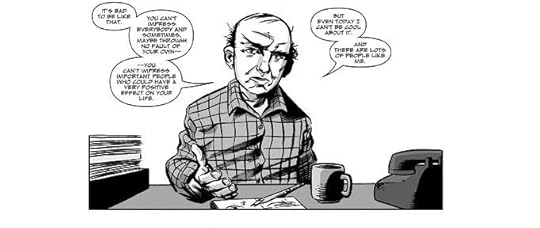
My favorite panel in the book is when, after explaining again how fear and impatience have deflated his efforts, Harvey just looks at you and says, "And there are lots of people like me." At least on that one page, he knows the problem isn't that he's a mutant with magic failure powers in an epic tragedy; it's that we're all playing a game whose rules often result in pointless damage, and this damage makes us into obstacles for each other.
Ever since I saw the film, American Splendor, I have been a big fan of Harvey Pekar. I'm not sure how I heard about The Quitter since it is not new (the copyright date is 2005).
If you like Pekar's other stuff: American Splendor or Our Cancer Year, you'll probably enjoy The Quitter.
Like his other works, The Quitter is autobiographical. The Quitter begins with Pekar's childhood and takes you up through his first jobs after high school and his life before American Splendor began. It can be painful, at times, to read about his life. You cringe at the decisions he made and wonder how anyone can be so honest about his own shortcomings and failures. Pekar's honesty, however, is what makes the graphic novel so great.
Pekar is so clearly a man of many talents, that it seems unlikely that he could be filled with so much anxiety and have so much trouble. I continue to wonder how, after a hit play about American Splendor, a feature film starring Paul Giamatti, and what must be (post movie) countless sales of his comics, Pekar can still be struggling. Even so, you realize that success for Pekar is always fleeting and anxiety and paralyzing stress is just his makeup. He is a basket-case who chooses to share his triumphs and his many shortcomings with his audience. Learning about his childhood struggles makes the reader realize even more both how talented Pekar is, and how troubled.
I'm glad Pekar has chosen to write about his life. Most of the "snippets" about his books mention "the average man" and even Pekar describes his comics as being about "his quotidian life." While his triumphs are not majestic, Pekar seems to be so talented (and he admits, in The Quitter>, for example, to having a photographic memory and not having to work hard to have success in geography and history classes and also to having a great ability in street fighting) that I do not realing see Pekar as an average man. Rather, I think he is an above-average man who has allowed his own self-doubt, nervousness, and weakness to limit his achievements.
In a roundabout way, Pekar "brags" about his writing and his Jazz reviews. He was being published at age 19 for writing about Jazz musicians and Jazz music. He had one college English class, yet he was a published writer. Obviously, his comic writing has been critically acclaimed and enjoyed by many, many readers.
In many ways, The Quitter is a "how-not-to" manual (and the self-deprecating title is some evidence of the fact that Pekar realizes this). You have to wonder sometimes if Pekar isn't intentionally playing things up to maintain his image. I believe that he really is what he purports to be, but his honesty about it all is quite staggering and hard to believe.
I'm not sure if I would enjoy The Quitter as much if it were the first Pekar I had read, but having read his other comics (I only have the anthologies; none of the original comic books) and seen the film based on his life, I truly enjoyed getting more of the story through The Quitter. I highly recommend it. The Quitter is a very quick read and is definitely something I could see myself picking up and reading again.
This was our penultimate entry in the library's Jewish literature discussion group. Honestly, I would've preferred one of the American Splendor collections, but seeing as I'm a hired hand---unpaid, at that---I go with the flow. The Quitter has plenty of the misanthropy one expects from Pekar since he began self-publishing his comics in 1976. It's the most novelistic of his autobiographies, however, eschewing the slice-of-quotidian bafflement approach of AS for a coming-of-age plot in which we follow Harvey's rise through a series of highly unfulfilling jobs until we arrive at that civil service clerkship he famously maintained for more than thirty years.
The big revelation shouldn't be so big for anyone who remembers Pekar's contentious appearances on Letterman in the mid-80s, especially the '88 one in which he went batshit on GE and was banned from the show for a couple of years. (It's on YouTube; you can look it up). As The Quitter attests, Pekar was a brawler who developed a defensive fondness for socking anyone who looked at him wrong in the jaw. So pronounced are the fisticuffs I almost think this book should've been called The Pugilist (or maybe Fisticuffs!. The fighting certainly overwhelms what Pekar intends to be the unifying theme of his quitting anything he was good to preclude the possibility of failure. That character tendency makes for a fascinating personality study as HP taps into traditional Jewish themes of father/son resentment and the schlemiel. Yet it also precludes a reader's interest in the cranky, curmudgeonly shtick that Harvey's been at so long that his persona feels as stale as Woody Allen's. Unfortunately, few attendees last night did care, and we thus had some problems really getting into the book. In the end, folks were more interested in the social history of Cleveland and the rise of 50s' jazz-hip culture that the story dabbles in. I tried to jumpstart a discussion of the underground comics that Pekar so influenced, but not even the appearance of R. Crumb toward the end of The Quitter could get yaps a'flappin. So I just kept on truckin'.
My own sense is that The Quitter is a sort of movie tie-in, designed to perpetuate the broader interest HP garnered after Paul Giamatti did his brilliant take on his slouch and grumble. Certainly worthy, but not a sock blower.
This is the first hardback graphic novel I've read. The late Harvey Pekar's American Splendor mantra was "ordinary life is pretty complex stuff." So is ordinary growing up. So was Harvey Pekar. That may explain the appeal of Harvey Pekar's observational art, which is pretty much a running narrative of his lifelong struggle to stack Wednesday on top of Tuesday. It has a raw, unprocessed quality to it -- which evokes a flash of recognition even from a reader whose life's circumstances were different.
There's a lot of conflict, sadness, and rejection in the Harvey Pekar story. some of which may have been self-inflicted, some of which may have been the result of some undiagnosed learning disability or brain injury from all the street fighting (though the extremes to which the street fighting narrative goes begs for some verification - there's no reason to think it's fabricated, but it's surprising that he survived to adulthood, and he wouldn't be the first person to embellish his biography).
At the same time, it's not really a sad story. Harvey Pekar ends up surviving and prevailing over everything but his fears.
However, I found the title "The Quitter", a loaded, condemnatory word in American Baby Boom English, to be misleading.
First, quitting isn't necessarily bad. It depends on what you're quitting.
Second, Harvey Pekar didn't quit everything. He quit some things, stuck with others, goofed away opportunities that he later regretted giving up, and took advantage of other opportunities - as many of us also have. He appears to have been a dutiful, devoted husband and father.
For one whose art was based on keen observation, including self-observation, he missed the fact that he seemed to suffer from a kind of toxic perfectionism, which led him to quit things that be might have been better off staying with. If he really had wanted to do some life-hacking, that would have been the place to start.
Read this at the library when I probably should have been working. That's what happens when I sit too close to the graphic novel section.
I felt worse for Cleveland losing Harvey Pekar this July than LeBron James's announcement a few days earlier, and when I read the sad news I made a mental note to pick up a copy of The Quitter because I knew it covered parts of his life not covered in his other comics.
This is Mr. Pekar's memoir covering the time from his birth to Polish immigrants to his famous job as a file clerk for Cleveland's Veteran's Hospital.
There is not much suspense reading this because any casual fan of his comics knows how it is going to turn out. The interesting part is reading about how he winds up where he does -- by quitting anything he feels will be too much of a challenge or when he feels slighted.
It is interesting to read how much Mr. Pekar was plagued by anxiety, self-doubt, and what I think are supposed to be panic attacks (including a fateful one he experiences in the Navy). It's unflinchingly honest and heartbreaking that no one could or would help him until much later in life.
I'm giving it three stars because the art feels almost tacked on to the story. Maybe it should have been an essay instead. I got a good sense of the Cleveland Mr. Pekar grew up in, but some of the writing was so clunky. Like when he mentions how excited he is to get a letter and the art shows him leaning against a mailbox with a thought balloon thinking how excited he is to get a letter. Maybe it's some meta thing that I'm not appreciating, but it struck me as pretty lazy.
Biasanya kalo baca biografi seseorang itu aku ada 2 rute :
1. Aku tertarik sama orang itu dan penasaran pengen tau kisah hidupnya, bahkan kejadian yang paling remeh sekalipun. 2. Aku belum tau siapa orang itu, tapi setelah baca jadi tertarik dengan kisahnya dan juga pada orang itu sendiri.
Ini pengalaman baru...aku sebelumnya ga tau siapa itu Harvey Pekar, dan nyoba baca kisah kehidupan yang, menurut blurp-nya, "indah dan lucu" itu... aku (; ̄Д ̄) Indah? Lucu?? Aku kira aku termasuk orang yang gampang kepancing untuk ketawa, tapi pas baca ini aku senyum pun nggak ""( >..<)
Semuanya tentang depresi, depresi, dan depresi.., aku yang tadinya ngakak-2 abis baca Ace of Diamond 5, begitu pindah ke komik ini langsung "gelap"~
Jadi inti kisahnya gini: anak berbakat - berkelahi - gagal - remaja berbakat - bikin masalah - gagal - pemuda berbakat - entahngapainlagi - gagal... Dan kadang "kegagalan"-nya itu bukan sepenuhnya gagal, tapi diceritain dengan aura suram yang seakan "ini-akhir-dunia" (눈_눈)
Dan ending-nya.... *nempelin muka ke tembok biar adem* ...dia akhirnya berhasil dan sukses dan terkenal...tapi tetep khawatir & depresi! ლ(ಠ_ಠ ლ)
Aku ga masalah kalo kisah semacam ini diceritakan secara satire, yang bisa diketawain sekaligus jadi bahan perenungan. Tapi cara penceritaannya yang penuh kekhawatiran dan kesuraman gini cuman bikin ikutan depresi bacanya~ ─=≡Σ((( つ><)つ
Positipnya : aku suka pas bagian si tokoh utama depresi kesal karena orang tuanya ga bisa memahaminya, tapi dia tetep sayang dan hormat sama mereka ^ ^
*mudah-mudahan yang baca ulasan guguk ini ga ikut depresi ya*^o^)9 Semangat!!
The Quitter is actually a story of resilience. One of the last stories autobiographical comics pioneer Harvey Pekar wrote, it covers his early, post WWII years as a son of Polish immigrants living in Cleveland. Illustrated by Dean Haspiel, The Quitter is, typically, brutally honest.
To an extent not previously explored, Pekar was a fighter and bully in his youth, resorting to violence as a means of earning respect he wasn't otherwise getting from his peers, with whom he didn't fit in. He also had a habit of quitting when situations got hard, feeling he had to either master a situation or remove himself from it. These two faults resulted in years of troubled frustration, continuing into adulthood. I won't reveal the emotional denouement. We all know, though, that writing jazz criticism and American Splendor became ways for Pekar to successfully express himself. The Quitter is a fitting bookend to Pekar's writing career.
Haspiel does heavy lifting in this dense, time and place-specific work. His bold, graphic B&W cartoony style is hard to pin down and describe; I see Harvey Kurtzman in it, John Romita Sr., Mazuchelli and Darwyn Cooke. It's a pleasing style with supple brushwork and expressive body language.
Pekar is one of the giants of American comic writing and in this book expressively drawn in monochrome by Dean Haspel you can see why. This is Pekar's autobiography of his younger years and he is relentlessly brutal and honest about his own shortcomings, in particular his inability to keep going with any task when faced with being less than perfect and not receiving adultation. It is a tendency all of us have and dealing with failure is an essential part of character growth and Pekar is mercilessly candid about the ways this shortcoming has crippled his emotional and professional life. One of those rare comics which is not action driven, not much happens but you come away feeling that you have encountered a mind of rare clarity and a story that you can truly learn from. I only wish he'd completed the story.
Although not the best of Pekar's work—read any of the anthologies to get an understanding of how great a writer he was—this is the most thoroughly autobiographical he wrote. Pekar was Cleveland's gift to the world. If you are familiar with his work and like it, you should strongly consider adding this to your library.
The book Quitter by Harvey Pekar in my opinion was an interesting read. It's goes through his life as a boy whose parents are Jewish immigrants. It was a battle for him through the early stages getting in fights with kids at school and his parents. I would recommend this if you like to read autobiographical books.
Harvey Pekar's autobiography left me wanting more from it. It just kind of runs down events in his life, but leaves out anything charming or interesting. Essentially, it's a series of fist fights and job losses.
Blargh. God this was a boring autobio. I thought I loved Harvey Pekar and his messed up ways but the more he goes on about how miserable and boring his life is... well the more boring it is. No insights, no light and shade, no nuffin. He's depressed, and depressing.
The Quitter is a long-form memoir in comics format. This being a part of Harvey Pekar's autobiographical universe, American Splendor, we encounter the common themes of continuous struggle against life's routine but nevertheless hard challenges, the neurotic worries, the crave for attention. But the story focuses on Harvey (Herschel's) early life and (for Pekar readers) is surprisingly upbeat. The art from Dean Haspiel and (lower text-size) Lee Loughridge is very high quality and consistent.
The story itself is probably typical of many Jewish kids born in the USA during the Second World War. Parents, both Jewish, originate from an industrial town in Eastern Europe (here, Białystok, Poland, near the border with current Belarus and former Soviet Russia). Pushed by laws enshrining violent deportation and discrimination, repeated pogroms and mass murder, and the rise of Nazis in Germany, many Jewish families emigrated to the US in the first four decades of the 20th century (here, the mother emigrates in the 1920s, the father in 1935). They settled down in many parts of the US (here Kinsman Ave., Cleveland, OH) and started doing lowly jobs or keeping small mom-and-pop stores (here, a grocery). Pekar tells us his family imposed strict discipline on their children, his father was mostly absent, and his mother was a continuous source of worry - paraphrasing, she constantly pushed him to learn to do a respectable, well-paying job, or else! In his formative years, she is also a card-carrying Communist, counter to what the entire country thinks (and on the wrong side of history, as she learns herself in the late 1950s, when Soviets advance tanks to crush Eastern European uprisings against Soviet-installed regimes). This is the stage for Harvey's development, in a series of life challenges often related to discrimination and lack of confidence.
The title indicates a view of the world from the perspective of a quitter, but the story is much more nuanced and the outcome is everything but. We see Harvey/Hershel repeatedly quitting. School football team, due to discrimination. File clerk at the US Railroad Retirement Board, because it was boring. The Navy, due to a mental breakdown (caused by... washing clothes?! But the reader of American Splendor remembers Pekar saw his dish-washing as his Achilles' heel). Various unqualified jobs, due to being laid off. College, due to grade pressure. Unable to tolerate anything but sure achievement and unqualified accolades, he quits and quits and quits.
But we also see Harvey picking up new passions, rising up again through personal skill and ambition. The events leading to quitting are perhaps not the thickest walls or the heaviest boulders, but they are large and they do not break Harvey's spirit. Harvey picks up a passion for Jazz and becomes a reviewer, an early indication of his ability to see complex domains critically. He leaves home (this one is not a form of quitting), gets a job, gets married for a first time (of three). Age 23, he meets an even younger Robert Crumb. The rest is history. His form of quitting will lead to the art and craft of American Splendor, various literary awards, and an award-winning movie.
The art in this volume works very well, but the story lacks typical Pekar wit and density. The medium-length format, only a bit over 100 pages, does not use his typical, punch-packing vignettes. Instesd, the story is overall hurried, but misses clear peaks or Pekar-style moments of critical reflection. Perhaps it's an author agreeing with his younger self.
Harvey continued to quit this way until July 2010.
Harvey Pekar, author of the “American Splendor” comics, wrote about his youth in “The Quitter.” His parents were from Poland and he was a first generation American. Growing up in Cleveland, Pekar would often quit things when he got discouraged, instead of pursuing them.
As a young man, he would get into fights and pride himself on his skill as a street fighter. It was a way for him to get what he felt was respect. But, when he played football, he eventually quit as he felt that he was not getting along with the coach. Instead of trying to resolve difficulties, he felt that quitting was the right thing to do.
He worked in his parents’ grocery store, but found it too slow for him and boring so eventually he quit that. He continued with street fighting since he felt that one it was one thing he was good at. He was too shy to ask girls out and didn’t have the confidence.
In this book he discusses that he did get into jazz. He would later write about his interest in jazz and collecting of records quite a bit in his “American Splendor” comic books.
Pekar worked as a file clerk for a short time at the U.S. Railroad Retirement Board, but after his temp job was over, he enlisted into the U.S. Navy. He started to lose his confidence while servicing in the Navy. He even had anxiety over doing his own laundry. He was sent to a therapist and it was determined that the Navy was not for him and he would be discharged. He went back to the Railroad Retirement Board and received a more permanent position, but this didn’t last as Pekar was bored and started goofing around at the job.
But then he did get another position as a file clerk at the Navy Finance Center in Cleveland and did like this one as he made some friends with some of his coworkers, but left it to become a postal clerk because he thought it might be a lot better than being a file clerk. He got a job as a substitute carrier but had to learn to drive and buy a used car to get to the area where he was to work and do his deliveries. But he got nervous about his job and would quit that one too.
He tried college next and did well, but again his restlessness got the best of him and he left college to hitchhike to New York so he could see some cousins and see if he could crash at their place and tour the city. He worked as a waiter for a short while, but didn’t like that either.
In New York, Pekar had an opportunity to meet with Ira Gitler, who was an American jazz historian and journalist. He told Pekar about a new magazine called “The Jazz Review” and told Pekar that they were looking for writers and suggested Pekar submit an article to them. Pekar wasn’t so sure they would be interested in his writing, but he did submit an article about Fats Navarro. The magazine wrote him back and asked him to expand on his article and he did and they published it.
He returned to college, but then when he got a C+ in Geography, again Pekar became discouraged and quit school. He got a job with Concord Records in Cleveland as a shipping clerk and got his own apartment to rent so he would not have to live with his parents, and Pekar did more writing for “The Jazz Review.” Things looked good for a while, but Pekar screwed it up. He became abusive to the owner and some of the customers and finally was fired.
He then got a job at a brewery factory, but eventually got laid off due to the fact that the brewery did a lot of hiring and firing. After some more odd and end jobs, he got another job with the Federal Government working as a file clerk and decided that he really needed the stability and tried to stay with it. That is where he started writing his comics about everyday life which would become “American Splendor.”
I think this book is really about Pekar growing up and learning more about himself and figuring out what was right for him.
I've read the bulk of Harvey Pekar's American Splendor and related output over the last couple of years, liking much of it while being critical of some aspects as well. In my eyes, the Quitter is one the best books he ever put out, matching if not exceeding Our Cancer Year.
It tells the story of his childhood and early adulthood, looking back on that time with the understanding of an adult who understands his own psychological compulsions in a way that the younger person didn't and couldn't. It's a narrative that doesn't get too bogged down in side plots or stray observations, and we come to see how Harvey's well-documented mental challenges dramatically effected the choices he made as a young person, and later locked him into the life he had.
Pekar, in all of his work, writes with great honesty and is self-critical. The art in this volume is clean and effective, and matches the clarity with which Pekar observes himself. It's an excellent graphic novel, finally coming close to the achievement that Pekar wanted from the outset of his comics career -- the use of the format to tell full fledged, resonant stories that are meant for grown up readers.
Even though this book came near the end of his life, it may actually be the best entry point for someone new to Pekar or non-superhero comics. It's accessible and interesting and satisfying.
Harvey Pekar’s work crossed decades with the very beginnings of the underground comix movement in the early 70s with Robert Crumb to his death in 2010. The Quitter focuses more on Pekar’s early life and how he had a penchant for quitting things, whether that was the military, school, or anything that he felt he would never excel in. It’s an interesting concept and a good way to reexamine one’s life with all of the failures.
Pekar’s voice is pretty idiosyncratic in comics. Through numerous narration boxes, you get inside his head, and it’s like he is telling a really long story about himself. It’s a little self-indulgent, but the self-awareness is interesting. His voice also keeps you turning the page as you want to hear what’s next. It is entertaining but can be a little droll.
The art by Dean Haspiel is a great fit for Pekar’s writing. He does the job of making the narration boxes flow with identifiable images to match the heavy writing. The art doesn’t go beyond expectations because it’s purpose is to prop up the text more than break boundaries. The combination makes this a pretty good book, but it could be entirely uninteresting to some people.
THIS is the guy -- Harvey Pekar -- an insecure, neurotic person with first generation immigrant parents trying to "fit in" in the pre-WWII and post-WWII "inner suburbs" of Cleveland.
HARVEY PEKAR, as a child, a teen, young adult, and then humble federal government file clerk, studied comics as a hobby, especially the: the Super Hero genre, and the R. Crumb "underground, counter-culture, hippie" Comix of the 1960s.
It was HARVEY PEKAR who figured out that were limits placed on the hippie counter culture or Super Hero formula which inhibited creativity. It was HARVEY who asked, Why can't I write comics about "the quotidian subjects . . . [of] the lives of working stiffs? We're as interesting and funny as anyone else."
And . . . He was right. He wrote the comics, and then R. Crumb and other artists drew the comics, AND AMERICAN SPLENDOR WAS BORN!
Brilliant. A real coming of age story of an everyman, and a genius among us, who just wants recognition for his efforts, his insights, and for just showing up, as a file clerk, to do his best in another day, for another dollar.
I was never very into American Splendor when I tried to dive in, even though R. Crumb’s work is pretty undeniable. Pekar’s slice of life stories of and for the common man should please the Dusty Rhodes fan in me, but reading I could never find a whole lot that worked for me when reading between the lines of his reverie.
The Quitter gives Pekar a decades-long narrative thread to follow, and it really works. He’s got direction, or at least points to touch on as he waxes on and on. We get a peak at all the interesting parts of his life: growing up a poor Jew in Cleveland, fighting a bunch, being obsessed with jazz, and anxiety over pretty much everything.
The art is good, if not a little less distinct in style than the classic Crumb stuff. (Not that that’s a legitimate or fair criticism, really.) Overall, the book makes me want to take another look at the American Splendor series, or at least seek out other non-AS books by Pekar.
Harvey Pekarin lapsuusmuistelo The Quitter lähestyy aihettaan Pekarin tyyliin omaelämänkerrallisesti, mutta kauhean syvälle ei kirjassa päästä. Kerronta pohjaa enimmäkseen Pekarin tekstiin, jota piirrokset lähinnä kuvittavat. Lopputulos on hieman vaisu katsaus epävarman ja psyykkisesti epävakaan Pekarin nuoruuteen. Katutappelut ja epäonnistumiset opiskeluissa ja naisten kanssa seuraavat toisiaan kun Pekar haahuilee työstä ja opiskelupaikasta toiseen. Lohtua elämään tuovat jazz-musiikki ja taitelijaystävät, mutta niistä sarjakuvaromaanilla ei ole hirveästi kerrottavaa. Sinänsä kiinnostava aikalaiskuvaus köyhien juutalaisperheiden elämästä ja lähestyvästä keskiluokan pahoinvoinnista Yhdysvalloissa, joka ei kuitenkaan onnistu tutkimaan aihettaan sen analyyttisemmin tai edes erityisen kouriintuntuvasti.
This is an autobiographical graphic novel about the comic book writer, Harvey Pekar. He details his life as a young boy growing up in Cleaveland, with his Jewish-Polish family. Throughout the book he talks about his various jobs. His insecurities. His young violent period as a street fighter. His bouts with sports in high school. He covers his early adulthood trying out the navy and going to college. He also details his relationship with his parents and other family. The artwork is not amazing, but does good job illustrating Harvey's story. It's in black and white, and the art style, though not to my taste, is okay.
It's an interesting book to read whether you know who Harvey Pekar is or not. Though, in parts of his story, he does come of as an unsavoury character. This is mainly when he talks about his violent encounters.
Although it was very good, I prefer the shorter, tighter, laser-focused American Splendor stories. The Quitter is a great overview of Pekar's life, the anxieties that he (and we) faced, and a look at some of the cultural, economic and social circumstances that created the Harvey Pekar that we know via his comics. But the classic Splendor stories, despite their brevity, hit with more depth than The Quitter was able to muster.
Still, it was pretty enjoyable. Harvey's conversational captions make the reader comfortable and brings you into his confidence, and Haspiel's art rocked.