Jump to ratings and reviews
Rate this book

Lungfish

Rate this book
For readers of Jenny Offill, Marilynne Robinson, and Claire-Louise Bennett, Lungfish is the shimmering and suspenseful story of a mother pushed to the edge by unseen forces as she and her family find themselves squatting on an otherwise uninhabited island off the coast of Maine

Tuck is a woman whose husband's addiction has drained their finances and driven them to move illegally to an abandoned island off the coast of Maine. There, she must care for their young daughter and scrape together enough money to leave before winter arrives—or before they are found out—while her husband struggles to detox.

Tuck finds herself at the mercy of what the island has to offer for sustenance and answers (little green crabs, bladderwrack, rosehip tea; notes scrawled out by her grandmother, smells held by the damp walls of the house, a failed invention left behind by her missing father)—living moment-by-moment through the absurdity, beauty, paranoia, and hunger that shoots through her life.

With exquisite prose that is displacing and even transformative, Lungfish explores the wild, unknown spaces of what makes a family, and the darkness that must be grappled through to find a way out. Meghan Gilliss’ debut is a brilliant and heartbreaking novel about addiction, doubt, marriage, motherhood, and the ground that is ever-shifting beneath our feet.

320 pages, Hardcover

First published September 13, 2022

96 people are currently reading
5775 people want to read

About the author

Meghan Gilliss

2 books32 followers

Ratings & Reviews

What do you think?
Rate this book

Friends & Following

Create a free account to discover what your friends think of this book!

Community Reviews

5 stars
278 (21%)
4 stars
433 (33%)
3 stars
379 (29%)
2 stars
173 (13%)
1 star
43 (3%)
Displaying 1 - 30 of 231 reviews
Profile Image for Will Byrnes.
1,372 reviews121k followers
January 18, 2024
…lungfish survive droughts by coating themselves in mud and sinking deep into sleep, the mud hardening and cracking in the sun until finally water returns and sets everything loose again, brings movement back to earth, and fish. Lungfish can go three and a half years without food.
--------------------------------------
…what’s new, now, is everything I didn’t see. My life behind the curtain.
Tuck is struggling to survive. She and her husband, Paul, along with daughter Agnes (two and a half), fled Pittsburgh after he lost his job and they got evicted. They head to an otherwise uninhabited island off the coast of Maine. It features a house that her grandmother owned, but gran has passed. And the house is to go to her son, Tuck’s father. Problem is that Pops cannot be located, nor can he be presumed dead, so Tuck is stuck. If her father were around to inherit, then Tuck and family would have a place to live. Thus, they are squatting in the house, dreading a determination by the executor of Gran’s estate that the place be sold. Winter is coming and she has to find someplace else to live before that happens.
description
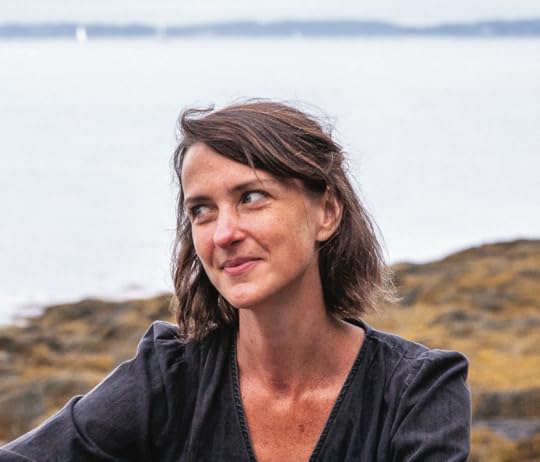
Meghan Gilliss - image from Skylark Bookshop

Problem #2 – hubby is a drug addict. It was why he’d lost his job and they were forced to move. He is trying to rehab on the island. And they are broke, having sold most of their possessions. So, Tuck is trying to survive on what little food remains in the house. Once Paul is well enough to work, he begins taking Gran’s boat to the mainland, and he does find something eventually. But then starts returning back to the island much later than expected, and with a paltry amount of money, and minimal provisions. So, the problem persists.

Tuck and Agnes forage for food in the woods and on the beach, barely managing to hold body and soul together. Tuck reads to Agnes. Her favorite is Rumpelstiltskin. They use the readable books that have been left in the house, religious texts, field guides, and poetry, William Blake gets some repeats, particularly The Tyger. There is a strange scent in the house that she associates with this poem and an actual tiger. There are field guides that help them in their foraging, and identification of local flora and fauna.

There are no phones, no internet connections, and a radio that is used sparingly with juice from a gas-powered generator. How does one cope with such aloneness? With only a small child for company most of the time? Many a new mother might ask the same question, particularly if their husband had made himself as absent as Paul has been.

Tuck has been mostly a passive sort, willing to accept whatever others, particularly Paul, might tell her. He is her provider and she is good with that, as long as, you know, he provides. It seems that he is better at providing for his addiction than he is at providing usable resources for his family. He tries going cold turkey, but it is a struggle, and the demons that have driven him toward addiction remain.

So, we have a very isolated (a total trope, on an island with no comms) woman having to face the fact that if she does not provide for herself and her daughter, no one else can be counted on to do so. This is her challenge and her path.

The book is written in fragments. Chapters (I counted 88, but could be off by one or two) are often only a page, or a part of a page long, comprised of small paragraphs. There is a lot of white space. But, while in terms of word count, it is probably not that much, it is a slow read. Gilliss has a very poetic style, which, while lovely to read, often calls for re-reading. Much of what we need to know is hinted at, but rarely overtly stated. It is a rewarding read, but requires real engagement. In a pointillist sort of way, Gilliss is offering us many, many dots, and asking us to step back and see the whole image she has created.

Several elements stand out. Smell features large. Tuck follows her nose to memories as well as contemporary revelations. The scents of her grandmother and father remain a presence, as does the unidentifiable aroma she names tiger.
I smelled my grandmother on the blankets in the mornings, after the night’s worth of body heat made a sort of steam collect in the wool; I smelled her on my skin. I smelled my father, too, when the tide was out and the mud squelched between our toes…I smelled my brother in the smooth-barked oak.
Hunger looms over all, a constant presence, made even more dire when she begins giving her paltry share of their food to Agnes. Yet Tuck is determined to say nothing, or as little as humanly possible, even as Paul returns home from work with little to offer them, having learned in a fraught childhood that it was safer to remain mute.

Seeing is key. By nature, I made do with what was given. By nature, I didn’t much notice what wasn’t. Tuck wonders how she had not seen his addiction earlier. But clearly Paul is not all that concerned, as focused as he is on trying to rehab, and then feeding his addiction. Abandoned by both parents, Tuck is now effectively being abandoned by her husband. But learning to see does not come naturally to her. I was late to so much knowledge.

Searching is another thread, which extends to the physical and spiritual worlds. It is crucial that she locate her father, so Tuck goes to the mainland library publicly accessible computers to search for him, and to search for a place to live, to search for her legal rights regarding the house, and to search for information about the drug Paul is addicted to. She is also searching for meaning. Tuck wonders whether it might help to attend church even though she is not an actual believer. Her grandmother was a Christian, but doesn’t faith require too much loss of personal identity to a collective mind? She also thinks about what is worth believing in, and what belief is. But she had been a believer in her husband, and now that faith has been shaken. She looks for meaning in the natural world of the island.

Gilliss writes beautifully about the nature her characters encounter, the creatures they see, and/or eat, the seaweed, mushrooms and other growing things that provide either calories or visual sustenance.
We have a piece of property like this in my family—a steadily shrinking piece of the land that generations of my ancestors have spent time on. - from The Millions interview
So, there is a lot going on here, a young mother coming to terms with the reality of her dire situation, contemplations of faith and meaning, using all the senses to paint a picture. It can be a bit tough to relate to Tuck at first. Really, honey? You did not see that your guy was doing drugs? How blind can a person be? Pretty blind, it turns out. But we can still relate to her struggle to save herself and her child, particularly once she starts to see more of the reality in front of her, once she becomes an active participant rather than a passive non-player. The writing is poetic and compelling, the fragmentary style interesting. It works to support a dream-like quality that meshes well with Tuck’s experience. Lungfish is a compelling first novel, beautiful and engaging, as rich with insight and beauty as it is heavy with dark circumstances and feckless behavior. It will be difficult to ever walk a beach again, picking up stones and examining the diversity of nature’s bounty without thinking of this book.
How could we be expected to save these things, one after another, when they couldn’t even do this basic thing for themselves?

Review posted – October 14, 2022

Publication dates
----------Hardcover– September 13, 2022
----------Trade paperback - November 28, 2023

I received a copy of Lungfish from Catapult in return for a fair review. Thanks, folks.


This review will be cross-posted on my site, Coot’s Reviews. Stop by and say Hi!


=============================EXTRA STUFF

Links to Gilliss’ personal and Instagram pages

Profile - From Catapult
MEGHAN GILLISS attended the Bennington Writing Seminars and is a fellow of the Hewnoaks Artist Residency. She has worked as a journalist, a bookseller, a librarian, and a hospital worker, and lives in Portland, Maine. Lungfish is her first novel.

Interviews
-----Skylark Bookshop - Meghan Gilliss discusses LUNGFISH> - by Alex George - video – 59:43
-----Ploughshares -
Lungfish’s Exploration of Isolation by Kaitlyn Teer
-----Electric Literature - There’s No Place Like Grandma’s Abandoned Island by Arturo Vidich
-----The Millions - Peace Alongside Unrest: The Millions Interviews Meghan Gilliss by Liv Albright

Item of Interest from the author
-----Bomb - excerpt

Item of Interest
-----William Blake - The Tyger
Profile Image for Candi.
707 reviews5,511 followers
November 16, 2022
Ugh. The blurb for this compares it to Marilynne Robinson’s writing (well, to be fair, “for readers of” Robinson, as well as a couple others I’ve not yet read.) I’ve had the pleasure of reading several of Robinson’s novels, and I can’t see the similarity here at all. Stylistically this was completely different and not nearly as compelling. I had to read the second paragraph two or three times. Not a good omen.

“There was a lack of practical concern that ran in our blood. She might have been the first, my grandmother, or it may have entered sooner – I know so little of those who came before. I never much thought to ask. I never much noticed what wasn’t said. Which is to say: By nature, I made do with what was given. By nature, I didn’t much notice what wasn’t.”

Meh. I picked this up at a respected coworker’s request. She’d read it and wanted to chat about it with someone. I’m always happy to oblige on that account! If I understood her correctly, she felt that she missed something in the telling and hoped that I could clear up the murkiness a bit. I’m afraid to say that I couldn’t. The problem was more likely in the delivery, not the reception. I believe it was purposefully opaque with its poeticism and desire to be unique. But that sort of thing just doesn’t work well for me with a plot like this. In a nutshell, it’s a story about drug addiction and the effects it has on a family, namely the wife and a very young child. The family moves to an isolated island, squatting on Tuck’s grandmother’s property after her death. The hope is that Paul, Tuck’s husband, will be able to overcome his addiction. The money is gone and food is scarce, with Tuck scavenging the island’s forest and coast for food. I should have had a ton of feeling for Tuck and little Agnes… but the writing kept me so far removed from them that I really didn’t care. There’s something about a fragmented style that always keeps me at arm’s length.

“This hunger can be the space I occupy next, when it’s ready. When the hole is whole. The pit round and pure. Everyone comes from somewhere. I’ll give everything there is to Agnes. Only my eyes will eat.”

Bloody hell! They’re literally starving and I didn’t give a damn! They were just words on a page. I could only think about finishing this quickly, reporting back to my friend, and moving on to the next book in line. There has to be a perfect place between melodramatic and overwritten and completely understated and muted where a story like this should reside in order to wreak havoc on this reader’s emotions. Yes, Marilynne Robinson can do it. So can Elizabeth Strout.

“We can make ourselves crazy, trying to know someone.”
Profile Image for ♑︎♑︎♑︎ ♑︎♑︎♑︎.
Author 1 book3,802 followers
September 16, 2022
A novel about the ravages of addiction that is told in a way that felt uniquely poetic and yet so grounded in the actual experience--a near-perfect fictional representation of the end of love and hope that comes when you realize your loved one will tell any lie, and suffer any degradation, and leave you and your child to starve, not caring, if that is what it takes to get the drugs they need. The novel is remarkable for the way it can feel experimental and dream-like, and yet at the same time feels so grounded in the grubby truth of addiction, as much as any memoir. The grueling trials that the narrator of the story goes through to keep her child fed—the fierceness of her will to survive, and to make sure her child survives—feel magnificently true.
Profile Image for Adam Dalva.
Author 8 books2,160 followers
April 9, 2022
Creative, experimental, beautifully structured, and moving - one to watch
Profile Image for Laura Rogers .
315 reviews198 followers
March 29, 2023
I should have known. I didn't like the cover or the title of Lungfish but it was recommended and had decent reviews.

I found Lungfish to be melancholy and perpetually caliginous. For me, it was as though Meghan Gilliss was given an assignment to write a novel that feels like unrelenting fog. Everything felt drab and gray: the storyline, the characters, and the setting. How could a mother repeatedly make such terrible choices, not just for herself but her young daughter. It just didn't work for me.
Profile Image for milo.
732 reviews
April 16, 2023
sometimes people publish books made entirely of sentence fragments and i think that they maybe should stop doing that
Profile Image for Georgia.
750 reviews57 followers
August 22, 2022
A beautiful, bruising novel of motherhood, hunger, addiction, and foraging set on a Maine island.

Having sold almost all their possessions, Tuck, her young daughter and unemployed husband arrive on the small Maine island where she spent summers. Though her recently deceased grandmother left the island to Tuck's long-absent father, Tuck and her family take up residence there as a last resort in a damp cabin.

We can make ourselves crazy, trying to know someone.


Tuck struggles to keep her daughter fed and protected even as she self-protects against the lies of her husband and the direness of their situation. The stream of consciousness and vacillation between timelines won't be for all readers, but I found that it contributed to the feeling of being stuck in an impossible situation, isolated in a dank, leaky house, and grappling with the crumbling of a previous reality.

You can ask someone into your world. But the price of refusal is steep.

While this book is set in the summer, there was a decided chill, making it perfect for an autumn read.
Profile Image for Lori.
1,788 reviews55.6k followers
December 11, 2022
Good lord, that ended up being sloggier than I had anticipated.

I knew nothing about the book going into it. It was a random impulse buy while I was browsing - I loved the cover, really like the publisher, and thought the summary sounded like something I'd enjoy. And when I first cracked it open and started reading, I was pulled in by the flowing internal narrative. The prose and the stark landscape was * chef's kiss *.

To set the stage: Tuck, her husband Paul, and their young daughter Agnes run away to squat in her deceased grandmother's empty house on a remote island in an attempt to hide from their problems. We learn that Paul has a drug addiction that Tuck didn't catch on to until all their money was spent and their home went up in flames (At least, I think it went up in flames. I'm second guessing myself now). Penniless, as Paul struggles with withdrawal and the ghosts of the things that pushed him there in the first place, Tuck struggles to keep herself and Agnes fed, all the while expecting someone to discover where they are and turn them out.

After about 100 pages of things not really progressing, the marital distress, addiction, suspicion, and scavenging started to wear on me. So much so that when I had a few spare minutes, I found myself sometimes doing other things when, under different circumstances, I'd have dived back into my current read.

It was also a bit of a mood influencer. Not enough to make me DNF it, but I noticed I felt crankier after putting it down. Like the foulness of Tuck's situation and how she was responding to it irked me well beyond the page. I don't know how else to explain it. Has that ever happened to you?

Profile Image for reading is my hustle.
1,673 reviews348 followers
October 29, 2022
without a safety net life is hard & this novel is a bruiser. it is beautifully told (& written) though requires close reading & i often had to read passages twice if not more. though not an uplifting read it is a gorgeous one.
Profile Image for Lolly K Dandeneau.
1,933 reviews252 followers
September 8, 2022
via my blog: https://bookstalkerblog.wordpress.com/
𝑻𝒉𝒆𝒓𝒆 𝒘𝒂𝒔 𝒂 𝒍𝒂𝒄𝒌 𝒐𝒇 𝒑𝒓𝒂𝒄𝒕𝒊𝒄𝒂𝒍 𝒄𝒐𝒏𝒄𝒆𝒓𝒏 𝒕𝒉𝒂𝒕 𝒓𝒂𝒏 𝒊𝒏 𝒐𝒖𝒓 𝒃𝒍𝒐𝒐𝒅.

Tuck and her little girl Agnes are squatting in her deceased grandmother’s house on an uninhabited island off the coast of Maine, empty bellied and lost, while her husband Paul attempts to detox. But addiction is a beast, and the island of her childhood summers may not be the most practical solution to their gathering problems. Her grandmother’s bookcase holds field guides, but is there enough food to salvage upon the land to sustain her growing girl, sick husband and herself? It’s like abandoning civilization and relying on blind faith, but in what? Her marriage? Her father isn’t missing but his whereabouts are unknown, and that poses a threat to her plan, as her grandmother left the house to him. It is her family’s norm, these disappearing acts, little unsolvable mysteries. His absence is much different from her mother’s own leaving which comes to light over time.

Together she and Agnes look for supper in the woods, anything to eat with the tides, on the shore, the rocks and Agnes’s hunger is an endless source of fear and worry on top of the undeniable fact that Tuck will have to find another place for them, before the cold arrives, or they are kicked out. For now, she is trying to keep them all from starving, supporting Paul and his idea that this place could be his salvation, save their family of three from his addiction. If not for the situation it would be like a vacation, a hands on education for little Agnes, but not like this. It will be an escape from Paul’s struggles in Pittsburgh (that was his pitch to convince her to go to the island), she wants to believe in him, to keep him from drowning. It’s her favorite place in the world, but without work there is no money, without money they cannot care for their child properly. How long can she ignore this stark reality? How far will she go for love, and does anyone really have the ability to save their loved one from themselves? It’s a common story, nothing unique about addiction, hunger, pain, disappointment, but the location makes for an original read. It’s a mad choice, but Tuck has run out of options. Not bad enough for help from the government, the country full of sad stories, maybe she isn’t a fool to think this could work.

She resents and loves Paul, it’s a dizzying concept. As she grapples with painful memories, feelings of rejection come ashore, a mother who was never solidly present, a father whose invention is the only reminder that he once lived in his mother’s house, her brother Conrad off living his own life, the family always alone. Is it that Tuck doesn’t want to surrender the only true thing she has created? She refuses to be the sort of woman who can’t take care of herself, who needs to rely on a man and yet, there is a fury in her that Paul isn’t helping provide, that he has gotten them into this mess. She wants, though, to forgive him his sins, to "𝑏𝑒 𝑡ℎ𝑒 𝑠𝑤𝑒𝑒𝑡 𝑣𝑜𝑖𝑐𝑒 𝑐𝑎𝑙𝑙𝑖𝑛𝑔 𝑜𝑣𝑒𝑟𝑡𝑜𝑝 𝑑𝑎𝑟𝑘 𝑡ℎ𝑖𝑐𝑘𝑒𝑡𝑠”, of the wrongness in his brain. It’s seductive, the thought that we can heal all the broken parts of those we love most. But his leaving, his choosing to fall over caring for his wife and child, it’s not turning out right. Their lives are going to hell.

How many days will he sleep, how long before Paul wakes up? How long before she wakes up? What will it take? What will it do to their curious, sweet little girl? Shouldn’t she try to save Paul for Agnes? Paul gives her a glimmer of hope, but will it last?

The beauty of nature, all the creatures that cling to underwater rocks, much like Tuck clings to hope, is so hard to stomach. Hunger can’t be salvaged by bedtime stories, faith, though Tuck tries, to keep light in her daughter’s heart. Bad weather is coming, will her marriage survive reality? It’s about loyalty, loneliness, motherhood, addiction, family dysfunction, mental health, and love. We accept lies for a reason, but there comes a time you must deal with the consequences of blindness. There is so much pretending, denial and need, it’s a family capsized. Beautifully written, it’s about choices and how easy it is to ruin it all. I love the title, 𝐿𝑢𝑛𝑔𝑓𝑖𝑠ℎ, it’s fitting. Tuck is a survivor.

Publication Date: September 13, 2022

Catapult
Profile Image for Sharon Umbaugh.
82 reviews8 followers
September 4, 2022
A novel about the strong bond between mother and daughter, rich with detail. The reader will come away with deep sympathy for the protagonist but great admiration for her courageous, determination and innovation.I appreciated all the descriptions of foraging for marine life on this coastal island.

Thanks to the publisher, author and NetGalley for the ARC.

~~~Sharon
Editor/Beta Reader, The Writer's Reader
https://thewritersreader.wordpress.com
Profile Image for Joy D.
3,134 reviews330 followers
January 29, 2023
Protagonist Tuck, her drug-addicted husband, and very young daughter retreat to her deceased grandmother’s house on an isolated island off the coast of Maine. The goal is to get her husband free from drugs and eventually find another place to live. They have little money for food and often go hungry. Tuck and daughter Agnes forage the island for food and struggle to survive. The descriptions of the natural world are well done but I found this book bleak and depressing.
Profile Image for Syn.
322 reviews62 followers
March 23, 2023
Poetically written and quite beautifully heartbreaking at the same time. Living on an island with an addict and the struggles of that relationship. The heartbreak, mistrust, trying to mend something, or bail out the water but the holes just continue to multiply. Trying to raise a daughter and barely just making it by, the struggles of the unseen that we so often miss. A lyrical and truly moving story.
Profile Image for Jamie Dacyczyn.
1,930 reviews114 followers
decided-against-reading
November 10, 2022
Six pages in and I'm like, "Whoops! Stream of consciousness writing style! Too literary for me! Abort, abort! Retreatttt!!"
898 reviews1 follower
March 18, 2024
This book is not boring, it is written well and keeps you engaged and kind of stressed the whole time as it is about a woman without many options who is stuck on an island in Maine kind of starving with her young child due to her husband's addiction and inability to pull it together. But it is BLEAK so, if you want to spend 300 pages feeling like maybe you want to put rocks in your pockets and jump in the water, this may be the book for you.
Profile Image for Mari.
31 reviews1 follower
July 8, 2025
The clueless complicity of our main character makes this a frustrating read, but it also provides a uniquely bleak glimpse into the realities of living with food scarcity, struggling to maintain income, and coping with mental health crises in isolation. Mundanely mysterious but steeped in Maine gothic aesthetics.
Profile Image for Tracey Thompson.
448 reviews74 followers
August 11, 2022
Tuck lives in her grandmother’s abandoned house, on a deserted island off the coast of Maine. The house has been left to Tuck’s estranged father, so Tuck is essentially squatting while trying to determine whether her father is still alive, and stake her rightful claim on the property. Tuck can barely afford to feed her young daughter, and her husband is a struggling addict. Lungfish is essentially an account of Tuck’s desperate, awful situation, wrapped in lyrical prose.

I really related to the narrator, Tuck. She has a vision of how her life “should” be; husband with a steady job, her daughter never going hungry, and for all of them to have a safe place to call home. Tuck is in a constant battle with the world to get to where she wants to be, and it completely drains her.

Gilliss’s writing is wonderful; raw and truthful. It can be disjointed at times, reflecting the chaos of Tuck’s life, but it is never difficult to follow.

A small story, with a lot to say about motherhood, marriage, family, poverty, and work.
Profile Image for The Headless Horror.
358 reviews30 followers
September 8, 2022
What a gut-wrenching, yet wonderfully written debut! First of all, the cover art and title drew me into reading the book, so great job there. Overall, I found this book to be quite depressing, but in a good way! Tuck and her daughter struggle to survive as her husband Paul battles drug addiction. Tuck's grandmother passed away, leaving a house on a small island to Tuck's father, whom she hasn't heard from in several years. Due to Paul losing his job and not being able to make ends meet, they decide to live at the house on the island until Tuck can settle the grandmother's estate and locate her father, and while they save enough money for an apartment. I found myself asking many times, why does Tuck put up with Paul? He's clearly just a selfish addict that doesn't care if his wife or daughter have food on the table. However, as I deeply examined this thought throughout the book, Tuck feels lost. She feels like she doesn't have anyone to turn to. There are so many matters affecting poor people in America, and this book does a good job of highlighting those. When Tuck inquires about food stamps, they tell her because she has a working vehicle, she doesn't qualify. I love the imagery the author created in describing the island, and what food she was taught to prepare by her grandmother, such as bladder wrack. I had to research what that was. I was worried I would not like the ending of the book, but I found it fit and I was happy with it. I liked how Tuck spoke about her time training as a veterinarian, particularly with horses. In writing these scenes, it shows how Tuck had the patience and love needed to deal with sick animals (and now an addict). I was captivated by the book, and it left me longing to see the sea. It also made me grateful to be able to afford the things I have. I am looking forward to reading more from this author, and appreciate the ARC from NetGalley and the publisher.
Profile Image for Meaghan.
Author 1 book5 followers
January 25, 2023
I honestly don’t know if my feelings about this book are due to the early praise comparing its prose to Marilynne Robinson, but I had a hard time with the plot and the language wasn’t elevated enough for me to overlook it. There were a couple of big things that were hard for me to ignore in order to suspend disbelief— spoilers ahead.

1. In no state do they deny you food assistance because you have a car. It doesn’t happen. You can still get assistance. And even if, for some reason, you couldn’t— you could certainly go to a food bank— a possibility that isn’t mentioned once?

2. I understand that the underlying idea behind this book is how we can become blind to problems that are so close to us— but it doesn’t make sense! If Paul is addicted to kratom and spending all your money, you know that’s an issue— which Tuck acknowledges from the beginning. So why does she stay on this island with her literal starving child and not demand answers from Paul? ESPECIALLY AFTER HIS SECOND ISLAND RELAPSE. I could see it if they were there for like a week but they are there for MONTHS.

3. This book should have been a short story— the father plot and the tension behind whether Tuck will inherit the island or not is nonexistent— it seems pretty clear that this pipe dream will never happen, and I get that that’s part of it, but tacking on a specific mental illness to the dad at the end of the book was weird and unnecessary. Also, Tuck doesn’t know a single other person that might give her and her kid a sandwich or something?

4. In what universe do they let this malnourished child leave with her malnourished mom with nothing more than apple juice? World’s shittiest hospital

My favorite part was Sharon the lobster lady. She was cool.

TL;DR Prose is not like Marilynne Robinson, should’ve been a short story, Tuck is a damn fool! Sharon is worth reading about, though.
This entire review has been hidden because of spoilers.
11 reviews
January 18, 2023
The fragmented style of writing is not for the casual reader that is looking to enjoy an escape from their busy lives into a nice story. It felt like something from a literature class, and quite frankly, I don’t need anymore homework after working a lot. It was a really great story with really great themes. I should have loved this book, having grown up on the coast of Maine and in a lobstering community, knowing how opioids have hurt these rural communities. But, the author didn’t even use quotations for dialogue. The scenes jumped so frequently and sporadically you’d have to go back and reread and be like, wait what? Where is she now? What is she talking about? I wouldn’t say it’s bad, but this book was written by writers for writers. It’s like going to see exploratory jazz music. Sure the musicians are extremely talented, and every other musician in the room thinks it’s amazing, but is it enjoyable to listen to? Only if you have studied music theory. If you are looking for interesting books about the coast of Maine, read Midcoast or Landslide. Great stories without the pretentious literary style. I did finish this book somehow, but I’m kinda mad I did. At least we had a good discussion in book club about why authors think they need write in this style. The leader of the discussion had to read a summary to make sure we had the events of the main characters life correct. Then we talked about the documentaries we’ve watched on the opioid epidemic. Only a few of us actually finished it and a couple of people give them selves permission to skip over tedious parts of the book.
Profile Image for Beth Weisberger.
231 reviews3 followers
November 5, 2023
I wanted to love this book. Beautiful cover, Maine author, woman author. But I found the prose hard to read and the story not very interesting. Also I couldn’t get past the premise: why can’t she simply go to a food bank instead of feeding her dear child seaweed!?
This entire review has been hidden because of spoilers.
396 reviews
February 17, 2024
I began by not liking this book very much at all, finding it incredibly dark ("caliginous," another reviewer said), and wondering if I could even give it a 3-star rating. But it was somehow also very compelling in those earlier pages, so I kept reading, reading, taking in the almost unbearable struggle of the narrator as she attempted to feed her starving child while her husband sucked up all of his earnings in his drug addiction. And gradually, very gradually, the brilliance of this book sunk in. I didn't "get" it all by any means, and think it would deserve multiple readings to understand all the references and inferences; even the chapter names mostly eluded me. Gilliss has a way with words that initially didn't make sense to me, but as I began to accept it for what it was, I began to appreciate it much more. For example:
"It's funny to think of sanity this way: like a sheet, hanging from the line. On one side, the magical thinking. And on the other, the paranoia. The sheet billows. The sheet is porous -- it lets a little of each side through; it must."
OR:
"Elsewhere in the world, lungfish survive droughts by coating themselves in mud and sinking deep into sleep, the mud hardening and cracking in the sun until finally water returns and sets everything loose again, brings movement back to the earth, and fish."
I greatly look forward to the All Books Considered session featuring this author and this book, to be held on 3/21/24, during which I hope to gain a greater understanding of the many, many facets of this stunning book. I'm grateful that I have read it.
Profile Image for Matthew Peck.
281 reviews4 followers
October 5, 2022
(This book was obtained via a Goodreads Giveaway). Meghan Gilliss's stunning debut is set on a private island in the Gulf of Maine. Narrator Tuck is squatting, along with her husband and toddler daughter, in a musty house owned by her recently deceased paternal grandmother. In fragmented chapters reminiscent of Jenny Offill's "Dept. of Speculation", the desperation of the situation becomes clear: husband Paul is is undergoing withdrawal from an opiate addiction that's wiped out the family's finances, and Tuck has no one to turn to for help. Her unstable father (rightful heir to the cabin) is somewhere in Central America; her mother's whereabouts unknown after abandoning them years ago. Tuck and her child eke out an almost post-apocalyptic existence on the island, cooking seaweed, scavenged shellfish and acorns while Paul tries to find work and Tuck sells decal bumper-sticker kits left from her father (the all-caps bumper sticker slogans sprinkled throughout the novel are the only thing that doesn't quite work for me).

Not exactly a fun summer romp, to be sure, but Gilliss's writing is on another level. A single page might have a detailed description of a tidepool, then a memory of a dream, then a line from a poem, then some intense psychological suspense, but it's all very meticulous and perfectly paced. I appreciate the way plot points are presented and not over-explained. This book respects its readers. It's a powerful portrait of motherhood, addiction and survival, and I look forward to reading Meghan Gilliss's future stuff.
11.4k reviews192 followers
September 11, 2022
Tuck's grandmother has died and her private island off the coast of Maine is Tuck's only hope to save her family. Her husband Paul is addicted to Kratom and has spent all their resources - so much so that there isn't even food for Tuck and their little daughter Agnes. This forces Tuck to scavenge from the sea life, to eat tiny crabs and flora (are the mushrooms safe?) until she finds old bumper sticker kits she sells in the small shore town for small amounts of cash- just enough to buy minimal food and fuel. She's stuck, stuck on the island, stuck without knowing where her father, who actually inherited it, is, stuck with Paul's cravings. This is a gorgeous and harrowing novel of a woman trying to keep it together for the sake of her child. The dory, the sea weed, the cold and wet, all of it add to the atmospherics. If I have a quibble, it's that Paul seems as much of a cipher to the reader as he clearly is to Tuck. Gilliss takes the reader back in time to understand a bit more about Tuck, whose childhood wasn't easy but nothing like what she's dealing with now. It's gorgeously written. Thanks to Netgalley for the ARC. Terrific read- highly recommend.
Profile Image for Raechel.
601 reviews33 followers
July 21, 2023
3.5 stars, rounded up.

This is a slow, dreamlike novel about a lot of things: motherhood, marriage, addiction, poverty, generational trauma, and denial. Tuck and her husband squat on her dead grandmother's island with their daughter as Tuck's husband battles his addiction. They face starvation and poverty and Tuck is left to fend for herself and her daughter.

I think this is an interesting story, and the dreamy writing style fits Tuck's shock and denial of her situation, but it also makes it difficult to follow the story at times. Dialog doesn't use quotations so sometimes you can't tell what is actually being said or by who. We skip through different points of time within the same chapter. It keeps you unanchored, which may have been the author's intent but it was frustrating for me to follow, especially with the heavy motherhood themes which isn't something I connect with easily in stories.

Still, I haven't read a novel like this before. I found Tuck's go-woth-the-flow and lack of making a hard decision for herself and her daughter frustrating, but realistic.
Profile Image for Kim Williams.
233 reviews7 followers
November 1, 2022
4.5 An artful and riveting story about poverty and survival. A mother of a toddler finds herself in the wilds of coastal island Maine in a musty old summer cottage while her husband goes through drug addiction withdrawal and is unable to provide any income for his family.
Luckily, main character Tuck is fiercely intelligent and a fighter. Wow, who knew so many ocean plants are edible! Don't let me lead you to believe this was fun or easy. There is suffering. Hunger. Anger. Remorse. Unfairness. . .
This is my favorite plot line - surviving against the odds, especially in a natural environment: What will she do? What would I do? First time author Meghan Gilliss unveils the circumstances that led this family to this spot in often-times cryptic ways, and with unusual details.
Can't wait for her next book.
Profile Image for AnnaRichelle.
327 reviews4 followers
January 22, 2023
I really enjoyed the way this author told this story, in short increments that make it seem like the protagonist is journaling but it is actually her thoughts as she tries to stand by her husband while he attempts to detox from his drug addiction. She finds out he's spent every penny they have on his kratom addiction while she was pregnant and had their first child. As a result, due to their state of financial destitution they decide to squat on a remote island off the coast of Maine that belongs to her deceased grandmother while her husband detoxes in one of the bedrooms in her grandmothers house, which is more like a dilapidated cabin. She, along with her little toddler Agnes, learns the plants of the island and how to live off of what grows there and what they can catch in the sea all while struggling with the wedding vows she made to stand together in sickness and health because she harbors such anger that he put them in this position. It's a great read!
41 reviews
February 19, 2024
This book blew me away - even if there times when I wasn’t quite sure what was going on. It didn’t matter. It reads sort of like poetry - it picks you up and takes you along without explaining much. It’s the story of a woman and her young daughter trying to survive on a remote island in Maine while her husband deals with his addiction/withdrawls. It’s haunting and beautiful and I feel like her voice will stay with me for a very long time.
342 reviews21 followers
September 6, 2022
With gorgeous and lyrical prose, Lungfish recounts the story of how Tuck, her husband Paul, and toddler Agnes, are forced by dire circumstances to move to her grandmothers isolated island off the coast of Maine. Pretty much left to fend for themselves, Tuck does the best she can, foraging the island for food and selling off possessions on then mainland, all while finding g out that her husband has an addiction problem.

This summary doesn’t do justice to the quality of the writing, with its shifting timelines and off kilter events, leaving the reader to wonder whether Tuck has her own mental health issues. Tuck’s encounters on the mainland are vivid in their sense of paranoia. This is not a quick read book, and paying careful attention to the prose provides its own rewards.

A remarkable debut.

My thanks to Catapult and to Netgalley for providing an ARC of Lungfish.
Displaying 1 - 30 of 231 reviews

Join the discussion

Can't find what you're looking for?

Get help and learn more about the design.