What do you think?
Rate this book


352 pages, Hardcover
First published June 9, 2022
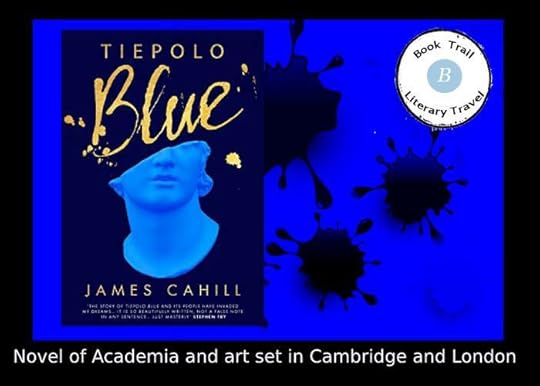
’The sun had broken through the clouds, rinsing the garden in glassy brightness.’This is a character study with more than a touch of Reginald Perrin and Prufrock about it, with a dash of Eleanor Rigby, and a smidgen of John Cleese. I was reminded of the devastating wit and sensitive observational style of ‘Gaudy Night’ by Dorothy L. Sayers, as our protagonist Don Lamb, bumbles through his life in Peterhouse College, University of Cambridge.
‘They set out at four o’clock and walk down to Herne Hill, passing the Rosses’ house on Craxton Road, then treading the border of Brockwell Park, on towards Denmark Hill. In the heat, people fill the streets. On a mound of grass at the foot of a tower block, two girls in crop-tops are bending over with laughter. They are in their early teens. One of them sits down on the grass and rolls onto her side. Her hair falls in a curl across an eye. The other eye meets Don’s as he and Ben pass.’This is the stuff of the novel: the reader assumes the role of spectator, adopting Don's idiosyncratic passive place in the narrative. He is voyeur in his own life; what happens to him is viewed at one remove. Don figuratively watches his life on a cinema screen, as objects manoeuvre themselves in front of him as static or moving images: the sculptures of Venus in the Brockwell Collection as they smash to the floor; the grotesque drunk who performs, jester-like, in front of Don on a bus; Val Black's white satin suit and the red wine stain with which Don sullies it; the gas cylinder in Val's House Beautiful that Don interprets as a Minoan pot; and, of course, skies.
“Look ahead – the converging pavements, the cylindrical building at the junction. You could build a frame around the scene and it would resemble a painting of the Italian Renaissance, structurally at least: you could draw lines over the surface of the image, mapping the recession of space.” [Don] tilts his head back and squints.’
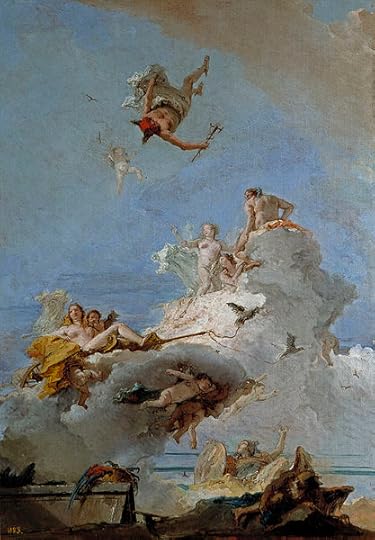
‘When he walks onto the poolside, his towel slung over one shoulder, he sees a large rectangular island of water. The heads of early-morning swimmers bob above the turquoise surface. […] The pool sides are crowded with people. Two girls sprint past him and jump, one then the other, sending geysers leaping into the air. Through his half-closed eyes, air and water become the same substance – pure blue, the same blue as in Tiepolo’s frescoes, only stronger, as if the skies of the paintings have concentrated into a brilliant essence.’What Don views is often new to him, but simultaneously in a state of degeneration or decomposition. This loops the entire plot round to the SICK BED artwork installed on the lawn at Peterhouse, which symbolises Don’s disentanglement from academia, in fact – his own unravelling, these found/looked-at objects are often signifiers of Don’s impending demise:
‘Afterwards, they come to a straggling parade of shops. Teenagers hang around the entrances. Plastic boxes stacked outside a greengrocer’s release the sweet-acrid scent of fruit and veg. The next shopfront consists of a glass sarcophagus arrayed with raw meat – cross-sectioned, minced, cubed, patterned with creamy fat and skewered with star-shaped pieces of green card that announce prices and weights in scribbled pen. The colours of objects, their small details, enter Don’s vision like new phenomena – things he’s never seen.’
‘Ripping at the foliage, he sees that the creepers conceal other objects – old tins, scaffolding poles, tyres stacked in a cylinder, glass bottles caked in grime. Woodlice scurry as he dislodges an empty litre bottle of Courvoisier. He continues to tear at the greenery. Buried in a mound of ivy is what looks like a car engine, a compression of blackened tubes and valves, and next to it, a heap of old clothes – leather jackets, jeans and a fur coat piled up like geological seams. The fabrics have been reduced almost to compost but are still identifiable – just – as what they once were.’At the close of the book, objectification is rounded off nicely: found objects melding with Art History, significant figures in Don’s life (Valentine Black, Erica Jay, Mariam Schwarz), and the unknowable (unviewable?) truths underlying his reality.
‘He tries to open the door to Ina’s annex. It is locked. He leans his head on the frosted glass, but the choppy surface discloses nothing. In a kitchen drawer, he finds a key with a tag marked ‘Back door’. This defunct route to the garden is behind the sofa in the television room adjacent to the kitchen. He goes through and heaves the leather chesterfield out of the way. The upper half of the door is glazed, but the view outside is blocked by a bush.’Even characters who meaningfully shape his existence, such as Paul, exclude him from their sphere, just as he is progressively pushed out of his own domain of art historian:
‘Don peers through the glass. It is some kind of garden store. Paul’s shed. The interior is orderly and spare, like an armoury. Pairs of black wellington boots – clean, gleaming – stand in a row, rising in height to thigh-high waders. One pair is slimmer and sleeker than the rest, more like jodhpurs. Bamboo canes, hooked at one end, lie sideways on a shelf. Against the back wall, sacks of peat are stacked in the shape of a couch and topped by a blanket. Above, hanging from hooks, are a coil of yellow hosepipe, a clawlike rake, and a complicated harness – all leather straps and shining buckles. His eyes wander over the small details.’Don’s repulsion from the lives of those whom he objectifies is best illustrated with his incursion into Goldsmith’s College – a realm he should dominate, but is instead brutally expelled from:
‘Unseen, Don looks around the circle of students. Their faces are so different from those he lectured in Cambridge. […] Without meaning to, Don has opened the door yet wider. They turn – all of them – to look at him.And if Don is the disconnected observer of his own life, locked-out, repulsed, even banished; Val is the Machiavellian player moving the pieces round the chessboard in Don's flaccid self-reportage:
“Can I help you?” says the older man.
Don scans the faces that are turned in unison towards him […]. “I’m an art historian,” he says. “A professor."
“Whoever you are, you are interrupting my class. Please go.”
The man places a hand on Don’s arm and edges him back through the door.
“Get out of here, dickhead!” the girl shouts […].
The door slams and Don is alone in the corridor. […] He tries the door handle again, rattling the aluminium lever and pushing with all his weight, but it has been locked from the inside.’
‘Don has played his role, but Val has been observing and orchestrating.’Don’s life is performed in front of him, behind a veil, the players having been cast and directed by Valentine.
‘[Don] gazes at the remains of the painting. He is struck, most of all, by the shimmering loveliness of the scene in its dissolved state. It’s as if a fine gauze has descended over the picture. The figures in their flowing robes have turned to soft-edged impressions. Hard forms have become crops of weightless, powdery colour. And yet the colours themselves have survived – strengthened, even. The whole thing pulses with blue, orange and umber. Goliath’s head is an ochre silhouette, as featureless as a face seen against a light-filled window. […] He thinks of his own artifice of his own role [at the Brockwell], in this place, and asks who – or what – will shake him free. Involuntarily, he stretches out his hand and touches the tip of each of the boy’s fingers. The veneer of the painting wobbles at his touch. It feels smooth, dry and unexpectedly warm.’Don is reaching out to touch his own existence, trying to make substantial contact with his life, shape some actuality, but the response is ‘wobbly’; insubstantial, precarious. This novel reads as a momentary glimpse into The Life of Don Lamb – just like David Nobbs’s Reginald Perrin – as his footing shifts and he outgrows the scope of closeted Professor of Art History. However, life can only ever be applied in the loosest of terms. Don’s intellectual or emotional connection with the series of rolling scenes that serve as his existence remains as numb as is his response to the seminal black&white photograph he finds of his younger self in a punt with Val at Cambridge. Only with Ben does Don approach anything like active agency:
'His desire to gaze [at Ben] is also a desire to feel, hold, and possess.'Ultimately, toward the end of the book, we read that Don has ‘seen enough pictures.’ The closure of the book is dazzling. ‘Tiepolo Blue’ reminded me of Sarah Winman's style - crisp and concise character studies – life looked at; the desire to be looked back upon.