From The Shortest History series comes the complete history of democracy, its champions, and its detractors—from the assemblies of ancient Mesopotamia to present perils
This tumultuous global story begins with democracy’s radical core idea: We can collaborate, as equals, to determine our own lives and futures. John Keane traces how this concept emerged and evolved, from the earliest “assembly democracies” to European-style electoral democracy to our present system of “monitory democracy.” Today, governments answer not only to voters on Election Day, but to intense public scrutiny (monitoring) every day. Keane calls this media- and communication-driven system “the most complex and vibrant form of democracy yet”—but it is not invulnerable.
We live in an age of political and environmental crisis, when despots in China, Russia, Saudi Arabia, and elsewhere reject the promises of power-sharing. At this urgent moment, Keane’s book mounts a new defense of a precious global ideal.
„A demokráciát az ember igazság iránti érzéke teszi lehetővé – de az igazságtalanságra való hajlama teszi szükségessé.” (Reinhold Niebuhr)
Ez a könyv megfizethetetlen abból a szempontból, hogy a demokráciát nem valami ideaként mutatja be, amit csak úgy idepottyantott nekünk egy liberális szakaszban lévő Úristen, mi meg élünk vele, ahogy, hanem egy történelmi kontextusba ágyazott folyamatként, ami kialakult valamikor az ősidőkben, elbukott, feltámadott, átváltozott – egyszóval organikusan jött létre, mindig reflektálva az adott időszakok sajátosságaira. Jó, szakmunkához képest időnként túl csapongónak éreztem – néha mintha egyetlen fejezeten belül váltana témát úgy, hogy azt logikailag nem okolja meg kellőképpen -, de azért melegen tudom ajánlani. De mivel akármilyen melegen ajánlom, úgyse fogja mindenki elolvasni, ezért inkább összefoglalom. Mert a demokrácia legrövidebb történetét is össze lehet úgy foglalni, hogy még rövidebb legyen. És onnantól kezdve az lesz a demokrácia legrövidebb története.
Keane három szakaszra bontja e politikai rendszer pályafutását: 1.) Részvételi demokrácia: Az athéniak persze azt hazudták, hogy ezt ők találták fel, pedig dehogy, a Közel-Keletről importálták, mégpedig a mezopotámiaiaktól, akik már jóval előttük megszülték a népgyűlések hagyományát. A demokrácia ezen szakaszának kulcseleme, hogy a polgárok közvetlenül vettek részt a politikában: kimentek az agorára (már akit odaengedtek), aztán hajrá, ereszd el a hajamat. Nem csoda, ha az összes valamirevaló filozófus (kezdve Platónnal) lanyha undorral figyelte ténykedésüket. Hisz ahelyett, hogy csendben filozofáltak volna, ahogy az rendes görög emberhez illik, állampolgári aktivitást fejtettek ki, azaz: csőcselékeskedtek. El fogjátok süllyeszteni az állam hajóját, ti részeg matrózok, morgott ez a mogorva Platón, egyáltalán nem törődve azzal, hogy Athén csak letett valamit az asztalra: a hellén világ egyik legnagyobb hatalmát hozta létre. Mégpedig nem függetlenül a demokrácia gyakorlatától, ami lehetővé tette számára, hogy olyan embereket is bevonjon a hatalom gyakorlásába (és ezzel összefüggésben: a hatalom megvédésébe, sőt kiterjesztésébe), akik egy arisztokráciában passzívan figyelték volna annak vergődését.
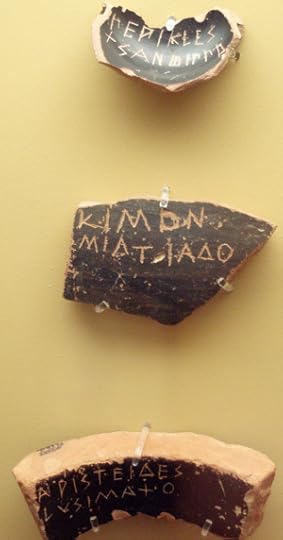
(Cserépszavazatok az ókori Athénból. Valamelyik marha Periklészre szavazott, úgy látom!!!)
Persze Platónnak igaza volt abban, hogy ez a demokrácia közel sem volt folttalan. Az egy dolog, hogy a demokratikus gondolatot Athén összeférhetőnek tartotta a rabszolgasággal, a szuverén államok megtámadásával, meg a nők és idegenek jogfosztottságával (ez Platónt se nagyon zavarta). Nagyobb gond volt, hogy a részvételi demokrácia ezen formája nem igazán fogadta el az ellenvélemény fogalmát. Számára a nép egyetlen szuverén volt, az általa hozott döntés pedig olyasvalami, ami kötelező érvénnyel bírt mindenki számára. Nem fogadta el a különvéleményt (erről Szókratész tudna mesélni, ha nem itatták volna meg méreggel), nem ismerte el, hogy egyetlen népen belül különböző érdekek is létezhetnek. Ilyen értelemben pedig sok tekintetben megelőlegezte az abszolutista uralkodók vagy épp a XX. századi diktátorok népértelmezését – hisz állampolgáraikat ők is monolit tömbként képzelték el, vagy azzá próbálták formálni.
2.) Képviseleti demokrácia: Aztán a részvételi demokrácia elhalálozott, de azért itt-ott fennmaradt, Izlandon, Svájcban, vagy épp Spanyolország északi felén, ahol már a XII. században létrejöttek parlamentszerű képződmények. A parlamentek kialakulása bizonyos földrajzi szükségszerűségeknek köszönhető: nyilván senki nem várhatta el egy ököritófülpösi kazánkovácstól, hogy eldobja a kalapácsot, és két hónapot utazzon azért, hogy szavazzon valahol a világ végén (plusz két méter) valami halászati joggal kapcsolatos hülye kérdésről. De azt már igenis megtehette ez a kazánkovács, hogy választ magának egy képviselőt, akiben megbízik, és azt utaztatja egész évben. Így vált a részvételi demokrácia képviseletivé – ami forradalminak bizonyult. Hogy mennyire, azt az Amerikai Egyesült Államok bizonyította be, ahol ez az elképzelés pár száz évvel később uralkodóvá vált, olyan siker alapkövévé, ami a nagyhatalmak közé katapultálta az országot, holott a fenekén még ott volt a tojáshéj.
Kialakult továbbá a képviseleti demokráciák azon sajátossága is, hogy érdekcsoportjai pártokba rendeződtek, ami szintén önmagán túlmutató jelentőséggel bírt. Hisz ezzel a demokrácia túllépett a szuverén és oszthatatlan nép ideáján (bár teljesen nem vetette el azt), és elfogadta, hogy egyetlen országban akár több érdekcsoport is élhet egymás mellett relatív békében. Azonban az eszme ellenségei most sem nyughattak – itt volt például a populizmus (amit Keane a demokrácia autoimmun betegségének nevez, igen találóan), és azok az önjelölt zsarnokok, akik a demokratikus eljárásokra támaszkodva megszerezték a nép feltétlen bizalmát, hogy aztán hatalomra kerülve megkezdjék az őket felemelő intézmények lebontását. Voltaképpen nem tettek mást, csak kihasználtak egy demokráciaparadoxont: azt, hogy a demokrácia gyakran maga teszi lehetővé azok fennmaradását, akik az életére törnek. Ezt a folyamatot, a demokrácia önfelszámolását nevezi a szerző democídiumnak.
3.) Ellenőrző demokrácia: A XX. század '40-es éveiben úgy tűnt, az ideának harangoztak. Brutális totalitárius diktatúrák emelkedtek fel, amelyek népszerűségüket nem ritkán pont annak köszönhették, hogy a liberális demokráciával szemben határozták meg magukat. De aztán mégse gyászmenet lett a vége, hanem újjászületés. A nácizmus bukása után ugyanis a kivérzett Európa nyitottá vált a demokrácia felélesztésére, mégpedig úgy, hogy annak egyes alapvető hibáit kiküszöböli. Így született meg a képviseleti demokrácia romjain az ellenőrző demokrácia. Abból a felismerésből építkezett, hogy az ember eredendően gyarló lény, a tömeg pedig megvezethető – következésképpen egy magára valamit is adó politikai rendszernek nem arra kell koncentrálnia, milyen módon választja ki vezetőit, hanem arra, hogyan ellenőrzi őket. Mert akármilyen szépnek és okosnak is tűnik egy leendő Nagy Vezér, lehet, a csúcson megzakkan, tele kell tehát bástyázni a demokráciát mindenféle fékekkel és ellensúlyokkal. Azt gondolom, a demokrácia ezzel lépett a realista szakaszba – ellentétben a vezérelvet vallókkal, akik valójában zsigeri idealisták, hisz abban bíznak, hogy ha valaki eljut a hatalom magasába, akkor nem adja el utána a saját anyját is, csak hogy ott maradhasson.
Persze a történetnek itt nincs vége. Az ellenőrző demokrácia nem végpont – hogy mi lesz a végpont, a jövő homályába vész. Továbbra is veszélyek leselkednek rá – az autoriter irányítás hívei például ismét erősödni látszanak, és (szokás szerint) az egyszemélyi vezetés gördülékenységét ajánlgatják a demokratikus körülményeskedés helyett. (Pedig hát emlékezhetnének rá, merre haladtak a múlt század közepén oly gördülékenyen az egyszemélyi vezetők.) És hát itt vannak a feloldhatatlannak tűnő ellentmondások is, például a kapitalizmus logikája és a demokratikus intézmények között*. Szóval a helyzet nem túl rózsás – de hát igazából sosem volt az. Ugyanakkor van miben bízni – mégpedig abban, hogy a demokráciának eddig is az volt a szuperképessége, hogy egymásnak ellentmondó igazságokat is képes volt egyetlen rendszerbe integrálni. Mondhatni, arra lett kiképezve, hogy túlélje a saját ellentmondásait. Épp ezért azok a válságok és katasztrófák, amelyek a birodalmakat és diktatúrákat taccsra tették, a demokráciákat csak megroggyantották. Képesek voltak feltápászkodni és levonni a konzekvenciákat – innovatívak és rugalmasak autoriter versenytársaikhoz képest. És egy dinamikusan változó létezésben, egy felgyorsult időben alkalmasint ez a legfontosabb.
* A kapitalizmus logikájából ugyanis az következik, hogy folyton újratermeli azokat az egyenlőtlenségeket, amelyeket a demokrácia igyekszik felszámolni. Tulajdonképpen csoda, hogy kibékíthetetlen ellentétük ellenére ilyen sokáig együtt tudtak élni. Ironikus ugyanakkor, hogy a kapitalizmus egykor a demokrácia felhajtóerejeként funkcionált, hisz a királyokkal és az arisztokratákkal szemben megteremtette azt a módos középosztályt, aki aztán részt kért a hatalomból – ezzel pedig oroszlánrészt vállalt a politikai rendszer átalakításában.
Це не коротка історія демократії, а недописана чернетка: автор зупинився на плані й синопсисах розділів, а потім, здається, випадково відправив усе це в друк.
This is not a short history of democracy, but an unfinished draft: the author stopped at the outline and chapter summaries, then somehow sent the whole thing to print.
Short but by no means sparing in insights, research and analysis! This is a really useful history which is only too relevant as we see democracy challenged across the globe, I found the writing style very clear and pitched at a level which will suit all readers interested in this topic.
Demokratija yra neapibrėžtumas, kuri institucijų pagalba šį neapibrėžtumą kontroliuoja – nenumatytos aplinkybės yra demokratijos draugas ir baisiausias autokrato sapnas.
The Shortest History series continues to impress me, so much so that I truly believe this book should be required reading in schools and that everyone in a currently struggling democracy (which means most of them) should read at least the second half of this book starting with the section on electoral democracies.
John Keane has done a wonderful job at coalescing the history of the governing practice and ideology of democracy into an easily consumable book befitting of the Shortest History series. I must admit though, that the beginning section on assembly democracies and the rise of Athenian democracy, while generally interesting, was not particularly captivating to me in what I was expecting from a book like this. This is partially why it took me a week to finish instead of a day like the Shortest History of Germany.
However, upon reaching the section on electoral democracy, things started to coalesce. Keane provides sharp insights and critiques into why assembly and electoral democracies failed or allowed totalitarian regimes to rise to power within themselves. However, it is the section on modern monitory democracy is not just compelling reading and insightful political and social science but also, I'd argue, the most important part of this book.
Keane provides an overview of monitory democracy that basically coalesced some separate ideas in my head that have been floating around for some time such as: Voting with your wallet is likely now more effective and immediate form of a participation in a capitalist system than voting with your actual ballot vote. The strengthening of alternative forms of "voting" (engaging in community whether its local or global, giving money to certain causes and corporations than others, constantly and consistently educating yourself) will help evolve democracy from a divisive popularity contest every two or four years to something that is truly more responsive to the citizenry. Voters are human and are subject to the foibles of human psychology as demonstrated by Brian Klaas's Corruptible and Michele Gelfand's Rule Makers, Rule Breakers. Voters can be radicalized, fooled, and corrupted by charismatic psychopaths, sociopaths, and other "evil-doers" as well as war, famine, natural disasters, economic stagnation, and other large scale calamities. Democracies and their institutions must be resilient enough to fight off these impulses and respond to crises effectively. Democracy should, at this point in history, not be thought of as a high ideal that is arbitrarily the best but rather the objectively best known governing system compared to others that, by their very nature, GUARANTEE oppression, bigotry, despotism, corruption, armed conflict, and lower standards of living.
That last point, expressed across the final few pages of the book, is Keane's magnificent defense of democracy as a system worth saving in the face of authoritarian threats that are the most nimble and adaptable than they've ever been before thanks to the proliferation of online radicalization spaces and the failure of corrupted democratic institutions and the surrender of those institutions to hyper-capitalistic systems that destroy true free markets. A society that values GDP, portfolio growth, and market capitalization rather than human well being will create citizens unenthusiastic or even antagonistic to said society.
As bad as things may be, they absolutely could be worse. While that is not necessarily a comforting positivist conclusion, think of it this way: democracies offer its citizens the most opportunities to change the status quo. That type of change is much harder and would be repressed by police and military violence in a typical autocracy or dictatorship. I would have hoped that the peoples of Europe currently electing far right parties into power would have remembered this. The last time they flirted with such centralized authoritarian power they caused two world wars that likely killed over 100 million people combined in the span of 30 years and caused untold economic and cultural destruction that fomented a cold war that precipitated another 40 years with the threat of nuclear destruction looming over every moment. So yeah, go ahead and vote for Le Pen or Orban. I'm sure it'll turn out as great for you as Trump was for the United States.
A very high recommend, or perhaps an insistence even, that you read this book. Skip the first section on assemblies and Athens if you must. Engaging with the chapter on monitory democracies is a must. I repeat that this should be required reading in schools and should be passed out at every social club and protest movement out there. Democracy is retreating in the world, and I genuinely don't see a better outcome if it dies out.
i thought this book was a just okay look at democracy's history. i probably should have been able to gather from the title when it called itself the "shortest history" that i was not going to get as much depth from the information than i wanted and that i would find obvious gaps as well.
the first part of the book was pretty solid, exploring how ancient civilisations understood democracy and deconstructing the myth that democracy began in athens. the book then has a major gap in its timeline between the fall of the athenian empire and then the establishment of america in the 18th century, only highlighting a few key moments in history. for such a substantial amount of time to miss in the development of political systems, i feel it might have been worthwhile to explain what political systems were in place instead of democracy and how they were evolving. this would have made the final chapter explaining why people should keep making the decision to choose democracy stronger, as i feel like i would have understood better what options i was not choosing.
there was also a lack of exploration of the weaponization of democracy. there was a general vibe throughout this book that democracy is the best political system, and many times were there facts and statistics showing what countries were and weren't democracies at the time of statistic. however, there was a significant failure to explain how democracy came to some of those countries and the role that it has played in colonisation and the oppression of native people. the book skirted around the fact that throughout history the ability to vote has been a white male privilege and that other members of society have not been able to engage with the democratic process. the trauma of that history means that it may not be possible for ethnic groups to forgive the system enough to reengage with it, which means we as a society must continue searching for a better solution.
this book was a good overview of democracy, it was just arguing overly in favour for it and did not want to stop to process any sort of critique. if you are to read this, i would recommend reading it with a very critical lens.
A breve história da democracia foi, precisamente, uma breve mas sucinta história da democracia. A ideia “anti-ocidental”, mas necessária, no início, onde John Keane afirma que a democracia não nasceu em Atenas mas sim no Oriente, é algo necessário e que seria giro que muitos “professores” de história tivessem em conta antes de dizerem que tudo começou em 5 a.C. No entanto, eu diria que tal esforço acabou por ser em vão ao dar mais ênfase a Atenas no capítulo da democracia de assembleia. Para além disso, achei por vezes um pouco confuso o decorrer da exposição nos capítulos II e III, onde iam primeiro para a revolução americana, depois para algo mais atual, depois voltavam para a revolução americana, enfim, achei um pouco confuso e gostava que Keane tivesse prestado lealdade à cronologia apresentada no início. Não obstante, recomendo na íntegra, é um livro muito importante, em especial para os jovens que desacreditam a democracia é que respiram por modelos de governação despóticos e opressivos. No fim, o que mais me espantou foi a forma eficaz de John Keane provar que a democracia, ao contrário dos outros regimes, beneficiou dos seus fracassos e dos seus opositores para se reinventar e evoluir, fenómeno único e muito complicado de explicar, mas que efetivamente aconteceu nos últimos milhares de anos.
I do appreciate when I walk away from a book on a subject I previously thought I was well-informed about with just a little more knowledge than I had going into it. Sure, a lot of this book will be familiar territory to your garden variety eurocentric history buffs, but there's still some trivia nuggets buried in here to make it worth your time.
For me, it was the focus on how the first parliaments (as we recognize them) formed in northern Spain at the beginning of the Reconquista, a handful of decades before all that Magna Carta business. I also took for granted that the current conclave system for selecting a new pope was just how it was always done, which is decidedly not the case. Also came across a fun anecdote about a 1791 election in Québec that was open to "all" property owners over the age of 21. "A man entered the polling place only to be told that he could not vote because his property was in his wife's name. Red-faced, he was ordered to bring her to the polls, since she was the qualified voter in their family."
The last third of the book focuses on the post-1945 era of "monitory democracy," which kind of lost me for a bit. The author was arguing that in a new age of watchdog agencies and other NGOs democracies are held more accountable than ever and are appropriately responsive to the desires of the people they govern over. It's hard for me to accept that at face value when the state of democracy across the world seems so precarious at the moment with hardly any heads of state boasting approval ratings in the black. There is discussion about rising competition from autocratic top-down nations, but not as much prognosticating about what the future of democracy might look like for my tastes. Still, an overall concise summary of the central subject that I can confidently say this is exactly what it says on the tin.
"The Shortest History of Democracy" read too much like a succinct work of academia to me. At first, it did a best effort to appease a broader audience, but in the second part I really got bogged down by unnecessary details and, frankly, boring paragraphs.
However, by the third part, the book picked up some pace again, and the final 20 pages I really liked. The ending of the book looks into the future and gives the author's personal and passionate reasons for defending and believing in this beast called democracy.
If anything, what I have learnt from this book is that, indeed, living under democratic rule is not something to easily take for granted. It is worth preserving. It "is the guardian of plurality - the protector of different ways of living freed from the dictates of arrogant, violent and predatory power."
To justify absolute obedience to rulers, regardless of their stupidity or cruelty, Ivan the Terrible said "Think on this and reflect: he who resists power resists God".
"Man's capacity for justice makes democracy possible; but man's inclination to injustice makes democracy necessary." Reinhold Niebuhr
Universal Declaration of Human Rights drafted 1947-48, in response to genocide in the aftermath of global war -the most translated document ever, available in 500 languages - proclaimed series of rights to be enjoyed by everyone 'without distinction of any kind, such as race, colour, sex, language, religion, political or other opinion, national or social origin, property, birth or other status', solved the problem who decides who 'the people' are?
Democracy and capitalism work against each other. There are more types of democracy than I expected. It seems like a basic enough concept that I didn't realize how little I knew about.
This entire review has been hidden because of spoilers.
Lo he leído para clase y honestamente... muy bien documentado y con algunas apreciaciones valiosas. Podría haber sido un artículo, errático el formato y cierta torpeza de juicio en valoraciones extra que no tienen demasiado sentido.
Ejemplos tontos:
- Considerar que los demócratas griegos tenían dudas sobre la legitimidad de la esclavitud porque no trataban mucho el tema... como si eso no fuera una razón para pensar que la asumían naturalmente, como parece que ocurría.
- Comentar que Franco era un dictador fascista... Dictador era, pero el término fascista es una imprecisión innecesaria.
According to the author the biggest merit of democracy is not securing prosperity or peace (the author even disputes that) but that it is able to control and oversee the mighty. Humans are tend to commit bad deeds and that is why the regulatory function of democracy is crucial to protect humans and the biosphere. Their current, third stage called monitory democracies are superior to the previous two, which only brought first, participation, and second, representation.
This entire review has been hidden because of spoilers.
This book is full of surprises. For example, democracy didn't start in Athens but around 1700 years earlier in the Middle East in cities such as Uruk, Nippur, and Lagash.
Of course, it depends on what you mean by democracy, so it's debatable there was ever democracy in Athens.
As for Parliaments, well they were an invention of what is today Northern Spain and were born out of a desire to drive the Saracens from their land.
The book ends by discussing despotism and the way governments are taken over by private corporations with the help of commercial media that demobilises and shepherds the citizenry.
leitura MAIS que necessária. tem a vertente histórica onde o autor contextualiza e insere as diferentes "fases" da democracia, não só a nível europeu/ocidental, engloba todos os pontos do mundo. tem, ainda, a vertente política, onde o autor faz uma crítica às condições necessárias para uma democracia ser funcional. critica fortemente governos que, no seu entendimento, são vistos como autoritários, deixando uma nota final em tom refletivo, não sabendo qual será a próxima fase da democracia.
Book Review: The Shortest History of Democracy: 4,000 Years of Self-Government - A Retelling for Our Times by John Keane
John Keane’s The Shortest History of Democracy offers a concise yet profound exploration of the complex evolution of democracy over four millennia. This engaging narrative weaves together historical events, philosophical ideas, and contemporary relevance, all while maintaining a brisk pace that makes it accessible to a wide audience.
A Comprehensive Overview
Spanning from the early assemblies of ancient Mesopotamia to modern democratic practices, Keane meticulously charts the transformation of democratic ideals through various cultures and eras. He emphasizes that democracy is not a fixed entity but rather an ever-evolving concept shaped by social, political, and economic forces. The book provides a sweeping overview of key milestones in democracy’s development, making it an informative guide for readers new to the topic or those looking to deepen their understanding.
Engaging and Accessible Writing
Keane’s writing is both engaging and approachable, deftly balancing scholarly insights with narrative flair. He employs clear language and relatable examples, presenting complex ideas in a way that invites readers to reflect on the implications of democracy in their own lives. The author’s ability to distill intricate histories into digestible segments allows the book to be both informative and enjoyable.
Themes of Struggle and Resilience
One of the central themes of the book is the notion that democracy is a continuous struggle rather than a completed project. Keane highlights the challenges faced by democratic movements throughout history, including oppression, inequality, and corruption. He argues that understanding the historical context of these struggles is crucial for appreciating the fragility of democratic systems today, especially in light of recent global trends toward authoritarianism.
Contemporary Relevance
Keane does not shy away from addressing current challenges to democracy, making the book particularly timely. He discusses how the ideals of democracy are being tested in various parts of the world, urging readers to consider their role in safeguarding democratic principles. This connection between historical events and modern dilemmas provides a powerful framework for understanding the importance of active participation in governance.
Conclusion: Essential Reading for Modern Citizens
The Shortest History of Democracy is a vital and illuminating work that captures the essence of democratic evolution. John Keane has crafted a narrative that is both educational and thought-provoking, making it an essential read for anyone interested in understanding the past and future of self-governance. This book serves as a reminder that democracy requires vigilance and participation, encouraging readers to engage with the political systems that shape their lives. Whether you are a student, a political enthusiast, or simply someone curious about the forces that have shaped our world, Keane’s work will resonate long after the last page is turned.
Nyilvánvaló politikai elfogultsága mellett a könyvnek vannak erényei. A történelmi áttekintés, a demokráciák bemutatása egyértelművé teszi, hogy nem csak egyféle demokrácia létezik, és a demokráciák kialakulását, fejlődését, fajtáit nem belső törvényszerűségek határozzák meg, hanem véletlenek, adottságok, hagyományok, szokások és aktuális igények, vagyis a körülmények. Még az utolsó oldalakon, a demokráciához írott dicshimnusz sorai közt is voltak kritikai észrevételek, melyek kiegyensúlyozottá, elfogulatlanná ugyan nem tették az írást, de legalább nem hagyta figyelmen kívül az ellenérveket. A záró gondolattal, miszerint a demokrácia legfőbb szerepe a hatalom ellenőrzésében van, még egyet is tudok érteni. Persze a politikai rendszerek mindegyike a hatalom megoszlásáról, a hatalmat gyakorlók ellenőrzéséről szól, különbség csak abban van, hogy kik birtokolják a hatalmat, valamint kik és hogyan igyekeznek ellenőrzést gyakorolni a hatalom birtokosai fölött. Amit leginkább hiányoltam, az az árnyékhatalom működésének leírása. Mert az összes politikai rendszert aláássa, hogy az ellenőrzésre kidolgozott módszerek a hatalmat névlegesen gyakorlók ellenőrzését tűzik ki célul, míg a hivatalosan hatalommal nem rendelkező árnyékhatalom korlátozására, ellenőrzésére szolgáló struktúrák, eljárások nem is alakulnak ki. Árnyékhatalom mindenütt kialakul, ahol a névleges hatalom meggyengül. A japán császárok nevében egy időben sógunok, majd a sógunok helyett régensek irányítottak. A 7-8. századi Frank birodalomban a Meroving királyok helyett a háznagy kezében volt a tényleges hatalom, az ifjú XIII. Lajos helyett az anyja kegyence, Concino Concini hozta a döntéseket, majd később Richelieu bíboros, de gondolhatunk II Andrásra és a merániakra, V. Károly német-római császárra és a Fuggerekre stb. A mai demokráciák működése sem érthető, ha nem vesszük számításba Deep State, a katonai-pénzügyi-ipari körök befolyását a kormányokra. Ugyanakkor az un. "diktátorok" hatalma nem korlátlan. Választások hiányában, vagy színjáték választások mellett sem tehetnek meg bármit, nagyon is tekintettel kell lenniük az "alattvalóikra", számításba kell venniük, hogy a népharag bármikor elsöpörheti őket. Különösen, ha a népharagot még szítja is egy az árnyékhatalom pozíciójába törekvő szereplő, aki kevésbé erős vezetőket szeretne látni a kormányrúdnál, olyanokat, akiket irányíthat. Az ilyen "exportált demokráciáról" is szívesen olvastam voltam részletes elemzést. Mindezekkel együtt érdemes volt elolvasni, különösen így, a Mearsheimer könyvvel (The Great Delusion: Liberal Dreams and International Realities) együtt.
History is a subject that fascinates me like no other and this book has been wonderful.
Contrary to the popular belief that democracy started its roots in Athens, the author has written facts from history that date back democracy to 2500 BCE in Syria-Mesopotamia. Since then, democracy has had its ups and downs with the change of rulers worldwide.
The book is divided into three parts: assembly democracy, electoral democracy and monitory democracy, and it beautifully explains each in simple terms.
I was intrigued by the timeline of democratic rule from its start in Syria- Mesopotamia to being ridiculed by fascists, tyrants and military rulers. Democracy's survival through two great world wars and how humans transformed from treating the ruler as God to becoming the principle of ‘the people’ has been narrated interestingly.
The book enlightens the struggle of women, blacks and enslaved people to get their rights to vote and be included as a part of society. It breaks the widespread belief that Islamic nations do not have a role in democracy by explaining the birth of the 'wakil' concept in Islam and how it contributed to democracy's advent. I loved how the book covered every part of the world, like the velvet revolution in Czechoslovakia, the Nazi's rule in Germany, Senegal’s 'demokaraasi', the largest democratic nation of India, UK's OPAL project, China, Taiwan, the US and much more.
Read this book if you have ever wondered how today's governance system came into place and how democratic rule fluctuated with time. The author has included the writings and sayings of many writers, artists, philosophers and reformers who are not commonly spoken about in history classes. The book ends with a powerful note on the positive side of democracy and how it is being abused by leaders worldwide, and how it can be stopped further. A must-read book for history lovers and political science readers. A short read with a vast array of details made available in one place.
Part of Black Inc’s ‘Shortest History’ series, this book is just what is claims to be- both short and a history- and although the last section took me from scepticism to despair, it does end with a claim for a radical democracy that can, perhaps, be “wisdom of global value”. This is a history that emphasizes change and contingency, upheavals and setbacks. As Keane notes in his introduction, “Democracy has no built-in guarantees of survival” (p. 6).
The structure of the book is foreshadowed by a very useful ‘Democracy’s Timeline’, where events drawn from across the globe flesh out the book’s three parts: The Age of Assembly Democracy; The Age of Electoral Democracy and The Age of Monitory Democracy. ... It’s not possible to retrieve and breath life into past justifications of democracy like Christianity, nationality, protection of private property and utilitarianism. Democracy doesn’t always bring peace (look at Israel) or “economic growth”.
Instead, he says, we need to reimagine democracy as the guardian of plurality, freed from the dictates of arrogant, predatory power (p. 195). We need to keep the problem of “abusive power” central to how we think about democracy. ... In this book Keane takes a very long view, going back much further than Athenian democracy, and his three-part frame of analysis is useful for discussing democracy without getting bogged down in detail. The book is engagingly written, it even has illustrations, and it scoots along at pace. If one of the advantages of reading “the shortest history” of a concept is a brisk, informed analysis (as distinct from re-telling) and introducing a new way of scaffolding one’s thinking, then it’s well worth reading.
The Shortest History of Democracy by John Keane is a short but concise history that goes into more depth than one might expect.
This little volume does more than just give a history, it also highlights the fact that democracy is not guaranteed to survive. In fact, it is through seeing how democracy has changed and evolved over the years, even at times into less desirable forms, that offers hope for its future. At turns uplifting and disconcerting, we are ultimately left with some hope even if it might seem like dark days indeed.
My favorite section was his explanation and analysis of monitory democracy. Keane offers some perspective that, while perhaps isn't new, is too often ignored or overlooked. But more than anything, even though this is a history, it is one that has an eye on the future and what that future might be. It is up to us to learn and start doing what we must to create the type of democracy we want.
Highly recommended for those wanting a brief history as well as those who want a big picture refresher to help them gain some grounded perspective on current events.
Reviewed from a copy made available by the publisher via NetGalley.
Book: The Shortest History Of Democracy Author: John Keane Genre: Non-Fiction/Political History Publisher: Picador India Pages: 256
Democracy is the word that trends globally from time to time, especially now when the largest democracy in the world is going to have its General Elections.
The Shortest History Of Democracy by John Keane is an attempt to make the readers familiar with the concept of democracy from the time of its origin to the recent debates where there are always comparisons between democracy and other forms of government. The book is divided into three parts: Assembly Democracy, Electoral Democracy and Monitory Democracy.
The author talks in detail about the origin of democracy and all the controversies around it. The first part of the book is quite interesting in that context. Although I was a little lost in the second and third parts at some moments.
Overall, this is a good book for someone who wants to know about the evolution of democracy, the emerging challenges and its significance in the current time, and something that could be read in a short duration.
A fascinating history of the concept of democracy that asks the very reasonable question 'is democracy the best form of government ever established or merely an aberration in a long global history of despots?'
In seeking to provoke the reader's answer the author takes us through the history of assembly democracy through electoral democracy and, finally, looking at the post-WW2 establishment of monitory democracies.
In essence Keane arrives at a conclusion that there is no better form of government than a democratic one for preventing the unfettered power of individuals, but is that enough?
If we accept the author's assertion that 'Nothing about human behaviour comes as a surprise: it sees that humans are capable of the best, and perpetrators of the worst. For that reason, democracy stands against ever form of hubris.'
The question of course is whether, in failing democracies where over half of the population would prefer living under the power of strong man despots, whether it will remain so?
De titel omschrijft dit boek zeer duidelijk: een bondige weergave van de geschiedenis van de democratie. Voor mijn smaak was de beschrijvende stijl dan ook een tikkeltje te vlak, al werd de verdieping en detaillering van verscheidene historische vormen van democratieën zeker wel grondig uitgewerkt. Bovendien ontbrak er naar mijn mening dikwijls een parallel tussen eeuwenoude variaties op de democratische regeerstijl en het hedendaagse gekonkel rondom onze democratieën, aldus een concrete lering die we uit eerdere pogingen kunnen trekken en meenemen naar onze toekomst. Iets wat de geschiedenis en het onderzoek daarnaar mijns inziens juist zou moeten dienen. Aan het eind van het boek gebeurt dit meer en dat gedeelte beviel mij dan ook meer dan de rest van het boek. Hieruit leerde ik ook dat we de democratie moeten beschermen en waarderen als de beschermheer van variatie in meningen en tegenover machtsmisbruik.
The Shortest History series is the opposite of the Object Lessons Series. Objects Lessons takes a very narrow topic and, in a very short book, drills down into it often including an element of memoir or gonzo journalism. The Shortest History series cover really large topics, in relatively short volumes. In this case short is 277 pages. I really struggled to engage with this book, but I don't know if it was the broadness of the topic, my attention span this winter, or that the review book was only available through the NetGalley app - not able to be read on Kindle. I would not have requested it if I have realised that, since I really don't read well on my tablet. Which is all to say that I didn't finish it, but I don't really think it's the book's fault.
i was given this book by NetGalley in exchange for an honest review.
The Shortest History of Democracy felt like it could’ve used another round in the editor’s review prior to publishing. Keane frequently gets sidetracked, loses focus, and (though the book is very short) ends up with some very long-winded and round-about explanations. In my opinion there were many opportunities to “trim the fat” of this book so as to have been far more concise in divulging relevant factoids. I recognize that “The Shortest History…” series is intended to be brief and is not intended to be an in-depth analysis so I give it some leeway here, but I’m sure that anybody in the western world who finished school through at least the age of 10 or 12 knows all of the important information in this book already. You’ll spend far more time reading this book than you would reading the Wikipedia entry for “democracy” for about the same level of detail.
A hell of a read! Thought provoking and long enough to get a sense of the essence of this thing we call democracy, The last section on why democracy I particularly enjoyed. What intrigues me is where do we go from here? Western democracies at least as judged by some are in crisis. Can democracy embrace the digital revolution so as to dramatically improve the process of exercising democracy? To allow us to reconsider its very fundamentals so that the power is exclusively with the people not with any individual. I have tried to do just this by proposing three new protocols for democratic governance .
Great historical analysis of democracy. I came in completely blind to the history of democracy, and although it felt many periods were skipped over, and perhaps democracy was overly focused on, I do feel fairly informed. It’s certainly one to read critically, sceptically even - the author is reluctant to criticise democracy himself - but I found it to be a fair defense.
They didn’t shy away from sharing others’ doubts, but laid a case for why they believe democracy is still better than the alternatives available. It left me with a fair bit to think about, in this age where democracy seems so doomed, I’ve left convinced that perhaps it’s still worth fighting for.