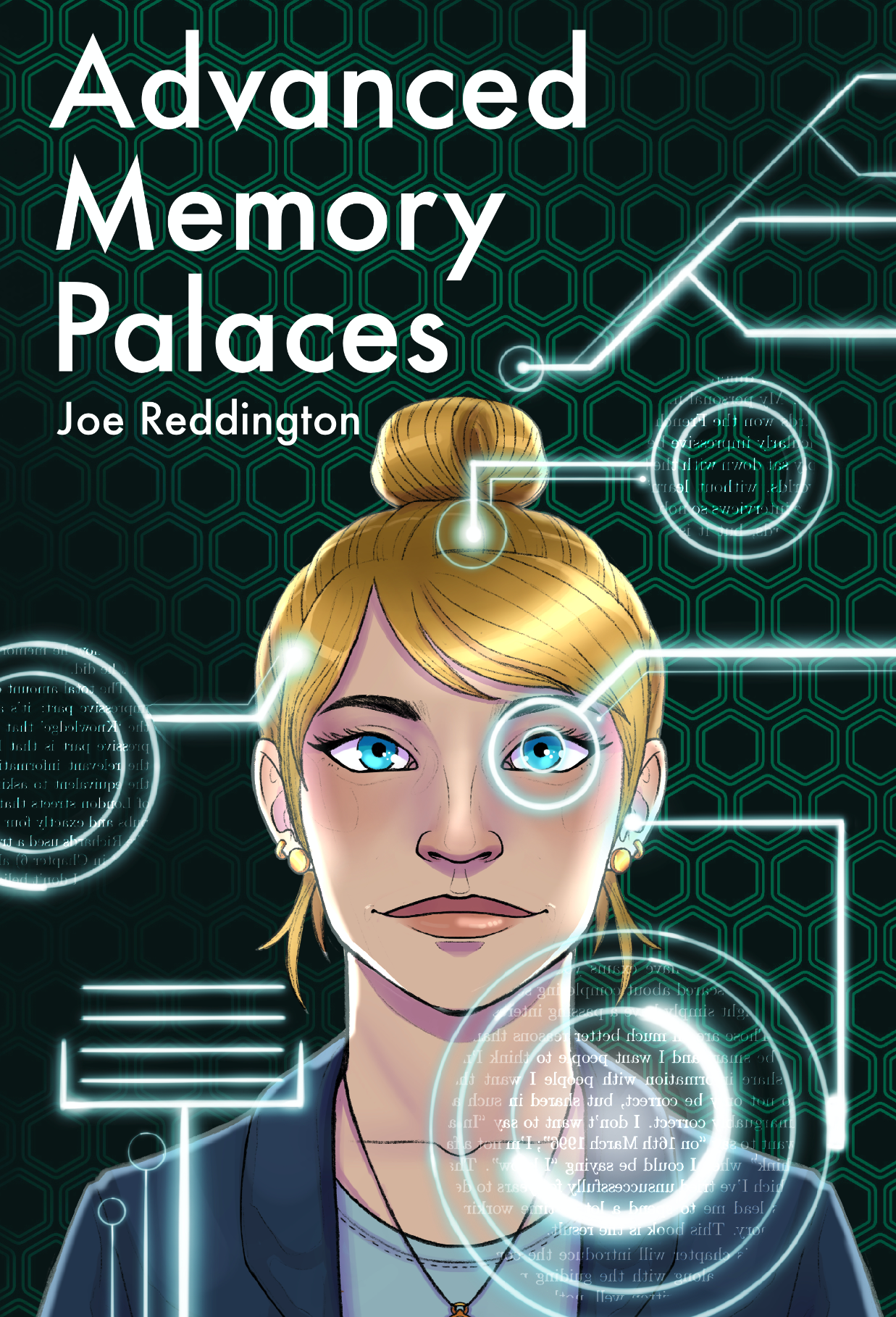
People into mnemonics and computer science both attack the same question: how do I structure this information in the most useful way? Every technique in mnemonics has an equivalent in Computer Science, but the reverse isn't true: this book shows how a range of techniques developed for computers apply to mnemonics, how they improve on the state of the art, and how they can be used for incredible long-term personal memory.
A very interesting book, with lots of practical applications — my concern about it is that general readers will be insufficiently familiar with programming ideas to make best use of this. Nonetheless, I would say it is worthwhile for students of memory techniques to pick up.
Fundamentally, the book makes the case for using structure as a tool to improve memorising. You should use appropriate structures to remember different types of information, and computer science has lots of kinds of data structures that don't appear elsewhere in memory literature. These are not necessarily complicated: the examples of classes and Karnaugh Maps were both clear and easy to understand — more than that, it was easy to see both why information should be structured that way and how one would practically go about doing something like that with one's own memory problems.
Also of interest is that this book focuses on use cases outside general knowledge or memory competitions (or memory tasks that extend from those two use cases).
Of all my books on the art of memory, this is the one I've gone back to most often.
Part of it is just pleasure, like a favourite album or movie. Reddington's voice is very human. It's less like taking a French language class, and more like spending a weekend around the home of a hospitable rural French villager.
That makes it a delightful irony that this book is also the most abstract and generalizable of all in the subject. Most of these books are obscurantist catalogues of ad hoc techniques, and they're only readable to the extent that the author has added narrative or literary flourishes. Reddington goes a different way, and gives you the big picture: "Part of the reason to write this book was to point out to the memory community that information generally has a structure and that everything is much easier when you can match that structure in your own memory."
The structure of the book itself is robust, and it vastly simplifies the challenge of relating the various techniques of the art. For that reason I'd recommend this as a first book on mnemonics, despite Reddington's disclaimer that it isn't intended to be.
If this were still the heady mid-20th century days of university tenures and research grants for creative cognitive and information science, Mr Reddington might have been provisioned to produce the subject's version of Rudolf Arnheim's "Visual Thinking," or George Polya's "How To Solve It." "Advanced Memory Palaces" might have been marketed to general audiences and eventually referred to as a "classic". The book is that well crafted.
Alas, those days are gone. But again, a small rural village is after all much nicer than an ivory tower. This is a remarkable little book, as humble as its author's intentions may have been. It's an exemplar of that rare thing, a textbook that makes a difficult subject easy to understand in a space small enough and organized for the reader to internalize. Books like this seem to have a way of finding their audience in spite of the economy, and in the very long run, outlasting this week's New York Times bestsellers.
The most novel memory book I have read in a long time
I find trained memory fascinating and have read dozens of books over the past 20 years on them. There is a lot of redundancy and the recent standouts are based on their examples and implementation tips. As the Author says himself, there is nothing new under the sun (in this field), but he has managed to do it. By focusing on the structure of memory as a parallel to computer programming, he has created a brilliant, challenging, and fun addition that will keep me thinking (and experimenting!) for some time to come. I look forward to reading other books from him in the future. For future editions, if he plans them, the only feedback is for visual aids/pictures for some of the more complex and new models, like the Karnaugh Map, especially for the more complex example at the end of the chapter. So appreciative that I found this book—my thanks to the Author for writing it!
Fascinating book, and a simultaneously refreshing read about memory from a computer science perspective. It was nice to see the author expand on some new ideas, and not just re-explaining the same rehashed memory techniques you can find in 29 other memory books. I'm interested in knowing what the author's thoughts are on memory techniques and entropy that didn't end up on the final version of the book. (perhaps for his next book).
I got a lot of value out of this book as a mnemonist who has been practicing memory techniques for over 7 years (and who thought he already knew all the techniques recorded).