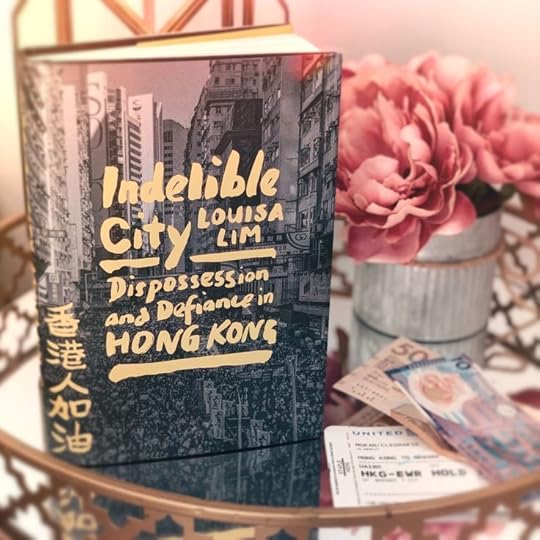
The story of Hong Kong has long been obscured by competing myths: to Britain, a ‘barren rock’ with no appreciable history; to China, a part of Chinese soil from time immemorial that had at last returned to the ancestral fold. To its inhabitants, the city was a place of refuge and rebellion, whose own history was so little taught that they began mythmaking their own past.
When protests erupted in 2019 and were met with escalating suppression from Beijing, Louisa Lim—raised in Hong Kong as a half-Chinese, half-English child, and now a reporter who had covered the region for a decade—realised that she was uniquely positioned to unearth Hong Kong’s untold stories.
Lim’s deeply researched and personal account is startling, casting new light on key moments: the British takeover in 1842, the negotiations over the 1997 return to China, and the future Beijing seeks to impose. Indelible City features guerrilla calligraphers, amateur historians and archaeologists who, like Lim, aim to put Hong Kongers at the centre of their own story.
Wending through it all is the King of Kowloon, whose iconic street art both embodied and inspired the identity of Hong Kong—a site of disappearance and reappearance, power and powerlessness, loss and reclamation.
Louisa Lim found her path into journalism after graduating with a degree in Modern Chinese studies from Leeds University in England. She worked as an editor, polisher, and translator at a state-run publishing company in China, a job that helped her strengthen her Chinese. Simultaneously, she began writing for a magazine and soon realized her talents fit perfectly with journalism.
In 1995, Lim moved to Hong Kong and worked at the Eastern Express newspaper until its demise six months later and then for TVB Pearl, the local television station. Eventually Lim joined the BBC, working first for five years at the World Service in London, and then as a correspondent at the BBC in Beijing for almost three years.
Lim opened NPR's Shanghai bureau in February 2006, but she's reported for NPR from up Tibetan glaciers and down the shaft of a Shaanxi coalmine. She made a very rare reporting trip to North Korea, covered illegal abortions in Guangxi province, and worked on the major multimedia series on religion in China "New Believers: A Religious Revolution in China."
Lim has been part of NPR teams who multiple awards, including the Alfred I. duPont-Columbia University Award, a Peabody and two Edward R. Murrow awards, for their coverage of the Sichuan earthquake in 2008 and the Beijing Olympics. She's been honored in the Human Rights Press Awards, as well as winning prizes for her multimedia work.
Currently attending the University of Michigan as a Knight-Wallace Fellow, Lim will return to her regular role as NPR's Beijing Correspondent before the end of 2014.
I had read Louisa Lim’s previous book about the Tiananmen Square Massacre a few years back and one of the things I remember most was how succinctly Lim was able to convey the “collective amnesia” approach that China used to essentially “erase” the incident from its history. Even though that book was written in 2014, I never actually knew of the book’s existence until June 2019, when I accidentally stumbled across it and decided, given the familiarity of the subject matter, I just had to read it. As I mentioned in my review of that book, reading it couldn’t have been more timely, since it happened to be right in the middle of the protests in Hong Kong over the extradition law. Coincidentally, now 3 years later, Lim has come out with yet another timely book, this time about those exact events that occurred in Hong Kong in 2019, but also covering the historical details that led up to it. This new book, titled Indelible City, obviously hit much closer to home for me, since I’m from Hong Kong and continue to be intimately connected to the city where I was born, even though it has now became a place that I no longer recognize.
To say that this book is about the protests though is a bit inaccurate, as it’s actually about much more than that. The first half of the book covers the history of Hong Kong, from when it became a British colony in the late 1800s up through the handover back to China in 1997 as well as the immediate years after through the early 2000s. Interwoven throughout this narrative are background details related to Lim’s own experiences as a mixed race Eurasian child who wasn’t born in Hong Kong, but grew up there and also lived most of her life there. Also woven into the narrative is the story of the King of Kowloon, which most Hong Kongers are likely familiar with, but not to the level of detail portrayed in here. This first half of the book I actually loved because of the way Lim was able to clearly convey the unique history, culture, and identity of Hong Kong — which, to me, is important due to the lack of books out there (written in English) that authentically tell the story of Hong Kong (case in point: I’ve been searching for these types of books most of my reading life and continue to do so). Up to this point, the majority of the narratives out there about Hong Kong are either told from the Western perspective or from the Mainland Chinese perspective — both of which are tremendously flawed and rife with biases that favor the side telling the story. This book is unique in that it is one of the few books out there where the narrative is actually from the Hong Konger’s perspective (and Lim definitely did a great job in the book explaining why this is of such huge significance). I can’t emphasize enough how satisfying it is to read about something I’m so intimately familiar with (in this case, the story of Hong Kong) and to see it actually done right — the details from the geography of the city, to the people, the culture, the language, the values that we hold dear, etc — things that someone from the outside who isn’t connected to the city would have a difficult time truly understanding.
Having said all that, the second half of the book was more of a tedious read for me, especially the section that covered the politics-heavy period from the Umbrella Movement in 2014 up through enactment of the national security law in November 2020 Of course I understand the necessity of including these events due to the outsized role they play in Hong Kong’s identity and history, and I definitely appreciate the amount of detail that Lim uses to relay the story — but for someone like me, who 1) hates reading about politics, and 2) was already more than familiar with all the details of those events as they occurred due to my connections to the city (it’s not an understatement to say that I lost countless hours of sleep endlessly monitoring the protests and everything that was happening on the ground in Hong Kong at that time) — so seeing all those details rehashed all over again made my head hurt, to be honest. Again though, this is strictly just me — others who may not be familiar with Hong Kong or the events that occurred the past couple years will likely find these details useful.
I could actually go on and on about this book, as there is so much in here worth bringing up, especially in the context of how much of what Lim writes about actually echoes my own experience of Hong Kong. But I will refrain, as I prefer that people read this book for themselves first — if anything, for the foundational knowledge that it provides about a city that is often misunderstood. This book is rare in that it actually gives voice to people whose opinions, throughout history, aren’t usually heard or counted: those living in Hong Kong who have no choice but to accept (whether willingly or unwillingly) their fate of forever being rendered invisible. To me, this aspect alone makes this book worth reading.
This is devastating, edifying, honest, exceptional. If you want to understand what is happening in HK, the absolute obliteration of any right to or opportunity for free speech or assembly, and how HK was freer as a UK colony than as a PRC colony, this is important reading.
Lim's telling of the history of HK was enormously helpful in my understanding of the current situation. I read a lot about HK and have spent a good amount of time there, and so it surprised me that I had bought the official PRC approved history of the place without looking further. That fake history is set forth as justification for China's current activities crushing the city under the heel of its very big boot. I thought I knew better than to just accept PRC versions of history and I felt chastened and reminded of why I should never not check on "information" issued by the Chinese government when reading Lim's comparisons of the identical language used in official statements about the HK protests and the "uprisings" (in English we call them peaceful protests) in other places actually in the PRC, including Tiananmen. Masters of the gaslight, and boy do they love a good slogan! Another piece of HK history that I had somehow missed was the historical resistance to any colonization, Chinese or English. This was well illustrated by the story of the King of Kowloon -- HKs own more political (and more insane) Banksy.
Lim has long been a favorite journalist of mine whose work with the BBC and NPR was essential listening for me. She has always been fair and even-handed in her reporting. Here though she discusses openly that she is a reporter second and a Hong Konger first. This book is 100% responsible and fact-based but it is not neutral. This is the cry of a person whose homeland is being destroyed.
Lim dedicated this book to the "people who fucking love Hong Kong" and I count myself as one, but also I think anyone who reads this will count themselves in that group even if they did not do so before. "Liberate Hong Kong, revolution of our times!" (If I was overheard saying that in HK I would be jailed.)
(Note: I received an advanced reader copy of this title courtesy of NetGalley)
To me, Louisa Lim’s Indelible City so effectively lays out the long tradition of Hong Kongers benign ignored by their rulers and so successfully details how the city’s autonomy and any illusions of “one country, two systems) have been steamrolled by a myriad of policies and tactics from mainland China that I reached the very last chapter feeling deeply saddened and genuinely anxious for millions of people an ocean away for me.
However, Indelible City is no eulogy. Besides providing an excellent overview of the last several years of steady and at times relentless absorption, Lim uses a combination of pointing to the recent protests, reaching deep into the region’s history, and circling back to the eccentric “King of Kowloon” Tsang Tsou Choi to successfully (not to mention hearteningly) reveal a unique Hong Kong identity that goes beyond the east-west hybrid character that Hong Kongers traditionally get generalized with. Specifically, it’s an identity of resilience and resistance that while exemplified in the last few years, also arguably has deep roots stretching far back through the centuries.
Packing both an informative and emotional punch, “Indelible City” is definitely in the running for one of the best nonfiction works I’ve had the good fortune of consuming this past year. Definitely recommended for anyone wishing to better know this unique city and its people.
As a final note - I would very, very strongly suggest pairing it with Karen Cheung’s soon-to-be-published The Impossible City, another fantastic Hong Kong-focused work.
There’s a really interesting narrative here of a journalist abandoning neutrality and becoming an activist, but I felt like it may have worked better as like a New Yorker article than a book. The whole structure also got really tied to the King of Kowloon and I felt there was maybe just a better way to write this, but overall an interesting and informative book.
• INDELIBLE CITY: Dispossession and Defiance in Hong Kong by Louisa Kim, 2022.
Louisa Lim started her research for this book in one direction - a biography of HK street artist and icon, "King of Kowloon" - and current events (2019-present) lead her to reshape the book into a larger cultural/political + personal history of Hong Kong.
The artist, the eccentric "holy fool" Tsang Tsou-choi, better known as the "King of Kowloon" was a graffiti/street artist, who also claimed that the British stole his family's land when they colonized the Kowloon region of Hong Kong, and demanded reparations and obeisance. His defiance is seen in his ubiquitous graphic art, crude and shoddy calligraphy that covered many walls in Hong Kong.
The "King" makes frequent reappearances throughout Lim's work; she uses his story of art and protest, and her own as a mixed-race child in HK to illustrate the modern shifts, and her early work as a journalist during the 1997 "handover" from the UK to China and the (fallacy) governance model of "One Country, Two Systems". As a journalist, Lim struggles with the ethics of engagement, and when to stop reporting on injustice, and start acting with the pro-democracy movement. This question is at the heart of the book.
🌟 Highlights of the book:
• Lim's discussion of her colonial school curriculum and the erasure of HK pre-colonial history. Her mother is described as a posh British historian who towed her children to every historical site and cemetery in the region for her research on local customs and pre-colonial practices, encouraging her children to question and 'dig deeper' (and undoubtedly this spirit lead Lim into her work as a journalist!) • In this same section (Chapter 2: Ancestors) she interviews an archaeologist about Hong Kong pre-history: "Fundamentally, the past is a political topic, and you've got to be careful how you package it and how you present it."
• All sections / mentions of the King of Kowloon. Tsang Tsou-choi died in 2007, and while much of his work has been removed by Chinese authorities, he remains an HK folk hero and his existing art is prized and collected.
I read another Hong Kong history last year (City of Protest by Antony Daparin) and Lim's book was much richer in tone and description. Definitely recommend if you are interested in reading more about Hong Kong and recent events in this region.
This book gives an overview of Hong Kong. It covers the debates on its history (was it really just a rock when it was “discovered” by the British?) and gives a quick overview of Hong Kong’s development, its annexation of the New Territories and how its 100 year lease was a result of the Opium Wars. There is a brief report on the 1984 negotiations regarding the lease’s expiration and how the British (the Thatcher government) lacked the will to protect Hong Kong, its systems and the people it would leave behind. There is a short section on how China’s investment in nearby cities was designed to rival Hong Kong and diminish its achievements. Amid all this, the people of Hong Kong had no voice.
The book, however, is not about Hong Kong’s history or political situation. It is about the character of the city which has been the home to refugees, artists and eccentrics. Louisa Lin shows the “indelible” character of the people and the city.
Lin sees “The King of Kowloon” as the embodiment of the heart of Hong Kong. The book begins and ends with him; he appears often and has his own chapter. This “King” is a graffiti artist who mainstreamed via shows in galleries and promoting commercial products. His messages, cleverly written and posted, are those of freedom and hope.
The author also describes Hong Kong through her reminiscences of memories of her family, her mother’s outings to historical sites, her educational experiences, visits to fishing villages, and her work as a journalist in Hong Kong and Beijing. She writes of the Lennon wall and the post-its that characterized the free speech of the time.
Some of the narratives reflect on the changed situation. Through Lim’s experience learning Cantonese and Mandarin she shows how the languages reflect the people who speak them. She segues into her observations on how Mandarin (the Chinese as spoken on the mainland) is engulfing Cantonese (Chinese traditionally spoken in Hong Kong).
The description of the handover ceremony emphasizes the symbols and the emotions they invoke.
The last 1/3 of the book is on the 2019 protests. Lim reports from “inside” giving the reader the look, feel and emotion of being there. You see how all encompassing it was with large events like crowds crashing public building and protestors painting over billboards with the next day another paint over by the Chinese overlords… then back again. There are small events such as school students “pen zoning” - forming a line by 2 students making a chain by holding each end of a pen. One performance artist buried herself with the Hong Kong skyline in the background.
COVID played into the hands of the Chinese overseers in that it kept the people indoors and apart. Lim’s writing shows the sadness engulfing the island with the lost momentum.
There is one B & w photo - it is of the King of Kowloon. The book needs and index.
This is a well written book, so I stayed with it even though it was not what I was looking for.
This entire review has been hidden because of spoilers.
This has to be up there as one of my favourite non-fiction reads of 2022 so far, and is essential reading for anyone who has even a slight interest in Hong Kong or its history.
Lim has put together a book which is endlessly educational and fascinating (but also readable and accessible!) book about Hong Kong: how it came to be colonised by the British, the story of British Hong Kong (this part was so informative), how the way the handover to China was dealt with has shaped contemporary history in the city, and the background of the protest movement and how it has become a part of what it means to be a resident in Hong Kong in the 21st century.
I was initially a bit sceptical of how Tsang Tsou Choi's story would be blended into the overarching topics Lim was writing about - thinking it might feel a bit forced or contrived - but in the end I think it really worked as a narrative thread throughout the book, and the author's portrayal of his life and work really helped convey the "Lion Rock Spirit" of Hong Kong itself.
Louisa Lim nella sua vita si è sempre sentita in bilico tra diverse identità, non sentendosi né pienamente hongkonghese, né totalmente straniera. Un destino che sembra accomunarla proprio alla terra che le sta così a cuore, stretta tra il suo passato di colonia britannica e il suo presente di regione amministrativa speciale cinese. Con questo libro, quindi, tenta di ridare a Hong Kong la sua vera identità, quella nascosta da decenni dietro le narrazioni ufficiali. Per farlo ricostruisce la sua storia, il suo passato coloniale e il suo ritorno alla Cina. Ma non si limita ad elencare i fatti storici. Arricchisce il racconto raccogliendo le voci di calligrafi ribelli, archeologi in protesta, curatori attivisti e manifestanti in prima linea. Alle loro storie personali, affianca la sua, descrivendo i profondi cambiamenti di cui è testimone diretta che stanno trasformando i tratti distintivi di Hong Kong. Non resta neutrale nel suo racconto, ammette di non riuscire a mantenere il distacco che il suo ruolo di cronista le imporrebbe. Ma questo è uno degli aspetti che rende il libro coinvolgente, in grado di colpire il lettore, anche nel caso conosca poco del passato e del presente di Hong Kong, di portarlo a riflettere e a interrogarsi sulla situazione hongkonghese e di aiutarlo a comprenderla più a fondo.
A powerfully written meditation on identity and hopeless defiance that straddles the line between personal memoir and biography of a city. I can't help but feel like it would have been a stronger book if it had committed more firmly in one direction or the other, but that doesn't mean I didn't appreciate the book I got. My one real complaint is the lack of illustrations; even a four-page center spread would have helped put faces to names and highlight how the city grew and changed under British and Colonial control. (But do pictures of Hong Kong pre-British arrival even still exist? After reading this and its descriptions of deliberate erasure, I wouldn't be surprised if the answer is no.)
The following book reviews have been shared by Text Publishing – publisher of Indelible City
'Lim deftly weaves her way through the ages, arriving at our current time, all the while capturing Hong Kong's soul inside the book's pages.’ Newsweek
‘Lim…mixes memoir and reportage in this riveting portrait of Hong Kong. Interweaving an up-close view of recent protests against Chinese rule with evocative details about Hong Kong’s colonial past, [Indelible City] is a vivid and vital contribution to postcolonial history.’ Publishers Weekly (starred review)
‘Lim’s outstanding history of Hong Kong is an epic must-read, covering Hong Kong from its earliest beginnings to the 2019–20 protests. From the first page, the importance of language and the voices of Hong Kongers are central themes. Yet Indelible City captures much more as it records the struggle of people oppressed by British colonialism and suppressed by communist China yet determined in their pursuit of freedom and cultural identity.’ Booklist (starred review)
‘An affecting portrayal of the spirited nature of Hong Kong and the many challenges it faces.’ Kirkus Reviews
‘Extraordinary…A must-read for our times…Honours the vibrancy of Hong Kong, its contradictions and the people who fought for it.’ Tim Watts
‘Unapologetically personal…The engine for this vivid, loving book is Lim’s insistent questioning—her recognition that whatever comes next for Hong Kong will require not only fortitude but also willful acts of imagination.’ New York Times
‘Illuminating…[Lim] writes mostly as a coolly objective observer, but opens with an account of crossing the line into activism…Though dominated by events since 1997, Indelible City also attempts a revisionist telling of Hong Kong’s history.’ Economist
‘Indelible City dismantles the received wisdom about Hong Kong’s history and replaces it with an engaging, exhaustively researched account of its long struggle for sovereignty.’ New York Times
‘The book is a celebration of an exceptional city and its colourful characters, particularly an eccentric artist known as the “King of Kowloon”. But reading it was also a mourning process for those—like me—who share the author’s assessment of recent events…Indelible City is an important book which will help keep the city, as many remember it, alive.’ Australian Financial Review
‘An ambitious project and a grand achievement, blending reportage and memoir to tell the story of a city caught between two competing narratives…Indelible City demonstrates the power of words in ways readers might not expect.’ Elizabeth Flux, Saturday Paper
'Lim’s discovery is that for those not handed a ready-made identity at birth, it is hard won yet uniquely powerful once gained. Of course, this too is the story of Hong Kong…Lim captures the heroism of futility—of a unique society and a distinct voice on the brink of vanishing forever.’ Kurt Johnson, Australian
‘Indelible City is more than a book: it is a haunting testimonial to the intertwined vitality, tragedy and hope of Hong Kong. Louisa Lim weaves together three powerful narratives to tell this city’s story…Unforgettable reading…If academic or journalistic work on China in the age of the National Security Law, concentration camps and genocide is to have any meaning at all beyond its own vapid self-reproduction, it must embrace an activist ethos—of which Indelible City is an outstanding example.’ Conversation
‘This is the best of boots-on-the-ground journalism that has a real sense of immediacy.’ Steven Carroll, Age
‘I devoured Indelible City by Louisa Lim, a punk history of Hong Kong.’ Jock Serong
‘Gorgeously evocative…An intimate and dream-like wend through the streets of Hong Kong, revealing layers of the bracing, complex, and palimpsestic city. Pierced through with Lim’s clear-eyed limpidity and passion…By weaving together multiple histories and narratives, those real and fictive, sanctioned and preserved, erased and newly discovered, Lim pushes back against the authoritative, state-imposed narrative.’ Jerrine Tan, Lit Hub
‘My favourite read of the past 12 months…[Indelible City] paints a complex and often tragic picture of Hong Kong’s life and culture under successive colonisers.’ Jock Serong
‘With lyricism, Lim evokes the modern Hong Kong she grew up in...Intimate and meticulously researched, Indelible City is an exquisite literary act of truth-telling.’ Prime Minister’s Literary Awards judges’ comments
I listened to the audiobook version. I was pretty disappointed in this book. Only having read a few things here or there about Hong Kong, I was excited to learn more about the city and its history. However, I came away from the book with only a little useful knowledge.
Despite stating in the introduction that she was upset that she had to change the names of some interviewees because of the recent Chinese government crackdowns that made it unsafe for people to speak out (she was upset because she had hoped the book would be told in the voice of Hong Kongers and changing their names dampened that), a good three quarters of the book was her own experience, her family history, and often even the direct quotes from interviewees were followed by statements like "this person had finally put into words what I had been feeling". It gave the whole book a sense of being mostly about the author and her family (her family being of the colonial elite and she herself admitting being disconnected from a large part of Hong Kong).
I don't think this book knew what it was, and it suffered from a lack of direction. Added into that was the author's constant struggling with the fact that she spent almost all of her life believing in some fake concept of "journalistic neutrality" and coming to the realization that journalists should probably report the truth rather than attempt to be "neutral" - a very frustrating concept which is great to highlight as a flawed aspect of the industry, but not so great when the author still seems to regard it as an important standard (though one she must deviate from in the extreme case of the Chinese government) despite all of her experience telling her otherwise.
The narrative thread about the King was very interesting and gave me some hope for the book at the beginning, but by the end it too felt overplayed.
Finish date: 13 November 2022 Genre: non-fiction Rating: C Review: Indelible City (ISBN: 9781922458513)
Bad news: This is NOT essential reading on the subject of Hong Kong and the protests of 2019. I was looking for more hard-nosed reporting not affected by feelings and Ms Lim had decided to include too much of herself and not enough of the Hong Kong news about the 2019 seismic shift in the city.
Personal: I've been fooled again. I assumed that a book about Hong Kong would center around account of protests in Hong Kong during 2019 along with very thorough analysis on actions and reactions between people. 70% of the book is around Ms Lim's reminiscences of memories and a quick scan of history as view through an atlas with very old maps. The theme connecting all of this is Ms Lim's writing about a quirky "King of Kowloon" (old man writing calligraphy graffiti around the city). Only 3o% (last section) refers to the uprising that set the city on fire. No, this is not my kind of book...too "touchy-feely" about Hong Kong. But if that is what you are looking for...be my guest!
This is essential reading on the subject of Hong Kong. Louisa Lim writes of Hong Hong's imagined and imaginary pasts, its searingly difficult present and its unthinkable future. Her research is impeccable, and she conveys her knowledge with passion and eloquence. At the heart of the book is a disabled and semi-literate trash collector with mental health issues, the 'King of Kowloon', whose incessant quest to stake his claim over the territory he says the British stole from his family by graffiti-ing every bit of government property he could find made him an icon of Hong Kong identity and a symbol of the 'indelible city' itself.
Bearing witness to resistance in the face of almost certain defeat is truly breathtaking. This is an impressive portrait of Hong Kong, its history, its protestors, its colonial past, its descent into authoritarianism. Lim grapples with the complicated line between journalistic integrity and national identity and I appreciated her struggle. This American Life did some excellent reporting interviewing the protestors and I loved Elizabeth Flux’s eulogy essay and now this book has rounded out my understanding. This complete transformation of a place and the freedoms of its people happened in recent memory, on our watch, and we should know more about it. This was excellent on audio.
Reading this book felt like a deeply personal act. Poignantly written, but also informative with bits and pieces of Hong Kong history and HK identity I didn't know about. Only criticism is that I felt the author attached a little too much importance to the King of Kowloon. Worth a read for anyone who wants to understand HK identity and the turmoil in recent years. She's put into words so many things I feel about the city I call home, but a home it no longer is and no longer exists.
Aluksi pidin tätä vähän tällaisena toimittaja pöyristyy -kirjana, jossa ihmetellään sitä miten kunnollinen maailma ei olekaan kunnollinen - varoitusmerkkejä oli - mutta lopulta tää oli kaunis kirja Hongkongista ja sen poliittisesta historiasta, tai kirjoitetun historian poliittisuudesta. Läpi tekstin palataan Kowloonin kuninkaaksi nimettyyn graffititaiteilijaan, josta kirjaprojekti alun perin kertoi - ihan kiinnostavaa, ja Limiltä hyvin seivattu kirjaprojekti poliittisen kuohunnan keskellä. Syvempi analyysi jää, mutta hyvä kertaus kaikesta tähän asti tapahtuneesta.
Honestly really heartbreaking. Upended so many of the preconceptions I had from the British & PRC narratives that dominated any discussions of HK in my world history textbooks growing up
Questo non è semplicemente un saggio su Hong Kong, è una lettera d'amore, un saluto commosso a ciò che è stato scorse non sarà più, una testimonianza che non può essere spazzata via, un mito orale messo per iscritto. È la vita di una città, con le sue leggende metropolitane, le sue contraddizioni, che fra due dominazioni ha cercato di mantenere e creare una propria identità. Ricca di chicche, riferimenti, curiosità, è un ritratto cangiante: ne usciamo con un amico in più e il cuore un po' pesante. Un incrocio fra la storia personale e quella cittadina, che non ha la pretesa di essere esaustiva e tuttavia riesce a ridarci l'atmosfera in modo preciso e dettagliato, la densità dell'aria riempie anche i nostri polmoni
I learned a lot, but given how little I knew about Hong Kong, that says more about me than Louisa Lim's work. The best parts for me were the history of Hong Kong as well as the threading of the King of Kowloon throughout the book - I knew nothing about him and his story was fascinating and a useful foil for the story of Hong Kong. However, I found Lim's writing tone a bit off-putting and at times very slow; it didn't help that she chose to narrate her own Audiobook, which she also did very slowly. My biggest issue, however, is one that Lim concedes: towards the second half of the book she abandons journalistic integrity for activism, and though I am more than sympathetic to the cause, I think the book really suffers for it. I would have liked to get a broader understanding of the various protests as well as China's response to them since 1997 as well as potential explorations of a path forward, if one could be found, but Lim highlighted only individual stories as well as her own experience in the protests. A lot more context was needed, in my view, and I feel like I only got a very partial understanding of what is currently happening.
The author has a very liberal analysis of violence which felt out of place in a book that gives an account of state violence and the rise of authoritarianism. She also has an uncritical fixation on the concept of journalistic neutrality which was frustrating. Despite her anecdotes of news reporting which clearly showed the links between the media and authoritarianism, the author never seemed to understand that journalistic neutrality really only serves to limit the spectrum of acceptable discourse.
I also thought the author’s self-identification with Hong Kong was overstressed and uncomfortable, mainly because it failed to address her direct entanglement in the British colonisation of Hong Kong. At times I thought she sought to distinguish Hong Kong culture from Chinese culture more than necessary, with some of her comments bordering on Sinophobia.
The book is more memoir than anything else, but I expected more robust political analysis. I liked the parts about Hong Kong’s history and the King of Kowloon.
After traveling to Hong Kong for the past 15 years and immerse in their culture I was intrigued to read this book.
It’s perfect especially if you are interested with the last couple of years and the riots the citizens of Hong Kong have displayed. Learning not only the reasoning behind the riots but also the history of Hong Kong. The author does an amazing job explaining the past and present, she gives you true insight into the people of Hong Kong and its true history.
Thank you riverhead books for this incredible copy.
This book kept making me think about how truth is not mutually exclusive from madness. Madness allows us to critique our socially constructed realities and re-imagine a different world. It begs the question, is the madman “mad” for his resistance to the system or is it us who are really “mad” for our apathetic obedience to the system?
A devastatingly beautiful, tragic and hopeful book.
A number of books about Hong Kong have popped up in the aftermath of the 2019 protests and the subsequent National Security Law imposed by Beijing on the city to put a stop to protests and dissent in general. Each have their own particular angle – this one by journalist Louisa Lim is a blend of history and personal memoir to explore the question of Hong Kong identity – what does it mean to be a Hongkonger? And more importantly, who gets to decide?
It's a pertinent question – partly because this was one of the driving forces behind the protests, but also because Hong Kong’s official history has always been written by the colonial masters in control of the city, be it the UK or China. Lim’s research shows that both competing narratives obscure the truth that HK has always had its own distinct culture that has become increasingly multi-layered over the years. Interestingly, Lim finds this complex identity embodied in Tsang Tsou-choi, a.k.a. “the King of Kowloon”, a local legend who spent decades covering public spaces with graffiti claiming the British stole his ancestral homeland.
Lim interweaves the history of HK and the story of the King with her own experience as a Eurasian who grew up in HK. All of this feeds into her experience covering the 2019 protests and her struggle to maintain journalistic neutrality as an out-of-control police force unleashed endless tear gas and vicious beatings on protesters, journalists and anyone else in their way. While Lim doesn’t excuse the violence from the protester side, she frames it within the proper context of both an asymmetrical power balance and the inevitable response of people who were understandably angry that their own govt was responding to their concerns about HK’s future with tear gas, beatings and jailing of opposition leaders. More than that, they were angry that they had been robbed of a future they had been promised by Beijing, who in their view had turned out to be just another colonial master who saw HK as an entitled land grab with an inconveniently different culture to be assimilated.
It’s a well-written, powerful book and a welcome correction of the official historical narratives of Hong Kong – especially now that HK’s history textbooks are being rewritten again under recent “patriotic” education reforms to suit the official Beijing narrative and foster a new “national” identity as dictated by the CCP. Lim’s previous book, The People's Republic of Amnesia: Tiananmen Revisited, described how Beijing had successfully managed to transform June 4, 1989 into a day in which (at least in China) nothing memorable happened. Lim warns that it could do the same with the 2019 protests (which have already been officially labelled by the HK govt as a violent separatist uprising funded by foreign govts intending to overthrow the CCP) – but she is hopeful the city’s “Lion Rock” spirit as embodied by the King of Kowloon remains, and its people will not forget their history or relinquish their identity so easily.
Partisan and raw account of the various Hong Kong protests of the 2010s before their crushing by the National Security Law in 2020, combining this with some memoir, an account of the Outsider Artist the King of Kowloon, and a general history of the place. It's ambitious and extremely sincere and wholly sympathetic to the particular kind of identity politics the protests fostered, regardless of their occasionally nasty underside (you don't have to do too much googling to see Apple Daily was on the extreme right; do I think they should all have been jailed? Not really, but it's worth mentioning imo). But I won't go all Vijay Prashad on it - those enjoying universal suffrage and the freedom of speech and assembly (those last two just about) have no business lecturing other people who would like them - but it would be nice to have had a little on the strategy or lack thereof of the protesters, especially given what they got in the end was vastly worse than anything they were protesting about in the first instance. In the 2010s, people enjoying all sorts of freedoms claimed they didn't have them, and then a few years later, they really didn't; the causality of this might work in more than one direction. But to get a sense of what was at stake, this is good, and its central point - that the majority of people in Hong Kong have never been able to exercise any serious political control over their government or their geopolitical status, and that in such a state, people are going to get violent - seems obvious and uncontrovertible. 3.5.
A memoir, A history, Reporting on the ground. This book is fantastic.
From someone who grew up in pre-transfer Hong Kong and then was a reporter afterwards. The book starts with one man's quest to lay claim to being King of the Island. The Art community decided his calligraphy in all its awkwardness was art. The protestors saw it as a way to speak out against first Britain and then China.
The author's family was part of the English colonial class and a Chinese Ex-pat Singaporean who help fund Sun Yat Sen. She brings all this energy to a sprawling, lovely, heart wrenching journey through perceptions of Hong Kong's history and the people who tried to take back their own power along the way.
2019 was not that long ago even though it feels like it. This is a great reminder.
Sono di Milano e le improbabili pennellate del Re di Kowloon non hanno potuto non ricordarmi le onnipresenti scritte “Lucifero culo” su pali della luce, centraline elettriche, muri della metropolitana. Anche la mia città, come Hong Kong, ha un’anima che è in via di dissoluzione, tradita ed espugnata dalla speculazione e dalla menzogna. Speriamo che un giorno possano entrambe riportare sul trono i loro legittimi re e dare nuovo spazio a noi umili sudditi.



 by
by
 Louisa Lim