Milliarden Vögel umrunden jedes Jahr die Erdkugel. Der spatzgroße Strandläufer fliegt ohne Halt von Kanada nach Venezuela – das entspricht 126 aufeinanderfolgenden Marathons ohne Nahrung, Wasser oder Schlaf. Dabei ziehen er Feuchtigkeit aus seinen Muskeln und Organen und nutzt das Magnetfeld der Erde mittels einer Form von Quantenverschränkung, die Einstein nervös gemacht hätte. In den letzten zwanzig Jahren ist unser Wissen über Zugvögel sprunghaft gewachsen. In seinem elegant erzählten Meisterwerk zeigt der preisgekrönte Autor und Ornithologe Scott Weidensaul, dass wir mehr über die Lebewesen auf Erden verstehen, wenn wir uns mit dem Naturwunder über unseren Köpfen beschäftigen. Und wie wir trotz Klimawandel unsere fragilen Ökosysteme schützen können.
Born in 1959, Scott Weidensaul (pronounced "Why-densaul") has lived almost all of his life among the long ridges and endless valleys of eastern Pennsylvania, in the heart of the central Appalachians, a landscape that has defined much of his work.
His writing career began in 1978 with a weekly natural history column in the local newspaper, the Pottsville Republican in Schuylkill County, Pennsylvania, where he grew up. The column soon led a fulltime reporting job, which he held until 1988, when he left to become a freelance writer specializing in nature and wildlife. (He continued to write about nature for newspapers, however, including long-running columns for the Philadelphia Inquirer and Harrisburg Patriot-News.)
Weidensaul has written more than two dozen books, including his widely acclaimed Living on the Wind: Across the Hemisphere with Migratory Birds (North Point 1999), which was a finalist for the 2000 Pulitzer Prize.
Weidensaul's writing has appeared in dozens of publications, including Audubon (for which he is a contributing editor), Nature Conservancy and National Wildlife, among many others. He lectures widely on conservation and nature, and directs the ornithological programs for National Audubon's famed Hog Island Center on the coast of Maine.
In addition to writing about wildlife, Weidensaul is an active field researcher whose work focuses on bird migration. Besides banding hawks each fall (something he's done for nearly 25 years), he directs a major effort to study the movements of northern saw-whet owls, one of the smallest and least-understood raptors in North America. He is also part of a continental effort to understand the rapid evolution, by several species of western hummingbirds, of a new migratory route and wintering range in the East.
When I was sailing the Atlantic on a small yacht, Mother Carey's Chickens, aka stormy petrels used to delight me, but puzzle me too. We would see them walking on the water when it was calm, sitting in groups on waves chatting, and flying out of sight to where we didn't know, but there were often stormy petrels around. Apparently they can sleep with half their brain when on the wing and also sleep 'roosting' on a wave. They live at sea, returning to land, the same place and the same partner, every year for up to 30 years. The rest of the time, the air above the ocean is their home.
And that was the most interesting thing I read in the book after the beginning where the author nearly becomes food for a big bear in Alaska. I've dnf'd it half way as it is boring. There is a lot about bird migration from the point of view of numbers, destinations, rest stops, it's a convervationists book really - here is where we protect because the numbers are falling due to... (catching, land being used, etc. etc). Lots of facts and figures, but it had no 'heart' to me. I'm probably the wrong reader. Three stars because it's not a bad book, just boring to me.
Heinrich Bernd's The Homing Instinct: Meaning and Mystery in Animal Migration was a much more fascinating book detailing how they did it, not just how they were constructed, but the organs, the interpretation. It was just so much more interesting.
I read this author's much earlier book on bird migration - Living on the Wind: Across the Hemisphere with Migratory Birds - over twenty years ago, long enough that all I remember is that it was about bird migration. But it's a subject that fascinates me and I've read several books this year alone which touched on the subject.
While this book is certainly about bird migration, it seemed a lot of it was about birders' efforts at banding and tracking the birds as well as conservation efforts to halt their decline. But I learned a lot.
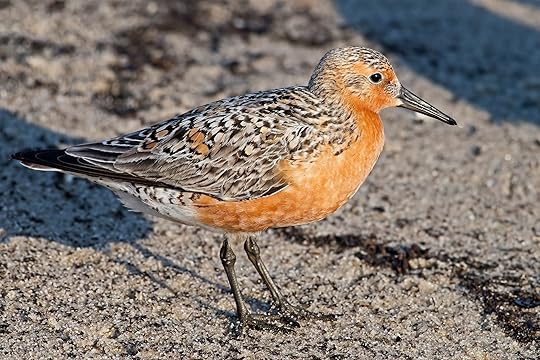
This is your red knot:
This fellow flies south to Australia for the winter. While there, his testes shrink, becoming almost functionless. The females ovaries shrink too, but not as dramatically. But as our brave guy flies north to his breeding grounds in Siberia his testes would have "ballooned to almost 1,000 times their minute winter size, pumping testosterone into the bird's bloodstream. . . . The seasonal expansion and contraction of gonads is an evolutionarily clever way of saving weight."
There was this:
Migratory birds can grow and jettison their internal organs on an as-needed basis, bolster their flight performance by juicing on naturally occurring performance-enhancing drugs, and enjoy perfect health despite seasonally exhibiting all the signs of morbid obesity, diabetes, and looming heart disease.
Migrating birds can fly for weeks, even months, without touching land, taking the briefest of naps while gliding.
Cool stuff but, as I said, this is really a book about efforts at protecting bird populations. One banding vignette pretty much reads like another and, really, whether the author actually saw a Grant's storm-petrel off the Hatteras coast (he wasn't sure) isn't that important to me. And whether certain changes in bird species are the result of evolution or phenotypic plasticity is a debate I'm just not willing to enter.
I'm on board with curtailing insecticides, but I wondered at the author's glee in the use of rodenticide to kill bird-eating rats in the Aleutian Islands. Aren't all -icides bad?
Anyhow, if you choose to read this book, it's probably because, like me, you like birds, find them fascinating and want to understand more about their ecological importance. And if you make it to page 281, you no doubt will be already warmed by the author's enthusiasm and probably share his protective feeling. Page 281 is when he gets to the ortolan bunting:
A handsome, six-inch-long bird with a peach-colored breast, pale yellow throat, and dark mustache marks, the author writes. But the French revere the ortolan for its meat, not its appearance:
Trapped in August and September on their way to Africa and kept in the dark to scramble their natural rhythms (at one time, they were blinded to accomplish the same thing), the birds feed constantly until they are bulging with fat, then drowned in Armagnac brandy, plucked and baked whole in a sizzling hot earthen ware cassole. The diner--head and shoulders draped with a large white napkin, allegedly "to hide from the sight of God" but more practically to trap the aromas and block any splatter--severs the head with a snap of the front teeth, then chews the rest of the bird in a cascade of searing grease and juices, grinding up bones and all.
The author recounts a story I knew, about how Mitterand, dying of cancer, ordered and ate two ortolans as his final meal. But nobody likes Mitterand. And Anthony Bourdain is revered, something I never got. So I was happy, in my odd way, to read this:
Anthony Bourdain called ortolan "the grand slam of rare and forbidden meals," and recounted an illicit dinner with a number of fellow gourmands: "With every bite, as the thin bones and layers of fat, meat, skin and organs compact in on themselves, there are sublime dribbles of varied and wondrous ancient flavors: figs, Armagnac, dark flesh slightly infused with the salty taste of my own blood as my mouth is pricked by the sharp bones."
An astonishing book on migratory birds. I have read elsewhere that migratory birds can navigate by sensing the earth’s magnetic field, but the sense is achieved by facilitating quantum mechanics? That just blows my mind away. The discovery was made by Klaus Schulten, a biophysicist.
A large part of the book consists of the author’s birding experiences all around the globe, from China, Alaska, Central California, remote islands in South Atlantic ocean, to Cyprus and Nagaland in Eastern Indian. New tracking technologies (miniature devices and more powerful batteries, GPS and radio tracking) have greatly enhanced the study of migratory birds. New discoveries lead to better understanding of these birds and more precise conservation effort. Did I know albatrosses fly across oceans, and swifts stay airborne for 10 months straight?
This book is also a harrowing read. We live in a depleted world regarding life forms except us. Tidal plains and coastal wetlands are crucial to a lot of migratory shorebirds, and these areas will be hit hard by the Climate Change. When people celebrate Elon Musk’s starlink, no one pays attention to the light (as in “bright light”) pollution that will affect migratory birds. Wild bird poaching is still a big problem across the globe. Asia is a “death trap” for a lot of migratory birds, but even Europe is not without crimes. Cyprus, with its tradition of a bird dish called ambelopoulia, stands out like a sore thumb.
Quote: “(I have) reverence for creatures that despite every obstacle we as species have placed in its path, continue to hold faith with wind and far horizon, with its genes and with the seasons; reverence for endurance and tenacity that I can’t match nor fully comprehend, but which leaves me breathless when I am confronted with it; reverence for this extraordinary bird and billions more like it, which by obeying their ancient rhythms, lit up the scattered and belligerent wild places of the world into seamless whole, through the simple act of flight. May it always be so.”
A World on the Wing is an epic reflection on what we're learning about the greatest natural phenomenon on the planet—and what we must do to preserve it. In the past two decades, our understanding of the navigational and physiological feats that enable migratory birds to cross immense oceans, fly above the highest mountains, forgo sleep for days or weeks, or remain in unbroken flight for months at a stretch, has exploded. Migrant birds continually exceed what we think are the limits of physical endurance, like a six-inch sandpiper weighing less than an ounce flying 3,300 miles nonstop for six days from the Canadian subarctic to northern South America -- the equivalent of 126 consecutive marathons with no food, water or a moment's rest.
Using the earth’s magnetic field to navigate through a form of quantum entanglement that made Einstein queasy. Yet for all the strength and tenacity of migrant birds, the phenomenon of migration is increasingly fragile on this ever-more altered planet. A World on the Wing, the newest book from acclaimed nature writer Scott Weidensaul, is at once a celebration of global bird migration, an exploration of our rapidly evolving understanding of the science that underpins it, and a cautionary tale of the challenges humans have placed in the way of migrating birds. It conveys both the wonder of bird migration and its global sweep, from the mudflats of the Yellow Sea in China to the wilderness of central Alaska, the remote mountains of northeastern India to the dusty hills of southern Cyprus.
A World on the Wing is also the story of Weidensaul's own journey over the past two decades from a deeply interested amateur to someone immersed in migration research, using cutting-edge technology to answer questions that have fascinated him all his life--and, with fellow scientists, researchers, and bird lovers, trying to preserve global migratory patterns in the face of climate change and other looming challenges. This is a fascinating, captivating and richly-detailed book that shines a light on a topic that for so long was misunderstood. Part study, part memoir, it is an eminently readable, information-rich read packed with facts, maps and statistics and a must for bird enthusiasts and nature lovers the world over. Highly recommended.
As a huge lover of birds and geography, the migration of birds has always amazed me so when I saw this book was available on netgalley I just had to request it! A World On the Wing is a really great read filled with beautiful descriptions, interesting facts and up to date science. I really enjoyed reading about the different migration patterns of birds and how they manage such incredible feats. For instance, who knew birds like Knots could break down internal organs before migration so they are lighter for the journey, and then regrow them when they meet their destination?! That is almost scifi sounding but is really what happens! Birds are remarkable animals and so many different species were discussed in this book which was a joy to read and learn about. I particularly loved the information about how climate change is affecting these migrations as well as the breeding grounds of some birds. It goes to show what a big impact it will have on our wildlife and how mass extinctions are a real possibility if we do not get climate change under control. I was unable to give this book 5 stars as I wish it had been a little more concise as it felt like a pretty long book. I also would have liked some illustrations of the birds as there were some that I had not heard of and it would have been great to seen images alongside the writing. That being said, this is a really interesting book and if you are a bird lover then I highly recommend giving this book a read!
Please note that I was gifted this ebook in exchange for an honest review.
This book was not what I expected. From the title and description, I assumed that A World on the Wing would be an overview of the science of bird migration. And while there is some of that—and the information is fascinating—most of this book is given over to other topics.
For one thing, Weidensaul is fond of the first person. Now, I have nothing against Weidensaul whatsoever—indeed, he comes across as smart and knowledgeable—but I personally could have done without much of his own storytelling. It is not particularly important to me, for example, how he arrived on this or that remote island, with what company, and so on. I want birds! Used in moderation, Weidensaul’s experiences could have given a bit of human interest to the science. But used in such abundance, I wondered whether he ought to just write his memoirs.
I am being a bit harsh. For Weidensaul wants to tell us, not only about the bird migration, but how people study it. And he has studied it for quite some time. Scientists must trek to faraway places, doing population surveys, counting birds in flight, luring them into nets with artificial calls, climbing trees, fending off protective parent birds with sharp claws, dealing with various corrupt governments, scrounging up funds for GPS locators—all this, to finally understand the phenomenon of bird migration. The practical barriers to tracking birds as they fly for thousands of miles are difficult to exaggerate.
Weidensaul also wants to talk about all the manifold ways that humans are disturbing this glorious migration. The big one is global climate change, of course, which is already changing the weather all around the globe. Since birds have evolved carefully timed migration patterns—to coincide with insect peaks, for example—these changes can have disastrous effects on bird populations. But there are smaller, if still important ways that we are distrusting things: shoreside development, mass hunting, invasive species… the list goes on. Since one single species of migratory bird can depend on several, distinct specialized environments—the loss of any of which could be fatal—they are the canaries in the coal mine, so to speak, of environmental destruction.
In the end, though I did not like his writing style, and bemoaned the authorial presence, I agree that bird migration is one of nature’s great spectacles. They were flying around the world long before we were. But if we are not careful, there may come a time when new songbirds do not arrive with the spring.
I just finished Scott Weidensaul's "A World on the Wing," and I easily count it among the best science and natural history books that I have ever read!
Thanks to Scott's own diverse field research experience, his meetings with friends and colleagues doing their researches around the globe, and his scoping knowledge of the current ornithological literature, his book is, in fact, a master class in ornithology, avian migration ecology, and global bird conservation. At the same time, it is exactly what he intended for it to be--a mind expanding (at times, mind-boggling) narrative about the physical, navigational, and survival challenges of bird migration; the awesome (here used in an altogether proper context) spectacle that it is, from one end of the earth to the other. Equally amazing are the innovations of the researchers who have dedicated themselves to de-mystifying migration.
Scott balances his descriptions of the massive, awe-inspiring scale and natural beauty of global bird movements, for example of countless thousands of Amur Falcons in the remote mountains Nagaland on the Indian subcontinent, with descriptions of the ugly human-caused harms, both advertent and inadvertent, that come to birds in too many places around the world and on an agonizingly large scale.
Scott knows ornithology and wildlife conservation--he has long been actively involved in both--but it is his ability to synthesize and clearly communicate volumes of information, and to personalize it, that makes his writing so compelling and authoritative. I highly recommend this book to bird and book lovers alike!
During a section set in India, he talks about people he met from BNG Birds, including a member who talked to him about birding in Philadelphia. I birded with that group at least half a dozen times when I was in Bangalore. I kept getting removed from the WhatsApp on suspicion of being a spammer because my non-Indian name seemed implausible for a legitimate member. I’ve eaten lunch with the guy he talked to at least 3 times after bird walks, he would drive to the New Jersey wetlands to bird and made 3D modeling software used for the game Crazy Taxi. I most distinctly remember the guy who led the bird walks in Lalbagh, an endlessly entertaining and super knowledgeable retired biology(?) professor who had 3-4 teeth and a million ornithology anecdotes. What a character. All the regulars were beyond friendly and welcoming. Very high on my list for whenever I go back to Bangalore and I super highly recommend for anyone who happens to visit and is looking for things to do on a weekend.
Within the genre of travelogue-cum-pop-science this is a standout entry. In absolute terms I don’t know that I loved it enough for a 5 but so many equivalent books fail so terribly that this is boosted by comparison. The science is well presented and interesting, and the memoir components are reasonably well written. If you enjoy books like this, this is a good one.
A World on the Wing is a fascinating read, full of facts, maps and statistics about migratory birds and the effect that human-caused climate change is having on their various habitats around the world. It's a long book, but it's packed with information and truly globe-trotting.
I would have enjoyed some illustrations or photographs of the birds, but was able to supplement the book with some Cornell University YouTube videos which helped me and might interest other readers.
One slightly irritating thing that the author did was to constantly compare bird sizes to "a robin" without making it clear whether he was talking about an American robin (a thrush about 25cm long) or a European robin (an old World flycatcher about 13cm long) which was quite confusing for this non-specialist reader from the United Kingdom. Despite this, the book was an enjoyable if intense read.
Thanks to the author, publisher and NetGalley for providing a review copy in exchange for honest feedback.
What are the migratory birds that fly the most distance each year? What are the best stops for migratory birds? Which migratory birds are the most endangered? What is being done to help them? How does being migratory change the bodies of birds that fly long distances?
Do you have questions about migratory birds? I would almost guarantee that author Scott Weidensaul will answer them in A World on the Wing. It's a book that thoroughly covers everything you want to know about migratory birds and it includes all the science behind the findings. In addition, Weidensaul flits from keystone spot to keystone spot to be right there to report on the birds first hand.
Scott Weidensaul masterfully describes the experience of witnessing birds on their migratory journeys and feeling awestruck knowing they have survived the many threats encountered along their routes. The book focuses not on birds in their breeding range or on their wintering roosts but the many flyover and stopover places on the way that are crucial to their survival. He is well acquainted with great spectacles of nature such as the stream of raptors passing over Hawk Mountain but each is a fresh and exhilarating new experience seen through Scott’s eyes. There are a few moments of adrenaline pumping terrors added to the thrills, encounters with grizzlies, poachers and government authorities. A photo from a rough road trip up a mountainside in Nagaland, India, reminded me of a harrowing van ride I once took down California Gulch in SE Arizona in search of a five-striped sparrow. (You hope it doesn’t rain, then it does.) I’m so grateful to Scott for his excellent storytellings. Now that my long distance travels are limited, I’m happy to be reminded of the heart-filling experience of watching an albatross soar or the soggy surprise of losing a boot between tussocks of tundra grass or the exhilaration of feeling a hummingbird lift off from the palm of your hand. Wherever Scott’s going, I’m along for the vicarious ride. Having received his message, I’m more confident than ever that my time is well spent helping to conserve the Texas coastal prairie, its farms, ranches, wetlands and grasslands. This eco-system is crucial for a number of migratory species and the thrill of seeing sandhill cranes, long-billed curlews, upland sandpipers, pintails and other migrants is reward enough.
And yes, first, this is not just about American birds; in fact, the book opens on the shores of China's Yellow Sea and ends in northeast India. All sorts of global flyways, plus what we've learned about pelagic birds, are discussed.
How do migratory birds do this? Weidensaul also discusses what we've learned here. First, on the navigation side, they may use quantum entanglement, vis a vis magnetism. Many birds also use starlight. Some also appear to use smell.
How do they survive these trips? First, they bulk up as much as any pre-hibernation grizzly. Second, many have "pit stops" on the way. Third, they use high-level winds to reduce their effort. (Pelagic birds almost entirely coast and expend very little energy.)
They also shed ANYTHING that might be excess weight. Intestines and gizzards shrink and shrivel for the non-stop migrators. Gonads drop to almost nothing.
But, if they get to their wintering grounds too late, or it's a bad year there, or if climate change is hitting either winter or summer grounds (actually, for trans-hemispheric migrants, they're BOTH summer grounds!) ripple effects happen.
Who knew birds could be so interesting? This was an eye-opening book for a number of reasons. For one, we still have some bird species in deep trouble because of humans’ impact on climate, the environment, and specific habitats. For another, I knew that birds migrated, but I didn’t realize just how far some species travel, or how much time some birds spend in the air! (Or that during certain times of year, thousands of birds are flying high over my house while I sleep!) And some of these birds have tracking devices—you can even follow their travels online! I learned a lot of cool stuff about migratory birds from this book, and, if you’ve ever wondered where birds go when they migrate, you will probably enjoy reading this book.
Spectacular. Weidensaul makes birding accessible to me in a way I really appreciate. I'm boggling over how much data the "ordinary" birdwatcher is contributing to Big Data Bird Science, and how we are learning so much at the end, here. By the time the last bird falls silent, we will truly understand what we have lost.
This is an excellent book about migrating birds, some of which move from one small region to a similar region in the opposite hemisphere each year, others spending years at sea. We follow the author as he joins birders, scientists and bird advocates globally, whether catching and ringing birds, counting them, or reporting the criminals who trap or shoot weary migrants.
Shooting is only one threat. Others include overuse of pesticide killing falcons which eat the insects - ironic since the more birds die the more pests there are to eat crops. Land reclamation from seafront removes safe feeding and resting grounds, replacing them with factories and highways for many miles in China. Birds need safe spots to break their journeys, especially during stormy weather. If they can't rest and feed, they arrive at breeding grounds underweight and late. Climate warming is also throwing birds out of step with the hatching of insects which feed chicks.
The radar tracking and tiny flight recorders and transmitters now carried by birds, using cellphone masts, or downloadable data, are providing eye-opening records of avian journeys.
I recommend this book to birders, ecologists, students and journalists. Also to anyone who has land upon which birds feed or nest or rest. Similar books would include the older On The Wing about tracking peregrines, Nature Beyond Solitude by John Siebert Farnsworth about bird science studies, The Narrow Edge about the red knot, and Curlew Moon about curlews in Ireland and UK.
I borrowed this book from the RDS Library. This is an unbiased review.
Having read, ‘The Wonder of Birds,’ the bar was set high as to my expectations for this highly acclaimed bird migration themed work. I certainly was not disappointed as the author is a talented writer and meticulous research scientist. He reveals the miraculous result of miniaturised sensors when applied to bodies of migratory bird species. Our knowledge of migration behaviours, patterns, and the basic bird populations has been limited by the observational capabilities of humans.
It seems a common sense notion and reasonable on the surface. The reader quickly comes to the realisation that technology affording scientists the micro sensor integrated into bird study is revolutionary. This is the story of all the amazing discoveries revealed by the new sensors matched with the indomitable dedication and brilliance of bird researchers. We have incredible historical information documenting the physiology of birds allowing for inconceivable endurance as well as the staggering distances traversed. There is also well documented observations of the timing of migration. It is the new data parsing specifics related to distances, patterns of flight, geography, and numbers that is emerging as a result of micro sensors.
There are species of birds that migrate tens of thousands of miles in a single year. There are a few geographic super zones such as the wetlands adjacent the Yellow Sea, Gulf of Mexico adjacent Texas through Alabama, Caribbean islands, and Quebec where up to hundreds of millions of migratory birds flock. The threat to birds from climate change, cats, hunters, skyscrapers, wind turbines, and building in these key zones has taken a horrendous toll on populations. All the new facts and implications of bird migration and populations come together in this wonderful book that allows for a deep appreciation of a subject as critical to humanity’s survival as our feathered friends for in the end we are all one.
“On such nights (as I knew from work we had done a few years ago in Pennsylvania, using specialized radar) migrants may pass at a rate of a couple million an hour. It is arguably the world’s greatest natural spectacle, and a nearly universal one, playing out twice a year over every landmass except Antarctica (where the migrant penguins shamble on foot), but one hidden from our sight by the anonymity of darkness. We sleep, unaware of the marvel above our heads.”
“Bird migration is a shadow of what it once was, but that shadow is still mighty enough to leave us slack-jawed and awestruck, at the right time and in the right place. There are still billions of migratory birds. Although the hour is late at least, as Pete Marra said, we know the score. And that includes the realization that each small bird flying north through the Canadian woods carries with it the echoes of the previous winter, where conditions in tropical lands thousands of miles away and many months earlier may predestine it for success or failure—an aspect of migration that is only now coming into focus, and providing yet another critical element in our understanding of how to keep the billions aloft, and safe.” ***** I have read other works from this author and really enjoyed them; this one had great parts but it was slogging through a lot of technical information that detracted from the book. If he wrote one more time, we never knew! We didn’t have nano technology! I caught this bird and banded it with a tag and a geolocator! We didn’t know because we didn’t have the technology! Look at this tiny geolocator! They are new!
I am an expert all of the sudden in editing, because I would have edited differently and edited out the same point over and over and over again. I also wonder if I felt bad for these poor birds constantly being messed with; so it is the ultimate of privilege to be in love with the knowledge of their lives, but not the way we have to get that knowledge. Bias. My lens is so much clearer on my biases, on our biases. I also was taken aback by the use of Old World and New World as descriptors. The New World was only new to the white Europeans, so it is not in favor; but I could not find anything on line with any explication, so I am mentioning it, but letting it go.
But. I still am flying over the oceans and seas with the billions of birds he described. I am inspired by all the people who are working hard to protect habitat for migrating birds. I was recently in the Caribbean and was on the lookout for magnificent frigatebirds; that was the one bird I was dying to see. I did see one; and I felt like a birder even though I am not; and I was so proud when I saw something different than the regular gulls I had been seeing, high up in the sky framed by palm trees on earth with me. I wasn’t sure it was what I thought it was; but it was. I was. They don’t migrate long distances, but they are in the book for their extensive time on the wing finding food.
I think the power of the book is the moments of awe as you read that gray cheeks thrushes weigh 30 grams and some cross the 600 miles of the Gulf of Mexico and some follow Florida and then the Caribbean; in winter they disappear in the forest of the northern South America, but they don’t know much after that. The author and scientists were in Denali to band them and try to learn more. There were several maps showing the vastness of some of the different migrations and I stared at them for a long time, just feeling that wind and that sky and that land and ocean. Or that sooty shearwaters can travel over 46,000 miles a year; Arctic terns 57,000 miles a year. That the longest non stop migration is from the godwits from Alaska to New Zealand in eight or nine days of uninterrupted flight.
Or how long do you think they might migrate for? A few weeks? 2 weeks here, 2 weeks there, stopovers on the way? Common swifts can fly without stopping for 10 months. 10 months! Or that Wilson’s storm-Peterson are the most wide ranging (found in every major ocean, sea, adn gulf, except northern Pacific) and are very abundant, but the 1.5 billion of the red-billed quela (and African finch) are the most plentiful.”
That is what you bring with you as you walk along your days. **** “It now appears that birds may visualize the earth’s magnetic field through a form of quantum entanglement, as wavelengths of blue light strike a migratory bird’s eye, exciting the entangled electrons in a chemical called cryptochrome. The energy from an incoming photon splits an entangled pair of electrons, knocking one into an adjacent cryptochrome molecule—yet the two particles remain entangled. Microsecond by microsecond, this palette of varying chemical signals, spread across countless entangled pairs of electrons, apparently builds a map in the bird’s eye of the geomagnetic fields through which it is traveling.”
“The gray-cheeked thrush was an utterly ordinary, extraordinary bird—as is every migrant that makes the leap into the void, guided by instinct, shaped by millions of generations of toil and savage selection, crossing the vaults of space through dangers we cannot comprehend, by lucky chance and near-calamity and great endurance, on the strength of its own muscle and wings. For eons uncounted, that has always been enough. But no longer. Now their future, for good or ill, lies in our hands.”
The spoon-billed sandpiper is the poster child for conservation in China, on the shores of the Yellow Sea, and that chapter (Spoonies) was one of the best. 70,000 of these birds disappeared when South Korea built a 21 mile long seewall. 70,000 creatures, gone. If you don’t care about birds, conservation, the planet, etc., can you care that 70,000 creatures are gone just like that? That that means something is wrong, if we can’t share our planet, design our technology, innovate! Something different?
“The Yellow Sea, especially on the Chinese side and in the northern gulf known as Bohai Bay or the Bohai Sea, is exceptionally shallow; during the past ice age, when global sea levels were hundreds of feet lower, it was largely dry land, with the channel of the Yangtze River running through the middle. The combination of a shallow coastal margin and a tidal range that during certain lunar phases may exceed 25 or 30 feet means that when the tide goes out, it goes out—for miles and miles and miles, exposing the most expansive natural mudflats in the world… The Yangtze alone now has some 50,000 dams along its main stem and tributaries, which had already reduced the movement of sediment into the sea by about 90 percent even before the controversial Three Gorges Dam.”
Along with spoonies, red knots use this mudflat as a stopover and have a unique sixth sense to find clams under the mud; their bill causes waves in the water and thud off the clams and a special organ on the beak can detect them. Creatures. Another risk to the mudflat is smooth cordgrass which a North American invasive that chokes out the natural flora.
“Saving the coast for birds would also save it for humans; almost everywhere that natural mudflats remain in Asia, shorebirds share them with people, millions of whom in China alone depend on the flats for collecting crabs or shellfish, or as nurseries for finfish that mature farther out to sea.” “A white cardboard shipping crate banged up against my shin; moving it, I saw that it was emblazoned with the name and logo of a Massachusetts seafood company, to which the harvested clams were destined. Zhang scowled, pushing the crate with his toe. “We are only 30 kilometers from the big chemical factories up the coast—all that pollution washes into the Yellow Sea. But these guys don’t care—they’re not going to eat them, they figure they can eat the clams in the United States.”
“Migratory birds can grow and jettison their internal organs on an as-needed basis, bolster their flight performance by juicing on naturally occurring performance-enhancing drugs, and enjoy perfect health despite seasonally exhibiting all the signs of morbid obesity, diabetes, and looming heart disease. A migrating bird can put alternating halves of its brain to sleep while flying for days, weeks, or even months on end, and when forced to remain fully awake has evolved defenses against the effects of sleep deprivation; in fact, birds actually seem to get mentally sharper under such conditions, the envy of any human slogging through the day after a poor night’s sleep. If all that isn’t sci-fi enough, we now know that they navigate using a form of quantum mechanics that made even Einstein queasy.” ______________________________ “The world was precisely equal halves of gray, divided by the flat line of the horizon—the smoky silver of an overcast sky, unmarked and smooth, and the darker, mottled granite and charcoal of a mudflat that stretched to every side, paper-thin sheets of water lying on its surface reflecting the clouds or ruffled by the breeze. There was a salty sharpness in the air, but the ocean was invisible many, many miles to our east. When the tide turned, the water would surge back across these flats, advancing faster than a person could easily move, but for now the Yellow Sea was only a rumor, carried on a damp and chilly wind.”
“The flocks came from the south, dense layers of small bodies that undulated and folded into themselves, creating sheets, splitting into tendrils, forming separate tributaries that reunited into great rivers of wings, all moving with tremendous speed. The first washed over and around us within seconds, thousands of small, fleet bodies sweeping past in a rush of thin, whispery sound very different—higher, more urgent—than the wind. I spun with them, turning on my heel like a weathervane buffeted by a changing gust, but they were already past me, receding, even as the next waves flashed to my right and left. Most were red-necked stints, the common, sparrow-sized “peep” sandpipers of Asia that are very much the size and shape of the semipalmated sandpipers I’m familiar with from home, but with a deep chestnut wash over the head and throat in this, their breeding plumage. Some of the birds were dunlin, with curved bills and black bellies, or ruddy turnstones, piebald with patches of rust and black and white like an Italian harlequin.” ******** “Many godwits make a 7,200-mile nonstop flight each autumn from western Alaska to New Zealand, a journey that takes them eight or nine days of uninterrupted flight—the longest nonstop migration known, exercising at the same metabolic rate as a human running endless four-minute miles. The godwits time their departure from Alaska with the passage of autumn gales, when they get a boost from powerful tail winds speeding them along the first 500 to 1,000 miles of their journey across the Pacific. Along the way, they must overcome extreme dehydration and sleep deprivation, to say nothing of the physical exhaustion that must come from pumping their wings millions of times without the slightest pause. With time, however, they come within range of more tail winds, the austral westerlies, which hurry them along…On the way back, the godwits depart to the northwest, leaving New Zealand by early April and crossing more than 6,000 miles of the western Pacific to China and the Koreas in another uninterrupted eight- or nine-day flight. Landing, they repeat the cycle of organ regrowth and gluttony yet a third time before making their final, roughly five-day ocean crossing of only—only!—about 4,000 miles back to Alaska.”
“The metaphor of marathon running is inadequate to fully capture the magnitude of long-distance migratory flight of birds. In some respects a journey to the moon seems more appropriate.”
“I’ve watched newly arrived bar-tailed godwits along the Keoklevik River in remote western Alaska—a flat, treeless, waterlogged land not far from the Bering Sea, part of the 19-million-acre Yukon Delta National Wildlife Refuge, where the incessant wind lashes beds of lush grasses and sedges along meandering river channels, and scours the slightly higher benches and ridges of spongy, flower-spangled tundra. Having just completed an 18,000-mile roundtrip—something a godwit may repeat 25 or 30 times in its long life—the birds waste little time.
I have tried to put myself into the head of a juvenile godwit, as the land falls away behind it for the first time and the Pacific, vast and deadly, rolls for days beneath its laboring wings. Is there doubt, deep in the long nights as the unfamiliar stars of the Southern Hemisphere wheel overhead? Is there fear? Or does the young godwit feel only certainty, a sense that it is doing merely what it must at this moment, drawn toward some unseen place by a biological magnetism? There is no answer for me in the dark brown eyes of the female, sitting quietly on her nest.
Coastal wetlands like those Eastern Shore tidal marshes, the thin rim of habitat on which so many species, especially migrant shorebirds, depend, are at grave risk from sea level rise. As oceans have climbed in the past, wetlands have been able to move inland in concert with the increasing depth. But today, in most areas, development along the coast will wall off any possibility of these ecosystems migrating inland, even assuming the marshes can keep up with the pace of rising water.”
“But the same geography that makes this crooked finger of barrier islands so vulnerable to hurricanes and tropical storms also makes it a mecca for anyone interested in seabird migration. For it is here, especially at the far southern end of the Outer Banks near the village of Hatteras, that the edge of the continental shelf and the deep water beyond come closest to dry land, and the sweep of the Gulf Stream is most easily accessible from shore. From here is the shortest route to an utterly different world, that of the pelagic migrants—the birds that, much as those European swifts that spend eight or nine months a year on the wing, have all but completely severed their connections with dry land.”
“About two-and-a-half hours after we left the dock, though, the seas calmed dramatically—we had crossed the shelf break and were into the Gulf Stream. One by one, we cautiously left the cabin and blinked in the brightening sun, which was breaking through as we left the clouds behind us. I felt a little like Dorothy stepping out of her black-and-white tornado into a technicolor Oz. The water was a vivid, clear cerulean blue, dramatically different from the dark, grayish inshore seas, and spangled with long wind-ordered rafts of golden sargassum, the floating seaweed of tropical oceans, which formed intensely yellow lines stretching for miles.”
“As the name suggests, the Tahiti petrel breeds on the islands of the southwest Pacific like the Marquesas, the Society Islands, and French Polynesia, coming to shore to lay eggs in burrows dug beneath rain forests. It has been recorded on a few occasions off Hawaii, and is rare along the Pacific coast of Baja Mexico and Costa Rica. Not only had it never been seen off North Carolina, but none had ever been recorded within hailing distance of the entire freaking Atlantic Ocean. “Someone said they think maybe it got blown across Panama by a storm,” said Smith, but how a Pacific seabird would end up in the wrong ocean is really anyone’s guess. Or even whether the Atlantic is, in fact, the “wrong” ocean for it at all. The Atlantic covers 41 million square miles, and the number of people out on it who would (first) bother to notice a rare petrel and (second) be able to identify it are ridiculously, vanishingly small.”
“Pelagic seabirds like petrels or albatrosses (tubenose groups) travel farther annually than any other group of migrants, crossing many tens of thousands of wind-raked miles of ocean every year. Black-capped petrels are an endangered species, but for much of the twentieth century they were little more than a cipher. They once nested abundantly on half a dozen islands in the Caribbean, where Spanish-speaking colonists called them diablotíns, little devils… By the middle of the nineteenth century, though, they appeared to be extinct, done in by hunting and introduced predators; the only hint that they survived was occasional reports at sea of petrels fitting their description. Not until 1963 were a handful discovered nesting in the highlands of Hispaniola; the entire population today is likely fewer than 2,000m and Aldo found in Dominica, where despite many previous searches it had last been seen in 1862, and they may nest as well on Cuba and Jamaica. The only other seabird that bests it for both rarity and Lazarus tendencies—the Bermuda petrel or cahow, which had been thought extinct since the mid-1600s, and which today still numbers fewer than 120 pairs.”
“As they soar effortlessly on the perpetual sea wind, distance is essentially meaningless to the tubenoses, whose travels connect incredibly distant pockets of tremendously abundant food. A wandering albatross, with 11-foot-wide wings the largest of them all, may during its so-called “sabbatical year” between biennial breeding attempts fly 74,000 miles, circumnavigating Antarctica two or three times without ever seeing land, returning once every year or two to land—almost always on some flyspeck island or remote archipelago insulated from predators by distance from any mainland—where they spend the bare minimum required by biology to lay an egg (always just one) and raise a chick. They compensate for this extremely low reproductive rate by living a long time; the oldest known wild bird of any species is a Laysan albatross named Wisdom, banded in 1956 as an adult and, at the age of at least 69, still returns.”
“Gough is often called the greatest seabird island in the world, with more than 5 million nesting pairs in all, including the endemic (and critically endangered) Tristan albatross, and the surpassingly lovely sooty albatross, a bird the color of wood smoke, its eyes rimmed with white and a slender yellow streak that curves up like a shy smile along each side of its dark bill. The numbers are staggering—2 million pairs of prions (a type of small, largely nonmigratory petrel) nest on Gough, including a million McGillivary’s prions, between 1 million and 1.5 million pairs of Atlantic petrels, a million pairs of great shearwaters, which during the austral winter migrate north, foraging the North Atlantic.”
“Sooty shearwaters are among the most abundant seabirds in the world, and the only shearwater known to occupy both the Atlantic and Pacific basins. Audubon’s shearwater, one of the smaller species in that group, whizzed past the bow, its willow-leaf wingtips slicing the surface of the sea as it glided and turned, then plunged headfirst into the floating bright yellow-brown mats of sargassum to catch—well, no one is quite sure what this species of seabird eats, though one was once observed eating bits of squid vomited up by dolphinfish, and it is presumed to mostly hunt for fish, squid…”
“Or maybe it was … reverence? Yes, that was it; reverence for a creature that, despite every obstacle we as a species have placed in its path, continues to hold faith with the wind and the far horizon, with its genes and with the seasons. Reverence for an endurance and tenacity I cannot match nor fully comprehend, but which leaves me breathless when I am confronted with it. Reverence for this extraordinary bird and the billions more like it, which by obeying their ancient rhythms knit up the scattered and beleaguered wild places of the world into a seamless whole through the simple act of flight. May it always be so. “
Like with most science and nature books, this one took me well out of my element. But I enjoyed it! Learned a whole lot about birds, only some of which I’ll be able to regurgitate properly, I’m sure. :P
Weidensaul is one of the sort who spends a lot of time circumnavigating the globe to learn about the life cycles of migratory birds. He and other scientists catch birds and band them on their legs, and then can track them as they move. This gives a lot of insight into what they need to survive, and unfortunately how climate change and other largely human factors are messing with them, and depleting avian populations.
I don’t have a lot of leg to stand on when it comes to veracity, because this is my first birding book. (Finally in with the cool nonfiction kids on BookTube! :P) What struck me most, in a positive light, was the ways in which modern day technology can aid in mapping a bird’s life cycle, even its genealogy sometimes, like never before. Some of this technology amounts to crowd sourcing, meaning that even casual birders can share their stats, which professional researchers can then utilize. Birding does seem to be one of those disciplines where enthusiasts from varying backgrounds can coexist peaceably. Also, it seems easily addictive. My dad has taken to bird watching since retirement, which at the moment means putting up a bird feeder and buying a poster of different species. But I expect to see him in hiking gear with binoculars at the local park soon. :P
Anywho. It felt like a bleak book sometimes, since these birds are fighting such an uphill battle. Most fledglings don’t even survive their first season due to all sorts of dangers. Weidensaul is part of various groups trying to conserve land and limit hunting to give these birds a better chance. Some have even been brought back from extinction levels, but most are still very much in the red.
It’s a book full of lush, physical details, more bird names than I could shake a stick at (listening to real-time bird calls as I read this book, I mostly felt bemused :P) and lots of various people and associations. He does break up the facts-and-stats part of this book with some personal asides; nothing too deep, but some sort of grounding into the realities he and his compatriots were facing during the various expeditions he documents in these pages. He gives a little bit of a backstory to some of the major players in the book, though to be fair, he’s much more detailed with the men than he is with the women. Also, I got tired of seeing “slim” as a physical body type indicator. We get it, dude; pretty much all these people are slim! :P
For all the negative underpinnings of the book, I’d agree with reviewers who say Weidensaul doesn’t give into despair. There’s too much wonder about being party to the lives of these fascinating birds. New scientific studies are honing into what makes them so easily able to navigate the skies (something about the sun and magnetism and oy. English major fail over here. :P) Also the fact that many birds, before engaging in migratory flight, engorge themselves to the point of diabetes and heart tension, yet unlike with humans they aren’t considered to be at death’s door. Instead, they’re able to use all that mass effectively as they’re up in the air for days and weeks at a time, existing on fleeting moments of REM sleep as they remain airborne. It’s really quite fascinating, says this newbie!
Also, for the most part, male birds seem engaged in caring for fledglings while they’re still in the nest. :P Me likey. Definitely feel more affinity for these animals now, even though I’m technically Team House Cat (Weidensaul wasn’t too hard on my feline friends. :P) The book, which was around his thirtieth, has so much information packed into it. And yet I could see room for more (more books, I mean,) as birders continue to flesh out these migratory patterns and work to conserve the resources our feathered friends need. Maybe I’ll be reading another birding book in future BookTube Prize ballots. We shall see!
Overall, an incredibly comprehensive insight into bird migration and the lengths birds have to go to to get where they need to be. We learn all about various species and their migration habits/ quirks, with some species less well known than others (to me anyway). We also learn a fair bit about the biology of birds, like how some atrophy their internal organs during migration, or how some put on layers and layers of extra fat to prepare for their long journeys. Clearly an enormous amount of research has gone into this book, and you can tell how passionate the author is about this subject. I liked how the hard facts and dense pieces of text were broken up by anecdotes and personal stories, it made the writer feel more human, rather than a very scientific and serious ornithologist.
My one major criticism is that the book is heavily geared towards North American bird species and birds migrating to various parts of North America. It felt a bit unfair and biased, but I guess the author is American so he is writing about what he knows. Granted, there’s a large section at the beginning covering China and birds migrating to the Yellow Sea, plus a smattering about Africa, South America and Scotland. However, I found it hard to care about these species as much because I did not understand the American geography or some terminology, and felt if he had offered a broader scope, it would have been more interesting for the reader. Also the chapters are SO long, it was hard to get through and definitely not pacy. I would probably read another book by this author, as he does write well, but I would need to pick a smaller volume.
A beautiful, stirring anthology of a nature writer’s experience with ten different migratory birds ranging all over the globe—from spoonbills on the shore of the Yellow Sea to Amur falcons deep in the forests and canyons of Nagaland.
At times devastating as it reveals how much we’ve lost (and caused to die) and at other times surprisingly hopeful for these birds’ tenacity, grace and adaptability.
The final paragraph sums it up well:
“It’s hard for me to stay what emotion was strongest just then. Maybe it was….reverence? Yes, that was it; reverence for a creature that, despite every obstacle we as a species have place in its path, continues to hold faith with the wind and the far horizon, with its genes and with the seasons. Reverence for an endurance and tenacity I cannot match nor fully comprehend, but which leaves me breathless when I am confronted with it. Reverence for this extraordinary bird and the billions more like it, which by obeying their ancient rhythms knit up the scattered and beleaguered wild places of the world into a seamless whole through simple act of flight. May it always be so.”
Chapter 2 discusses how birds use quantum entanglement to orient themselves. Mind blowing. But "spooky action at a distance" is not the only part of how the science of birds seems science-fictional. There is much more here including how bird change their organs in order to fly continuously for up to 9,000 miles. Chapter 4 discusses how changes in technology allow humans to chart how birds migrate systematically around the world. And what that mapping means for our understanding of the planet. Again, mind blown.
The environmentalist ideology that I expected gave ground to Weidensaul's ability to share his fascination with birds. He made me love birds.
He has no grounding in political economy and in the Marx/Hegel matrix on the relationship between humans and Nature, of course. But without saying it he ends up in the right place, at least what I think of as the right spot. Which is that humans no longer have an option but to treat the entirety of Nature on this planet as something we must hold ourselves responsible for. This means not only that we must conserve but also that we must become better custodians. Including not only different species of birds but also of different types of human cultures.
The last chapter demonstrates the required relationship between Third World peoples who depend on the destruction/consumption of nature (eagles in this case) and the First World desire to conserve bird species.
I’ve read several books that present the amazing side of nature alongside the ecological destruction that people perpetuate. Sometimes it’s hard to read. There are times that, despite the author’s literary eloquence, my anger at the senseless destruction drives me to pause my reading and wonder whether I should move on to different book. Perhaps a happier tale? Maybe fiction. Alas, I read on.
World on the Wing fits the mold I describe. However, it also offers an amazing account of bird resilience and perhaps, just perhaps a glimmer of hope.
The more I learn about birds, the more fascinated I become. This is particularly true when it comes to migration. How do they do it? How can they fly many thousands of miles, facing storms, light pollution, and myriad other obstacles in their paths? Upon reaching their destinations they rest, breed, and fatten up only to lift into the air in their billions and do it again. There are pelagic birds that fly ocean voyages and seemingly never land. They feed and even sleep while on the wing. These facts on scratch the surface of the amazing feats of which birds are capable. It’s awesome. It’s also incredibly sad. Bird populations are plummeting. We’ve lost so many birds to habitat destruction, hunting, cats…the list goes on. Yet these birds, these spirits of the sky, are tough. Their physiology gives them (seemingly) endless endurance and iron will. They continue to overcome the obstacles. But for how long? If people continue on our destructive path, one day we’ll awake to silence. The songs will be gone. Replaced by noise. An airplane flying over. A truck roars by on its way to the sea to claim yet another few miles of coastline for commerce and replace yet another critical bird habitat. The author offers hope in the success stories. But the successes all seem tenuous. Threats always loom on the horizon. More and more people are learning about the need to save our birds. Is there still time?
A comprehensive and compelling account of bird migration. Advances in technology now enables the tracking of very small birds. The topic is important as the number of songbirds worldwide is dropping dramatically. The threats to songbirds survival are many. It is not only canaries in coal mines that warn humans of threats to their safety and existence, but birds everywhere that let us know how fragile our futures are.
Listening on audio enabled me to get through a great deal of information. I think that having a copy of this book would be important for research.
This was really good, I enjoyed the narration, I felt like I was on the trip with him and seeing what I was seeing, descriptions were just good enough to let me lose myself in the book. As is the nature of books about nature, there are a lot of horrifying (but true and important) things mentioned about downfalls of bird populations. I enjoyed the descriptions of wonder more than the descriptions of day to day and problems being faced, but it was all well written.
Edit: I want to emphasize REALLY HORRIFIC. If you’re sensitive to animal death maybe we walk through contents together.
Thank you Scott for writing this book. I usually like nature books and i can see that many people rate this one but this wasn't it for me. Some but only a few interesting facts, but pretty boring throughout. Most of it is just dragged out stories about him going to different places looking at birds with his ornitology buddies. The length of the book could have been easily cut in half. Would I rather get stuck on a limestick in Cyprus than read it again? Yes.
Finally finished!! I liked this overall and felt like it was pretty digestible for a non-birder. Some of the chapters dragged a big with data and biology stuff that I was not as interested in but I really enjoyed the accounts of his travels and time in the field. Kinda too late to apply what I learned to my capstone project but it feels like a good end to the school year.
An excellent book for anyone with an interest in birds, as the authors awe at migration shines from every page. Vivid writing on a worldwide odyssey as a few dedicated people try to hold back the crushing tide of human indifference.
I found this book to be a successful merger between scientific exposition and accessible birding stories based around every conceivable aspect of migration. The overarching focus on recent environmental changes, in light of dwindling bird counts and habitats over the past few decades, gave me a strong context for what can be done about it. The author kept leading me to a place of gloom over our human caused predicament, before lighting the path just enough to realize much of the fight is still winnable (especially with improvements in modern technology). I also loved all the bird facts - using quantum entanglement to see the earth's magnetic poles, swifts that remain air bound for 10 straight months, godwits that migrate on an unbroken 12,000 km flight. It's all a fascinating arena I'm now starting to understand thanks to the author.