Jump to ratings and reviews
Rate this book

Scream: Chilling Adventures in the Science of Fear

Rate this book
For as long as we've gathered by campfires to tell ghost stories, humans have always loved a good scare. From the splatter flicks of the 70s, to Japan's obsession with drowned girls, to creepy modern experiences like the overnight ghost hunt at the Trans-Allegheny Lunatic Asylum, the horror industry has thrived across time and cultures. Our obsession with getting scared is obvious to anyone who visits ScareHouse, a haunted house in Pittsburgh that is annually ranked among the scariest in the country, and has become a booming attraction with nearly 150 employees and lines wrapping around the block. It even has its own sociologist, who conducts surveys and observations to make its performances ever more terrifying. Her name is Margee Kerr.

In this surprising, scary, entertaining book, Kerr puts her expertise to the test. Not merely content to observe others' fear, she confronts it in the form of things like skydiving, paranormal investigations, and a visit to Japan's infamous "suicide forest." In her willingness to explore the world's scariest attractions, Kerr shows why we seek out terror even when there is plenty to fear in everyday life. Whether she's dangling by a cable from a 116-story tower or experiencing New York City's "Extreme Haunt," BlackOut, in which participants are handcuffed, forced to crawl through dark tunnels, and given a gun and told to shoot someone, Kerr parses the elements of fear with humor and the precision of an expert.

Along the way, she takes a personal journey that leads to valuable insights about what we fear--and what it says about who we are.

228 pages, Paperback

First published September 29, 2015

77 people are currently reading
4329 people want to read

About the author

Margee Kerr

3 books20 followers

Ratings & Reviews

What do you think?
Rate this book

Friends & Following

Create a free account to discover what your friends think of this book!

Community Reviews

5 stars
205 (18%)
4 stars
417 (38%)
3 stars
362 (33%)
2 stars
86 (7%)
1 star
11 (1%)
Displaying 1 - 30 of 188 reviews
Profile Image for Will Byrnes.
1,372 reviews121k followers
October 23, 2025
Our threat response is automatic, but what we fear is largely learned.

…I’m looking at how we experience fear biologically (and the consequences of continuous heightened fear states), how we construct fear socially, and how we interpret it psychologically.)

What scares you? It varies for most of us, but certainly death and personal, physical harm will come out at or near the top. It certainly should. Alongside that would be a fear of harm to those close to us. But there are plenty of other things that are probably, ok, certainly listed in a wikiphobia somewhere. Some of our fears are well-grounded, others not so much. Fear of heights makes sense. Fear of open places certainly originated before homo sapiens was the planet-wide apex predator. Fear of snakes sure sounds like a sound Darwinian reaction. Fear of the number thirteen, hmmm. But whatever the cause there is a biological element to fear and that is a primary focus here.

description
That’s Kerr on the splat side addressing a fear of heights

Elizabeth Kubler-Ross may have given us On Death and Dying. Atul Gawande gave us Being Mortal, the Sy-Fy network and premium cable keeps us well filled with entertainments designed to scare the bejesus out of us. But Margee Kerr, in Scream, has written a nifty look at fear itself. Kerr is both a scientist and a practitioner of the frightening arts. No, you won’t see her on any version of the Walking Dead, Chiller Theater, Creature Features, American Horror Story, Grimm, Penny Dreadful, Evil, or any of the other frightfests that fill our cables, streamings, and airwaves. And you will not find her name on the binding of books occupying the same section of the bookstore or library as Stephen King. But Kerr could probably explain exactly how each of the above does what it does to you. She is your goto gal for figuring out why the long-haired ghosts in j-horror get screams from Japanese audiences and a much more tepid response from Western viewers. She can tell you why it makes sense to hold someone’s hand when you are frightened, and can explain in some detail, on a biological level, not only how being scared can be a really good thing, but how it has steered our evolution.

Kerr, with a doctorate in sociology, has one foot firmly planted in the realm of academia, research of the library and real world varieties, and the other in the realm of applied fear-mongering. No, she does not work for Fox News. But she does want you to be scared, and she knows how to make that happen
thrilling activities provide a safe space to give our impulse-control police a break (and for those who believe that screaming and being scared are signs of weakness, being in a situation in which it is OK to express fear can feel pretty good.)
She keeps her focus primarily on physical, immediate fear experiences and scoots across the planet to sample the fear menus far and wide. Why would she do this? Well there are two reasons. She has an academic interest in learning the mechanisms of fear. And the other interest is a bit more down-to-earth. She works for one of the nation’s best known haunted house venues, Scarehouse, in Pittsburgh. She has spent umpteen hours studying peoples’ reactions to the frights they receive there. So she was, in addition to pursuing her academic interest, researching ways to improve the Scarehouse product, and reports at the end of the book on how she applied what she learned. Ok, maybe a third reason is that this is huge fun for her.

description

Kerr puts herself through a fair range of scary experiences, not all of which were part of an entertainment venue. She begins with roller-coasters, noting their beginning with 17th century Russian Ice Slides, scary not merely for the usual thrill of sliding downhill very fast, but for the deeper thrill of knowing that reliability and safety were far from certain. These days the rides may be wilder, and perhaps a bit more challenging, not only to one’s sense of balance, but to one’s ability to keep down that regrettable pair of hot dogs you might have scarfed down prior to boarding the roller-coaster car, (an uncle of mine in the wayback was famous for spewing his partaken beer and partially digested Nathan’s Famous over an unfortunate date at Coney Island) and one’s ability to remain conscious. (I confess I passed out momentarily on one such, in Hershey Park) But the fear of mortal peril has been pretty much eliminated.

description
You know who, from you know what

Screaming, appropriately enough, comes in for some attention
There’s something freeing, and even a little bit dangerous, in screaming as loud as you want. Screaming is part of our evolved survivor tool kit, protecting us by scaring away predators and alerting others of danger nearby. Pulling our face into a scream is also believed to make us more alert, intensifying our threat response just as squinching our nose in disgust blocks foul odors from going into our nostril). Adam Anderson at the University of Toronto found that when people made a frightened expression, they increase their range of vision and have faster eye movements and a heightened sense of smell from breathing more rapidly through their nostrils. Not to mention, when we scream, our eyes widen, and we show our teeth, making us appear all the more intimidating to any predators.
She indulges in a range of fears, from leaning out over the top of the CN Tower in Toronto in challenging a fear of heights, to searching for ghosts in some supposedly haunted places, including spending some quality alone time in a notoriously haunted former prison, to looking at infrasound as a possible source for many spectral experiences, to checking out haunted houses in Japan (got scared out of her wits), to hanging out in a Japanese park noted for the number of suicides that occur there, to fearing imminent personal peril on the streets of Colombia. She also goes to a noted researcher to have her own fear indices checked out, and gets a bit of a surprise there.

description
Kerr has a spooky time at Eastern State Pen - from EasternState.org

Kerr takes a wider view in some chapters, moving past the how-can-we-scare-ourselves-for-fun mode to actual application of scientific insight into fear with a look at PTSD and why some folks are more susceptible than others. In another segment she looks at the impact of a shredded safety net (the GOP 2016 platform?) on how difficult and exhausting it is for people to deal with the chronic stress, fear, trauma and violence that results. She also looks at how memories are formed, and at attempts to erase some of those, offering some intel on the influence of parental helicoptering on one’s ability to manage stress. She also reports on the significance of and elements that make up “high arousal states.” She offers plenty of hard-science intel which I very much appreciate. But Kerr also gives readers plenty of you-are-there experience, sharing some of her personal material, beyond the immediacy of the location and thrill. It is this combination of science and personality that provides the strength of Scream.

Of course Margee is anything but a scary sort herself. Check out her vids, thoughtfully noted below, and you will see for yourself. Kerr’s bubbly and engaging personality comes through quite well. This does not come through quite so well in the book, which felt a bit meandering, drifting a bit away from her core material at times.

In the CV posted on her site, Kerr says
My current research interests involve understanding the relationship between fear and society. People are reporting they feel more afraid today than 20 years ago and many scholars argue that we live in a ‘fear based’ society.
Has she watched the evening news, or read most national or local newspapers? One of the things that modern communications has done most successfully is to create an environment in which fear is the top story, above the fold, below the fold, on page Six, and on the nightly news. If it bleeds it leads. We thrive on fear, or seem to. One of our major political parties has a set of policies based almost entirely on fear. Bowling for Columbine did an excellent job of highlighting the fear culture in which many of us live.

description
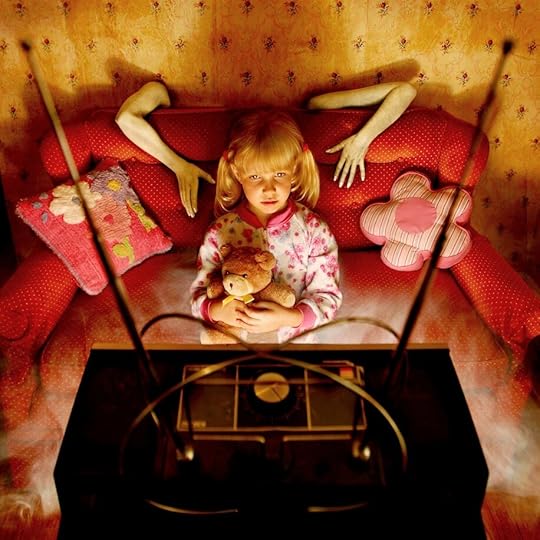
“Couch” by (Joshua Hoffine) - image from The Washington Post

Fear is how those in charge control those who are not. Whether it is fear of the other, of jail or of poverty, death panels, jack-booted federals coming for your freedom, the red menace, yellow peril, illegal immigrants, police, street thugs, alien invaders, the zombie apocalypse or rampaging jihadis, we are a nation driven by fear. The fact is that fear does an excellent job of getting past our filters. We live in a cry wolf economy and business is howling. I suppose on a biological level there is some internal chemistry that says, “Well, it sounds like bullshit, but if it isn’t I could die, so why take the chance?” And it does not have to be about death, although that is the all time best seller. It could be about one’s ability to compete in the world, which really is a subtle message about death, the death of your DNA anyway. Too fat? Too bald? Too gray? Too tall? Too short? Too ugly? No one will love you. You will never have children. Better buy our product to ensure that you attract a mate. Buy our product or you won’t get a job. You and your children, if you have any, will starve. Kerr does not ignore this terrifying element of contemporary culture, particularly in her chapter on Colombia, but I do hope that when she dives into these waters again, she gives it more of a look.

FDR was wrong. There are plenty of real things to fear out there, just maybe not the things we are told to fear. In any case, whether one’s fear is justified or not, how our biology copes with fear is consistent. And it is not only well worth learning about, Scream provides an entertaining, enjoyable way to learn. There’s nothing scary about that.

My beloved picked this item up for me from the author at a book fair in return for an honest review.

Review first posted – 10/9/15

Publication date – 9/29/15


This review is cross-posted on my site, Coot’s Reviews. Stop by and say Hi!" target="_blank" >Coot’s Reviews. Stop by and say Hi!

=============================EXTRA STUFF

Links to the author’s personal, Twitter and FB pages

Items Specific to Scarehouse
-----The Scarehouse site
-----A behind the scenes look at Scarehouse by Heather Johanssen
-----The Scarehouse youtube channel
-----Margee’s overview
-----Profile of Margee
-----Margee on Uncanny Valley
-----Why are clowns so scary

Other Items of Interest
-----A nifty article on the scariness of the simple triangle
-----One of the places Kerr visited (twice in fact) is Eastern State Penitentiary
-----On Halloween, 2015, the NY Times published a piece by Margee on her spectral experiences at ESP
-----For Halloween 2016, the Times cited Kerr in an article by Steph Yin - A Scaredy-Cat’s Investigation Into Why People Enjoy Fear
-----Another NY Times piece offers some fun videos of things that may make your skin crawl - Spooky Science Stories, Just in Time for Halloween
-----Washington Post - Great fun, this one - How a photographer brings his children���s nightmares to life - By Karly Domb Sadof and Joshua Hoffine

description
“Basement” - shot by Joshua Hoffine - image from above article - many more like these can be found there

-----Smithsonian - Can Experiencing Horror Help Your Brain? - by Mathias Clason
Profile Image for Johann (jobis89).
736 reviews4,680 followers
July 6, 2019
Sociologist Margee Kerr takes you on a tour of the world's scariest experiences as she unravels the science behind fear and why we seek it out.

This was such an incredibly fascinating and unique book. Kerr provides fascinating insight into fear and horror in different cultures, as she immerses herself in a range of different experiences - from haunted houses to the Japanese suicide forest to scaling the CN Tower.

Some parts become a little scientific, which I loved but might not be for everyone (these parts were quite short though). I also enjoyed her discussion of how your own perceived safety can influence whether or not you seek out fear - not necessarily something I had ever considered before but it's SO true.

All in all, really worth checking out if this kind of thing interests you! The audiobook was a delight. 4 stars.
Profile Image for Audra (ouija.reads).
742 reviews326 followers
July 19, 2016
Margee Kerr: if you're out there, reading this, will you please hire me? I live for October. I love haunted houses and go to all the ones I can get to in Colorado every year. I love scary movies, scary books, scary everything. I also took psychology and sociology classes in college because I want to know what makes people tick. You found a way to put those two things together to study and learn about fear as an emotion and as a social construct and I want in!

Basically, your job sounds incredible and you are having way too much fun. Please share the scare!

We've all experienced fear, whether you search it out at haunted houses, amusement park rides, or in books and movies, or whether you try to avoid it but it finds you anyways, like when your sister jumps out of a closet at you, or you see a massive spider in the bathtub. Fear and how we deal with it is an unavoidable part of life. Whether you fear speaking in front of crowds or your dark closet at night, that feeling is real and it affects us. What you might never have thought about though is how feeling scared could be a positive experience instead of just a negative one.

Margee Kerr has gone on an amazing, and sometimes frightening, adventure to start unraveling the science of fear. This is a field that not many people are studying, so fear is almost untapped as a scientific field. Why do we feel fear? And why do we feel it about specific things like dark places, heights, or clowns? What does fear mean for our bodies, physiologically? What does it mean for our minds? Why do people react differently? And the most mind-boggling question of all: why are there so many people who seek out that feeling, whether it be through thrill-seeking adventures like skydiving or paying to go through a haunted cornmaze?

This book is a wonderful exploration and will definitely open your mind to the possibilities of fear. After all, if there's one thing being scared and conquering your fear will do, it'll make you recognize that life can be fleeting and remind you to take every chance that you get. And honestly, what's better than feeling alive?
Profile Image for Becky.
887 reviews149 followers
July 25, 2016
A 3.5 that I rounded down to 3 rather than up to a 4, because she shone so brilliantly in chapters, and at others times found her inner dialogue and flashbacks to personal experiences important, but ultimately misplaced within the broader narrative at the time. While I perfectly enjoyed reading about adventures, I could never quite connect with her voice during the more intimate moments, such as her emotional confrontation with the ideas of her own mortality in the "Suicide Forest."

Favorite chapter was Bogata and the products of a fear-inspiring environment on the average person, why the safest nation on earth is obsessed with feeling fear, and the way in which her newly designed scare house chooses to present fear to its customers. These are all things that I think would be a relevant and important discussion on a national level.

Least favorite chapters were the suicide forest, the earlier chapters on roller coasters, and in general, getting the novel off the ground in the beginning.

Still, would be interested to see more from Kerr in the future, though, I hope she lets someone else narrate the audiobook. She seemed ill at east in the beginning, and never fully mastered the stride that professionals have.
Profile Image for Cynthia.
1,198 reviews226 followers
August 19, 2021
Bear with me, friends. I have A LOT of thoughts on this one.

I’ll begin by saying that psychology, sociology and neuroscience are my favorite sciences! Because of that, Scream, oozing with all three, was exactly the kind of nonfiction I could get lost in!

Margee Kerr, a sociologist, is interested in the science of fear. This interest sparked an in-depth study on the topic, one that included Kerr putting herself in a number of fear inducing situations to better understand the psychology behind it.

I found the information presented to be deeply fascinating! I was very grateful that I had a physical copy, as my husband and I listened to the audiobook for our book club discussion, but I found myself needing to underline so much that I had the book plopped open in my lap as we listened.

I loved that the author included scientific information mingled with real-life experiences, both from the past and for the sake of her research. I think the data was better illustrated through her personal tidbits and, for me, this seemed the perfect balance.

I learned a lot about the Japanese culture through this, which was an unexpected bonus, and my favorite chapter in the book involved the famous Japanese Suicide Forest, not because of that content, but because of the author’s meaningful takeaway.

I do have a few minor quibbles, though. Firstly, I was a bit dissatisfied with the exploration of what the author labeled as “real fear,” (as opposed to situations we choose to induce fear, like roller coasters and haunted houses). There was a lot of mention of trauma in the book and while Kerr did touch upon her own experience living in an environment that had produced authentic fear within her, I would have really loved to have seen this particular exploration go beyond her own experiences. For the sake of the chapter, she did choose to go somewhere that she believed would produce fear within her and she did relate her response to that visit back to past trauma, which I appreciated. However, I thought there was so much more that could have been done here and that talking to other people who’d endured authentically terrifying and life-threatening situations would have really enhanced the material.

I must also mention a couple things that bothered me in the final chapter:

First, she listed “more extroverted” as a “more favorable psychological characteristic.” It was unclear if she was taking the example of extroversion from the study she was referencing or if it supported a personal bias (or both). I was bothered by what it communicated, though. I really dislike the idea that extroversion is the ideal and that there is something wrong with introverts. I feel like a statement like the one in this book further influences that belief. The actual psychological definition of these personality types (which differs from the dictionary’s definition) has its complexities, but largely boils down to how one processes information and restores energy. Any implication that one personality type is better than the other doesn’t sit right with me and it never will. Furthermore, a statement that implies this in a scientific book is actually not a very scientifically-minded statement.

Lastly, I was bothered by this sentence: “This highlights how important perception is in fear,” which was used to support the contrast between some people feeling terrified when closed in a coffin inside of a haunted house while others were feeling comfortable within that enclosure. I thought this statement lacked nuance. The haunted house, as well as many of the other examples she included in the book, were controlled environments with manufactured producers of fear. It seemed clear throughout the book that she understood fear can be experienced beyond such things and, while neurological responses may differ, the fear exists, all the same. To make this blanket statement about fear and perception as a conclusion without noting that she meant in controlled environments bugged me. And that probably is what she meant. But it wasn’t clearly conveyed and the fear (or lack thereof) produced in a chosen haunted house experience cannot be compared to the fear experienced when faced with situations that are legitimately terrifying and outside of our control. We cannot perceive ourselves as safe when the information within our neurological reach (i.e. “This is only a haunted house.”) isn’t present.

As a whole, I really liked Scream a lot. It’s clear that a tremendous amount of academic and field research was put into it and I felt it was written in a way that held my attention. I found it quite educational and I will be referring back to my underlined passages for review. I think this was an excellent topic of study and I’m grateful Kerr was so invested in presenting it!
Profile Image for Justin Tate.
Author 7 books1,456 followers
September 12, 2016
Unexpectedly poignant and thoroughly-researched, this is a one of a kind book that analyzes fear from all angles, from roller coasters to haunted houses to high-crime neighborhoods to PTSD. Meanders a little here and there, but overall a well-structured study that reads quick and makes you think. The notes on the positive effects of fear were especially noteworthy. Recommended!
Profile Image for Ellen Gail.
910 reviews434 followers
December 27, 2020
I am so excited to tell y’all how good this is!


Do you like horror movies? What about roller coasters? Haunted houses?

Now, have you ever wondered why you like those things? Why does fear, specifically controlled fear, thrill and entice us? Sociologist Margee Kerr tackles the many facets of fear, from amusement parks to our own mortal dread, with an easy readability and charm that bears comparison to Mary Roach.

Much like a roller coaster, curated or manufactured intense emotional experiences like haunted houses, scary historical sites, and even things like sweat lodges and physical challenges need to start from a place of safety, take you on an out-of-control ride in which you push yourself beyond your boundaries, and return you safely, feeling better and a little wiser.

I love being scared. Pretty much always have, hence me selecting this book. But a part of me has always felt weird about it. Why do I love roller coasters and suspenseful horror fiction? Now I am the odd duck out because I don’t like haunted houses. Or rather, I wish I did. I love the concept! But strobe lights trigger a horrendous migraine without fail, so I’ve learned that it’s something I can only love and appreciate for other people.


I'll leave the sciencey explanations to the book itself, which it does a very good job of, but personally it’s a release. When Sydney Prescott survives, bloody and traumatized but SURVIVES, I feel better. Like my own personal drama bullshit doesn’t mean as much. It weighs lighter on me. It's the same way I feel after I get off a roller coaster - the endorphins make me feel invincible but also peaceful.


The tone is perfectly balanced, addressing our fear of real ghosts with as deft of a hand as it does fictional ones. From taking a sky walk to confronting our fear of death, it shows us the catharsis in terror and in honest confrontations with our feelings, even those that terrify us.

As Ernest Becker famously stated in his 1973 work Denial of Death: “This is the terror: to have emerged from nothing, to have a name, consciousness of self, deep inner feelings, an excruciating inner yearning for life and self-expression—and with all this yet to die.”

Scream: Chilling Adventures in the Science of Fear does exactly what it promises. It delves into the physical and social sciences surrounding the very essence of our fear and shows us exactly why we like to have a scary good time.

Profile Image for Kelsey Myers.
73 reviews9 followers
July 13, 2015
Margee Kerr is a sociologist who studies fear. She challenges herself to travel the world experiencing the wide range of how fear can present itself-- from physical thrills to haunted locales to the not-so-fun reality of living in high crime areas.

In the end, I found this book to be too memoir for my taste. Sorry, Margee, but I really could care less about the first time you rode a roller coaster. And more than anything, I found myself annoyed that you would *think* I cared, but I guess that's just my bias showing.

The most interesting part of the book, by far, was Margee's experiences as the sociologist-in-residence at ScareHouse, one of the biggest haunted house attractions in Pittsburgh. This is a genuinely interesting job and something I would've loved to hear more about-- a shame it only lasted half a chapter.
Profile Image for Meghan (TheBookGoblin).
300 reviews46 followers
October 18, 2022
Finally I can back up my love of being scared to my friends with science! As a person with an intense anxiety disorder, my friends and family never understood why I love horror and being scared so much, and I’ve always explained that it makes me feel “alive” and takes me completely out of the anxious space because it demands all my attention. Margee Kerr concludes this many times over in this research-based exploration of fear. The results are unanimous: people feel great after being scared.
While it does read quite a bit like a college essay (writing is maybe not Kerr’s strong suit), the research is solid and it was cool to read about how the various types of fear create different triggers in our brain.
I wouldn’t mind a second book to this with current-day updates in research.
Profile Image for Bob Schnell.
650 reviews14 followers
August 9, 2015
Advanced reading copy review Due to be published September 29, 2015

Did you ever wonder why haunted houses, horror films and thrill rides are so popular? Why do people enjoy being scared? Margee Kerr is a sociologist who tackles these questions in "Scream: Chilling Adventures in the Science of Fear". Not only does she take a laboratory view of the physical and psychological side of fear but she puts herself in the role of guinea pig as well. She travels the world to ride the tallest roller-coaster, spend a night in a haunted prison, visit a forest of suicides in Japan and walk alone down the crime-ridden streets of Bogota, Colombia. She takes her experiences and uses them not only to study fear but also to help design new features for ScareHouse, a haunted house attraction in Pittsburgh, PA.

The travel portions of the book are entertaining and interesting, but the science sections get a little too technical for the average reader. The author herself gets a tad annoying as she describes her dread and fright in the weird situations she helped to orchestrate. She realizes that she has hair-trigger emotions but always seems surprised at her reactions. There's a disconnect that would seem to invalidate the scientific findings. Still, recommended for people who wonder why scaring people is such big business.
Profile Image for Jill H..
1,637 reviews100 followers
March 18, 2016
I was not sure what to expect when I picked up this book....it turned out to be a sociological/psychological study of fear mixed with the personal stories of the author's search for the ultimate terrifying situation. Why are people afraid of the dark, or ghosts, or spiders or height? And how does our brain react when we are faced with a flee or fight situation when we feel threatened by something that frightens us?

It is an interesting study but the book is uneven.......some chapters are, frankly, rather boring while others hold your attention and some of the situations in which the author put herself, make me question her sanity!!! But she certainly threw herself into her work to illustrate from her actual experiences what fear does to the human body and psyche. Pretty interesting stuff with a few slow chapters but still worth the read.

BTW, if you read in bed and put the book on your nightstand and turn off the light, you will get a bit of a fright. The title glows in the dark, so turn the book over or you will be looking at the word "Scream" all night long!!!
Profile Image for Shana Yates.
845 reviews16 followers
January 11, 2016
This book has some good tidbits and interesting facts about fear and thrill seeking. But you have to wade through a lot of awfully self-indulgent and flighty narrative of the author, who seems markedly frivolous for someone with an advanced degree in sociology. I would love a book more robust in science and less peppered with introspective (but somehow shallow-feeling) vignettes from the author's life and why she thinks she enjoys being scared and thrilled. Luckily, it was short so I didn't waste too much time.
Profile Image for Claire.
1,251 reviews57 followers
October 28, 2015
I've never enjoyed learning about a new subject as much as I did learning about the science of fear while reading this book. Not my typical read, I'd rather read a book to feel fear, not read to find out why I feel fear and why I enjoy and sometimes crave the feeling. But this book was written in a way that took you on a journey of someone else's fear and taught you along the way.

There were several parts of the book that really stood out to me. When Margee visited Eastern State Penitentiary, I was especially excited. As a long time fan of paranormal investigation TV shows and the occasional book, I've always been interested in ESP and the happenings there. So to read about her experience was incredibly exciting for me. This section gave me very weird dreams though. I don't know if I was overthinking the science behind my fascination or just a coincidence, but my dreams were full of prison cells and ghosts. It also fueled my desire to make the trip across the state to visit ESP myself.

I enjoyed the entire trip to Japan. When she visited the suicide forest, I had an incredibly moving experience. She did an exercise where she contemplated her death and its consequences. Not only did I do this as I was reading, but it brought me to tears as I thought what my death would do to my family and loved ones. It wasn't the first time a book made me cry, but it was the first time a book on fear made me cry. To me, it was kind of a conflicting feeling.

My favorite part was how she wrote about the development of the Basement at the ScareHouse. Having gone through the haunt and experienced the sensations she developed and wrote about, it was very interesting to see the whys behind the scares. To see that it wasn't just a "wouldn't it be cool if.." development, but a "here's what we should do, and here is why we should do it" construction. The science behind the scare is fascinating and it's clear why ScareHouse is as successful as it is.

Read this book, even if it isn't your normal read. You won't regret it.
Profile Image for Robin.
1,603 reviews35 followers
October 28, 2015
Over the years, I've had a love/hate relationship with scary movies, books, and activities. I remember my first "almost-peed-my-pants" scary experience and that was when as a kid in the late 1950s, watching Twilight Zone's "Beauty is the Eye of the Beholder." Talk about a startling development! Even though it thoroughly scared me, it started my love affair with anything that would create fear, especially if ghosts and haunted mansions were involved. I went to books (Stephen King's THE SHINING gave me nightmares and the undercurrent of horror in Shirley Jackson's HAUNTING OF HILL HOUSE gave me the heebie-jeebies), movies (Hell House was, well, hell to watch, and Poltergeist was really spooky), and roller coaster rides (until I rode the NYNY Vegas coaster and gave myself whiplash--that was the end of that). So why do we read/watch/do these things that scare us silly? That is the focus of SCREAM and I was anxious to find out the whys of this Catch-22 issue.

I found what most interested me about Kerr's book was when she immersed herself into scary situations: riding a Japanese roller coaster, going through a horribly scary haunted house situation (manufactured), spending the night in a haunted prison, and (the scariest activity of all--to me anyway) walking the EdgeWalk on Toronto's CN Tower. She analyses every emotion and physical feeling she goes through when doing these activities and breaks them down into science, which got a little too detailed for my taste.

This was an interesting look at the science of fear and I have a little better understanding as to why we seek situations to become scared, but I ended up skimming some of the more technical explanations of the psychology and past experimentation; however, someone with a more scientific brain might enjoy those parts of the book.

P.S. I forgot to mention that one night I got up and was startled to see the lettering on the cover glows in the dark. Check it out for yourself.
Profile Image for Heather.
585 reviews6 followers
May 1, 2019
2.5 I am solidly down the middle conflicted about this book

I think it was well researched, and very informative. I listened to the audio and found that her voice was clear and easy to understand.
However I didn't like the overall layout of the book.
Example of what I mean (not spoilers, this is my own made up story):
Here is a story of a cat, let's talk about this cat for awhile, seeming for no reason, oh my goodness there is a bus approaching and the cat is in the way.... oh no... so big scientific terms, side story, reference to other part of the book you thought we were finished with, more scientific terms, now that you have forgotten and no longer care about this cat, let's get back to talking about the cat and how it ultimately meant nothing.

I thought the experiences were interesting but for how scientific she claims to be, I felt like this book was an emotional journey book with science thrown in.
And I felt like the whole "why fear is good thing" was a very minimal part of this book.

Overall I enjoyed the scientific information and a few of the personal experiences (whilst others left me bored or annoyed depending)... I am glad I read it, but I think it speaks volumes that I am also glad to be done with it.
Profile Image for Rachel (TheShadesofOrange).
2,887 reviews4,798 followers
November 12, 2017
3.5 Stars
Written by a sociologist, this book explored the reasons why people love to be scared. As a self declared thriller-seeker, Kerr travelled around the world to test drive different types of fear-inducing experiences. Personally, I was most interested in the psychological thrills section, which featured haunted houses and paranormal investigations. The author compared how different cultures consume horror entertainment. The differences between Japanese and North American haunted houses were absolutely fascinating. Furthermore, this book discusses the relationship between safety and fear. The author argues that a sense of control is key to managing anxiety and enjoying scary experiences.
Profile Image for Cassandra Rose.
523 reviews60 followers
November 5, 2016
ORIGINALLY POSTED: https://bibliomantics.com/2016/11/04/...

When I finally dove into Scream, I was expecting a thorough exploration of fear. Sadly, the book was incredibly unbalanced, with Kerr either succeeding or failing chapter to chapter as she attempted to tackle a wide range of subjects. From the science that was far too science-y, to the sometimes painful person anecdotes, I was left wanting so much more.
Profile Image for Craig Ranallo.
214 reviews24 followers
September 28, 2017
A fascinating and unique study of fear. No one researches quite like Margee Kerr, it seems. Visiting skyscrapers, haunted houses, amusement parks halfway around the world, abandoned prisons, cemeteries, and unending dark alleys, Kerr compiles over a year's worth of study and observation about the nature and science of fear: what is fear? Where external factors influence it? What internal factors? How do we process it psychologically, emotionally, and physically? Why do fears and responses to fear differ from person to person? These and a whole host of other interesting questions are probed as Kerr examines everything from stomach-dropping sensation on roller coasters and sky-walks to confrontation of death to real-life fear of physical harm in the streets of Bogota.

I related so much to the poignant observations and stories Kerr told along with her research. I grew up feeling that my interest in all things frightening and horror-related was something strange, but never understanding why; to me the benefits and the thrill of being scared (in safe capacities) were obvious. I appreciated that Kerr worked towards a hopeful message that by allowing ourselves to be adventurous, to push ourselves to the edge and take risks and yes, even give ourselves a good fright, we could end up bringing more happiness and joy in our lives.

It also made me giddy that I had a personal connection to ScareHouse and the Basement, the haunted attractions that Kerr personally worked/works on as part of her research and experimentation into how to give excellent, boundary-pushing yet still safe and respectable scares each Halloween season. I'm a Pittsburgh native, I know people that have worked at ScareHouse, I've gone through many a time myself--including the first iteration of the Basement in 2013 (and several others in the following years)--so I feel proud knowing that this amazing haunt in my hometown's backyard has become the focus of such a thrilling and adventurous experiment and gained the national attention it deserves.

Rock on, Margee. I hope I'll get the chance to talk with you soon!
Profile Image for Jess.
726 reviews15 followers
February 17, 2019
This is a really interesting, informative, but most of all emotional look at the psychology of fear. I'm torn between 4 and 5 stars, so I'm gonna go with 4.5 and work from there.

A lot of people seem to have some huge problem with anecdotes in their non-fiction. To those people, I have to ask - why not just pick up a textbook if you want solid facts? This is pop-psychology, not hard science. Personally, I think anecdotes make books like Margee Kerr's so much better - I like having a story to follow, I like being able to relate to the phenomena that's being explored. I like getting inspiration for new things to try.

There are some really intriguing concepts here, and I've learned a lot about fear, and had some little existential crises. I love Kerr's writing style, I love how I got to go on this journey with her, and I loved how approachable the narrative was - I was never left stranded in a sea of uber-biological terms, and the book works through the more complicated concepts in layman's terms.
Profile Image for Kelly.
Author 6 books1,221 followers
Read
September 11, 2018
I really enjoyed this look at fear. Margee uses herself as the subject, but in addition to sharing her personal experiences, she brings in plenty of research to both confirm and refute what she's felt. Fear here isn't defined as what you might expect -- yes, there's haunted houses and scary movies, but there are also things like death, being in a place you don't know, worry around being a crime victim, and other situations where your fight or flight response might kick into overdrive.

Margee reads the audiobook and it's enjoyable. Worth reading, especially for any brain/emotion nerds. Also great for readers who find themselves the rare person who loves scares but never finds themselves especially scared (this is thing Margee digs into with the help of another researcher).
Profile Image for Michelle.
628 reviews230 followers
November 2, 2015
A unique and fascinating look into the terror of the horror industry and the impact on human emotion: "Scream: Chilling Adventures in the Science of Fear" authored by sociologist Margee Kerr, who also has worked in the famous "Scare House" a thrill attraction in Pittsburg, PA. Kerr takes her readers around the world touring haunted houses, thrill ride roller coasters, the CN Tower Edge Walk, the haunted Eastern State Penitentiary (1829-1971), the Aokigahara-Juki Forrest, also to the most violent murder/kidnap terror hot spots in the world Bogota, Colombia, where US travel warnings alert/advisories are routinely issued.

In a basic understanding of fear and the origin of Halloween; it was the Irish and Scottish immigrants that introduced Celtic ritualistic superstitions associated with "Samhain": where costumes worn and bonfires burned to keep tormented spirits away, combined with the Christian practice of "All Saints Day" where departed loved ones were held in memory and prayer. The traditional American custom of honoring of the dying and departed used to be more of a community practice, where the dying were visited, prayed for. Currently the dying are kept in hospitals and nursing homes, in a isolated, solitary, often fearful environment. The Japanese, share a belief in the immortality of the human soul: "Kamin" is centered around the afterlife. The common Japanese custom involves worship of ancestors and departed ones, and a tremendous belief and fear of ghostly hauntings. It was very interesting the comparisons between different cultures.

In 2014 Kerr visited 30 haunted houses: including the Factory of Terror, Canton, OH.- Ghostly Manor, Standusky, OH.- Terror Behind The Walls, PA.- Black Out, NYC. The haunted house discussed the most was Scare House. Readers were also taken on a frightening tour of ESP, the oldest penitentiary in the United States investigated multiple times: (1834, 1897, 1903) for "licentious, immoral practices, embezzlement, cruel and unusual punishment." The imposing intimidating gothic design, heavy iron gates, small dark suffocating cells, solitary confinement were chilling. The ESP re-opened in 1991 for public tours.
Kerr toured 9 attractions in Japan, and was most terrified at the Diaba (Odaiba) Strange School. Here, a young girl (the snow doll) and a young boy (who later committed suicide) were tortured by an evil old woman, now haunt this attraction on Tokyo Beach. The story had a similarity to Hansel and Gretel, and the written materials and videos were all in Japanese (no English translation) explaining the negative energy of the cursed school, tourists were given objects and provided sayings to cleanse the environment.
I have lived in Okinawa, so the Japanese attractions were of particular interest. I had never heard of the "Aokigahara-Juki Forrest" located at the foothills of Mount Fuji. The Japanese authorities quit posting official statistics (2010) to discourage the problematic number of suicide deaths in this haunted superstitious location. The author traveled there by bus, and thought the postings on the signs were encouraging visitors to get help for their emotional problems. Mental illness is often stigmatized in Japan, and suicide deaths may be considered honorable: (Samari warriors and Kamakazee pilots) lead Japan to have the longest life expectancy and the highest suicide rate in the world.
An estimated 32 million dollars spent on "The Takabisha" the steepest roller coaster in the world, at Fuji-Q Highland, where tourists wait in line 4 hours to experience this thrilling 2 minute ride.

This was really a fascinating read, though it was weighted down by an endless amount of scientific stats and data: from "stomach drops", impulse control, the brain scans from fMRI and EEG's that study fear and brain stimuli. Some might appreciate all this technical information, I didn't. The stats concerning violent crime, the two men following Kerr around in Bogota were quite alarming, also Kerr's own recollection of living in crime ridden neighborhoods and the effects of PTSD on average citizens compared to war veterans. There are many good photos included. With thanks to the Seattle Public Library.
256 reviews26 followers
January 14, 2016
Short take: A sociologist looks at fear. It's a lot less dry than that sounds. Using herself as a guinea pig, Kerr examines various kinds of fear -- biological fear (say, the fear of heights), psychological fears (being alone in the dark or fear of death), and engineered sorts of fears (haunted houses). She looks at both the sciencey side of things (less interesting to me, but that's just because of me) as well as how it fits into a broader societal context, whether that's the role of prisons in early America or the role of suicide in Japan. The book is most interesting, however, when she delves into her own reactions and experiences to roller coasters, extreme height stunts, her ruminations on death while alone in Japan's "suicide forest" (side tangent: Please do not see that awful, exploitative horror movie that deals with the forest. That's gross.) and so on.

At the end of the book, she brings all these experiences and revelations together to help create The Basement, which I'd heard of, known as one of the scariest haunted houses in the world -- but founded in psychology and biology to leave you feeling amazing at the end of it. I would have liked to have learned more about how she designed each of the haunts around her principles, as that section is pretty breezy.

In all, it's an interesting chance to look at our own interactions with fear. In modern America, most of our fear is things we choose to endure -- thrill rides, scary movies. For me, this book gave me an interesting chance to look at myself and gain some insight into why some scary things appeal to me (I have never met a ghost tour I didn't want to take) and why others leave me very cold (I can probably count on one hand the number of horror movies I've seen). It also offers interesting insights into how fear can be managed and even turned into a positive experience.

Overall, a thoughtful and well-written book.
Profile Image for jeremy.
1,202 reviews309 followers
October 16, 2015
in scream: chilling adventures in the science of fear, pittsburgh sociologist margee kerr explores the fundamental human emotion of fear. by visiting haunted houses, a former penitentiary, amusement parks, towering heights, japan's infamous suicide forest, a ghost hunt, and other scary (intentionally or otherwise) locales across the globe, kerr offers an account of fearful experiences. blending personal first-hand anecdotes with popular science (all well-cited in thorough notes at the book's conclusion), scream aims a roving light onto a dark and often misunderstood corner of the human psyche.

perhaps more a memoir than a proper pop science book, scream, nonetheless, is, at times, both fascinating and engrossing. kerr's enthusiasm for the subject (beyond her own professional interest) is wholly contagious, and the zeal with which she conveys her work, studies, and immersive journeys into the nature of fear carries the book. anyone with even a cursory curiosity for what scares us, the physiological responses that follow, and the cultural construct of fear itself – as well as the latest scientific findings on the subject – will find more than a little to enjoy.
years ago, i became a sociologist because i wanted to make people's lives better. i wanted to find ways to end the hurtful and damaging impact of prejudice, discrimination, and abuse rooted in fear. i never thought i would accomplish that in a dusty basement, with a knife in one hand and a black bag in the other.

Profile Image for Victoria Butler.
467 reviews12 followers
August 11, 2023
I really enjoyed this book! Kerr got to go on a months-long adventure all around the globe, experiencing scary and thrilling things from roller coasters to haunted houses and writing about them using science (I'm jealous). I'm planning to go to Japan in the next few years and will honestly add some of her stops to my trip.

My only quibble was some of the "real world" section, specifically the Colombia trip. Though most of the book was based on her experiences first hand, I think interviewing or working with consenting people who have gone through trauma and true terror would have been more effective than travelling to a rough neighborhood in a relatively poor country and getting bad vibes and writing about it. It felt a bit off and privileged. However, this was one chapter in an otherwise excellent book.

I learned a lot from this book, including some medical and scientific reasons why I'm an anxious woman who also loves thrills. This was the Eat, Pray Love for spooky girls I've always wanted.
17 reviews
July 17, 2025
Number of ✨️ - 4⭐️

Main motivation to finish it: Enjoyment

Format: Book

Initial thoughts: Very cool and interesting book. Sometimes writing a non-fiction is hard, especially with added science details, if you want to retain your audience. I enjoyed the layout of the book, the way different fear scenarios were split and the intersection of neuroscience, psychology, anthropology and sociology was layed out.

Final thoughts: Overall a solid book, I wish there were certain concepts that were included like gender/sex differences of fear or more expansion on first world vs third world fears. I think Dr Kerr could easily write a second book, even include her findings from her research. I did find some of the content a bit too technical and didnt feel like it was necessary to add thag level of detail for a book that is meant to be for everyone (if I didnt have a background in neuroscience, I think some of it would have been too much). I also think that last chapter could have been taken out all together and ingrained in the other chapters. I think the book had a lot of good things in the beginning, but the ending chapter and the memoir like structure lost a star for me.

Short attention span friendly? Yes

Would I read it again? Yes, parts of it

Would I tell my mom to read it? Yes
Profile Image for Taylor.
404 reviews8 followers
November 4, 2019
The author does a fantastic job of walking you through the science and the prose of her journey. It's a book I think everyone should read. My only complaint were the parts that lacked objectivity due to a strictly feminist lense, and it sounds like regurgitated rhetoric.
Profile Image for Chris Boutté.
Author 8 books278 followers
November 12, 2020
I've been a huge wuss for most of my life. I've hated haunted houses and scary movies, and I'm a 35-year-old man, but my girlfriend loves all that spooky stuff. This last year, I've learned to love horror movies and being scared, and I wanted to learn some of the psychology behind it. This book from Margee Kerr is exactly that. Why do some people love scary movies? Why do people love haunted houses? What about adrenaline junkies who risk their lives? Are people who are into BDSM psychologically different? Kerr answers all these questions and much more. 

As a lifetime lover of fear, Margee did a ton of research for this book, but my favorite was the final chapter. After all of her research, she puts together an ideal fear experiment, and it was really cool to hear about. I really enjoyed this book and wish there were more like it.
Displaying 1 - 30 of 188 reviews

Can't find what you're looking for?

Get help and learn more about the design.