

What do you think?

The Giant, O'Brien
New York Times Book Review Notable Book of the Year
Los Angeles Times Best Book of the Year
London, 1782: center of science and commerce, home to the newly rich and the desperately poor. In the midst of it all is the Giant, O'Brien, a freak of nature, a man of song and story who trusts in myths, fairies, miracles, and little people. He has come from Ireland to exhibit his size for money. O'Brien's opposite is a man of science, the famed anatomist John Hunter, who lusts after the Giant's corpse as a medical curiosity, a boon to the advancement of scientific knowledge.
In her acclaimed novel, two-time Man Booker Prize winning author Hilary Mantel tells of the fated convergence of Ireland and England. As belief wrestles knowledge and science wrestles song, so The Giant, O'Brien calls to us from a fork in the road as a tale of time, and a timeless tale.
Los Angeles Times Best Book of the Year
London, 1782: center of science and commerce, home to the newly rich and the desperately poor. In the midst of it all is the Giant, O'Brien, a freak of nature, a man of song and story who trusts in myths, fairies, miracles, and little people. He has come from Ireland to exhibit his size for money. O'Brien's opposite is a man of science, the famed anatomist John Hunter, who lusts after the Giant's corpse as a medical curiosity, a boon to the advancement of scientific knowledge.
In her acclaimed novel, two-time Man Booker Prize winning author Hilary Mantel tells of the fated convergence of Ireland and England. As belief wrestles knowledge and science wrestles song, so The Giant, O'Brien calls to us from a fork in the road as a tale of time, and a timeless tale.
208 pages, Paperback
First published January 1, 1998
About the author
Hilary Mantel
131 books8,132 followersHilary Mantel was the bestselling author of many novels including Wolf Hall, which won the Man Booker Prize and the National Book Critics Circle Award for fiction. Bring Up the Bodies, Book Two of the Wolf Hall Trilogy, was also awarded the Man Booker Prize and the Costa Book Award. She also wrote A Change of Climate, A Place of Greater Safety, Eight Months on Ghazzah Street, An Experiment in Love, The Giant, O'Brien, Fludd, Beyond Black, Every Day Is Mother's Day, Vacant Possession, and a memoir, Giving Up the Ghost. Mantel was the winner of the Hawthornden Prize, and her reviews and essays have appeared in The New York Times, The New York Review of Books, and the London Review of Books.
Ratings & Reviews
Friends & Following
Create a free account to discover what your friends think of this book!
Community Reviews
Displaying 1 - 30 of 311 reviews

December 22, 2016
An intriguing mixture of fact and fantasy. Unlike the Cromwell novels and A Place of Greater Safety, the need for invention is clear here.
Although the Irish giant Charles Byrne and the surgeon John Hunter are real historical figures, and Byrne's bones do form part of the specimen connection Hunter left to the Royal College of Surgeons, Mantel acknowledges that her choice to make Byrne an intelligent and well-read raconteur is implausible. In Mantel's version the name Byrne was chosen by O'Brien's scheming agent. Much of the atmosphere and period detail seems plausible enough, and the story is full of comic touches and tragic moments.
An entertaining book, not her best, but her best is so good that that is not a criticism.
Although the Irish giant Charles Byrne and the surgeon John Hunter are real historical figures, and Byrne's bones do form part of the specimen connection Hunter left to the Royal College of Surgeons, Mantel acknowledges that her choice to make Byrne an intelligent and well-read raconteur is implausible. In Mantel's version the name Byrne was chosen by O'Brien's scheming agent. Much of the atmosphere and period detail seems plausible enough, and the story is full of comic touches and tragic moments.
An entertaining book, not her best, but her best is so good that that is not a criticism.

Read
June 13, 2011Based on the true story of an Irish Giant who travelled to London in the 18th century to exhibit himself, as a kind of one man freak show. He is eventually persuaded to sell the rights to his body after his death to a Doctor and in fact the Giant's bones are still held as part of the Hunterian museum in London, in a curious twist these have allowed researchers to identify some of the Giants kin who live in Northern Ireland and who are still prone to giantism .
One of the themes of the novel is place. Ireland is poor but the giant has a social role, a recognised creature who crosses the boundary from mere man to folklore, in London there are guineas to be had but the giant there is merely a freak not even a man and worse the only accommodation for him and his cronies and hangers on are in cellars. He is displaced in location, in lore, and eventually in law, his life and relation to Doctor Hunter suggestive of the relationship between Ireland and the rest of the united Kingdom in the eighteenth century.
One of the themes of the novel is place. Ireland is poor but the giant has a social role, a recognised creature who crosses the boundary from mere man to folklore, in London there are guineas to be had but the giant there is merely a freak not even a man and worse the only accommodation for him and his cronies and hangers on are in cellars. He is displaced in location, in lore, and eventually in law, his life and relation to Doctor Hunter suggestive of the relationship between Ireland and the rest of the united Kingdom in the eighteenth century.
December 12, 2023
Only my second book by Hilary Mantel and not a mention of Cromwell…apart from a pejorative comment ‘Cromwellian.’
The book is set in the 1780’s and is an embellished true story about an Irish giant who comes to England - Charles ‘O’Brien and John Hunter - an anatomist who wants his bones.
The language is descriptively rich. A sad tale but comic at times. A relatively short but enjoyable read.
The book is set in the 1780’s and is an embellished true story about an Irish giant who comes to England - Charles ‘O’Brien and John Hunter - an anatomist who wants his bones.
The language is descriptively rich. A sad tale but comic at times. A relatively short but enjoyable read.

October 19, 2012
I have read several other books by Mantel, and enjoyed them all. But this one stands out, not just as an enjoyable read, but as an excellent piece of literature. Mantel is a reliably good author - engaging, smooth, and honest. But sometimes, an author manages to rise above "good," and create something truly unique, something that breaks the rules, takes risks and succeeds in charting new territory. This is what Mantel has done in The Giant O'Brien.
The Giant O'Brien is based on the true story of the Irish giant, Charles Byrne, who was exhibited in London in 1782. In all likelihood, Byrne had acromegaly, a pituitary disorder that causes abormal growth. (Andre the Giant, from the Princess Bride, suffered from this disorder, as did Lincoln.) Interwoven into Byrne's tale is the story of John Hunter, the famous Scottish anatomist. During that time, anatomists had to rely on the pickings of the gallows, or on body snatchers, the so-called "resurrection men," for their subjects. Hunter, in his dedication to collecting and analyzing new specimens, becomes obsessed with the Giant, and their paths cross - with heart-rending predictability.
What marks this novel as exceptional is its blend of highly contrasting narrative styles. The fanciful and utterly charming tales of the Giant, which, in keeping with the events of the novel, grow darker as the story unfolds, contrast starkly with the poverty, filth and bleakness of London in the late 18th century. Mantel enjoys shocking her audience with her gruesome portrait of the times, yet these, and other shocks, are balanced by the touching naivete of the Giant's followers, whose fall from grace is not actually so much a fall as a recognition that they are already flat on their backs. Other stories have featured these themes - urban poverty, desperation, obsession - but nowhere have I seen them treated with more humor and wit than in this novel. For, in spite of the subject matter, this book is frequently hilarious. It is also quite beautiful. Mantel is a master of lyrical writing; her scenes are like paintings.
Beyond beautiful writing, humor, and worthy subject matter, what makes this book special is that it is not really about the Giant, his followers, the obsessive anatomist, the poverty, or the failure of dreams. These are motifs. The real theme is the "resurrection men," who appear sporadically throughout this novel. They mirror and elucidate the Giant's charming, and ultimately horrifying, tales. For it is the writer who resurrects characters, and who tells their tales. Mantel is the true "resurrection man," and her task, like the Giant's, is to charm, to horrify, and to raise the dead.
The Giant O'Brien is based on the true story of the Irish giant, Charles Byrne, who was exhibited in London in 1782. In all likelihood, Byrne had acromegaly, a pituitary disorder that causes abormal growth. (Andre the Giant, from the Princess Bride, suffered from this disorder, as did Lincoln.) Interwoven into Byrne's tale is the story of John Hunter, the famous Scottish anatomist. During that time, anatomists had to rely on the pickings of the gallows, or on body snatchers, the so-called "resurrection men," for their subjects. Hunter, in his dedication to collecting and analyzing new specimens, becomes obsessed with the Giant, and their paths cross - with heart-rending predictability.
What marks this novel as exceptional is its blend of highly contrasting narrative styles. The fanciful and utterly charming tales of the Giant, which, in keeping with the events of the novel, grow darker as the story unfolds, contrast starkly with the poverty, filth and bleakness of London in the late 18th century. Mantel enjoys shocking her audience with her gruesome portrait of the times, yet these, and other shocks, are balanced by the touching naivete of the Giant's followers, whose fall from grace is not actually so much a fall as a recognition that they are already flat on their backs. Other stories have featured these themes - urban poverty, desperation, obsession - but nowhere have I seen them treated with more humor and wit than in this novel. For, in spite of the subject matter, this book is frequently hilarious. It is also quite beautiful. Mantel is a master of lyrical writing; her scenes are like paintings.
Beyond beautiful writing, humor, and worthy subject matter, what makes this book special is that it is not really about the Giant, his followers, the obsessive anatomist, the poverty, or the failure of dreams. These are motifs. The real theme is the "resurrection men," who appear sporadically throughout this novel. They mirror and elucidate the Giant's charming, and ultimately horrifying, tales. For it is the writer who resurrects characters, and who tells their tales. Mantel is the true "resurrection man," and her task, like the Giant's, is to charm, to horrify, and to raise the dead.

December 31, 2020
“I once wept, sitting in that chair.”
“For what reason ?”
“I don’t recall.”
“Your memory fails ?”
“Everything fails, sir. Reason, and harvests, and the human heart.”
I took some time before writing this review, only because I was quite weirded out by how the story unfolded. This was my first Mantel and I really was unsure of how I should have perceived this piece of writing. I think after sitting with it for a few days, I've finally been able to recognise the genius in Mantel's writing and can understand why she is so highly regarded.
Set in London in the late 18th Century, the novel recounts the journey of Charles Byrne and John Hunter, and their inevitable crossing of paths. What is unusual here is that Byrne is a gentle and scholarly Irish giant; a freak of nature, one may call him, and Hunter is a renowned Scottish doctor who specialises in performing autopsies. It is interesting to note that both characters are real. Byrne's bones are currently on display at the Hunterian Museum in London.
While it is recorded history that Hunter took Byrne's cadaver after his death for experimentation, the story leading up to this event is where Mantel's skills come in. She paints a picture of how Byrne, with his "friends" arrive at London where he is paraded as a freak. While his friends squander their money on women and alcohol, Bryne saves his earnings and dreams of the day when he'll return to Ireland; to his safety, to his home, to a life of reading and recounting stories.
This is where Hunter is brought into the storyline. Before the Anatomy Act of 1832, autopsies on corpses of ordinary humans were outlawed. This ushered in an illegal trade in corpses and a rise in grave robbers, with Hunter at the forefront. When Hunter came to know of Byrne, his interest piqued. He would enquire about his wellbeing which the giant always thought of as genuine care, but was more or less stemming from self-interest.
In the intervening period, with the giant exercising his story-telling skills and the doctor reminiscing over past patients, Mantel writes in a manner that not only disturbs the reader, but almost keeps them at the edge, despite knowing what is about to come. Her style of writing is magnificent; I am yet to read anything which can mimic her knowledge, her literary prowess and her turn of phrase. There are scenes which are grotesque and there are scenes which make your heart warm, such as interactions of Byrne with Pybus, and the relationship between Hunter and Wullie.
The story, to me, is about friendship and trust, betrayal and resignation. There is incredible dichotomy in the pitting of the Giant against Hunter, with the backdrop portraying squalor, murder, rape, abject poverty, illiteracy, prostitution in the hustle-bustle of mighty London. Both Byrne and Hunter come from poverty and wish to reside in London to realise their dreams of leading a life of comfort. While London turns out to be a place which swallows up the genteel giant, it is Hunter who thrives because of his scepticism, his excessive pessimism and preoccupation with death. In this context, the novel comes off as a commentary on the juxtaposition of art and science, where the latter eventually triumphs.
The book was so disturbing that I was unable to understand the magnitude of the sadness in it. After having thought about it, I can conclude that this is one of the most heartbreaking stories I have ever read, and that I'm definitely getting my hands on Mantel's other works. Would recommend this if you have the capacity to stomach it.
“For what reason ?”
“I don’t recall.”
“Your memory fails ?”
“Everything fails, sir. Reason, and harvests, and the human heart.”
I took some time before writing this review, only because I was quite weirded out by how the story unfolded. This was my first Mantel and I really was unsure of how I should have perceived this piece of writing. I think after sitting with it for a few days, I've finally been able to recognise the genius in Mantel's writing and can understand why she is so highly regarded.
Set in London in the late 18th Century, the novel recounts the journey of Charles Byrne and John Hunter, and their inevitable crossing of paths. What is unusual here is that Byrne is a gentle and scholarly Irish giant; a freak of nature, one may call him, and Hunter is a renowned Scottish doctor who specialises in performing autopsies. It is interesting to note that both characters are real. Byrne's bones are currently on display at the Hunterian Museum in London.
While it is recorded history that Hunter took Byrne's cadaver after his death for experimentation, the story leading up to this event is where Mantel's skills come in. She paints a picture of how Byrne, with his "friends" arrive at London where he is paraded as a freak. While his friends squander their money on women and alcohol, Bryne saves his earnings and dreams of the day when he'll return to Ireland; to his safety, to his home, to a life of reading and recounting stories.
This is where Hunter is brought into the storyline. Before the Anatomy Act of 1832, autopsies on corpses of ordinary humans were outlawed. This ushered in an illegal trade in corpses and a rise in grave robbers, with Hunter at the forefront. When Hunter came to know of Byrne, his interest piqued. He would enquire about his wellbeing which the giant always thought of as genuine care, but was more or less stemming from self-interest.
In the intervening period, with the giant exercising his story-telling skills and the doctor reminiscing over past patients, Mantel writes in a manner that not only disturbs the reader, but almost keeps them at the edge, despite knowing what is about to come. Her style of writing is magnificent; I am yet to read anything which can mimic her knowledge, her literary prowess and her turn of phrase. There are scenes which are grotesque and there are scenes which make your heart warm, such as interactions of Byrne with Pybus, and the relationship between Hunter and Wullie.
The story, to me, is about friendship and trust, betrayal and resignation. There is incredible dichotomy in the pitting of the Giant against Hunter, with the backdrop portraying squalor, murder, rape, abject poverty, illiteracy, prostitution in the hustle-bustle of mighty London. Both Byrne and Hunter come from poverty and wish to reside in London to realise their dreams of leading a life of comfort. While London turns out to be a place which swallows up the genteel giant, it is Hunter who thrives because of his scepticism, his excessive pessimism and preoccupation with death. In this context, the novel comes off as a commentary on the juxtaposition of art and science, where the latter eventually triumphs.
The book was so disturbing that I was unable to understand the magnitude of the sadness in it. After having thought about it, I can conclude that this is one of the most heartbreaking stories I have ever read, and that I'm definitely getting my hands on Mantel's other works. Would recommend this if you have the capacity to stomach it.

July 28, 2024
Ich weiß gar nicht mehr, wo ich das erste Mal von diesem Riesen Charles Byrne gehört habe, bestimmt in einem anderen Roman. Ich dachte gleich, was für eine spannende Geschichte und fand heraus, dass Hilary Mantel ein Buch über ihn geschrieben hat.
Dieser Roman war insofern spannend, weil ich drumherum recherchierte. Da gibt es außer diesem Riesen, der sehr jung starb, auch den begabten Arzt John Hunter, der sehr ehrgeizig (im Sinne von wissbegierig) war und dabei wenig moralische Grenzen kannte. Er sammelte Objekte unterschiedlichster tierischer – und auch menschlicher – Art. Das macht auch Lust mal wieder Stevensons The Bodysnatcher zu lesen.
Der Riese O'Brien (oder Byrne) wollte eine Seebestattung, doch Hunter stahl seine Leiche und obduzierte sie – und bis vor Kurzem konnte das Skelett des Riesen im Hunterian Museum in London besichtigt werden. Nach jahrelangen Bemühungen einzelner wurde dem nun ein Ende gesetzt. Stattdessen wird ein Gemälde von Joshua Reynolds gezeigt, auf dem John Hunter zu sehen ist und im Hintergrund die Füße O’Briens/Byrnes.
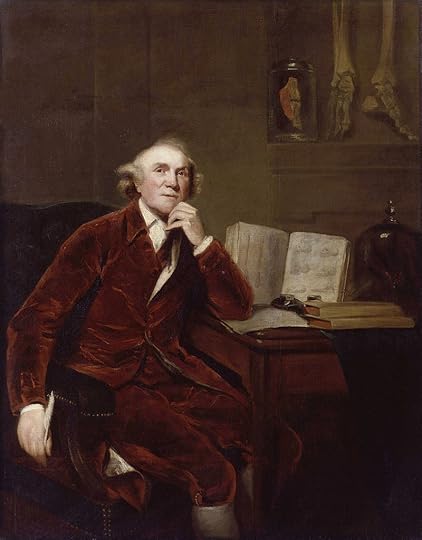
Vor diesem Hintergrund bin ich gerne gefolgt, aber ich fand sie bei weitem nicht so brillant geschrieben wie Wolf Hall. Unter anderem die Geschichten, die der Riese ständig zum Besten gibt, sind manchmal etwas langatmig und hemmen den Erzählfluss.
Dieser Roman war insofern spannend, weil ich drumherum recherchierte. Da gibt es außer diesem Riesen, der sehr jung starb, auch den begabten Arzt John Hunter, der sehr ehrgeizig (im Sinne von wissbegierig) war und dabei wenig moralische Grenzen kannte. Er sammelte Objekte unterschiedlichster tierischer – und auch menschlicher – Art. Das macht auch Lust mal wieder Stevensons The Bodysnatcher zu lesen.
Der Riese O'Brien (oder Byrne) wollte eine Seebestattung, doch Hunter stahl seine Leiche und obduzierte sie – und bis vor Kurzem konnte das Skelett des Riesen im Hunterian Museum in London besichtigt werden. Nach jahrelangen Bemühungen einzelner wurde dem nun ein Ende gesetzt. Stattdessen wird ein Gemälde von Joshua Reynolds gezeigt, auf dem John Hunter zu sehen ist und im Hintergrund die Füße O’Briens/Byrnes.
Vor diesem Hintergrund bin ich gerne gefolgt, aber ich fand sie bei weitem nicht so brillant geschrieben wie Wolf Hall. Unter anderem die Geschichten, die der Riese ständig zum Besten gibt, sind manchmal etwas langatmig und hemmen den Erzählfluss.

June 30, 2022
Horror comes in many forms but the most subtle form is of impending danger. Like showing little red riding hood happily prancing around and in the next frame showing a big bad wolf scheming for its next prey. That is what Ms.Mantle achieves in this brilliant narrative based on a true event.
We meet the gentle story telling giant O'Brien who is moving to England from Ireland to escape poverty. He will be on display where people pay to see the freak of nature. His agent and his set of " friends" are greedy and want him to open his purse up a bit, but he is saving up for a noble cause.
In parallel we meet Dr.John Hunter - a man of science who employs Grave hunters to get specimens to advance his research. Atleast he doesn't murder them you feel, but his progress is also shown in alternate sections making their meeting inevitable.
The gentle storytelling giant is suffering from ailments of both body and mind. He finds himself growing - which is not a good sign for a giant and suddenly his mortality is real. The way the people around the giant turn makes you feel for him. To know this was based on real people makes you feel bad.
Set in a time where Phrenology was a dominant theory, the actions of men of science might seem alien. The tales narrated by the giant are a delight - especially loved the story of the 7 dwarves who meet Snow white. The change of language from Scottish to English as we gradually move is something you don't realise immediately.
A fantastic piece of historical fiction.
We meet the gentle story telling giant O'Brien who is moving to England from Ireland to escape poverty. He will be on display where people pay to see the freak of nature. His agent and his set of " friends" are greedy and want him to open his purse up a bit, but he is saving up for a noble cause.
In parallel we meet Dr.John Hunter - a man of science who employs Grave hunters to get specimens to advance his research. Atleast he doesn't murder them you feel, but his progress is also shown in alternate sections making their meeting inevitable.
The gentle storytelling giant is suffering from ailments of both body and mind. He finds himself growing - which is not a good sign for a giant and suddenly his mortality is real. The way the people around the giant turn makes you feel for him. To know this was based on real people makes you feel bad.
Set in a time where Phrenology was a dominant theory, the actions of men of science might seem alien. The tales narrated by the giant are a delight - especially loved the story of the 7 dwarves who meet Snow white. The change of language from Scottish to English as we gradually move is something you don't realise immediately.
A fantastic piece of historical fiction.

April 3, 2022
Based on two real-life characters this is a mixture of historical fiction, myth and fable. Charles O'Brien, a gentle Irish giant, travelled to London along with his entourage in 1782 to be exhibited to citizens of that city and John Hunter, a celebrated surgeon and anatomist, who buys dead bodies on which to experiment and who wants the Giant's bones after his death for his collection.
Now I realise that Mantel is contrasting the experiences of the 'freaks' and the scientists in the so-called 'Age of Enlightenment', however at no time did I ever feel that the two stories ever really converged, instead they ran like two railway lines indefinitely running parallel to one another. Charles O'Brien, the story-telling giant who is doomed to an early demise simply because of his size whilst the socially inept man of science, John Hunter, who needs to dissect things to understand the world around him, is widely lauded and live a comparatively long life.
This my first experience of the author and I felt that this was an experiment that just didn't work. The squalor the streets of London and Ireland at the time are convincingly portrayed, there are some memorably comic passages but it also contains quite a lot of unnecessary dialogue that added little to the flow of the plot and simply left me bemused. Not a book that will live long in the memory for me.
Now I realise that Mantel is contrasting the experiences of the 'freaks' and the scientists in the so-called 'Age of Enlightenment', however at no time did I ever feel that the two stories ever really converged, instead they ran like two railway lines indefinitely running parallel to one another. Charles O'Brien, the story-telling giant who is doomed to an early demise simply because of his size whilst the socially inept man of science, John Hunter, who needs to dissect things to understand the world around him, is widely lauded and live a comparatively long life.
This my first experience of the author and I felt that this was an experiment that just didn't work. The squalor the streets of London and Ireland at the time are convincingly portrayed, there are some memorably comic passages but it also contains quite a lot of unnecessary dialogue that added little to the flow of the plot and simply left me bemused. Not a book that will live long in the memory for me.

October 26, 2022
Vor allem der Anfang war großartig, irische Helden im Schlamm. Ich kannte diesen Stil bisher nur von Flann O'Brien, aber vielleicht ist es ein verbreiteter irischer Stil und ich lese nur zu wenig aus der Gegend. Fünf Sterne für den Anfang, es bleibt aber auch danach noch sehr gut. Nach fünf oder sechs Büchern von Hilary Mantel kann ich allerdings sagen, dass Frauen bei ihr generell nur als Randfiguren vorkommen, und aus ihrer Autobiografie weiß ich auch, warum. Es ist fast unredlich, mit Mantels Büchern meine Bücher-von-Frauen-Statistik aufzubessern.

November 20, 2016
I was so excited to read this - what? John Hunter? And an untreated, brilliant, acromegalic? I have visited the Hunterian Museum in London innumerable times. There is nowhere else like it to see the natural history of (thank Kali) now treatable diseases. Syphilis, tuberculosis, astounding goiter, plague, neurofibromatosis, and, yes, acromegaly - Giant O’Brien’s sad skeleton hangs, slump shouldered among the whale penis’ and basketball-sized tumors. Hunter’s obsession, formalin, and great care has preserved - for at least 300 years the tissue of horrible disease in good condition, complete with careful clinical notes. The best, well second to the British, museum in London, in my opinion.
So this nicely written novel should have been literary dulce de leche for me. But it wasn’t. I forced myself to finish it. Yes, i vaguely knew the story, but it didn’t help that Ms. Mantel outlined it in detail at the outset (why?). Like a colouring book, then, she just fills it in. The best bits were the descriptions of the unexpected in JH’s experiments, some quite graphic and scary - but what a life, and indeed, what a heritage, a gift to all of us.
In contradistinction, the descriptions of the misery the giant’s continued uncoupled bone growth, the empty life of this brilliant, this deep intellectual, this sardonic soul - knowing his entire life was, like the young women born to prostitution (also quite bright), just for the amusement and monetary use of others. He had no control even over his last wish - to be kept intact at death so he could go somewhere after death, as was his belief.
All of this makes for a compelling story. Like other Mantel books, though, that i should have devoured, i once again picked at the edges. She has a way of drying out the very best ingredients. I finish, wishing it had been written by someone else.
Ah well.
So this nicely written novel should have been literary dulce de leche for me. But it wasn’t. I forced myself to finish it. Yes, i vaguely knew the story, but it didn’t help that Ms. Mantel outlined it in detail at the outset (why?). Like a colouring book, then, she just fills it in. The best bits were the descriptions of the unexpected in JH’s experiments, some quite graphic and scary - but what a life, and indeed, what a heritage, a gift to all of us.
In contradistinction, the descriptions of the misery the giant’s continued uncoupled bone growth, the empty life of this brilliant, this deep intellectual, this sardonic soul - knowing his entire life was, like the young women born to prostitution (also quite bright), just for the amusement and monetary use of others. He had no control even over his last wish - to be kept intact at death so he could go somewhere after death, as was his belief.
All of this makes for a compelling story. Like other Mantel books, though, that i should have devoured, i once again picked at the edges. She has a way of drying out the very best ingredients. I finish, wishing it had been written by someone else.
Ah well.

July 18, 2023
Who can rival Mantel for the ability to write sentences that just sweep you up and knock you down at the same time. She is so damn readable and then on ever page there’s a line that just leaps out. I just bloody love her.
The Giant O’Brien follows the eponymous Irishman, his agent and a band of fellow countrymen’s journey from the poverty-stricken countryside of Ireland to the filthy basements of London in the 18th century. On the journey and during their time in England a lot is lost and changed, including their language and ways of understanding each other.
O’Brien is a storyteller and a poet. Gentle, removed from all around him and philosophical.
Alongside him, we meet John Hunter; esteemed surgeon and expert on anatomical oddities. Famed throughout England but penniless due to his habit of borrowing and spending vast amounts on rare and unusual specimens to dissect and study.
Hunter covets the giants bones and so the two meet.
There’s a lot that’s strange and gruesome in this book. There’s a fair bit of violence. Based on real people but almost entirely fictionalised, Mantel paints a broad picture of time and place, of transitions, and of misplaced ambition.
Not as good as Beyond Black or Bring Up the Bodies but I mean honestly what is?
The Giant O’Brien follows the eponymous Irishman, his agent and a band of fellow countrymen’s journey from the poverty-stricken countryside of Ireland to the filthy basements of London in the 18th century. On the journey and during their time in England a lot is lost and changed, including their language and ways of understanding each other.
O’Brien is a storyteller and a poet. Gentle, removed from all around him and philosophical.
Alongside him, we meet John Hunter; esteemed surgeon and expert on anatomical oddities. Famed throughout England but penniless due to his habit of borrowing and spending vast amounts on rare and unusual specimens to dissect and study.
Hunter covets the giants bones and so the two meet.
There’s a lot that’s strange and gruesome in this book. There’s a fair bit of violence. Based on real people but almost entirely fictionalised, Mantel paints a broad picture of time and place, of transitions, and of misplaced ambition.
Not as good as Beyond Black or Bring Up the Bodies but I mean honestly what is?

January 9, 2012
An astonishing display of Hilary Mantel's brilliantly fertile imagination. She takes the bones of a true story (that's not a metaphor) and fleshes it out to ponder the collision of poetry and art with science and logic. Set in late 18th century London, it traces the fascination of a famous anatomist, John Hunter, with an equally famous but desperately poor story-telling Irish man who comes to town to display himself as a 'giant' rather than starve in the wilds of his home land. The anatomist recognizes that Charles O'Brien, who is only 22 years old, is dying of the malady (a genetic oddity) that has made him 7'7" tall. O'Brien knows he's dying too, and that John Hunter (how well-named!) wants his bones. The thought horrifies him. O'Brien is the civilized one of the two. His fine story-telling and myth-making fail to civilize degenerate London, though, and he comes to see his fate. So can we. His bones, which the anatomist boiled in acid within hours of O'Brien's death, still hang on display today at the Hunterian Museum in London. A wrenching story that's also mordant, sly--and above all, brilliant.

March 10, 2013
Mantel is still a goddess, but I didn't enjoy this book. It's well written (duhhhh it's HM) but SO UNRE-FUCKING-MITTINGLY BLEAK. Reading this book is like watching someone you love being slowly disemboweled with a rusty spoon: it's unbelievably painful and leaves you doubting the point of human relationships.
I gave The Giant, O'Brien 2 stars rather than negative 723, as was my first intinct, because Mantel could spit on the floor and it would be a better book than most out there.
* yeah, you're welcome. Further similes available upon request, 25 cents each. Cash only.
I gave The Giant, O'Brien 2 stars rather than negative 723, as was my first intinct, because Mantel could spit on the floor and it would be a better book than most out there.
* yeah, you're welcome. Further similes available upon request, 25 cents each. Cash only.

December 6, 2021
I'm (again) in awe of Mantel.As another reviewer beautifully pointed out,it seems she "channels,more than write".
Gorgeous writing for a Dickensian,sad, extraordinary book.
Gorgeous writing for a Dickensian,sad, extraordinary book.

September 13, 2026
An awkward and unsatisfying story based on two real characters, who as far as I can tell didn’t actually have anything to do with each other.
Charles O’Brien was an Irish giant in the 18th century whose wretched life was doomed to be a short one. In the novel, he and a rag-tag group of friends journey to London to try and make their fortune featuring O’Brien in freak shows.
John Hunter was a successful surgeon who needed cadavers to advance his medical knowledge and became obsessed with obtaining the giant’s body, though I don’t remember now exactly how he came to possess it.
I enjoyed Mantel’s description of the utter Dickensian squalor (though this would actually pre-date him by at least 50 years) that the Irish emigrants endured, and their repartee. It certainly contrasted with the dry and refined life of Dr. Hunter, yet they are two parallel but unconnected stories, with Hunter’s being if anything less appealing than O’Brien’s. I simply did not see the point.
I usually like to re-read a story to get a better sense of how the parts fit together. I couldn’t bring myself to do that this time though.
Charles O’Brien was an Irish giant in the 18th century whose wretched life was doomed to be a short one. In the novel, he and a rag-tag group of friends journey to London to try and make their fortune featuring O’Brien in freak shows.
John Hunter was a successful surgeon who needed cadavers to advance his medical knowledge and became obsessed with obtaining the giant’s body, though I don’t remember now exactly how he came to possess it.
I enjoyed Mantel’s description of the utter Dickensian squalor (though this would actually pre-date him by at least 50 years) that the Irish emigrants endured, and their repartee. It certainly contrasted with the dry and refined life of Dr. Hunter, yet they are two parallel but unconnected stories, with Hunter’s being if anything less appealing than O’Brien’s. I simply did not see the point.
I usually like to re-read a story to get a better sense of how the parts fit together. I couldn’t bring myself to do that this time though.

August 3, 2013
I like Mantel’s writing style, but there’s an awful lot of style here with relatively little substance. This novel is based on true events, and the subject matter is certainly fascinating, but overall I was unsatisfied by the way she tells this story.
Charles Byrne was an 8-ft-tall Irishman who came to London in 1782 to exhibit himself as an oddity. John Hunter was a famous surgeon and naturalist who feverishly collected biological specimens, and who desired to obtain Byrne’s skeleton - rather insensitively, since Byrne was still using it at the time.
The prose is poetic, if sometimes incoherent, and there are some brilliant passages. I enjoyed John Hunter’s practical lecture to the group of potential body-snatchers. I also enjoyed one of the giant’s storytelling sessions where where a local woman provides cynical commentary on the plot (“It will end badly.”).
John Hunter was a fascinating person, and there’s an excellent nonfiction book about him: The Knife Man: Blood, Body Snatching, and the Birth of Modern Surgery.
Charles Byrne was an 8-ft-tall Irishman who came to London in 1782 to exhibit himself as an oddity. John Hunter was a famous surgeon and naturalist who feverishly collected biological specimens, and who desired to obtain Byrne’s skeleton - rather insensitively, since Byrne was still using it at the time.
The prose is poetic, if sometimes incoherent, and there are some brilliant passages. I enjoyed John Hunter’s practical lecture to the group of potential body-snatchers. I also enjoyed one of the giant’s storytelling sessions where where a local woman provides cynical commentary on the plot (“It will end badly.”).
John Hunter was a fascinating person, and there’s an excellent nonfiction book about him: The Knife Man: Blood, Body Snatching, and the Birth of Modern Surgery.

June 4, 2026
Sometimes I forget how dark Hilary Mantel’s writing can be. This is the woman who gave us
Beyond Black
and Every Day Is Mother's Day, after all. She did gothic well.
In 1782, Charles Byrne (probable real name, Charles O'Brien) or “The Irish Giant,” came to London to display himself. By all accounts, the London public loved him, and he was quite the local celebrity for a little over a year. He was robbed of his earnings at the Black Horse pub, some £700, and died soon after from his giantism, aged 22. Although he had made his wishes to be buried at sea explicit, the Scottish anatomist, John Hunter, managed to acquire his body, and eventually put Byrne’s skeleton on display in his own museum. From these bare facts, Hilary Mantel has woven a tale almost as fantastical and far darker than the fairy stories O’Brien spins for his companions in her novel.
With such a minimalist plot, it’s the dialog—and the atmosphere and characters it builds—that carry this story. In a style The New York Review of Books described as “a brilliant pastiche of Swift and Joyce,” Mantel paints us a world of wonders and cruelty. There’s much talk in the later chapters of Toby, a pig who can read, count, and possibly tell your future. In their first night in London, the Giant and his band hear a list of fellow Irish who have come to London before them only to meet their ends by hanging. It continues for over a page.
As Mantel wrote in her author’s note, although it is based on one, this is not a true tale. In this novel, O’Brien is an intelligent and charismatic storyteller. John Hunter was known to have a temper. Mantel’s version is impatient, irritated at the world, and comes by his famous collection through driven obsession. There isn’t much difference to him between his live experimental subjects and the corpses he dissects. If anything, as the chapter where he gives a training speech to newly hired body snatchers shows, the corpses are treated better.
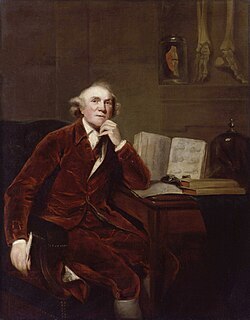
John Hunter by John Jackson (1813), after an original by Sir Joshua Reynolds (about 1786). The feet of Byrne’s skeleton can be seen in the upper right corner. Source.
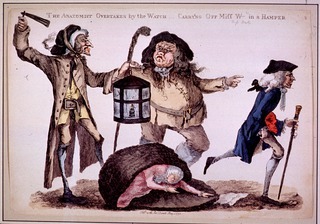
The Anatomist Overtaken by the Watch by William Austin (1773). This caricature of John Hunter is a far less flattering portrayal, as he’s used as a stand-in for all resurrectionists. Source.
Much like her historical novels The Mirror & the Light or A Place of Greater Safety, Mantel doesn’t alter the history as the story heads to its inevitable ending. But, oh what a journey it takes. From the Giant’s friends telling him he needs to add to his repertoire the Irishmen’s “gallant charge” against English butchers burning a Guy Fawkes effigy (which they took to be Saint Patrick), to the paragraph comparing the Irish gentry (who were enclosing the land) to the alien and dangerous Fair Folk, to the confused Jankin paying for a song and handed sheet music instead of a performance (“He ought not be let out alone”), there was plenty to witness along the way. In the background are always the resurrection men, who never let the dead lie easy. Recommended.
In 1782, Charles Byrne (probable real name, Charles O'Brien) or “The Irish Giant,” came to London to display himself. By all accounts, the London public loved him, and he was quite the local celebrity for a little over a year. He was robbed of his earnings at the Black Horse pub, some £700, and died soon after from his giantism, aged 22. Although he had made his wishes to be buried at sea explicit, the Scottish anatomist, John Hunter, managed to acquire his body, and eventually put Byrne’s skeleton on display in his own museum. From these bare facts, Hilary Mantel has woven a tale almost as fantastical and far darker than the fairy stories O’Brien spins for his companions in her novel.
With such a minimalist plot, it’s the dialog—and the atmosphere and characters it builds—that carry this story. In a style The New York Review of Books described as “a brilliant pastiche of Swift and Joyce,” Mantel paints us a world of wonders and cruelty. There’s much talk in the later chapters of Toby, a pig who can read, count, and possibly tell your future. In their first night in London, the Giant and his band hear a list of fellow Irish who have come to London before them only to meet their ends by hanging. It continues for over a page.
“Dear God,” said the Giant. “Was the whole country of Ireland hanged, and not one spared?”It was the age of the Georgian “Bloody Code,” when just about any crime carried the death penalty. However, we soon see how the London Irish are all too willing to fleece, rob, exploit, and do violence to their own. They suffer far more at the hands of each other than the law.
“When the people gather they call it the crack-neck assembly. When you are turned off they call it the cramp-jaw, and the new jig without music, and dancing in the sheriff’s picture frame.”
As Mantel wrote in her author’s note, although it is based on one, this is not a true tale. In this novel, O’Brien is an intelligent and charismatic storyteller. John Hunter was known to have a temper. Mantel’s version is impatient, irritated at the world, and comes by his famous collection through driven obsession. There isn’t much difference to him between his live experimental subjects and the corpses he dissects. If anything, as the chapter where he gives a training speech to newly hired body snatchers shows, the corpses are treated better.

John Hunter by John Jackson (1813), after an original by Sir Joshua Reynolds (about 1786). The feet of Byrne’s skeleton can be seen in the upper right corner. Source.
The Anatomist Overtaken by the Watch by William Austin (1773). This caricature of John Hunter is a far less flattering portrayal, as he’s used as a stand-in for all resurrectionists. Source.
Much like her historical novels The Mirror & the Light or A Place of Greater Safety, Mantel doesn’t alter the history as the story heads to its inevitable ending. But, oh what a journey it takes. From the Giant’s friends telling him he needs to add to his repertoire the Irishmen’s “gallant charge” against English butchers burning a Guy Fawkes effigy (which they took to be Saint Patrick), to the paragraph comparing the Irish gentry (who were enclosing the land) to the alien and dangerous Fair Folk, to the confused Jankin paying for a song and handed sheet music instead of a performance (“He ought not be let out alone”), there was plenty to witness along the way. In the background are always the resurrection men, who never let the dead lie easy. Recommended.

July 2, 2013
The semi-fictionalised account of the of the eponymous Charles O’Brien, a young man from Kerry in Ireland who travels with his friends to London in order to exhibit his own prodiguous body to the gawping masses. O’Brien, who’s skeleton is still on display in the Museum of the Royal College of Surgeons in London, was close to 8’ tall and caused a temporary sensation when he arrived in the British capital in 1782. One of the people attracted to this one-man spectacle was John Hunter, a famed surgeon, scientist and anatomist. Exploited as a freak by all, including himself, the fascination surrounding O’Brien’s incredible size is something that will continue even after his death, for this is an age of scientific discovery, a time when surgeons and anatomists craved novelty amongst the corpses they examined and dissected in the name of their emerging discipline.
Charles O’Brien is a whimsical man, giant by birth and storyteller by inclination. In a different time he might have been a bard, or even a druid, a keeper of tales and a sharer of hidden wisdom. O’Brien cherishes the folk tales of his people, and regards their potential loss as something to be avoided at all costs. His main motivation is preservation of this lore. Scottish surgeon John Hunter stands seemingly in contrast to this. Hunter is a man of science. Backwards science, perhaps, to modern eyes, but his knowledge rests on sound principles of observation and experimentation, though his moral compass is skewed, to say the least, and his methods seem somewhat outlandish. It is not stories and mysteries that Hunter is interested in - it’s answers. His compulsion is to know, to cut away the flesh and scrape off the viscera and peak at the truth of the world. Despite these differences, this is not a story of faith versus science. Both characters have similarities to go alongside their differences. Hunter and O’Brien are both self-made men, men possessing a level of intelligence and erudition beyond what should be dictated by their lowly origins, and both men share a sense of wonderment concerning nature and the world, though this manifests itself in very different ways. O’Brien is a marvel of nature, and Hunter is a man who explores and explains the marvels of nature.
“The lesson is about believing that things may be invisible but still exist,” the Giant explains to his followers after one of his cryptic stories leaves them baffled, a sentiment Hunter would surely share if he’d heard it.
In addition to being a portrait of two different-yet-similar men, The Giant, O’Brien is also a fascinating period piece. Mantel is meticulous in her research, and it pays off. From the homely poverty of rural Ireland, with it’s feuds and famine and rough camaraderie, to the ugly and corrupting glamour of 18th century London, Mantel portrays a vivid, dirty, lived-in world.
Mantel also displays her usual wit, though it often emerges in the dryest or blackest of ways. O’Brien’s ‘press conference’ was hilarious, and Hunter’s punctilious instructions to his army of grave-robbers was darkly amusing (some tips - don’t steal the dead’s clothes! That’s a crime don’t you know. Just take the bodies, if you please, because stealing a dead body isn’t technically illegal. Use wooden shovels, as they make less noise, and rope ladders, for the same reason. Employ female acquaintances to play grieving widows, mothers and sisters for a quick and easy way to get your hands on a body, but make sure their cover story is airtight first. And so on)
Hunter himself can be a bit of an over-the-top mad scientist at times, and I felt like his extreme portrayal detracted from the book somewhat. He becomes a bit of a caricature at times, rather than a character. Similarly, the turn to villainy of O’Brien’s crew is rather abrupt and a little hard to follow given the scarcity of their characterisation (with the exception of O’Brien’s agent Vance, and the unfortunately named Bitch Mary)
Despite those gripes, this was not far away from Mantel’s usual high calibre. It's an interesting and melancholy story, told with the smooth stylish prose of Mantel's that I've come to love. Short, but rewarding.
Charles O’Brien is a whimsical man, giant by birth and storyteller by inclination. In a different time he might have been a bard, or even a druid, a keeper of tales and a sharer of hidden wisdom. O’Brien cherishes the folk tales of his people, and regards their potential loss as something to be avoided at all costs. His main motivation is preservation of this lore. Scottish surgeon John Hunter stands seemingly in contrast to this. Hunter is a man of science. Backwards science, perhaps, to modern eyes, but his knowledge rests on sound principles of observation and experimentation, though his moral compass is skewed, to say the least, and his methods seem somewhat outlandish. It is not stories and mysteries that Hunter is interested in - it’s answers. His compulsion is to know, to cut away the flesh and scrape off the viscera and peak at the truth of the world. Despite these differences, this is not a story of faith versus science. Both characters have similarities to go alongside their differences. Hunter and O’Brien are both self-made men, men possessing a level of intelligence and erudition beyond what should be dictated by their lowly origins, and both men share a sense of wonderment concerning nature and the world, though this manifests itself in very different ways. O’Brien is a marvel of nature, and Hunter is a man who explores and explains the marvels of nature.
“The lesson is about believing that things may be invisible but still exist,” the Giant explains to his followers after one of his cryptic stories leaves them baffled, a sentiment Hunter would surely share if he’d heard it.
In addition to being a portrait of two different-yet-similar men, The Giant, O’Brien is also a fascinating period piece. Mantel is meticulous in her research, and it pays off. From the homely poverty of rural Ireland, with it’s feuds and famine and rough camaraderie, to the ugly and corrupting glamour of 18th century London, Mantel portrays a vivid, dirty, lived-in world.
Mantel also displays her usual wit, though it often emerges in the dryest or blackest of ways. O’Brien’s ‘press conference’ was hilarious, and Hunter’s punctilious instructions to his army of grave-robbers was darkly amusing (some tips - don’t steal the dead’s clothes! That’s a crime don’t you know. Just take the bodies, if you please, because stealing a dead body isn’t technically illegal. Use wooden shovels, as they make less noise, and rope ladders, for the same reason. Employ female acquaintances to play grieving widows, mothers and sisters for a quick and easy way to get your hands on a body, but make sure their cover story is airtight first. And so on)
Hunter himself can be a bit of an over-the-top mad scientist at times, and I felt like his extreme portrayal detracted from the book somewhat. He becomes a bit of a caricature at times, rather than a character. Similarly, the turn to villainy of O’Brien’s crew is rather abrupt and a little hard to follow given the scarcity of their characterisation (with the exception of O’Brien’s agent Vance, and the unfortunately named Bitch Mary)
Despite those gripes, this was not far away from Mantel’s usual high calibre. It's an interesting and melancholy story, told with the smooth stylish prose of Mantel's that I've come to love. Short, but rewarding.

November 1, 2019
Two different men’s path crosses. One is known as Giant O’Brien / Byrne and the other John Hunter. The story has a disorientating start, and jumps between the two stories of these men, who are with different. O’Brien is a humble soul struggles for having an abnormal sized body but unfazed travels to London, England to capitalise on this to have a better life. Hunter, a man of science where ethics have a lower priority than his own ventures and experiments. In places this novel is dark and gruesome, especially when corpses and body parts are involved. And the men O’Brien travels with are a motley crew of scallywags, his life is not an easy one but never does he lose sight of his own humanity, nor does he judge others for using his abnormality for their own personal gain.
Inspired by real characters, in some ways it’s a beautiful, and O’Brien’s plight is heart-breaking but Mantel’s telling is disjointed; for a chunk of the beginning I was lost and could not work out where this was going, this changed about half-way where I saw the powerful themes that underlines this novella. The ending left an impression.
Inspired by real characters, in some ways it’s a beautiful, and O’Brien’s plight is heart-breaking but Mantel’s telling is disjointed; for a chunk of the beginning I was lost and could not work out where this was going, this changed about half-way where I saw the powerful themes that underlines this novella. The ending left an impression.

August 24, 2021
I liked the allegory of the book (the untamed, grotesque Irish giant vs. the British scientist hunter) the most about this novel, more even than the actual story. I think maybe this book wasn't the best one to do as an audiobook, or it wasn't the right time for it for me, because I kept finding my mind wander during the giant's stories, which some would say are the best part of the book. My favorite characters were "Bitch Mary" and Joe Vance, the giant's agent.

June 27, 2011
A tall tale of a tall teller of tall tales

January 8, 2026
Eigenlijk is de 18e eeuw de leukste eeuw om over te lezen. De tijd waarin wetenschappers experimenten gaan uitvoeren om zelf te zien wat de waarheid is in plaats van blind de bijbel te geloven, maar ook de tijd waarin freakshows normaal zijn en de mensen zich grof uiten over de medemens. Alles zit in dit boek, heel interessant en leuk verhaal!

January 30, 2026
what even was that

September 2, 2020
This is based on the true story of Charles O'Brien, who was born in Ireland, and died in London in 1783. He was of giant stature and exhibited himself in the freak show tradition in London. I've seen his stockings in a museum: he was certainly a large man, believed now to have a pituitary tumour. This is a strange novel, covering the last year of O'Brien life. In Mantel's hands, O'Brien is an educated man, lamenting the loss of education in Ireland, and struggling to survive hunger and clearances of the land. He spins yarns to garner the respect of his companions, and it courteous and careful in his action. However, O'Brien is not long for the world, as his giantism is slowly killing him. Much of this novel he spends passively lying in bed, unable to concentrate on anything but his painful decline. This makes the story oddly directionless: from the beginning, we witness O'Brien's decline, which is compared to the surgeon, John Hunter, who knows of O'Brien and wishes to acquire his corpse. Hunter has given himself syphilis in order to study the disease, and is also losing his faculties. This, then, is a book of loss, of decline, of endings. It's held together by Mantel's masterful prose, and immersive atmosphere, but the characters fail to grab the reader, and one is left wondering what the point of it all is.

May 2, 2013
Intricate dance between the Irish giant selling his stature and the obsessive dissector greedy for the corpse, all set in the grimy underworld of 18th century grave-robbers, freak shows and London back alleys. The friction between the dreamy and poetic spirit of the Celt, and the rationalist mania of the British surgeon supplies sparks of the sort that have started cultural brush fires since the age of Enlightenment. Mantel is consistently acerbic in her portraits of the warring types, and is well-attuned to the casual grotesque that features in daily life of the early Metropolis. A quirky cast, precursors to the more flamboyant and sentimental crew gallivanting through Dickens' novels. Note, the theme of bodies for sale - surely not simply historical in our age of rent a womb, buy a baby, auction an organ and exhibit the petrified corpse.

July 27, 2021
A poignant, and rather sad story, verging at times into the stuff of nightmares. I remain in awe of Mantel's writing, but this is the book of hers that I have enjoyed least. I am not 100% sure why, but I could not quite get into the story - the words flowed over me, but I did not engage with the characters, not even the giant O'Brien. Mantel's writing is occasionally so poetic, that I can struggle to form an image in my mind of what she is on about, and this book, at least the start of it, felt like this for me. But if you like Mantel's writing, give this a go, as you may get more from it than I did.

June 18, 2012
I must admit I was expecting a little more from this book. It didn't seem to gel together as well as it could have done, and aspects that I thought were interesting or promising often led nowhere at all, or were simply glossed over. Having said that, there are many elements that do work in this short novel, it is well worth reading; just doesn't seem to work as well as other things I have read by Mantel, Wolf Hall for example.

January 13, 2018
Started with great promise as the fantastical poet-giant led his band of foolish young Irishmen to the post-golden-age streets of London, but the novel peaked early and dribbled to a miserable close (despite the introduction of the historical, grave-robbing surgeon John Hunter).

July 23, 2023
This is the first of Mantel's books that has disappointed me - I couldn’t engage with the sorry tale of a (real life) 'giant' and the anatomist who covets his bones. Steeped in the viscerally grim poverty of Victorian London and populated with a cast of grotesques (not the giant, who is rather endearing), the story has its charms - there is poetry, philosophy and wit - but it darts irritatingly between characters and doesn't hold itself together as well as I'd like.

October 22, 2024
Mantel never disappoints! Not her usual style of writing but still immeasurably enjoyable and the story itself was a mixture of fun and fact, based on a true story from the 1700's.
Displaying 1 - 30 of 311 reviews