Au cœur de la Grande Dépression, l’inventivité est mère de sureté pour joindre les deux bouts. Stéphanie St. Clair, dite Queenie, l’avait déjà bien compris en débarquant à New York il y a maintenant presque vingt ans. L’inventivité quand on est une femme et que l’on est noire, c’est bien plus qu’une nécessité. C’est une question de survie.
En quelques années, cette jeune servante antillaise immigrée s’est affranchie du poids de la servitude ancestrale. Mieux encore, elle a créé son propre rêve américain : la loterie clandestine d’Harlem. Une ascension qui fait grincer des dents, tant du côté des autorités locales que de la mafia blanche. Dutch Schultz, dit le Hollandais, un mafieux sans scrupule, compte bien faire main basse sur le royaume de la « Frenchy ». Mais c’est sans compter la détermination et l’impétuosité de Queenie, dont le lourd passé continue de guider les pas…
Après Giant et Bootblack, Mikaël nous emmène dans le Harlem de la prohibition pour un nouveau diptyque new-yorkais en clair-obscur, à la rencontre d’une femme aussi forte qu’énigmatique.
Harlem by Mikaël reads like a Boardwalk Empire spin-off series, set in Harlem, 1931, the same year the fifth season of the show ended, it has a very similar tone, but instead of Nucky Thompson, it stars Queenie, an immigrant from the French Antilles who is running an illegal lottery in the city of Harlem, and with the end of the Prohibition coming soon, her competition, bootlegger Dutch Schultz, tries to take her out of business, so not an unusual story, but is still an engaging and immersive read, packed full of atmosphere and style, all while addressing the struggles of the black community in the thirties, and the art is just gorgeous, beautifully illustrated in tones of black, brown and white, with a lot of attention to detail, to the point that some of the backgrounds end up looking like photographs, which was a joy to marvel at, can't wait to read the second and last part of this story, highly recommended, just make sure you put on some Harlem music of the time to read along with it.
Mikaël has really carved out himself a niche in telling stories about 1920s/30s America. So it goes with Harlem, which might seem a pretty typical gangster story, except that this gang is comprised of Black gangsters, with a Black woman as their leader.
The story is okay, as it tends to be with Mikaël, but the art is quite striking.
First of all, this adult graphic novel is a magnificent artwork. Coloring, drawings, details of buildings, characters, era, etc. everything is exquisite. In some parts, I couldn't concentrate on the story because I was so immersed in the artwork.
So what is this graphic novel about?
The story takes place in Harlem, in 1931. People are trying to live while the Great Depression continues and prohibition is still in effect. We follow the story of a woman called Stephanie St. Clair, a.k.a. Queenie. She is an immigrant from the French Antilles and the owner of a lottery scam. As you can imagine, with this kind of work it's impossible to avoid trouble. So as you can guess, the story is quite gripping. It tackles subjects such as racism, being black in that era, injustice, corrupted politicians, and a discriminatory police force. You won't be able to put down the novel.
According to the information given at the end of the novel, even though the story is a work of historical fiction, it is inspired by real-life characters. Thankfully, the author/illustrator gives the readers sources of inspiration. I appreciate these details about the books.
Although I love the book, I have a little personal complaint which is connected to my bad eyesight. It was really hard for me to read dialogue balloons as they have a different type of font than I am used to. I wish there was a technology that allows people to change fonts in speech balloons.
Many thanks to Europe Comics and NetGalley for providing an ARC of the novel for reviewers.
Harlem is a story of Stephanie St. Clair or Queenie, an immigrant from French Antilles. She is one of the most powerful women in Harlem, and she runs a lottery business during the Prohibition years.
The art is very good. The brown color is dominant, with occasional use of other colors. This is volume 1 (of 2).
Thanks to Europe Comics for the ARC and this opportunity! This is a voluntary review, and all opinions are my own.
*Thanks to Europe Comics for giving me the ARC of this book through Netgalley*
Harlem Part 1 is an historical fiction comic about Stephanie St. Clair, A.K.A Queenie/Madame Queen, a prominent racketeer in New York, specifically Harlem. In the final days of the prohibition era, mobsters were looking for diversifying their business. Since Madame Queen successful lottery game in Harlem was known, vicious mobster Dutch Schultz tried to intimidate her and steal her territory, however St. Clair stood her ground against him and other mobsters, and never budged her gambling business.
It's great to see a comic book based on one of the many interesting women that were involved in male-dominated illegal business born during the Prohibition and Depression era. It's a much needed perspective from that side of american history.
The artstyle is pretty cool, the color palette choosen for this story fits the era pretty well. Can't wait to read the second part.
Thanks NetGallery for providing this ARC in exchange for an honest review.
A peek at early last century's Harlem history, just a little before Prohibition ended. There is history here about the 'lotteries' , Queenie, a lottery owner, and how money was made, via the lottery scam. Enter Dutch Schultz, who is trying to take over these lotteries but Queenie fights back hard. With Prohibition going away, Dutch needs a new income stream, but unfortunately, it looks like that will be heroin.
I enjoyed this graphic comic book. The art was good as well as the story telling..
You know I always say I love a good period noir-styled book from Europe Comics, and today is no exception. Rather than the “tried and true” setting of either Manhattan or Chicago for tales of the pre-war urban underworld, Mikaël has opted for a refreshing story set in Harlem. With the Great Depression running strong and racial tensions at their peak, the city is a hotbed for crime. When most try to trample black voices in the city, one woman steps up to make sure they are heard – Stephanie St. Claire or “Queenie”. For those that do not know, Queenie was actually a VERY real person that lived up until 1969 and is known by many as the woman that stared down the mafia and largely won.
This is the first of two volumes of Harlem, and it sets the tone for the meteoric rise of Queenie as one of the most famous black business women of the time. Due to racist policies, it was hard for many black people to make a living, much less to invest said money like their white counterparts. If they somehow did, white fury usually had something to say about it like in Tulsa in 1921. This brought people like Queenie into the underground, where popular institutions like policy banking were the norm. Policy Banking was a mixture of investing, gambling, and playing the lottery that was technically not legal, but ignored like many prohibition-era “crimes” due to corruption. Bronx-based mob boss Dutch Schultz tried to move in on her territory and she fought back with the fury that he could never imagine.
This was an interesting comic about a chapter in history I was largely unaware of until I read this book and did further research. As with many aspects of Black History, a lot of this is never really taught in school, but with me living in the middle of the United States and the fact that school doesn’t concentrate on talking about crime bosses going to war with each other, I’ll give it a slide. This was a great comic, and I will be eagerly anticipating the second volume.
i went into this without realising stephanie st. clair was a real person and wow, her character (on page and off it) blew me away. the sheer power and resilience she radiates even just as a drawing on my screen is inequitable. the art style was so so beautiful and captures more than just the details of early 1900s harlem -- it captures spirit. i could spend ages gazing at these pages, and i eagerly await a sequel!
Despite what novelty the fact the lead character is a Queenpin, as opposed to a Kingpin, brings to things, this is a very standard Jazz Age crime saga. Our heroine runs a very profitable pyramid of staff working on a lottery, whose aim (and whether the players know this or not is not proven either way) is to match the post-decimal digits in the stock exchange closing figures. Black Harlem is a hotbed of corruption, coloured unemployment and muscle in the pay of "Dutch" Schultz, who wants in on her turf badly. The whole (heh heh, this is only the first half) is a lot better than the creator's own "Giant" where the story's delivery is concerned, but the look doesn't feel better, and the plod to a halt while we wait for the conclusion to arrive is proof you really have to be a fan of this kind of story to get much out of it. I'll not be one of those holding their breath for part two – and the rush shown to get this translated and into the English markets is neither an indication of its quality nor a help for those wanting the rest any time soon.
j’ai lu le premier volet de Harlem qui retrace la vie de Stéphanie St. Clair, dite Queenie dans le New York du début des années 30 en pleine Grande dépression.
Harlem est particulièrement touché par la crise, le chômage des noirs est très élevé. Dans ce contexte, Queenie, originaire des Antilles françaises, met en place un système de loterie illégale. Son affaire est florissante. Elle gagne très bien sa vie, mais elle participe également à la dynamique du quartier en finançant pas mal de structures. Mais alors que la fin de la prohibition s’annonce, un trafiquant d’alcool blanc veut prendre le pouvoir sur son territoire et contrôler son business. Queenie n’a pas l’intention de se laisser faire. Ce n’est pas parce qu’elle est noire et que c’est une femme qu’elle va se laisser impressionner par les mafieux blancs. Difficile de résister face à des mafieux qui ont plus de moyens et le maire dans la poche.
J’ai beaucoup aimé cette bande dessinée. L’histoire est très prenante. On suit Queenie et son organisation dans sa lutte contre la mafia, mais on découvre aussi par flash-back des bribes du passé de Queenie et surtout on découvre le contexte socio-économique de Harlem.
l’héroïne se bat pour elle même, pour sa propre indépendance, mais dans son discours on voit aussi un combat pour les droits des noirs et aussi pour l’émancipation des femmes. Elle apparait comme quelqu’un de très dur, qui mène à la baguette son organisation. Mais si elle est dure en affaire, elle ne semble pas insensible au sort de son quartier et des habitants de Harlem.
Je ne connaissais pas du tout ce personnage historique et je suis ravie de l’avoir découvert via cette bande dessinée. Au-delà de l’aspect historique, la BD est très bien faite. C’est très agréable à lire, on est prix par l’histoire et j’ai beaucoup aimé le dessin et ses couleurs.
(4/5, I really liked it) Premier tome du troisième épisode de la série New-York, du bédéiste Mikaël, HARLEM (initialement nommé QUEENIE) amène le lecteur en 1931 dans le quartier noir de Manhattan. Cet arrondissement est contrôlé par une énigmatique femme « d’affaires », Stéphanie St-Clair, une francophile originaire des Antilles. Des rivaux veulent prendre le contrôle de sa main mise sur la vie commerciale qu’elle a élaborée selon un principe pyramidale qui la place au sommet.
Là est le prétexte choisi par l’auteur pour tracer le portrait des inégalités raciales en ce temps de Grande Dépression où la pauvreté et les préjudices marquaient le quotidien des Harlémites. Comme dans les précédents épisodes de cette série, Mikaël intègre au récit le passé secret du héro ―de l’héroïne, dans le cas présent―. C’est au compte-gouttes que sont évoquées les étapes ayant mené Queenie vers Harlem et l’origine de sa montée dans la business.
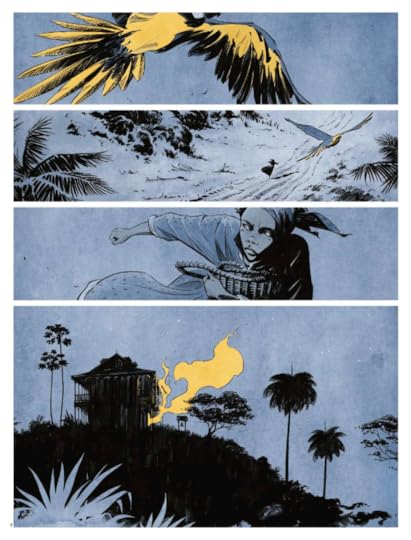
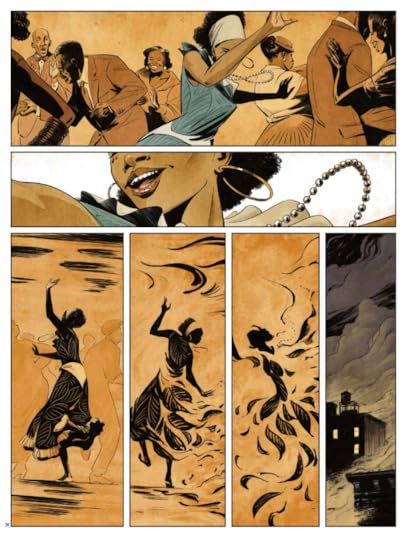
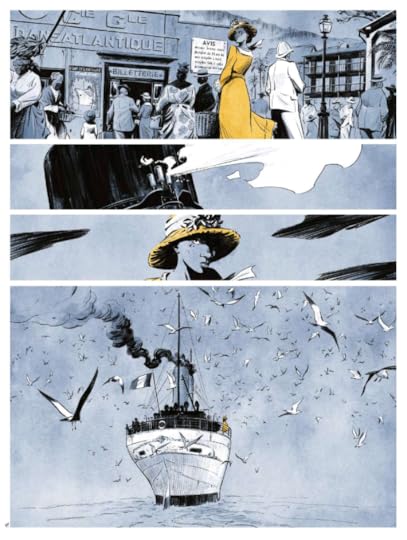
Mikaël nous a habitué à une grande qualité artistique dans l’élaboration des planches. Ici encore, c'est une réussite. Le choix des couleurs indique au lecteur la période évoquée : orange-vert-brun pour le présent, bleu-jaune, pour le passé. Les dialogues sont clairs et réalistes. Le récit est à la fois dense et fluide, captivant et divertissant.
Dans ce premier tome, nous y rencontrons/suivons une icône noire-américaine Queenie. Je ne connaissais pas et j'ai pu la découvrir et éprouver un certain intérêt pour elle. Je peaufine donc encore mes recherches! Parce qu'il est toujours intéressant d'inclure des personnes connues comme elle dans nos leçons en français pour parfaire la culture générale de nos élèves.
Nous nous retrouvons à Harlem vers 1930, entre clubs de jazz, mafia et loterie clandestine. Une histoire émouvante, qui prend aux tripes! Je vous la conseille. Je ne pense pas la donner à des élèves (je donne cours de le degré inférieur et je pense que mes élèves ne pourraient pas comprendre la totalité de la BD et ses subtilités.) mais pour des lecteurs avec un bon niveau, pourquoi pas!
Je ne connaissais pas Mikaël et je suis très heureuse de l'avoir découvert avec Harlem. Les dessins et l'histoire étaient très bien réalisés. Je suis assez étonnée de l'avoir apprécié et d'avoir bien pris le temps de le lire, car cette BD sortait totalement de mon registre. Une belle découverte agréable et je vous la recommande chaudement.
Thank you to the publisher and NetGalley for this ARC in exchange for an honest review!
Harlem by Mikael is an adult graphic novel that straddles the genres of historical and noir. The story is set in Harlem in 1931. The story revolves around Queenie, an immigrant running a lottery, and Dutch Schultz, a bootlegger during the Prohibition. According to the description, Dutch "sees Harlem as ripe for the picking, especially with the police and politicians for sale to the highest bidder—at least if you’re white."
Overall, Harlem is a decent graphic novel that explores a section of history that is rarely depicted in graphic novels and books in general. One highlight of this book is the incredible artwork, particularly the colors. Much of this book is brown, black, and gray, which sets up the noir atmosphere. I loved the sections in blue and yellow, which added a new dimension to the story. I took off 2 stars because of the adult/sexual content, which I thought was unnecessary. If you're intrigued by the description, you can check out this book, which is available now!
This whole graphic novel is a movie. A good movie!
Enter into the streets of Harlem and we meet the french black woman who runs it, as she is popularly called, Queenie.
She's Headstrong, beautiful, tough, stubborn, and certainly doesn't care about what the folks say about her.
Her turf is now threatened by some man named Dutch. She's not about to give up all that hard years of working for the present she now has. But Dutch is willing to push her father.
I love this story so much. The colour panels and art style is amazing. The detailing to each characters personality with certain gestures and the Dialogues well written.
The story unfolds superficially, but soon enough there'd a glimpse at the darker past of Queenie as she grows up in what looked like Creole before running away to Harlem. Now she must fight for her turf and maintain her lottery business while making a choice to side with the Russians or Italians if she is to win against Dutch in the upcoming war.
This book was given to me in exchange for an honest review from Netgalley.
A stunningly beautiful graphic novel telling the story of "Queenie" and her life as a lottery boss in Harlem. The story follows the Stephanie "Queenie" as her empire is put in jeopardy by a white mafia boss known as "The Dutchman." It's a story about race inequality at it's core as well as a good representation of the Harlem Renaissance era.
The art is BEAUTIFUL and fully colored (It looks like watercolor or gouache?) and there are parts where we see flashbacks of Queenie's childhood that are colored with a beautiful blue hue and pops of yellow. It creates a distinct shift in the narrative and establishes tone and emotion for the ready really wonderfully.
One thing I wish there was (and maybe it will come in the final print?) is a glossary of the creole slang and phrases that are used. I don't mind looking them up but I think it would be really helpful for readers to be able to find that info in the book somewhere.
Harlem Volume 1 is a very well done graphic novel, both in storyline and in artwork. It’s very rare for me to read one in which both the storyline and art are by the same person.
Stephanie St. Clair, aka Queenie, runs an illegal lottery in Harlem during the first few years of the Depression. She’s starting to be challenged by the mobster Dutch Schultz, who either wants her to join his gang or be eliminated. Queenie is remarkably independent, fearless, and adept at fending off challenges, and this book not only describes that, but also provides artwork without words describing her origins. The Harlem scenes are stunning in their shades of brown, grey and black. While I would have given this 5 stars, I felt the very few panels with almost graphic sex were gratuitous and unnecessary.
My thanks to Europe Comics and Netgalley for allowing me to read this book (already published) in exchange for an honest review.
Une bande dessinée intéressante et prenante sur la vie de Stéphanie St Clair ou Queenie, femme noire, solitaire, marraine de la loterie à Harlem dans les années 1920-1930. Un parcours difficile d’une femme déterminée qui doit faire face à la concurrence, un Hollandais, la mafia aussi, qui veulent s’emparer de ce qu’elle a réalisé. J’ai aimé cette bande dessinée sombre et vraisemblable concernant l’époque de la Prohibition : corruption, crimes, racisme. La pertinence des dessins avec les couleurs marron pour évoquer le présent et dans les tons bleutés quand ils relatent le passé de Stéphanie. L’écriture est fluide et concise, le choix de différentes graphies pour présenter les pensées du journaliste notamment, qui, on le comprend à quelque chose à se reprocher, est très pertinente et permet un suivi facile du scénario. A lire, j’attends la suite.
I was given an ebook arc free through NetGalley. A beautifully illustrated and well-paced first volume, Harlem immersed me in the 1930s Harlem scene, with all its speakeasies, gangsters and culture, but with a refreshing look at the black community at a time that so often focuses on white America. Queenie is truly a strong, complex protagonist whose journey we become invested in through her strength of character and the interspersed flashback pages that, without dialogue, let the artwork do the talking. It was fantastic to read a graphic novel that didn’t hold the hand of the reader, just jumped us straight into the characters’ world, and didn’t patronise us by over-explaining how everything works. Gritty and real, stylish and sultry - I loved the characters, the artwork is beautiful, and I’ll be on the lookout to pick both volumes of Harlem up when I can!
Set in Harlem NY in the '30s. A strong and powerful black woman, known as Queenie runs these streets. She came to America from France, and even though her skin was the same color as her black neighbors, she was still treated as an outsider because she sounded different.
She built an empire and had no plans to easily give it up, no matter what.
The art is so reminiscent of those times, the pen work just beautiful. I'm looking forward to seeing how the story plays out. Another gem from Europe Comics.
Thanks to @netgalley, Europe Comics, and Mikael for the opportunity to read this eArc in exchange for my honest and unbiased opinion.
🌱THE EXCELLENT ~ Excellent art & detailing of characters ~ Great costuming, scene & tone setting ~ Lovely integration of some challenges of the time & what people did for amusement & hope ~ Strong & delicate female lead
Stephanie St.Claire, has lived a harrowing life, she lost her mum while young & free, was put into service, escaped & managed to buy her way aboard a ship to the wilds of Harlem. Harlem, a place teeming with opportunity, gangs, turfs & the rising battle between alcohol, gambling and dope.
As one of the Queens of Harlem running the gambling scene, she must keep a finger on the pulse of the city & keep her people in line - even against an ‘upstart’ white Dutchman intent on taking what she has built with her wits sweat and blood by starting an all out turf war.
✨𝗚𝗶𝘃𝗲 𝗶𝘁 𝗮 𝗿𝗲𝗮𝗱.
🌱THE MEH ~ Somewhat impersonal? 🤔🤷 I wasn’t really able to sink into the story ~ Couldn’t really find a character to like (guess this relates to the point above)
Merci aux éditions Dargaud et à Netgalley de m'avoir permis de découvrir ce titre.
2.5 étoiles**
J'ai moyennement aimé ma lecture malheureusement. J'ai trouvé que la thématique et l'univers était très intéressant mais pour ma part, j'ai un peu été perdue dans le déroulement de l'intrigue. Le côté mafia ne m'a pas plus emballé que cela même si je dois avouer que l'histoire de Stéphanie Saint Clair me paraissait intéressante. Cette BD est loin d'être mauvaise, c'est juste que cela n'a pas été une lecture faite pour moi.
This story is fascinating and beautiful, and I want to read more of it. The artwork is breathtaking, I loved the smooth colors and the feeling that the lines make as it seems to be exactly done in 1920s New York. Queenie/Stephanie/Frenchie whichever name you refer to her as, is such a strong and beautiful character. Her attitude is perfect for a Black woman in Harlem, NY who runs a club and a gambling ring. Wonderful! Looking forward to book two.
Mikaël fait preuve de sens critique dans sa bande dessinée Harlem. Elle met en évidence les incohérences. J’ai par contre quelques réserves concernant les dessins et le style. J'ai bien envie de connaître la suite des aventures de Queenie. Mon avis : https://lesparaversdemillina.com/harl...
L'histoire en soi est intéressante et les dessins de Mikaël sont toujours aussi beaux. Toutefois, comme encore trop souvent, le corps des femmes noires est hypersexualisé. Les gros plans sur les fesses, les scènes de sexe qui n'amènent rien au scénario, on aurait pu s'en passer.
Bibliothèque manufacture, Nantes. Forme: Belle couverture, beaux traités graphiques autour des dessins. Découpage top. différenciation du passé et présent par le traité couleur fonctionne très bien. Fond: histoire déjà connue mais racontée sous un angle intéressant