Jump to ratings and reviews
Rate this book

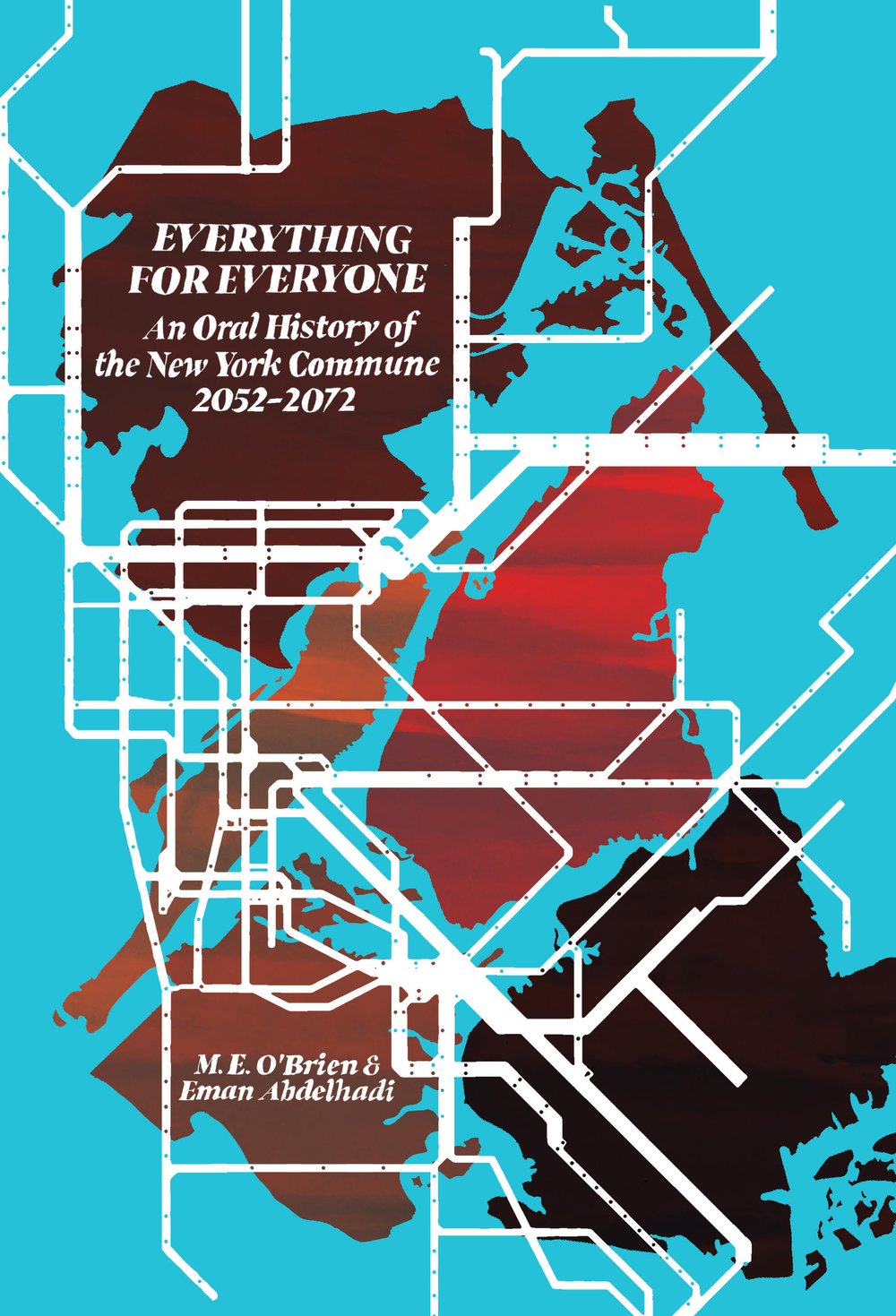
Everything for Everyone: An Oral History of the New York Commune, 2052–2072

Rate this book
By the middle of the twenty-first century, war, famine, economic collapse, and climate catastrophe had toppled the world's governments. In the 2050s, the insurrections reached the nerve center of global capitalism—New York City. This book, a collection of interviews with the people who made the revolution, was published to mark the twentieth anniversary of the New York Commune, a radically new social order forged in the ashes of capitalist collapse.

Here is the insurrection in the words of the people who made it, a cast as diverse as the city itself. Nurses, sex workers, antifascist militants, and survivors of all stripes recall the collapse of life as they knew it and the emergence of a collective alternative. Their stories, delivered in deeply human fashion, together outline how ordinary people's efforts to survive in the face of crisis contain the seeds of a new world.

256 pages, Paperback

First published January 1, 2022

373 people are currently reading
8117 people want to read

About the author

M.E. O'Brien

4 books193 followers

Ratings & Reviews

What do you think?
Rate this book

Friends & Following

Create a free account to discover what your friends think of this book!

Community Reviews

5 stars
757 (41%)
4 stars
595 (32%)
3 stars
304 (16%)
2 stars
127 (6%)
1 star
32 (1%)
Displaying 1 - 30 of 438 reviews
Profile Image for Kai.
Author 1 book264 followers
August 6, 2022
we could do this. i mean, i'm just kidding. unless...?
Profile Image for The Conspiracy is Capitalism.
380 reviews2,448 followers
September 11, 2023
Can we imagine a future worth saving?

Preamble:
--An antidote to Capitalist Realism: Is There No Alternative?
--Let me re-trace the steps that led me to consider a speculative fiction as my most-enjoyable read of the year:
i) For context, fiction is buried in my list of reading priorities, relegated to when my brain is in a stupor. I’ve just found little success in fiction for the questions that haunt me.
ii) The last fiction to captivate me is Varoufakis’ 2020 Another Now: Dispatches from an Alternative Present; however, this was assisted by the (geo)political economy that was at the center of the book (i.e. structurally, how could capitalist markets for labour/finance/land, global trade imbalances, etc. be abolished).
iii) This year, I’ve been systematically (re)reading Graeber (RIP), in particular his under-read magnum opus Direct Action: An Ethnography (written in 2009, before Graeber’s 2011 breakthrough Debt: The First 5,000 Years). One highlight is analysis/demonstration of the uses of speculative/science fiction and ethnography
iv) …And, lo and behold, I encounter this book which combines speculative/science fiction and ethnography (oral histories)! What a perfect playground to experiment with Graeber’s analyses (wish Graeber had found the time to write a sci-fi)!

Highlights:
--Each one of these 12 short-story oral histories deserves a full-length book, which I would read (12-for-12 is a stunning success rate for me!). Overall reflections:

1) Capitalist Realism or Capitalist Crises?
--Before we imagine alternatives, we need to be clear on the present situation. In the next section, we’ll explore why fiction seems to avoid carefully unpacking “capitalism” (i.e. political economy). In this book’s (fictional) introduction:
Unfortunately, explaining the global market before liberation is beyond the scope of this project. We highly recommend Understanding the Capitalist Market, Understanding the Geopolitics of Imperialist Nation States, and Understanding Wage Dependency as supplemental reading to this section [these are fictional works].
--My one-line summary of “capitalism”: the commodification of society, in particular the peculiar markets of labour/land/money featuring the “fictitious commodities” of humans/nature/purchasing power, which are not “produced” just for selling/buying on markets. Yes, Polanyi’s The Great Transformation: The Political and Economic Origins of Our Time is an exhausting read for this, but luckily we have eloquent nonfiction like Talking to My Daughter About the Economy: or, How Capitalism Works—and How It Fails to introduce this. I’ve also summarized Fraser’s synthesis of Marx + Polanyi here.
--I find this political economy builds a strong foundation to appreciating the underlying contradictions of capitalism, whereas most historical accounts only reveal the brief surfacing of crises (consider: Thinking in Systems: A Primer).
--“Capitalist Realism” cannot be a totality; this cancer/virus could not have survived without its host. Capitalism is dependent on:
i) outsourcing its contradictions (slavery/colonialism/imperialism, settler colonialism), and
ii) watered-down socialist policies (so social reproduction is not extinguished).
…Vivid examples include the Enclosures/Industrial Revolution’s commodification (and degradation) of humans/nature to create the labour/land markets in brutal workhouses and “dark Satanic Mills”, culminating in a social crisis in Europe only relieved by:
i) settler migration (relief to Europe’s labour market), and
ii) public sanitation/health policies (relief to social reproduction): Less is More: How Degrowth Will Save the World
--Thus, this books recognizes:
i) looming capitalist crises,
ii) the opportunities they present as the status quo crumbles
iii) to expand socialist causes, some already somewhat in practice out of necessity; see Debt: The First 5,000 Years for Graeber’s “actually-existing communism” (in contrast to myths of “primitive communism”/“mythic communism”/“epic communism”):
But all social systems, even economic systems like capitalism, have always been built on top of a bedrock of actually-existing communism.

Starting, as I say, from the principle of “from each according to their abilities, to each according to their needs” allows us to look past the question of individual or private ownership (which is often little more than formal legality anyway) and at much more immediate and practical questions of who has access to what sorts of things and under what conditions. Whenever it is the operative principle, even if it’s just two people who are interacting, we can say we are in the presence of a sort of communism.
--Crises: national states become increasing vulnerable to social protest. States are unable to maintain social reproduction/outsource its contradictions under the mounting burden of the parasitic/volatile finance (speculative gambling/debts for rent-seeking) and accelerating ecological collapse, bringing down the “middle class” (who have been an essential buffer for “Capitalist Realism”). When things we take for granted collapse (ex. car transportation), seemingly insurmountable social norms follow (ex. car culture); paraphrasing Assange, humans are extremely adaptive to both change (heroic efforts to survive) and status quo (tragic efforts to tolerate oppression). A Paradise Built in Hell: The Extraordinary Communities That Arise in Disaster
…One of the states to collapse is China, which opens up a can of worms on really-existing socialism. I’ll bypass this (still working to synthesize with Graeber’s analysis of “bureaucracy”) by saying that Western imperialist states also collapse, so the siege is over… these other crises include:
i) collapse of the US dollar (“dedollarization” has recently become a trendy topic, so we need to dig deeper: Super Imperialism: The Origin and Fundamentals of U.S. World Dominance)
ii) even the US military, with its overreach attacking Iran leading to mutinies. While many Leftists are allergic to studying the US military given its endless layers of imperialism/conservatism, we should not all abandon careful study of its contradictions, including its dissenters from War is a Racket: The Antiwar Classic by America's Most Decorated Soldier to Veterans for Peace, to comparisons between wartime mobilization and the Green New Deal (which must be analyzed with extreme caution! For a critical take that re-centers the Global South: A People’s Green New Deal). Similarly, Graeber points to the academic bias where academics attribute importance to what is intellectually interesting (thus, neglecting the importance of sheer violence with all its vulgar stupidity).
iii) further pandemics (Dead Epidemiologists: On the Origins of COVID-19); collapse of capitalist healthcare [emphases added]:
Of course, it wasn’t the doctor who had really turned grannie away [for not having health insurance]! It was the hospital! And who was the hospital? It was whoever was making money off it, and those faces were invisible. It was the whole fucking system. I remembered these pamphlets that people would hand out on the subway or on the street or that people would forward to me. Things about how the system was broken, how it was capitalism, etc. I always thought, “I don’t have time for this,” or “I don’t have energy for this.” But then I realized, “I don’t have time because of this. I don’t have energy because of this.” This system had taken everything from me, from us. It had taken my mom, my grannie—even myself. It had even taken me away from me.
iv) collapse of academia (capital tied to volatile finance):
Like, the universities are gone, of course, or the idea these specialized fields of knowledge are separated out from the rest of life or not subject to the same logic of profit and exchange. But, in this other way, the zeal for knowledge was saved. Way, way more people read and debate philosophy and theory than ever when I was growing up.
v) We should add Varoufakis’ hacktivism targeting the fragility of financial risk in Another Now: Dispatches from an Alternative Present and supply chain vulnerabilities in Choke Points: Logistics Workers Disrupting the Global Supply Chain.

…See the comments below for the rest of the review: “2) Synthesizing the Left’s conflicts” and “3) Resilience in Diversity”…
Profile Image for Thomas.
1,863 reviews12k followers
October 8, 2025
I thought this book was okay! I liked the ideas it presented about a liberated future, including a radical reshaping of how we relate to work, the abolition of the nuclear family and a more cohesive community orientation toward care, and a more unified front on climate change. I appreciated the little notes of humor too, like how one character living in the future comments on how ridiculous our current paradigm around health insurance is. Unfortunately where this book fell flat for me was the format. Again, vibed with the ideas, but I was bored by the oral history format and how telling instead of showing it was. That said, for a more comprehensive view of the positives of this book I’d recommend Gabriella’s review, which I largely agree with even if the writing style didn’t work for me.
1 review4 followers
July 25, 2022
“Everything for Everyone: An Oral History of the New York Commune, 2052-2072” is my book of the year so far. Go read it and then give your copy to a friend. It’s Kim Stanley Robinson meets communization theory meets trans feminism and so much more. It’s a beautiful vision of the future that shows how we can get through the dark days ahead and build a new world from the ashes of the old, all while healing ourselves from trauma through revolution. And it’s told through oral history interviews that are so, so well done.

Bottom line: read Everything For Everyone. Buy copies for your friends. Read it with your lovers. Give it to comrades at demonstrations. This is the book we all need right now.

"It means we take care of each other. It means everything for everyone. It means we communized the shit out of this place. It means we took something that was property and made it life." --Miss Kelley of the Hunts Point Commune
Profile Image for Henk.
1,195 reviews301 followers
September 11, 2025
I did not expect to love this book so much, but it is well executed and really makes one think what an alternative could be to our current capitalist system, that seems to be drifting ever further to the nationalist right and techno dystopia
Nostalgia is a toxin for that expansive visioning that needs to happen. We need to be done with nostalgia

M.E. O'Brien and Eman Abdelhadi imagine 12 interviews set in the 2070s, with a number of people looking back at the momentous events that led to their current work. In a way we are inundated by dystopias that is is hard to think of successful examples of utopias. I argue Everything for Everyone: An Oral History of the New York Commune, 2052–2072 does this job very well, even though in my heart I believe that Hegel is right in that every societal step forward tends to leads to a pendulum like counter reaction backwards.

The world imagined by the authors is profoundly changed, multipolar, after being wrecked by pandemics, the effects of climate change, wars and full scale insurrection. All this led to a fall of the nation state, and in its downfall a complete revaluation of the capitalist system and the nuclear family. To get there, we learn about the Levant and Andes being centres of communes after the fall of the USD as global reserve currency. Institution of a draft, outsourcing of army to private companies, famine and insurrection leading to civil war. With chaos in the US, a final intifada ensued and led to a free Palestine. We also follow a Bangladeshi nurse setting up a free hospital after the army pulls out from New York.

People are no longer defined by their work, which they can undertake in just 3 hours a day in a 3 day work week. Skincraft, a redefinition of sex work, is now voluntary and enjoyed being something akin to therapy, with one of the leaders of the commune being a prostitute and former crystal meth addict.
Cybernetics, implants and hallucinatory augmentation are supported by localised internet. Gestation of children is a possibility for all, breaking down the nuclear family notion and giving kids the chance to fully develop themselves and parents the opportunity to be supported beyond their family.

The army being run by a council of grandmothers, with communal decisions supported by computing power from AIs and quantum supercomputers. Legitimacy from giving up power and property. In some corners of this new world music and dancing form the basis for community. Mining moved in majority to astroids and is being automated, with a Mars colony ship launch eagerly looked forward to, even though air travel between continents is still being rebuilt. Even a space elevator is being constructed, something that always has me kind of tearing up, as it would be such a show of global unity if we could pull that off in reality.

However this is far from a sappy narrative, or a liberal wishlist turned into a world. Grief and generational trauma play an important role in the interviews, making clear that things needed to get very bad to get to a new world. There were death squads, mass internment of Chinese citizens, managed by ICE. Indentured factory labourers, being forced to flee on a container ship. Mass sterilisation of non-believers, incarceration in cages, sexual violence and the police acting as a gang, extorting civilians. Foreign wars, nuclear strikes and abandonment of climate change impacted regions all undermining legitimacy of the government. Ultrawealthy rebasing to space orbitals and tourists on the moon are starved to death as retribution when control of the earth got in communal hands, with their automation not helping them when no food is send up anymore.

It makes one think if it is true that human agency and openness for change really arises just when we are pushed to the brink. Humanity having lived on a knife's edge of starvation for millennia never triggered much societal changes, while examples like the Paris commune and even the French Revolution itself were led by elites that supplanted other elites, in a sense not changing the underlying fabric of power in society all too much.
Late stage capitalism in a sense is like what is described in Candide, professing itself as the best of all worlds, but in all actuality ranging from pretty disappointing to borderline dystopian for the average civilian living under it. This book does something similar to what Ada Palmer undertakes in her Terra Incognita series: imagine what an alternative could look like societally, beyond the technological, and what we could strive towards instead of resigning ourselves to the status quo which seems to encompass a descent into kakistocracy, kleptocracy and further enshittification of our world.

Quotes:
It means we took something that was property and made it life

History is so much actually people telling the story of themselves that they want others to remember

We refused to stop existing

All of life was up for debate in a way

I think I discovered the person who I could be by being in a struggle with other people.

You didn’t have phones?
We barely had food.

We built a refuge for ourselves, right here

The world has gotten better but I don’t know how to catch up with it

Insurance was what determined if you could afford to get sick

Their violence was met with violence

The past doesn’t go anywhere, it’s with us all the time
Profile Image for Joshua Loong.
143 reviews42 followers
January 29, 2023
I really wanted to like this more than I did. A novel presenting itself as an oral history of a future New York City commune after the collapse of global capitalism and the on-going climate crisis sounded incredibly interesting. Imagining near-term alternative futures are always fun, especially with all my recent readings on climate, it felt like this would particularly resonate. On top of the experimentation with form (the creation of a novel out of an oral history set in the future), there seemed to be a lot of promise. There was even a blurb in the front of the book comparing this to Nabokov’s Pale Fire which is one of my favourite novels!

Unfortunately, this was not at all like Pale Fire which I guess is a bit unfair because its one of the greatest works in the English language. This just did not resonate with me at all. I appreciated the authors’ attempts to weave together many layers of feminist, queer and leftist theory together to imagine an alternative future that both seems recognizable to our current conception of progressive thought but stretch it into something completely novel and almost alien. The world they imagined felt incredibly rich and interesting. I would love to read other novels set in this alternative future.

However, the oral history aspect of this novel fell flat for me. Many of the individuals they created for these interviews felt like composite caricatures of different “theory” / “diversity” check boxes. My issue is less with the latter part of that statement as the former. The characters themselves did not feel real in any sense. They felt like flat conduits from which the author could create a “theory” spiel. In such a richly imagined world, this was incredibly unfortunate to have such a central aspect of the book fall flat.

Furthermore, there were several inconsistencies here. The characters who were written as the interviewers, frequently asked questions that would not have made any sense in context. They asked questions as if they were in our present, not their present. Questions revealing something that would be clearly obvious to someone in their time, and would be unnecessary. This is in addition to inconsistencies with how the climate crisis has unfolded. They made several mentions to cities that were flooded and abandoned (such as parts of Florida and what they termed “what was formerly called New Jersey”). Yet many parts of New York, which is also functionally at sea level, were fine and habitable? It doesn’t make any sense.

There was a lot of good here, but there was enough bad that it was very noticeable. For some the concept and topic alone might be enough to overcome that, but personally this just fell flat.
Profile Image for Alexander Peterhans.
Author 2 books297 followers
March 19, 2025
"Hundreds of thousands chanting at these soldiers, “Drop the gun and run.” And eventually they did. They dropped their guns and they ran. And to tell you the truth, we didn’t run after them. Because it wasn’t about them . It was about us, how big and beautiful we were in that moment. How unstoppable."

An interesting bit of mostly utopian futurism, that I feel is slightly marred by its execution. The future described here is one that leans a lot on utopian ideals of community, socialism and even communism, with some detours into bad stuff like religious cultism, and there's some eye-opening stuff in there (at least to me), especially on something close to communal sex work.

"By the time I got into the dance scene, this was maybe when I was thirteen or fourteen, in ’44 and ’45, wet tech had become a huge part of music. This meant kids had these head implants. We would have surgery rooms at the parties, for kids to get new augs. There were a few veteran medics from the war in Iran, where auggie implants were big on the US side of things. The medics knew a lot about how to do simple, quick neural implants."

The problem I think the book has, is that it isn't an oral history as I would define it - the text is much too conversational, while I would expect an oral history to be heavily edited down, the interviewers basically being invisible, if you will. I found myself getting impatient with the conversational bits, seeing as they didn't add much to the (future) history being retold.

But that's just a form criticism, the ideas are still interesting, even more so in today's climate (2025).

(Thanks to Common Notions for providing me with a review copy through Edelweiss)
Profile Image for Tracy O'Brien.
87 reviews10 followers
December 11, 2023
World War Z if the boogeyman is capitalism. Under-researched, internally inconsistent, and a disappointment.

Everything for Everyone, a fictional retrospective set in 2074, paints us a rosy picture of a post-revolutionary New York where everyone is fed, safe, and happy, where after the bombs and the plagues and the death we’ve finally made it, where health insurance has been relegated to a specter to scare children and the cargo barge raves have on-site mediators. Unfortunately, this picture falls apart the moment you look too hard at it, and ultimately reads as a childish fantasy.

Everything for Everyone is structured as 12 interviews with various folks involved in the great communization of New York. The authors have literally self-inserted themselves into this future as aging academics struggling a little to understand this brave new world, frequently in ways that make no sense, like asking for a definition of a slang term that is evidently common enough to be present in every single interview.

As these interviews cover a wide range of topics, from sex work to space travel to DJing, we get a pretty wide range of perspectives and opinions—with one notable exception that bugged the crap out of me. There isn’t a single interviewee who expresses even the faintest hint of a belief that things would have gone better for them under the old system, or regret about a single thing that was lost in the move away from capitalism. The plausibility of their utopia and their credibility as narrators is damaged by the way that O’Brien and Abdelhadi (either as authors or as characters) are unwilling or unable to imagine people who are in any way harmed, not by the revolution, but by the society that came after.

In Everything for Everyone, we see some pretty fantastical technologies to make this perfect utopia possible, but they just don’t read as plausible. In a fifty-year span, we have: space elevators, a Mars colony, full-sim implants, total abolition of the nuclear family, emergent sentient AI, and commonplace uterine transplants, to name just a few.

O’Brien and Abdelhadi briefly mention the “collectivization of knowledge production” but never really touch on what has replaced the university as a center of learning or medical boards as a mechanism of making sure people don’t, you know, die horribly of surgical errors. I’m not saying communists can’t run hospitals, but in a spec fic about specifically communists not just running hospitals but advancing reproductive medical science to the point that uterine transplants are common, gestation and egg production are separated more often than not, and none of this poses major risk to any of the participants I need to know how the communists are running their medical studies. There simply has not been enough time between when the hospitals got back up and running for there to have been the kind of long-term studies you’d need on reproductive technology that complex before deploying it at the scale described in Everything for Everyone.

The sentient AI is dropped on us in the very last chapter, and apparently it’s an emergent phenomenon just hanging out doing algae monitoring and playing games of pretend by itself and totally uninterested in interacting with humanity, but the scientist being interviewed is absolutely unquestioning of the idea that it is completely sentient and literally nobody has mentioned it before, which was so jarring to me I nearly dnf’ed it at 96% out of outrage. That’s just not how any of that works! (And the idea that we’d still be pursuing AI solutions to problems like algae in this new future where we’ve decided to manage energy consumption conservatively is depressing beyond words, tbh)

Everything for Everyone asks us to imagine this as a possible future, as a trajectory that we could already be on. However, it not only fails to show how these great implausible leaps of technology happen, but insists that they are possible by iterating on the tools we have today. If we can’t get to the futures presented in Everything for Everyone without a magic bullet, it becomes a meaningless exercise in “wouldn’t it be nice if,” failing in its singular and explicit goal.
Profile Image for Megan.
Author 19 books615 followers
September 16, 2023
Honestly brilliant, what a genius concept - near-future post-revolutionary world described via speculative oral history. As creatively imagined social theory, it's meticulously, comprehensively mapped out across multiple sectors/social layers (education, reproduction and family making, health and medicine, food, etc.) and across multiple places and communities, with attention to the local. Really convincing and exciting as a model of potentiality, and there's some great humor as well. I couldn't quite get into the story or characters and - though I've read a lot of non-speculative oral history that is fascinating and dynamic - found the content of the interviews drier and more expository than I would have liked. That said, it's doing A LOT in an original and exciting way, and I'm 100% here for this project.
Profile Image for Veda Sunkara.
151 reviews3 followers
August 12, 2024
♥️

We should write our dreams more, this was awesome :,)
8 reviews1 follower
August 5, 2024
Man, I hated this book almost as much as I wanted to love it. When it was breathlessly recommended to me by friends who said it represented a beautiful vision for what a post-capitalist society would look like, I thought it would be just that: a vision. Instead, it’s just a lot of talking points that are thinly disguised in a bunch of very cringe, self-congratulatory prose.

The book takes the form of a series of fictional oral histories, told by the people who rebuild the world in the not-too-distant future. And how exactly do they rebuild order in a world that has collapsed under the weight of capitalism? Don’t look for any actual answers, or even a vision of what the result looks like. How do a group of sex workers manage to get all of New York City fed when the food system collapses? Why, they work with the farmers, that’s how. No description of what they actually *do* with the farmers - just a lot of wistful reminiscing about what a great job they did, working with those farmers. How do a group of club kids rebuild the internet, for the vague purpose of bringing back dance parties? Why, they work with all sorts of people who also…want there to be an internet… and by golly, they rebuild that internet, I guess. It’s a lovely idea that people will put their differences aside and work together, but I don’t need to be told over and over again that that’s how good things are built.

I thought this book would make me feel hope. Instead it was just a smug victory lap around some half-baked idea of how we can build a better world - which, sadly, actually felt more improbable by the time I was done with the book.
Profile Image for Jenn Adams.
1,647 reviews5 followers
June 23, 2022
If you liked the style/format that World War Z was written in, but you like the idea of a communist utopia more than a zombie-ridden dystopia, this book is for you.

I could probably stop there, but to give a little more information -
This is written as a collection about about a dozen fictional interviews conducted in the future, looking back at the... currently near-future (~2030s and forward) in a world where the status quo broke down. While the focus is on what the characters generally consider to be positive changes, there is definitely a sense that everything got a lot worse before things got "better". Each interview tends to focus on a different angle (e.g. sexwork, now called skinwork or gestation and family dynamics) so some chapters were more interesting than others. As with any work structured this way it's pretty dry. Pretty much exclusively "telling not showing" without a plot. Really interesting stuff to me though.

Thanks to Edelweiss and the publisher for this eARC in exchange for my honest review.
Profile Image for KC.
76 reviews7 followers
October 1, 2022
So, there's a book. It's near-future science fiction. In this book, a global (anarcho? communist) revolution has occurred, with the end of restructuring society as it is lived and experienced everywhere around the globe. The story features a (to our best knowledge) realistic idea of this revolution: It's not one large, catastrophic event, with clear belligerents and winners. It's more haphazard, a fracturing. Upheavals in, say, the Andes or Thailand, those occur years before similar events do in New York and Melbourne. But over the course of fifteen, twenty years or so, revolt generalizes, communities start to create their own systems of defense and care as the state spends more and more energy on all these different fights with all these different factions, and, ultimately, the state withers away of attrition, communes flourish, and so does life, in a very different and more free way.

The book I'm talking about is pretty cool, with a diverse cast of interesting characters that all either played different roles in the revolution or just grew up during or after it. There are those involved in sex work ("skin care"), therapy, ecological restoration, planning and logistics, dance and events and drugs and space (literal space) — there are also just children and teenagers. The characters' diverse roles — as they existed before and during the revolution, and as they changed during and afterwards — are all depicted so as to give the book more depth, more of a well-rounded consideration of alllllll the different ways that life has changed for these people since the revolution.

The thing is: This is not that book. This is those characters telling you about the events of that book. This is a fictional oral history. It is interviews. It's different; perhaps in some ways this is a better product, as it was meant to be, but I do wish I could read the other book, which exists between the lines here.

There's obviously an element of added... realism? to the format of a fictional oral history like this one. I actually approached this book with an underlying desire to have certain political questions "clarified" because of this format, specifically those dealing with the substantial ways in which life will almost undoubtedly change during my lifetime. It should be said: I did not have a good time with this approach. I was stuck thinking that the book was kind of hokey and overly optimistic, a bit too general in its answers: for every question it intended to answer, I had three more to ask. ("Whataboutism," essentially)

So for me this book slowly grew into what it actually is — a work of fiction. Politically charged fiction, nofuckingdoubt, one actually kind of organized as a dialogue so as to convey the authors' attempts at envisioning a cautiously optimistic-yet-realistic idea of the world after a revolution that would occur in my lifetime. But a fiction nonetheless. And it is as a fiction I appreciate it. The world and the narrative that the authors create just by oblique reference is rich and complex, and I appreciate their optimistic vision regarding the future's changed attitudes around gender, family, work, school, etc. It's just a cool fictional landscape to occupy for awhile. And even if it doesn't solidly answer any questions for me, just touching on those questions and saying "what if?" is compelling enough. It's essentially food for thought for those who think about these kinds of things, plus a dash of near-future tech and space shit for good measure.

I will say, though, that I don't know if the authors have ever truly talked to a real seventeen-year-old, lol, jeez, it shows
Profile Image for Gabriella.
533 reviews353 followers
August 19, 2024
Actual Rating: 4.5 stars

I am so glad this book exists! It is very inspirational, even while describing harrowing, not-so-far-away events. Showing what is possible “on the other side” of these ongoing and impending crises is really encouraging to me, especially because the authors did so in a way where I didn’t have to suspend disbelief too often.

Finding our roles + better relations to “work”
One key theme that I loved from Everything for Everyone is how each person alive can take a role in shaping and contributing to this new world. This is something I really admired when reading Light in Gaza: Writings Born of Fire. That collection has a similar format with compiling different narrators, except those narrators are IRL Palestinians who are resisting the occupation with their research, caregiving skills, literary hobbies, agricultural experience, and so much more!! This idea that anything you do can be directed towards supporting other humans is so beautiful. It made me hopeful about the things I can do now to better prepare for the things I don’t want to come (climate collapse, civil war, mass famine) and the things I sincerely hope will come after/during all the doom (fall of capitalism, family and prison abolition, end of the nation-states, etc.)

Here are just a few of my favorite quotes about this topic:

1. This quote in Chapter 1: “…in the weeks after taking the Market I focused on what I was best at: taking care of people. About five hundred people came to live in the Market and work on food distribution. I made sure every one of them got taken care of when they were sick, had friends or a sweetie or decent sex, had a safe place to sleep, had ways to learn something new and help out…It was an inspiration for a lot of people in trying to rethink how to live. I found my role here at the beginning, and I focused on that so I wouldn’t find the rest of it too overwhelming.” (29)

2. This passage about drilling down to what you can do to meet the needs in your surrounding area, and how that exercise can help with finding your place in things: “I think that model really influenced the communes later, how everything had to be local first. You had to know who you were dealing with, there had to be trust, you were accountable not to some big, anonymous dawla but to like your actual neighbors and housemates.” (48-49)

3. This discussion of how much would have to shift for us to find an affirming relationship to work: “At first, I was on cleaning duty. I liked that. I liked getting things clean and ready for everyone…I think living in the camps and then in the factory housing left me with this very deep resentment about work, and it took me some time to learn other ways of relating to tasks…Like, we knew in the factory we would starve if we didn’t work. But now there was no job that no one was unwilling to do. No job was worth more than another. But I had always hated work so much, there was a clash inside me.” (108)

The last quote especially spoke to me, as it’s going to be SO REAL FOR SO MANY PEOPLE who are exhausted by the labor exploitation of our current world. However, this book offered so many promising examples of a more affirming connection that we could have to work. I particularly enjoyed the moments in Chapter 3 when Tanya described how her aunt and baby sister truly came alive through getting involved with the commune. It reminded me of the huge shift that the concept of work takes on in one of my favorite books ever, The Land by Mildred D. Taylor. Once Paul, Cassie, and Mitchell are freed from bondage and living by choice in Mississippi, they develop this really proud connection to the laborious tasks of chopping trees, planting crops, building a physical home, and many other items. It’s the same work they did on the plantation, but it’s completed with completely changed autonomy, promise, and thus fulfillment. I think Everything for Everyone shows a similar shift taking place in the lives of its characters.

It gave me hope that while a perfect relationship to work or our roles within a communist society won’t cohere perfectly in this world, there is hope in the next—and there are windows to begin now. I saw so many potential roles I could take on, many of which I can begin practicing today! Like in addition to just becoming better with socializing with my neighbors and growing my caregiving tolerance and skills, there are even some ways to use my educational/professional training more thoughtfully. Like this book even has a character who is an information systems processor/research analyst who helps ensure there is democratic decision making at the general assembly!! If this really becomes a future “role”, I call dibs on it cause wow!!!

Family abolition (and other concepts of a liberated world), live in action!
This book also includes many beautiful explorations of the forms family abolition could take in a communist society, and how each of those forms would be incredibly empowering for children and gender-oppressed people. Abdelhadi and O’Brien show how the commune and its networks of care would actually be an important antidote to loneliness and isolation, without stripping members of the autonomy we currently have to sacrifice to be “a part of something.” Like what a concept, that people wouldn’t have to stay together because they wouldn’t be lonely and left to die without a romantic partner!!!

I also *loveddddddddd* the connection of ecological and psychological restoration in Chapter 10. This chapter is about a schizophrenic scientist on a quest to help mitigate the damages of climate change in a world that is now seeking to take better care of the planet. The scientist is partially doing all this by seeking to simultaneously reconcile the damage of psychosis with the potential for their unique mental state to actually help them live more fully and positively within the new world. I’m poorly describing the concept, but it nearly brought me to tears! A world where that sort of approach to mental health exists would literally be a lifesaver for several of my loved ones.

I should note that this literary framework all makes sense coming from M.E. O’Brien, who has one of the most helpful views on this from most modern thinkers I’ve seen. I often come back to this quote from her interview with David Camfield:

“Ultimately the kinds of communities that we yearn for are not going to be possible under capitalism…Communities may be organized as authoritarian property-based cults that are focused on their own reproduction at the exclusion of the outside world. Or if a community is actually an inclusive place that working-class people can participate in, then they usually lack the material means of being able to persist in the [face of the] tremendous violence of racial capitalism. When we speak of community, we are yearning for something else, we are yearning for something that we have not yet figured out how to create, and ultimately something that will require the overcoming of class society. What we mean by community is our yearning for communism.”


Suffice to say I will be bumping her other book, Family Abolition, way up my TBR. We need more people thinking about these topics in such a way!!

Random pettiness
This is random, but I also enjoyed Abdelhadi and O’Brien’s prediction that if/when these insurrections happen, the self-proclaimed leftists will have little to do with it. On page 10, the author-narrators note that “Pre-insurrection, there were groups who identified as communists and were commonly called the ‘organized left.’ These groups and their rhetorical and theoretical framework largely played only a marginal role in the insurrections.” Their argument is basically that the state will “cease to exist” due to the combination of economic and climate collapse and mass uprisings, most of which will be initiated by people who have never considered themselves to be “political” before. This all just felt so much more realistic to me, especially in America, because let’s be so honest, our “serious” communists here are not going to save anybody. as this lovely thread from last week notes, most U.S. leftists can't even find their way out of a roommate chores dispute—explain to me how will they "lead a revolt", quickly!!!

Additionally, I do think many other reviewers had thoughtful criticisms of this book’s literary flaws, including but not limited to the “tell, not show” nature of the oral history form. I didn’t mind this and thought it was a fine choice, though I agree with reviewer KC that reading a live action version of this book could have been incredibly exciting to read. As several review note, I think this book’s main stylistic issue is the conversational similarities of the interviewees. They really aren’t separate characters, but instead a collection of plot devices used to showcase different aspects of this new world. Again, this new world really excites me, so I dealt with it! However, it really did feel like they were just checking random boxes sometimes—and more than anything, I was upset that they didn’t create a character who could speak more about the “Republic of New Africa” and the NUCLEAR ATTACKS that happened in this story!

This is getting too long, because the main thought I have is that you should read this! It is super encouraging, even while being very sobering about some of the real things that are likely to happen in the next 50 or so years. I am doing a buddy read of this one, which I think will be a really helpful way to keep thinking about some of the themes over the long term. Potentially more thoughts after that, but until then, I would completely recommend this book, and also Kathleen’s stunning review of it.
Profile Image for J.
316 reviews2 followers
October 16, 2023
Interesting premise, but a slog to get through. Also, it's very preachy. I don't imagine any non-liberals reading this. And I can't imagine life being as great in this world as they want to make it seem.
Profile Image for Matthew.
252 reviews16 followers
January 1, 2023
if i had to recommend one book i read in 2022, it would be this one. run don’t walk!!
Profile Image for kathleen.
84 reviews4 followers
Want to read
July 27, 2024
really cool!
have not really read a book like this before - like speculative oral histories
cool to read as a companion to m.e. o'brien's "family abolition" - i remember not being totally compelled by the communization theory that o'brien outlines but this made it kind of tangible and specific, i was like ok, cool, let's do it!

hard to remember distinct characters honestly since many of the interviewees had a similar tone of voice - not really a critique, i liked how the whole thing was kind of expository (even kind of dry at times?) sometimes it felt overstuffed, like the authors were trying to hit every component of what this world looks like. but so much of it was really delightful, the teenage creche, raving is a RIGHT for all, all the detail about meetings and assemblies. i will definitely remember chapter 5 - the interviewee is a socal chinese american who escapes from an internment camp w her family and then flees on a cargo ship to CHINA as a refugee and works in a factory in HANGZHOU and is part of insurrections there and then later in life returns to FLUSHING (i.e. the falasheng commune) to help set up a trauma recovery center. so cool

i like that the authors were both characters in the book

i used to think a lot about climate change in my early 20s and that was deeply entwined w uncertainty about the direction of my life or what i was supposed to be doing - i didn't understand why people around me seemed focused on the idea of a career, or ambitions for the future, wasn't that all over? what were we even talking about? that's not exactly how i feel anymore (maybe because my life is a lot more stable and also i'm less insecure about whatever i'm doing lol) but i read parts of the paper "deep adaptation" recently and it gave me a nice shock. this, along with "everything for everyone" has made me think a lot about the future the past few weeks. i want to think about societal collapse in a serious way! and make commitments to a future that i can't fully comprehend, but will 100% be characterized by massive disruptions and upheavals."everything for everyone" made me think that maybe the skills i want to develop now - on how to talk to people, and come to decisions with other people, and train other people to run good meetings lol - maybe these are the right skills to be focusing on

separately, i have been thinking about loneliness a lot, since i have been for the better or worse quite lonely this year, despite having many people who i love and get to see frequently. it seems silly but i've often felt like this was my fault, the product of decisions i had made on where to invest my time, or where to live, or how to structure my intimate relationships, or an inability to fully embrace the couple form + escalator in my life. it all seems very stupid. but i think this book helped me remember that what i have wanted all my life is a kind of collectivity that is not really accessible to anyone around me either. i am dreaming about a different kind of social relations!

thank you m.e. o'brien and eman abdelhadi!


Profile Image for Joachim Stoop.
950 reviews866 followers
March 29, 2024
Twee onderzoekers willen achterhalen hoe New York -dat in de 2e helft van de 21e eeuw een gigantische commune is geworden- zichzelf uit de as van allerlei crisissen heeft herrezen en doen dit aan de hand van 12 interviews met sleutelfiguren in de New Yorkse wederopstanding. Uit de volledig uitgeschreven gesprekken (die het gehele boek beslaan) blijkt dat de wereld onherroepelijk veranderd is. Na helse strijd heeft het volk in verschillende brandhaarden de macht van politie, leger, multinationals neergeslagen en hebben de mensen ingezien dat ze enkel door elkaar te helpen ook voor zichzelf kunnen zorgen. Melig en naïef? Oud-communistisch? Nou nee, daar is het te 'bleak' voor en vooral ingebed in een gloednieuwe situatie: post-neoliberalisme, post-internet, post-repressie, post-de winner takes all kapitalisme. Wat het boek zo intrigerend maakt is, hoe we uit de interviews met speldenprikken vernemen hoe alles is gecrasht, hoe je vanaf nul aan community building kunt doen en hoe seks, reizen, dansen, ruimtevaart, klimaat, technologie, etc. anders ingevuld worden. Het is tegelijk heel grimmig en heel hoopvol, maar vooral mateloos fascinerend.
Ik weet dat dit Science Fiction/Non-fiction werk niet voor iedereen is, maar aan wie zich inzet voor grassroots movements en -om met Bregman te spreken- zijn of haar morele ambitie wat wenst op te krikken- schenkt dit een heel unieke invalshoek.

Ik zeg er nog wel bij dat het concept toch wel iets knapper was dan de uitwerking. Hier en daar was het wat saai, repetitief en moest ik doorbijten.
Profile Image for lore.
15 reviews3 followers
July 18, 2025
I wasn’t going to write a review on this book – I rarely ever rate what I read, I'm supposed to be moving in to my dorm tomorrow and haven't packed a thing, and furthermore, it was recommended to me on the laurels of high praise by a dear friend. Although the premise— a brightly hopeful fictional oral history of a future global revolution and resulting commune was interesting, I never clicked into it and soon resigned to just slog through the last half before casting the whole ordeal off as a faulty thought experiment in revolution. After all, bad writing about fantasy rebellions is never so revolutionary as an occurrence itself.

Then I began Chapter 5, the interview with Quinn Liu, a second-generation Chinese immigrant who stowed away to the mainland to escape American internment camps before leading a revolution in the factories she was indentured to. In the chapter, she describes the pivotal moment in which she breaks away from her parents, who desperately try to conform and refuse to resist during the uprising. After they split, Liu never sees them again, something she reports with detachment.

“Liu: 'But my parents weren’t into me organizing. They said we had to keep working, to earn our right to leave the factory, to get our papers, to regain our citizenship. I wasn’t having any of that.'

Abdelhadi [interviewer]: 'What did your parents want?'

Liu: 'It was really contradictory. Like they wanted to leave, to make it back to the towns they were from. But the military controlled the countryside, and there was no way they were going to make it without papers… But they couldn’t fucking see that. So, it was all about how we all had to make it back home, but we had to stay there and keep working. It really made no sense. That kind of fight was happening all over the factory, because so many people were in our situation. So many of these families that had made it back to China from terrible situations, and these huge divides between parents who had this fantasy of the old life and kids like me that were ready to burn it all down.'

Liu: … '‘Don’t you want to go home to Guangxi?’ they said. I said, ‘What home? I’ve never been there and you’re crazy to think that whatever is happening here isn’t happening there. You don’t even know anyone there anymore.’'"
(emphasis mine)


And: oh, god. What a horrific thing to say in this world.

I was a highly politicized young teen — while quarantined in 2020 I would spend upwards of 20 hours a day online, arguing with bots on Twitter and signing up for Zoom grassroots organizing trainings. The work I did was well-intentioned but blundering, but I can’t say I denounce it: failure is an essential part of learning, and we were only at the age at which you flail blindly at the world in broad strokes with grappling hands at whatever you can touch. Maybe I am most distressed by Liu’s statements because I see myself all to clearly: screaming matches with my parents to be allowed to go out and protest, stifled dinnertime discussions across seemingly-irrectifiable chasms in opinion. The old folks were stale, uncaring, and their resistance to my political participation seemed endlessly heartless. My parents just don’t get me, man.

There was such an urgency in my actions and those of many young kids around my age because we had just reached the precipice, to think "God, that's horrific. How have we allowed these atrocities to become entrenched in our society, to have adapted to endure and bystep them?" And that's the proper response, the single-beam sort of justice that needs to be awoken in every young person.

But now, I get it. I almost understand why the authors fail to include much description of revolution or the actual detail of transforming a community: revolution is cruel, violent, and punishing. It means death, famine, depravity, and any hope curdles into delusion fast under the sun. My grandparents survived the Cultural Revolution, and my parents protested with Tiananmen square in the Chinese youth Democracy movements in the 90s. And still, they warn against my own political involvement, not because they are unsympathetic to the cause or that adolescent fervor, but because they care. They cannot bear to see their child harmed, thrown into the most depraved brutality that comes with political turmoil, and who could blame them? To throw your life away for the greater good like that is a great tragedy, and a betrayal of the family.

No parent wants their child to be a revolutionary, if not for the simple reason that to do so is to sign a contract of martyrdom. Is that idea so foreign, so unimaginable you cannot extend sympathy to a parent that wants to protect their child or return to the familiar place where they once dreamt of a brighter life? The devil you know, after all.

As a community, I think the worst thing we have done is to have left our debts unpaid by forgetting our history. When there are so many challenges facing us still, the only thing that seems worth ruminating is the future. To descend into the past is only to retreat deeper into the realms of oppression – nothing kind or honorable there beyond the occasional historical precedent of protest or uprising. But ultimately, those also must fall among failures, because if they had truly succeeded, they would have never stopped fighting until it was all exterminated, never stopped progressing and left us with this half-fractured reality.

To be young is to constantly be frustrated: angry at the world, angry at authority, angry at the failure of those before you to have left you (in the words of Mary Oliver) “on this fresh morning/ in this broken world”. When you are fourteen and shaking your fist at the world, the restraints are as tight as they have ever been, and it seems that everyone else, having let it go on for so long, has become desensitized, or worse, never did care, about what you see with freshly emblazing eyes. How can you be given the context to fit yourself in as part of a larger movement if it seems that nothing has been done besides settle into a state of complacency?

But what we also need to remember is that we are never the first people to have walked this road, not the only ones to recognize what we're seeing in all its vitriol and cruelty. There are years/decades/centuries of organizing work that paved the path before us. And although the obligation to be part of that revolution calls, we all also have a duty not only to the widest depths of community, but also to the ones closest to us. It took me a long time to understand and I don't know if I'll ever master it, but to love others is to also allow them to love you for a long time. To take care of yourself so there is something to give to others.

I don't think that is a ridiculous perspective to occupy, much less by two immigrant academic parents striving to hold on to ones they love in the face of insurmountable danger and collapse of all other social institutions, and I think it's cruel to ridicule it as presented otherwise.

To dismiss the work that precedes us as incomplete above all else flattens the debt we owe to each other, and for a book that so touts our human need for community, for each other, it is bewildering.

I don’t think a better future based on the simple principle of communal care is an impossible concept. But it starts with unlocking boundless empathy and gratitude for all that exists before and beyond us. The way O’Brien and Abdelhadi present the story simply makes imagining this future with any kind of realism inconceivable.

I plead for sympathy in the face of failure not only for our past, but also in this book. Truly what hurts the most is the failure to simply imagine in any meaningful way. To imagine a brighter future, a place we can truly all belong and thrive. A place that serves and cares in turn.

When my friend told me about this book a few weeks ago, we were in the midst of reflecting on the events of the past year as we wrote letters to Palestinian female prisoners. “That chapter on the liberation of Palestine, it just feels like something that could have happened. Like, it wouldn’t be that hard.”
And really, I wish that too.
Profile Image for sam.
87 reviews
March 29, 2025
I keep coming back to this book, I feel like this is such an important text to have, giving us ways to imagine the future. More people should have this on their shelves
Profile Image for Marta.
122 reviews4 followers
September 27, 2025
Honey I've AWOKEN from the capitalist realism STUPOR I was living in - wake up with me sheeple!!

This book is a speculative fiction DELIGHT: an oral history archival/research project by scholars in the 2070s documenting the decay and fall of capitalist societies and nation states in the 2050s: the revolts, insurrections, and rebellions that made it possible, the deeply traumatic and difficult transitions that ensued, and the anarchist/communalist arrangements that followed, which display examples of utopian futures within all kinds of fields such as urban management, ecosystem regeneration, production of science and technology, raising teenagers, you name it!

(((Full disclosure I'm a sucker for the format so I was so IN even when I only knew the premise: a future scholar writing about/discussing the present and potential future from a farther future tickles the sweet spot on my brain - just like its dystopian counterpart the handmaid's tale an absolute banger for me thank you margaret atwood for always reigning supreme!!)))

This book came at the perfect time for me, at a moment when I felt no hope or joy towards the ever more precarious societies we live in. The book explores different perspectives of a similar event: late late late stage capitalism is falling by its own weight (the collapse of entire ecosystems, increasing poverty, senseless war) and that's when community-led direct action kickstarts real, systemic change: overthrowing police and military rule, multitudinary assemblies to ensure basic needs for all, and the eventual setting of communal arrangements focused on individual and collective flourishing. I swear this book jolted me awake and reminded me that there might come a time when I'll need to get on the streets and actually fight the mf police!!!!!!!!!!!!

And I guess this is the beauty of this book/format/content: it reminds us that we're in fact NOT experiencing the end of history, that we might be able to overthrow current power sturctures when the time is right - and until then, we need to continue imagining, communing, and designing the futures we actually want to inhabit. If we can't even imagine them we will never make them happen. Hunny find your local anarchists and start plotting!!!!!
Profile Image for Zachary.
460 reviews15 followers
April 4, 2025
I feel complicated things about this book. It felt both very real and unbelievable. The time frame seemed possible, but the change in culture felt rushed.

I loved the imagination though, and truly thinking of utopia needs to be done in more ways like this. The book went through chapters focusing on multiple problems in our current time, climate change, the rise of fascism, religion based discrimination, and so much more. I felt like this could be a framework of it's own for thinking of the future.

There were problems though. Mainly with the space travel chapter. I think the author would gain a lot from reading the Red Mars Trilogy by Kim Stanley Robinson. It informed my perspective on space travel and colonization more than anything else. And the ethics of it. I side with Ann Clayborne wholeheartedly. Otherwise, that chapter too had the orator speak of killing the wealthy mass murderers on the moon colony without thought, and that disturbed me. Obviously there's a war, but... this sits poorly with me, reminding me of the desth penalty in lieu of rehabilitation and adaptation.

I wonder if this author read Record of a Spaceborn Few by Becky Chambers. Reading this book made me wonder if the author had a lot of influence from that book or not.
Profile Image for Maria Aleksandrova.
14 reviews2 followers
January 7, 2025
Finally, a book on fully automated luxury gay space communism!

3.5 stars, I actually liked the book, but maybe I was expecting a more sci-fi world building approach that was perhaps never the authors' intention. It was a comforting read though. I also found that some of the interviewed people lacked individuality for me. And why are people still not vegan in this brave new world, ugh? Glad to have read this nonetheless, led to some interesting discussions in the household and made me want to learn new skills, get more involved in local organizing and start a commune.
Profile Image for Ravi.
278 reviews1 follower
June 27, 2023
liked the concept but not the execution. waaaaaaaaaay too smug libsoc for my tastes. kind of annoyed by how much of an afterthought stuff like agriculture, power generation, and waste management seemed to be; it’s always fuck engineers until everybody’s dying of dysentery
Profile Image for Sean.
86 reviews26 followers
August 16, 2024
This is such a beautiful world, so rich and alive with new possibilities, I want to be there! If people ask me what the world I’m fighting for looks like, I’ll just show them this book. It’s a concrete, complex, and compelling utopia. In some ways it reminded me of Walden Two by B.F. Skinner, a fascinating utopian novel I read as a teenager, but Everything for Everyone replaces Skinner’s behaviorism with a much deeper psychological exploration informed by psychoanalysis and various spiritualities.

I was fascinated by the details of living a real democratic life, the explorations of variegated impacts of the revolutionary process on different regions, and the extreme differences in experiences depicted. Mushroom or algae AI converge with mass creative ecosystem restoration and the mechanics of planning.

I love the documentary / oral history style too! It’s essential to the realism and a format with far more narrative power than I realized. Cannot wait to recommend this book to people infected with cynicism! A real spark of hope.

“It’s crucial to not make the myth of the revolution too rigid or solid. Solid enough everyone can learn the outline of it, or that there is ample data available for whatever it is people want to think through, but not so solid anyone can pretend we have it figured out.”
Profile Image for gul.
13 reviews
January 10, 2024
ok so i had high hopes for this, and it’s probably unfair to criticise such an ambitious and risk-taking book (especially as someone with a background in political theory and an active research interest in abolition) but i was pretty disappointed in this. i get the choice of format - academics are not necessarily cut out for writing science fiction (no shade) so the interviewing made sense, and i suspended disbelief and set aside initial cringe. but the actual substance of the abolition felt shallow. what i didn’t like/didn’t find clear:

- why is sex work (labelled ‘skinwork’) STILL gendered in their utopianism? my view of emancipation doesn’t involve sex work even if it is “run by the girls”
- why are people still transitioning and medically changing their bodies? why has everything been abolished but gender
- apparently even in the communes people still want to “gestate” - it isn’t clear why. aren’t we family abolitionists committed to the view that desires to procreate are extremely contingent upon our current mode of social reproduction and pronatalist culture?
- those born without wombs can apparently procure them for transplant - zero discussion of where these uteri are coming from (women’s bodies) and the ethics surrounding these surgeries
- apparently genetically engineered biodiversity is okay in this world
- the algae servers are sentient - they have hopes and dreams - yet we’re still farming them?
- in this utopia, medicalisation and transhuman bodily modification is still rife - i find this objectionable and unrealistic - it doesn’t seem like a more authentic and connected way of living with each other in the world
Profile Image for Claire.
1,015 reviews110 followers
January 10, 2023
Wow.

Review to come maybe? There are some books you only think about while you're reading them and others that you can't stop thinking about, and this was definitely the latter. I kept stopping to text people that they had to read this.
Profile Image for Peyton.
66 reviews1 follower
November 26, 2025
Hmmmm. I went into this book pretty excited by the format, and that was never truly the issue I had with this book. It was pretty short and sweet, and only by the last chapter/interview did I really feel fatigued by the larger-scale concepts they were talking about. However, I did have a ~few~ criticisms.

First, it immediately bothered me that although it was only about 40 years in the future, seemingly all the people the authors 'interviewed', regardless of the fact that most of them were over or around 40, had no concept whatsoever of what life and society had been like before all these revolutions. Despite the fact that there seems to be a big importance on sharing stories and talking about the past, these people have forgotten and must explain what a 'job' for wages was, what healthcare was, what a monogamous couple was, and basic things like that. IT HAS NOT BEEN THAT LONG!!!!! Making the authors seem so old/unc for simply remembering what a 9-5 was definitely bothered me. With this point, somehow, even though the entire world was undergoing revolutions/war/fighting, people have been able to invent concepts such as a space elevator, space colonies, augmented AI that gets implanted into people, artificial wombs for everyone, and a SENTIENT algae AI, in 40 years. It just felt a little bit like a fantasy story that contradicted the fictional 'reality' the story was trying to tell, and when these things started appearing, it completely took me out of it.

Second, I hate to be the one to say it, but this book was absolutely giving 'solo poly hijabi amputee' in many ways. I feel like a republican complaining about this part, but damn, it did become a bit distracting at points, I must admit.

Third, I think the idea that absolutely no one had any reservations about this huge dramatic shift in society made it seem more fantastical, yet again. It seems like the big bad (the fash, if you will) were all conveniently disposed of, in space, or the NYPD being killed (?), etc, and no other nay-sayers remained. I just have a hard time believing that every other person completely agreed from then on. Where are the middle ground people? I think some story about dealing with people that were on the fence or perhaps previously happy with their lives in the old society would've been very interesting - how this current society integrated people on the other side as well - but instead, it was either you're an evil fascist and died or you are 100% in for the brave new world of communization. This was a massive plot-hole for me.

Fourth, with all my other points being made, I obviously got to a point where I just had to be like "sure, alright, whatever you say". This made hearing, for the 12th time, about the intricacies of how this new world worked a bit frustrating. It felt like a fictional/impossible utopia from the authors, almost their fanfiction of the world/NYC, was being described, and I was not engaging by the end.

Lastly, I think had I ever lived in NYC or if I was more in-tune to the culture there, I would have felt a stronger pull and interest for this book. I just don't have that same love and care for this specific city, and any references to anything were completely lost on me. Maybe if it was Philly....

Overall, 2.5/5 stars. Once again, I actually enjoyed the format and the way the story was written. No complaints there. It was simply the content that I found issue with, unfortunately.
Profile Image for Tara.
667 reviews8 followers
November 19, 2025
3.5 rounded up

Loved a lot about this, the themes, politics, and future building/dreaming is excellent. I just didn't love the format, it's interview style which means it's very heavy on the info dumping, making it hard to stay engaged. I also listened to the audiobook which I think added to the structure being tough, having to hear the narrator say who was speaking each time, some pronunciation issues with some of the cultural references, etc. But on the flipside the audiobook also helped with the info dumping.
That being said, I still think it is well worth your time for it's imaginative vision of what an abolitionist future free from capitalism can look like and how we get there. I think this would be great for a book club, I would have loved to be able to discuss each interview.
Profile Image for sarah.
103 reviews4 followers
June 9, 2024
Imaginative and deeply touching, probably the most impactful fiction book I've read in a long while. Made me think about how small this moment in history (industrialization, the market economy) is relative to how long we've been on this planet and how small that period is relative to the planet itself and so on. There was a before, and there will be an after.
Displaying 1 - 30 of 438 reviews

Can't find what you're looking for?

Get help and learn more about the design.