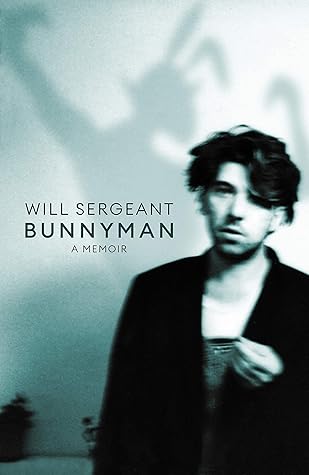
This is a very good memoir. If the option were there I'd probably go with a 4 1/2. Like Peter Hook, who has written excellent memoirs as the bassist of Joy Division and New Order, Sergeant is a guy who probably never would have become an artist were it not for Rock and Roll. Born into a working class/lower middle class family in greater Liverpool in 1958, Sergeant gives a good glimpse of what it meant to grow up in dysfunctional family which his mother eventually fled, counterintuitively creating a new sense of peace in the household, even as Sergeant realizes she was the victim, and his father was abusive.
Since I am just four years younger than him, the story of his developing musical taste is familiar, honed first on what here in America would be classified as classic rock, but with predictably divergences from the US path, Roxy Music and Eno and Gong feature heavily and of course David Bowie, but also Dr. Feelgood, who I now realize were a big influence on Sergeant's rhythmic guitar playing. Yet none of this inspires him to learn to play an instrument, and it is not until about two thirds of the book that thanks to punk and connections made at the Liverpool punk club Eric's that he decides to take up a guitar. It is a very different story from the middle class bohemian drift of the other memoirist of the Liverpool punk/post-punk scene, Julian Cope. Sergeant comes closer to being the non-rebellious non-conformist Peter Guralnik paints Elvis to be than Cope, which seems very clearly class related. For example, Sergeant gets a job training as a chef at Liverpool's historic department store, and never really thinks of jacking it in until the situation at the store after being purchased by another company looking to cut costs.
While that social historical aspects of the book are interesting, Sergeant is at his best recounting his musical pleasures, and I wish there were more. Once he gets to music consuming age the chapters regularly mention a record of the era that meant something to him, and I wish he had done more with that, especially his description of the Velvet Underground is good. He is at his best though as an eye witness. His account of witnessing Joy Division transform from the boring punk band Warsaw to something revelatory is most evocative, as is his half page description of watching Modern Dance era Pere Ubu. His reminiscence of Iggy Pop performance at Eric's is also first rate.
As a fan of Liverpool post-punk from my introduction to it in 1980, Sergeant's version of the scene and the origins of the Bunnymen is rather different that what was long the received account centered around Cope. Cope plays a role here, and Sergeant displays none of the animosity towards Cope that Ian McCulloch has, rightly or wrongly. But Peter Wylie of Wah! Heat, and member of the idea of a band The Crucial Three along with Cope and McCulloch is not mentioned once. Also of interest is the development of their original repertoire. No surprise that "Read it in Books" was early, as was "Going Up." "Pictures on the Wall," while early only comes about when they decide to record for Zoo, and the notion that "Happy Death Men," "Monkeys" (albeit under a different name), and "All that Jazz" all preceded "Rescue" and "Crocodiles" was a bit of a surprise -- of course I wasn't in Britain to listen to the first John Peel session, so this won't be news to others who were there, or have made greater use of the availability of Peel Sessions than I have.
Finally, a few thoughts about this memoir in comparison to similar, Cope and Hook's Joy Division memoir. Hook and Sergeant are comparable, but Hook seems more comfortable with the written word than Sergeant, which doesn't exactly hurt his memoir, but it is more conversational. Cope's story is more effervescent, like the man he is, and like Hook definitely clearly comfortable with writing. That said, Sergeant knows how to leave us wanting more. This book ends, knowing they have a record deal, and they have found their drummer, but no word about meeting Pete DeFreitas or how they knew he was right for them, especially since the pressure to find a drummer in order to get the Sire record deal could easily have led them to have chosen anyone only to discover later the new drummer was not suitable. So there is definitely more to come. I'm looking forward to that.