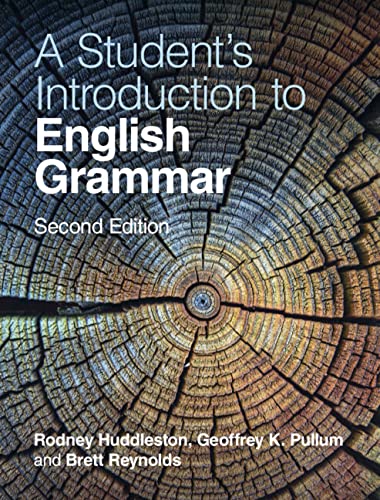
A new edition of a successful undergraduate textbook on contemporary international Standard English grammar, based on Huddleston and Pullum's earlier award-winning work, The Cambridge Grammar of the English Language (2002). The analyses defended there are outlined here more briefly, in an engagingly accessible and informal style. Errors of the older tradition of English grammar are noted and corrected, and the excesses of prescriptive usage manuals are firmly rebutted in specially highlighted notes that explain what older authorities have called 'incorrect' and show why those authorities are mistaken. Intended for students in colleges or universities who have little or no background in grammar or linguistics, this teaching resource contains numerous exercises and online resources suitable for any course on the structure of English in either linguistics or English departments. A thoroughly modern undergraduate textbook, rewritten in an easy-to-read conversational style with a minimum of technical and theoretical terminology.
A book that takes you step by step through English grammar, provides examples and explications. Despite the fact that is quite well written and all, there is one thing which makes me re-think my buying it. There are exercises at the end of each chapter, but the answer key is not provided. At the back of the book it says, that there is web support available. So I went to the web page of the book and found the answer key BUT I had to register myself in order to download it. I though OK no problem, but to my big surprise after registering I had to ask for a lecturer account to download the material. Is this a new form of harassment of customers? It was asking me also for official address to my work for verification! At my work we do not have such a thing, does it mean I am going to be discriminated? And if I would not be working as a English Teacher but I would be a student, I don't have a permission to access the answer key? Cambridge if you want to get paid for the answer key then do it, but do not put unnecessary obstacles under legs of people who buy your publications.
I like to think I'm fairly bright. I've taken several science classes and taught myself straight out of the textbook with ease. A good textbook should provide examples and help you to understand a subject with very little trouble.
That's why this textbook is shite. The science of language is all over the place. Half the time I don't understand what is being said and the examples provided are not clearly explained. The glossary is incomplete. Every page produces a new way to analyze a sentence. The order in which this text teaches its reader grammar is also unclear. I feel like an idiot while reading this textbook, and I am a third year university student majoring in English who excelled in Intro to Linguistics.
This text had potential. I just wish it were actually clear.
If I could, I would gladly burn all copies of this book. And I LOVE books.
P.S.- An answer key to those chapter exercises would have been nice.
As I am an English teacher, I read a lot of grammar books. This book stands out as one of the good grammar books in that it gives me a new perspective. First and foremost, I find that the author's attitude toward the issue of theory versus practice makes sense. I would even say, "I am on the same page." Also he gives me insight on the usage about much and some other areas. I will add this to a "I-will-read-once-a-year-or-two" book list.
This is not a grammar book for everyone. When the title says Student's it's talking about incoming students at Cambridge University whose major is not linguistics, not young kids. It's sort of a precursor to a full course in linguistics, and the book is distilled from an enormous book for dedicated professionals or professional wannabes in the field of linguistics. The nomenclature used, right down to the names for and numbers of the parts of speech, are different from what most people are acquainted with. Punctuation is not even mentioned except once in passing in the middle of a single paragraph near the end. Which makes sense, because punctuation is truly not a part of a study of a language, which is more properly about words, their types, and the ways they are structured within syntactical units (phrases, clauses, sentences, etc.) to create meaning.
The book certainly provides an education for persons who are deeply interested in the underpinnings of the English language -- as I am myself, or at least sufficiently so to have struggled through this book a few pages at a time now and then for many months.
But like? When do they kiss? I was waiting for the ennemies to lovers to ennemies-to-lovering? The VP never cracked the NP… anyways (useful book it’s great 👍🏻)
It's clear that the authors know their stuff, and I was very interested to read a descriptive grammar. Read this for a book exam at a Finnish university. Don't know what the Finnish students' background has been like with English Grammar, but as an American school kid, then an editor and EFL teacher, I've dealt mostly with prescriptive grammars and style guides.
It's possible that the amount and variety of English grammars in my head interfered with the absorption of Huddleston and Pullum's approach. The structure and presentation of this book did nothing to help. I suppose the authors faced some pretty severe space constraints trying to fit a huge subject into a slender book, but many sections are so terse as to be nigh undecipherable. While the superficial structure is reasonable, when the book gets down to details, it become scrambled.
I forked over 35€ for this book, but would gladly have paid 50€ if they'd doubled the length, broken up more information into tables, kept examples closer to explanations (sometimes you have to leaf back several pages to see the sentence they are referring to), evened out the granularity of the chapters and sections, and put more than the bare minimum of words into their description.
To sum up my feelings: I taught myself Finnish from Karlsson's Finnish an Essential Grammar, which uses only a few more pages than A Student's Intro. I still return to Karlsson's book when I need an explanation for some tricky tidbit uttered by a lecturer, written in the newspaper, or presented in another Finnish textbook. I feel very sorry for the plight of any but the highest level non-native English speaker trying to come to grips with English through the aid of A Student's Intro.
Everything your primary and secondary school teachers told you about grammar was wrong.
Well, not everything. But a lot of it was. Huddleston and Pullum distill their very large (and very expensive) The Cambridge Grammar of the English Language into a reasonably digestible and affordable form.
Descriptivists to the core, H&P support their arguments with countless examples to aid their readers in rethinking grammar.
I counter-recommend the Kindle version, which I had hoped to keep around for reference in electronic form as an argument settler, but the conversion was--surprise, surprise--poorly done. The "displayed" examples, to use TeX jargon, were inconsistently rendered, and footnotes mis-numbered and their return points incorrectly anchored on multiple occasions. Stick with a paper copy.
A thoughtful guide about English grammar, based on a much larger work "The Cambridge Grammar of the English Language". If one wants just an introduction, this work suits well by explaining main grammar rules and the way English language works. Learners of English as Second Language will benefit the most from this book as the authors provide simple and concise explanations filled with examples.
A very clean, descriptive overview of English grammar for non-linguists with tons of examples drawn from various sources. Geoff and Rodney know their stuff.
• Page 330: Replace “staff meeting)]” by “staff meeting])”.
• Page 375: Replace “subject) is” by “subject, is”.
Comments:
• Page 119: I think that the remark “An individual member of this class can’t be divided into bits of the exactly same kind as itself” misses the point. A rectangle can be divided into smaller rectangles, this does not make “rectangle” a non-count noun here.
• Page 139: The remark beginning with “if an actor reads” is irrelevant to the semantics, because the actor is just … acting (as if). Indeed, a sentence where the first person is used might also be ascribed to a fictional person and apply neither to the speaker nor to the author.
• There is nitpicking over the term “possessive” (as opposed to “genitive”) even though there are other grammatical terms which could be criticized in the same vein, e.g., the accusative case is not only used for accusations. I guess the issue is that the word “possessive” also happens to have a meaning well-known outside of grammar.
• To me, it seems like the unacceptability of sentences like “Her son had lost its rattle” can be explained by semantics rather than syntax: Since “son” is a (semantically) gender-specific term, it would be weird/inconsistent to use “its” rather than “his”. The word “its” also does not go well with “Max” because the name is, in effect, personifying.
A concise version of Huddleston and Pullum's The Cambridge Grammar of the English LanguageThe Cambridge Grammar of the English Language. If you find something confusing, you can look it up in the Cambridge book for details. It's elaborate. This guide book is very basic actually. For traditional grammar, you can also read another book, Longman's A Comprehensive Grammar of the English LanguageComprehensive Grammar of the English Language: A. They differ in some respects. Meanwhile you can refer to Chomsky's Generative Grammar. It would be interesting and inspiring.
It's a good book, but it's a descriptive grammar, so it isn't great for ESL students and of little practical use for ESL teachers. Also, it doesn't provide answers to the exercises, so it is of limited value to native English speakers outside of a classroom environment. The authors are quite opinionated at times, but in general, they do a good job of substantiating their research. For people not required to read this for a course, I recommend reading the first chapter for free on Kindle before committing to this book. Overall, I did learn some important things about English grammar and it kept me engaged. If it came with an answer key, I'd immediately give it 5 stars.
This is an excellent book on English grammar by linguists that reworked English grammer from scratch and won awards for the work. This makes much more sense than the grammar that I learned in school, but has not be widely adopted that I can learn. There is a much longer version of their grammar for a person really interested in this approach. I've read the book twice and thoroughly enjoyed it. But it is so different in many ways from the traditional approach, I haven't mastered it. But it really does do English as it should be understood.
From the instructions for the exercises of chapter one: "When you complete an exercise, it's very important to check your answers... Mastering the exercises will typically lead to better learning"
There is no way to get the solutions unless you work in academia. Do NOT buy this book if you are a self-studier.
I enjoyed reading this grammar. Knowing that their readers might not be very familiar with the complex rules of English syntax, the authors have endeavoured to make every rule of grammar easy to understand. Chapter 3 on Clause Structure, Complements and Adjuncts, Chapter 10 on Subordination and Content Clauses, and the Chapter on Noun and Noun Phrases are the some of the best in the text.
Prescriptivists and people who prefer the traditional approach to English grammar will, however, be disappointed by the authors' descriptivist bias and viewpoint. Notwithstanding this minor issue, one will, definitely, benefit from this excellent work that has exercises at the end of every chapter.
I am going to use this book as a reference as I study other grammars.
Good attemt by both the writer but proving the grammer from example rather than any standard defination although there are but inadequate moreover by giving example explain the grammer which is the best way for explaination keep it up Authors.Our grammer teacher suggest this book which solve alot of problems regarding grammer Thank you..!
Correction- A linguistics student's introduction to English grammar. Way too complex,analytical and long winded to be of any use to a ESL/EFL student trying to learn English grammar.
I prefer their comprehensive version rather than this condensed version.