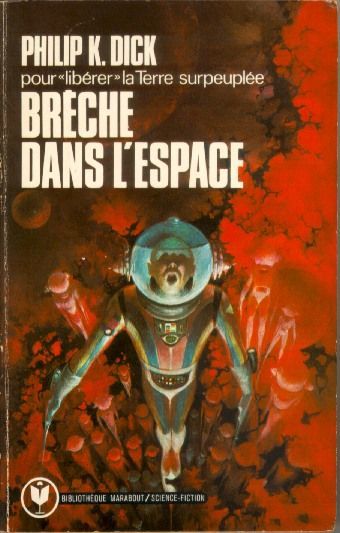
Although he displayed remarkable prescience in many of his books, cult author Philip K. Dick was a good 72 years off the mark in his 18th sci-fi novel, "The Crack in Space." Originally released as a 40-cent Ace paperback in 1966 (F-377, for all you collectors out there), the novel takes place against the backdrop of the 2080 U.S. presidential election, in which a black man, Jim Briskin, of the Republican-Liberal party, is poised to become the country's first black president. (Dick must have liked the name "Jim Briskin"; in his then-unpublished, non-sci-fi, mainstream novel from the mid-'50s, "The Broken Bubble," Jim Briskin is the name of a DJ in San Francisco!) Unlike Barack Obama, whose campaigning centered around the issues of war, economic crisis and health care, Briskin's talking points are a staggering overpopulation problem, the issue of what to do with the "bibs" (100 million frozen citizens awaiting their thaw in a better day), and the shutting down of the Golden Door Moments of Bliss satellite, an orbiting brothel housing no less than 5,000 women. When a door to a parallel Earth is discovered in the wall of a defective Jiffi-scuttler (a tubular device for instantaneous transportation from place to place), Briskin feels confident that he finally has a solution as to where to dump all those bibs. But problems loom, when an exploration team discovers that this parallel Earth is not vacant, but rather peopled by...well, perhaps I'd better not say.
Filled with a typically large Dickian cast of characters (38 named characters are featured...15 of them in just the first 10 pages!), "The Crack in Space" is a very swift-moving vision of the future. With the use of jetcabs, men and women in this book flit from city to city like you might commute to work; indeed, one potential assassin flies from Reno to Chicago while Briskin is delivering a speech! As in many other Dick novels, divorce is featured (Dick himself was married five times) and some truly outre characters are presented. Most memorable here is George Walt, the owner of the Golden Door satellite: a one-headed, two-bodied mutant who constantly bickers with himself. Dick presents a future here in which abortions are legal and paid for by the government (and this was written a good seven years before Roe v. Wade was settled); the only coffee that is consumed (except by the lowest classes) is the "nontoxic," synthetic kind; and political parties, under the ruling of the Tompkins Act, are allowed to jam the transmissions of the opposing party. It is a typically nutty Dick world, for the most part, in which Briskin's campaign manager voices some very PC words on Dick's behalf. Thinking about the people found on the parallel Earth, Sal Heim ponders "the difference between say myself and the average Negro is so damn slight, by every truly meaningful criterion, that for all intents and purposes it doesn't exist." Again, a pretty right-on sentiment for 1966, and one which makes the book praiseworthy in its own right.
"The Crack in Space" is hardly a perfect work. Fast paced and entertaining as it is, and filled with colorful characters, bursts of humor and remarkable situations, there are some problems that crop up. Several main characters (such as Myra Sands, a renowned abortionist) just kinda disappear, and the exploration of the alternate Earth (for this reader, the most fascinating and exciting segment of the book) is a bit too brief. Still, these are mere quibbles. Though this book has been pooh-poohed by some (the British critic David Pringle, in his "Ultimate Guide to Science Fiction," inexplicably calls it "a clotted Dick narrative"), I really did enjoy it very much. Let's just hope that President Obama has an easier time with his wars, economic woes and health care reforms than Jim Briskin will have with his problem of the bibs!