

What do you think?

The Alien
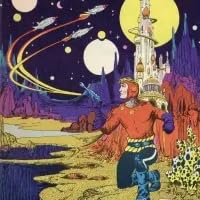
Speculate for a moment on the enormous challenge to archaeology when interplanetary travel is possible . . . and relics are found of a race extinct for half a million years! A race that was so far in advance of ours that they held the secret of life restoration! What happens when a member of that race is brought back after 500,000 years of death . . .
- GenresScience Fiction
160 pages, Paperback
First published January 1, 1951
About the author
Raymond F. Jones
196 books12 followersRaymond Fisher Jones (November 15, 1915, Salt Lake City, Utah - January 24, 1994, Sandy, Salt Lake County, Utah) was an American science fiction author. He is best known for his 1952 novel, This Island Earth, which was adapted into the 1955 film This Island Earth and for the short story "The Children's Room", which was adapted for television as Episode Two of the ABC network show Tales of Tomorrow, first aired on February 29, 1952.
Jones' career was at its peak during the 1940s, 1950s, and 1960s. His stories were published mainly in magazines such as Thrilling Wonder Stories, Astounding Stories, and Galaxy. His short story Noise Level is known as one of his best works. His short story "The Alien Machine", first published in the June, 1949 Thrilling Wonder Stories, was later expanded into the novel This Island Earth, along with two other short stories, "The Shroud of Secrecy", and "The Greater Conflict", known as The Peace Engineers Trilogy, featuring the character Cal Meacham. Jones also wrote the story upon which the episode "The Children's Room" was based for the television program Tales of Tomorrow in 1952.
Jones' career was at its peak during the 1940s, 1950s, and 1960s. His stories were published mainly in magazines such as Thrilling Wonder Stories, Astounding Stories, and Galaxy. His short story Noise Level is known as one of his best works. His short story "The Alien Machine", first published in the June, 1949 Thrilling Wonder Stories, was later expanded into the novel This Island Earth, along with two other short stories, "The Shroud of Secrecy", and "The Greater Conflict", known as The Peace Engineers Trilogy, featuring the character Cal Meacham. Jones also wrote the story upon which the episode "The Children's Room" was based for the television program Tales of Tomorrow in 1952.
Ratings & Reviews
Friends & Following
Create a free account to discover what your friends think of this book!
Community Reviews
Displaying 1 - 13 of 13 reviews

July 15, 2013
Published in 1951 this novel is entertaining for old fashioned science fiction. Simply, it's a story about a "time capsule" found among the ruins of a civilization on an asteroid between Mars and Jupiter. This time capsule also contains a being over 500,000 years old, and the formula for resurrecting it. What destroyed the planet and what is locked in the capsule? Wonky science, sociology, philosophy and space opera ensue.
Raymond F. Jones is mostly known for his novel, This Island Earth, which was made into the classic movie from the 1950s.
Raymond F. Jones is mostly known for his novel, This Island Earth, which was made into the classic movie from the 1950s.

December 17, 2023
Despite being written in 1951, this book would be considered a parody in the current year of 2023. Why? Because the antagonist is a copper-skinned fellow who wants to control the entire universe, the protagonists are scientists who are seen as blashphemers for not believing in the copper-skinned fellow's right to rule, and the human population is seen as disillusioned with leaders and government, grasping at any straw, even if it's a copper-skinned fellow from outer space.
In many ways, the story is reminiscent of the Space Seed episode of the original Star Trek series, wherein a derelict vessel is found containing the remains of an ancient despot, brought back to life by science, and quickly determined to be malevolent. The race is on to stop the orange terror, who is insulated by a growing army of fanatical yahoos with a religious fervor rivaling that of Al Quaeda.
If only it were this easy to dispose of such an unconditionally evil threat to humanity. And by easy, I mean possible. The method used to do the deed is pure science fantasy, but the ride is exhilarating, the characters well-defined, and the science not too Asimovian, for those of us whose understanding of rocket science is limited to Buck Rogers, or Star Wars.
In many ways, the story is reminiscent of the Space Seed episode of the original Star Trek series, wherein a derelict vessel is found containing the remains of an ancient despot, brought back to life by science, and quickly determined to be malevolent. The race is on to stop the orange terror, who is insulated by a growing army of fanatical yahoos with a religious fervor rivaling that of Al Quaeda.
If only it were this easy to dispose of such an unconditionally evil threat to humanity. And by easy, I mean possible. The method used to do the deed is pure science fantasy, but the ride is exhilarating, the characters well-defined, and the science not too Asimovian, for those of us whose understanding of rocket science is limited to Buck Rogers, or Star Wars.

March 28, 2025
The Alien
Dr. Illia Morov (she is not important btw) is running away from Earth to Venus and Delmar Underwood calls her out on it. Although he can’t deny that Earth has its own problems. An archeologist on aliens and asteroids Phyfe is important, Terry and Bernard as well bla bla they find a crystalline rock and experiment on opening it. Poignant on its description of life and government, “Murder was common, there was little trust in authority, people were driven mad by the availability of luxury;” the book readies you for this world within.
Illia and Del reunite (this tale isn’t about the humans though so there is little build up)as the world learns about the alien and they start to reconstruct it. There’s already cults popping up to worship the alien, viewing its (not even complete) image as a form of god. The scientists debate if the alien will be kind or not.
Turns out the alien is part of the Sirenian Empire and were fighting a group called the Dragbora. A manuscript reveals something about a struggle and 2 aliens who strived to be preserved, “If it was Toshmere, the alien will be all that we hoped he would be. If it is Demarzule…” Turns out they find a manuscript that says it's the tyrant Demarzule, so they don’t want to resurrect him.
The cults become a mob when they somehow find out the scientists want to kill the alien. Demarzule (“The Great One”) manages to raise and greets the fanatics in his alien language. Hell breaks loose and the scientist gang escapes knowing they need to kill Demar, they flee to get records of the Sirenian Empire. If the Dragbora had killed the Sirenian before, they might still be able to! The book kind of loses build up at this point as they race to the rival’s planet. They arrive and mildly talk and eat with them before being shown “mother-flesh”, a type of cancerous material that aids in making organs, this has nothing to do with the plot till later as a weapon but was fascinating, and probably a hidden meaning about intelligence and brain power.
Sometimes the book is profound: “Forever, we shall remain in our barren moon of glass while only the ghosts of the gods possess our metal Heaven World!" While at other times it becomes bogged down with explanations or moves too quickly with a plot twist.
Illia helps remove a developed brain thing into Underwood so that they can telepathically take on the Sirenian. They win and it just...ends. An unpleasant roller-coaster of a book.
Dr. Illia Morov (she is not important btw) is running away from Earth to Venus and Delmar Underwood calls her out on it. Although he can’t deny that Earth has its own problems. An archeologist on aliens and asteroids Phyfe is important, Terry and Bernard as well bla bla they find a crystalline rock and experiment on opening it. Poignant on its description of life and government, “Murder was common, there was little trust in authority, people were driven mad by the availability of luxury;” the book readies you for this world within.
Illia and Del reunite (this tale isn’t about the humans though so there is little build up)as the world learns about the alien and they start to reconstruct it. There’s already cults popping up to worship the alien, viewing its (not even complete) image as a form of god. The scientists debate if the alien will be kind or not.
Turns out the alien is part of the Sirenian Empire and were fighting a group called the Dragbora. A manuscript reveals something about a struggle and 2 aliens who strived to be preserved, “If it was Toshmere, the alien will be all that we hoped he would be. If it is Demarzule…” Turns out they find a manuscript that says it's the tyrant Demarzule, so they don’t want to resurrect him.
The cults become a mob when they somehow find out the scientists want to kill the alien. Demarzule (“The Great One”) manages to raise and greets the fanatics in his alien language. Hell breaks loose and the scientist gang escapes knowing they need to kill Demar, they flee to get records of the Sirenian Empire. If the Dragbora had killed the Sirenian before, they might still be able to! The book kind of loses build up at this point as they race to the rival’s planet. They arrive and mildly talk and eat with them before being shown “mother-flesh”, a type of cancerous material that aids in making organs, this has nothing to do with the plot till later as a weapon but was fascinating, and probably a hidden meaning about intelligence and brain power.
Sometimes the book is profound: “Forever, we shall remain in our barren moon of glass while only the ghosts of the gods possess our metal Heaven World!" While at other times it becomes bogged down with explanations or moves too quickly with a plot twist.
Illia helps remove a developed brain thing into Underwood so that they can telepathically take on the Sirenian. They win and it just...ends. An unpleasant roller-coaster of a book.
This entire review has been hidden because of spoilers.

April 15, 2021
Departe, cu mult dincolo de orbita lui Marte, Lavoisier naviga greoi, cu precauţie printre câmpurile de asteroizi. Puţini erau aceia dintre membrii Expediţiei Asteroidale Smithson conştienţi de faptul că se aflau în mişcare. Trăind în acest vast teren câte un an sau doi la rând, cu greu mai remarcau altceva, exceptând fragmentele de cultură vechi de o jumătate de mileniu ce îi înconjurau acum din toate părţile. Singurul contact cu Pământul în acel moment era legătura radio prin care Dr. Delmar Underwood o chema pe Dr. Illia Morov de la Centrul Terestru Medical. Părul blond, precis coafat al Illiei, avea o vagă nuanţă aurie în contrast cu halatul alb-imaculat pe care încă îl mai purta atunci când răspunse la telefon. Ochii i se deschiseră larg, afişând o expresie de plăcere, în clipa în care recunoscu pe ecran chipul lui Underwood.
October 31, 2023
I listened to this as part of The 11th Science Fiction Megapack. It was very interesting with will developed characters lots of action and misdirection leading to the conclustion. 2023
pulbished in the 1950s
pulbished in the 1950s

October 21, 2020
One of the best science fiction novels I've read in a long time, a thought-provoking, mysterious page-turner.

March 16, 2022
First novel by the author of THIS ISLAND EARTH. A fast read with an intriguing premise.

March 30, 2024
Silly fun stuff with a dash of philosophy

April 8, 2024
Classic example of pulp science fiction at its best.
August 7, 2026
Completely engaging exploration of human motivation and endurance.

February 1, 2017
I enjoyed the beginning but I felt the concepts got a little weird as the story developed. Jones starts with the idea that humans have always looked for a leader to follow. Jones called this leader idea "the head man stage". In the future time this novel takes place there are chaotic political and social conditions on Earth. Some scientists speculate that this is because man is becoming more mature and are rejecting the "head man" concept. The chaos is the result of trying to transition to a more independent, self reliant mature stage but not really understanding what is happening. As a result world leaders are elected and then quickly pushed out of power because humans can no longer find a "head man" they can give up their autonomy to. Interesting idea except it stops having much importance to the plot by the middle of the book.
The new focal point is the discovery of a alien superhuman being in suspended animation on one of the asteroids that used to make up a planet between Mars and Jupiter. This alien superman is revived and becomes the new "head man" of the the Earth with a following of true believers that take control of the Earth.
My take is humans were giving up the "head man" concept because they couldn't find one that filled their new , more demanding requirements but the superhuman alien was a strong enough personality and leader to fill the bill. Unfortunately he was a power hungry warlord type.
This book was written in 1951 and this may have reflected the unthinking devotion that was given to recent leaders like Hitler and Mussolini. I've probably given too many spoilers already so I'll stop here except to say that the ending seems to be go against the philosophy that had been driving the novel to that point.
Something that has nothing to do with the plot but stood out for me was the use of the concept of semanticists and the the idea that adhering to this philosophy made humans better people and also allowed them to use linguistics as a powerful tool in other scientific areas. It made me wonder if Jones was interested in Korzybski 's General Semantics theory. Many other SF writers of the day, notably A. E. van Vogt, also accepted these ideas. Other SF figures interested in General Semantics were Robert Heinlein, H. Beam Piper, Frank Herbert and editor John W. Campbell Jr.
I've only taken a cursory look at General Semantics but plan to look into it more deeply in the future even though it has fallen out of favor in recent years. One reason for a this negative view today is because L. Ron Hubbard claimed to have used the theory in his creation of Dianetics. But people familiar with General Semantics say that Hubbard totally butchered and distorted those ideas when he developed Dianetics and Scientology. Guess they feel very strongly that they don't want to be associated with Scientology and I can't blame them.
The new focal point is the discovery of a alien superhuman being in suspended animation on one of the asteroids that used to make up a planet between Mars and Jupiter. This alien superman is revived and becomes the new "head man" of the the Earth with a following of true believers that take control of the Earth.
My take is humans were giving up the "head man" concept because they couldn't find one that filled their new , more demanding requirements but the superhuman alien was a strong enough personality and leader to fill the bill. Unfortunately he was a power hungry warlord type.
This book was written in 1951 and this may have reflected the unthinking devotion that was given to recent leaders like Hitler and Mussolini. I've probably given too many spoilers already so I'll stop here except to say that the ending seems to be go against the philosophy that had been driving the novel to that point.
Something that has nothing to do with the plot but stood out for me was the use of the concept of semanticists and the the idea that adhering to this philosophy made humans better people and also allowed them to use linguistics as a powerful tool in other scientific areas. It made me wonder if Jones was interested in Korzybski 's General Semantics theory. Many other SF writers of the day, notably A. E. van Vogt, also accepted these ideas. Other SF figures interested in General Semantics were Robert Heinlein, H. Beam Piper, Frank Herbert and editor John W. Campbell Jr.
I've only taken a cursory look at General Semantics but plan to look into it more deeply in the future even though it has fallen out of favor in recent years. One reason for a this negative view today is because L. Ron Hubbard claimed to have used the theory in his creation of Dianetics. But people familiar with General Semantics say that Hubbard totally butchered and distorted those ideas when he developed Dianetics and Scientology. Guess they feel very strongly that they don't want to be associated with Scientology and I can't blame them.

June 22, 2019
Gelesen als Das Erbe der Hölle
Ein Forscherteam lüftet das Geheimnis des verschwundenen Planeten zwischen Mars und Jupiter. Dabei rufen sie einen Mann aus der Vergangenheit ins Leben zurück und entfesseln damit das grauenhafte Erbe der Vergangenheit, den kosmischen Krieg, der die Vernichtung der ganzen Menschheit bewirken kann.
Ein sehr kurzweiliges Buch, wenn auch die Story heutzutage nichts Aussergewöhnliches mehr ist.
Ein Forscherteam lüftet das Geheimnis des verschwundenen Planeten zwischen Mars und Jupiter. Dabei rufen sie einen Mann aus der Vergangenheit ins Leben zurück und entfesseln damit das grauenhafte Erbe der Vergangenheit, den kosmischen Krieg, der die Vernichtung der ganzen Menschheit bewirken kann.
Ein sehr kurzweiliges Buch, wenn auch die Story heutzutage nichts Aussergewöhnliches mehr ist.
May 31, 2025
3.5/5
A good, original novel, especially since it was published in 1951. Human archaeologists on a distant planet discover the ruins of an ancient extraterrestrial civilization far more advanced than Earth's, extinct 500,000 years ago.
I found the pace a bit slow. At times, I lost interest in the story.
A good, original novel, especially since it was published in 1951. Human archaeologists on a distant planet discover the ruins of an ancient extraterrestrial civilization far more advanced than Earth's, extinct 500,000 years ago.
I found the pace a bit slow. At times, I lost interest in the story.
Displaying 1 - 13 of 13 reviews