Jump to ratings and reviews
Rate this book

Septologien #6-7

A New Name: Septology VI-VII

Rate this book
"With Septology, Fosse has found a new approach to writing fiction, different from what he has written before and—it is strange to say, as the novel enters its fifth century—different from what has been written before. Septology feels new."—Wyatt Mason, Harper's

Asle is an aging painter and widower who lives alone on the west coast of Norway. His only friends are his neighbor, Åsleik, a traditional fisherman-farmer, and Beyer, a gallerist who lives in the city. There, in Bjørgvin, lives another Asle, also a painter but lonely and consumed by alcohol. Asle and Asle are doppelgängers―two versions of the same person, two versions of the same life. Written in melodious and hypnotic “slow prose,” A New Name is the final installment of Jon Fosse’s Septology, “a major work of Scandinavian fiction” (Hari Kunzru) and an exquisite metaphysical novel about love, art, God, friendship, and the passage of time.

197 pages, Paperback

First published January 1, 2021

233 people are currently reading
4132 people want to read

About the author

Jon Fosse

234 books1,821 followers
Jon Olav Fosse was born in Haugesund, Norway and currently lives in Bergen. He debuted in 1983 with the novel Raudt, svart (Red, black). His first play, Og aldri skal vi skiljast, was performed and published in 1994. Jon Fosse has written novels, short stories, poetry, children's books, essays and plays. His works have been translated into more than forty languages. He is widely considered as one of the world's greatest contemporary playwrights. Fosse was made a chevalier of the Ordre national du Mérite of France in 2007. Fosse also has been ranked number 83 on the list of the Top 100 living geniuses by The Daily Telegraph.

He was awarded The Nobel Prize in Literature 2023 "for his innovative plays and prose which give voice to the unsayable".

Since 2011, Fosse has been granted the Grotten, an honorary residence owned by the Norwegian state and located on the premises of the Royal Palace in the city centre of Oslo. The Grotten is given as a permanent residence to a person specifically bestowed this honour by the King of Norway for their contributions to Norwegian arts and culture.

Ratings & Reviews

What do you think?
Rate this book

Friends & Following

Create a free account to discover what your friends think of this book!

Community Reviews

5 stars
1,538 (62%)
4 stars
707 (28%)
3 stars
174 (7%)
2 stars
39 (1%)
1 star
18 (<1%)
Displaying 1 - 30 of 370 reviews
Profile Image for Vit Babenco.
1,784 reviews5,784 followers
October 24, 2022
He walks the road of being… He’s on his walk of life… The end of the road is already in sight… Are there God and the Last Judgement waiting at the end of the road?
…call The Holy Spirit, because all good art has this spirit, good pictures, good poems, good music, and what makes it good is not the material, not matter, and it’s not the content, the idea, the thought, no, what makes it good is just this unity of matter and form and soul that becomes spirit, I think, no I’m not thinking clearly now, I think and I’ve thought thoughts like this so many times, I think, that because pictures have a spirit painting can be compared to praying, that a picture is a prayer, I think, that the pictures I paint are prayer and confession and penance all at once, the way good poems are too, yes, you could say all good art is like that in the end…

He keeps recalling his own life and the life of his alter ego… And which life is real and which life is dreamt up? Is he the one staying at home or is he the one lying delirious in the hospital?
…and once again I’m reading Meister Eckhart and the book I’m reading now is called Unity with God, I just started it, but it really is worth reading even though I hardly understand anything, neither of Meister Eckhart, whom I’ve read again and again over all these years, nor of life…

What we are and what we wish to be are two different things.
Profile Image for Meike.
Author 1 book4,947 followers
October 8, 2023
A WELL-DESERVED NOBEL 2023 FOR FOSSE!!
Finalist for the National Book Award for Translated Fiction 2022
Shortlisted for the International Booker Prize 2022

So this is clearly Nobel Prize bait, but you know what? Just give this man his damn Nobel. And the International Booker. He deserves it, because this is unbelievably good literature. Fosse's Septology tells the story of Asle, an elderly, widowed Norwegian painter. What happens, you ask? Well: Almost nothing, there is barely any plot, let alone character development. Most of the time, Asle sits in his house looking at the Norwegian Sea, contemplating his life. This last part (after, obviously, The Other Name: Septology I-II and I is Another: Septology III-V) starts with him deciding to quit painting, he acquires a dog and near the end, the devout Catholic crosses a body of water on Christmas - go figure what that might lead up to (and if you now have the impulse to comment that this is a spoiler, you clearly don't deserve to read this masterpiece, which is not about the plot, stupid).

This flawlessly executed stream-of-consciousness narrative utterly destroyed me emotionally, I had to pause again and again because the writing is so beautiful and Asle's reflections are so affecting without ever being kitschy. We learn (among other things) about him studying painting, how he met the love of his life, how he converted to Catholicism, and how he became a successful painter. The mundane little vignettes of Asle reminiscing about his young self standing around somewhere or sitting in a café are somehow particularly profound. The reflections that are sometimes evoked by mental images appearing before the painter are expertly woven into the stream-of-consciousness in a fragmentary, non-linear style, together with ruminations about God, references to Meister Eckhart, as well as prayers - in Latin, of course (myself being a Catholic with Latinum, I fully support this narrative decision). The effect is almost mythical: How does Fosse pull this off? This aesthetic reflection of the memories of an old man are entrancing, absorbing, and, as the Booker judges have stated, transcendent.

Asle is an unreliable narrator, because his mind fails him (there is more than one possible explanation why this might be). In his thoughts, we hear about another (really?) painter named Asle who is about to die in a hospital, and who lived an alternative life to our narrator Asle - and he is not the only doppelgaenger in the book. The narrator Asle's late wife was called Asel, and several items, people and even the dog mentioned might or might not exist outside of Asle's head (the dog who is supposedly constantly at his heels is named after the Norse god of poetry, Bragi, plus check out the story of St. Dominic and his dog - there are no coincidences in this text). Asle's neighbor, the fisherman on whose boat they cross the water to celebrate Christmas, is called Åsleik, which goes back to the Old Norse words for "god" and "joke". Jon Fosse, I like your thinking.

I started Septology with this last part and will now read my way back to the beginning, in English or German (the brilliant Hinrich Schmidt-Henkel is Fosse's German translator). This is an amazing work, showcasing what fiction can achieve that no other art form can.

You can listen to my interview with Frank Wynne, jury president of the International Booker 2022, here.
Profile Image for Paul Fulcher.
Author 2 books1,954 followers
November 19, 2025
From our new Nobel laureate

Shortlisted for the 2022 International Booker Prize
Finalist for the 2022 National Book Award for Translated Literature
Translation longlisted for the 2022 Oxford-Weidenfeld Prize
Shortlisted for the 2022 Republic of Consciousness Prize, US and Canada

And my novel of the millennium so far


and the taxi is still standing there and I ask The Taxi Driver to take me to St Paul's Church and he says that'll be fine and I realize that I can't think clearly, I'm not sad, I'm nothing, just empty, just an empty blackness, I think and The Taxi Driver stops by St Paul's Church and I pay and I go into the church, dip my fingertips into the basin with the holy water, make the sign of the cross, and go to the third pew from the back on the left, I kneel and then sit down at the end of the pew and I think that ! always sit there, because that was where Ales always sat, and where we always sat together, I think and then I bow my head

A New Name: Septology VI-VII is the third and final volume in Damion Searls' translation of Jon Fosse's Septology, a novel in seven Parts but physically published in three volumes from 2020-22, the English translations published by Fitzcarraldo Press at the same time as the Norwegian originals. And it is key to say up front that they do constitute one overall novel, rather than three separate works

From the author's Nobel lecture: In Septology, it is this silent language ... that says that the first Asle and the other Asle may well be the same person, and that the whole long novel, of around
1200 pages, is perhaps just a written expression of one extracted now.


My reviews of the previous volumes:

The Other Name: Septology I-II
I is Another: Septology III-V

And I should also say upfront that the work as a whole constitutes one of the great novels of world literature in the last 10 years. It comes with a wonderful blurb from Jesse Ball which both speaks to the qualities of the novel and Ball’s own uniqueness as a writer:

Fosse’s portrait of memory remarkably refuses. It will not be other than: indelible as paint, trivial as nail clippings, wound like damp string. This book reaches out of its frame like a hand.


As with each of the Parts, Part VI opens with Asle visualising himself contemplating the painting that he finished immediately before Part I began, a painting that he increasingly feels will be his last:

And I see myself standing there looking at the two lines that cross in the middle, one brown and one purple, and I see that I've painted the lines slowly, with a lot of thick oil paint, and the paint has run, and where the brown and purple lines cross the colours have blended beautifully and I think that I cant look at this picture anymore, it's been sitting on the easel for a long time now, a couple of weeks maybe, so now I have to either paint over it in white or else put it up in the attic, in the crates where I keep the pictures I don’t want to sell, but I've already thought that thought day after day, I think and then I take hold of the stretcher and let go of it again and I realize that I, who have spent my whole life painting, oil paint on canvas, yes, ever since I was a boy, I don't want to paint anymore

He goes on to realise:

yes I have a real aversion to even the thought of painting anymore and I don't understand what changed so suddenly inside me, because it used to be that I had to paint, not just to support myself but to get rid of all these pictures lodged in my head, I think and I realize that there are still pictures in my head but I also realize that they are about to fade away on their own, they are about to come together into one slow picture that doesn't need to be painted and won’t be and cant be, yes, the pictures are about to come together into a stillness, a calm silence, I think and I feel filled with something like peace

In the present-day we left Part V on Thursday evening, with Asle sitting outside of Åsleik's house in his car, having suffered a panic attack towards the end of their meal together. Part VII opens on the next day, Friday, 3 days before Christmas, towards the end of the day, and with very little action, but rather Asle increasingly absorbed in both his memories, and also his contemplation of his own artistic future.

In his past recollections, we see Asle almost immediately where Part V left off, after his first meeting with Ales, and while there is more narrative development, Fosse's 'slow prose' takes us in detail through the first hours of their future life together.

Asle and Ales, she whispers
and he whispers into her ear
Ales and Asle, he whispers
and she says that it's strange that they have such similar names, the letters are the same, you just have to move them around a little
And neither name's all that common either, she says
Ales isn't anyway, Asle says
and she says that Asle may be more common than Ales, but she doesn't know anyone else named either Asle or Ales, so both names are pretty unusual, she says and Asle says that he doesn't think he knows anyone else named either Ales or Asle either


Ales, who lives in Bjørgvin, takes Asle on a tour of the immediate area, in particular The Lane, The Country Inn, The Coffeehouse and The Beyer Gallery, which even decades later form the centre of his visits to the city:

and then they walk down The Lane and Ales says that if they take a right and go down that street they'll be able to see The Country Inn, the hotel where people visiting Bjørgvin from the nearby countryside often stay, and on the ground floor there's The Coffeehouse, one of the cosiest cafés in Bjorgvin, she often goes there herself, she sits there and sketches, she says, and what she actually likes to do there is sit at a table and secretly look up at this or that person and then she tries to do a drawing of him or her, Ales says
...
they get to The Beyer Gallery, they can even see the building now, and she points to a big white wooden building up ahead, with a big parking lot in front of it


That his first impression of the gallery that will form the foundation of his artistic career is of the parking lot, a nod to the way his visits to the city for the rest of his life involve him parking there, his only knowledge of the roads the way in to and out of the city from that spot, and then travelling around the rest of Bjørgvin by foot or by taxi.

In Part I, Asle saw a young couple of lovers who appeared to be himself and Ales from their youth. Here we see the other side of that story, with the present-day Asle seeming to haunt the past Bjørgvin, Ales and Asle often encountering his figure.

And the mirroring and time-slippage also extends to Ales and Asle seemingly also being followed by "the woman with the medium-length blonde hair", who is seemingly Guro (likely the other Asle's sister Guro rather than the Bjørgvin Guro, but standing for both), a figure to whom Ales takes an immediate and instinctive dislike. Ales also has an immediate mutual disdain with Asle's first landlady in the city, Herdis Åsen, who herself claims a past relationship with Eiliv Pedersen, Asle's teacher at the art school, which mirrors the one the Bjørgvin Guro claims, in the present-day to have had with Asle.

Meanwhile, Asle also sees the early days at the Bjørgvin Art School of the other Asle. His Bjørgvin revolves more around drinking at The Alehouse and The Last Boat, and we see the end of his relationship with Liv, due to his affair with Siv, a fellow Art School student.

Part VII opens on Saturday, "Little Christmas Eve." Asle visits Bjørgvin, to both visit the other Asle and also take all of the paintings he had been keeping for himself, including the purple and brown St Andrew's Cross, to a delighted Beyer to sell. There he encounters two separate, and for him shattering, deaths, sleeps in the city overnight (in Room 407 of The Country Inn of course) and then returns early on Sunday, Christmas Eve, to take a boat with Åsleik to visit Åsleik's sister Guro for Christmas.

In the past, we see Asle meet Beyer for the second time (Beyer having bought the paintings at Asle's first ever, self-run, exhibition years earlier), although this time realising Beyer's importance as owner of the city's most influential gallery.

Asle's Catholic faith and theological beliefs play an increasingly central role to the novel, and to his own contemplation of his and other's mortality, or rather to the mortality of their temporal life and immortality of their soul. Asle increasingly quotes from the teachings of Meister Eckhart

In jenem Sein Gottes nämlich, wo Gott über allem Sein und über aller Unterschiedenheit ist, dort war ich selber, da wollte ich mich selber und erkannte mich selber (willens), diesen Menschen zu schaffen. Und darum bin ich Ursache meiner selbst meinem Sein nach, das ewig ist, nicht aber meinem Werden nach, das zeitlich ist. Und darum bin ich ungeboren, und nach der Weise meiner Ungeborenheit kann ich niemals sterben. Nach der Weise meiner Ungeborenheit bin ich ewig gewesen und bin ich jetzt und werde ich ewiglich bleiben.


And Fosse bring the novel to a fitting and very moving end.

Wonderful - 5 stars doesn't do the novel justice.

‘And I will give him a white stone, and on the stone a new name written, which no one knows except him who receives it.’—Revelation 2:17
Profile Image for Fionnuala.
886 reviews
Read
April 11, 2023
While I was reading this book, I had a dream.
I dreamt that I was looking at a Rorschach inkblot, and as I looked, one side of the inkblot moved away from the other to become a separate shape and no longer just a mirror image of the first one. In my dream both blots looked like a man in a long black coat but only one was upright. The other had lain himself down.

There is a man in a long black coat in this book, and it's not clear if he is one man or two men so my dream was not surprising, and although it didn't throw much light on the puzzle of the book, I'm grateful to my unconscious mind for at least providing me with an opening paragraph for a review I found difficult to begin.

But even while finding it difficult to begin this review, I still had a huge need to get started in order to work out my thoughts and feelings about Jon Fosse's Septology which is a project as hard to grasp as the notion of a landmark in the middle of the sea, something that is mentioned a lot in A New Name.

And furthermore, it's hard to talk about A New Name without talking about The Other Name and I Is Another, the first and second volumes of this series, episodes I to V, to use Fosse's Septology subtitles. A New Name contains episodes VI and VII.

When it became clear that the first episode of the first book took place on a Monday and the second on a Tuesday, the word Septology spoke to me of a seven day period and therefore I expected the final episode to take place on a Sunday, and it did, which is fitting for a book about creation though the creation involved is artistic creation and not related to the Christian origin myth of God creating the world in six days and resting on the seventh.
However, one of the men in the long black coats (who are both artists and both called Asle) and whom I'll refer to from now on as Inkblot One, does rely on Christian prayers to calm his mind before sleeping, reciting them both in Latin and in his own language, Nynorsk. In this way, the words of the Pater Noster, the Ave Maria, and the Gloria Patri mark the transitions between evenings and mornings in the narrative. And it's interesting to see how the main female character, Ales (who is present in the narrative only in Inkblot One's mind) emerges as a kind of embodiment of the prayers he relies on so much, in particular an embodiment of the last lines of the Pater Noster: et ne nos inducas in tentationem sed libera nos a malo.
Inkblot One seems to see her as a sacred figure (one of his memories of her is as a snow angel) who has delivered him from the evils of alcoholism, and in some of the scenes from his memory she has the role of shielding him from temptation which presents itself in the form of other women, in particular a blonde woman called Guro who hovers on the edge of many of the scenes he describes over and over.

Yes, Inkblot One is constantly describing scenes from his memory (perfect or imperfect is not clear), and when he remarks about his paintings that they have something to do with something I’ve seen, something that’s stuck inside me in a way, and that I suddenly see again, yes…it’s like I have a huge collection of pictures stored in my head …I’m trying to get rid of them by painting them, the reader can't help but think that the entire Septology is a collection of memory pictures that Inkblot One has stored inside his head and that he must rid himself of.

In those memory pictures, he sees himself interacting with people from his past, both from his childhood and his adult life. Sometimes it is Inkblot Two he sees (though never as a child).
And it emerges that Inkblot Two has not been delivered from the evils of alcoholism by any ministering angel, and as a result his life seems to pan out differently and be peopled with characters that Inkblot One doesn't admit to having any connection with, although the blonde woman called Guro is mentioned in both their lives.

A character called Sigve is present in both their lives too and it's interesting that he is the person who introduced them both to alcohol when they were teenagers, and that it is only during that period (when they were both drinking) that the two Inkblots actually speak to one other. When Inkblot One is sober, as he is during the seven days of the (much later) present time of the narrative, he never has a conversation with Inkblot Two, and although he reports seeing him, Inkblot Two is unconscious during the encounter.

It's also interesting that by the end of the book when Inkblot One has narrated all his memories and is content to simply repeat the mantra of his prayers, he has also rid himself of all of his paintings, all except the one that he reverences as if it were a holy icon and that depicts Ales, the figure he believes rescued him and who embodies the prayers he repeats over and over: Benedicta tu in mulieribus.
The ending is as eloquent as the Ave Maria and as ethereal as an icon.

I began my review of the first part of the Septology, The Other Name, with a quote from Ezra Pound: Man reading should be man intensely alive. The book should be a ball of light in one's hand
Can you imagine my surprise when I realised that the last line of the last volume of the Septology mentions a ball of light. I felt intensely alive as a reader in that moment.

……………………………………………………………

Further thoughts in the comment section...
Profile Image for Glenn Russell.
1,511 reviews13.3k followers
Read
October 9, 2023


A New Name, VI-VII - Jon Fosse's concluding novel following The Other Name, I-II and I Is Another, III-V forming his Septology I-VII (the Roman numerals indicate the time span of the novel, seven days of the week beginning on Sunday). The Norwegian author views his work as a cohesive whole where a reader will, ideally, read A New Name after having read The Other Name and I Is Another. Reading the novels in sequence makes abundant sense since the entire Septology is, in the main, one continuous sentence written in fluid, mesmerizing stream of consciousness.

Similar to the two previous novels, A New Name begins with artist Asle standing before the painting in his studio where two thick, dripping diagonal lines cross in the middle, one brown line and one purple line. And Asle reflects he's spent his entire life painting ever since he was a boy and now, for the first time in his long life, he doesn't want to paint any longer.

“and I think that I want to get rid of this painting and get rid of the easel, the tubes of oil paint, yes, everything, yes, I want to get rid of everything on the table in the main room, everything that has to do with painting in this room that's been both a living room and a painting studio, and that's how it's been since Ales and I moved in here so long ago, so long ago, because it's all just disturbing me now and I need to get rid of it, get it out of here, and I don't understand what's happened to me but something has, something has happened.”

Ales is Asle's now-dead wife, his soulmate, his lover, who died way too young. The above quote is pivotal and sets the tone for the entire novel – old Asle is on the cusp of a life-changing transformation with echoes of the words of a key author to Asle, Christian mystic Meister Eckhart - “And suddenly you know: It's time to start something new and trust the magic of beginnings.”

A New Name is a magnificent novel where we encounter Asle's stream of artistic and spiritual consciousness beginning with his brooding over his painting on Friday to the last page where, on Saturday, he's on a small boat with his friend crossing a body of water, a gushing, hypnotic mindstream incorporating the following:

The Everyday - Many of Asle's reflection in the novel focus on his time as a younger adult – sadness over his Grandmother's death, reading art books as part of his education at The Art School, dealing with his overly judgemental landlady who will not allow Ales into his apartment - “but she takes for granted that people know the rules of proper behaviour, she would have thought they'd go without saying.” Such commonplace happenings ground the work and give all phases of Asle's life more solidity, roundness and depth.

The Other Asle – Nowhere in the novel is shifting from first-person to third-person, from actual events to imagination and a blurring of Asle's identity more apparent then when Asle thinks of the complex life of his namesake, the other Asle, currently in intensive care in a hospital after blacking out drunk on the street. “The thought that he's going home to another woman drives her completely crazy, Siv says and Asle says that he'll come here, he'll move in with her and Siv says that he and Liv are married and he says he'll have to get a divorce and she says that'll take a long time, first he'll have to separate and then it takes a year or so and only then will he be able to get divorced.” With the inclusion of the other Asle, Jon Fosse, an author who has been married three times himself, spins pregnant possibilities (or, perhaps, actualities) for his main character.

Love – The memory of those tender times with Ales become even more of a presence in A New Name, as, for example, when Asle and Ales are together at a coffeehouse shortly after they've met - “and she says that today is one of the great days, one of the days when something happens, yes, an event, because it's so strange, day after day goes by and it's like time is just passing, but then something happens, and when it happens the time passes slowly.” And also those times when Asle recognizes that he's alone - “no more than I understand how when I wake up in the middle of the night it's always like Ales is lying in bed next to me, always, I wake up and then it takes some time before I understand that she's not there.” I wouldn't want to push the point too far but I suspect Asle giving up painting is closely tied in with his linking his painting with thoughts of Ales, and his thinking has become not only mildly upsetting but excruciatingly painful, almost like a form of torture.

Art – After all those years, Asle still vividly recalls the words of his professor at The Art School, words that form a cantus firmus in his viewing his own art “the greatest artists do something different, they bring something new into the world with their own unique quality, their entirely unique art, yes, they create a new way of seeing that no one has ever known before.” And, as an old man, Asle reflects back on his art - “it's like everything that's happening around him, in the real world, goes away and it's like he sees nothing but that picture, and why do pictures get stuck in his head like that?...and it's to get rid of these pictures that he paints...and it's what the picture says that he tries to paint, yes, to make it go away, and in a way the picture kind of turns into part of himself.” A question worth pondering: What's the connection of Asle's thinking here with his removal of that painting in his studio, the painting of two large dripping lines forming a St. Andrew's Cross?

Myth – Asle's dog is Bragi and his friend's name is Åsleik. In Norse mythology, the god of poetry is Bragi who was revered for his wisdom. And Åsleik means both god and joke. And there is a definite sense of timelessness in Septology (no mention of things like computers or cell phones) that lifts Jon Fosse's fiction to the realm of the mythic, a work of epic proportion.

Spirit – Similar to Asle's large canvas with two dripping lines, so, from the first pages, Asle's life drips with thoughts and feelings of knowing God in the mystical way Meister Eckhart knew God, as when Asle thinks: “I want everything to stay perfectly silent, I want a silence to come falling down over everything that exists, and also me, yes, over me, yes, let a silence snow down and cover me...I will be empty, just empty, I will become a silent nothing, a silent darkness.” Will Asle reach something approaching the peace of silent darkness as he crosses that body of water with his friend? Travel with Asle via A New Name to discover for yourself.


Norwegian author Jon Fosse, born 1959
Profile Image for Katia N.
710 reviews1,111 followers
April 8, 2022
Update: It was long listed for the International Booker Prize 2022.

It is the 3rd part of a single novel. All those 3 parts were published separately within 2 years. I’ve read and enjoyed the first part soon after it was published. I’ve read the other two together and finished recently. In hindsight, I wish I would wait before reading the first part until the whole novel is published. As it is, my experience of reading the 1st part has slightly overshadowed for me the rest. In the nutshell, the majority of the ideas were pretty much expressed and explored there. However, the whole novel is still the one of the best books Ive read that are written recently. Unless specified otherwise, this review would refer to the work in its entirety.

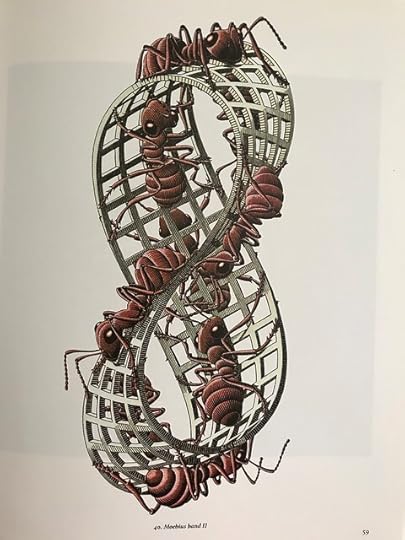
Imagine a strip. It obviously posses two opposite sides. But of you cut it, half-twist it and connect the ends you would end up with a Mobius strip. Something that defines common sense - an object with only one side combing the two. The initial sides are still separate and quite visible, but they are merged in one. This novel has reminded me a Mobius strip. Everything which appeared to be different, even opposite are seamlessly metamorphoses into each other. Time warps in a way that the past has become the future and the future meets the past. The characters seemingly different become similar, merge into each other, follow each other thoughts and actions… But only for an instance and then they separate again going their individual ways and meeting their separate fates.

Escher M
M.C. Escher

And I, while I am reading, I am like the ant from the famous Escher’s work, travel on the one side of the strip only to find myself suddenly and inevitably on the other. And all of this is going on a certain loop. And I do not know whether this loop is going to end. But I suspect that - yes. But I cannot say how. Though maybe I already know how from the beginning. But I still cannot say.

And this form, this ambiguity, but equally the discipline with which Fosse adhere to it is the work of art.

“Everybody has that feeling when they look at a work of art and it's right, that sudden familiarity, a sort of...recognition, as though they were creating it themselves, as though it were being created through them while they look at it or listen to it." That what Gaddis said in The Recognitions. He talked predominantly about the visual art. The big part of this book is also about this. What is “a good” picture? But I remembered Gaddis in connection with the novel as a whole. It feels “right” in Gaddis's sense.

And for this feeing, I could forgive Fosse what I perceived the weakness of the plot in this last part. The women characters there were all too possessive competing for the attention of the two relatively passive men. I could forgive him a cliche - a stream of visible white light coming through the window when someones dies…Though there was a minor female character, new to this part, that I found superbly crafted. She is possessive as well all right but in a less banal way. She is an old woman renting a room to the main character. She is a bit mad and a bit desperate lady, but at the same time full of style and energy. She reminded me of Miss Havisham from Great Expectations. I thought it was brilliant move by Fosse adding her to the cast of his characters. Continuing with the visual metaphors, if this novel was a painting it would be something in the shades of white, black and greys. This lady has splashed a little streak of red into the canvas.

I talked about the ideas in my review of the first part. In the rest of the novel, those ideas are amplified and developed. For me it seemed the novel has progressed more from the nature of creativity deeper into metaphysics, the nature of the Divine. In this part, the author more explicitly paid tribute to Meister Eckhart. “and if it wasn’t for him I would never have found words for closeness of God.” Those were the words of the main character.

“of course Meister Eckhart is right about how many of the people who don’t believe in God are people who really do, while the ones who are doing all kinds of things to show that they believe in God actually believe in something other than God, they believe in an idol, because they believe in good works, in repentance and fasting, in sacraments, in the liturgy, in this or that conduct bringing them closer to God, yes, most of those who are inside are outside, and most who are outside are inside, the first shall be last,…”

Indeed. “Those who are inside are outside…”. It seems, we are back on the Mobius strip.


PS
Just a few words about the translation into English. It is very good. It seems it conveys the cadence of the original. And it flows perfectly. However, I would be interested to find out what was in the original for “The Namesake”. It just somehow a bit of a narrow term. And I did not like “open-faced sandwiches” and “High Academic School”. I thought they use “butterbrots” in English and it could be understood. And high-school is just a high-school whether it is an academic stream or not. But all these things are not a big deal, just a pet peeve of mine as the words get repeated a lot in the novel.
Profile Image for Enrique.
603 reviews388 followers
March 5, 2024
Finalizada la saga de Septología. Tenía preparada una larga reseña, el enfoque, la filosofía, su recogimiento religioso, el desdoble de personajes, los tiempos, las sensaciones, la composición del puzle, y acabó siendo larguísima y poco interesante…. y finalmente no la elimino, pero me la guardo para mí.
 
Breve: como lector hay que probar la sensación y el intimismo que nos propone Fosse aquí, más que el qué, el cómo.
 
¿Es la mejor lectura de los últimos años? Creo que sí, salvando algún clásico que están a nivel de esta obra ¿Es una aventura y uno de los retos más divertidos como lector? Seguro que sí.
 
Recomendable, creo que de vez en cuando hay que probarse como lector, y que mejor manera que con esta maravilla, unos disfrutarán y no querrán terminarlo, como es mi caso, otros abandonarán en el primer libro. Solo decir, que al que no le gustara la Trilogía, difícilmente se encontrará cómodo aquí.
Profile Image for nastya .
388 reviews521 followers
October 5, 2023
Once more with less feeling

As the ending of this prayer nears and so is death, Asle is preparing for the unknown, anticipating becoming one with the god, his long gone wife Ales, his grandmother, friends lost.

Now seeing this work as a whole I feel... disappointed? Tricked? I was waiting to go somewhere, to have a point and this book wasn’t interested in it. It makes me wonder why stop now, why not publish another part every year? It’s more of the same and strangely after 800 pages of this meditation, the ending felt very rushed as if Fosse just woke up one day, decided he needed a boat and a dog and he doesn’t want to write this book any longer.

I was thinking, why did I like the first book so much if all of them are the same? And I think it’s novelty of cource, but also partly because the first part is lonely, with minimal character interactions. And here Fosse introduced us to a few relationships that are just badly written, especially every female character that is just a caricature, a jealous basic caricature. (The grand relationship was written as something from Ghibli’s Ponyo.)

The cadence of the prose was the only gimmick of this whole project and you can’t sustain 800 pages on one gimmick, you just can’t, when the whole work is a stasis.

I think there’s a good trilogy in this septology, perhaps duology.
What promised to be the highlight of my reading year ended in disappointment.
Profile Image for Alan.
719 reviews288 followers
February 4, 2023
I’ve been in hiding for a couple of weeks, but I am slowly creeping out of my hole. With that, at least, comes the end of Septology. I wanted to stay relatively free of literary criticism when I wrote my thoughts on this final volume of Septology (and Septology as a whole). That being said, I couldn’t help but notice the quote that Transit Books chose to publish on the front cover of each volume of the books: “Jon Fosse is a major European writer.” – Karl Ove Knausgaard. Every time I flipped the book shut, there it was. I thought to myself, hey, what an absolutely nothing, diplomatic bullshit quote to say huh? He said nothing more flattering about Fosse? That’s the quote we chose to go with? So I looked up “Karl Ove Knausgaard Jon Fosse” on Google, because I’m sophisticated like that. I found an article on Lit Hub, published in 2019, which outlined Knausgaard’s ideas on Fosse. Beautiful article. He speaks highly of Fosse, who was a teacher of his, apparently. A little bit of jostling going on between student and teacher? Who knows. Nevertheless, he said the following:

Fosse’s writing contains scarcely an idea, and not a scrap of provocation, the contemporary is toned down or else avoided completely, and although his work often approaches death and explores a kind of existential ground zero, it is never disillusioned and certainly not misanthropic, but full of hope. Fosse’s darkness is always luminous. Moreover, his writing presents no face towards the reader, but is quite open. Houellebecq’s writing reflects everything, throws everything back, in it the reader sees himself and his own time, whereas Fosse’s writing absorbs the reader, is something into which the reader vanishes, like wind in the darkness.

My experience reading this book (Septology as a whole, that is) was religious. Not in that vague sense that I myself am constantly guilty of using, saying “religious” to add some salt to “enjoyable”. No. It was complex, difficult, and often felt like a direct line of energy connected below, to the ground, to the plug that connected all humans, but also a direct line of energy connected above, to the hopes and dreams of all of us muddled into a pantheism informed by art and love. I thought about art as the calling that rules your life, whether you want to or not. I thought about talent and hierarchy within art.

I also felt a swelling in my chest, a slowly brightening glow, radiant, filling up my soul with thoughts of romantic love, the kind experienced by Asle and Ales. The kind that you can’t quite describe in words, a struggle that Asle had. He couldn’t put into words why the whole of his connection to Ales felt much greater than the sum of its parts. I must admit this is an idea that hasn’t left my brain for a while. I need to do more reading.

I thought about friends. There are some you stick it out with no matter what they do and who they are, and those that fade from your life over time. Perhaps you lose them to the flow of time, or perhaps they lose themselves in life and take the nearest exit out. Perhaps they drink a lot, and matter how much you hint, how much you tell, how much you plead, they don’t tackle the devil within.

For this volume of Septology? 4 stars. For Septology as a whole? Also 4 stars. A stimulating experience, and one that I think will continue to grow inside of me.
Profile Image for Hugh.
1,293 reviews49 followers
February 2, 2023
Deservedly shortlisted for the International Booker Prize 2022

This is the final part of Fosse's extraordinary Septology, and it follows the pattern of the previous parts (each section covering a day in the life of the narrator Asle in a long monologue with no sentence breaks) and further resolves some of the more confusing aspects of the previous parts. The focus this time is on the young adulthood of the narrator and his slightly older doppelganger (the other Asle) and their contrasting experiences of love and marriage.

The reasons why the narrator talks about his younger self in the third person also become clearer - he sees himself in the pictures his memory retains, some of which became paintings. His dead wife Ales is a much stronger presence this time, and it is clear that her strong will and faith was instrumental in saving him from the fate of the other Asle, and his decision to convert to her Catholic faith - once again each section ends with him reciting Latin prayers.

Meanwhile the foreground/modern story fades further into insignificance - much of the book follows Asle's thoughts and memories as he resolves to stop painting, and sits looking out on his favourite view of the fjord, until on the final day we join him and his neighbour Åsleik as they embark on the Christmas boat trip to stay with Åsleik's sister Guro.
Profile Image for Pavel Nedelcu.
484 reviews117 followers
April 7, 2024
BETWEEN ART AND GOD

In this monumental work, Fosse manages to reflect in the most delicate way on life, art, love, religion, choices made in life. The protagonist Asle, an old man passing through a critical moment, relives certain important moments of his life over a period of several days around Christmas.

With the Scandinavian fjords in the background and the Norwegian desert landscape providing a perfect basis for reflection, the painter Asle wanders outside and inside himself, on the verge of a major existential crisis, determined by the loss of reference points: on the one hand painting, Art, on the other Faith, both accentuated by the death of his wife, an event he never managed to get over.

Fosse's prose is hypnotic because he follows Asle's inner struggle in sentences hundreds of pages long, and because he repeats the key concepts and scenes in his discourse dozens of times, while also revealing, when less expected, novelties and plot twists.

That’s to say I believe SEPTOLOGY could be regarded as a universal literary masterpiece focussed on the exploration of the meaning of life. From this perspective, it stands alongside other monumental works that share the common theme of existential inquiry, such as Proust's "In Search of Lost Time" and Musil's "The Man Without Qualities".
Profile Image for Fabian.
136 reviews82 followers
July 20, 2024
Samuel Beckett's trilogy is about the physical decline of the protagonists, their increasing physical limitations and their constriction. Molloy, Malone and the Unnamable are people reduced to thoughts and memories who exist in paralysis. 

In Jon Fosse's heptalogy, the same applies to the protagonist Asle, but in his case this constriction relates to the psychological. The climax is reached in the conclusion "A New Name". What has been foreshadowed so far is brought to its logical conclusion: a painter who no longer wants to paint, a man who is left with only his memories, but who shies away from looking at certain places so as not to be reminded of the loss associated with them, who no longer likes the taste of food, who no longer takes off his coat to sleep and who focuses his gaze solely on a certain point in the sea. At the end of a life, there is tiredness, resignation. He finds support in his faith alone and so the transcendental level gains even more weight in this part.

But unlike Beckett's trilogy, which ends with the Unnamable, Fosse's work ends with a new name. Hope, which in Beckett's work is only present in its absurd form - "I can't go on, I'll go on" - is much more tangible in Fosse's work. The overlapping of the characters (Asle - Asle, Guro - Guro) illustrates - as in Beckett's books (Murphy, Molloy, Malone) - on the one hand the mysteriousness of life. On the other hand, it also shows the insignificance of the individual - and at the same time his significance. For all our interchangeability, we are unique: we may exist in many, but our respective consciousness belongs only to us. Or in Asle's case, to the reader. We take part in his life, see the world through his eyes, merge with him and after reading the last page, it is difficult to let go because we know that something great has come to an end.
Profile Image for Great-O-Khan.
466 reviews126 followers
January 23, 2024
"Ein neuer Name" enthält die abschließenden Teile sechs und sieben der Heptalogie des Literaturnobelpreisträgers Jon Fosse. In den ersten fünf Teilen wurden vier aufeinander folgende Tage (Montag bis Donnerstag) im Leben eines Künstlers dargestellt. Der sechste Teil führt die Woche nicht im eigentlichen Sinne fort. Er setzt einige Wochen später ein. Es ist zwei Tage vor Heiligabend. Es ist ein Freitag. In gewisser Weise wird die Woche also doch fortgesetzt, nur eben mit einer Pause zwischen Donnerstag und Freitag. Asle ist in einer künstlerischen und in einer religiösen Krise. Stilistisch sind wir wieder im Kopf des Künstlers. Das Buch endet am Samstag, zugleich Heiligabend.

Im ersten Band ging es um das Künstlerdasein, im zweiten um die Künstlerwerdung, im dritten geht es nun um den Künstler in der Schaffenskrise. "nein malen kann ich nicht mehr, da muss ich mit diesen Bildern in meinem Kopf eben leben" Inhaltlich stand im ersten Band der "andere Asle" im Mittelpunkt, im zweiten der Asle, in dessen Kopf wir uns befinden, selbst, im dritten die verstorbene Frau Ales. Das ist jedenfalls meine Lesart.

Die Bücher lassen viele unterschiedliche Lesarten zu. Dadurch wird das Werk aber nicht beliebig. In meinem Kopf ist ein ganz bestimmtes Bild und bei anderen Lesern wird es mit anderen Bildern genauso sein. Es ist eine große Kunst über mehr als tausend Seiten nur durch Sprache so zu fesseln. Die "Heptalogie" von Jon Fosse ist ein ganz großes Meisterwerk der Weltliteratur.
Profile Image for Ken.
Author 3 books1,239 followers
Read
June 9, 2023
Finally, completed the "sept" of the "septology" or, to be more accurate, the "trip" of the "triptych." For reasons Canadian-forest-fire-hazy, I think I liked this best of the three. It's not that the books are inconsistently written or the story line is any better, it's more me getting used to thee, Jon Fosse, and your crazy in the head narration.

Asle, I mean. or the other Asle, possibly. I'm sure all the dopplegänger stuff is beyond me, but I got used to the slides from present to past, to the record number of "and's" and, God help us, to the repetition.

You always knew when you were approaching the finish line of a section because Asle went all Latin on you. He even left me a few Meister Eckhart recommendations, only I forgot to write the book titles down. Probably, though, a German mystic and philosopher is way beyond me. Still, most of Asle's Catholic belief seems rooted in the good Meister.

In the final pages, what I was waiting for and got. All hell breaking loose mentally. Stream of consciousness turning to white-water consciousness and, ultimately, like a bolt out of the blue, it was over.

Bragi be with you,
Me
Profile Image for Neil.
1,007 reviews757 followers
March 29, 2022
“A New Name” contains parts 6 and 7 of Jon Fosse’s “Septology”. I think it’s necessary to start by saying that parts 1-5 are really required reading before diving into these final parts. Septology is best thought of as a single work that happens to have been published in three volumes and, for me, at least, it should be read as a single work. (Addendum: the Autumn 22 catalogue from Fitzcarraldo includes a single volume version of this). In fact, this is exactly what I have just done: I read parts 1-2, “The Other Name”, for the third time, immediately followed by parts 3-5, “I Is Another”, for the second time, immediately followed by parts 6-7, this book, for the first time. It took me 8 days but I have to say that I have never felt that 8 days reading a book has been so well spent: if there were a 6 star option on Goodreads, Septology is one of the rare books that I would put in that category.

It’s virtually impossible to write about this book without involving the other volumes and a review almost inevitably becomes a reflection on all three volumes. In all three, we spend time with Asle. Asle is a painter and each part of the novel opens with Asle looking at his most recent painting which consists of two diagonal lines that cross one another. Then, in all parts of the novel, we listen in on Asle’s thoughts as he recounts what happens to him in the novel’s present and reflects on key memories. And it is these reflections that make the novel so haunting, so thought provoking and so unique. One of Asle’s most important friends is also called Asle and is also a painter. Key to haunting nature of the book is the ambiguity about the relationship between the two Asles. At times, it appears they are the same person (and many reviews use the word “doppelgänger” which I feel is a bit misleading). At other times, it seems clear they are different people. This is one of several aspects of the books that are open to interpretation and that Fosse never sees a requirement to resolve. As the first Asle remembers events from his past, the other Asle flits in and out of the story, sometimes in the novel’s present, sometimes in the past. Sometimes it can be difficult to remember which Asle you are reading about (although one is generally “I” and the other is generally “Asle” which helps), but I think that is very deliberate on the part of the author. First Asle’s wife, Ales (another key feature of the novel is the similarity and repetition of names) features heavily (she died sometime ago and Asle has never recovered).

Asle’s memories lead to thoughtful reflections on the meaning of life, death, God, religion and art: this is a book about big subjects.

But what makes reading these books a unique experience is the prose style which is completely hypnotic and almost impossible to put down. There aren’t full stops (and this is one of the reasons it’s hard to put the book down because there are no obvious stopping places apart from at the end of each part), the narrative skips from one time period to another without warning, and the memories are not chronological. Not only are the memories presented non-chronologically, but there some kind of time-slippage in play where current Asle becomes involved in scenes he is remembering. Very early on in Book 1, Asle witnesses a scene in a playground between young Asle and Ales and it seems that he is physically present even though the event happened years beforehand. And in this book, during Book 7, we apparently re-visit that scene but seen, somehow, from younger Asle’s point of view and he is aware of the presence of someone who can only be older Asle. Again, Fosse sees no requirement to resolve these ambiguities and the novel is, for my tastes, much stronger because of that.

This is a work that I am sure will withstand repeated readings. As I said at the start, I have already read parts 1-5 more than once and I think that reading the whole of 1-7 is something that you could do again and again and each time you could lose yourself in the hypnotic prose and come out of the book feeling like something inside you has changed.

And you can’t say that about many books.
Profile Image for Juan Nalerio.
710 reviews159 followers
September 11, 2025
En las últimas dos décadas, Fosse, dramaturgo, poeta, ensayista, además de novelista ha ganado casi todos los premios que se le han cruzado por el camino, Nobel de literatura incluido. Hay grandes argumentos para esto. Es un autor de culto comparado con Ibsen y Beckett; tiene la severidad del primero y el uso de la repetición insistente del segundo.

Más allá de esto, su prosa pausada e hipnótica, su trama simple y hermosa llena de luz a sus lectores. “Un nuevo nombre” (Septología VI-VII) tiene un final extático. Asle, su protagonista entra en estado de arrobamiento, de euforia, se desconecta de la realidad exterior y su amada Ales, muerta hace años, le toma de la mano y lo acompaña, provocándole una experiencia interior, espiritual, mística y emocional que es trasmitido a través de un flujo de conciencia recargado.

La narrativa de Septología agita, conmueve hondamente. Leerla exige una actitud abierta; aceptar los pensamientos del personaje que sigue el misticismo del maestro Eckhart, sacerdote alemán del siglo XIII. Pasar página a página es una invitación a dejarse llevar por la corriente de la conciencia, así como la barca de Asleik surca las costas del fiordo de Sygne con Asle y Brage y dos cuadros para visitar a la hermana en navidad.

Tomando el conjunto de las siete partes, Fosse nos plantea conocer dos vidas, dos Asle, dos pintores que son dobles, dos versiones de la misma persona que transcurridas al mismo tiempo, con saltos al pasado y encuentros plantean un juego de posibilidades que pone en juego las subjetividades. ¿Qué nos hace ser quienes somos? ¿Por qué vivimos una vida y no otra?
Profile Image for Matthew Ted.
1,007 reviews1,037 followers
November 5, 2023
136th book of 2023. #12 in my challenge (read a trilogy): Alan and I decided this was applicable, being three physical books, though split into seven parts.

And the Septology is over. Oddly, this was my least favourite of the three, but by now, Asle's wandering thoughts were so familiar, they might have been my own. Yes, Bragi the dog, and yes, the boat, and yes, Ales, and yes, the Beyer Gallery, and so on. I found the ending underwhelming, on first reading, but when I returned to it and re-read it, later in the day and without nearby noise and distraction (the sanctity of a lamp-lit bedroom), I found it poignant. Even by reading this and his newest release, A Shining, I am happy that Fosse won the Nobel Prize this year.
Profile Image for María Carpio.
396 reviews362 followers
May 10, 2024
Luego de leer y reseñar las siete partes de esta Septología he llegado a la conclusión de que la resolución de esta novela es un enigma. Y eso es bueno, pues, como diría el escritor chileno Benjamín Labatut, sin misterio no hay buena literatura. Y es que todo eso que parecía en cierto modo evidente en la trama de esta novela, resulta que no lo es. Y tomando en cuenta de que "lo evidente" de esta novela ya es casi ausente, no porque su narrativa sea intrincada (que por más que sea cada libro un solo párrafo sin aliento, no lo es en lo absoluto), sino porque hay algo en lo profundo del espíritu humano que quiere representar, que se nos escapa a la razón. Y de eso también habla en esta novela -disquisiciones que considero medulares en este libro-, de la metáfora aclarada en la que compara a la pintura (y al buen arte) con el espíritu humano: aquello que es la perfecta correspondencia entre fondo y forma, entre materia y contenido, entre cuerpo y alma, entre objeto e idea. Esa dualidad que desarrolla de forma más específica en esta parte es la que resume lo que es este libro: la perfecta combinación de contenido y continente, de estilo narrativo y argumento, pero de aquello que va más allá de la simple trama y roza lo fundamental que, como diría Fosse en voz interior de su personaje Asle, es intraducible en palabras. Fosse/Asle compara una pintura con una oración, y este libro está llena de ambas. Pero, a la vez, Asle/Fosse piensa que son las palabras, esas mismas palabras, que nos han sido dadas por Dios como una especie de traducción del lenguaje único, de aquel que está antes de toda lengua. La fe sin duda es uno de los grandes leit motiv de esta obra, pero no confundirse con aquella idea de la religión que por desconocimiento (o desconexión) se tiene. No, la fe de Asle/Fosse no es una fe beata, curuchupa o mojigata. No es la fe de las formas, de la hipocresía social, de las moralinas y moralismos. No. Nada más alejado de eso que la fe de Fosse. Si puedo describirla de alguna forma sería una fe de lo esencial. El fundamento del espíritu humano. Obra recomendadísima y Nobel merecidísimo.
Profile Image for Marcello S.
647 reviews291 followers
November 12, 2024
Un'esperienza che è meglio fare piuttosto che farsela raccontare.

[89/100]
Profile Image for Seigfreid Uy.
174 reviews1,042 followers
June 15, 2024
a million stars to the whole septology. easily one of my all time favorites. that was just brilliance on brilliance on brilliance.

jon fosse, you are a national treasure.
Profile Image for Rudi.
172 reviews43 followers
January 28, 2024
Das wird noch lange nachhallen.
Profile Image for Chris.
612 reviews183 followers
April 7, 2022
Really good! It’s as if you’re in Asle’s head, following all his thoughts, musings, memories etc. I found it’s very recognisable, it’s how my mind works at least. And then there are the different versions of the same person, how people may have turned out if they had made different choices. This was a very fascinating and almost hypnotising read. It was the first book of the septology that I read and it definitely won’t be the last!
Profile Image for Ernst.
644 reviews28 followers
December 1, 2024
Ach wie schön, das hätte jetzt gerne noch weiter gehen können, im Finale tut sich ja noch so einiges, aber es ist ok, mit Fosse erstmal durch zu sein. Er wird ja bestimmt noch weiter schreiben und ein bisschen Fosse-lose Zeit wird mir auch guttun.
Profile Image for Darryl Suite.
713 reviews812 followers
May 23, 2022
Perfection. I’m not kidding: pure perfection. I’m going to reread this trilogy this summer. Again, not kidding.
Profile Image for Sini.
600 reviews162 followers
February 19, 2022
Met veel plezier las ik "Een nieuwe naam", het slot van de in drie boeken uitgegeven septologie. Het proza was net zo bedwelmend als in "De andere naam" en "Ik is een ander", met dank aan vertaalster Marianne Molenaar. En ook in dit laatste deel ging het weer volop over de raadsels van leven en dood, in een eindeloos meanderende zin, die zelfs op het einde van de roman niet eindigt in een punt.

We volgen de oude schilder Asle, in zijn meanderende mijmeringen over heden en verleden: mijmeringen over zijn geliefde maar lang geleden overleden vrouw Ales, over zijn dubbelganger Asle die in zeer kritieke toestand in het ziekenhuis ligt, over het peilloze raadsel van het leven en het al even peilloze raadsel van de onkenbare God, en over zijn geobsedeerde verlangen om dat raadsel als raadsel af te beelden in zijn schilderijen. Of liever, om de hem obsederende beelden, die hem "iets" willen zeggen zonder dat hij weet wat precies, om te zetten in "iets" wat hij dan nog een beetje begrijpt, zodat het raadsel van het leven tastbare vorm krijgt via zijn schilderijen. Schilderijen, die hij als een gebed ziet tot een onkenbare God, een God die zo ongeveer de ultieme personificatie is van het ontbrekende antwoord op de vraag "waarom is er iets, en niet veeleer niets". Een ondefinieerbare God Wiens aanwezigheid hij vooral ervaart in stilte, in duisternis, in leegte, in vertwijfeling, of in wat hij aanduidt als "nabije afwezigheid". En in paradoxen of in andere leemtes van de taal. Want Hij ontsnapt aan elke voorstelling en aan alle woorden. En juist de verbijstering daarover krijgt alle ruimte in Asles schilderijen, mijmeringen en gebeden. Al is hij in dit laatste deel het schilderen inmiddels helemaal moe en zat.....

"Ik is een ander" zoog mij minder mee dan "De andere naam", maar in het afsluitende deel "Een nieuwe naam" werd ik weer helemaal door Fosses stijl gehypnotiseerd. Die stijl moet je wel liggen, want niet iedereen zal houden van die eindeloze meanders en afdwalingen, vol met herhalingen van steeds dezelfde motieven of zelfs letterlijk dezelfde scenes. Maar ik wel, dus. Alleen al door die herhalingen, in een zin die maar niet tot een einde kan komen en die ook tussendoor nauwelijks tot logische voortgang of tot conclusies komt, wordt de verwondering van Asle sterk voelbaar. Er zit geen lijn in Asles mijmeringen, alleen geobsedeerde herhaling en afdwaling, maar juist dat geeft uitdrukking aan het raadsel van zijn ik en de wereld. En van zijn verbijstering daarover. Een verbijstering die nog extra wordt gevoed door Asles ouderdom, en zijn steeds verminderende greep op de wereld, die juist door alle herhalingen en afdwalingen extra voelbaar wordt. Meer nog dan in de vorige delen van deze septologie. Maar ook door de complexe aard van zijn denkbeelden. Want zijn geworstel met de onkenbare God, en zijn uiterst persoonlijke vermenging van katholieke liturgie met de negatieve theologie van Meister Eckhart, is naar mijn gevoel nog indringender dan dat het in de vorige delen al was. Zodat de God waarin Asle gelooft nog meer een belichaming wordt van het ontbrekende waarom, van de onverklaarbaarheid en onbegrijpelijkheid van al het bestaande, en van alles waar taal en rede geen greep op hebben. En zodat zijn schilderkunst nog nadrukkelijker een worsteling wordt met de ongrijpbare God. En ook een gebed tot hem, en het medium bij uitstek waarin Zijn Afgrondelijke Ondoorgrondelijkheid op raadselachtige wijze kan glanzen.

Dat alles charmeerde mij zeer. Bovendien zit "Een nieuwe naam" vol duizelingwekkende scenes, waarin het heden (de oude Asle, vanuit ik- perspectief, kijkend naar steeds hetzelfde punt in de zee vanuit het raam van zijn koude huis) vervloeit met het verleden (de jongere Asle, vanuit hij- perspectief). Alsof het verleden hem in het hier en nu bespookt als een obsederend beeld, dat hem "iets" wil zeggen zonder dat hij weet wat. Alsof zijn lang geleden overleden Ales weer bij hem is, en hem ook toespreekt en aanraakt en troost, maar als nabije afwezigheid. Of als even droeve als troostende droom van een oude man die zijn einde voelt naderen, wat niet alleen een droom is van een onherroepelijk einde maar ook een droom van hoopgevend - hoewel onbegrijpelijk- licht. En dat vlak voor Kerstmis, het feest van Jezus' geboorte en de voor Asle zo onbevattelijk hoopgevende menswording van God. Ook lijkt het soms alsof hij bijna versmelt met zijn dubbelganger Asle: eveneens schilder, eveneens geobsedeerd door beelden, identiek aan de Asle die deze andere Asle voor zich ziet maar toch heel anders. Alsof Asle ook een heel andere Asle had kunnen zijn, met een heel ander leven. Alsof dat leven dus gestuurd is door toeval, of- zoals Asle zelf soms denkt- door de in raadselen gehulde voorzienigheid. Fascinerend raadselachtig zijn de scenes waarin de oude Asle naar de jonge Asle kijkt, en de jonge als het ware weer naar de oude. Zodat heden en verleden, of droom en werkelijkheid, voor even versmelten in een rationeel niet te bevatten totaalbeeld. Fascinerend raadselachtig zijn ook de scenes waarin de oude Asle als het ware van binnenuit ervaart hoe zijn dubbelganger in zijn ziekenhuisbed bespookt wordt door zijn verleden, en hoe dat verleden en zijn heden vermengd worden in totaal koortsachtige en bijna spasmodische hallucinatie, die ook de taal enkele bladzijden lang volkomen ontregelt. Waarbij je niet meer weet wie er ontregeld raakt: de oude Asle die deze scene droomt, zijn dubbelganger die in het ziekenhuis ligt, of beiden. Ook dat levert een onbevattelijk totaalbeeld op, vol betekenislagen en verdubbelingen en doordesemd van mysterie. Een totaalbeeld dat misschien alleen Asle bij benadering zou kunnen schilderen. Of dat misschien alleen Fosse kan schilderen, maar dan in woorden.

Wij ordenen en begrijpen de realiteit in korte zinnen met punten, of in iets langere zinnen met voegwoorden als "dus" of "omdat", en die zinnen verbinden we dan in samenhangende alinea's. Fosse daarentegen laat zijn hele septologie bestaan uit een eindeloze en meanderende zin zonder punt en zonder logische lijn, en daarin maakt het verbinden en begrijpen plaats voor een verwonderd beschouwen dat niet eens waagt te willen begrijpen. Dat verwonderde beschouwen wordt met dit laatste deel passend afgesloten. De mijmeringen over kunst en de onkenbare God uit de vorige delen worden in "Een nieuwe naam" op fascinerende wijze verder uitgediept, maar worden daardoor des te verwonderlijker; we komen meer te weten over Asles dubbelganger, maar dat vergroot juist diens raadselachtigheid en die van Asle zelf; we leren meer over Ales, maar voelen daardoor juist des te meer haar nabije afwezigheid. Een heel boek lang kijken we bovendien mee met een ik- figuur die verwonderd en niet begrijpend staart naar een stil en duister punt in de verte, en in zichzelf. Aan het einde van "Een nieuwe naam" voel ik kortom vooral veel verwondering. En juist daarom is het een passend slot van Fosses intrigerende septologie. Een septologie die ik misschien nog een keer achter elkaar en zonder pauzes herlees, wat mijn gevoel van verwondering vast nog zal vergroten.
Profile Image for Dax.
336 reviews195 followers
March 29, 2022
This final installment of Fosse’s Septology continues the unique reading experience that was created with the first two books. It could be said that Fosse’s approach grew even more experimental with some of the prose and stream-of-conscious style. That being said, this one felt slightly more flat than the first two books. Maybe I became a little fatigued with the style, maybe Asle became a little tiresome at times. It certainly felt more rushed; as if Fosse was a little tired of the project himself. The ending felt half fleshed. The Septology as a whole is excellent, but ‘A New Name’ is just good. This review probably sounds overly negative, but that’s only a result of my high regard for Fosse. All literature lovers will enjoys this. Solid three stars.
Profile Image for Daniel KML.
116 reviews31 followers
November 3, 2021
[The following text is the result of a quasi dream-like state of insomnia-induced imagination]

Excuse me, Mr. Fosse, please, accept my apologies — I’d like to take advantage of today’s event, of the fact that I’m finally meeting you in person to tell you that I believe that you produced one of the greatest works of art of the 21st century. Please, accept my apologies for maybe taking too long to say many of the things that I’m feeling towards your work. I hope that the people here queueing will not mind waiting a bit longer to get their book signed. I believe that you have managed to produce something quite unique with your work, Septology, Mr. Fosse. You have managed to maybe redefine what a novel can be, what a novel truly can express. It is very hard to describe with simple words what you actually have achieved with your latest book. Maybe, maybe it is the slow prose, the spiraling phrases, the hypnotic cadence and pace in your text, your use of simple words — a very banal prose that feels very immersive. A prose that actually made me feel like experiencing the main character’s mind — your work allowed me to have a true glimpse of his spirit, I think, I really felt like gaining access to some inner essence of him, to his invisible uniqueness, to what actually is supposed to be his being.

It felt very different. And this produced a chain of reactions that I was not expecting from reading your book. It is just like when…when the main character is staring at the sea, reflecting on his past and the way the images and memories crystalize, it is truly, truly something different. And I think that that is probably the result of your prose, of your choice of words, the constructions you make with the text rhythm, your way of making everything so interconnected, but at the same time going in all different directions. And it really felt different, it felt divine. And the way you convey that divine feeling, saying that it is actually very difficult to define what makes good art, and that good art is very related to the divine because you can’t express it in words, but that when you see it you know it, when you feel this uniqueness, when you feel this merge of both form and content, of body and soul, then you feel that you have something naturally divine in front of you — the fullest feeling of sublime. And that is what I felt by reading your work, by reading your books, by reading your prose. And this is all very impressive, I think, your translator as well, I think, he also took part in this almost mystic endeavor and, congratulations to Mr. Searls for such a brilliant translation. The many encapsulated essays on the book helped to build that feeling, so many thoughtful reflections — I would even call them revelations — on the divine, on the nature of the sublime, allowing me to experience what a religious feeling really can be, what a religious feeling can produce. And, um, look, don’t, don’t take me wrong, I’m not a religious person. I mean, I think I understand the role that religion can play in society and in the life of a person and the sense of community and the rituals and so on and so forth, but by reading your book, by reading your reflections on religion, on the divine, on God, on mortality, on the way that the character relates to that, well, I actually went to a mass because of your book. I went to a catholic church after so many years. I wanted to feel it and I think that the way you phrase it, the way you articulated this religious experience, I was able to feel it somehow — I had never felt anything as religious as reading your book.

I have to say a bit more on your prose rhythm and your choice of words, the way you space the ideas, the way you write the dialogues, the way you make them hypnotic. There is this specific moment in the first volume, in which there’s a couple playing in some kind of playground, somewhere near some woods, and they are playing with the swing. Then after the swing, they start playing with the seesaw. I’ve never had a similar reading experience as when I read the almost poetic way in which you described this couple playing and I actually felt like I was in some kind of textual seesaw, I think. And to think that I was struck by so many sensible feelings only by reading a passage on a couple playing in a playground. That was the effect of the way you distributed the words, the way you constructed the phrases, the way you built a very beautiful and poetic description, actually making me feel as if I were there, actually going up and down in a seesaw, with that couple.

And on top of those reflections, I mean, I’m not going to get into the doppelganger thing, right? The absurd dialogues, the Beckettian elements, both Ales and Ales, the alcoholic, and the other that turned out to be a successful artist. I think that that added a very nice dimension to the book, but I would not say that that is what made it special. What really was special, I think, in regards to those multiple characters, appearing and fading out, and fading in again, I think that rather the way they fade in and fade out, that felt magical, the way some characters appeared as ghosts in some scenes, that felt special, that felt haunting.

Well, and then there are the reflections on art — I was really touched by what you said that the artist is always trying to paint the same picture or to write the same book over and over again and that every book or every painting is an iteration on the previous one. And that you are just trying to get this thing out of yourself, right? It can either be a picture, a message, a story, a form, or some kind of content, right? And I believe that you actually managed to produce a perfect piece that combines form and content, body and soul, i.e., the spirit being received by God, and maybe you don’t need to write any books anymore because you did write the one final book.

Well, there are so many things to tell about your work, Mr. Fosse, and excuse me, apologies for taking such a long time here. And, well, I really don’t have words to express it. It is really magical. It is really mystical. It is just different, different from everything else that I have ever read. When I got my hands on the third and final volume — I never looked forward so much to reading a book — and when I opened the first page and when I started reading the first paragraph, I actually started reading it out loud, out loud to myself, out loud to feel the hypnotic intensity of your prose, out loud so that tears started rolling out of my eyes. And, well, I had never felt anything like that by reading a book, the very first moment at the very first page at the very first paragraph, having this urge to read it out loud, and many, many times I caught myself reading your book out loud. And during that last part where the character has this kind of final incantatory stream of consciousness or whatever you call it, or a divine revelation, or, you know, that old cliché that people say that when you’re close to death, you see all your past moments flashing by. That is how I felt during those final pages of the book. And I actually read it out loud several times, several times and read it out loud, that final part, that flashing moments of life part, and I recorded my voice and listened to it, and read it out loud again, and it was so powerful, so moving, I would even say that maybe it was like taking some kind of mild psychedelic drug, absorbing this different mental state, and, this is it Mr. Fosse. I’ll really stop here, and, I would just like to thank you, for this unique existential journey, from my inner intellectual self, from my, if I have one, soul, thanks for letting me to actually feel as if I had a soul, that I have this thing that is connected to my body and mind, and form and content, this divine spirit, this sublime feeling — looking at something and actually feeling that there is something else that is just unexplainable, something very hard to define with words, this something else. And that is represented in your work, it is there. Thank you very much, Mr. Fosse.
Profile Image for Christopher.
333 reviews136 followers
Read
February 21, 2023
This book has become lodged in my head, I think, and if I’m going to get it out, I’m going to need to write it out of my head, that’s for sure, I think, and I think that the entry point for my own understanding of this book is the reconciliation of the doubling of the characters, I think

And now, I see Asle and the other Asle wearing the same black coat, the same brown shoulder bag, with the same long hair, and I think, unless there’s further description to differentiate them, they must be one and the same, yes, of course, but then I see that one has married Liv and Siv and has had three children and drinks himself to death, while the other has married Ales, has had no kids, has stopped drinking, and has had a successful career as an artist, I think and I think that the author knows that the reader will inevitably be forced to reckon with these ideas and will begin to do that according to the conventions associated with writing, namely a realist narrative, I think, and I think that under those conditions the reader will be forced into the position that Asle is hallucinating or that there really are two Asles, both who paint and so on, yes, of course, and the first position doesn’t seem to be attractive because the Asles meet and there seems to be enough information to suggest that the Asles are distinct, but the second position doesn’t seem to be attractive because if we accept two Asles, then we also must accept two Guros, and we must accept Liv and Siv, and we must accept that Asle and Ales contain the same letters and that soul mates meet each other in a coffee shop and come together and etc. I think, and I think this is abhorrent in a realist novel, not to mention that the first Asle doesn’t speak much, no, he often falls silent when he is around other characters especially when there are difficult things to discuss, and no, that doesn’t square with his memory of some deeply personal experiences of the Namesake Asle, for example, the scene where the Namesake Asle returns home to find his wife Liv has overdosed, I think, and I think there is no way he would have this information so this leads back to the first interpretation, the hallucinating narrator, how else would you explain Asle remembering a younger version of himself commenting on his current self driving past him and observing him without solipsistic hallucinations?

But no, maybe there is a third thing, another way of looking at these two interpretations and holding their contradictions both in mind as truer than either of the realities, a sort of koan or thought-generative paradox narrative picture whose reflection reconciles that we are actually unknown to ourselves as we grow older, as we edit our own memories through repeated narration to ourselves using the aid of images, pictures, paintings, diaries, remnants of permanence whose information is lossy-encoded by virtue of time moving forward and the impossibility of total recall for most, I think and I think that third way of interpreting the text must take into account the reflections on God, yes, of course, they’re too big a part of the book to ignore, that’s for sure, so maybe this third way is like a prayer or a meditation, something that uses prior forms but whose unity of form and content produces something entirely unique, something unnameable

And now I see that Asle re-experiences many things that involve bifurcations, points at which things could have been otherwise, I think and I think that life is like that, I think and I think there are many things that we regret doing, choices that we made that we wish we could unmake (like writing this review in a terrible mimic of Fosse’s style) and ways that we can actually remake ourselves and convert to new ways of life and new thinking that can make us into different people, yes, and there’s also many places to revisit in the text that will make another reading yield a more coherent, or possibly less coherent interpretation, yes, I seem to remember in the first installment, the other name, some talk about two selves, the self of the body or the historical self (the self who is composed of the series of facts and events that actually occurred) and the soul-self, the spiritual side, the self that is changeable moving forward, I think and I think there it is, the two selves, the Asle and the Ales in each person, and maybe the girl with the long dark hair is actually Liv, and the Guro that lives in Bjørgvin actually had another name at one point in the retelling (so Åselik’s Sister could be the only historical Guro), and that St. Andrew’s cross is also St. Andreas cross at the beginning of section VI of a New Name, and that there is a nearness and a farness that is captured throughout this text in a way that is unbelievable, and that maybe that third interpretation is really possible and now I think that I should really stop because despite all of this, I really need to drive to Bjørgvin again to visit Asle, I think

And now I see that the painter has single images while the writer has many successive images in a single work, and that the reader becomes another type of artist in the interpreting of the work of art, yes, of course and that the writer writes the book and it is a single book and the reader reads the book as many times as they want and that it’s never the same book even though it is the same book
This entire review has been hidden because of spoilers.
Profile Image for Luis.
69 reviews9 followers
July 17, 2024
Finalizado el último tomo de Septología. Un genio Jon Fosse. Una experiencia de lectura única.
Displaying 1 - 30 of 370 reviews

Join the discussion

Can't find what you're looking for?

Get help and learn more about the design.