Award-winning Filipino comic, and now hit Netflix anime series!
In a neglected area of Luneta Park, a man is found strangled by the weeds and vines.
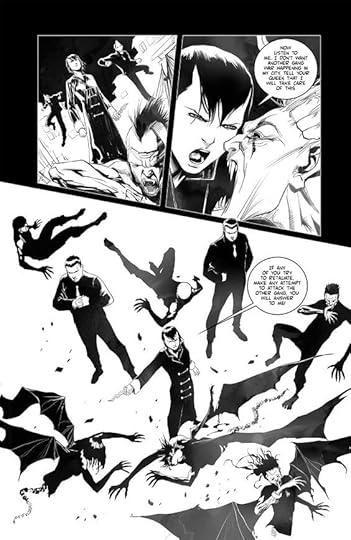
Across town, a murdered manananggal is about to spark a supernatural gang war.
Over at the university, a strange illness is driving college students mad with despair.
At the harbor, demons have gathered to watch the country’s greatest boxer fight for his very soul.
Foul play. Magic spells. Supernatural criminals.
When the case takes a turn for the weird, the police call Alexandra Trese.
Trese Vol 4: Last Seen After Midnight contains 4 stories from the case files of Alexandra Trese:
• CADENA DE AMOR • A PRIVATE COLLECTION • WANTED: BEDSPACER • FIGHT OF THE YEAR
Each features updated/remastered artwork, as well as bonus material, including Alexandra’s journal entries chronicling her creature encounters and more.
Budjette Tan is the writer of the award-winning comic book TRESE, which he co-created with his partner/illustrator Kajo Baldisimo.
TRESE has been adapted into an anime series by Netflix.
He was a founding member of ALAMAT COMICS in the 1990s.
He's also the writer and co-creator of THE DEMON DUNGEON / DARK COLONY books, which he made with Bow Guerrero and JB Tapia.
He was also the co-editor of the KWENTILLION scifi/fantasy comics magazine (published by Summit), the UNDERPASS horror anthology (Summit), and SOUND: A Comic Anthology (published by Difference Engine).
Another great volume of stories. Trese helps the local police solve murders and takes on more mythical creatures in the process. I love that she is just an accepted part of the community/society and there's not any friction between herself and law enforcement. I know that supposedly adds another layer of tension to other stories, but it's part of what makes this a breath of fresh air for me.
If you haven't been reading Budjette Tan's story or looking at Kajo Baldisimo's art, you're really missing out. Recommended.
The book was so highly anticipated that I’d be tempted to give it a full five star rating. The build up to the launch Trese 4 was so hyped that I fear it may fall flat. But that was no need; it was well organized and coordinated that almost all National Bookstore branches had copies two days after the event.
Budjette Tan and KaJo Baldisimo bring their A game in Trese 4. KaJo even improves here, his drawings are crisp and detailed his fight scenes bloody with flying sweat and blood and his monsters fearsome. The book has four stories and two stands out for me.
SPOILER WARNING
Of the four tales, Fight Of The Year opened potential subplots that can be explored further in Trese. It introduces Sytan, who is the devil of the Trese universe and his existence alluded to in earlier Trese stories. I feel retaliation is coming after Trese burned his illegal businesses. There is also Manuel, what if he finally loses a fight? So many story possibilities and I hope to get answers soon in the next Trese book, whenever that may be released.
Cadena de Amor1 star – I just did not get this. The story is about an old woman who can spread vines (that reminded me of a recent read The Ruins that I really liked) like spreading dust at Sahara Desert. There is a scene when the responding police said: “I should’ve brought the lawn mower!” Hello, the lawn mower is for grass and not vines. Then I just did not see the connection of the old woman and Florabelle who was abducted by the hooligans aboard the ship, and the old woman. Why would the old woman want to kill Florabelle? And if she is all-powerful, why did she not know that Florabelle is already dead? Also, the man who painted for Trese to see where Florabelle was? I saw that already in that TV series, Heroes. Hey, have some originality!
A Private Collection2 stars – One bored man whose new car is losing its fragrance resorts to killing mythical creatures just to have fun. This just don’t make sense. Too shallow. However, the storytelling is taut and the fight scene is well-drawn, so it’s okay. And of course, I work at Emerald Avenue so I kinda was able to relate to this.
Wanted: Bedspacers4 stars – I really liked the storytelling including the lady character Bangungot seems like an original concept but the idea of somebody clutching one’s heart that is mistaken for heart attack has been used in a Hollywood horror film (Jeeper’s Creepers?). Also, if Bangungot is a woman, why not Bangungat or Bangunget? Aside from these, I tried finding other faults here but could not find any. Good job on this one, Budgette Tan and Kajo Baldisimo!
The Fight of the Year - 2 stars – I am no fan of Manny Pacquio and I found this story utterly corny. However, the saving grace here why I did not give this 1 star (in GR, means I did not like it) was the make-over of Trese. She appeared in a party here with coiffure hairdo, fully made up, and wearing a black sexy dress with half of the upper breast exposed. I did not know that Trese, whose daily hairdo is like that of a balding old woman’s, can look delicious too.
I still prefer Books 1 & 3. Book 1 because of its brilliant spin on Darna and the nuno inside the manhole at the Balete. Maybe the reason why old nuno looks malnourished and sickly is because of the odor and garbage inside the sewers here in the Philippines. Unlike the sewers in the US where some action stars can go and hide when they are being chased by the police. Here, we cannot do that because our manholes are full of garbage, the floodwater cannot even enter them.
I also liked Book 3 (my favorite so far) because of its innovative and unpredictable plots.
However, this Book 4 is definitely better than Book 2. Also, the best thing about this Book 4 is: the book binding. It is a lot improved and it even comes with a shiny dust jacket. I should have rated this with 2 stars but I am adding another star for the sturdy book binding. At least, the pages do not get detached while you read the book for the first time. Good job, Visprint, Inc.!
When I finished reading Trese a few months back, I was very excited to read the next book. Truth be told, I thought the fourth book was already out last year, so I added it in my Christmas wish list. Oops, my bad!
So I wasn't exactly sure when the next installment would be out, but I wasn't really in a big hurry because there were still too many books on my TBR. However, I admit to letting out a squeal of delight when I heard of the launch of the fourth book. Of course I will be there. Of course I need to get it. And of course, I need to get them signed. :)
Trese 4: Last Seen After Midnight follows the same format of the first three books: 4 short stories each showing a case. But unlike Book 3, Mass Murders (my favorite), the cases were not connected. This is not a bad thing, and I wasn't really expecting them to really continue on what was shown in the third book, although I know some people who would like that.
But then again, who cares? The fourth Trese installment is just as good as its predecessors, and possibly even better. The cases still deal with paranormal creatures from Philippine mythology and more. This time, Budjette and KaJo made use of pop culture and melded it into the cases flawlessly. Cadena de Amor got me humming Eraserheads' Ang Huling El Bimbo as it reminded me of a recent murder case that hit the TV and newspapers everywhere. The Fight of the Year is undoubtedly based on Manny Pacquiao, and I really loved the explanation they gave on why crime rate goes down and why the boxer, "Manuel" fights so hard. Oh, and how can I forget -- Alexandra Trese in a dress!
A Private Collection was written as a Trese short movie that didn't push through, so there were more action scenes involved in this case. This is probably the one where I saw Trese in her angriest, and the one I felt most nervous because I thought she was about to get beaten. I'm curious now to see how this would translate to a movie -- must be really, really cool. :)
But my favorite (and I think everyone else loved this one too) was Wanted: Bedspacer. In this story, Budjette and KaJo gives us a different version of the bangungot. Common knowledge translates bangungot to nightmare, but Philippine mythology equates this to the batibat, a fat spirit that chokes their victims as they sleep by sitting on their chests. However, in this story, the bangungot is a spirit that joins sad people in their loneliness, trying to keep their hearts from breaking by holding it, sometimes too tight that the person dies. There were no hardcore action scenes here, just some sleuthing and a sad revelation when they find out what really happened. I thought this was the one with the best plot, a great resolution, a reference to something that Trese did in book 3 and possibly even hinted a past heartache for Trese. :) This is why when they asked if Trese should get a romantic interest, I'm all yes! Not because I'm a girl, but because I think it would give Trese's character more depth. I'm not saying she has to have a boyfriend -- unrequited love has always been good writing material. :P
Mass Murders is still my favorite Trese book so far, but Last Seen After Midnight truly delivers. If you haven't read any Trese books yet, well this is the time you should, because you're missing out on a lot. Is it too early to say "I can't wait" for the next? :)
Definitely one of my favorite volumes! Tan and Baldisimo really took so many aspects of contemporary Filipino culture and said, "Let's make it fantastic!" Their creativity is unparalleled.
I was first introduced to Alexandra Trese and her Kambal from a friend of mine who is a fan of Budjette and Kajo, the same guy who fell in love with the metaphor of The Clinic in the Underpass Comics (read his blog here)
He then forwarded me to this blog to get to know Trese better.
She is awesome.
Budjette and Kajo's black-and-white-way of retelling Philippine folklore has a different tone from CLAMP's storytelling of Japanese folklore through Yuuko and her explanations to xxxholic. While Yuuko is considered the witch of dimensions whose own time has stopped, Alexandra, better known as Trese, is considered to be a mandirigmang-babaylan - A warrior and a shaman in one.
I first read this fourth volume while waiting for a friend in Powerbooks, planning to watch Hunger Games with his treat. Last Seen After Midnight introduced me to four cases that Trese handled as the crimes and investigations turned for the weirder, bleaker and darker. And that is the first volume I've read of all her escapades.
At first glimpse of these gothic panels, everything is simply cool. The coolness made me mass-hoard Trese's comic adventure during 2012 Summer Komikon and buy the first three volumes to get to know her better.
While the first thirteen cases are not-so-different from these four cases in the fourth volume, I shall make a different review since they are of different-feel from this one.
Cadena de Amor ended with two stars rating, not because of the cliche case of kidnapping women to be prostitutes abroad, but because of abrupting its ending. The justice was not delivered effectively thus the story hinted that the underworld will seek its balance, in its wicked way. This is not good for kids especially those who are enlightened that the Police/Justice System advocates the rights of the women. For me, it would be much better if the police would shut down the ship's operations, or would arrest the captain.
A Private Collection - ended with three stars. It has a different feel of gang war between creatures of the underworld. This enlightened me that they have human emotions too. What if we encounter an aswang-manananggal-gang-war? What if they battle flesh-for-flesh? Not knowing that the main resaon is the guy who is just enjoying the game of hunting and collecting stuff. Ridiculous as it may be, it made me curious.
Goosebumps! If I was Trese I would lose my cool from seeing Kambal disappear before my very eyes. By the way, I was introduced the first time to NUNO SA MANHOLE here. HE LOVES SWEETS just as I am. Does this mean...? AHAHAHAHAHAHAH, nevermind.
Wanted Bedspacer is the most alluring story and won me with five stars. The story is totally original. The characterization of Bangungot as a lonesome woman who holds the despair of men - man, that's unique! This gives the reader a wonder what one is feeling if he has the symptoms of suicidal tendencies. This awakens the teenage readers that breaking up is hard to do, heheheheh. And for a Matrona Reader that I am, this is my personal favorite amongs the four cases.
The Fight of the Year ended with four stars since it gives meaning to the parody of our People's Champ Manny Pacquiao. You have to read it to see what I am trying to type in this review (but I do not want to spoil you, since, I guess, this is Budjette and KaJo's treat for you). Plus, the sexy-chic-look of Trese... imagining Scarlett Johansson as the Black Widow.
I shall be waiting for Trese's escapades in the next nine volumes, since the creators recently planned to release 13 Trese Komiks. Kudos to Budjette and KaJo for making storytelling of Philippine folklore appeal to the current generation. YAY! :D
I was first introduced to the Trese series by a colleague of mine at the university I'm teaching at, who chose to discuss the comics as part of her class. She encouraged me to read them, and I was immediately hooked. I love mythology and folktales and horror, especially local ones. And I also love Mike Mignola's Hellboy, so falling in love with Trese really wasn't so hard.
But to call Trese a "Filipino Hellboy" would be doing a great disservice to its creator and writer, Budjette Tan, and its artist, KaJo Baldisimo. For one, the stories told and the way those stories are told are simply not in Mignola's style, or anyone else's for that matter. As I mentioned in another review, Tan's storytelling is very Filipino. There is a cadence, a rhythm, in the way he tells the stories that is rather unique to the way people tell stories in the Philippines, particularly the scary ones. And Baldisimo's art, while somewhat similar to Mignola's in that he also relies on chiaroscuro to create a specific look for Trese, his art is more fluid, less blocky, with fine, delicate lines adding and highlighting movement. To reiterate something I mentioned in the other review, Baldisimo's art looks like the city of Manila under the light of streetlamps, where those streetlamps exist. It's a very unique look, and Baldisimo captures it perfectly.
Three collections come before Last Seen After Midnight: Murder at Balete Drive, which introduced the world to Alexandra Trese, the Kambal, and the Manila they inhabit; Unreported Murders, which expanded on what was presented in Murders at Balete Drive and created set-up for what promised to be a collection full of revelations regarding the Kambal and Alexandra herself; and then Mass Murders, which did indeed prove to be very revelatory, explaining the Kambal's origins, as well as how Alexandra became Manila's newest protector.
With such excellent stories already told, it went without saying that readers wanted to know what happened next. Mass Murders raised many questions: where is Alexandra's grandfather? What happened to her brothers? Will any of them be showing up anytime soon? Is the Talagbusao gone for good or will he be making a comeback? Those were just some of the questions raised after Mass Murders, and many - or rather, I - was hoping I would get some answers.
Last Seen After Midnight turned out to be something else entirely, more like Murder at Balete Drive: a collection of cases with no connection to each other or to any greater story arc - or at least, a previously written story arc. While this is rather disappointing, the stories themselves are well-told, and fascinating all on their own.
Part of the reason why these stories are so interesting is that Tan draws upon Filipino pop culture and history - both past and recent - to form a basis for his stories, blending them with the eerie, shadowy creatures from myth and folklore for a world that is easy to get lost in. For instance, in the first story, "Cadena de Amor," Tan references incidents as reported in the news, as well as the ancient, older folklore about engkantos, sets it in a familiar place (in this case, Luneta Park and the Bay area), and throws in a popular song by the Eraserheads as the cherry on top of all that goodness. This is classic Trese at its finest, and it's a very strong way to open the collection.
The next story, "A Private Collection," did not prove as strong as the first one, mostly because it's central antagonist is not exactly a figure that's common in Filipino pop culture or folklore.
Fortunately, the third story, "Wanted: Bedspacer," returns to more familiar ground: the concept of the bangungot, known to science as Sudden Unexpected Death Syndrome, or SUNDS for short. Just like in "Cadena de Amor" and other Trese stories, the locations are familiar (especially to college students, who form a large bulk of the readership of Trese), and almost everybody knows what bangungot is. This is all well and good, and very familiar, but the way Tan has conceptualized the bangungot is a clear echo of Asian horror movies - something which might raise a few eyebrows.
Despite this similarity, however, "Wanted: Bedspacer" might be viewed as a more direct continuation of the events in Mass Murders than the other three stories in the collection. If only for this link, any similarities to Thai horror movies might be forgiven.
But the intertextuality of Trese, already made clear in each and every story up until this point, reaches a peak with the last story in Last Seen After Midnight, titled "The Fight of the Year." This story is unique in that it is set outside of Manila, in General Santos City - and the location should already give the reader a very good idea as to who the main character (aside from Alexandra, of course) is in this story.
The level of intertextuality in "The Fight of the Year" - and indeed, in the Trese series as a whole - is the main reason why this series is so entertaining. Teasing out the references, reading the implied threads of meaning, is all part of the fun - and all part of why this series is as good as it is. To understand Trese, one has to understand, at least in part, the Philippines as it is today, but one also has to understand the Philippines as it was in the past. The reader can only see and appreciate the hidden threads of thought and reference in Tan's stories and Baldisimo's delicate black and white images if they are familiar with the Philippines - Manila, more specifically - as it was then, and now. And if the reader does not, then they are missing something great and wonderful indeed.
5 stars out of 5. And it's just getting better and better!
Each time I read a volume of Trese I always have high expectations and with all honesty, the book is not a let down. It's like the story and the art just keeps on improving every volume. This volume is just as good as its predecessors. This volume follows some new adventures of Alexandra Trese and the Kambal (Twins) in helping the authorities solve crime of supernatural causes in Metro Manila.
The first story, Cadena de Amor, follows an old woman who has the capability of spreading vines. The second story, A Private Collection, is about a rich hunter who collects mythical creatures. The third, Wanted: Bedspacers, is about a new take on Bangungot (Nightmare), more of who ant what causes it. And lastly, The Fight of the Year, a story about a boxer who made a deal, selling his soul for rich and fame, with a rich man that he'll fights mythical creatures each year to save his town being one of the most awaited event where the demons and creatures of the underworld converge. This part opened a potential subplots with the introduction of Sytan, who is the devil in the Trese universe who for sure will retaliate after Alexandra burned down on of his business.
Among the five stories, it's the story of Bangungot that I enjoyed the most. I like the originality of how the book interpreted why people die from sleep. In the book, bangungot is interpreted as a spirit who joins people who are going through tough times, the spirit goes with the person, trying to keep their hearts from breaking by holding it, sometimes too tight that the person dies. It has this romantic vibe that I really enjoyed. And the artwork interpretation is again, commendable. In terms of artwork, the last one really is for me the one that has the most impact. The author and artist also finally decided to do a make over of Trese when she attended a party. She appeared in the party fully made up and wearing a sexy black dress. It will no long be a surprise if in the coming volumes we'll see Alexandra having a romantic interest. All hail!
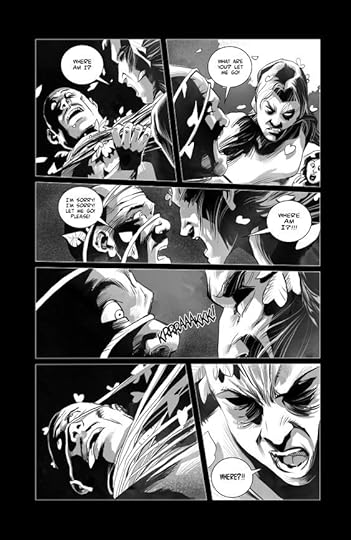
This volume has more action scenes than the previous volumes and the artwork really did give more intensity to the fight scenes. I noticed that the drawings are now more crisp and detailed. The intensity of Alexandra being nearly beaten really got me at the edge of my seat.
One of the best thing also about this volume is the book binding. Aside from it's sturdier, it now has a plastic dust jacket which I didn't notice when I first got my copies.
This volume still continue to use its well-tested formula of mixing pop culture and Philippine general events plus the touches of Philippine folklore. This volume truly delivers! I'm looking forward to read the next one.
BLAM! BLAM! BLAM! After 17 cases, Trese still seethes with its trademark edginess and darkness. The new volume again exhibits a nuanced manipulation of its source materials. Budjette and Kajo’s execution is still tops. As we’ve come to expect, the stories are tight, well crafted. The artwork, a work of art. It’s amazing how the interest is sustained and how the telling of stories shows remarkable restraint in their emotional effects. By the last case, the deliberate branching out to pop culture stretches and expands contemporary reality to accommodate the fluid concept of heroism. Heroism as an absolute masochistic self-sacrifice and as a complex of materialism and messianism. Ever since my mouth fell open at the first cases (Murder on the Balete Drive), I was a happy vampire, sated after every spanking new version of Pinoy lower myth. Arguably the franchise is even prophetic, as shown by the previous collection Mass Murders (still their best), which described some horrible crimes. Relevant in what it can say about our culture of violence and cruelty, in the south and elsewhere. I think I can read 13 more collections of these, maybe more, and still dig it. For sheer entertainment, visual fun. An impassioned engagement with the underworld’s underbelly.
Reading this, I went back to the time where I still believe that kapre, tikbalang, mananaggal, duwende, nuno sa punso, engkanto are all true. I still used the phrase "tabi-tapi po" when I put our garbages outside the house or when I'm walking in a place full of grass and trees. I even want to read American Gods and Sandman because of this comic series. As my friend said to me once, "They are all true and they still exist, as long as you believe in them."
Budjette Tan and Kajo Baldisimo extract the dark heart of Philippine storytelling. I was bewitched. I was beguiled. And I am certainly entertained with this one. And sometimes, I can't help but think that engkanto and aswang do really exist.
Out of the four cases in Last Seen After Midnight, I only liked The Fight of the Year. That is one intriguing story. :)
Oh, wait. I think A Private Collection appealed a little bit to me. I thought Trese was going down and the villain was going to win, but no. So that case turned out okay.
4.5 stars! 'Fight of the Year' is my favorite story in this collection. In fact, I would say that it's my favorite story in the series so far. Well, okay it's tied with the Kambal's backstory. But yeah, those are definitely my top 2.
Our favorite paranormal consultant with the devil's haircut returns again with another quartet of mysteries. While I appreciate the epic feel of book 3, I think she's at her best when she solves standalone cases. This foursome can't touch the richness and complexity of the stories in the inaugural volume, but it's still a darned good read.
Only thing is, I feel like most of her cases don't really pose much of a challenge to our heroine. Her unorthodox methods are pretty much infallible, and you just know that in the end the perpetrators will be brought to justice.
To be fair though, it's these very investigations and their creative peculiarities that drive the stories. It's in the unnatural rituals (that sometimes border on the necromantic) she performs to scry whodunit, her descent into the under/otherworld to interrogate its intriguing denizens regarding the suspects' whereabouts, the crazily inventive ways she deploys her allies, henchmen, or her very own skills to neutralize or even terminate them when necessary, etc. There may be some pattern in these, but hackneyed/lazy/unoriginal they definitely are not. There are also some cases that deviate from this, so they're not cookie-cutter at all.
Just bought this from the 38th MIBF and I looked at all my purchases thinking how expensive all of it were. I finished this and I remembered why I spend money on books. It's because they are worth it.
My favorite Trese volumes are the ones that expand the worldbuilding more than "monster of the issue" stories. Because of that, Fight of the Year was my favorite story in this volume. I also liked the various ways the nature spirits were portrayed in Cadena de Amor.
It followed the classic 4 issue structure but I think it would be beneficial for there to be longer stories rather than many small ones. All in all, it's a great read!
This took me a while to finish because I haven't been in the mood to pick it back up. Tonight I finally decided to finish this book. I particularly liked the last story, Fight of the Year. I think it's a pretty cool "what if" to the life of a famous boxer. To know what he is really fighting for. I also learned something new about bangungot and batibat. That was cool to know.
When I went out to get more Trese, I scanned the art first to see if I liked it LOL. I ended up skipping #3, going straight into Trese #4: Last Seen After Midnight.
Cadena de Amor The volume starts off shaky with the underbaked Cadena de Amor. Called upon to investigate the plant-based murder of an unidentified man, Trese subsequently finds herself having to look for a disappeared woman, a gardener of Luneta Park.
The art here is mostly strong: detailed settings, expressive faces, and a nicely executed flashback differentiation. However, the paneling feels boxy, which flattens the pacing, and the diwatas’ character design looks unfinished enough to pull me out of the story a bit. On the writing side, the story could have used more space to breathe; there are too many drastic plot beats packed into its short length. They do come together logically for a satisfying conclusion, but the path there feels compressed.
Violence against women is a central element of Cadena, and luckily, Tan handles gender with more finesse here than Trese #2. I appreciated that the anger the victim’s surrogate child feels about her disappearance isn’t silenced or dismissed; instead, Trese channels it toward the true perpetrators, affirming that anger against those who exploit women is valid. There’s also something beautiful in the symbolism of the shape-shifted diwata using the gardener’s face to yell and demand her return.
That the story sympathizes with the virginal, motherly gardener is a given, but I was pleasantly surprised that it gave a shape-shifting enkanto seductress an important role in the case. The female presence in this story is varied, from OP Trese to the grumpy diwata to the sexy enkanto to the caring gardener, which coalesces well with the story’s core. It’s a clear step up in female character writing in the overall Trese series.
A Private Collection Trese’s mad dash to solve the murder of a manananggal before the chaos leads to a gang war is a bit simple as a story, but it lets Baldisimo flex his action chops, and I am not complaining. It was pretty hype. Watching Trese and the Kambal make light work of getting through the gangs, facing off aswang with pistols and manananggals with M-16s, was the most exciting part of Trese #4. Trese’s casual dominance over the gangs shows that her diplomacy stems from her restraint and responsibility. The way Testigo looks on the handkerchief is an inspired visual touch, reminding the audience why there’s “Babaylan” in “Babaylan-Mandirigma.”
Though Trese gets wounded after clashing with the suspect, A Private Collection stands out as a showcase of her cool factor—and is very memorable for it.
Wanted: Bedspacer There might be some bias here, but this was my favorite one. The story is set in a familiar place, Katipunan, and happens to familiar faces, dorm-living college students.
If A Private Collection shows off Trese’s coolness as a character, Wanted: Bedspacer revisits the series’ core appeal of supernatural mystery-solving. The story refines this detective side with a richly detailed opening sequence showing the dormers, going about the night right before the deaths, and actually gives the reader puzzle pieces to work with. The supernatural element—the bangungot—is handled especially well. I like this mystery because the nature of the deaths and injuries feels grounded enough to happen in real life, while the supernatural cause plausibly expands that reality rather than breaking it.
I also liked the back-and-forth between the doctor and Trese. Captain Guerrero is great, but it’s interesting to see Trese doing her job while contending with the disbelief of an understandably skeptical professional. In real life, after all, medical practitioners often dismiss folk explanations for illness.
Beyond its keen depiction of student life and setting, I loved this story most for how it interrogates an accepted cultural attitude, revealing the inhumanity not in the bangungot, but the one embedded in the ordinary. Its cutting seriousness heightens the tragedy—dying after working so hard to pass the finals, and the emotional toll a competitive education system exacts on kids.
Fight of the Year Once a year, a boxer named Manuel must fight twelve supernatural beings to keep them out of his hometown—an annual obligation from the contract he signed in exchange for success.
The bleak premise doesn’t hide that this story is Trese’s creators paying homage to one of the greatest boxers of all time, Manny Pacquiao. Manuel, clearly modeled after Manny, faces twelve formidable opponents and triumphs each time. The story ushers in these terrifying, impossible foes one after another without much tension—it’s quickly clear that the story isn’t concerned with if Manuel will win, but how. That confidence in his victory is explained by Trese, who attributes his physical prowess to his deep devotion to his people.
Setting aside the actions that have since soured Manny’s legacy, it’s undeniable how vital he once was to the nation’s morale and pride, and how irreplaceable his impact was at his peak.
Fight of the Year rightly shines a light on the immense willpower Manny must have had to become the athlete he was—celebrating the unparalleled athletic greatness he achieved, as well as the person he had to be to reach it. It’s a story worth savoring, not to rehabilitate his image, but to remember the fleeting, beautiful unity we once shared through what he meant to all of us.
Stories ranked by how much I liked them Wanted: Bedspacer Fight of the Year A Private Collection Cadena de Amor
Trese #4: Last Seen After Midnight is a strong showing from Budjette Tan and Kajo Baldisimo, who grow more confident in their craft and find new ways to play with the one-shot format. Baldismo experiments with subtle stylistic shifts across stories, mostly to great effect. Tan adds freshness with new character dynamics, setting a story outside Manila, and varied plot structures. Most importantly, he pulls back the political commentary and forefronts the personal. The series’ darkly fantastical world is most powerful when it shelters the shine of human truths. The distinct atmosphere of Trese is greatly energized by Tan and Baldismo’s dynamism in this volume. I loved it.
There was an afterword that said there was a project way back when to turn a Trese story to a ten-minute movie. It fell through.
I still maintain that this would be a good TV series...: *with the right director *with writers who won't fall victim to Philippine TV norms; who will take risks *with staying true to the essence of Trese *with an episode per week broadcast
WOW. I seriously love how the author makes a dig at Filipino folklores/culture/icons and still make it sound so --- I dunno decent and worthy? It's also scary how she managed to make even the seemingly mundane heartbreak as caused by some underworld creature. I need to red something lighter to get these scenes out of my head!
Last seen after midnight comes with four cases and my favorite one is the "Wanted: Bedspacer." I gotta love the Cadena de Amor too, was not really expecting Ehead's Huling El Bimbo to be part of this horror collections. But it's nevertheless, good.
man, remember when Pacquiao's image was just that of a skilled boxer who became a philanthropist as well, instead of an absentee senator and presidential aspirant who'll eventually become patsy to someone else from PDP-Laban calling the shots?