

What do you think?
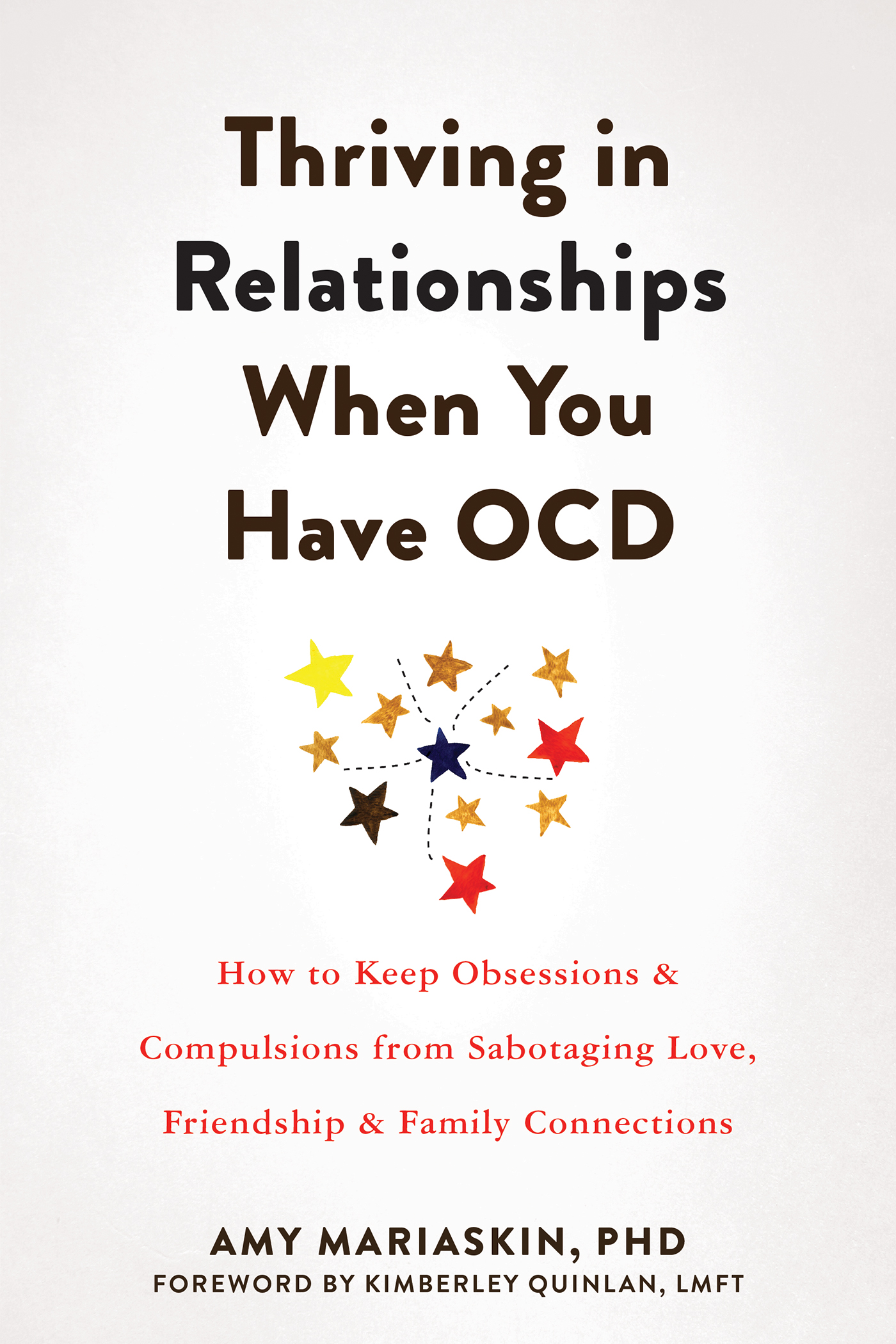
Thriving in Relationships When You Have OCD: How to Keep Obsessions and Compulsions from Sabotaging Love, Friendship, and Family Connections
Don’t let OCD be the third wheel in your relationships! This practical guide will help you build and nurture the connections you deserve.If you have obsessive-compulsive disorder (OCD), you may seek constant reassurance from others, lose time to compulsions, struggle with unwanted thoughts and intense emotions, or act out in ways that are ineffective. These symptoms can put a major strain on your relationships—whether it’s with family, friends, partners, or other relationships. And you may feel alone, embarrassed, and ashamed of your symptoms, which can lead to further withdrawal and social isolation. So, how can you reduce the impact of OCD on your relationships?Drawing on evidence-based practices grounded in cognitive behavioral therapy (CBT), exposure and response prevention therapy (ERP), acceptance and commitment therapy (ACT), and mindful self-compassion, psychologist Amy Mariaskin offers a comprehensive guide for managing your toughest symptoms—before they hijack your relationships. With this book, you’ll find hands-on skills to move toward what you truly want in your relationships and strengthen feelings of intimacy, trust, and connectedness. And finally, you’ll learn how to cultivate self-compassion, mindfulness, and curiosity—all while challenging the beliefs and behaviors that keep you feeling stuck in isolation.If you’re tired of OCD sabotaging your relationships, this book will help you take control of your symptoms—and your life.
200 pages, Paperback
First published December 1, 2022
Ratings & Reviews
Friends & Following
Create a free account to discover what your friends think of this book!
Community Reviews
Displaying 1 - 26 of 26 reviews

September 15, 2023
3.5ish — helpful and interesting!
August 10, 2023
Informative, thoughtful, compassionate, and also laugh out loud funny at times. What more could you ask for in a book about OCD?
June 5, 2024
I picked this book up at some point between December of 2023 and January of 2024. I was going through a really rough patch in a romantic relationship, wherein both me and the other person I was with had pretty severe anxiety disorders, although neither of us had official OCD diagnoses. I read this book, along with many others, as part of an aggrandized mission to research how healthy relationships work, so that I could save OUR relationship.
...Needless to say, this book didn't really help me achieve my goal in the way I hoped it would. For anyone who has read it, I'm sure you understand why.
Nor, frankly, did I achieve that goal at all. Me and this person I was dating broke up in February. I was about 80% of the way through the book at that point in time, but I put it down and did not finish reading it until today.
Here are some of my takeaways.
I do have OCD traits, although I do not have a diagnosis and am not sure I would fit the criteria for diagnosis. I may or may not ever seek an official diagnosis. I’ve discussed traits of OCD with my therapist before, and it’s been helpful, but since I am in treatment for Generalized Anxiety Disorder, and my OCD traits are not severe, we’ve agreed that treatment for my anxiety is helping sufficiently.
A lot of the way I behaved in my romantic relationship was symptomatic of the larger way that I have handled my anxiety ever since I can remember. My desire to fix my significant other's problems, figure out how to help them handle their anxiety, and use that knowledge to save our romantic relationship... that approach was unproductive. None of my research helped to save our romantic relationship, in the end. And furthermore, obsessing over the past and combing over the details of what happened between us is not a useful way to determine whether or not I could have taken a certain course of action that would have been guaranteed to save that relationship. Trying to know, with certainty, if I COULD have saved our relationship with any particular action... that's impossible. I cannot ever know what would have happened if I had done things differently. The only thing I can do is recognize how my choices affected the both of us, and decide if I want to behave differently in future situations—no matter how those future situations end, and with the recognition that I can't guarantee any particular outcome.
I'm tempted, even now, to re-read this book and analyze our entire relationship through its lens, but that's not really the point of the book. I will probably read it again at some point, sure, but this time hopefully through the lens of understanding myself better and understanding the condition of OCD in general--and maybe gaining a little bit of compassion for my younger self and the person I was dating at the time, and the way we dealt the best we could with the circumstances we were in. Not trying to imagine how I could have "fixed" another person's problems or how I could have "fixed" myself.
So many of my worst anxieties were reflected in this book and are considered NORMAL parts of this mental disorder—and the practical tools in this book are excellent supplements to what I have learned in therapy whilst treating my official diagnoses. I see a panorama of some of my loneliest moments in the symptoms that the author describes in this book, and it's good to know I am not alone. It's good to know that there will be other romantic relationships, other platonic relationships, where I can continue using positive skills I've gained and practice more compassion. I am stronger than I think I am—and even when some of my fears do come true, I have resources to handle the consequences, and I have skills to manage my reactions to my emotions. If there is one thing that falling in love taught me, it is that sometimes it's worthwhile to step out of your comfort zone and be brave. Sometimes it's worthwhile to take risks that might not end well. Because even in situations that don't end well, sometimes the experience is worth having—the joyful, the painful, and everything in between.
...Needless to say, this book didn't really help me achieve my goal in the way I hoped it would. For anyone who has read it, I'm sure you understand why.
Nor, frankly, did I achieve that goal at all. Me and this person I was dating broke up in February. I was about 80% of the way through the book at that point in time, but I put it down and did not finish reading it until today.
Here are some of my takeaways.
I do have OCD traits, although I do not have a diagnosis and am not sure I would fit the criteria for diagnosis. I may or may not ever seek an official diagnosis. I’ve discussed traits of OCD with my therapist before, and it’s been helpful, but since I am in treatment for Generalized Anxiety Disorder, and my OCD traits are not severe, we’ve agreed that treatment for my anxiety is helping sufficiently.
A lot of the way I behaved in my romantic relationship was symptomatic of the larger way that I have handled my anxiety ever since I can remember. My desire to fix my significant other's problems, figure out how to help them handle their anxiety, and use that knowledge to save our romantic relationship... that approach was unproductive. None of my research helped to save our romantic relationship, in the end. And furthermore, obsessing over the past and combing over the details of what happened between us is not a useful way to determine whether or not I could have taken a certain course of action that would have been guaranteed to save that relationship. Trying to know, with certainty, if I COULD have saved our relationship with any particular action... that's impossible. I cannot ever know what would have happened if I had done things differently. The only thing I can do is recognize how my choices affected the both of us, and decide if I want to behave differently in future situations—no matter how those future situations end, and with the recognition that I can't guarantee any particular outcome.
I'm tempted, even now, to re-read this book and analyze our entire relationship through its lens, but that's not really the point of the book. I will probably read it again at some point, sure, but this time hopefully through the lens of understanding myself better and understanding the condition of OCD in general--and maybe gaining a little bit of compassion for my younger self and the person I was dating at the time, and the way we dealt the best we could with the circumstances we were in. Not trying to imagine how I could have "fixed" another person's problems or how I could have "fixed" myself.
So many of my worst anxieties were reflected in this book and are considered NORMAL parts of this mental disorder—and the practical tools in this book are excellent supplements to what I have learned in therapy whilst treating my official diagnoses. I see a panorama of some of my loneliest moments in the symptoms that the author describes in this book, and it's good to know I am not alone. It's good to know that there will be other romantic relationships, other platonic relationships, where I can continue using positive skills I've gained and practice more compassion. I am stronger than I think I am—and even when some of my fears do come true, I have resources to handle the consequences, and I have skills to manage my reactions to my emotions. If there is one thing that falling in love taught me, it is that sometimes it's worthwhile to step out of your comfort zone and be brave. Sometimes it's worthwhile to take risks that might not end well. Because even in situations that don't end well, sometimes the experience is worth having—the joyful, the painful, and everything in between.

February 11, 2024
humbug!!

March 15, 2025
3.5 rounded up
January 2, 2023
Obsessive compulsive disorder can wreak havoc in an individual’s life and negatively impact relationships and overall functioning. This book provides important information on how to not allow OCD to impact your relationships. It provides examples, explanations and worksheets for assignments to work through the exercises. The book is broken down into separate chapters that assist the individual with different relationships as they related to OCD; including: friendships, romantic relationships, family, roommates, parenting, and work colleagues. All different types of relationships are covered which is vital. This book is easy to read and the strategies provided are helpful and there is a lot of guidance provided so that the reader can participate in the exercises and worksheets. I highly recommend this book to anyone suffering from OCD or anyone that has a relationship with someone with OCD. Thank you the publisher and NetGalley for the advance review copy in exchange for my honest review.

January 28, 2023
This is a book I never knew so many of my clients needed. It fills a gap in the literature about OCD. Not only does it educate about the types of OCD but it differs from so many other books out there by focusing on how OCD impacts relationships. Where many books are written about how to help a family member when they have OCD, this is written for the sufferer. It helps suffers learn how to thrive instead of just survive in the many relationships they encounter throughout their lives. I love that the author uses the phrase “OC Normal”. It’s a concept that I share with clients to help them feel less isolated.
As a therapist who integrates ACT into my practice, I loved seeing Dr. Mariaskin include so much about values, asking readers to connect with what matters most to them to help them figure out what work they would be willing to do. There are so many useful exercises included in the book.
I highly recommend this book to both sufferers and therapists who treat OCD.
As a therapist who integrates ACT into my practice, I loved seeing Dr. Mariaskin include so much about values, asking readers to connect with what matters most to them to help them figure out what work they would be willing to do. There are so many useful exercises included in the book.
I highly recommend this book to both sufferers and therapists who treat OCD.
January 5, 2026
Precisely what it sets out to be- a digestible, evidence-based, practical guide to navigating interpersonal relationships with OCD. Written for casual audiences including but not limited to affected individuals, with insights that may be useful for loved ones and clinicians. Readers with OCD may find themselves feeling seen in the pages of this book in a way that is both comforting and unfamiliar in this world. Families, friends, and partners may too gain increased understanding and compassion for the inner worlds of their loved ones.
Overall a quick and easy read that inspires self-compassion, increases awareness, and provides a pragmatic, accessible approach to treating that pesky third wheel in relationships affected by OCD- all while maintaining an air of lightness, hope, and humor along the way.
Overall a quick and easy read that inspires self-compassion, increases awareness, and provides a pragmatic, accessible approach to treating that pesky third wheel in relationships affected by OCD- all while maintaining an air of lightness, hope, and humor along the way.

December 13, 2022
Ever wonder what is "OCD normal" when it comes to relationships? Family, friends, romantic? How does the OCD mind react?
Thriving in Relationships When You Have OCD is a great look into what is OCD normal. This book gives explanations, examples, worksheets and even "homework" assignment to use if you find them helpful. The book breaks relationships down into categories and focused each section on a different realtionsnship found in most people's daily lives.
If you are looking for an addition to your OCD books, this book is the book to grab. It takes a look at an area of life for people with OCD that, up to this point, had not been discussed. Finally, I would like to thank NetGalley and New Harbinger Publishing for providing this ARC for my honest review.
Thriving in Relationships When You Have OCD is a great look into what is OCD normal. This book gives explanations, examples, worksheets and even "homework" assignment to use if you find them helpful. The book breaks relationships down into categories and focused each section on a different realtionsnship found in most people's daily lives.
If you are looking for an addition to your OCD books, this book is the book to grab. It takes a look at an area of life for people with OCD that, up to this point, had not been discussed. Finally, I would like to thank NetGalley and New Harbinger Publishing for providing this ARC for my honest review.
January 27, 2023
An excellent resource for OCD sufferers, their friends, and family members. The author makes a point of being inclusive of different types of relationships - was I expecting to have to read something to the effect of "OCD - it impacts dads too!" in the parenting chapter, or have the examples shared in the romantic relationships or sex chapters be exclusively heterosexual? Yes. But Amy proved me wrong!
The content is accessible, with a good mix of theory and practical exercises. I also laughed out loud a few times! No small feat for a book about a mental illness I live with! Great read, goes on my shelf right next to Grayson.
The content is accessible, with a good mix of theory and practical exercises. I also laughed out loud a few times! No small feat for a book about a mental illness I live with! Great read, goes on my shelf right next to Grayson.

June 15, 2023
This was a thoughtfully written and thoroughly researched book that offered a broad scope of how OCD affects different aspects of life. However, it felt like the book was trying to address too much and no one section received the level of depth that would have been helpful. Some good ideas and good questions in here, but not enough specific strategies. Still, this is a book that would be especially helpful for folks just learning about how to address their OCD.

February 18, 2025
I honestly couldn’t finish this. It started off really informative and then turned into a therapist session with activities, which is not what I was wanting. I wanted it to be more informational than it was. I started to get really freaked out by some of the examples, which is ultimately why I couldn’t read it anymore.

April 22, 2025
I mourn my late diagnosis all the time. This book was helpful, but too upbeat and superficial. The OCD-Normal terminology feels kind of silly to me as well but it’s all semantics anyways. Still it is important that there is literature on relationships and OCD that isn’t necessarily relationship-OCD.

April 23, 2026
I think what I enjoyed most about this book was the authors ability to make you comfortable from the start. She is very open and accepting of all people. It was so incredibly helpful for me and I can’t believe that my whole life I thought I was alone in some of these feelings. Definitely a book you can read more than once when you’re struggling.

January 5, 2023
A wonderful resource for those struggling with obsessive/compulsive symptoms or anxiety… or for those wanting to support loved ones struggling! Dr. Amy’s compassion and sense of humor shine through each page.

June 10, 2023
IF YOU HAVE OCD READ THIS BOOK!
It's pretty straightforward yet amazing; the exercises provided in this book were super helpful to me, and I have seen an improvement in my relationships, as well as on the understanding of my disease.
It's pretty straightforward yet amazing; the exercises provided in this book were super helpful to me, and I have seen an improvement in my relationships, as well as on the understanding of my disease.

March 7, 2023
4,5/5 ⭐️
Un livre complet et lucide sur le OCD et les façons de minimiser ses impacts sur nos relations. Ça m'a donné pleins d'outils concrets et de pistes de réflexion/discussion. J'ai adoré!
Un livre complet et lucide sur le OCD et les façons de minimiser ses impacts sur nos relations. Ça m'a donné pleins d'outils concrets et de pistes de réflexion/discussion. J'ai adoré!
March 16, 2023
Quick and easy preface to getting a better handle on your relationship based symptoms.

November 18, 2023
highhhhly recommend even if you don’t experience ocd! still would be super helpful for folks who deal with anxiety especially interpersonal anxiety

June 16, 2024
This was so so helpful to me, I have r-ocd along with classic OCD and this made me feel so much less alone and less crazy.

Read
July 22, 2024helpful

December 3, 2025
therapy book 4, obviously was not a for fun read but it was helpful for understanding my clients with some relationship OCD

January 8, 2026
pretty good
March 12, 2026
Pretty solid if you’re looking for an introduction to OCD and its impact on different types of relationships. Each area felt like it didn’t go as in depth as I wanted it to.

Read
August 12, 2026Immemorable. Not the depth I was looking for.
September 23, 2026
Helpful assessment of ways to challenge OCD themes while maintaining and building relationships. It was mostly written for the person with OCD rather than the family or partners.
Displaying 1 - 26 of 26 reviews