Jump to ratings and reviews
Rate this book

Siódmy koń. Opowiadania zebrane

Rate this book
Leonora Carrington – najważniejsza malarka surrealistyczna, pisarka, skandalistka i feministka brytyjskiego pochodzenia. Była partnerką Maxa Ernsta i przyjaźniła się z Pablem Picassem. Jej twórczość literacka jest prawie nieznana polskim czytelniczkom, dlatego zbiór opowiadań „Siódmy koń” to świetna okazja do przypomnienia tej wybitnej postaci. Do grona fanów jej twórczości literackiej należą m.in. Björk, Olga Tokarczuk i Ali Smith.

Zbiór „Siódmy koń” zawiera opowiadania pisane od lat 30. do 70. XX. wieku, czyli z okresu szczytowej formy aktywności twórczej Leonory Carrington. Powstały w języku francuskim, hiszpańskim i angielskim. Wszystkie te opowieści rozgrywają się w fantastycznych, upiornych krajobrazach i pełne są – charakterystycznych dla Carrington – surrealistycznych zjaw i bohaterów.

224 pages, Paperback

First published January 1, 1988

34 people are currently reading
1710 people want to read

About the author

Leonora Carrington

71 books934 followers
Leonora Carrington was an English-born Mexican artist, surrealist painter, and novelist. She lived most of her adult life in Mexico City, and was one of the last surviving participants in the Surrealist movement of the 1930s. Carrington was also a founding member of the Women’s Liberation Movement in Mexico during the 1970s.

Ratings & Reviews

What do you think?
Rate this book

Friends & Following

Create a free account to discover what your friends think of this book!

Community Reviews

5 stars
189 (42%)
4 stars
174 (39%)
3 stars
66 (14%)
2 stars
12 (2%)
1 star
2 (<1%)
Displaying 1 - 30 of 61 reviews
Profile Image for Nate D.
1,654 reviews1,254 followers
January 5, 2012
Leonora Carrington, expelled from convent school and defying parental wishes in order to study painting, eloped from England with Max Ernst in 1937, at age 19, soon joining her excellent visual work with an outpouring of writing in both French and English, some of the very best that first-wave interwar surrealism had to offer. Along with House of Fear, this collects the majority of Carrington's short fiction from that period, from New York during the war for surrealist journal VVV and others, and for several decades of life in Mexico City afterwards. It's fairly out of print, but cheap used copies do pop up every now and then, like this one.


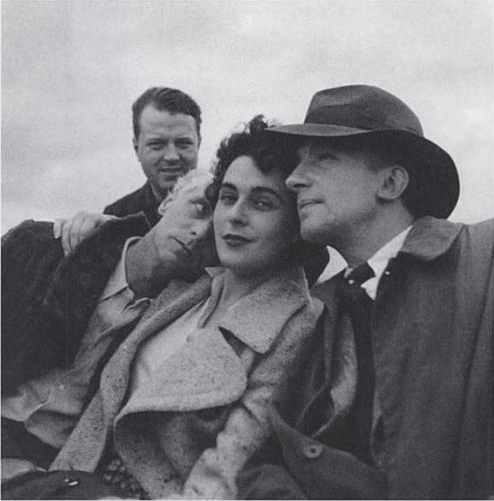
(Carrington with Ernst (to the left of her, here) and other surrealists)

Among her many merits, Carrington had a real knack, compared to the "automatic writing" employed by many of her contemporaries as a means of excavating the subconscious, for investing her dream-fables with a decidedly non-automatic cohesion. These read like myths or fairy tales, but often totally anarchic or anti-social, and occasionally becoming a sort of horror story. And often with a satiric bent, and usually in rapid, highly-entertaining telling. All of which I'm wild about, of course.

Since there's not a lot of information around, here's what is actually included in this volume (stars indicate the best):


*As They Road Along the Edge (1937-1940) :: Longer (for Carrington) tale of a wheel-riding wild girl in the mountains who falls in love with a wild boar and gets into a confrontation with the local clergy.
True, the people up there were plants, animals, birds; otherwise things wouldn't have been the same.
The cats caterwauled and stuck their claws into one another's necks, then threw themselves in a mass upon Igname and Virginia, who disappeared under a mountain of cats. Where they made love.


The Skeleton's Holiday (1938 or 39) :: Part of a collaborative story with various luminaries of the time like Ernst, Arp, Duchamp, called "The Man Who Lost His Skeleton". Carrington's segment recounts the skeleton's exultant exploits after losing his man. Probably due to proximity to the others, this is the most random-sounding, and the least Carrington-esque of the lot.

*Pigeon, Fly (1937-1940) :: a deliciously eerie fable freed, like most of Carrington, of any obvious moral import.
And here is another thing: the objects around me are becoming terribly clear and vivid, much more alive than I am. You know, Eleanor, I'm afraid. . . . Listen, the chairs in this room are very old, and so is all the rest of the furniture. Last week, I saw a little green bud on one of the chairs, the kind of bud that appears on trees in the spring. And now . . . how horrible . . . it has become a leaf . . . Eleanor!
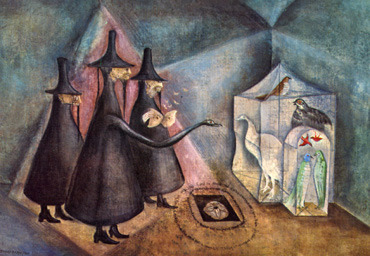

The Three Hunters (1937-1940)
Monsieur Cyril de Guindre (1937-1940)


*The Sisters (1939)
Perhaps my favorite: Another creepy gothic fairy tale of vivid narrative force and inconclusive lesson. A young women prepares a somewhat ghastly feast for a visiting ex-king, while locked in the attic, her secret sister dreams of moonlight and red. The suggested confrontation never comes; instead they converge in a kind of alternative versions of hedonism. Here is where I'm talking about Carrington's excellently ambiguous moral compass, especially.
Enchanted with his deep reflections, the king rubbed his hands and did a few dance steps. Drusille looked at the trees and thought the fruit looked like little corpses. She looked at the sky and saw drowned bodies in the clouds.
Engadine came out of the kitchen. She was carrying a suckling pig stuffed with nightingales. She stopped with a cry. In front of her an exultant white apparition blocked the way.
His beard was full of sauces, fish heads, crushed fruit.


Cast Down By Sadness (1937-1939) ::
Cast down by sadness, I walked far into the mountains where the cypresses grew so pointed that one would have taken them for arms, where the brambles had thorns as big as claws. I came to a garden overrun by climbing plants and weeds with strange blooms.


*White Rabbits (1941) :: The first of the New York stories, a macabre tale of the neighbors glimpsed across the street. A real place Carrington stayed, perhaps?
He seemed to be unconscious of our presence or of that of a large white buck rabbit which sat and masticated on a chunk of meat on his knee.
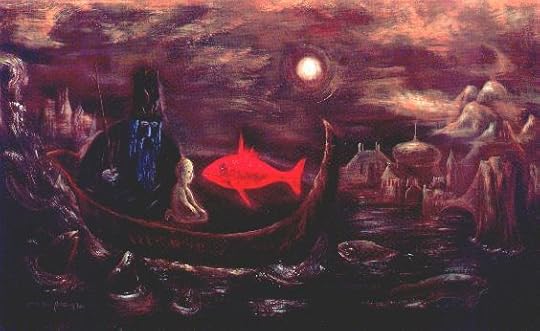


Waiting (1941)

The Seventh Horse (1941) :: Another distinctively Carrington-esque wild-girl, this one caught in the garden by her hair, and a husband who wants only to run with the horses...

*The Stone Door (1940s, pub.1976) :: Surrealist occultists write the best fairy tales. Besides The Hearing Trumpet, this is Carrington's only novel that I know of (hopefully another exists somewhere amongst her papers!). Here, she re-edited it from her original into a 70-page novella. It's captivating, and quite different in tone and style from her other work, opening with a series of journal entries from a girl in Mexico (Carrington herself?), retreating from ennui and isolation into a series of dreams that take her across the Land of the Dead and leave her stranded, trapped, at a closed stone door in the mountains. On the other side of which lies interwar Hungary, where a young Jewish boy begins to hear her cries. With a powerful balance of convincing details of a known world being invaded by unreality and pagan rites. I really really must find a copy of the full-length version of this, as soon as possible.
Standing on a hill and looking back along the road I saw the city of tombs still visible in the distance. Before me, the road continued like a dusty ribbon whose borders were marked by heaps of broken sculpture and miscellaneous rubbish such as partially unwrapped mummies in different stages of mutilation, painted tablets in every known and unknown language, books and parchments dried into convulsive gestures, old shoes, sandals, and boots, and any number of pots and casks, urns and dishes in whole or small pieces.
I then understood that the word to address such a primitive and embryonic body would have to come from a language buried at the back of time.
For centuries, they dressed up Love for easy digestion as a fat little boy with wings, pale blue bows, and anemic-looking flowers. behind this bland decoration Love snarled its rictus through the ages. With shrieks of adoration, it flung itself on human breats, "to crush you, to suck your life away. I cannot drag my own weight over the crust of the earth, so you must carry me on your back so that in time you will be crippled with my weight." These words are in every heart in the mating season.
Kneeling before the ram, he caught its spiral horn in his right hand, twisting back its head and exposing the beating pulses of his neck. He cut its throat with the triangular stone. The girl caught the blood in her cupped hands, saying: "Drink the scarlet milk of Paradise, Little Brother, for it is ours. [...] The Old Gods are our food, The New Gods will be revealed to us in time and out of time. The Old Gods are dead; Earth, the Goat will renew the lifeblood of the Myth and will violate the Garden of Paradise."
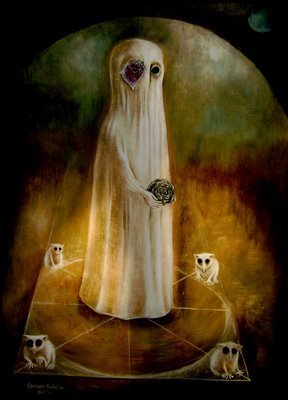
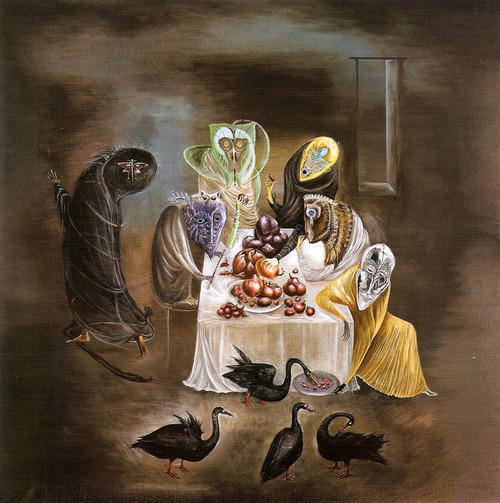


Originally I was going to go on cataloguing the contents of this book, right through the Mexican post-war, post-Stone Door years. Except I don't really have time at the moment, so let's leave it there for now. Highlight of the later stories, for me, was "Et in bellicus lunarum medicalis", on the fate of a set of surgery-performing Russian rats who, oddly, no one wanted to employ. And weird future-vision "How to Start a Pharmecuticals Business".

Profile Image for Glenn Russell.
1,512 reviews13.3k followers
Read
December 20, 2021


The Seventh Horse - a collection of sixteen short stories where Leonoara Carrington lets it rip.

As part of her incisive essay on a key autobiographical tale, My Mother Is a Cow,, critic Anna Hundert wrote: “In this dream world, where the nonbinary divine is also a “cow-faced fan,” divinity cannot be about enforcing any kind of perceived normality. Instead, divinity is about opening up to the world’s delightful queerness, and naming it all as sacred.”

How true! If you're looking for normality, for stories where the world keeps to its predictable, socially constipated, sickening order, don't even think of coming near this book.

Leonora fell in love with Surrealist painting at age ten and fell in love with Surrealist artist Max Ernst at age twenty. She ran away with older, married Max and the couple lived and created art in southern France for two years before the Nazis crushed their idyll. They took Max away to a concentration camp and some time thereafter Leonora was taken away and held captive in a Spanish mental hospital where she was subjected to powerful drugs, electroshock, cruelty and torture.

The Seventh Horse is very autobiographical. I enjoyed each story for its play of images and happenings; in my mind's eye, I could imagine a sequence of vivid surreal paintings very much like the many surreal paintings Leonora created in her long life (she lived to age 92). On another level, I appreciated Leonora's symbolism and scathing attack on a society and culture she found positively suffocating and spiritually deadening. Many critics cite her mythmaking, her openness to magic, her participation as a founding member of the women's liberation movement in Mexico during the 1970s.

Frequently when writing a review of short stories, as a way of sharing the author's vision, I'll do a compressed retelling of one, two or three of the stories. Such a retelling of a Leonora Carrington story is impossible. Thus, no better way than simply including direct quotes from several of the tales - as you read, imagine a surreal painting.

AS THEY RODE ALONG THE EDGE
She was afraid of Iganme's beauty. then she spat into the stewpot and put her lips into the boiling liquid and swallowed a big mouthful. With a savage cry she brought her head back out of the pot; she jumped around Igname, tearing her hair out by the roots; Igname stood up, and together they danced a dance of ecstasy. The cats caterwauled and stuck their claws into one another's necks, and then threw themselves in a mass onto Igname and Virginia, who disappeared under a mountain of cats. Where they made love.

PIGEON, FLY!
I couldn't believe my eyes. Yet as I looked from the model to the portrait there was no denying the truth. The more I looked at the corpse, the more striking became the resemblance of these pale features. On canvas, the face was unquestionably mine.

THE THREE HUNTERS
I was having a rest in a deep forest. The trees and wild fruit were ripe. It was autumn. I was beginning to fall asleep when a heavy object fell on my stomach. It was a dead rabbit, blood running from its mouth. It was dead of fatigue. I'd hardly freed myself of the rabbit when, with a leap more agile than a stag's, a man landed beside me. He was of medium height, had a red face, and a long, white moustache. From his face, I'd have guessed him to be about ninety.

THE SISTERS
Drusille lit the candle, illuminating a dirty little attic without windows. Perched on a rod near the ceiling, an extraordinary creature looked at the light with blinded eyes. Her body was white and naked; feathers grew from her shoulders and round her breasts. Her white arms were neither wings nor arms. A mass of white hair fell around her face, whose flesh was like marble.

CAST DOWN BY SADNESS
Dominique gave a cry and fell to the ground. Arabelle began to undress. Quickly there was a heap of dirty clothes beside her, but she kept on taking off more with a sort of rage. At last she was completely undressed, and her body was nothing but a skeleton. The girl, arms crossed on her chest, waited.

THE SEVENTH HORSE
A strange-looking creature was hopping about in the midst of a bramble bush. She was caught by her long hair, which was so closely entwined in the brambles that she could move neither backwards nor forwards, She was cursing and hopping till the blood flowed down her body.

THE NEUTRAL MAN
I found it difficult to suppress a little smile, since for a long time I had been living with a Transylvanian vampire, and my mother-in-law had taught me all the necessary culinary secrets to satisfy the most voracious of such creatures.

ET IN BELLICUS LUNARUM MEDICALIS
At this point the Soviet Rats themselves appeared on the scene, trying out a new dance step., the Paso Doble Pancreas, a new therapy based on manipulating the digestive system by eating bricks instead of meat (thus also saving money).

THE HAPPY CORPSE STORY
Thorns grabbed at the pair as they hurried through the wood. Great Scott, a nasty black-and-white terrier, ran constantly at the corpse's heels, snapping. The mangy creature lurked the haunts where the Happy Corpses abide, since one can hardly stay live in this case. The dog smelled as bad as the corpse; it was practically impossible to tell one from the other. They just looked different.

Profile Image for Eddie Watkins.
Author 48 books5,558 followers
September 29, 2014
Leonora Carrington is not a surrealist, she is Leonora Carrington. She is also a creative alembic with the capacity to transform everything she touches - every plant animal mineral, every personal emotional upheaval, every beef with authorities (authorities of every kind) – into an infectious concoction of the purely imaginative.

Her work is fantastical (in the true, the best, sense), and being fantastical in the true, the best, sense means it presents an alternative-seeming world while staying rooted in the actual life of the senses and in the storms and tides of emotion of a deeply engaged human life. There are recurring images of beings (animals, humans, plants, and minerals are equals in her world, and so all are equally “beings”) with roots that either reach deeply into things and are thus invisible, or are visible and thus unattached to that being’s surroundings, indicating a psychic malady. These roots are the living matrix of her stories, the fibers that carry her living and life-giving creativity.

And these stories are fantastic (in the degraded sense), meaning they are great! Through her writing (and her painting, for which she is better known) she gives the impression of a person who is completely free, whose inner world is not only totally uncorrupted by noxious social influences and programming, but is such a powerful force that it supplants her external world also; as if her eyeballs are permanently stained (as in stained glass) by the welling up of images from within, so that to look out onto the external world is to see it permanently altered by her internal world. This internal world of hers is well-stocked with occult/alchemical lore, and her inner being is clearly a veteran nomad in Dreamland, and knowledge gathered from books and astral travels permeate and inform her work. So in addition to there being an almost automatic, or unconscious, creative informant behind her work due to the essential character of her inner nature, there is also that intentional informant that is her conscious and scholarly side.

What’s also fantastic about this collection is the sheer variety of tone and approach, even as each is unmistakably Carringtonian. She effortlessly glides from satirical humor (with a healthy helping of flammable bile) to the child-like, from serious adult quest narrative to comic fairytale; and each is only as long as it has to be, some like sketches (or small canvases) and another like a condensed epic.

The condensed epic in question being The Stone Door, which is by far the most ambitious work here (and the version contained is a shortened version of her novel by the same name). The Stone Door has little of her characteristic humor (usually satirical), and instead focuses on some serious alchemical issues – personal transformation alchemy and possible triumph over death – and is presented as interlocking quest narratives. It begins as a series of journal entries, and maintains a touch of the clipped and somewhat cryptic qualities characteristic of personal journals even as the narrative blossoms out into a full-blown story encompassing the “real” lives of the characters and their dream and astral/imaginal lives. Maintaining this “personal journal” quality throughout lends an air of urgency and authenticity to the story, and this urgency and authenticity translates into the potential for the story itself to “work on” (as in The Great Work, i.e. alchemy) the interior life of the reader.

This is writing that can reach its serious alchemical roots into the reader even as it supremely entertains, and if the reader is receptive and allows these roots to take hold, this is literature that can free one’s own imagination and enlarge one's inner life – you can feel it as you’re reading, as it thrills your imaginal nerves and stains your eyeballs.

Profile Image for Wojciech Szot.
Author 16 books1,419 followers
March 6, 2022
Człowiek nie jest w opowiadaniach Carrington ukoronowaniem stworzenia, lecz bytem niepewnym. Jak w opowiadaniu "Kiedy przychodzili", w którym narrator nie jest pewien, czy mająca "wielkie łapska z brudnymi paznokciami" Virginia Fur jest jednak człowiekiem. Autorka jawnie wątpi w kondycję człowieka.

Elizabeth z napisanego w 1941 roku opowiadania "Czekanie", która trzyma "na smyczy dwa duże płowe psy w odcieniu swoich włosów, które też zresztą wyglądały jak osobne zwierzę, siedzące jej na głowie", zdaje sobie sprawę ze swojej ułomności i mówi: "Jestem tylko człowiekiem. Nie to, co one…" - to spoglądając na siedzące nieopodal zwierzaki. W tym samym opowiadaniu czekająca na niejakiego Fernanda Margaret zadaje właścicielce psów egzystencjalne pytanie: "Wierzysz, że przeszłość umiera?". Odpowiedź na nie zdawałoby się, że jest absurdalna i surrealistyczna: "Tak. Owszem, jeżeli teraźniejszość podrzyna jej gardło". Zdanie warte zapamiętania.

---

"Siódmy koń" w przekładzie Ochab i Kłobukowskiego - książka warta lektury. Więcej tutaj - https://wyborcza.pl/7,75517,28149108,...?
Profile Image for Jowix.
449 reviews143 followers
March 1, 2022
Uwaga, będzie pianie z zachwytu.
Opowiadania Leonory Carrington są ze wszech miar niesamowite. Autorka kreuje swoje przepastne w znaczenia światy pospiesznie i precyzyjnie, z nieposkromioną wyobraźnią, na szalone i oderwane od rzeczywistości, ale jednocześnie silnie zakorzenione w zachodniej kulturze i tradycji, więc osobliwe i znajome zarazem.
Jej bohaterki są wolne, płynne, dowcipne, inteligentne i przewrotne. Stają przeciwko etykiecie udziewczęcania i po prostu robią swoje.
Lektura mogłaby nigdy się nie kończyć - jest w tym zbiorze tyle do odkrycia, że raz na pewno nie wystarczy. Wspaniałe!
Profile Image for ola_hiperbola.
282 reviews50 followers
December 12, 2023
Jak to z opowiadaniami bywa, były tu lepsze i gorsze, ale ogólnie jak dla mnie większość była zbyt surrealistyczna i abstrakcyjna, jakbym słuchała opowieści czyiś dziwnych snów, gdzie ciężko odnaleźć jakiś sens.
Ponoć można doszukać się tu różnych metafor i przesłań, mnie niestety większość musiała umknąć 🤷
Lecz muszę przyznać, że takie abstrakcyjne klimaty w jakimiś stopniu mnie fascynują i pobudzają moją wyobraźnię, z początku byłam bardzo zaintrygowana, ale z czasem ten surrealizm zaczął mnie po prostu męczyć.
Profile Image for S̶e̶a̶n̶.
979 reviews582 followers
March 16, 2024
On the outskirts of our sad savage town, I was overcome by a feeling of profound melancholy, though I fought it off by stuffing a large amount of jasmine essence up my nose.

Remember that trousers are the first rung down the ladder of degeneration.

This is a love letter to a nightmare.
These few statements are ones pulled in a random attempt to sum up this wondrous collection of surrealist painter and writer Leonora Carrington's short fiction. The pieces range from the folkloric and fairy tale-esque to completely bizarre, off-the-wall absurdism. They are often dark, but with a light touch, if that makes sense. The centerpiece is a shortened version of Carrington's novel The Stone Door. This labyrinthine tale describes two epic journeys through time and place, the first of which occurs in a "dream, memory, or vision." A basic premise guiding the story is that someone becomes trapped on the wrong side of the stone door, which separates the land of the Dead from the land of the Living. Someone else tries to save the first someone. There's some back story on each of the someones. I can't do it justice so I'm sticking with vagueness.

The other tales all entertain in one way or another. In "The Happy Corpse Story" someone goes to Telephone Hell because he died of a heart attack during a telephone conversation. In Telephone Hell everyone has a phone "constantly glued to their lips or ears" for, in this person's unfortunate case, nine hundred and ninety-nine billion aeons before finally getting rid of it. [One wonders what Leonora would think of today's widespread and voluntary enactment of her version of Hell]. Also in this story, Carrington takes aim at corporate culture, describing a character as "an executive at a firm," meaning that "he actually executed persons with showers of legal documents proving that they owed him quantities of money which they did not have." But her scathing mockery does not stop there...

'Firm' actually means the manufacture of useless objects which people are foolish enough to buy. The firmer the firm the more senseless talk is needed to prevent anyone noticing the unsafe structure of the business. Sometimes these Firms actually sell nothing at all for a lot of money, like 'Life Insurance,' a pretense that it is a soothing and useful event to have a violent and painful death.

Another of my favorite stories in which Carrington's satire shines is "How to Start a Pharmaceuticals Business," in which an innocent picnic of the narrator and her two noble guests, Lord Popocatepetl and the Viscount Federal District, strangely results in the narrator's receipt of a Joseph Stalin mannikin, whose moustache hairs turn out to possess properties useful in the treatment of "whooping cough, syphilis, grippe, childbearing and other convulsions." The story is set in the Mexico of some sort of utopian world in which society has opted to voluntarily regress from the modern age. As one example, the Black King of the North, New York the First, issued an edict known as the Law of De-Electrification of the Americas.

This collection offers a good introduction to Carrington's fiction, showcasing her many storytelling styles as well as her keen social insight. Highly recommended and pairs well with her collection The House of Fear.
Profile Image for Tentatively, Convenience.
Author 16 books246 followers
March 1, 2012
The more I find out about Leonora Carrington, the more I love her. From the very 1st story, "As They Rode Along the Edge", she sets the tone for her being an extremely strong-willed visionary (for a recited version of this story w/ illustrations by Justin Duerr & Mandy Katz go to: http://www.youtube.com/watch?v=4LuinG... ). She's described on the back cover as "A precocious child, expelled from convent school" & her anti-Christian enthusiasm & full-blown paganism is completely heartfelt & all-encompassing. Cf the anti-clericalism of surrealist Benjamin Peret w/ the wonderfully articulate & humorous character of this writing. These stories were written between 1937 & the 1970s & they cover alotof territory. I'm particularly fond of "The Stone Door" - the version here being a shortened version of something that's apparently published elsewhere as a bk all its own. In this one, Carrington starts off w/ what at least seems to be a personal diary of discontent that gradually mutates entirely into an heroic & epic quest. I often complain that I find much surrealist writing of little interest but w/ Carrington the writing is as great as her phenomenal painting.
Profile Image for eris.
224 reviews1 follower
July 27, 2023
pięknie napisane opowiadania, które poruszyły we mnie uczucia, których dotąd nie czułxm. osobliwe i absurdalne, przepełnione symbolami, które odkrywać będę podczas drugiego czytania, bo za pierwszym razem chciałxm nacieszyć się świeżością tych historii
Profile Image for Simon.
430 reviews98 followers
February 29, 2024
This short story collection by mystic and multi-artist Leonora Carrington is much more varied than her previous ”The House of Fear”, perhaps as a result of the stories found here having been written during a lengthier stretch of time spanning from the 1930's to the 1970's. The usual mythologised versions of weird and disturbing formative moments in the author's life are there, but just as many of the stories do not fit that template at all. ”The Skeleton's Holiday”, for example, seems more inspired by the Day of the Dead festival in Carrington's adopted home country of Mexico than anything else. As far as I can tell, ”The Skeleton's Holiday” was written as part of a Surrealist literary exercise called ”The Exquisite Corpse” where each chapter of a story is written by a different author. In a display of her trademark wry humour, Carrington includes a story later on where the protagonist encounters a literal exquisite corpse... whose succession of weird revelations I will not spoil more of.

As mentioned before, ”The Seventh Horse” contains several stories following the traditional Carringtonian narrative where an adolescent girl comes of age through interaction with monstrous half-human stand-ins for relatives, who put the heroine through a series of challenges. Thing is, these are more varied than those in ”The House of Fear” as well as more genuinely horrifying. The best example is ”The Sisters” where the heroine's sister is a human-headed bird/bat-creature resembling a cross between the harpies of Greek mythology and a gender-flipped version of H. P. Lovecraft's ”The Dunwich Horror”. The overall impression is that of Carrington overtly riffing on popular horror clichés here in a way she did not in ”The House of Fear”.

When reading ”The House of Fear” I suspected that Carrington got her inspiration for several of the stories from the many interpretations of Lewis Carroll's ”Alice in Wonderland” and its sequel as either feminist or occult allegory. (if not both) One of the stories in here, ”White Rabbits”, more or less confirms that while taking the ”Alice” inspiration in a somewhat different direction than expected.

There are a few things I want to remark upon after having re-read ”The Seventh Horse and Other Tales” in 2021, for the first time in five years. On the first reading back in 2016 I interpreted the stories in here to be modelled upon the folklore of the British Isles with all its holdovers from pre-Christian paganism, at least before being sanitised by Victorian authors. In 2021 I looked more for similarities to either Greco-Roman mysticism on one hand, which however came from the same proto-Indo-European religion as the Celtic mythology, or the Kabbalah on the other. After all, Carrington frequently uses a plot structure where the protagonist goes through a process of spiritual awakening by solving a series of cryptic riddles posed by not-quite-human entities - the same model of initiation as can be found in Greco-Roman mystery religions as well as in the Kabbalah. The observation of these parallels in ”Alice in Wonderland” is key in the reading of that book as a metaphor for Kabbalistic initiation by Western occultists from Aleister Crowley to Erwin Neutzsky-Wulff, and it is probably no coincidence that the Greco-Roman myth of Cupid and Psyche follows a similar narrative.

I did on first reading already suspect that many of the stories to be found within ”The Seventh Horse” were written by using a randomised storytelling process as a ritualistic game to unlock the powers of humanity's collective subconsciousness. Which does grasp at the same underlying phenomenon as the initiatory paths of Greco-Roman mystery religions and the Kabbalah, that I mentioned before. It is probably no coincidence that Carrington strove in her artwork and stories to create new sets of symbolism that required a substantial amount of active interpretative work by the audience to tether to an existing cultural tradition. Notice that one of the stories appears to riff on imagery surrounding the Day of the Dead, an Aztec pagan holiday, which modern Mexicans effortlessly incorporate into a Roman Catholic context despite that seeming absurd to outsiders... I think there is an important point in here.

Something else that is noteworthy is that on first reading I found ”The Seventh Horse” less rewarding a reading experience than ”The House of Fear”, but today I actually find it the most accomplished of the two short story collections. I would still recommend that you read ”The House of Fear” first, however: That book contains more biographical information about Carrington's life that provides some important context to her literary and artistic output explaining several recurring themes more clearly.
Profile Image for Krysia o książkach.
934 reviews659 followers
August 28, 2023
Świetny zbiór opowiadań. One rzeczywiście są bardzo mocno abstrakcyjne, oniryczne, dużo opiera się o niedopowiedzenia, ale jednocześnie są niezwykle trafne i pod wieloma względami wciąż aktualne. Dużo można wyczytać między wierszami, są bardzo pojemne znaczeniowo. Każde kolejne zdanie to większy zakończenie, zdumienie albo wręcz szok, niektóre zakończenia wbijają w fotel. Autorka potrafi malować słowem, przenosić w inne, dziwne światy, mimo tego, że tworzy krótką formę. Wspaniała rzecz, polecam.
Profile Image for mrzokonimow.
257 reviews19 followers
August 11, 2022
Rzeczywistość u Leonory Carrington iskrzy i pęka, a ze szpar i szczelin pączkują dziwy, zapełniając kolejne akapity opowiadań czarnym humorem, groteską i surrealistycznym miszmaszem.
Można się w tych kolorowych kuriozach pogubić, ale pogubić się warto, a jeśli komuś miło wspomina się Topor czy Cortazar, to pogubić się wręcz powinien.
Profile Image for Justyna Sk.
362 reviews26 followers
April 18, 2023
Surrealistyczne, oniryczne, szalone - odnalazłam w nich swoje własne sny. Genialne!
Profile Image for Emejota (Juli).
219 reviews115 followers
November 30, 2020
Es una locura. Es como estar leyendo algo que sabes que no deberías estar leyendo. Perturbador pero a la vez fascinante.

No es un libro. Es brujería.

*Cuando iban por el lindero en bicicleta
*¡Vuela, paloma!
*Las hermanas
*Conejos blancos
*La puerta de piedra
Profile Image for Ione.
6 reviews4 followers
June 30, 2007
This collection of some of Leonora's strangest short stories are much like her paintings--surreal, haunting, logic-defying, and irreverent. Many of the stories are peppered with alchemical symbols, much like her art, and leave you wondering about what's beneath the surface of it all. One of the best pieces in the book is the novella "The Stone Door," about a Hungarian Jew from the 20th century who wonders through his life in this century aimlessly, but finds passion across time in Mesopotomia where he must find his true love on the other side of the stone door in the mountain Kescke. However, trying to sum up any of the pieces in a straightforward sentence is an oversimplification of Leonora's wonderfully swirling, dreamlike prose. Her literary works are hard to track down, but if you can, definitely give her a try.
Profile Image for Anna.
201 reviews16 followers
December 30, 2018
There were a few standout stories here (I liked all the animated corpses/skeletons doing things but it might just be my aesthetic).

For the most part though, reading this collection is like listening to someone recount their dream: hard to follow, generally boring, and most likely pointless to you.
Profile Image for Marianna Kleczewska.
6 reviews1 follower
February 1, 2024
Czytając czułam się jakbym znalazła gdzieś w lesie zatęchły domek dla lalek (w stylu wiktoriańskim) i bawiła się nim z wymyśloną przyjaciółką, która nie jest do końca człowiekiem i w każdej chwili może mnie zjeść.
Profile Image for Joan Rius.
79 reviews18 followers
September 2, 2022
M’és difícil parlar de Carrington; és una autora molt conscient de l’economia dels seus símbols, i parteix de pretextos que desconec (tradició celta, alquímia, bruixeria, pintura medieval, surrealisme...). Pot arribar a despistar al lector sense paciència, que de seguida ho vol entendre tot, i que pot confondre l’exuberància simbòlica dels relats amb una escriptura a raig, insensata i inexpugnable. La veritat, però, és que Carrington parteix, com qualsevol escriptor, de les seves experiències. El primer conte, “Presentació en societat”, en què una noia s’intercanvia amb una hiena i la fa anar en lloc seu a la seva presentació en societat, es basa en la seva pròpia presentació amb 18 anys al palau de Buckingham. El relat adopta un matís de crítica ferotge als ambients en què es va criar, cosa que passa en d’altres contes. Que li agradessin la pintura medieval i surrealista, dos tipus de pintura en les que saber llegir bé l’entramat de símbols és condició ineludible de la comprensió de l’obra, pot ser una de les causes de la complexa simbologia de l’escriptura i la pintura de Carrington. Però quan entrem a poc a poc en la seva obra, es va entenent una mica millor. Perjemple: el millor relat del llibre, “Conills blancs”, un relat terrorífic en què la visita a la veïna del davant fa de versió macabre del viatge al cau del conill (a la Carroll), amb conills que mengen carn podrida i una parella que semblen morts vivents. Aquest conte fornit d’imatges crípticament sòrdides, el va escriure una Carrington de 24 anys, que acabava d’arribar a Nova York, fugint del manicomi del qual s’havia escapat, i que es troba separada dels seus amics i del seu amant, encarcerat a Europa. Pudé el va escriure una Carrington que seguia veient la inquietud i el terror d’una vida de guerra i confinament en les vides deixatades dels seus nous veïns...que eren la seva única aventura possible. Potser un viatge a un país de les meravelles ple de malsons, cap al qual s’inclina l’ànima d’una Leonora ja molt cansada de tot, prò que s’esforça encara per tornar a sortir d’allí...una vegada més, tornant cap a l’esperança.

Extret del meu IG: https://www.instagram.com/p/CfjF2H6j_M6/
Profile Image for Daniel.
32 reviews37 followers
December 2, 2011
Carrington at her best. When I first enjoyed her paintings I was really thrilled to find out that she also wrote many short stories and a couple of novellas, I expected that someone with her imagination would be able to craft some really great works. I was not disappointed. Her stories feel like dreams, and while it is true that most of them lack an actual ending or sense of conclusion I think that this only adds to their power: it feels all the more like waking up from a very strange and lucid dream. I can't recommend her enough for anyone who's ready to let go of reason for a while and take a deep dive into this brilliant woman's beautiful imagination.
Profile Image for lisa_emily.
365 reviews102 followers
December 22, 2007
I love this book! It's a collection of very short stories from one of Surrealism's most imaginative painters. The stories evoke humor and magic.
Profile Image for Helen.
172 reviews1 follower
May 21, 2015
When someone asks which writers are in my pantheon, easily Leonora Carrington will be up there right next to Angela Carter and Jorge Luis Borges.
Profile Image for Jukka.
306 reviews8 followers
Read
July 6, 2011
The Seventh Horse - Leonora Carrington

A collection of mysterious and surreal short stories and a novella.

I read this together with The Lacuna by Barbara Kingsolver which made an interesting mix. Surrealist writer Andre Breton is mentioned in Lacuna. Carrington was a surreallist painter in Mexico City in the same time period as Lacuna. She was friends with both Kahlo and Rivera -- unfortunately she made no appearance in Kingsolver's book.

There is something arbitrary to these stories, which caused me to consider what other handling could mean in similar genre.
Profile Image for Teresa O..
5 reviews2 followers
August 13, 2017
Leonora's art is amazing: passionate, wild and magical.
Her tales are like tales for grown-ups and her heroines, often depicted as half-beasts, are fascinating, unconventional and refreshing.
Profile Image for Michelle Renyé.
Author 5 books9 followers
June 23, 2021
Surreal literature. You need to read it like certain kinds of poetry or take it in like dreams. And then you can also create other readings of it by doing research in bios and herstories.
Profile Image for Magdalith.
412 reviews139 followers
January 26, 2024
3.5/5
Niektóre opowiadania rewelacja i 5/5, ale jednak w większej ilości surrealizm mnie męczy.
Profile Image for ajsinfajer.
275 reviews10 followers
December 30, 2023
Z opowiadaniami Leonory Carrington jest jak z jej obrazami lub ogólniej szerzej pojętą sztuką: przemówią do wybranych. Tak jak będąc w muzeum albo dajemy się wciągnąć w świat namalowany na płótnie, albo przechodzimy do kolejnego ledwo zawiesiwszy na pierwszym oko. I oprócz odpowiedniej wrażliwości nie ma tu chyba głębszego powodu.

Carrington w „Siódmym koniu” cały czas sięga po zwierzęce personifikacje, bez pardonu stawiając człowieka poniżej nich. Są nie tylko koloryzującymi świat elementami fantastycznymi rodem z majaków autorki, ale przede wszystkim wyrazem powątpiewania Carrington w kondycję ludzką. Jak w opowiadaniu „Czekanie”, gdzie bohaterka mówi o psach „Jestem tylko człowiekiem. Nie to co one”.

Zwierzęta Carrington nie są jednak alegorycznymi postaciami z bajek - bliżej im do psychodelicznego koszmaru. Jak to jednak ze snami bywa - najciekawsze są dla samego śniącego, a opowiadane za dnia tracą na mocy, bledną, stają się niezrozumiałe. I tu bardzo pomocne staje się posłowie Agnieszki Taborskiej, która wprowadza w konkretne sytuacje z życia autorki, rozjaśniając nieco mrok jej bardzo specyficznej prozy jak i osobowości. O ktorej wiele może powiedzieć choćby ten fragment: „Carrington lubowała się w dowcipach kulinarnych: niechcianych gości częstowała omletem z ich włosami ściętymi podczas snu i wkładała im do łóżek żywy drób.”

Przy pierwszym obrazie wpadłam w zachwyt, przypatrywałam się detalom, chłonęłam klimat i podekscytowana podchodziłam do kolejnego. W połowie jednak zrobiłam się zmęczona i po pewnym czasie całkiem miałam dość, nie mogąc oprzeć się wrażeniu, że oglądam wciąż to samo, tylko namalowane innymi odcieniami. Zapraszam jednak do kupienia biletu i przyglądaniu się na spokojnie, znając biogram autorki - mogę obiecać zarówno bezgraniczny zachwyt jak i sromotne rozczarowanie.
Displaying 1 - 30 of 61 reviews

Can't find what you're looking for?

Get help and learn more about the design.