A research-based toolkit for turning challenging times into a springboard for healing, insight, and new beginnings.
The trauma, loss, and uncertainty of our world have led many of us to ask life’s big questions. Who are we? What is our higher purpose? And how do we not only live through but thrive in the wake of tragedy, division, and challenges to our fundamental way of living?
Choose Growth is a practical workbook designed to guide you on a journey of committing to growth and the pursuit of self-actualization every day. Created by renowned psychologist and host of The Psychology Podcast Scott Barry Kaufman and positive medicine physician and researcher Jordyn Feingold, this is an evidence-based toolkit—a compendium of exercises intimately grounded in the latest research in positive psychology and the core principles of humanistic psychology that help us all navigate whatever choppy waters we find ourselves in.
Topics include fostering secure attachment, setting healthy boundaries, practicing radical self-acceptance, and more—and each exercise is grounded in the latest research from the fields of psychology and positive medicine.
Whether you’re healing from loss, adapting to the new normal, or simply looking ahead to life’s next chapter, this supportive and insightful guide will help you steer yourself to calmer waters—and deeper connection to your values, your life vision, and ultimately your most authentic self.
Scott Barry Kaufman, Ph.D., is a humanistic psychologist exploring the depths of human potential. He has taught courses on intelligence, creativity, and well-being at Columbia University, NYU, the University of Pennsylvania, and elsewhere. In addition to writing the column Beautiful Minds for Scientific American, he also hosts The Psychology Podcast, and is author and/or editor of 9 books, including Transcend: The New Science of Self-Actualization, Wired to Create: Unravelling the Mysteries of the Creative Mind (with Carolyn Gregoire), and Ungifted: Intelligence Redefined. In 2015, he was named one of "50 Groundbreaking Scientists who are changing the way we see the world" by Business Insider. Find out more at http://ScottBarryKaufman.com.
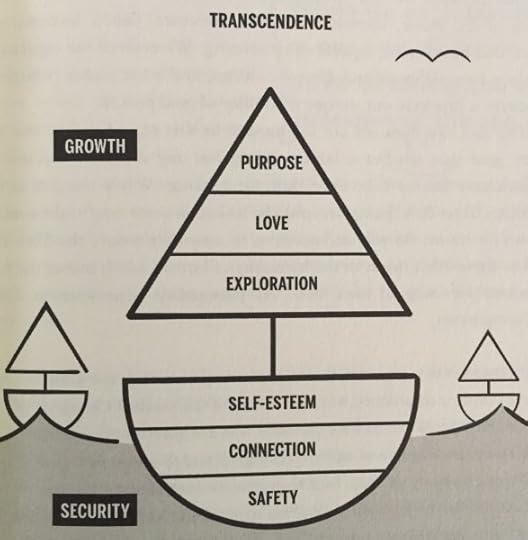
Scott Barry Kaufman and Jordyn H. Feingold's Choose Growth is a direct response to the COVID-19 pandemic. In an effort to transform our collective trauma into an opportunity for reflection and posttraumatic growth, Kaufman teamed up with Feingold to expand and operationalize the research from his previous book, Transcend: The New Science of Self-Actualization, which upgraded Abraham Maslow’s hierarchy of needs using a sailboat metaphor:
Chose Growth takes the reader on a brief but detailed tour of the sailboat, starting with basic security needs, working up toward growth needs, and ending with advice on how to “become a transcender.” Filled with accessible research summaries and practical suggestions for how to live better, Choose Growth should prove an effective tool for anyone seeking to understand and walk the path of human flourishing.
Key Concepts and Notes:
––SBK’s Transcend was my favorite nonfiction book of 2020, so I was excited to see that Choose Growth was a continuation of that work. It was also well-timed for me personally because I am in my first year of graduate school in counseling psychology, and plan to use SBK’s sailboat model as one of the foundational theories in my future practice. ––I think Maslow would celebrate not just SBK’s modification of the hierarchy of needs, but also his completion of Maslow’s “Theory Z”––the suggestion that “self-actualization is just a bridge to transcendence” (144). SBK’s concept of “healthy transcendence” is the logical extension of Maslow’s legacy. ––Feingold, a former student of SBK’s, seems like an important person to watch in the decades to come. Choose Growth is a solid step in her efforts to promote the new field of “positive medicine”––a healthcare-based extension of the positive psychology movement. ––Overall, this book is incredibly well-researched. Readers can be confident that they are engaging with an evidenced-based approach to self-help. With the exception of the sailboat metaphor, the content isn’t particularly novel, but it’s presented in a way that’s easy to digest, remember, and put into practice. ––I didn’t complete all the recommended practices/exercises, so I can’t speak directly to their efficacy. But I reviewed all of them and think they have a lot of potential, especially when selectively applied to areas where a particular person happens to be underdeveloped. The book seems like a terrific resource for therapists looking to help clients explore and articulate their basic needs, values, and goals. ––Personally, I found the advice on how to manage anxiety to be very helpful. I love the idea of personifying this emotion, thanking it for looking out for me, and then telling my anxiety that it’s no longer needed. I’ve come across this idea before but Choose Growth really solidified it for me. ––SBK and Feingold do a good job of acknowledging that systemic injustice, structural dysfunction, bad luck, and group identities play a significant role in mental health, but they mostly focus on meeting universal needs, drawing out our common humanity, and treating people as individuals. This positive, inclusive approach zeroes in on the aspects of our cognition and personal lives that are within our control, fostering a sense of possibility and empowerment. ––I love that SBK and Feingold explicitly reject the idea of a “best self.” I think a lot of people get stuck on this notion that their goal in life should be to discover and become their best self, but it turns out that’s just not how the human body-mind works. Each person is “a bundle of various and sometimes conflicting impulses, emotions, roles, and drives” that can either be suppressed or amplified by a huge variety and internal and external stimuli (84). The goal, therefore, should be to identify, create, and maintain the circumstances in which our best potentialities tend to arise. This process is ongoing and endless throughout the lifespan. We’ll never arrive at a “best self,” and in fact we shouldn’t want to because that would mean the end of growth. ––In general, I think Choose Growth represents the our best available model for how people can live well, one that honors our shared humanity and also delights in our individual differences.
Favorite Quotes:
Let us embrace what is human about all of us and seize this collective opportunity to grow, personally and collectively. Underneath our tribalism and arbitrary ways of dividing each other, we all have the same basic needs for safety, connection, self-esteem, and love, and we all want to matter, to find meaning, and to live a vital life. (xviii)
Choosing growth today is a way to honor our past, live more deliberately in the present, and nurture the future we hope for. To choose the path of growth is to integrate all the various parts of ourselves and uplift the completeness of our human experience. This process involves learning, accepting, and integrating all parts of ourselves, including those dark parts that we may wish to suppress or tuck away. It is when we harmonize these parts of ourselves that we may cultivate greater compassion, connect more deeply with others, extract more meaning and joy from life’s lessons, and ultimately contribute to the world in ways that are authentic, gratifying, and synergistic with those around us. (xxi)
As we move through life and aim to cultivate growth, one of the most high-yield investments we can make is a steadfast commitment to our relationships. The people we surround ourselves with, physically, virtually, emotionally, and spiritually, shape our realities in profound ways. Robust bodies of research show that happiness, health, and well-being are not just functions of our individual experience, but rather are properties of the groups we are a part of. (28)
For decades to come, the era of COVID-19 will provide a common reference point and language for all humans on the planet who lived through this time to connect, share stories, and relate to one another. A conversation starter with a stranger on an airplane, a fellow patron in a restaurant, first-date fodder, tales for our grandchildren one day: We will likely all be talking about this moment in history, and how it changed us, for the rest of our lives.
Stories connect us, reinforce our sense of purpose, and provide us with a path forward to close the gaps between the realities we lead and those which we imagine. They can help us integrate the darkness of our lives into our narrative, and perhaps even emerge from and grow from that darkness. (138)
Healthy transcendence is not about being more enlightened than others, but about being more authentic to ourselves and synergistic with the world. What is good for us is good for others. What we love to do, or that which we are even called to do, positively impacts others. There is a great connection between self and world. We don’t choose ourselves over others, and we also don’t choose others over ourselves. There is a harmonious integration between self and world. (144)
In daily life we often fall subject to the defense of “splitting” or resort to “all-or-nothing thinking”…However, making room for uncertainty by practicing “yes, and” with ourselves and others can help us honor the complexity and richness of our full human experience, and to not only tolerate but embrace and revel in the complexities, contradictions, and gray areas we live in…
Whereas “yes, but…” narrows the possibilities and places conflicting experiences and views at odds with one another, “yes, and” helps us to enthusiastically accept the totality of an experience; validate, rather than undermine conflicting impulses or feelings; and thereby foster mutual, positive regard with ourselves and others. (166)
While we’re each in our own boats traveling in our own individual directions, we really are inextricably connected to and interdependent on one another. Our own actions, even within our own boats, have rippling effects, creating tides and wakes that impact those around us as well as those who will come after us. (171)
This review was originally published on my blog, words&dirt.
Another great one by SBK! (And Jordyn Feingold!) Read this one for The Science of Living Well and had already read Transcend & it was also part of the syllabus for this class. We had to read chapters from each books each week that were related to the lectures. I was a little full of myself and didn't think this book would contribute any new information but it did! I learned so much from this book. Yes, some concepts were repetitive, but of course that's normal because the majority of people won't read both Transcend & CG. But I obviously learned a lot because my entire notebook is filled up haha.
I said in my review of Transcend that everybody NEEDS to read that book because it will change their lives. And that it should replace the Bible as the most-read book on the planet. Well I stand by that for this book too! I think what I especially loved about this one was the amount of exercises it had. We had to choose some of those for the class and they really did help me. Maybe it's just the psych nerd in me but they're so fun and just really helped me.
I also thought it was really inspiring that Jordyn Feingold was a co-author for this book. She's still in her psychiatry residency and she published a whole book???? I really look up to her for that. As well as all of her work with positive medicine. I'd like to be that impactful at such a young age as well.
This book made me so happy I need to go and read the rest of SBK's books but for now I'm onto Lisa Miller! Checking all the boxes for Barnumbia professors — I think that's a smart method because I can literally just ask them questions right on campus :)
Dear friend, In terms of useful books to buy in physical format, this tops the recent list. It’s full of exercises and activities, essentially designed as a personal workbook for your growth, with lots of humanistic and positive psychology throughout. My two biggest takeaways are: 1) My strengths on the VIA Character Strengths Assessment: love of learning, kindness, love, gratitude, and honesty. At first I didn’t appreciate this assessment, but the context Scott & Jordyn provide in the book, tying these strengths to virtues makes them so much more useful. 2) Exercises for savoring life. These I have yet to try out with consistency; this idea of intentionally savoring future, present, and past moments is one that is most exciting and applicable for me. In pursuit, Darien
3.5. I’d expect typical reader to benefit from this book, perhaps a lot. But imo it was somewhat lackluster summary of current thinking wrt psychology, mindfulness, emotional growth etc.
Psychical book recommended. Does not translate well into audiobook.
Along with Jordyn Feingold, Scott Barry Kaufman has authored yet another masterful work. The concepts encapsulated within the pages of this book should be a part of every high school psychology and every college Intro to Psychology course.
I enjoyed it and it is worth a second read. I enjoyed the activities throughout and did most. I would like to go back and do all of them. Well written, good ideas.