Jump to ratings and reviews
Rate this book

Black Butterflies

Rate this book
Sarajevo, spring 1992. Each night, nationalist gangs erect barricades, splitting the diverse city into ethnic enclaves; each morning, the residents – whether Muslim, Croat or Serb – push the makeshift barriers aside.

When violence finally spills over, Zora, an artist and teacher, sends her husband and elderly mother to safety with her daughter in England. Reluctant to believe that hostilities will last more than a handful of weeks, she stays behind while the city falls under siege. As the assault deepens and everything they love is laid to waste, black ashes floating over the rooftops, Zora and her friends are forced to rebuild themselves, over and over. Theirs is a breathtaking story of disintegration, resilience and hope.

256 pages, Kindle Edition

First published May 5, 2022

612 people are currently reading
37882 people want to read

About the author

Priscilla Morris

1 book190 followers
Priscilla Morris is a British author of Cornish-Bosnian parentage, who lives in Monaghan, Ireland. She grew up in London, spending her childhood summers in Sarajevo. Black Butterflies, her debut novel, was inspired by family history and tells one woman's story of disintegration, loss, resilience and hope. When not writing, Priscilla teaches creative writing online and runs writing retreats in Catalonia. Find out more on www.priscillamorris.org


***

I wrote my debut novel BLACK BUTTERFLIES (2022) to understand the siege that devastated Sarajevo from 1992-1996. It turned many of my maternal relatives, including my grandparents, into refugees. It's inspired by their stories and, in particular, by the extraordinary tale of my great-uncle, the Bosnian landscape painter Dobrivoje Beljkasic. It was shortlisted for the Women's Prize in 2023, as well as four other prestigious awards, and has been translated into Bosnian, Slovenian, Italian, Dutch, Spanish, Catalan, French and Arabic.


I have a PhD in Creative Writing from the University of East Anglia and read Spanish, Italian and Social Anthropology at Cambridge University.

Find out more at www.priscillamorris.org.
Connect with me on instagram on @priscillamorriswriter.

Ratings & Reviews

What do you think?
Rate this book

Friends & Following

Create a free account to discover what your friends think of this book!

Community Reviews

5 stars
5,141 (39%)
4 stars
5,772 (44%)
3 stars
1,712 (13%)
2 stars
224 (1%)
1 star
37 (<1%)
Displaying 1 - 30 of 1,575 reviews
Profile Image for Jack Edwards.
Author 1 book298k followers
March 28, 2024
This book specifically documents one woman's experience living in Sarajevo during the Bosnian War, but also speaks to a wider truth of human perseverance in times of conflict. It recounts the trauma, isolation, and devastation of war, but also the remarkable power of the human spirit, and the way communities come together to provide a glimmer of hope in the bleakest of times.

One scene that will always stick with me is when it starts snowing in Sarajevo, and the temporary peace this brings our protagonist. The purity and perfection of the snow (think of the intricacy of each snowflake, a beauty produced entirely by nature) is problematised by the inevitability that it will eventually melt. Initially coating the evidence of war's destruction with a shimmering white blanket, the snow eventually disappears into a brown slush. If anything, this causes the protagonist to feel an even grander sense of emptiness, having been offered a momentary refuge - it serves as a reminder of what she has lost.

I loved the way this book depicted the importance of art, presented here as the antithesis of war, though also deeply intertwined. I think of this Bertolt Brecht quote, which remains as pertinent as ever:

"In the dark times
Will there also be singing?
Yes, there will also be singing.
About the dark times.”
Profile Image for Sujoya - theoverbookedbibliophile.
789 reviews3,512 followers
April 26, 2023
*Shortlisted for the 2023 Women's Prize for Fiction*

4.5⭐️

Set in 1992 Sarajevo, Black Butterflies by Priscilla Morris is a harrowing (fictional) account of the first year of the Siege as seen from the perspective of fifty- five year old painter and Professor of Art at the Academy of Fine Arts , Zora Kočović, a civilian trapped in the war-torn city that has always been her home.

“Half of Sarajevo is Muslim, a quarter Serb, and fewer than one in ten Croat. A third of marriages are mixed, the children simply calling themselves ‘Yugoslav’.”

Predominantly secular and home to a multi-ethnic population, April 1992 saw Bosnian Serb Nationalists place Sarajevo under siege, intending to remove Bosnian Muslims – an act of “ethnic cleansing”. Anti-nationalist peace marches were met with sniper attacks and widespread violence. Zora, a Serb whose family has called Sarajevo home for generations, is heartbroken with what is happening around her. As the situation begins to worsen she sends her husband and her elderly mother to England to live with her daughter and her family with hopes that the situation is a temporary one and life would return to normal soon enough. Left on her own, she spends her time painting her favorite bridges and landscapes in her studio on the top floor of the Vijećnica (Town Hall), teaching and hoping for better days.

“There’s a new category here now: the good Serb, i.e. the Serb who is not a nationalist, who does not want to divide the country, to ethnically cleanse. I’m constantly having to reassure people that I’m a good Serb. It’s driving me insane.”

But when the unrest intensifies and all avenues to leave are gradually shut down, she is trapped, alone but for her neighbors and students, deriving comfort and support from one another. Braving the elements and coping with food shortages no electricity, no heat and no water while trying to stay alive amid mortar fire and sniper bullets they also bear witness to the destruction of the city they all love and the lives they built around it.

“We’re all refugees now, Zora writes to Franjo. We spend our days waiting for water, for bread, for humanitarian handouts: beggars in our own city.”

This is a brutally honest, informative and hard-hitting story. Given the subject matter, that is not surprising and the author paints a vivid picture of the struggles of daily life amidst a horrific war. Zora’s pain and despair are palpable as she tries to contact her family and find a way to leave when her living conditions become unbearable. While on one hand, the author is brutal in her description of the volatile political climate, violence and horrific living conditions, she also paints a poignant picture of strength and resilience, humanity and a sense of family and unity among those struggling to survive the war. The symbolism of Zora’s art and the significance of the title “Black Butterflies” against the upheaval and devastation Zora witnesses is of particular significance to this story. Zora's art is not only a source of engagement and comfort for her during those difficult times but also provides readers a brief glimpse into the folklore and historical Ottoman architecture of Bosnia-Herzegovina. I would urge you to read the Author’s Note wherein Morris talks about her family and the real events that inspired this novel.

Overall, I found this novel to be a well-researched, beautifully-written work of historical fiction. It is hard to believe that this is the author’s debut novel and I look forward to reading more from this author in the future.
Profile Image for Rosh ~catching up slowly~.
2,377 reviews4,888 followers
April 27, 2022
In a Nutshell: An enlightening and traumatising fictional account of a war I wasn’t much aware of – the Bosnian war of the early 1990s. Well-researched, well-written, bitter-sweet.

Story:
1992, Sarajevo. Zora is a 55 year old artist who teaches art at college and loves to paint bridges and nature scenes in her spare time. She stays with her 70 year old husband and also has her 83 year mother staying nearby. When the war begins, Zora’s family doesn’t believe that it would go on for long. But when the law and order situation degrades after some ethnic groups tussle over their rights, Zora’s husband plans to take his sick mother-in-law to the UK where his daughter lives with her family. However, the transport lines are closed soon after his departure and Zora find herself stuck all alone in a war-torn city, with hardly any resources, very few trustworthy neighbours, and no hope of escape.
The story is narrated in the third person perspective of Zora.

First, know a little more about the Bosnian War to realise how historically significant (and monumentally stupid and infinitely wasteful) it was. Estimates suggest around 100,000 people were killed during the war. Over 2.2 million people were displaced, making it the most devastating conflict in Europe since the end of World War II. In addition, an estimated 12,000–50,000 women were raped, mainly carried out by Serb forces, with most of the victims being Bosniak women. The author focusses on the experiences of those surviving in the part of Sarajevo that was under attack by the Serbs. I was grateful that she didn’t include any rape narratives in her story – I don’t think I could have handled that. Simply reading this statistic is enough to depress me.

Where the book worked for me:
💐 It was an eye-opener! There were so many situations I simply couldn't fathom - your family property being distributed among strangers because of a communist government's weird beliefs, being on the waiting list for more than a decade to get a flat allotted, the government declaring that anyone can move into empty house as the owners have “abandoned” them… and this is even before the actual war began! How we take our privileges under democracy for granted! Sigh.

💐 The author pays fair attention to each of the ethnic groups in Sarajevo. To use her stats, “half of Sarajevo is Muslim, a quarter Serb and fewer than one in ten are Croat. About a third of the population are in mixed marriages.” All of these are represented fairly in the story through characters coming from various ethnic identities. More importantly, no sides are taken. (The author mentions in her note that there are no ethnic identities but national identities in Bosnia, but unless you read her note entirely, you won’t understand why. So I stuck to the word “ethnic” in this review.)

💐 There are no breaks through regular chapters. Instead, the narrative is divided in long sections named by season – Spring, Summer,... This was a great way to highlight how time passes differently under situations of siege. (Don’t we all remember how time almost stopped during the lockdown?!?) This feels like one endless story that spirals slowly into a kind of claustrophobic hopelessness.

💐 The title has a special significance in the story, and this gets revealed only about the midway mark in a distressing event. I would have thought it to be an exaggeration but when I read that part, I remembered a scene from the first episode of the TV series ‘Chernobyl” where a similar experience with “black butterflies” was shown. That scene helped me visualise this event properly. In addition, you can search online for the meaning of “black butterfly” and once you read the book, you will see what an apt title it is for this story.

💐 There is a strong underlying theme of bridges, which is so ironic in a war story. Zora’s specialty is painting bridges. Her latest artwork is set around one of the main bridges of the city. Some folk stories within the narrative are set around bridges. And yet, all the bridges between Sarajevo and the outside world have been destroyed by the war, as have the internal metaphorical bridges between the different ethnic groups.

💐 There are many situations in the book that will show you a side of war you have hardly ever seen in fiction. Some scenes create a claustrophobic feeling; others are way too disquieting. The story hits hard on your emotions. The writing enhances the impact. Sample this line written by Zora in a letter: “We're all refugees now. We spend our days waiting for water, for bread, for humanitarian handouts: beggars in our own city.”

💐 The ending is perfect for such a story.

💐 The author has researched her book well and it shows in the detailed and precise penning of incidents and feelings.

💐 The author’s note clarifies which two persons' experiences she combined and adapted into this story. That lends a lot of validity to what would otherwise have seemed as fictional events improbable in real life.

💐 I couldn’t believe that this was a debut novel. It has a maturity lacking in the writing of far more experienced authors.


Where the book could have worked better for me:
⚠ If there was one thing that strongly took away from my experience, it was the romantic track. Yes, yes, I understand… war time, living in the present, exceptional circumstances, absent spouses, can’t function within normal societal rules,.. blah blah.. But it was still forced and unnecessary to the main plot.

⚠ There are a lot of lengthy descriptions of the city and its sites. It felt like an emotional ode to Sarajevo, a tad overdone. (This is understandable given the topic of the book.)

⚠ I wasn’t much familiar with the details of these events except for a skeletal knowledge of the war having taken place. So I found myself a little lost at times in understanding the geography and the politics of the region. I also didn’t understand what issue the war began over. (Then again, one of the characters says that even they fail to understand why the war started in the first place. So I guess there’s no easy answer to this question.) I would have appreciated a brief note at the end on the facts behind the cause of the war and the political climate at the time, just like the facts behind the ethnic groups were clarified in the author’s note.

⚠ The book is marked as literary fiction but it is more of a commercial historical fiction. This didn’t make any difference to me this time but to those who expect a book to cater to its advertised genre, this could be a minor problem.


I couldn’t help connecting this story with the situation in Ukraine right now. Of course, the author hasn’t written this book to capitalise on the current war because I had received this book from Netgalley in January and it is meant to be published on the 30th anniversary of the ‘Siege of Sarajevo’. But there are so many similarities between the experience of Zora and what we read about Ukraine citizens in the newspaper. It makes me feel like no matter how much our technology progresses, we humans don’t progress in “humanity” – our thoughts are still all about power and control, whether over nature or over other people. We are truly a selfish species on the whole. 😟

All I can say is, if you are looking for a book that unveils the hidden costs of war on the citizens forced into it, and that juxtaposes many opposite feelings - vulnerability and resilience, hope and hopelessness, devastation and creation, this is the book for you. But please note, if you are in an anxious or depressed state of mind, I suggest you stay away from this book until you are in a happier mental place.

4.5 stars. (Yes, I said 4.25 here earlier today, but it’s a debut novel, and it is still in my mind after the entire day has passed by. It deserves more!)


My thanks to Duckworth Books and NetGalley for the DRC of “Black Butterflies”. This review is voluntary and contains my honest opinion about the book.


***********************
Join me on the Facebook group, Readers Forever! , for more reviews, book-related discussions and fun.
Profile Image for Canadian Jen.
661 reviews2,804 followers
June 3, 2023
I searched high and low for this since its publication last year. Even crossed a continent but couldn’t land a copy until I found one online this year. Finally.

This is the story of the Sarajevo siege that raged from 1992-1996. A story of Zora, an artist, who didn’t travel with her daughter, husband and mother to England. While they were gone, she became trapped within her city. Hunger, fear, cold. Their constants.

An ugly history and an annihilation. What started as a war for territory shifted to one of religion, with muslims being targeted.
Black Butterflies fluttering the landscape. The ashes from the fires that took the library books, the artist’s canvasses and other historical items of significance.
The writing captivating. The art a reflection of the beauty Sarajevo had before the war. The landscape; the bridges; the people.
The cost of war: devastating.
4.5⭐️
Profile Image for Emily Coffee and Commentary.
607 reviews265 followers
July 1, 2024
A remarkable account of the strength of art, love, and hope in the face of war. The prose was beautiful, showing the limitlessness of inspiration and human connection as clear and bright as paint on a canvas. I also very thoroughly appreciated that this story helped to uplift the voices of a people seldom heard in mainstream media. A haunting and resonating new novel.

Thank you so much to Priscilla Morris and Book Sirens for this ARC. Please read this book, it will stay with you, especially if you have a connection to the arts.
Profile Image for Roman Clodia.
2,895 reviews4,646 followers
May 9, 2022
Sorry, I don't want to sound like a book-snob, but this is far more commercial in writing style, tone and attitude than I expected (lots of those 'cold needles of panic pierced my stomach' type sentences - ugh!). I was interested in the subject matter but this feels superficial in treatment and with no subtlety or nuance or additional historical insight, or any sense of knowledge beyond that which anyone outside of the former Yugoslavia could have read in the newspapers. Just not my type of book
Profile Image for Foz ☀️.
151 reviews48 followers
August 28, 2025
- عن حصار سراييفو في البوسنة، وعن الحرب والقتال والصراع بين الصرب والكروات، وعن الجوع والبرد القاسي وانقطاع وسائل التواصل مع العالم الخارجي، تأتي لنا هذه الرواية لتحكي ما تلته حرب البوسنة -صربيا- كرواتيا- بلغة سهلة ممتعة أحياناً وقاسية أحياناً أخرى

- رسّامة هي وعائلتها، المكونة من زوجها وابنتها وأمها العجوز يعيشون في سلام في البوسنة، وهناك؛ بعد تفكك يوغوسلافيا، اشتعلت الحرب بين أعراق هذه الدولة، وهنا لن تتحدث الكاتبة عن التاريخ ليوغوسلافيا بل ستكتفي بذكر صربيا وكرواتيا والبوسنة، لأن هذا ما أدى إلى النزاعات في "البوسنة" بشكل عام وبشكل خاص الكاتبة من أصول بوسنية، ولكن لم يمنعني هذا من الاطلاع على باقي الصراع في يوغوسلافيا حيث ألبانيا ومقدونيا وكوسوفو وسلوفينيا ومونتينغرو أيضاً تعرضوا للحرب، ولكن وضع البوسنة مُختلف وهذا يرجع لوجود غالبية مسلمة ما يشكل قرابة نصف عدد سكانها 51%، واللغة الرسمية لها هي صرب-كرواتيا وهذا يرجع إلى أنهم كانوا دولة واحدة يوغوسلافيا وتضم جميع الدول التي ذكرتهم، أيضاً جغرافياً البوسنة في المنتصف ولا تطل على بحار
- تنقل لنا هذه الحكاية ما عاشته الرسامة وأسرتها في هذا الحصار تحت القصف، تمكنت عائلتها بالرحيل ولكن البطلة تشبثت في مكانها بسبب أن الناس بدأت تستولي على أي بيت أو شقة فارغة ويقيمون فيها ويسرقونها بكل بساطة، لكن القصف كان أفضع من تينك الجدران وحتى الجدران تحطمت إثر القصف، الرسامة تعيش مع جيرانها وأبنائهم، يتشاركون كلهم في نفس المعاناة والحزن والأسى، على الرغم من اختلاف بعض الأعراق هذا صربي أو كارواتي كانوا متلاحمين إلى أن جاءتهم هذه الحرب، الصرب في جبهة و الكارواتيين في جبهة أخرى يتطاحنون.
- أسلوب الكاتبة جميل ولكن ما لم يُعحبني هو أنها جعلت من إحدى الشخصيات "كاتب" وكتب قصة، القصة يحكيها داخل هذه الرواية لم تعجني كثيراً كانت في الجزء الأخير، الكاتبة من فهمي (لم تذكره) هي ليست من المسلمين ولكن أوضحت فكرة أن حتى البوسنيين بينهم وبين بعضهم كانت هناك خلافات أي بين المسلمين والمسيح، وكانت هناك شخصية وهو خالها وهو مُعادي للمسلمين، انصدمت بإن لهم أغنية ترجع إلى أيام الحرب العالمية تُعادي المسلمين، غريب أمر الأوربيين بصراحة، عموماً نجحت الكاتبة بتوصيل أفكار الفئات المختلفة في هذه البقاع من العالم، ويجدر الإشارة بأن الترجمة ممتازة جداً وطبعاً أنصح بقراءتها.
Profile Image for Lady Clementina ffinch-ffarowmore.
942 reviews243 followers
May 25, 2022
My thanks to Duckworth Books and NetGalley for a review copy of this book.

Black Butterflies is a beautiful, powerful, heart-wrenching, and haunting story of a city torn by war, and of its people, coping not only with the adversities of daily living, but also the helplessness and heartbreak of seeing the city they love destroyed before their own eyes. Based on real-life incidents and experiences from her own family and relatives, author Pricilla Morris paints a picture from a few decades ago, that has resonance and relevance in the present context.

Zora Kočović is a professor of art at the Academy of Fine Arts at the University in Sarajevo, where she lives with her husband Franjo, a former journalist and eighty-three-year-old mother, who spends winters at their flat. Sarajevo is a city Zora knows and loves deeply, so much so, that she can’t envision living anywhere else:

She loves Sarajevo. She knows all its alleys and courtyards, all its scents and sounds—the way the light falls at the end of their street in wintertime, the rattle of the tram, the blowsy roses that bloom each June in the mosque gardens, the plums and fogs in the autumn, the ponderous old men playing chess in the cafés, the mahalas—the old neighbourhoods—that radiate from the centre like the spiral of a snail’s shell.

Sarajevo has always been multicultural—its people living and mixing harmoniously, most families mixed—most celebrating the festivals of all cultures. But now there is unrest. Conflict is brewing—people starting to leave, and refugees allowed to occupy any flat that’s empty. Zora decides that while she will stay back a while for her painting and her job, Franjo and her mother are to travel to England for their annual visit to their daughter Dubravka, married to an Englishman, Stephen and their little daughter Ruby. Zora will join them later.

While things are difficult and there are small obstacles she must face, Zora begins to enjoy the solitude and the chance it gives her to engage in her painting. But before long, things take a turn for the worse, and the conflict turns into a full-blown war. The city is being destroyed all around her, going to university or her studio is no longer an option, and her own apartment building is damaged in the shelling. Things start to get scarce—food, water, electricity—and then completely vanish. The little contact she had with her family on the telephone too comes to an end, when lines are cut off. All the residents of Zora’s apartment building come together, helping each other cope with a situation most of them find hard to understand. We follow Zora as she tries to come to terms with all that’s going on.

This was a wonderful though heart-breaking book which kept me reading all through, and one which I highly recommend.

The Bosnian war of 1992–1995 was something I knew little about, and this book helped me get some context. While the book doesn’t go into the motivations and differences that led to the conflict (indeed, the characters themselves are at a loss to point a finger at why), it goes give one an insight into the kind of multicultural space Sarajevo was. I had no idea that it was part of the Ottoman empire once, and enjoyed getting glimpses of its culture like how festivals were celebrated and some folklore as well as some of its bridges and landmarks. Sarajevo’s people continue to fight against the seeds of division that the conflict tries to sow (there are some of course, who hold radical views, too). A particularly beautiful, yet highly distressing moment is where people get together to save what they can from the library which is on fire:

Have you ever heard of such a thing? A human chain to rescue books. A moment of coming together, of resistance. But what good did it do? They say almost two million documents burnt in there. First editions, rare manuscripts, land records, newspaper archives. Our heritage destroyed in a night.

The focus of our story is Zora’s experiences. With her we too watch as a rich, bustling, lovely city is plunged into war—as a relatively normal life (there is unrest already when the story opens) deteriorates into a struggle for day-to-day survival—a battle not only against the war and its weapons, but also against its impacts, whether lack of basic necessities or the elements or the constant insecurity and uncertainty. Before long it seems—there are no beginnings and endings. Just war.

Zora must cope with much—the struggle for survival, the pain of watching the city she loves being torn to pieces around her, her art that she lives for and through which she expresses herself destroyed, separation from her family (whom she needs more than ever at these times), grappling with the question of leaving versus staying, and really also wondering about the war itself which makes no sense. Morris gets us to experience every little emotion with Zora—the shock, the hurt, the cold, the hunger, also the few moments of comfort or happiness snatched amidst it all. And she treats it with subtlety and sensitivity—we feel pain, loss, helplessness, hopelessness—and without bringing in the slightest hint of drama.

Art is also an important thread of the book. This is what Zora does and also really the way she expresses her love for the city and also her emotions towards it. Initially we see her painting its bridges and landscapes—and later the destruction and fires that take over the city. Art also ends up offering her solace, when she feels lost, for her neighbours sending their little daughter Una for lessons gives her (in fact them both) something to look forward to.

While we see and experience everything though Zora’s perspective, we also get a sense of the community—her neighbours particularly who turn into a source of much needed comfort and support for each other during the ordeal—while each also deals with their own problems.

A beautiful and poignant read. 5 stars!
Profile Image for Jodi.
544 reviews236 followers
August 15, 2025
In April 1992, Zora and her husband sensed an uprising may be imminent, as tanks and military equipment moved into place in the hills above their Sarajevo home. At the time, Zora’s mother was very ill, as her daughter—who lived in Britain with her husband—begged them all to come for an extended visit. It was a very difficult situation, but it was decided that Zora’s husband would take his mother-in-law to Britain, while Zora stayed behind in Sarajevo. No one could imagine the hostilities would last more than a few short weeks.

In fact, however, the siege of Sarjevo—the beginning of the Bosnian war—was about to begin and would last four long years. In the months that followed, Zora had to deal with one desperate situation after the other: water and electricity were cut off, communication lines were destroyed, no fuel could be had. Starvation was everywhere. Violent gangs took over people’s homes and sold everything in sight. Snipers were seen on rooftops, shooting indiscriminately—killing even children! On the few occasions Zora ventured out to find food, she’d come across dead bodies in the streets, laying there for days and sometimes weeks! The last straw for her—what nearly destroyed her—was the burning and complete devastation of the Bosnian National Library. Zora was a famed artist in Sarajevo and, many years earlier, the city gifted her a large art studio under the building’s beautiful domed roof. Late one night, as she looked out her apartment windows, she saw flames billowing from the Library. She could see millions of “black butterflies” falling from the skies and floating everywhere. These were not only the burnt pages of thousands of books, but also burnt canvases—every one of Zora’s irreplaceable paintings had gone up in smoke and flame. Destroyed forever. She ran from her home to the site of her demolished studio, as though in a blind rage. She then filled bag after bag with these black butterflies, as though to rescue them. In the end, she would use them in a new kind of art she’d create—her “Fire” series.

This was an absolutely horrifying story, based on actual tales related to the author and described in the book's "Author's Note". Sadly, it continued for months as Zora and neighbours in her high-rise building would huddle together, hoping to find a little warmth, and sharing whatever they had to keep each other alive. In the end, thanks to her personal connections, this nightmare ended for Zora long before peace came but, for thousands of others, it meant years more suffering. I wondered, too, about those I imagined may have prayed for death to take them.

It's not a long book, but it took more time than usual to read it as I could bear it only in small chunks. And in every moment I read, I felt intense gratitude—profoundly grateful that I was born, and have always lived, in Canada, where war happens only somewhere else; never here.🙏

In the words of one WWII veteran came a phrase that is true of ALL conflicts “ There is no flag large enough to cover the shame of killing innocent people.


“Nothing–good–ever���comes–of–violence” 4.5-stars ⭐⭐⭐⭐
Profile Image for Kerry.
1,056 reviews176 followers
September 24, 2024
An amazing novel about an artist surviving the siege in Sarajevo during the Balkan war 1992. Short listed for the Women's Prize in 2023. Review to come. I hope I can do it justice. So good it should not be missed. Narration by Rachel Atkins who is excellent.


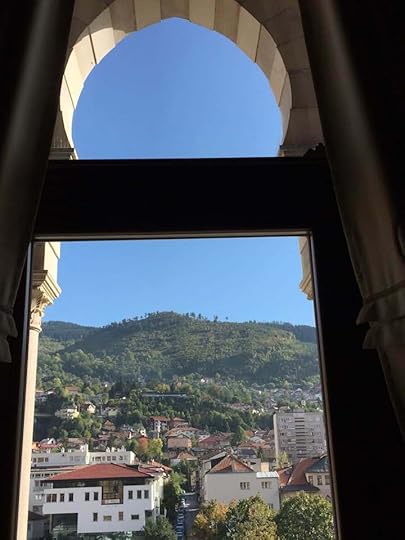
I just had to include a picture taken in Sarajevo when I visited there a few years ago. What a beautiful city it is, now totally rebuilt since the days of the war.
This book brought back so much of all I remembered about the people and the setting and its beauty with its many bridges and thick forests above and all around. It is a place I am drawn back to if not in person, in my reading.

This novel is a fictional account of a woman artist who lives and works in Sarajevo during the days of the Bosnian war, specifically 1992 when Sarajevo was encircled by Serb forces and cut off from the outside world during a siege that lasted over 1000 days. It is the longest siege in modern warfare and resulted in the deaths of over 11,000 citizens over 500 of then children.

It is narrated by a local painter who like so many never believed that the city would be invaded or that the war would last so long. Sarajevo had been and still is a city where much of the Serb, Croat and Muslim populations have intermarried or are neighbors and have lived in peace. Few of the details of the war are discussed in this novel. Instead it is more of a personal account by Zora of her hardships during this difficult time when food and fuel for heat became progressively scarce and snipers and bombs became part of daily ife. Zora's family left before the siege began believing she would soon join them. It soon becomes clear that she will not be able to leave and must find a way to fill her lonely days. At first she spends her days teaching art and painting in her studio in the Fine Art Center that is above the National Library. Alone at night she makes friends with many in her apartment building. Neighbors and friends gather nightly to share food and fuel for a wood stove. A found family develops as the siege continues and all must work together to survive.

As the siege continues relationships develop and the reader learns more of the backstory of the people who Zora becomes close to. It was inspiring and heartening to read how people helped each other during this difficult time. When the Vijecnica (National Library and Fine Arts Center/Town Hall) is hit by 30 incendiary shells, citizen worked together to try to save what books they could from the burning building. (The black butterflies of the title are the ashes of books that rain down on the city for days). Unfortunately many of Zora's paintings are lost. Many of her paintings are of bridges, a particularly striking image during this time of bridges to the outside world lost and bridges between people who remain built.

Most of Sarajevo has since been rebuilt. Amazing, as barely 30 years have passed. Most of the citizens still recall these days and many tours are available where I learned about this war that I was only faintly aware of in the USA.

This is a short novel, less than 300 pages, but with so much to recommend it. It is definitely a 5 star read and I recommend it in print or audio form.
Profile Image for Gabril.
1,041 reviews254 followers
November 7, 2023
Sulla dannata guerra fratricida in Bosnia finalmente leggo un libro antiretorico, sincero, maturo (niente protagonisti bambini/adolescenti a pietire afflati di lettori commossi) che racconta come Sarajevo sia diventata nel giro di pochi mesi una prigione a cielo aperto.

Distrutta inspiegabilmente la cultura multietnica che la caratterizzava, di cui il rogo della bellissima biblioteca nazionale è il tragico simbolo, la città diventa il teatro di una guerra assurda e implacabile, sprezzante di ogni diritto umano e insensibile a ogni differenza: implacabile e assurda come tutte le guerre, del resto.
Perché l’odio inveterato cerca il suo oggetto a caso e poi colpisce a raffica, ovunque. È il caso dei cecchini appostati ai piani alti di qualche edificio che si dilettano a fare il tirassegno contro chiunque abbia la sventura di passare per strada in quel momento. Giovani, vecchi, donne, bambini: è lo stesso. L’odio praticato come religione rende tutti uguali nello spargimento di morte a caso.

Priscilla Morris si ispira alla sua storia famigliare per raccontare di Zora, serba bosniaca, pittrice di una certa fama e insegnante all’accademia delle Belle Arti, che si trova nel giro di poco tempo prigioniera in una città assediata e ben presto ridotta alla fame. Recisi tutti i contatti col mondo fuori, Zora non riesce più a comunicare con i suoi cari: sua figlia vive in Inghilterra; suo marito Franjo l’ha raggiunta insieme alla fragile madre di lei, per proteggerla dalle prime minacciose incursioni dei nazionalisti serbi.

Musulmani, croati, serbi sono i gruppi che costituiscono la nazionalità bosniaca: non sono etnie diverse ma appartengono allo stesso ceppo slavo. Negli anni Novanta però qualcosa si rompe, la pacifica convivenza viene lacerata dal nazionalismo fanatico che rimane tuttavia incomprensibile alla popolazione civile e agli intellettuali come Zora.

Il racconto di una città sotto assedio è precisa, devastante, mentre segue il progredire insensato della violenza. La vita quotidiana dapprima sembra soltanto sospesa, ma in breve tempo ogni frammento di normalità viene annullato, sembra ardere nel rogo della Vijećnica, il palazzo simbolo della città, una meraviglia architettonica da cui si innalzano ora nere scaglie di cenere: quel che resta della cultura, del buon senso, della vera, autentica umanità. Una sola domanda : perché?

E poi: “Nel giro di una settimana, Sarajevo si apre come una piaga.[…] siamo tutti i profughi ormai, passiamo i giorni ad aspettare acqua, pane, aiuti umanitari: mendicanti nella nostra stessa città.”

Zora non può più insegnare, il suo studio distrutto nell’edificio distrutto, eppure cerca, fino all’ultimo, di continuare a dipingere: la sua specialità sono i ponti, ma quando si guarda intorno vede solo rovine: “Tutto, ovunque, è marrone e buio, fradicio e rovinato”.

I sopravvissuti si stringono intorno a quel che resta delle loro case, alle poche coperte, al niente di cibo.
E intanto, senza quasi più contare i giorni, un anno è passato.

Qui c’è la storia di Zora e non solo. Personaggi che rappresentano un popolo, legami umani che si intrecciano e si spaccano, sentimenti, parole e corpi. Qui c’è una città, Sarajevo, che è impossibile non vedere e non amare.
Qui c’è una letteratura che ci restituisce la vita nella sua nuda, essenziale e complessa verità.
Profile Image for Rachel.
334 reviews21 followers
May 10, 2023
In her twenties, when she returned home from her six years in Paris and Belgrade, she realised she couldn't live anywhere else. And now, she wants to stay in the city she loves as it's shaken, to see things through.


This is the third book in my quest to read all of the shortlisted books for this year's Women's Prize for Fiction.

Black Butterflies tells the story of Zora, a woman who decides to remain behind in her war torn home of Sarajevo, while her husband and mother leave to stay in England with Zora's daughter. The devastation of the war - the death, the hunger, the destruction of the city, the freezing cold of winter with no heat, and more - plays out on these pages. The story is a harrowing one, but there are also glimmers of hope throughout, through new love, painting, community gatherings, and dinner parties. People still manage to show kindness amidst the darkness.

The story is impactful, but it did not impact me as much as I had hoped. I felt disconnected from the characters - they weren't well-fleshed out and I didn't feel like I really knew them. There is a very sad death towards the end that I could acknowledge as heartbreaking but I didn't feel the sorrow because of that disconnection. As a reader, characters and dialogue are my two biggest interests so, unfortunately, this fell a bit flat.

This is certainly a compelling choice for the Shortlist but not my favorite, as it stands.

My 2023 Women's Prize for Fiction Shortlist Rankings (so far)
1.) Trespasses by Louise Kennedy
2.) Black Butterflies by Priscilla Morris
3.) The Marriage Portrait by Maggie O'Farrell

Rating: 3.5 / 5
Profile Image for Aly Lauck.
365 reviews23 followers
December 9, 2024
Great historical fiction book on the Bosnian war! The imagery on this book comes to life with the words!
Profile Image for Kristine .
998 reviews299 followers
Want to read
February 8, 2024
This was just Long Listed for the Women’s Prize for Fiction That is my favorite awards competition.

I am especially interested in this book, as I remember the atrocities in Sarajevo. I just ordered the book now, so another book I can’t wait to Read 🥰📚📚📚📚

The 2023 Women’s Prize for Fiction went to Demon Copperhead, Barbara Kingsolver. I have 3 to finish and think reading them closely helps decide which book strikes me as the best. I think this year’s nominations were all good.

Now how have I pushed this book aside and not Read It Yet! Maybe, because I have about 40 books ‘I’m Reading”. I Really Must Prioritize this One and Start 🥰
Profile Image for Chrissie.
1,058 reviews92 followers
August 26, 2024
I went in blind, and soon realised that this book was set in Sarajevo just before, then during, the Bosnian war.

I always love to learn something from a book, and empathise with characters.

Unfortunately, I found the writing rather simple, and the dialogue stilted. I wanted to love the characters, but did not feel that I got to know them enough to really care about them. I could not visualise them or their surroundings clearly, I needed much more description and depth.

I read the incredible "The Cellist Of Sarajevo" years ago. If you might feel the same as me about Black Butterflies, do read The Cellist Of Sarajevo, it's wonderful, and has everything this book lacks.
Profile Image for Khai Jian (KJ).
620 reviews71 followers
May 4, 2023
"We're all refugees now...We spend our days waiting for water, for bread, for humanitarian handouts: beggars in our own city"

Set in 1992, Zora Kočović is an art professor who lives in Sarajevo with her husband, Franjo (a former journalist), and her 83 years old mother. Sarajevo is a multicultural city (where the city is full of the Muslim, Serb, Croat, and Yugoslav populations) but racial sentiments, and ethnic tensions have arisen, and conflict is brewing. At this point in time, Zora decided to stay in Sarajevo for her painting and her job while Franjo and her mother traveled to England to visit their daughter Dubravka. Unfortunately, subsequent to the recognition of Bosnia as an independent and sovereign nation, the Bosnian War broke out and Sarajevo was under siege. Zora is trapped in Sarajevo and she is forced to maneuver around the constant bombings, shellings, and violence happening in the city, together with her neighbors and friends, and she has to resort to art to keep herself sane.

It was mentioned in the Author's Note that Black Butterflies is inspired by Priscilla Morris's great-uncle's story (where her great-uncle, an artist, was devastated and vowed not to paint after the destruction of the Vijećnica, the National Library of Bosnia) and the rescue of Priscilla Morris's maternal grandparents by her father from the Siege of Sarajevo. Black Butterflies is definitely an eye-opening read as it is premised on a European historical backdrop in 1992 that I am not familiar with: the Breakup of Yugoslavia, the Bosnian War, and the Siege of Sarajevo. The atmosphere surrounding the siege (the constant fear, the uneasiness, the hurdles that the citizens faced, the despair and oppressive state of the citizens), in particular, the dehumanization and degradation that occurred during that period are depicted very well by Morris. The other aspect of this novel would be the role of art in the state of war, where Zora resorts to art as a tool of comfort. When the Vijećnica was completely destroyed on 25 August 1992 (as a result of Serbian shelling during the Siege of Sarajevo), which resulted in the destruction of a majority of rare and unique collections of manuscripts and books in the library, Zora's despair, fear and desperation are amplified. The term "Black Butterflies" is used to describe the "burnt fragments of poetry and art catching in people's hair". It signifies the destruction of the last comfort and refuge that the citizens of Sarajevo have during the siege. "Have you ever heard of such a thing? A human chain to rescue books. A moment of coming together, of resistance. But what good did it do? They say almost two million documents burnt in there. First editions, rare manuscripts, land records, newspaper archives. Our heritage destroyed in a night".

Though the historical events during the Bosnian War are intriguing and there are certain heartwrenching moments in the book, there is a lack of depth in characterization, particularly the examination of the relationships between the character (especially the relationship between Zora and Mirsad, a bookseller whose romantic relationship with Zora bloomed during the siege). The book reads like a typical historical fiction without any uniqueness in form or distinctiveness in writing or prose (PS: I know I shouldn't be too harsh as this is a debut work by Morris). While it's shortlisted for the 2023 Women's Prize for Fiction, this is just a 3.5/5 star rating (and I can't believe the judges opted this over I'm A Fan!).
Profile Image for Rebecca.
4,182 reviews3,447 followers
September 26, 2022
Drawing on her own family history, Morris has crafted an absorbing story set in Sarajevo in 1992, the first year of the Bosnian War. Zora, a middle-aged painter, has sent her husband, Franjo, and elderly mother off to England to stay with her daughter, Dubravka, confident that she’ll see out the fighting in the safety of their flat and welcome them home in no time. But things rapidly get much worse than she is prepared for. Phone lines are cut off, then the water, then the electricity. “We’re all refugees now, Zora writes to Franjo. We spend our days waiting for water, for bread, for humanitarian handouts: beggars in our own city.”

When even the haven of her studio is taken away from her, she’s reduced to the bare bones of existence, with just a few beloved neighbours to keep her spirits up. Her painting, more an obsession than a hobby, keeps her human as she awaits space on a Red Cross convoy. The title has heartrending significance: ‘black butterflies’ are fragments of paper carried on the breeze after the burning of the National Library of Sarajevo, 30 years ago last month. It was especially poignant to be reading this during the war in Ukraine and think about the sorts of daily dangers and deprivation that people face in conflict zones. The pages turned quickly and I was reminded of Girl at War, one of my absolute favourites, as well as The Pianist.

Originally published on my blog, Bookish Beck.
Profile Image for Andrea.
1,081 reviews29 followers
October 16, 2023
4.5★

A few years after the event/s I became quite obsessed with the rolling wars that brought about the end of the former Yugoslavia, and read about it voraciously, but it was always the siege of Sarajevo that made my heart hurt the most. It's been a long time since then and I thought I'd had my fill until this novel by Priscilla Morris came along with its enticing cover, for the 30th anniversary of the siege. Morris's story is based upon the real life experience of older members of her own family, and I think it's an essential additional to the canon. It covers the first 10 months, and while it doesn't shy away from the horror and desperation, it also provides an insight to the warmth and humanity of the multicultural populace, trying to go about their ordinary lives under extraordinary circumstances. Rachel Atkins' narration is excellent.

Because I read the audiobook edition I wasn't able to read the Author's Note, but I found this article that explains how the novel relates to the author's family. https://www.irishtimes.com/culture/bo...

This book was shortlisted for The Women’s Prize for Fiction 2023, and I recommended it highly.
Profile Image for Joy D.
3,128 reviews329 followers
November 6, 2024
Protagonist Zora is an artist and art teacher in Sarajevo. She lives with her older husband and looks after her mother, who lives nearby. When barricades first appear in the streets, it seems strange, but residents just push them out of the way and go about their business. They do not expect what is coming. Zora stays to work, paint, and look after her home, while her husband takes her mother and travels to England to live with their grown daughter and her British husband. At first, Zora appreciates the time to focus on her art, but the ominous signs escalate into full-scale warfare – the Bosnian War (1992 – 1995). The storyline follows the slow descent into a hellish existence, without the conveniences she used to take for granted, such as electricity, ability to buy food, postal services, trash disposal, and running water. The residents face constant threats from shelling and snipers.

The residents have always lived in a society of mixed ethnicities. Zora is a Bosnian Serb and is friendly with her Bosnia Muslim and Bosnian Croat neighbors. Many reject the nationalistic views of those in the hills who are shelling the city and think that separating the population into ethnic divisions is ridiculous. These folks band together and try to survive the best they can. Some of the most touching scenes involve small groups of people huddling around a stove in their living room, where the windows are covered with trash bags since they were blown out by shelling. It is a very cold winter, and they tell stories and try to keep each other’s spirits up.

This is an amazing debut. The author has based this story on her own family history. Morris is adept at describing the city, and putting the reader in Zora’s shoes, living the nightmare along with her. The wanton destruction, corpses in the street, starvation, and the descent into chaos are both gut-wrenching and scary. People forget what “normal life” feels like. It is a moving and powerful story of war that reminds us of the dangers of extreme nationalism.
Profile Image for Ann.
364 reviews122 followers
April 17, 2023
I was overwhelmed with emotion by this novel of the siege of Sarajevo. Zora, a known Bosnian artist (and our heroine) and her husband are long time residents of Sarajevo. The reader understands that Sarajevo is a city in which people of many nationalities and religions live in relative harmony. When the fighting starts (1992), Zora’s mother and husband flee to England, leaving Zora in Sarajevo. With beautiful writing and incredible insight, this novel deals with the many facets of the ensuing siege and war. We see Zora, the artist, as she continues to paint and to teach art, until her workplace is destroyed and her art takes on a different form. We see the suffering of (mostly Muslim) refugees who have been forced from their homes with nothing but scars and are trying to continue their lives in Sarajevo. We see young men forced into military service. We see how the war pits nationalities and religions – and therefore neighbors - against each other. We see and feel the effects of constant shelling and the related fear and deaths. As the siege continues and winter comes, we see people suffering without food, power or water. We see the incredible emotional toll this takes upon all those living in Sarajevo. In the midst of it all, we see love – both family and romantic. Zora’s perspective, as a woman alone in a city under a brutal siege, who has watched the city she loves evolve into terror and destruction, will stay with me for a long time.
Profile Image for Carol (Reading Ladies).
924 reviews196 followers
May 31, 2022
4.5 Stars

Thanks @BookSirens and the author/publisher for a complimentary eARC of #BlackButterflies upon my request. All opinions are my own.

In the spring of 1992, fifty-five year old Zora can’t imagine that the Siege of Sarajevo will last long. Her husband and elderly mother leave for England, and she stays behind to continue working as an artist and teacher. The situation deteriorates quickly and Zora has waited too long to leave. The places she loves are destroyed and black ashes float around. Zora joins with her friends to survive the days, offer comfort to each other, and find reasons to hope.

“Everything is better when done together. The taste of food and water, the touch when they hug each other hello. They’ve made it through one more day, each reunion a confirmation that they’re still alive.”

Told from Zora’s POV, the use of third-person helped remind me that this beautifully written, descriptive, heartbreaking, and reflective story wasn’t a memoir!

The story starts with an element of denial which is also common in the World War11 stories I’ve read. Citizens can’t imagine circumstances could get worse, that the rumors are true, that the occupying force would really threaten lives or cause destruction or take away freedoms or imprison responsible citizens. I think most of us felt a bit of denial early in the Pandemic. This will be over in two weeks. It couldn’t possibly get worse or last for years. It’s human nature to deny that the worst could happen. We see this situation in Ukraine today. Before the Russian invasion, I saw an interview with some Ukrainian citizens and they reported that they were not concerned and planned to continue on with their normal activities…..they are threats we have heard and lived with for years and we’re not worried they said.

The author depicts the complexities of war that includes turning neighbor against neighbor, making difficult decisions to leave or stay, caring for strangers, family, and friends, waking up one day as a refugee, loyalty to neighborhood and homeland, friends and acquaintances of different ethnicities are suddenly enemies, separation of families, etc.

Black Butterflies vividly details the costs of war, the extent of destruction, and survival strategies for people who are caught in it. The author brings war down to the most personal level. I appreciate the themes of people helping people, resilience, determination, hope, human kindness, and compassion for refugees.

Those who have an appreciation for art will find lots to love about Black Butterflies. Among other subjects, Zora loves to paint bridges and I thought often about those bridges as a metaphor for human connection and in terms of physical escape or entrapment. Art is a tool for survival.

I’m recommending Black Butterflies for fans of beautifully written historical fiction, for readers who might be familiar with Sarajevo, for readers who love stories about ordinary people in the most difficult circumstances, and for those who appreciate a memoir-like narrative.

Content Consideration: If you are negatively affected by the coverage of conditions in Ukraine, you might need to know that some content in this book is similar.

For more reviews visit my blog www.readingladies.com where this review was first published.
Profile Image for Karyn M.
113 reviews14 followers
October 21, 2025
4 / Zora, artist, teacher, wife, daughter and mother, 55 years of age, stays behind in the early months of the Sarajevo Siege in 1992 after the collapse of Yugoslavia. We follow Zora as she carries on navigating the uncertainties of life in a city held hostage. Believing that the unrest won't last long, she hopes, somewhat naively that the spirit of the city she loves will overcome the worst of humanity. 

I feel this is quite a believable representation of how a creative idealist could act in a time of crisis. Zora does not sink into the depths of despair; she tries to keep her focus on her art and the small joys with the people she finds herself with. In her art she is drawn to landscapes and, in particular, bridges, in which she holds symbolic hope for the reconstruction of and the rejoining of her community and city.

Sarajevo, historically at the crossroads of trade, made it rich, complex, vibrant and culturally diverse. The capital and largest city in what is currently Bosnia and Herzegovina, Sarajevo lies in a valley surrounded by alps, which also made it possible for the siege to persist, leading to so many lives lost. Some new atrocities of this time have only come to light in the last few years and so much information about the history and absolute horror of this time can be found online if you want to know more.

I remember seeing the Bosnian War on the news, seeing teenagers being targeted by snipers on their way to school, images I will never forget. I really enjoyed this book and its softer approach, it has a quiet devastation feel to an absolute nightmare for the people of Sarajevo, and I’m glad for the prompts it gave me to learn more of the country’s history and this period.

Pricilla’s debut novel, is a fictionalised account of real events that happened to her own family. I think she did a great job and it deserves its place on the Women’s Prize Shortlist 2023.

Below are a few of my favourites

“It’s futile in any case, every morning the inhabitants of the streets, whether Muslim, Croat or Serb simply push the barriers aside and get on with their days.”

“Mysterious ditches are being dug at the ends of their streets in the small hours of the morning, and no one feels safe anymore.”

“Who knows what colour uniform we’ll be wearing in the morning.”

“There’s the sense of a movement growing, that the anti nationalist voice of Bosnia that wants unity and peace will be heard.”

“Not in Sarajevo, no one cares about nationality here, you know that. Everyone is Sarajevo is from a mixed family or in a mixed marriage.”

“Sarajevo had always been held up as a model of tolerance. Zora cannot believe that this fighting will go on, that the real spirit of the city will not rise up and prevail.”

“Well, if this is to be her last day here in god knows how long, she is going to paint until Farouk comes to get her. To hell with everything else!”

4 ⭐️ Audiobook read by Rachel Atkins
Profile Image for Irene.
989 reviews
August 2, 2025
Ze kan haar ogen niet losrukken van het brandende gebouw. Het is polyvalent en heidens, duizend dingen tegelijk. Het is een offer aan de lucht, hoewel ze niet precies weet met welk doel. Het is een kreet om hulp, een rooksignaal naar de rest van de wereld. Het is louter vermaak voor de Serviërs in de heuvels.

Erg goed en ook mooi verhaal. Wat mij betreft veel te onbekend, want voor mijn gevoel is dit stuk geschiedenis onderbelicht. Ik weet zelf weinig van deze oorlog in Sarajevo, en weet ook nauwelijks boeken die hierover gaan. Iets om op te zoeken.

Hoewel het een tijd was vol ontberingen, gemis, lijden, dood en meer nare dingen, lees je ook de kracht van kunst, elkaar steunen, hoop, veerkracht.
Er is moed en hoop, maar als het atelier van Zora en de bibliotheek afbrandt, glijdt dat allemaal weg. Het lijkt zinloos. Rook, stof en losse bladzijden als zwarte vlinders zijn het enige dat door de lucht zweeft.

Mirsad blijft staan en plukt iets uit Zora's haar. Hij houdt het tussen zijn duim en wijsvinger zodat ze het kan zien.
'Dit valt al dagenlang overal in de stad neer, zelfs helemaal bij het vliegveld en in Ilidza. Weet je hoe ze worden genoemd?'
'Nee.'
'Zwarte vlinders,' zegt hij zachtjes. Hij tuurt naar de geschroeide pagina alsof hij hem probeert te lezen en stopt hem vervolgens zorgvuldig in zijn borstzakje. 'Verbande flarden poëzie en kunst die in je haar blijven zitten.'


Gebaseerd op verhalen van gevluchte familieleden van Morris zelf en n.a.v. onderzoek en verhalen in Sarajevo zelf. Mooi en waardig opgetekend door Priscilla Morris. Een aanrader.

Deze recensie verscheen ook op https://lezersgoud.nl/zwarte-vlinders...
Profile Image for Jonathan Pool.
714 reviews130 followers
July 3, 2023
I read this as a consequence of the book’s shortlisting for the Women’s Prize for Literature, 2023.
I’m surprised the book achieved this acclaim since I found it worthy, heartfelt and uncomplicated. That’s damning the book with faint praise.

The number of fictionalised stories or historical accounts of siege is many and longstanding. From Troy to Stalingrad, and Ukraine, the subject is endlessly interesting and horrifying. The reader cannot help but be transported to the setting and to put yourself in that situation.
Priscilla Morris writes her story surrounding the siege of Sarajevo (starting in 1992). It’s a very personal story in which she, and especially older memories of her family, recall events from a first hand perspective. Morris spent some time back ‘home’ researching the events, and drawing on oral history.

There’s not too much to say about the novel. The human interest element revolves around a talented painter, and her fascination with the bridges of Sarajevo (Goats bridge in particular) is well described. Also highlighted is The Vijecnica, site of the University and (in) famous scene of the assassination of Archduke Franz Ferdinand in 1914.

This is all pleasant enough but it doesn’t stir the blood. Ironically I rarely felt any visceral sense of the fear that would have been prevalent as the city ran out of supplies.
I regard this as a comfort read ( though the subject matter would suggest otherwise). Not one to linger long in the memory however.
Profile Image for Emma Goldman.
45 reviews1 follower
May 19, 2023
Shortlisted for the Women's Prize for Fiction but this is more historical than literary. Undoubtedly paints a vivid picture of a besieged Sarajevo in 1992, and deserves to be read for that reason. But the writing is often clichéd, with no nuance, and the characterisation weak. I really don't feel I know any of the characters in the book at all. Perhaps the point is that they are meant to be 'everyman'? It's difficult to sustain interest, though, when you can't connect with anyone The book is told in the present tense and describes all and everything almost from afar. Perhaps this is meant to convey a dream-like quality, showing a disbelief, an incredulity at what is happening as the city falls? But again, it gets in the way of connection. Things that should have moved me intensely didn't. On a more pedantic note, the book has several grammatical errors and it's puzzling how they got through the editing process.
Profile Image for theliterateleprechaun .
2,441 reviews218 followers
March 11, 2022
“War couldn’t happen here in Sarajevo. Not here where everyone loved each other, she’d told herself with the simplicity of a child.”

Priscilla Morris took me inside the siege of Sarajevo through the eyes of Zora Kocovic, a Bosnian Serb painter, who finds herself trapped in the Bosnian capital and survives to escape during the bitter winter of 1992.

As the shelling begins, Zora pleads with her husband to take her elderly mother to stay with her married daughter in England. When he arranges to return to Sarajevo, he discovers that the Sarajevo Airport has been taken over by the Yugoslav National Army and it’s impossible to enter Bosnia. Meanwhile, Zora is trapped in her hometown as it falls apart around her. I sat in tears reading about the description of violence and anarchy and how quickly things escalated. I read about looting, snipers on rooftops, empty grocery stores, water and electricity cuts, barricades and no-go zones, labyrinths of tank traps, trapping pigeons on window sills for food and lineups for humanitarian handouts. I held it all together until I came to a letter dated July 18, 1992, and the dam broke and I sobbed. On the flip side, I noted hope and determination. The residents of Zora’s apartment building stuck together and supported each other revealing their resilience and love for their community as they painted, sang and watched out for one another. I may have been raised at the height of ‘the troubles’ in Northern Ireland but I have no concept of life in a war zone. It was eye-opening.

I was appreciative of an opportunity to read about a period in history I knew absolutely nothing about. I discovered that it was the longest siege in modern warfare and it gave me insight into what living in a war zone must be like for those Ukrainians who are unable to leave. Now I know the conditions they are fleeing from and the battle within their hearts as they struggle to make the right choice. The people in Bosnia who left were labelled ‘deserters’ while those who stayed were labelled ‘good Serbs.’ Now I know that it’s not always possible to leave a war zone, especially when I read about how quickly things escalated.

I liked the symbolism in the title even though it was heartrending.

This book will be published on the 30th anniversary of the Siege of Sarajevo. It’s an informative novel allowing readers to develop compassion for refugees and those who seek asylum today.

I received an advance review copy for free from BookSirens and am leaving this review voluntarily.
Profile Image for Deacon Tom (Feeling Better).
2,635 reviews242 followers
May 18, 2022
"Black Butterflies." was a terrific book and had a pace that was really fast.

The prose was beautiful. Beyond writing, it was well crafted in order to draw us into the story.

Characterization is what makes a book transcend storytelling and move into a memorable experience. As a member of the US military in the 1990s, I was part of the teams that were involved the war. So, I can honestly say this book is very accurate knowledge that I have of the situation, even though it is a novel – – historical fiction.

Very well written book that I recommend.

I received an advance review copy for free, and I am leaving this review voluntarily.
Profile Image for Heidi.
816 reviews37 followers
April 4, 2023
Longlisted for 2023 Women’s Prize for Fiction

A harrowing examination into the siege of Sarajevo in 1992, a period in history of which I knew nothing. This book explores both the atrocity of war, including the desperate toll on innocent people who are just trying to live. It also does a wonderful job examining what makes life worth living at all, including the power of human connection and the transcendence of art. This book reads very quickly, and it placed me within the setting so well.

However, I wanted a bit more from the characterization. Zora’s strength, resilience, and love for her family and her art were on full display, but I wish we had seen more of the nuances of her character. I also wanted more from the side characters. The ending also felt a bit abrupt. I get that in the horrors of war some threads will never be tied up fully, but it was a bit too open-ended for my taste. This book also includes one of my least favorite tropes , and the fallout of that was never examined in any real depth.

I do appreciate this novel for its ability to bring me deeply into a previously-unknown period of human history. It was a short, but powerful, read.
Profile Image for Aisha.
306 reviews54 followers
July 19, 2025
A poignant tale of war-torn Sarajevo in the early 90s. We follow an artist by the name of Zora in this narrative of love, loss, resilience, desperation and hope. Through her eyes we see what a war can do - each experience drenched in sorrow, each moment lived in fear and each memory swimming in tears.

Through 200 pages or so we will observe the slow decay of a once-vibrant city and its inhabitants. And each time we look up from our page, we will find that life is extraordinary - where one is reading about it, another is going through this in a different part of this world.

Priscilla Morris is an author to look out for. She deserves every bit of praise she is getting for this book.
Displaying 1 - 30 of 1,575 reviews

Can't find what you're looking for?

Get help and learn more about the design.