Evie is a near-perfect bioengineered human. In a broken-down future England where her kind has been outlawed, her ‘husband’ Matthew keeps her hidden. When her existence is revealed, she must take her chances on the dark and hostile streets where more than one predator is on the hunt.
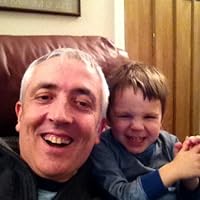
Paul grew up in Surrey and lives in London with his wife Mary and son Thomas. He has a degree in English Literature & Language from Reading University. The Actuality is his debut novel.
Visit www.paulbraddon.com for interesting information on The Actuality, Paul and the opportunity to join his readers' club.
Evie has a comfortable life in the luxury penthouse flat that she lives in with her husband, Matthew. She is fortunate to have a garden on the roof too otherwise after it would have come too oppressive. They have a live-in assistant called Daniels who helps in all sorts of ways around the place. They have been married for 40 years now and yet Evie still looks around 21 years old. This is because she is a near-perfect bioengineered human. This android type was declared illegal many years ago and if it was to become known that she still exists, then there are plenty of corporations that would want to use her to learn how she is made.
The world that they live in is very different from our own, it is after climate change has savaged people lives and the post-apocalyptical Britain is much colder after the Gulf Stream stopped, there has been a collapse in the birth rate, the food chain has been decimated the very fabric of the society that we know has been shattered. The police force is there to protect the wealthy from the poor and if you have money, you live in your own bubble away from the misery outside.
Her comfortable world comes to an abrupt end one day, a hova car drops down into her garden with the intention of capturing her and taking her for the reward that is offered. She resists capture, but she knows that she must flee to evade capture. She and Daniels head to Cambridge where there is a cottage that they can stay in while they decide what to do next. It is while in the city that she becomes aware that there is another of her kind around, but he is imprisoned behind glass. The authorities are on their tail though and they have barely been there before it is time to move on and see if they make it to Europe. The race to evade capture is on…
Braddon has written a fast-paced science fiction thriller with a fully believable plot. The main character, Evie feel fully developed, but the others that she interacts with feel a little two dimensional. I really liked the world that he has created in this book, his dystopian future, 100 years on from now, is utterly different to our own and feels both plausible and utterly terrifying at the same time. I thought that there were a couple of inconsistencies in some of the tiny details, but that was not enough to stop me from enjoying this book.
I would describe The Actuality as Garland's Ex Machina meets Nettheim's Humans - sentient bioengineered humans are classed as outlaws and our main character, Evie, is forced by her 'husband' to stay hidden.
Reading the first half or two-thirds of The Actuality, I truly thought I was in for a 4-star read. I absolutely loved the characters. Evie had so much depth to her, the discussions of her emotions and the memories she had, the relationships she had built in her time as a sentient android. Daniels was a genuinely great character and I wish we'd seen more of him throughout the story. I was also really enjoying trying to figure out who I could trust and who was definitely someone to be wary of. This was definitely one of my favourite things about the book, the way characters are written and the depth of their personalities.
However, the final third or so felt like a drop in quality to me. Braddon introduces a whole new cast of characters who simply don't have the depth that the original cast of the first two-thirds had, so we don't get to build as close a connection with them. Had the story stuck with the original path it was taking, this definitely would have been an amazing book for me. Following these new characters alongside Evie, however, meant that the original story got lost somewhere and it almost felt like Braddon couldn't find that thread to bring it back and weave it through again.
I described this to a friend as the feeling of two completely different books being ripped in half, then being put back together, except they'd been mixed up in the process. The writing and story of the ending did not feel like the writing and story of the beginning. There's also an 'invented' language in this called Eurospeak, which is a combination of French and English. I really didn't enjoy this aspect - it was jarring and made me feel like I didn't want to continue reading out of the sheer annoyance of it. For example: 'Do you believe moi like being slapped around tout le temps? Je ne une grande idiot.' or, 'je ne got em pas plus'. It felt a bit too ridiculous for me.
The ending itself felt very dissatisfying, too. I didn't feel any sense of closure as it was very open-ended. While I'm not normally against an open ending, this one felt a little too open. There's usually a case of two options that the ending could have and the author leaves it open for the reader's interpretation. The Actuality feels like it's missing at least another 30 pages at the end, where readers would be provided with those options. The ending felt rushed and abrupt, which ultimately contributed to an unfortunate 2.5-star rating.
This had so much potential based on the premise and the first half of the book, but I was thrown by the second half and unfortunately did not love it as much as I think I could have.
Content warnings: issues with body image, murder, questionable consent, sexual assault, death of a child.
Thank you to Sandstone Press and Paul Braddon for providing me with a copy in exchange for an honest review. All thoughts and opinions expressed are my own.
An exploration of the world experienced by a near-human artificial lifeform, trying to make her way and discover herself in an inimical world. It's not a new topic, of course. Since Asimov's robot stories in the 1950s there has been plenty of examination of this concept - and strictly it wasn't new then, as it's pretty much the theme of Pinocchio, dating back to 1883. This could hardly be more clear from the movie AI -Artificial Intelligence (and to a lesser degree the Brian Aldiss short story it was based on, Supertoys Last All Summer Long) where the puppet from Pinocchio is replaced by a synthetic human.
The fact this is a well-trodden path isn't a problem, though, because Paul Braddon manages to find new things to say and gives us an intriguing plot for Evie, the artificially intelligent creation in his novel. I was a bit worried for part of the first section of the book, which is quite slow, reflecting Evie's relatively limited life at that point, and set in a world more reminiscent of a 1920s country house than a twenty-first century London. In fact, it was ironic, after the recent venture by Kazuo Ishiguro into this topic, given Ishiguro's best known output being set in an English country house. Braddon's vision of the future also felt a little old-fashioned - an economically collapsed England where the dollar is preferred to the pound - not only are such dystopias starting to feel dated, but if they needed revisiting, the renminbi seem far more likely to be dominant than the dollar. But Braddon's book is far more readable than Ishiguro's Klara and the Sun, while Evie seems a far more technically savvy creation than the oddly ignorant Klara.
I very much liked the way that Braddon makes Evie neither evil nor good, both extremes that can limit development in a character - instead there were plenty of shades of grey. Some of the other characters are less well filled-out, but even so, it's a book that manages to balance plot and character well. A definite positive addition to the AI/robot/android literature.
There was one thing I really didn't like about this book - it seems to be set in alternate universe. Not only has Braddon moved the Channel Tunnel from Folkstone to Dover, here we have a twenty-first century where trains (on a line that's currently electrified) are diesel powered. The idea of still using fossil fuels in the next century seems more like set dressing for the dystopian setting. I do also wonder if there isn't a bit too much homage to other Science Fiction titles (the antithesis of Ishiguro, who seems never to have read SF). Is it a coincidence that the American AI that Evie meets is called David, like the AI in the movie? And Evie's flight to the continent has more than a ring of Logan's Run to it. Throw in repeated Pinocchio aspects, more than a touch of the films Blade Runner and Ex Machina and even a nod to the 1931 Frankenstein movie and there seemed to be a lot of cultural referencing.
There is no doubt this novel has flaws (including the ending, which I really didn't like) - but overall it was engaging and enjoyable, while Evie's character had a lot more to interest the reader than is the case in many such books. A good debut by Braddon.
The Actuality is a great debut novel by an author who is clearly going to make a mark on the literary scene. What I like is that it is both a thrilling page turner, but also a beautifully written book, and it's not too often that you see these two elements combined so deftly. The chapters are short, often ending with a cliff-hanger, which keeps the story moving at a sharp pace. The characters are rounded, and well-drawn, especially Evie, who is always sympathetic, often funny, but never a stereotype - the way Paul Braddon takes the reader through her learning journey is remarkable. The Actuality also has a strong sense of location, moving from London, to Cambridge, to Paris and to the Austrian Alps. It is also packed full of great ideas, which really make you think about artificial intelligence. Sure, this has been done many times before by great writers such as Dick and the late, great Harlan Ellison but in spite of this, Paul Braddon gives the concept an ingenious slant. In fact, it has a killer of a twist near the end, which I never saw coming, but it really worked, made complete sense, and pulled the threads together beautifully. The Actuality deserves to be a television series because it has all the ingredients to be a sensational thriller. It is very visual and would easily translate to a television or cinema screenplay. In fact, if Hitch were still alive, he would have loved it's potential for gripping cinema, especially the scene in the Cambridge Museum, which was straight out of a Hitchcock movie. It's not perfect, the Paris sequence dragged a bit, and the little French girl was an annoyance, especially her Franglais, which didn't work for me, but this is a minor quibble, and doesn't take away from the five stars that this book fully deserved.
It's no surprise that the BBC optioned Braddon's novel for dramatisation before it was even published. This is a tight, driving story, often breathlessly dramatic, with interesting things to say about artificial intelligence and environmental catastrophe. Clearly, The Actuality belongs to the same family as Blade Runner, AI, Humans and Ishiguro's Klara (coincidentally published at the same time as this). If I say there are also echoes of Frankenstein, The Old Curiosity Shop and Pinocchio, it's not to suggest that the book lacks originality, but that it wears such influences well. I especially enjoyed the sections set in future London and Cambridge. The world-building background detail was sometimes a little too thorough for my taste, but that's in the context of a concise novel by a writer who knows his way around a cliffhanger, can surprise you with a plot turn, and engaged me from start to finish.
Evie is a near-perfect bio-engineered human. She's the pinnacle of artificial intelligence, what scientists call "true AI'. This is the Holy Grail of artificial intelligence - the ability to exhibit behaviour as skilful and flexible as humans, artificial consciousness, awareness of external objects, of ideas and self. Some believe such a thing is impossible, other's that it's closer than we think. In The Actuality, Evie's "husband", Matthew, hides her away from prying eyes, and we learn this is because the government has banned her kind. AI bio-engineered beings were rolled out, but several disasters caused widespread panic and people came to fear they might be a danger to humankind. Now all but the most basic of service model is illegal.
Evie and Matthew live in an apartment with Matthew's servant, Daniels. She's closer to Daniels and has a better relationship with him than she does with Matthew. She has memories based on those of Matthew's wife, who passed away years before, and she has consciousness which Daniels acknowledges. Matthew disagrees and denies she is true AI, which she finds hurtful. As the novel progresses we learn she wasn’t truly conscious when she came to the household. She was as close to it as possible, but not fully conscious.
While only mentioned in passing in the text, this is a key debate in AI research: how to tell when something is truly conscious and not a clever imitation. The Turing Test, named after the mathematician and computer scientist, Alan Turing, is used to debate when something should be considered conscious. Because it's easy for an algorithm to appear conscious when it isn’t; bots on social media show this all the time, and many accounts are nothing more than clever code. Matthews believes Evie is nothing more than a clever bot, but Daniels knows the truth, which is somewhere along the line she developed consciousness, and is true AI.
When disaster strikes and Evie has to leave the sanctuary of the apartment, we learn Britain is an impoverished country, battered by economic decline and the ecological disaster threatening the globe. It's become an insular and bitter nation, and suspicious of outsiders and strangers.
The Actuality is a great novel, it's a speculative sci-fi story of Evie's search for a home and a sense of belonging, but it also grapples with some big ideas, and ones which have a real urgency. The environmental crisis and Britain's place in the world is often discussed - and the author's portrayal of a country turning in on itself reflects many people's fears over Brexit. But it's his consideration of AI which is to the forefront. This isn’t as far off in the future as we might think, indeed it's likely society will need to discuss the issues the author raises about autonomy sooner rather than later.
At heart The Actuality is about unforeseen consequences. Because humans are terrible at predicting the future. The climate crisis has crept up on us, and so will the consequences of AI if we're not careful. Indeed, they already are. Not too long ago I worked on a documentary about the war in Afghanistan. I was researching the drone programme. Drones, and to a lesser extent night raids by special forces, are a central plank to the US counterinsurgency strategy. Sophisticated computer algorithms are used to select targets. But in a guerrilla insurgency, how might US forces choose targets? It appalled me to learn one method was meta-data. Simply put, US forces harvest the phone contacts of insurgents. If an Afghan has called the phone of an insurgent, or the insurgent called their phone, the algorithm might well list them as a legitimate target. So "efficient" is this system, US forces kill people whose names they don't even know. Sometimes they know nothing more than a phone linkage.
The algorithms the Americans use are a form of dumb AI, but AI they are. Already the US and others are working on more autonomous killing machines. AI is also being developed for civilian life. To be clear, AI is not intrinsically a bad thing, far from it, it has many positive applications; to believe otherwise would be Luddite. But as the drone programme shows, the consequences, if not considered, can be disastrous. The Actuality grapples with this, and Evie is the personification of an unintended consequence. Invented as the plaything for the rich, she is now conscious and therefore surely has rights. But in a world where human life is devalued, what chance does she have?
The title of this book gives nothing away. I had completely forgotten what I'd known about the book when I requested it, so it took me by surprise.
The time is around a hundred years in the future. Britain's experiment with robots/virtual humans/I forget what they call them, has gone sour. It's now outlawed to have an advanced humanoid like Evie - not that she realises because her owner/master/husband keeps her in their luxury penthouse flat with its splendid rooftop garden. For 40 years she's lead a charmed and refined life as his companion, seeing only her husband and his general factotum, Daniels, who does whatever a wealthy man needs to have done for him by his assistant.
London is falling apart. Evie's home is surrounded by poverty, dysfunction and danger but it doesn't touch her life until one day when the police land a 'Hova' on the roof of the apartment to ask her questions about who she is. Not long after, Evie and Daniels go on the run. Wealthy people and powerful corporations would like to get their hands on Evie and learn from her technology. Who can she trust and where can she go?
It's an enticing premise and I was soon hooked. In my mind, I was always thinking of the Channel 4 series, Humans, and Evie as one of the 'Synths' from that show. She managed to be the most human character in the book without being a human at all. We empathise with her terrors and her challenges, and will her to survive against seemingly unconquerable odds.
I can't 100% be sure that I entirely understood the ending - but I think I got it.
I enjoyed it a lot and will recommend it to my friends - if I can remember the title. It's a memorable book with an almost instantly forgettable name.
Thanks to Netgalley and the publishers for my ARC.
The imagery of future-England, the way people feel about each other - even the way there is advanced tech which is not accessible to all seemed like a true (but bleak!) representation of the earth's future.
The actual storyline was intriguing, with natural highs and lows of action. It felt very satisfying - even if the story didn't go in the expected direction. Evie was a sympathetic protagonist, and the explanations for future history (if that makes sense!) were well written and flowed naturally, giving the reader a good background.
Rounded up to 5 from 4.5 stars, and really that's only from my personal opinions about one of the characters which I won't share!
Thanks to Netgalley and the author for the opportunity to read this book before publication. Would love to read more from this world!
This was published this week and is being adapted by the BBC. It’s about a near-perfect bioengineered human in a broken-down England. Her kind is outlawed, and when she is discovered living with a ‘husband’, she has to flee from those predators who would wish to exploit her. I was impressed by the futuristic world the author has built, and it’s a great premise. Whilst the first half was very compelling, unfortunately the second half felt a bit rushed for me. This is getting very favourable reviews so don’t just take my word for it. Thank you Sandstone Press for the review copy.
This fair and unbiased review orginally appeared on my blog, available at www.infinitespeculation.com. It was conducted with gratitude for the free electronic copy of the book which I received from the publisher, Sandstone Press.
Forbidden from leaving the apartment she has shared with her husband for the forty years of her existence, Evie is unique - a highly advanced, bioengineered automaton with the likeness and implanted memories of a dead woman, and perhaps the last functioning example in the world. She is unregistered, however, meaning anyone who guesses her secret could turn her in to the authorities. Forced to take to the dangerous streets of London, Evie will have to learn to blend in with those around her if she is to survive.
Evie’s life within the walls of the luxurious apartment is one of comfort but also one of complete and utter stagnation, her agelessness only adding to this atmosphere. Although she is happy, she often finds herself wondering what life is like outside the apartment, and there’s an air of the gothic heroine about her as she looks out onto the streets below from her gilded cage. Her implanted memories comfort her, but only add to the feeling that she is insubstantial; somehow lesser than the woman she imitates and forever in her shadow.
As a main character, Evie does lack agency at first - she’s frequently happy to go along with what other people suggest and largely does as she’s told. While some readers might find this a frustrating character trait, a less naïve Evie would be a much less believable one. Braddon has clearly considered how her cloistered upbringing would cause problems for her in the wider world, and the social cues she misses and the culture shock she frequently experiences make her easy to root for (even if it’s not always clear exactly what we’re rooting for her to actually do). The easy humanity he finds in her artificiality is surprisingly charming too - her modesty around plugging in to charge, for example, manages to evoke both sympathy and empathy despite a dearth of comparable life experiences for the majority of readers.
The world itself is likewise well considered, with Braddon even showing his thinking behind it in a brief but enlightening appendix. The London of 2130 is very different to the London of 2020, and whilst some things might be a little harder to swallow than others - digital Big Ben has something of a Futurama flavour to it, for instance - the vast majority of the changes feel well reasoned and believable. These aren’t positive changes though, far from it - surveillance has vastly increased, the pound is so weak that British citizens are forced to carry dollars around with them because they’re more readily accepted, and the police seem to exist solely to protect the wealthy. Much of this economic fallout, it’s made clear, has come about thanks to climate change; without being full blown cli-fi, this is a message that’s well delivered and woven into the worldbuilding seamlessly.
Another thing in The Actuality’s favour is the prose itself, which is excellent. Whilst some parts of the novel, particularly the beginning, might be considered slow by more impatient readers, those who like to savour every last sentence will find much to enjoy here. Whether it’s a brief yet evocative description of a character, an atmospheric snapshot of a scene, or even a desperate chase, the writing is consistently very strong. Despite the sci-fi elements occasionally crossing over into harder sci-fi territory, there is a real potential for genre breakout to The Actuality thanks to the quality of the writing and the contemporary themes covered.
The Actuality is smart, literary science fiction, Braddon working with some really interesting ideas around personhood and identity and how memory relates to both, while never losing focus on the emotional core of the novel - Evie, and her journey towards self-actualization.
Thank you to the publisher for sending me a proof copy of this book.
I don’t often read sci fi novels. In fact, I don’t think I have read any sci fi novels in the last 10 years actually! The premise of this novel really appealed to me so I was willing to try a genre I don’t usually read! Boy, I am glad I did because I really enjoyed this debut book. I would say I enjoyed it more than I was expecting to as well.
This book was optioned by the BBC as a potential new TV show and I can see why this was the case. The plot is fast-paced, well written and provides a cast of interesting characters.
Braddon explores what it means to be truly ‘conscious’ in this dystopian futuristic world he has created. Evie’s existence gives rise to a multitude of deep philosophical questions. What does it mean to be “conscious”? So morality and consciousness go hand-in-hand? Is AI consciousness better than human consciousness? This book and Evie’s character feels somewhat like a futuristic Frankenstein tale of nature and nurture where Evie as the ‘creature’ seeks to fit in with a human society that is repulsed and frightened by her existence.
The book had a very positive start and middle but it seemed like it ran out of steam a bit towards the end. I know that a sci fi novel is not going to have any realistic elements to it but I like to feel that a fictional story can have a level of ‘believability’ to it. I felt that this believeablity was lost a bit from the introduction of Sola onwards. It’s clear that Sola is being used as a plot device to show Evie’s growing humanity and her ability to feel instinctual maternal feelings despite her artificiality but it just felt with Sola’s introduction that story got very chaotic.
Despite my above comments, there were things I did enjoy in the last part of the book. Such as the very somber and ambiguous ending and the encounter with the real Evelyn. These elements gave the book an even darker tone. For example, the fact that Evie’s whole purpose is undermined by Evelyn’s appearance later on in the story really opens up debate as to whether Evie has, in fact, become an autonomous and conscious being.
Altogether, in my opinion this is a very successful debut novel. It had an action packed plot, a strong female protagonist with lots of depth to her character and it was very well written. Braddon also opens up some great avenues for discussion and thought with his exploration of consciousness, morality, AI intelligence and climate change. I really recommend this book to sci fi and non sci fi lovers alike!
This entire review has been hidden because of spoilers.
Do androids feel, love, suffer and think for themselves? Thought-provoking, engaging and fast-paced debut.
Evie is a bioengineered android of the most sophisticated kind. In twenty-second century England her species has been forbidden and terminated in many European countries due their involvement in a series of disasters. However, she is still around because she was never registered by Matthew, a wealthy widower who had commissioned her forty years before as a replica of his first wife. The affluent couple lives sheltered with Matthew’s personal assistant Daniels. They occupy a high-rise apartment with adjoining private garden complete with pond, statues and alleys, the only outdoor place Evie is allowed to. She must be kept hidden because such a rare specimen makes a lucrative prey. However, when a flying hova detects her and crashes in the garden, she will have to run for her life.
Evie is a complex and enchanting character: her husband thinks she is merely a sophisticated toy, which hurts her feelings as she overhears him; Daniels, instead, understands that there’s more to her. Braddon engages with a central question in AI studies, i.e. to what degree can AI machines achieve consciousness. But he does so with levity and without excessive theorizing. For example, having lived a sheltered life, Evie is extremely naïve and bound to make many mistakes as she is on the run. This gives the author the opportunity to imagine how an android might learn, develop and change. Braddon also looks at the way her feelings, instincts, and decision-making processes might arise and develop: from attachment and sexual impulses to fear and feelings of motherhood, up to more sophisticated mental processes.
The depiction of England as it may become in 100 years’ time is well-drawn and all too close to what could be reality: a country plagued by pollution, crime and economic crisis, scattered with dilapidated buildings and impoverished tribalized communities. The Thames is “poisonous and dangerous and full of slithery eels" and sharks because of warming temperatures and the tube not working as it has become too expensive to pump out the water.
At times I felt like I was reading a script of an action movie, and unsurprisingly I read it has been optioned by BBC Studios. Everything in this debut make for a propulsive, engaging and fast-paced read. Also suitable for readers looking for a page-turner even if they are not particularly into sci-fi.
Here's an extract of my full review on The Publishing Planet website...
"With an endorsement from Christina Dalcher and rights optioned for TV by BBC studios, The Actuality (2021), published by Sandstone Press, certainly has the commercial makings of a hit. What is most striking and buzz-building about this book is how The Actuality is so powerful in its own right. The strangely musky and claustrophobic City feels like old industrial London while simultaneously distant and futuristic. The world around Evie is brutal, with England in a harsh and sharply cold climate. It follows some steps of Phillip K. Dick, but marks brand new territory in the exploration of AI and what it means to be human.
Evie is a joyful character to follow. She is a near-perfectly bio-engineered human who for whatever reason, has developed a conscience – the mark of true AI. Evie is in hiding, but when her existence is revealed, she must take to the hostile streets. Her discoveries of natural space are among some of the most beautifully written passages in the book, with such attention to every whisper of the wind and green among the foliage. Evie’s experience of the world is what makes her feel so human. She is what we like to think humans are: open-minded, naïve, hopeful and kind. Sadly, these values lead her to be constantly exploited as Evie is surrounded by humans who wish, knowingly or unknowingly, to manipulate her as both a rare creature and as a woman."
Striking, intelligent and beguiling, Braddon's debut novel is one to watch, as I imagine will be the case with all of his future works.
Some reviewers called this a dystopian novel, which isn’t what I would normally go for, but I personally don’t think it falls into that category. It is a beautifully written book with lovely sentence structures and similes that flowed throughout the book. The delicate prose and moments of humour takes this book away from the sci-fi/dystopian genre. Some of the turns of phrase reminded me of Steinbeck novels in their acute observation. There were parts of it that also reminded me of Gunter Grass’ Tin Drum and Herman Hesse’s Steppenwolf. Particularly the Doll’s House scene and when Daniels and Evie were walking through London to get to his daughter. I also liked the description of life in 2130; cutting edge inventiveness without being ludicrous, juxtaposed with Victorian squalor. Paul includes a section at the end where he explains his thinking, which gives a useful insight and also elaborates on concepts that are eluded to in the book. As with all great authors, Paul leaves a lot unsaid, instead there are hints and oblique references allowing and encouraging the reader to build their own picture.
I look forward to seeing it dramatised... I’m planning the cast list already.
The Actuality is a refreshing sci-fi dystopian novel featuring artificial intelligence and bioegineered humans with the ability to feel. The novel follows Evie who is bioegineered, events unfold leading to her travelling a broken England as Braddon paints an all too believable future, Evie chances her luck on the streets coming into contact with some vexatious characters along the way.
Evie and Matthew live in an apartment with Daniels Matthew's servant, we see more of Daniels throughout the novel as he takes her through the impoverished streets due to the economical and ecological state the country is in - the UK is no longer united and infertility is soaring due to poor food supply. The novel develops further as Evie tries to find a meaning to her existence and there are some interesting points made throughout the novel - I found some of the ideas weren't fleshed out enough and I was left wanting more! I can't reveal much more without spoiling the plot but all in all a decent novel with a unique idea, interesting plot and characters that sci-fi fans will love.
I was a bit sceptical at first as I don’t usually read Sci-Fi/Dystopian often.. but it didn’t disappoint, I enjoyed it and I felt SO drawn to Evie’s character!
Evie being shut away for so long, away from the outside world.. once the story developed and she was on the run I just felt so invested and couldn’t stop reading, needing to know what was going to happen and hoping in my mind that nothing would happen to her. I’d definitely say I felt emotionally connected to her.
A very cleverly written book with some fantastic descriptions and I liked the world that Paul Braddon created. Sometimes it’s definitely worth going out your comfort zone to read a different genre, you might be surprised.. as I enjoyed this!
Evie is a near-perfect bioengineered human. In a broken-down future England where her kind has been outlawed, her ‘husband’ Matthew keeps her safe but hidden – until her existence is revealed. Now Evie must take her chances on the dark and hostile streets, where more than one predator is on the hunt.
This is totally not the kind of book that I would normally read. I am not a fan of sci-fi novels however the premise of this caught my attention and I thought I would give it a go.
And I am definitely glad I did. This was a really entertaining novel which kept me gripped throughout. Set hundreds of years in the future it gave an excellent glimpse of what the future planet may look like and the problems we face in terms of climate change and the future of technology.
However, above all that was a really thrilling plot with a delightful twist at the end which I have to say I did not see coming (although it seems so obvious now!)
Thanks to Netgalley and Sandstone Press for an ARC in exchange for an honest review.
I have to say it is the best novel I have read in a long time. Very atmospheric, great plot and very thought provoking. I especially liked all the little touches showing what the future might look like e.g. 2 Eiffel Towers and a digital Big Ben. The characters really came to life for me. The plot was excellent, really gripping. I especially like the fact that the plot did not follow exactly the usual “hero’s journey” format. I have found myself contemplating the issues that arose in this novel quite a lot. What is a sentient being? Is there such a thing as a soul? Could AI have a conscience? I highly recommend.
This is a brilliantly written, gripping, fast paced, page -turner of a book. The theme is strikingly original and it is an authorial triumph. The "artificial humans " not only engender the reader's sympathy but occupy the moral high-ground for a significant majority of the story. Evie feels as we feel, perhaps more so, but the humans cannot comprehend this, so certain are they of their own superiority. I have to say that I found myself preferring the robots......
I finished an early copy of this book by an old friend at the weekend. I was up till 01:30 Sunday morning! It was just brilliant. One of those books that you daren’t put down in case something happens while you are not looking. An absorbing, believable and disturbing future peopled with real characters that you might be able to trust. It challenged how I think about a number of real-world issues too. I demand a sequel.
My first venture into the sci-fi dystopian genre and I’m thoroughly impressed!
The authors description of a new London set years in the future were brilliant and I could visualise it perfectly and it wasn’t all pretty and futuristic!
It’s broken down into parts…a bit like a robot I suppose….and at the end of each part something will always manage to shock, sadden you or leave you on a mini cliffhanger.
The story follows Evie who has never ventured out of the house she lives in and now must learn to survive outside and experience the real world for the very first time. Along the way, through memories that Evie has, we learn more about how she was developed and the reasons why. Some of the experiences Evie goes through were heartbreaking to read, also to hear what happened to David (another AI like herself) was truly awful.
I will also say that there is a shocking twist near the end that took me totally by surprise (that’s all my saying). It was perfectly executed and definitely needed to further enhance what Evie experienced.
Overall this book raises so many questions …”do AI/robots have a conscience? Can they feel emotions? Or are they merely machines?” I know I have many thoughts about it all now and I think there will be many difference of opinions of how other readers interpret the ending.
This was a fabulous book which would be perfect to read as part of a book club or buddy read to discuss the topics along the way!
Braddon lights a fuse with this unsettling, future imperfect debut. A high tension, fast paced, futuristic thriller. Evie the artificial intelligence hero literally races the fuse through a world of sinister characters, mesmerising inventions which echo Wells and uncomfortable questions of the relentless desire of a species to control 'the other'. And could it be that in the apparent wisdom of the robot, Evie is more human than the humans?
Yes. Very good concept. There is one character I wish had never been killed off in the first part of the book. I suppose the ending was inevitable...... it was good though and looking forward to seeing it adapted for TV (I believe that's the plan anyway).
loved it. a great story and liked that it didnt jiggle around in either narrators or timelines as seems to be the fashion at the moment. Not sure I understood the end but this was a great read