

What do you think?

Peter Müller trilogy
Early Mass
At last, Elizabeth realised her own idea. Through these women’s discomfiting entanglement, because of the estranging way they echo one another—discordantly rather than harmoniously—Segantini’s feminine couples do not epitomise the dichotomy so much as they protest it. They antagonise as much as encapsulate it. Neither fallen nor elevated, they float in between, and drift disconcertingly towards us.
A young art historian, Elizabeth Howe, develops a fascination with a picture by the late nineteenth-century Italian symbolist painter Giovanni Segantini, A messa prima (Early Mass), thought to be painted over another image censored by the Church, that of a sinner girl. Elizabeth’s study of Segantini’s painting leads her to dispute the standard psychoanalytic interpretation of his art by Karl Abraham, who argued it conveys a long-held wish to punish women. Instead, for Elizabeth, Segantini’s extraordinary images of floating female bodies register silent protest against masculine desire. Weaving together the life and art of Giovanni Segantini, the writings and correspondence of Abraham and his mentor Sigmund Freud, and the journey from Milan into the High Alps that leads Elizabeth Howe from breakdown to recovery, Early Mass is a ghost story, an art-historical detective fiction, and an account of redemption.
Early Mass is the second book of a trilogy published by MA BIBLIOTHÈQUE: the first, The small, appeared in 2020, and the third, Berlin W, or, mésalliance, is forthcoming in 2022.
A young art historian, Elizabeth Howe, develops a fascination with a picture by the late nineteenth-century Italian symbolist painter Giovanni Segantini, A messa prima (Early Mass), thought to be painted over another image censored by the Church, that of a sinner girl. Elizabeth’s study of Segantini’s painting leads her to dispute the standard psychoanalytic interpretation of his art by Karl Abraham, who argued it conveys a long-held wish to punish women. Instead, for Elizabeth, Segantini’s extraordinary images of floating female bodies register silent protest against masculine desire. Weaving together the life and art of Giovanni Segantini, the writings and correspondence of Abraham and his mentor Sigmund Freud, and the journey from Milan into the High Alps that leads Elizabeth Howe from breakdown to recovery, Early Mass is a ghost story, an art-historical detective fiction, and an account of redemption.
Early Mass is the second book of a trilogy published by MA BIBLIOTHÈQUE: the first, The small, appeared in 2020, and the third, Berlin W, or, mésalliance, is forthcoming in 2022.
120 pages, Paperback
Published December 1, 2021
Ratings & Reviews
Friends & Following
Create a free account to discover what your friends think of this book!
Community Reviews
Displaying 1 - 1 of 1 review

February 12, 2022
Early Mass (2021) is the second in a trilogy of novels by Simon Wortham, published by the small independent press MA BIBLIOTHÈQUE. Wortham is a Professor in the School of Arts, Culture and Communication at Kingston University, whose research is "concentrated on the connections between continental philosophy, literary theory and a variety of political and psychoanalytic texts."
The first was 'The small' (2020, link to my review) and the third, 'Berlin W or Mésalliance', is due later in 2022.
The framing device of 'The small' was email correspondence between a lecturer/author and his publisher: Dr Josh Goetz, Senior Lecturer in Contemporary Literature in the Department of Comparative Studies at Central University in London and Megan Taylor, Commissioning Editor at Penham International (Academic). 'The small' formed a book within the book, a collection Goetz had assembled from a cache of computer files sent to him by Professor Peter Müller, former Chair of Goetz's department, shortly before Müller's death by suicide, and which he wanted Taylor to publish. The resulting book was an eclectic collection of brief essays, described by Friedrich Keller, from the University of Zurich, in the foreword to Early Mass:
The premise of Early Mass is further unpublished writings, this time in the form of a novel, Early Mass, were discovered in the late Professor Peter Müller's university office by a Visiting Professor, "S.K.". S.K. explains what she discovered and how she edited it:
The manuscript was found in a disused filing cabinet in the room I was allocated on the top floor of the Wells Street Building of Central University in London while a Visiting Professor in the Department. of Comparative Studies (formerly occupied by the academic author Peter Müller). It was written by hand and took several months to bring to publishable standard. Although it was unsigned, attribution of the text was simplified by an initial comparison of the handwriting albeit rather changed, that is to say shrunken in size—with other samples held in the departmental office. The personality of the characters vas, notwithstanding, unmistakable. Subsequent comparisons with other material, including a posthumous text I learnt of through contact with a former colleague of Professor Müller, proved conclusive.
It is worth noting that the manuscript in its discovered form was not bound. Instead the sheets were held together by a large foldback clip at the top rather than the side of the page and some of them were torn, actually rather neatly in places, meaning it is impossible to be sure whether the published version is in fact complete, if it had been subjected to retrospective interference by another party, or if such ‘revisions’ were indeed deliberate and intended on the part of the writer himself. Nevertheless, the text is reproduced by permission of the author's estate and family.
It was hard to know how old the sheets of paper I discovered might be. However, what is clear both from the written content and physical condition of the manuscript itself is that its age is more recent than a handwritten text might suggest. The other posthumous material I mention was sent by email attachment, not long before his death, by Professor Müller to his colleague; the electronic files included passages of text that were remarkably close to some of those found here. For the time being, it must remain a mystery why the two came to light in such different formats, or for that matter, which came first.
The "posthumous material ... sent by email attachment" referring of course to 'The small' and the attentive reader of the former will immediately spot, inter alia, how the form of Early Mass apes Robert Walser's famous microscripts, and also a nod to Herbert Spencer's 'binding pin', an early forerunner of the modern paperclip.
In terms of Early Mass itself, Keller's Foreword explains the set-up:
The novella is about a young woman, Elizabeth Howe, an art historian of relatively humble English origins whose early life in some way causes her obsession with an overpainted canvas by Segantini, the now almost forgotten Italian divisionist painter. Like Segantini, Müller was more or less orphaned at an early age, his father having been killed in an Allied bombing raid that inadvertently devastated parts of his hometown Schauffhausen, close to the Swiss-German border, in early 1944; his mother thereafter suffering a terrible decline that saw Peter effectively sold into child labour tinder the Verdingkinder scheme of the post-war years. Segantini's mother had died after losing are elder son in a fire, meanwhile, and soon afterwards the father abandoned his remaining son, who ended up in a reformatory in Milan. If the bits of text sent to me by Goetz suggest a certain correspondence between Müller's tragic demise and Segantini‘s own fateful death on top of the Schafberg in September 1899, Early Mass connives a different outcome for its female protagonist, and I cannot help but wonder if Peter is to be found rewriting the same story to give it a different ending.
I suspect (but this is my guess, not from the text) that the name of the protagonist of Early Mass comes from Herman Hesse's Peter Camezind (1904), written by Walser's contemporary and, to an extent, rival. There we find a scene where one of the character's, called Elisabeth, is entranced by a Segantini painting in the Kunsthaus in Zurich, a venue which also plays a crucial role in this novel:
As for the painting with which the Elizabeth of this novel is obsessed, the opening chapter of the novel describes it:
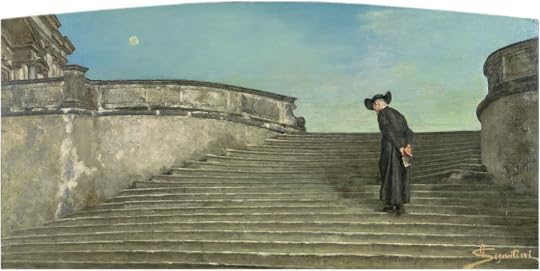
The painting in question, from the mid-1880s is known as A messa prima. Over two metres wide by more than a metre high, it depicts a priest climbing the baroque steps of the church in Veduggio, near Pusiano, just before mass at first light. Dressed in traditional black cassock and soft-brimmed clerical cap (neither exactly a biretta nor cappello romano, but more like a black Dutch bonnet with two large ears, rounded and upturned), he is bent forward and faces away from view. Behind his back, the old gnarled hands of this priest twist around a prayer book, holding it open at an unseen page. The stairs and curved supporting walls are expansive and imposing, dominating the composition. The cleric does not so much scale them as he loiters, set adrift in their dizzying pleats. He looks down, lost, as if he has forgotten his duties for a moment or misplaced his calling. Eroded by time and use, the stone steps soften and undulate like waves. Ahead of hint, railer darkly; they seem to gape like the abyss behind a coming crest.The light falls in confused patterns as the moon still hangs in a looming morning sky. A thin brightness casts a silhouette on the curvature of the the wall behind the priest. I front, on the other side - where does not look—the eye can trace the on the bent surface of plaster a spreading white stain, perhaps an ancient imperfection in the material, which eerily matches the shape and size of the man, an X-ray figurine complete with funny white rabbit ears like a lolloping capuchon. An inverted shadow, a ghost in a mirror. Unlike its darker brother frozen mid-flight, the shape looks ready to ascend.
One of the first paintings by Segantini to gain recognition, particularly from the Milanese artist and dealer Vittore Grubicy, who was to become his patron for a time (and to whom Segantini once wrote that the pain of melancholy was like barking your shin against something sharp). A messa prima is notable for the rare attribute of a prominent signature.
One thing more: it is said that Segantini had overpainted the picture onto a canvas that originally depicted a young sinner, a girl, at the behest of Church authorities displeased with his work. If the signature was added in big, daubed, orange-red letters—in conspicuous defiance of their disapproval, one wonders if the enigmatic image we see today actually speaks to what is hidden beneath the surface. As if what is missing is the only thing that makes sense of it. A small black mark in an ocean of grey, the priest in his distracted isolation suggests that what the artist was really painting was absence. A relinquished meaning over which, by signing so forcefully, Segantini and not the Church presides with some degree of emphasis.
The novel itself alternates between exposition of this nature and Elizabeth's own story, both of her childhood (troubled, in a sense, by its lack of drama and any parental interaction, "an interminable childhood that never was") and exposition reminscent of the essays in The small, with a particular focus on the relationship between Sigmund Freud and Karl Abraham, their discussions of mania and melancholia, and the latter's pschyoanalytical interpretation of Segantini and his paintings.
I say 'exposition reminiscent' but in fact the resemblance goes beyond that. For example a large part of the 2nd opening chapter of the novel, other than with some 'as Elizabeth was to discover' interjections is a verbatim reproduction of one of the essays in 'The small', or perhaps the essay in a reproduction of the novel.
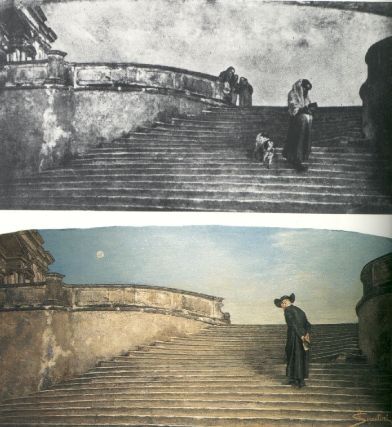
Rather brilliantly a blurb from Naomi Waltham-Smith describes Early Mass as "an overpainting of Wortham's first novel and even a protest against it', which speaks wonderful to the plot of Early Mass since Elizabeth rejects Abraham's interpretation of Segantini and his work, and is obsessed with Segantini's rumoured overpainting of a different scene, with her aim to persuade the custodians of the Segantini Museum in St Moritz to allow her to use modern scanning techniques to 'psychoanalyse' Segantini's work. She discovers a clue to what might lie underneath in a early study for the painting held in the private collection of Georg Schäfer.
Another fascinating novel and I eagerly await 'Berlin W or Mésalliance.'
The first was 'The small' (2020, link to my review) and the third, 'Berlin W or Mésalliance', is due later in 2022.
The framing device of 'The small' was email correspondence between a lecturer/author and his publisher: Dr Josh Goetz, Senior Lecturer in Contemporary Literature in the Department of Comparative Studies at Central University in London and Megan Taylor, Commissioning Editor at Penham International (Academic). 'The small' formed a book within the book, a collection Goetz had assembled from a cache of computer files sent to him by Professor Peter Müller, former Chair of Goetz's department, shortly before Müller's death by suicide, and which he wanted Taylor to publish. The resulting book was an eclectic collection of brief essays, described by Friedrich Keller, from the University of Zurich, in the foreword to Early Mass:
The manuscript, as I recall, concerned Herbert Spencer's claim to have invented the paper clip; Jean-Baptiste Rousseau's spat with Voltaire in a carriage ride through Brussels (I think it was) and Pascal's phobia of abysses, after his own gig nearly plummeted into the Seine; the actor Michel Simon's bohemian home in Noisy-le-Grand in the Paris outskirts, with its mesh tunnels through which pet monkeys roamed freely; Robert Walser's death in the thick snow on Christmas Day; Giovanni Segantini's painting of floating women; the psychoanalytic dispute on the nature of tics; Giacometti's tiny statues pocketed as he rode the night-train from Geneva to Paris after the war, and the inhuman grace of Kleist’s puppets; and Swiss ballooning.
The premise of Early Mass is further unpublished writings, this time in the form of a novel, Early Mass, were discovered in the late Professor Peter Müller's university office by a Visiting Professor, "S.K.". S.K. explains what she discovered and how she edited it:
The manuscript was found in a disused filing cabinet in the room I was allocated on the top floor of the Wells Street Building of Central University in London while a Visiting Professor in the Department. of Comparative Studies (formerly occupied by the academic author Peter Müller). It was written by hand and took several months to bring to publishable standard. Although it was unsigned, attribution of the text was simplified by an initial comparison of the handwriting albeit rather changed, that is to say shrunken in size—with other samples held in the departmental office. The personality of the characters vas, notwithstanding, unmistakable. Subsequent comparisons with other material, including a posthumous text I learnt of through contact with a former colleague of Professor Müller, proved conclusive.
It is worth noting that the manuscript in its discovered form was not bound. Instead the sheets were held together by a large foldback clip at the top rather than the side of the page and some of them were torn, actually rather neatly in places, meaning it is impossible to be sure whether the published version is in fact complete, if it had been subjected to retrospective interference by another party, or if such ‘revisions’ were indeed deliberate and intended on the part of the writer himself. Nevertheless, the text is reproduced by permission of the author's estate and family.
It was hard to know how old the sheets of paper I discovered might be. However, what is clear both from the written content and physical condition of the manuscript itself is that its age is more recent than a handwritten text might suggest. The other posthumous material I mention was sent by email attachment, not long before his death, by Professor Müller to his colleague; the electronic files included passages of text that were remarkably close to some of those found here. For the time being, it must remain a mystery why the two came to light in such different formats, or for that matter, which came first.
The "posthumous material ... sent by email attachment" referring of course to 'The small' and the attentive reader of the former will immediately spot, inter alia, how the form of Early Mass apes Robert Walser's famous microscripts, and also a nod to Herbert Spencer's 'binding pin', an early forerunner of the modern paperclip.
In terms of Early Mass itself, Keller's Foreword explains the set-up:
The novella is about a young woman, Elizabeth Howe, an art historian of relatively humble English origins whose early life in some way causes her obsession with an overpainted canvas by Segantini, the now almost forgotten Italian divisionist painter. Like Segantini, Müller was more or less orphaned at an early age, his father having been killed in an Allied bombing raid that inadvertently devastated parts of his hometown Schauffhausen, close to the Swiss-German border, in early 1944; his mother thereafter suffering a terrible decline that saw Peter effectively sold into child labour tinder the Verdingkinder scheme of the post-war years. Segantini's mother had died after losing are elder son in a fire, meanwhile, and soon afterwards the father abandoned his remaining son, who ended up in a reformatory in Milan. If the bits of text sent to me by Goetz suggest a certain correspondence between Müller's tragic demise and Segantini‘s own fateful death on top of the Schafberg in September 1899, Early Mass connives a different outcome for its female protagonist, and I cannot help but wonder if Peter is to be found rewriting the same story to give it a different ending.
I suspect (but this is my guess, not from the text) that the name of the protagonist of Early Mass comes from Herman Hesse's Peter Camezind (1904), written by Walser's contemporary and, to an extent, rival. There we find a scene where one of the character's, called Elisabeth, is entranced by a Segantini painting in the Kunsthaus in Zurich, a venue which also plays a crucial role in this novel:
Elisabeth sah ich in diesen Monaten nur ganz wenige Mal auf der Straße, einmal in einem Kaufladen und einmal in der Kunsthalle. Gewöhnlich war sie hübsch, doch nicht schön. Die Bewegungen ihrer überschlanken Gestalt hatten etwas Apartes, das sie meistens schmückte und auszeichnete, manchmal aber auch etwas übertrieben und unecht aussehen konnte. Schön, überaus schön war sie damals in der Kunsthalle. Sie sah mich nicht. Ich saß ausruhend beiseite und blätterte im Katalog. Sie stand in meiner Nähe vor einem großen Segantini und war ganz in das Bild versunken. Es stellte ein paar auf mageren Matten arbeitende Bauernmädchen dar, hinten die zackig jähen Berge, etwa an die Stockhorngruppe erinnernd, und darüber in einem kühlen, lichten Himmel eine unsäglich genial gemalte, elfenbeinfarbene Wolke. Sie frappierte auf den ersten Blick durch ihre seltsam geknäuelte, ineinandergedrehte Masse; man sah, sie war eben erst vom Winde geballt und geknetet und schickte sich nun an zu steigen und langsam fortzufliegen. Offenbar verstand Elisabeth diese Wolke, denn sie war ganz dem Anschauen hingegeben. Und wieder war ihre sonst verborgene Seele in ihr Gesicht getreten, lachte leise aus den vergrößerten Augen, machte den zu schmalen Mund kindlich weich und hatte die überkluge herbe Stirnfalte zwischen den Brauen geebnet. Die Schönheit und Wahrhaftigkeit eines großen Kunstwerkes zwang ihre Seele, selbst schön und wahrhaftig und unverhüllt sich darzustellen.
Ich saß still daneben, betrachtete die schöne Segantiniwolke und das schöne von ihr entzückte Mädchen. Dann fürchtete ich, sie möchte sich umwenden, mich sehen und anreden und ihre Schönheit wieder verlieren, und ich verließ den Saal schnell und leise.
As for the painting with which the Elizabeth of this novel is obsessed, the opening chapter of the novel describes it:
The painting in question, from the mid-1880s is known as A messa prima. Over two metres wide by more than a metre high, it depicts a priest climbing the baroque steps of the church in Veduggio, near Pusiano, just before mass at first light. Dressed in traditional black cassock and soft-brimmed clerical cap (neither exactly a biretta nor cappello romano, but more like a black Dutch bonnet with two large ears, rounded and upturned), he is bent forward and faces away from view. Behind his back, the old gnarled hands of this priest twist around a prayer book, holding it open at an unseen page. The stairs and curved supporting walls are expansive and imposing, dominating the composition. The cleric does not so much scale them as he loiters, set adrift in their dizzying pleats. He looks down, lost, as if he has forgotten his duties for a moment or misplaced his calling. Eroded by time and use, the stone steps soften and undulate like waves. Ahead of hint, railer darkly; they seem to gape like the abyss behind a coming crest.The light falls in confused patterns as the moon still hangs in a looming morning sky. A thin brightness casts a silhouette on the curvature of the the wall behind the priest. I front, on the other side - where does not look—the eye can trace the on the bent surface of plaster a spreading white stain, perhaps an ancient imperfection in the material, which eerily matches the shape and size of the man, an X-ray figurine complete with funny white rabbit ears like a lolloping capuchon. An inverted shadow, a ghost in a mirror. Unlike its darker brother frozen mid-flight, the shape looks ready to ascend.
One of the first paintings by Segantini to gain recognition, particularly from the Milanese artist and dealer Vittore Grubicy, who was to become his patron for a time (and to whom Segantini once wrote that the pain of melancholy was like barking your shin against something sharp). A messa prima is notable for the rare attribute of a prominent signature.
One thing more: it is said that Segantini had overpainted the picture onto a canvas that originally depicted a young sinner, a girl, at the behest of Church authorities displeased with his work. If the signature was added in big, daubed, orange-red letters—in conspicuous defiance of their disapproval, one wonders if the enigmatic image we see today actually speaks to what is hidden beneath the surface. As if what is missing is the only thing that makes sense of it. A small black mark in an ocean of grey, the priest in his distracted isolation suggests that what the artist was really painting was absence. A relinquished meaning over which, by signing so forcefully, Segantini and not the Church presides with some degree of emphasis.
The novel itself alternates between exposition of this nature and Elizabeth's own story, both of her childhood (troubled, in a sense, by its lack of drama and any parental interaction, "an interminable childhood that never was") and exposition reminscent of the essays in The small, with a particular focus on the relationship between Sigmund Freud and Karl Abraham, their discussions of mania and melancholia, and the latter's pschyoanalytical interpretation of Segantini and his paintings.
I say 'exposition reminiscent' but in fact the resemblance goes beyond that. For example a large part of the 2nd opening chapter of the novel, other than with some 'as Elizabeth was to discover' interjections is a verbatim reproduction of one of the essays in 'The small', or perhaps the essay in a reproduction of the novel.
Rather brilliantly a blurb from Naomi Waltham-Smith describes Early Mass as "an overpainting of Wortham's first novel and even a protest against it', which speaks wonderful to the plot of Early Mass since Elizabeth rejects Abraham's interpretation of Segantini and his work, and is obsessed with Segantini's rumoured overpainting of a different scene, with her aim to persuade the custodians of the Segantini Museum in St Moritz to allow her to use modern scanning techniques to 'psychoanalyse' Segantini's work. She discovers a clue to what might lie underneath in a early study for the painting held in the private collection of Georg Schäfer.
Another fascinating novel and I eagerly await 'Berlin W or Mésalliance.'
Displaying 1 - 1 of 1 review