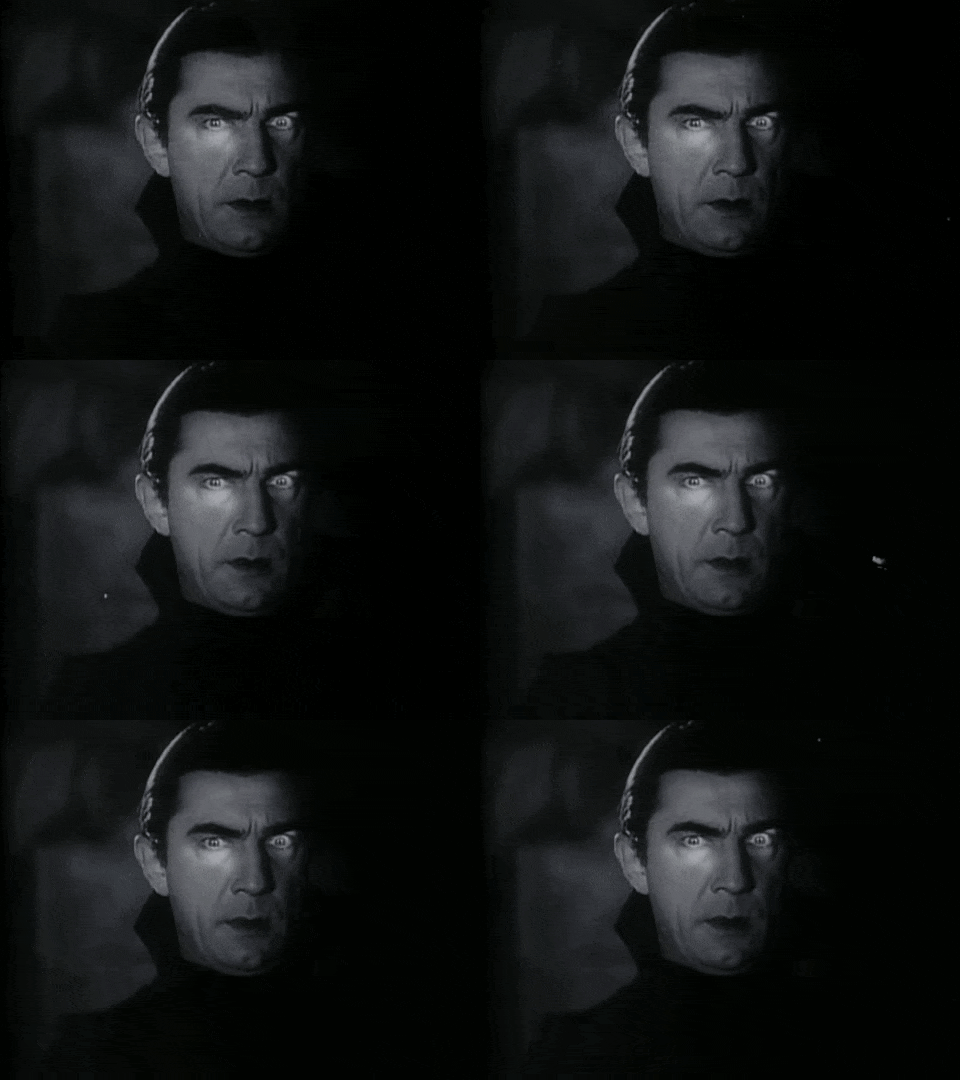
Homicide detective Harry Picard had seen a lot of violent deaths... but never like this. Three bodies—blonde, female, strangely emaciated—were found in the Potomac River with their throats brutally slashed. Each had been seen in the company of a huge, hulking man dressed in black. Picard's investigation catapulted him into a roiling morass of passion, sexual intrigue, violence, and primordial fear... as he faced an enemy as powerful, and as horrifying, as man's oldest superstitions!
First published in 1965, Leslie H. Whitten's Progeny of the Adder updated the traditional vampire tale by bringing the undead out of the Old World and into a police investigation in a large American city for the first time—a formula often imitated in the decades since. This reprint, the first in thirty years, includes a new introduction by Will Errickson.
While more thriller than horror, Progeny of the Adder does feature a vampire; not the cuddly, lovely type, but the real deal. Progeny reads, however, as a police procedural with the lead being a homicide detective Harry Picard. The novel starts with the discovery of a dead body fished out of a river in D.C. and then another, one much more 'fresh'. It seems our killer has a thing for blondes!
Written in 1965 and it shows in the casual racism and language (prostitutes are 'bimbos' or 'whores'; Blacks are 'shines', etc.). If you can get past this, Progeny makes for a pretty good thriller. Picard has few clues; really none. The only link he possesses, the victims are prostitutes, does not lead to much. Oddly, the bodies seem drained of blood and 'wasted away'. All the gals were full figured and yet their bodies turned up emaciated (as well as bloodless), like something stole their life force. It takes quite a bit for the notion that a vampire, or at least a madman with delusions of being a vampire, enter the stage...
I did enjoy the pacing here and Whitten keeps turning that up as the novel progresses; yes, the final 40 pages or so race by. Whitten tosses in a romance (unnecessarily IMHO) to add to the story as well. Overall, not a classic by any means, but a fun read if you can get by the racism/sexism. 3 toothy stars!!
This was the most procedural of police procedurals. And here’s a first, I’m not complaining. I liked the outside way of delivering the story to the reader like watching the case unfold alongside the main detective. There’s a slice of love worked in, but not too much to distract from the manhunt, I mean creature hunt. Not the most lovely of writing, but for sure a tidy afternoon of creepy vampire scenes. Reminiscent of the first Kolchak: The Night Stalker movie.
My reasons for reading this are a little abstract. When I was a kid, I loved KOLCHAK: THE NIGHT STALKER - and so read the novel by Jeff Rice. My late sister, who was a big vampire fan, said "you should read PROGENY OF THE ADDER sometime, it's VERY much like The Night Stalker." I filed that away in the back of my mind. With the passing of my sister last year, I inherited her vast collection of vampire books and so now had a copy of PROGENY and said "I really should read this sometime". I decided to revisit Kolchak this year and after reading the two books, and Mark Dawidziak's Night Stalking: A Twentieth Anniversary Kolchak Companion - which has a short write-up of Whitten's abandoned lawsuit against ABC for THE NIGHT STALKER TV movie - I realized this was the prefect time to read PROGENY... and here we are.
I'll get to the whole NIGHT STALKER aspect later, but first let's look at the book on its own. POTA was written in 1965. It is, essentially, a police procedural set in Washington, DC in which bodies of young women begin turning up on the banks of the Potomac river - drained of blood and with their throats torn out, natch - and police Sergeant Picard starts an investigation which ultimately uncovers a killer, Sebastian Paulier, who seems to be a vampire. It is a police procedural first and foremost - the mysterious killer is tracked through clues and witnesses, faced off against (he actually escapes from direct confrontation with police an astounding 4 times!), harried and chased down through stakeouts and squad work.
This is, in some ways, the usual throwaway paperback read of its time - I don't mean that in a derogatory sense, just an acknowledgment of the form Whitten was writing for "airport reading", as it's come to be called. The book has no chapters and so flows inexorably forward with just occasional paragraph breaks. It starts out a little dull and uninvolving, even with the murders and investigation - or this just may be that I'm not a fan of mysteries, generally, and not a fan of police procedurals, specifically, and don't read many novels nowadays - but picks up speed once the police track Paulier and ambush him, only to lose him (this first major action sequence - set in an old farmhouse and barn in Derwood, MD and near Rockville, northwest of DC - is well-done and creepy, as the police find almost all their preparations useless. It was also notable because it occurs about 15 minutes from me - an odd occurrence to come across when reading an old novel) and so the chase is on. Even so, the book is a bit flat - I usually don't complain about characters but Sergeant Picard, our main character, is so average and so mostly by-the-book (even in his wary courting of a dead comrade's widow, and willingness to check in with another friend, an easy women, for satisfaction - although he's interrupted before that can come off) that he never impresses very much. Perhaps he's a very realistic portrayal of your average cop of the time, however, and so realism trumps entertainment but doesn't make for intriguing reading.
You get some sense of Washington, DC at the time, but only in some senses - there's complaints about politicians but it's kept mostly low-key, we get some pretty extensive portrayals of the seedy lives of prostitutes and call-girls (the bars they frequent, the conventions they trawl, their code of conduct and how they view johns) which was interesting, and there's even some extrapolation of diplomatic procedure as the daughter of the diplomat from Scandia becomes an accidental victim (more on that below). Race is slightly touched on when two black men out night-fishing discover one of the bodies. The plodding pursuit of leads, witnesses and clues is very DRAGNET, which I guess is admirable (as I just said) since realism is stringently maintained. The whole approach of the book is to almost never play up the horror aspects, to thus make the whole idea of a vampire more real for the reader - the bodies are drained of blood and their throats torn, for example, but they also evidence extreme weight loss and clothing too large for them, as if the killer had kept them prisoner while feeding off them. The furious battles are exciting, if still a bit clunky. The religious aspects of the belief in evil as represented by Paulier is evident but subtle. The ending, if a bit anticlimactic after such sustained high-action, is well-done.
And so, what of Jeff Rice and THE NIGHT STALKER? I guess one could say that anyone who set out to write a novel in which modern killings are eventually traced to a real-life vampire, the event handled as if it were a criminal investigation - which it is anyway - may come up with similar plot points (while details about the different cities, DC and Las Vegas, would vary). Dawidziak takes this approach when he discusses the lawsuit (called off when Rice claimed he could prove that all his characters were based on people he personally knew - which, honestly, seems beyond the point), while Joe R. Lansdale, IIRC, feels that Rice's book is an obvious lift. And me, having read them so close together?
I'll have to admit that Rice's claim that he never read Whitten's book seems highly unlikely. The general frameworks may be the same by simple coincidence, but there are enough circumstantial similarities to make me highly suspect. For example -
Both books are procedurals, with Whitten's a police and Rice's a journalistic - in both cases the main character is the first to suspect the killer is a man who *thinks* he is a vampire. In Whitten, we see how a squad is put together and search through trash with Picard. In Rice we see how a newspaper edition and specific story is put together, and beat the pavement with Kolchak.
As is usual for procedurals, the character moves amongst various social strata while pursuing the investigation - prostitutes, college professors (a closeted gay professor in Whitten's book, a boisterous drama teacher in Rice), blue collar witnesses. In both books, two key clues come from real-estate agents and huckster used car salesmen (both of them comment on the killer's bad breath that reeks of the grave).
The actual details that set the lead's mind in the direction of vampirism are, as you might expect, similar - drained blood, saliva in the throat wounds (in a nice touch, Whitten's morgue director comments on the lack of bacteria in the saliva). Each writer focuses on different details - Rice accentuates the strength of the killer (throwing a body 50 feet), Whitten notes little touches (call-girl victim has wadded up tissues with minor dabs of blood, the above-mentioned weight-loss).
Locals politics play their part - internal police friction in Whitten, external corruption and croneyism in Rice.
In both books, a singular victim (representative of the "sexual perversion" of the time) breaks the pattern - in Whitten, the Scandian diplomat's daughter becomes a victim because she was a nymphomaniac who played at being a call-girl. In Rice, Janos Skorzeny (the vampire) accidentally kills a drag-queen assuming he is a woman.
The vampire killers, when finally characterized, are similar in many ways. Both Paulier and Skorzeny are terse and reticent to speak, with menacing voices when they do. In both cases we are presented with an extensive history of their movements around the world provided by intelligence services - Skorzeny starts in Romania and ends in Canada by way of Europe and Britain, Paulier starts in Yugoslavia and ends in Canada, by way of Malaysia. In both cases, the killers are suspected of foul deeds wherever they live (Whitten does a nice job with Paulier's time as a slavemaster-like lord of a rubber plantation, tying in Malaysian folklore stories of the Penanggal, whose head and intestines detach from the body and fly through the air at night to hunt - one of the more outre forms of vampires).
Both killers choose to flee Canada by taking an airplane to a "nearby" city chosen for specific reasons: Washington, DC is "a city of foreigners" (due to politics) who don't gather into ethnic enclaves, and also a city where, at the time, streetwalkers were still a common sight, trawling for visiting conventioneers, as opposed to NYC where the streets had been heavily policed for some time. Las Vegas is a city where constant night life and foreign visitors are common, and where prostitutes are as well. Both of these points are extrapolated on at length in both books.
Both killer's lairs are run-down, working against expectations of grand Dracula-like castles. Both are stocked with various breath-aids and dental supplies, broken mirrors and (in the case of Whitten), tanning solution. The forced restraint and slow draining of victims is implied in Whitten and confirmed in Rice.
Both investigations feature run-downs on both vampire lore and the history of real-world psycho killers (later to be redefined serial killers) - Rice's section is more extensive, but both mention the expected suspects. Both books feature extended physical confrontations with the police in which the vampire defies all expectations of overwhelming force to win the day and escape. Both books feature extensive car chases in which the geography of the cities is so detailed that one could plot the chase on a map.
The differences mainly involve what aspects of vampirism each author chooses to accentuate. In both books, the vampire easily resists bullets and is super-strong. The use of "native earth" for the vampire's resting place is given more time in Whitten, as is the vampire's mesmeric qualities (in particular, this is another well-done aspect of POTA - the vampire's mesmeric quality is described in very vivid terms by a decoy police-woman - Picard's love interest - and seems to work on the victim's moral/spiritual fortitude as much as their intellect and will, undermining and subtly corrupting the target). Neither vampire transforms into a wolf or bat (probably considered a bit hard to swallow and would grate against the realism being emphasized) but, cannily, Paulier twice escapes from dangerous situations by slipping through spaces too small for him to have utilized, which was a nice touch. Both vampires are presented as brutal, cold and calculating, but Whitten also adds a nice grace note with the subtle implication of Paulier anonymously paying for one of his victim's funerals. On the other hand, Paulier also seems the more monstrous, as desperation due to the police dragnet drives him to blatant child abduction near the climax of the novel.
In the end, the similarities seem fairly damning, if not conclusive. Perhaps it really is a case of similar intent turning out similar narratives - but I find that hard to swallow (I also note in passing that in POTA there's a scene during the dead prostitute's funeral in which a cynical, muckraking reporter named Mockley puts in an appearance). Who can say for sure? Regardless, I find THE NIGHT STALKER a better read - Carl Kolchak pops off the page as a much more colorful and interesting character than Harry Picard and Kolchak's personal situation drives the narrative in interesting ways, whereas Picard just kind of plods along. But still, I'm glad to have finally read PROGENY OF THE ADDER and if you're interested in the representation of vampires in pop-culture of the 1960s, and attempts to re-define them, you should check it out.
And so I figured I should now also read Whitten's Moon of the Wolf, which was also on my list and was itself adapted into a TV movie in the 1970s (I reviewed the movie on Goodreads here). Small town sheriff investigates a mysterious wolf killing in 1930s Mississippi bayou country - hmmmmmm....
Crime Fiction meets Vampires in a romp across Washington, D.C. Stemming back from a time when vampires were frightening monsters and not sparkling heart throbs.
I found this quite entertaining and some of the fight scenes were exciting as heck. Additionally, the vampire stalking some of the victims and the immediate aftermath, bone-chilling. Poor Susy!
Besides the old TV series Dark Shadows and a dumbed-down kid's version of Dracula, this book was the only real early introduction to the vampire myth I had (later on, when I was inspired to write my own vampire novel after reading an article in Christianity Today about the Christian roots of the "horror" theme in literature and movies, I didn't read other works in the subgenre, so as not to be unduly influenced, until my own book was finished). I read this one as a young teen, and it's well-written enough to have left a lively impression after all these years --though I was only recently able to identify the author and title again, through some good help from the Goodreads Vampire Lovers group.
Whitten noted that he wrote the book to explore the question of how a modern urban police department (it's set in Washington, DC) would cope with an actual vampire; so it's a blend of vampire novel and police procedural, as the cops try to find the killer of a young prostitute, and gradually find mounting evidence that the perp is a vampire --though they resist that conclusion. (The supernatural aspect is artfully handled; they never find conclusive proof that the villain is really one of the Undead --but they don't prove that he isn't, either, and there was definitely no doubt in this reader's mind about what he was!) Despite the victim's occupation, I don't recall that the book actually had any heavy erotic content (unlike some later vampire fiction), nor do I recall any major amount of bad language or gratuitous gory violence; that kind of thing would have turned me off markedly, back then as well as now, if it had been present. I do recall that the male-female pair of officers investigating the case came across as likable, and that the plot held my interest from start to finish.
I wanted to enjoy this more than I did, the lack of chapters did not help move the plot along and it felt very disjointed. I couldn't get into the storyline and it took me far longer to read that a book this size normally would.
The first half is a rather dry, dull, and woefully dated police procedural with a bland and unremarkable homicide detective at the helm. At about the halfway point, however (not coincidentally, when the antagonist shows up), this turns into a pretty decent horror-thriller, with a few very good action/chase scenes, some effective attacks and kills, and a clever ambiguity regarding the presence of the supernatural (is the killer really a vampire? Or does he just think he’s one?), which is maintained until the solid (if abrupt) ending. Overall, a good read for vampire completists or those making their way through the Paperback from Hell reissues, strong on plot (eventually) if lacking in character development (and seriously, what’s with all the “P” names?).
Really, this is 3.5 stars, but not such a good 3.5 stars that it deserves to be rounded up. It suffers some due to its age (continually calling prostitutes "whores" kept dragging me down; "Negroes" I could overlook since this was written in 1965, but the whole "Suh" thing when they spoke to the police also rubbed me the wrong way), but it also suffers because it takes the police WAY too long to realize this dude is a vampire. I mean, I get that they're too cynical and masculine to believe in such a thing, but surely at some point before the 65% mark of the story someone should have said, "This guy seems to think he's a vampire!" and act accordingly?
Still, it's a compelling read, and I like the way the plot developed.
Like Will Erickson notes in the excellent introduction, the reprint of this book in the Paperbacks from Hell series, this book is at heart more of a police procedural than an action packed horror story. I mean, there's a few scenes of dread and well-built suspense, but what stuck out to me was the trial and error investigation of the Picard character. It was a fun and fast read (finished it in four days!) and even though some terms and attitudes aged poorly, they did not detract from the heart of the story.
This suspense horror tracks the investigation of the murders of several prostitutes and the daughter of a foreign government official. Really enjoyed this addition to the PFH series. First published in the 60s and reissued in the 80s (?) the fast pace story ends with a satisfying (if not a little adbrupt by today’s standards) chase/climax.
I'm usually up for this kind of thing, but this was way too dull for my taste. And while I have a fairly high tolerance for such things, a lot of the language really hasn't aged well.
This is more police procedural than vampire story and light on the horror elements. Not scary or particularly gory and definitely a product of its time. All sex workers are referred to as whores and most other women are bimbos. I don't hold it against the author since that is just how people talked back in 1965, but I am not of that time so it was always jarring.
Recommended for vampire completists like me. Otherwise skip this one.
Short thrilling police procedural with a possible supernatural element. Love the Paperbacks From Hell series.
P.S. The factory I'm working at is shutting down August 29th, and I read this entire book today because my supervisor didn't have anything for me to do. My job prospects look good for at least two other places after August though, so don't worry.
Maybe one of the funniest books I’ve ever read First half is extremely procedural and somewhat boring; the only redeeming quality is the romance between two of the characters. Second half is police standoff after standoff with a straight-up dracula vampire
you will not get closure on either the vampire or the romance
This entire review has been hidden because of spoilers.
Let's get the controversy out of the way first, shall we? I am a die-hard Kolchak fan, but it is clear to me from the evidence that the first Kolchak television movie absolutely plagiarized Progeny of the Adder. I've seen the movie dozens of times and with this novel fresh in my mind I can't come to any other conclusion.
Progeny of the Adder pulls off a neat trick. The story is pure police procedural, and its slow accumulation of evidence is more realistic and thorough than most episodes of Law & Order or CSI. When action finally breaks out everything goes off the rails in the best way as the supernatural antagonist is revealed. The lack of chapter breaks manages to convey both the grind of diligent police work and the breakneck speed of violence when it inevitably breaks out.
The 1966 novel was ahead of its time. Its sense of changing social mores is spot on, and it is grounded by a strong sense of place in Washington D.C.
Highly recommended, and of particular interest to the history of the horror genre.
3.1 stars 1970's pulpy vampire horror. Feels dated in the same way Dark Shadows feels archaic. I've been wading thru terrifying, evil vampire literature for decades. I'm in the process of compiling a top 60 all time scary vampire novels. Progeny of the Adder didn't make the cut.
Do you despise romantic, sparkly, low-calorie vampire stories? If you're searching for evil, dangerous, vampire monsters then check out my vampire horror ratings. You'll find oodles of under-the-bat-radar vampire classics, along side the blood sucking essentials.
I'm so sorry to say but I can see why someone brought there PBH reprint to the HPB of this book.
Not to say that when it was written back in 1965, it might have been something new and exciting to pave the way for vampire fiction of the 1970s but it was really just...so boring.
The title comes from a poem by Baudelaire but seems too highbrow for what is in the pages.
Harry Picard is going after a man who may be a vampire or just thinks he is a vampire, but it is never made truly clear. A female police officer goes undercover has a prostitute and has a run in with the man where it seems he uses some form of hypnosis on her, but I started zoning out.
There are no chapter breaks in the whole book so everything just sort of ran together that I had to mark my stopping points in random sections. I think the only time I had a moment of shock is when the "vampire" kills a bloodhound on his trail and his poor handler is devastated.
I am a fan of crime procedure shows but this novel is just not for me. Dracula has been regarded as a classic too and I had to read it for Senior English but didn't really enjoy it. Progeny of The Adder is well written but just not a book I'd see myself re-reading in the future.
Fast Procedural, with Fangs Progeny is a fast and straightforward supernatural procedural, maybe one of the first of the genre. While reading this, I felt like I was seated in dark mid-twentientih century movie theater eating popcorn in the middle of a creature double feature. I sank my teeth into the quick pace, simple characters, and detailed action. Skip the introduction to avoid spoilers. Be aware of slightly racist and sexist language.
Clear and smooth writing shows off the author's journalistic roots. A hard-nosed detective with a soft spot for a single mother hunts an alleged murderer who acts like a textbook cinematic vampire in 1960s Washington D.C---it sounds like hack work, but Progeny might be---as the back of the book says---the first novel to implant "the Old World [vampire]...in a large American city," even before Kolchack: The Night Stalker.
Thanks to Valencourt Books for raising Progeny from the dead as part of their series of Paperbacks from Hell (from Grady Hendrix and Will Errikson).
“Progeny of the Adder” is an intriguing novel that explores the mysterious and enigmatic world of vampires. The book delves into the lives of its characters and gradually unveils their connections to the supernatural realm. However, it’s important to note that the true vampire narrative takes shape only in the latter half of the book, which might be a bit of a slow burn for some readers.
While the overall storyline is captivating, the pacing of the book tends to drag on, making the reading experience feel somewhat prolonged. Personally, I found the book to be neither exceptionally gripping nor completely lackluster. It falls somewhere in between – not hot nor cold, so to speak. “Progeny of the Adder” is a one-time read that offers an interesting premise, but the execution might leave you wanting more.
It took me a while to get invested as the beginning felt boring at times. I almost DNF’ed it, but around halfway through the pace got faster and it became more interesting. Towards the end I was really invested and couldn’t stop reading.
A few downsides:
There are so many names and there are like 4 characters with names so similar it was confusing at times. Took some getting used to.
Keeping the fact of the time this book was written in, at times certain passages felt uncomfortable to read. I also didn’t really connect with the main character (Picard) at times, as he had some off-putting internal monologue about the african american witnesses and about his love interest Susy among some other things.
(Not really related:) I kept expecting the policemen to find a random, mysterious, bad-smelling bat in his hiding place lol…
This entire review has been hidden because of spoilers.
This is well written and plotted, with mostly well realized and engaging characters (the female lead is a little shaky, but it's from 1962, so that's par for the course, and at least she has a job - and a non-traditional one at that). It's supposedly the novel that initiated the 1970s craze for bringing traditional monsters into contemporary settings, and I can believe it. Essentially, it reads rather like a horror novel written by Ed McBain, which was fun - his voice isn't McBain, but his approach and storytelling and the police procedure aspects do feel quite familiar. I feel enthusiastic about this book.
It is a sad, sad thing to admit...but Leslie H. Whitten was cheated out of a bit of moolah. The final chapters, which led to chasing down and dispatching the vampire in this book, are nearly identical to Jeff Rice's "Kolchak Tapes," which was published years later.
This is annoying. Whitten was an old hand at writing. He should have been paid.
This is pretty standard fare in re to 1960s horror writing. It is a competent police procedural with a nasty old garlic-gagging Universal style vampire chomping on the citizens of the nation's capital thrown in for thrills and chills. It is not terrible, by any means.
Lowkey racist, sexist, and homophobic, have no interest going on. Also the main characters keeps pestering a woman to go on a date with him, like dude, no means no. So while I think the story is interesting in the way it’s going, it’s too much a product of it’s times for me to want to continue. Someone with police experience, pls rewrite this so thats its not horribly outdated, thanksss.
Yes I have been DNFing ALOT the past few weeks. My reading time has decreased drastically because of school so I don’t want to waste my time with books I’m not feeling.
An atmospheric slow burn of a vampire tale. We follow Detective Picard through the streets of Washington D.C. on the chase for a Vampire who's stalking prostitutes and draining them of their blood. A fun 60's novel that's well written and a bit gritty and subtly supernatural, you don't get all the answers regarding our Vampire Killer but it's nice to have a him be a bit unknown. An enjoyable time.
Like a late night vampire movie from 1975 you caught on late night syndicated TV in 1990. Great fun, moves at great clip and l like that it's pure policing. No old Romanian Unc shows up and tries to convince them what they're dealing with. They have to sort it out on their own which was refreshing. The "Night Stalker" people owe this dude and actually, this was way better than any episode of that old show. Great Fun. Tightly plotted and well written.
This is a terrific book , very similar to the night stalker . In fact written filed a lawsuit after the Night Stalker aired . I can see why !!! The night stalker is a poorly written rip off of this novel . I wish Mr whitens books were available now ! My copies of moon of the wolf and progeny of the adder are falling apart . Somebody needs to rerelease these books NOW PLEASE