

What do you think?

Die Weisheit der Esel: Ruhe finden in einer chaotischen Welt
Rare Book
Hardcover
First published January 17, 2008
Ratings & Reviews
Friends & Following
Create a free account to discover what your friends think of this book!
Community Reviews
Displaying 1 - 30 of 109 reviews

November 24, 2016
An English man who gives up on the struggle for a literary career in New York City retreats to the Avignon region in central France for a period of rural contemplation. Based on earlier brief forays in Egypt and Morocco, he takes up long hiking trips with a donkey for a companion and pack animal. He learns to accommodate to their famous stubbornness: “You tell a horse …but you need to ask a donkey.” According to a French expression: “A donkey pushes himself; he’s not pulled.”
His donkey’s name is “Gribouille”, meaning doodle or scribble. He comes to appreciate his slow steady pace. Often he makes mysterious stops, which he learns to abide with patience:
It’s not a dead empty moment, this is no mere pause when a donkey stops and nothing happens. I sense some profound presence, a fullness.
He begins to be transformed in this new partnership and infected by his conception of the donkey’s outlook:
With upright, inquiring ears and curious petitioning eyes, they’d give me melancholy stares. They seemed so utterly calm and gentle. Under their frizzy fronts and impenetrable gaze, behind their dark, nonjudgmental eyes, I sensed deep philosophical thoughts as well as a tacit fraternity—the fraternity of a chance meeting on a summer’s afternoon. The vulnerability of two finite beings in illicit rendezvous.
Time slows down amid donkeys. In their company things happen quietly and methodically. It’s hard to forget their innocent gaze. It’s a calm that instills calm. Your mind wanders, you dream, you go elsewhere, yet somehow you remain very present. Milan Kundera says in his novel “Slowness” that speed, the demon of speed, is often associated with forgetting, with avoidance, and slowness with memory, with confrontating. We move slowly when we want to listen to ourselves, to others, and to the world around us. We move slowly when we want to confront ourselves. If only we could slow down.
He reflects a lot on donkeys in literature. Robert Louis Stevenson, who wrote a memoir of traveling by donkey in the French countryside as a young man, seemed to have missed the boat, as he beat his animal in frustration with its stubborn ways. In contrast, Cervantes seemed to find in Sancho Panza’s relationship with his Dapple a model of human love. Sancho admires Dapple’s tender humility and loyalty with no demands. He weeps when he has to leave Dapple behind for an adventure and at another point, upon being reunited after he abandoned him to serve as a provincial governor, he hugs him close and exclaims: “How hast thou been, my dear Dapple, my trusty companion and joy of my eyes!”
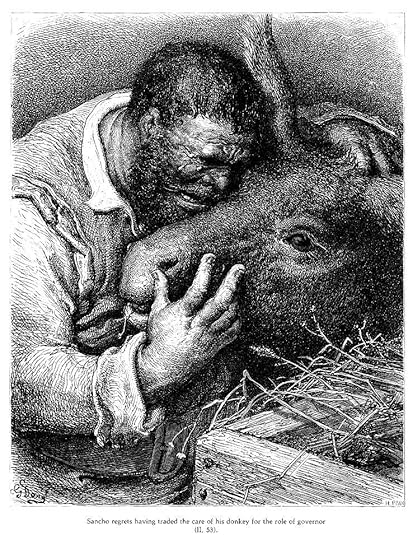
From an illustration of Don Quixote by Gustave Doré
As another of Merrifield's many examples, Prince Myshkin in Doestoevsky’s “The Idiot” finds an aid to his melancholy by contemplation of a donkey’s industrious, patient, long-suffering ways, and projects that: “The look in his eyes says it all—he understands.” In a 1966 film about a donkey of fable, “Balthazar”, the animal of the title is portrayed as a silent witness of human folly and as a creature following the stages of life like that of humans--growing up, a long life of work, and mystical phase in age before crossing over into death.
I soaked up the vibes that Merrifield presents for himself and found the impact soothing and charming. No big philosophy or Zen meditations. We don’t get much of an autobiographical inner journey to go with the outer journey, such as that brilliantly written in Matthiessen’s “The Snow Leopard” or even with simpler humor and self-deprecation in Bryson’s “A Walk in the Woods.” It seems that in New York his literary ambition ended up with him barely eking out a living writing a poet’s biography and a few works of Marxist social commentary and reviews. But life in the big city discouraged him: “It started to turn sour, turned into a high maintenance monster that swallowed me up and spit me out.”
I grooved on the outcomes he gained for himself, though I was left wondering whether that meant retirement of all his literary ambitions, which I would feel sad about. I long myself to have an epiphany like he describes on his travel:
It hits you sometimes , just for a moment, when you enter a patch of sunlight: a feeling of being free, of realizing you can do what you want, go where you want, that you’re answerable to nobody. Accept donkey. For an instant, you almost smell it, feel its tingling force. Liberty. I’m the first man on Mars, the artist as a young man, the Consul drinking mescal, the King of Spain, penning my own diary of a madman. …I’m anything I want. And anybody. I’m even me, yes, plain old me, affirming my own self, a stiff from Liverpool with a brown, French donkey. Who would have believed it! Not me. People change, can change, sometimes for the better.
…Real happiness comes in unforeseen places, through surprising twists and turns, through honesty. The straight and narrow is usually a lie, a lie to oneself.
His donkey’s name is “Gribouille”, meaning doodle or scribble. He comes to appreciate his slow steady pace. Often he makes mysterious stops, which he learns to abide with patience:
It’s not a dead empty moment, this is no mere pause when a donkey stops and nothing happens. I sense some profound presence, a fullness.
He begins to be transformed in this new partnership and infected by his conception of the donkey’s outlook:
With upright, inquiring ears and curious petitioning eyes, they’d give me melancholy stares. They seemed so utterly calm and gentle. Under their frizzy fronts and impenetrable gaze, behind their dark, nonjudgmental eyes, I sensed deep philosophical thoughts as well as a tacit fraternity—the fraternity of a chance meeting on a summer’s afternoon. The vulnerability of two finite beings in illicit rendezvous.
Time slows down amid donkeys. In their company things happen quietly and methodically. It’s hard to forget their innocent gaze. It’s a calm that instills calm. Your mind wanders, you dream, you go elsewhere, yet somehow you remain very present. Milan Kundera says in his novel “Slowness” that speed, the demon of speed, is often associated with forgetting, with avoidance, and slowness with memory, with confrontating. We move slowly when we want to listen to ourselves, to others, and to the world around us. We move slowly when we want to confront ourselves. If only we could slow down.
He reflects a lot on donkeys in literature. Robert Louis Stevenson, who wrote a memoir of traveling by donkey in the French countryside as a young man, seemed to have missed the boat, as he beat his animal in frustration with its stubborn ways. In contrast, Cervantes seemed to find in Sancho Panza’s relationship with his Dapple a model of human love. Sancho admires Dapple’s tender humility and loyalty with no demands. He weeps when he has to leave Dapple behind for an adventure and at another point, upon being reunited after he abandoned him to serve as a provincial governor, he hugs him close and exclaims: “How hast thou been, my dear Dapple, my trusty companion and joy of my eyes!”
From an illustration of Don Quixote by Gustave Doré
As another of Merrifield's many examples, Prince Myshkin in Doestoevsky’s “The Idiot” finds an aid to his melancholy by contemplation of a donkey’s industrious, patient, long-suffering ways, and projects that: “The look in his eyes says it all—he understands.” In a 1966 film about a donkey of fable, “Balthazar”, the animal of the title is portrayed as a silent witness of human folly and as a creature following the stages of life like that of humans--growing up, a long life of work, and mystical phase in age before crossing over into death.
I soaked up the vibes that Merrifield presents for himself and found the impact soothing and charming. No big philosophy or Zen meditations. We don’t get much of an autobiographical inner journey to go with the outer journey, such as that brilliantly written in Matthiessen’s “The Snow Leopard” or even with simpler humor and self-deprecation in Bryson’s “A Walk in the Woods.” It seems that in New York his literary ambition ended up with him barely eking out a living writing a poet’s biography and a few works of Marxist social commentary and reviews. But life in the big city discouraged him: “It started to turn sour, turned into a high maintenance monster that swallowed me up and spit me out.”
I grooved on the outcomes he gained for himself, though I was left wondering whether that meant retirement of all his literary ambitions, which I would feel sad about. I long myself to have an epiphany like he describes on his travel:
It hits you sometimes , just for a moment, when you enter a patch of sunlight: a feeling of being free, of realizing you can do what you want, go where you want, that you’re answerable to nobody. Accept donkey. For an instant, you almost smell it, feel its tingling force. Liberty. I’m the first man on Mars, the artist as a young man, the Consul drinking mescal, the King of Spain, penning my own diary of a madman. …I’m anything I want. And anybody. I’m even me, yes, plain old me, affirming my own self, a stiff from Liverpool with a brown, French donkey. Who would have believed it! Not me. People change, can change, sometimes for the better.
…Real happiness comes in unforeseen places, through surprising twists and turns, through honesty. The straight and narrow is usually a lie, a lie to oneself.

February 17, 2017
In my first grad school librarian class, the professor, the most helpful lifelong of all college instructors, handed each of us a reading list, instructing us to be able to discuss the books in the following weeks' classes. My list had 17 items. Other students had similar sized lists. Every list was different. Students wouldn't be competing for a limited number of library copies. That pace continued ... it strongly influenced my reading patterns after becoming a public library director. There are thousands of books that could be included in my Goodreads catalog that I "read like a librarian." Can't claim to have "read" them but acquired useful knowledge about their contents.
In reading bits and pieces of Merrifield, I enjoyed the tales he told about donkeys in literature, the animals themselves, etc ... it's the sipping type story that also led me to Wikipedia or the public library's catalog ... Would like to hike mellow the mountains in France's midlands with Gribouille and Merrifield.
Did you ever wonder if there is a difference between being a burro and being a donkey? Physically no, linguistically, in Iberian, burros is the name. In Anglo and elsewhere, they are labeled donkeys.
Tragically, China has a special use for Donkey skin!
http://www.bbc.com/news/world-africa-...
In reading bits and pieces of Merrifield, I enjoyed the tales he told about donkeys in literature, the animals themselves, etc ... it's the sipping type story that also led me to Wikipedia or the public library's catalog ... Would like to hike mellow the mountains in France's midlands with Gribouille and Merrifield.
Did you ever wonder if there is a difference between being a burro and being a donkey? Physically no, linguistically, in Iberian, burros is the name. In Anglo and elsewhere, they are labeled donkeys.
Tragically, China has a special use for Donkey skin!
http://www.bbc.com/news/world-africa-...

January 25, 2020
I am split on this book. I don’t regret having read it. I like very much those sections of the book where the author speaks of his own travels in France accompanied by a donkey named Gribouille through the Haute-Auvergne region of France. Hearing of his own personal experiences is what I like. Having read this, I would love to have a donkey. I like their temperament. I knew little about them before reading this book!
So why is this book just OK? Why do I give it only two stars? Simple answer---the author doesn’t stick to what I like. He gets off track. The book covers a wide range of other topics, and they are presented in a haphazard fashion. Had the author stuck to the main theme of his travels with Gribouille, I would have been much happier. Instead, he throws in short chapters about himself, where he has lived, studied and traveled. He adds chapters about fables and books where donkeys play a key role, and he philosophizes, not just a little but a lot! The book has no order. He repeats and zigzags back and forth between topics and books mentioned before. This is a book where filler information expands and drowns out the book’s core.
Travels with a Donkey in the Cévennes by Robert Louis Stevenson is referred to multiple times, as are Aesop's Fables, George Orwell's Animal Farm and Miguel de Cervantes Saavedra' s Don Quixote. These sidetracks are too lengthy and philosophical. The Bible and the Koran, Spinoza, Aristotle and Kafka are pontificated upon. Chapters are devoted to The Primal Scream by Arthur Janov, animal assisted therapy and the benefits of positive reinforcement over physical punishment in the training of donkeys. These sidetracks are either excessively detailed or superficially covered. Some subjects discussed are unnecessary because they are so obvious. The philosophical tirades are not well expressed. Often merely phrases or incomplete sentences are used. At times one is forced to guess at what the the author is saying. I am expressing merely my point of view.
There are some bits of humor.
What have I learned about donkeys? Why do I now like them as much as I do? Donkeys have endurance. They are agile and patient. They are gentle. They are social creatures. You don’t tell a donkey to do this or that, you ask them. It is helpful to show them why that which you are suggesting will not bring them harm. They have a strong sense of self-preservation. They are not idiots; they are smart; they know they must take care of themselves. They have a soft, soft spot on the crown of their head. View them as the “fluffy lawnmowers” that they are. They love dandelions. They can run, if they want to. They may decide to bray at the sheer joy of the day. People call them stubborn, but that is simply because we humans order them around and demand they do something that doesn’t make sense to them! Do you hear what I am saying? I like donkeys. I like them the way they are. The book taught me this. Before reading it, I knew practically nothing about them. I was scared of them!
Peter Johnson narrates the audiobook. He speaks all the French words with a strong American accent. At times you have to wrack your brain to figure out what term or place he is saying. On the other hand, the author does state that he cannot speak French well, making this a good excuse for the poor French. While I could understand the English words easily, the tempo is uneven. The pacing is off. Too often the way he speaks does not feel natural. Johnson’s performance I have given two stars. It’s OK; it’s better than bad.
All I knew when I started was this:
A donkey can also be called a burro or an ass. A mule is born when you breed a male donkey to a female horse, also known as a mare. A hinny is born when you breed a stallion, i.e. a male horse, to a female donkey. Mules possess characteristics of both of their parents. They are usually sterile and thus unable to reproduce.
I have come quite a way; I have learned quite a bit about donkeys!
*****************
*The Wisdom of Donkeys: Finding Tranquility in a Chaotic World by Andy Merrifield 2 stars
*Don Quixote by Miguel de Cervantes Saavedra 1 star
*Running with Sherman by Christopher McDougall TBR
*Travels with a Donkey in the Cévennes by Robert Louis Stevenson TBR
*Last of the Donkey Pilgrims by by Kevin O'Hara TBR
So why is this book just OK? Why do I give it only two stars? Simple answer---the author doesn’t stick to what I like. He gets off track. The book covers a wide range of other topics, and they are presented in a haphazard fashion. Had the author stuck to the main theme of his travels with Gribouille, I would have been much happier. Instead, he throws in short chapters about himself, where he has lived, studied and traveled. He adds chapters about fables and books where donkeys play a key role, and he philosophizes, not just a little but a lot! The book has no order. He repeats and zigzags back and forth between topics and books mentioned before. This is a book where filler information expands and drowns out the book’s core.
Travels with a Donkey in the Cévennes by Robert Louis Stevenson is referred to multiple times, as are Aesop's Fables, George Orwell's Animal Farm and Miguel de Cervantes Saavedra' s Don Quixote. These sidetracks are too lengthy and philosophical. The Bible and the Koran, Spinoza, Aristotle and Kafka are pontificated upon. Chapters are devoted to The Primal Scream by Arthur Janov, animal assisted therapy and the benefits of positive reinforcement over physical punishment in the training of donkeys. These sidetracks are either excessively detailed or superficially covered. Some subjects discussed are unnecessary because they are so obvious. The philosophical tirades are not well expressed. Often merely phrases or incomplete sentences are used. At times one is forced to guess at what the the author is saying. I am expressing merely my point of view.
There are some bits of humor.
What have I learned about donkeys? Why do I now like them as much as I do? Donkeys have endurance. They are agile and patient. They are gentle. They are social creatures. You don’t tell a donkey to do this or that, you ask them. It is helpful to show them why that which you are suggesting will not bring them harm. They have a strong sense of self-preservation. They are not idiots; they are smart; they know they must take care of themselves. They have a soft, soft spot on the crown of their head. View them as the “fluffy lawnmowers” that they are. They love dandelions. They can run, if they want to. They may decide to bray at the sheer joy of the day. People call them stubborn, but that is simply because we humans order them around and demand they do something that doesn’t make sense to them! Do you hear what I am saying? I like donkeys. I like them the way they are. The book taught me this. Before reading it, I knew practically nothing about them. I was scared of them!
Peter Johnson narrates the audiobook. He speaks all the French words with a strong American accent. At times you have to wrack your brain to figure out what term or place he is saying. On the other hand, the author does state that he cannot speak French well, making this a good excuse for the poor French. While I could understand the English words easily, the tempo is uneven. The pacing is off. Too often the way he speaks does not feel natural. Johnson’s performance I have given two stars. It’s OK; it’s better than bad.
All I knew when I started was this:
A donkey can also be called a burro or an ass. A mule is born when you breed a male donkey to a female horse, also known as a mare. A hinny is born when you breed a stallion, i.e. a male horse, to a female donkey. Mules possess characteristics of both of their parents. They are usually sterile and thus unable to reproduce.
I have come quite a way; I have learned quite a bit about donkeys!
*****************
*The Wisdom of Donkeys: Finding Tranquility in a Chaotic World by Andy Merrifield 2 stars
*Don Quixote by Miguel de Cervantes Saavedra 1 star
*Running with Sherman by Christopher McDougall TBR
*Travels with a Donkey in the Cévennes by Robert Louis Stevenson TBR
*Last of the Donkey Pilgrims by by Kevin O'Hara TBR

July 7, 2017
After living in the noisy and fast-paced atmosphere of New York City for a decade, geography teacher and author Andy Merrifield searched for a more tranquil life. He found it walking across Auvergne with Gribouille, a big chocolate-colored donkey, as a companion. It was a time of reflection and slowing down as they traversed the French rural bridle paths.
I had never given much thought to donkeys and their gentle, quiet nature, but was fascinated by them by the end of the book. The author reflects on art and literature involving donkeys. He also tells us about visiting less developed countries where the animals are often abused, overworked, and lack good veterinary care. There is also a section about animal therapy where donkeys are brought into nursing homes to visit the residents. I was charmed by Gribouille, and Andy Merrifield's lovely writing.
I had never given much thought to donkeys and their gentle, quiet nature, but was fascinated by them by the end of the book. The author reflects on art and literature involving donkeys. He also tells us about visiting less developed countries where the animals are often abused, overworked, and lack good veterinary care. There is also a section about animal therapy where donkeys are brought into nursing homes to visit the residents. I was charmed by Gribouille, and Andy Merrifield's lovely writing.

August 4, 2011
I ended up enjoying this book far more than I had anticipated. At first I thought, "A book about a man walking around France with a donkey? Sounds like fun." Being a big fan of travel writing, I picked it up at the library, but this book was so much more than travel writing/literature. This is a love song to donkeys, to slowing down, to living life with less but being more content. It's a lovely story filled with Merrifield's philosophies about life, literature, and donkeys. At times, Merrifield drones on perhaps a tad too much with all the literary references, but he's a former professor, so I suppose you have to excuse him his literary indulgences.
The title of the book is fitting mostly because Merrifield postulates on these issues in the book, but also because, in order to fully digest the text, the reader is forced to slow down, to read with tranquility. I'll be the first to admit that, probably due to the internet, my attention span has gone down quite a bit since I left college leaving my ability to slow down and really enjoy a text at an embarrassingly low level. I thought I'd be able to skim this book the same way I do most books, but I found his narrative forced me to slow down, to find tranquility in both the his words and in my reading style. Bravo to Merrifield.
The title of the book is fitting mostly because Merrifield postulates on these issues in the book, but also because, in order to fully digest the text, the reader is forced to slow down, to read with tranquility. I'll be the first to admit that, probably due to the internet, my attention span has gone down quite a bit since I left college leaving my ability to slow down and really enjoy a text at an embarrassingly low level. I thought I'd be able to skim this book the same way I do most books, but I found his narrative forced me to slow down, to find tranquility in both the his words and in my reading style. Bravo to Merrifield.
November 19, 2013
The Wisdom of Donkeys
By Andy Merrifield
4 stars
pp. 258
Finding tranquility in a chaotic world is Merrifield's subtitle to The Wisdom of Donkeys and that is exactly what Merrifield was doing following a personal undefined crisis. Merrifield a native of Liverpool, England had wanted two things in his life to live in New York City and immerse himself in academia. He had both of those, a PhD in Geography, an urban Marxist theorist an active author and yet during a crisis of faith he walked away and found succor from the donkeys of Auvergne, France.
Merrifield had a moment of insight in Morocco watching the donkeys in Marrakesh and saw a vision for his next book, an account about donkeys. He journeyed to Egypt where donkeys originated and spent a day helping a donkey vet. Visited the famous Sidmouth Donkey Sanctuary in England. Finally he settled in France and embarked on a foot journey with Gribouille, a chocolate brown donkey. As he strolls he reviews the arts literature about donkeys from Aesop to Dostoyevsky, Cervatanes to Sexton. I love animals but I was amazed at all one can learn about donkeys.
Here is a glimpse of some Egyptian history:
The Wisdom of Donkeys is rich in information about donkeys and occasionally gives the reader a glimpse of his experiences walking through France as when his walking companion, Gribouille at first refused to cross a bridge and how he eventually crossed. We meet youths on bicycles, innkeepers and a variety of horses, goats and sheep along the way. But if one is really interested in a travel journal this is not really the book for you. I did find myself in the relaxed reflective mood that one gets in a slow walk through the countryside appreciating the lush green fields which surround.
This is a hard book to categorize, a review of the literature, a psychological study of donkeys, a bit of philosophy and a bit of a memoir. I quite enjoyed reading it, but cannot recommend it for all
By Andy Merrifield
4 stars
pp. 258
Finding tranquility in a chaotic world is Merrifield's subtitle to The Wisdom of Donkeys and that is exactly what Merrifield was doing following a personal undefined crisis. Merrifield a native of Liverpool, England had wanted two things in his life to live in New York City and immerse himself in academia. He had both of those, a PhD in Geography, an urban Marxist theorist an active author and yet during a crisis of faith he walked away and found succor from the donkeys of Auvergne, France.
Merrifield had a moment of insight in Morocco watching the donkeys in Marrakesh and saw a vision for his next book, an account about donkeys. He journeyed to Egypt where donkeys originated and spent a day helping a donkey vet. Visited the famous Sidmouth Donkey Sanctuary in England. Finally he settled in France and embarked on a foot journey with Gribouille, a chocolate brown donkey. As he strolls he reviews the arts literature about donkeys from Aesop to Dostoyevsky, Cervatanes to Sexton. I love animals but I was amazed at all one can learn about donkeys.
Here is a glimpse of some Egyptian history:
The Wisdom of Donkeys is rich in information about donkeys and occasionally gives the reader a glimpse of his experiences walking through France as when his walking companion, Gribouille at first refused to cross a bridge and how he eventually crossed. We meet youths on bicycles, innkeepers and a variety of horses, goats and sheep along the way. But if one is really interested in a travel journal this is not really the book for you. I did find myself in the relaxed reflective mood that one gets in a slow walk through the countryside appreciating the lush green fields which surround.
This is a hard book to categorize, a review of the literature, a psychological study of donkeys, a bit of philosophy and a bit of a memoir. I quite enjoyed reading it, but cannot recommend it for all

December 30, 2020
I received this book from Penny. It's about a man who, unhappy with his current life, sets out on a pilgrimage with a donkey as his companion. This book made me fall in love with donkeys, and with pilgrimages. The donkey's slow pace and gentle wisdom helped the author slow down and as the subtitle says, "find tranquility in a chaotic world". After I read it, I desperately wanted to find a donkey to spend time with and googled and found a place in Manitoba, but have not yet visited. Someday. 8/10

February 21, 2008
It was good - and teaches us a valuable message about how this equine species can teach us how to be patient, kind, thoughtful, careful, gentle, and calm. But that message could have been conveyed in fewer pages. Like the author's donkey pal, the book is heartwarming, but moved at a very slow pace. I just lost interest and gave up about half way through.

Read
May 25, 2021DNF @ 20%
Unfortunately the author's meandering, "stream of consciousness" style prose just wasn't for me. The narrative constantly wanders to whatever seems to be on the author's mind in the moment he was writing it and not enough on his travels with his donkey Gribouille. As always, your mileage may vary.
Rating: N/A
Unfortunately the author's meandering, "stream of consciousness" style prose just wasn't for me. The narrative constantly wanders to whatever seems to be on the author's mind in the moment he was writing it and not enough on his travels with his donkey Gribouille. As always, your mileage may vary.
Rating: N/A

October 15, 2014
I enjoyed this book, and perhaps I am biased since I have donkeys and I hike with them almost daily- so I have my own views of donkey-nature. This tale is about a man who walks across southern France with a donkey, and like many such memoirs the story weaves in present experiences with history of the area, history of donkeys, other tales about donkeys, and tales from the author's past that are brought forth as a result of his long trek with the donkey. An enjoyable book for those who like stories of meanderings and the stories that spring from such past times.

January 16, 2016
A nice read written by a man that backpacks around southern France with a donkey as a companion. He relates a lot of stories of donkeys in literature (he is an encyclopedia of literature) to how they are viewed today as he walks from town to town with Gribouille.

November 18, 2015
biraz yavaşlamaya, benliğe ve hayata dair sakince düşünmeye ihtiyacınız varsa bi' bakın derim..
May 26, 2023
Wunderschön, liebevoll und klug.

June 4, 2025
A strange book, indeed. I personally love donkeys, though I have never owned nor interacted with one. There's just something about their sweet eyes and compact form which I feel drawn to. I learned a lot about donkeys, and was saddened to hear how abused they often are by ignorant people who think they can be beaten to do something they do not wish to do. I had to skim some of the descriptions of animal cruelty. They are strong, resilient and intelligent animals who avoid danger at all costs. They are not stubborn, just cautious and require gentle, patient teaching. As people do, but we are forced to learn, and it often breaks our spirits, too. I could relate to Andy's description of how working in a mindless job stole his adolescence. When I retired, I spent years "trying to rediscover a paradise lost," as Andy experienced. He refers to Spinoza's philosophy that "we feel and know ourselves..as eternal beings in a grander holistic unease. It's very hard to do, finding this state of mind, this state of peace, this freedom." That is what Andy's journey is all about. That's what he's looking for. I enjoyed his references to other works like The French Lieutenant's Woman, which I haven't read. But in the end I found it difficult to follow Andy's journey. It seemed he lost his focus, as he plodded along and his musings became random, to me. I became disengaged. I forced myself to finish it but the ending wasn't surprising or enlightening for me, perhaps because I've already accepted Spinoza's notion of the "finitude of life...that one day you get old and die, and it's that that makes the eternal now so precious and meaningful, so worthy of clinging on to. Soon it may be too late: now must be forever." I didn't really see how he needed this long journey on foot through the Auvergne, to discover that. But maybe others would be inspired to undertake a vision quest, and that's not a bad thing.

March 1, 2021
This might have been a five star book, had I read it travelling somewhere with a donkey myself, one chapter each night. As it was, listening to the audio book pretty much straight through, it suffered. A lot. Even when I had reined in the narrator a little (he's rushing through the book as if it was a horse race, not a donkey treck and his French pronunciation sucks, frankly...) I still felt myself rushed at a 0.9x speed (the lowest it would go without sounding weird). I did stop a few times to ponder a chapter, listened to the one about Heidegger twice, but that wasn't enough. I think the author was trying to transport the experience of how the mind wanders when you wander with a donkey, how stories develop, when you tell them to a donkey. But it didn't quite work for me. Not this time. I hope to reread more leisurely one day. Still, there's not too much about real donkeys in here, as the title implies, it's more about ideas about donkeys.

August 24, 2026
This is one of my all-time favourite non-fiction books, and I've read it multiple times. I love how he has captured the essence of donkeys through the entire narrative. The writing style mimics the donkey's leisurely pace, and the descriptions pay homage to my favourite animal perfectly. I also enjoy all the philosophical discussions and the vivid, beautifully written descriptions.

July 11, 2026
ESEL, ARM UND VERACHTET IN DER WELT
Kurzmeinung: Tiere sollten grundsätzlich nicht dem Menschen dienen müssen. Der Autor weckt Sympathie für diese oft gedemütigten und misshandelten Tiere.
Präliminarien: Das vorgenannte Buch erscheint schon 2008, ist aber erst jetzt übersetzt. Der britische Autor ist zeitgenössisch, geboren 1960 und obwohl er – laut wiki – schon mit 16 Jahren von der Schule abging, erwarb er einen PhD in Geographie und lehrte später an der Uni von Southampton, dann sogar an der Clark University in Massachusetts. Möglicherweise weil er seinen Wohnsitz in New York genommen hatte und davon nicht abrücken wollte, bekam er keine Festanstellung. Ungefähr 2000 stieg er für eine Weile aus, widmete sich den einfachen Dingen des Lebens und wohnte in der Auvergne, wo er seine Eselsgeschichte schrieb. 2011 kehrte er in den Unibetrieb zurück. Warum?
Inhalt: Der Erzähler und Autor hat den Draht zu sich selber verloren. Eine Wanderung mit Esel soll ihn wieder erden, seinen Kopf frei machen und ihm dazu verhelfen, sein Leben zu überdenken.
Der Kommentar und das Leseerlebnis:
Die Reise mit dem schokoladenfarbenen Esel Gribouille durch einen Teil der Auvergne nimmt dem Leser mit in eine beschauliche Wanderung voller spiritueller Momente und Reflexionen. Viele grauenhafte Details darüber, wie die schönen Tiere in der Welt missbraucht, gefoltert und geschunden werden, muss man hören. Der Mensch ist im Umgang mit Tieren nie unschuldig gewesen, sondern brutal und übergriffig. Es nimmt mit von der Qual der sich nicht zur Wehr setzenden Tiere zu lesen. Trotzdem folge ich dem Autor/Erzähler nicht in seinem Statement, die Esel würden würdevoll leiden und sich mit jedem Schicksal abfinden. Das tun sie natürlich nicht, sie haben nur keine Wahl.
Der Autor schöpft viel aus erlesener im Sinne von gelesener Literatur, in der Esel vorkommen, sei es der Esel Dapple von Sancho Panso aus „Don Quichotte“ oder Robert Stevensons „Reise mit einem Esel durch die Cevennen“; es stellt sich heraus, dass Stevenson ein großer Tierquäler gewesen ist. Es ist unverständlich, warum der Autor trotzdem nur wertschätzend über Stevenson spricht. Ich bin froh, dass ich nie etwas von ihm gelesen habe. Sogar Bileams Esel wird verhandelt. Diese Einschübe finde ich mega langweilig.
Der Autor/Erzähler wiederholt sich ziemlich oft, wenn er von den tiefgründigen Augen der Esel spricht oder vom Wert des Tagträumens. Insgesamt weckt er in seinen liebevollen Beschreibungen des Esels Gribouille jedoch beim Leser Sympathie, Liebe und Mitgefühl und Verständnis. Allerdings bleiben auch einige Fragen offen, zu kurz beschrieben und zum Teil zu abgehoben, sind die autobiographischen Splitter für mich.
Fazit: Der Roman hat mich etwas enttäuscht, denn von der Wanderung wird nicht besonders viel erzählt, dagegen ist einiges „esoterische Zeug“ zu verdauen. Teilweise waren es trotzdem viele mir bis dato unbekannte wertvolle Informationen über Esel, die das Buch liebenswert machen und natürlich ist „Die Weisheit der Esel“ Literatur mit Entschleunigungscharakter.
Kategorie: Wanderliteratur
Verlag: Nymphenburger, 2026
Kurzmeinung: Tiere sollten grundsätzlich nicht dem Menschen dienen müssen. Der Autor weckt Sympathie für diese oft gedemütigten und misshandelten Tiere.
Präliminarien: Das vorgenannte Buch erscheint schon 2008, ist aber erst jetzt übersetzt. Der britische Autor ist zeitgenössisch, geboren 1960 und obwohl er – laut wiki – schon mit 16 Jahren von der Schule abging, erwarb er einen PhD in Geographie und lehrte später an der Uni von Southampton, dann sogar an der Clark University in Massachusetts. Möglicherweise weil er seinen Wohnsitz in New York genommen hatte und davon nicht abrücken wollte, bekam er keine Festanstellung. Ungefähr 2000 stieg er für eine Weile aus, widmete sich den einfachen Dingen des Lebens und wohnte in der Auvergne, wo er seine Eselsgeschichte schrieb. 2011 kehrte er in den Unibetrieb zurück. Warum?
Inhalt: Der Erzähler und Autor hat den Draht zu sich selber verloren. Eine Wanderung mit Esel soll ihn wieder erden, seinen Kopf frei machen und ihm dazu verhelfen, sein Leben zu überdenken.
Der Kommentar und das Leseerlebnis:
Die Reise mit dem schokoladenfarbenen Esel Gribouille durch einen Teil der Auvergne nimmt dem Leser mit in eine beschauliche Wanderung voller spiritueller Momente und Reflexionen. Viele grauenhafte Details darüber, wie die schönen Tiere in der Welt missbraucht, gefoltert und geschunden werden, muss man hören. Der Mensch ist im Umgang mit Tieren nie unschuldig gewesen, sondern brutal und übergriffig. Es nimmt mit von der Qual der sich nicht zur Wehr setzenden Tiere zu lesen. Trotzdem folge ich dem Autor/Erzähler nicht in seinem Statement, die Esel würden würdevoll leiden und sich mit jedem Schicksal abfinden. Das tun sie natürlich nicht, sie haben nur keine Wahl.
Der Autor schöpft viel aus erlesener im Sinne von gelesener Literatur, in der Esel vorkommen, sei es der Esel Dapple von Sancho Panso aus „Don Quichotte“ oder Robert Stevensons „Reise mit einem Esel durch die Cevennen“; es stellt sich heraus, dass Stevenson ein großer Tierquäler gewesen ist. Es ist unverständlich, warum der Autor trotzdem nur wertschätzend über Stevenson spricht. Ich bin froh, dass ich nie etwas von ihm gelesen habe. Sogar Bileams Esel wird verhandelt. Diese Einschübe finde ich mega langweilig.
Der Autor/Erzähler wiederholt sich ziemlich oft, wenn er von den tiefgründigen Augen der Esel spricht oder vom Wert des Tagträumens. Insgesamt weckt er in seinen liebevollen Beschreibungen des Esels Gribouille jedoch beim Leser Sympathie, Liebe und Mitgefühl und Verständnis. Allerdings bleiben auch einige Fragen offen, zu kurz beschrieben und zum Teil zu abgehoben, sind die autobiographischen Splitter für mich.
Fazit: Der Roman hat mich etwas enttäuscht, denn von der Wanderung wird nicht besonders viel erzählt, dagegen ist einiges „esoterische Zeug“ zu verdauen. Teilweise waren es trotzdem viele mir bis dato unbekannte wertvolle Informationen über Esel, die das Buch liebenswert machen und natürlich ist „Die Weisheit der Esel“ Literatur mit Entschleunigungscharakter.
Kategorie: Wanderliteratur
Verlag: Nymphenburger, 2026

May 20, 2022
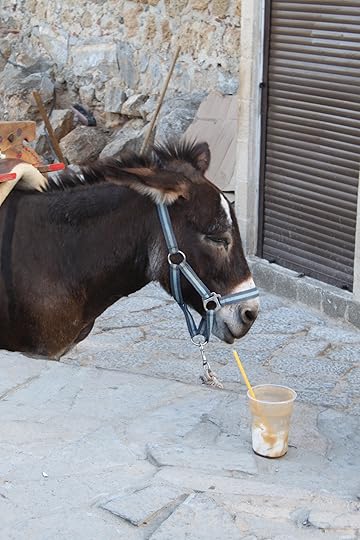
"They're the most philosophical of all animals, much more philosophical about their fates than human beings. And it's an instinctive philosophy, a stoic acceptance, a kind of beautiful strength, passive rather than aggressive."

April 24, 2025
War ganz nett, aber hat sich irgendwie ziemlich gezogen. Weil es um Esel ging, gibt’s aber zumindest drei Sterne 😁

April 14, 2018
Well-written, but I found it a bit dull. The writer draws inspiration from the natural peacefulness of donkeys, but the lessons are fairly predictable. I read it mainly as research for a novel I'm writing that involves a donkey, so I wasn't fully open to it on its own merits. As a meditation, I think it serves well.

July 21, 2023
This book is incredibly difficult to categorize and I loved it so much. On the surface, it's just a man walking around with a donkey in France and thinking about things.
Honestly, that's what it is all the way down, but it's also very readable, very thought-provoking, honest, and funny.
Honestly, that's what it is all the way down, but it's also very readable, very thought-provoking, honest, and funny.
June 14, 2025
Expecting cuteness I get philosophy-squared, but in staged intervals, interrupted by on-the-pathway musings and appreciations of nature, and, especially, appreciation of donkeys. In this case, one particular donkey, Gribouille, who accompanies Merrifield along French country lanes and from village to village on a “wander-with-a-donkey-for-your soul” expedition (it’s a real thing, Aluna Voyages, for example, offers a 5-day trek for 575 Euros). Well, Merrifield signed up for one not far from where he was living at the time, and, being an academic, wrote about it--but he wrote as a “friendly” academic--no footnotes--but plenty of references to donkeys of history and literature. Gribouille means (according to Wikipedia) “a naïve and foolishly happy person” but it also can be translated as “scribbling.” Merrifield scribbled very well for this book and as the reader joins the two on the pathways, one slows and walks at his—Gribouille’s—pace through rural France, and, as a bonus, learns much about traditions and history—and donkeys. One can be thankful that Merrifield did not write this in the mode and fashion of an academic, or we’d be overwhelmed by footnotes. The “works cited” would include: Schubert’s piano sonatas (the book’s first sentence, no less), Milan Kundera’s Slowness; Jacques Prevert’s, “ditties”; and, of course, Robert Louis Stevenson’s Travels with a Donkey in the Cevennnes, (though Stevenson mistreated his companion, Modestine). We’d continue with Robert Bresson’s 1966 movie Au Hasard Balthazar, a donkey tale with a sad ending; Dostoyevsky’s novel The Idiot and his character Prince Myshkin—and we haven’t even gotten to page 10. But it is a gentle drum that beats the academic rhythm, which shows that donkeys can conquer the supposed benefits of human civilization through patience and distraction (if not abstraction). We rev back up with more references: Somehow Isaac Bashevis Singer and Shadows on the Hudson springs from Merrifield’s memory. Of course, the uber-donkey, Sancho Panza’s Dapple, is introduced to the story, but from Franz Kafka’s viewpoint. Monty Roberts, a well known “horse whisperer” appears just before John Fowles’ The French Lieutenant’s Woman ... and we don’t feel the change in the “grain” of the trail or the text at all. The “psychology” of the donkey comes up again and again, and we are gently pushed along to the conclusion that they have no psychology, which explains their nature and success. The reader is asked to consider the film: My Dinner with André which is all about two characters mostly futile attempt to answer “Who Am I?”—the play/movie is supposed to reflect donkey logic. Gribouille avoids that self-reflection and just continues on down the road—or not. Dostoyevsky reappears with, of course, The Idiot, as well as Notes From the Underground. Merrifield likes Dostoyevsky for some reason; my experience of this slightly mad Russian, is more ambivalent. One reference is to the novel The Idiot, and the ex-Russian scholar in me reminds that it was written mostly in Florence, Italy, not huddled in a cold garret in St. Petersburg. But Merrifield connects Dostoyevsky to the sad and bad parts of his life. Recovering a bit, Alphonse Daudet’s The Pope’s Donkey is invoked next to provide a useful analogy—don’t stand behind a donkey you’ve pissed off. Then we read about Juan Ramon Jiménez (Nobel Prize winner for Literature, who knew?) and Platero and I, Platero being a “merry gray donkey.” Jimenez is a critic of Baruch Spinoza and he ended up exiled from Franco’s Spain, to New York City, where, Merrifield wonders, did he think often of Platero. Merrifield is thinking a lot so we have to review Martin Heideggar’s “two kinds of thinking”: calculative and meditative and, with the aid of a donkey trek we can see the nearness of distance and we are on the path to Being. So, there. But let’s lighten up and move along the path to a book supposedly for children, Henri Bosco’s Culotte the Donkey, who is loved “only by a little boy” who reminds us that we need to “go out and play” from time to time. Donkey poems are not always very serious, but G. K. Chesterton could spin one out with a biblical reference that sparks the tale of Jesus arriving in Jerusalem astride a donkey. Millet, the French painter, painted (sketched, really) a woman astride a donkey either going to or coming from work in the field. That was modified into The Flight into Egypt and copied by van Gogh as Peasant Couple Going to Work. But donkeys are not so often the subject of “art”—perhaps they are too much the opposite of art: the object is staring back you. Next we encounter the “ass” and it’s inevitable alternative meaning from there ... we surface in Shakespeare and then segue quickly from the Bard into the Quran (something of a jolt). Muhammad rode his ass Ya’foor ‘everywhere’, we soon learn. Which leads to the Old Testament and the take on Balaam, another mis-treater, who provoked a donkey to speak. This leads to Walter Benjamin but Walter only acted like a donkey—looking back in his work. Challenge a hungry donkey with two equally distant and equally sized bales of hay with a pail of water beside each and, we are told via “Buridan’s Paradox” that the donkey would starve since he/she couldn’t make up his/her mind which way to go. That story is tied to Aristotle and Spinoza somehow, then on to Euclid’s “fifth geometrical proposition”, pons asinorum (Bridge of Asses) which, of course, is linked to John Fowle’s The French Lieutenant’s Woman where Sarah’s obstinacy (donkey-like) is praised. Well, of course there are fables about donkey’s and Aesop offers The Asses Brain and The Ass in the Lion’s Skin as well as The Ass and the Grasshopper—Donkey-driven morals simply abound. But no less of a moralist as George Orwell and the “most intriguing character” in Animal Farm is Benjamin, a donkey, who is often more cryptic than informative. Alphonse Daudet appears next in Merrifield’s book, but briefly, even though he included donkeys in many of his tales. Donkeys are, of course, above us, all the time, in the constellations Asellus Borealis and Assellus Australis, these astronomical phenomena offer the chance to muse on the subject without having to read, but that reverie is disturbed by Gaston Bachelard (a philosopher) who comments on one’s ability to form one’s own constellations—even of donkeys, so one merely has to look up...then we are invited to consider that Dionysus is often depicted astride a donkey as Aristophanes wrote in Frogs. But, Hark! I hear the notes of Franz Schubert whose “...piano is the sound of tragic braying...” long nights in rural France do that to you. I am introduced to Gaston Bachelard, “the great philosopher of reverie” who famously (we read) recounts how in Maurice Barrès work Berenice, the titular character loves to gaze in her donkey’s eyes. Antoine de Saint-Exupery is invoked for the benefit of donkeys only because he describes how a little water goes a long way in the desert. That would, of course, lead to Andrew Jackson who used a donkey’s tail as a campaign symbol that helped him defeat the aristocratic John Quincy Adams. That, in turn, led to the donkey becoming the symbol of the US Democratic Party. So there! Next we learn, for no apparent reason, that here was a more or less famous donkey-artist (meaning donkey-as-artist) who “painted” among the revolutionary “modern” artists of Montmartre. Lolo was her name and the Lapin Agile was her showplace. Her chef d’ouvre was “Coucher de soleil sur l’Adriatique” and “large crowds” came to see this “masterpiece.” Lolo was found drowned near her usual out-of-town field in St. Cyr-sur-Morin; Merrifield speculates this was a suicide, as Lolo missed her life in Paris. Her demise was not far from where Pierre Mac Orlan lived and Merrifield went to visit this slightly naughty novelist and songwriter, who lived, as Merrifield wrote, in a “...slightly foxed universe.” Now, that is compelling! As the book begins to wind down, nearing the end of the trek, Samuel Taylor Coleridge is invoked, and one must quote “To a Young Ass” at some length here: “Poor little foal of an oppressed race,/I love the languid patience of they face;/And oft with gentle hand I give thee bread,/And clap thy ragged coat, and pat thy head.”...Peaceful, but the real lives of donkeys in the workaday world of Egypt is not so pleasant. We learn this as the text veers off to stories from Egypt about a dedicated veterinarian trying to “humanize” the treatment of these animals...before coming back to a...Primal Scream—or the bray of a donkey—or, the 1970 book by Arthur Janov advocating for a form of donkey-bray therapy. Anne Sexton, Sylvia Plath, Dostoyevsky and Arthur Rimbaud are mentioned in one exhilarating page as we are given the rhyme “Anne, Anne / Fuis sur ton âne” to ponder how names, hunger and donkeys converge. Arthur Rimbaud is quoted at length as we are told that “...fleeing on a donkey means more than taking a vacation...it means bringing it all back home...” Which segues into Chang Kuo’s magic donkey and then “donkeys as therapists” ... they are very calming in a clinical/hospital/hospice setting. Sancho Panza, Kafka, Gustave Doré, Robert Bresson, George Orwell, Spinoza and Shakespeare usher us out of the tale and the end of the book ... and we are left to wonder why we don’t “own” a donkey and all those other books.

July 29, 2015
maybe i'm just not ready to grasp "tranquility" but this book moved too goddamn slow for me. also, it felt like, rather than writing a book about a personal experience, the author SEEMED to go on a personal experience for the purposes of writing a book. i guess you've got to create your writing inspiration when you're living the slow life in a small french hamlet? he never goes into his "why" for the journey, nor the distance or time (at least, i didn't pick up on it - i think it was a few days?) but he could have just went up the hill to the store to pick up some milk. i dont even know. (fact: donkeys produce milk. he should have picked a female for his milk needs if he was in a pinch.) he made donkeys seem really cute and i would consider getting a pet donkey now, if only because they remind me of me, cute little stubborn asses. aside from that, all i got from this book was that i could really use a nice little picnic in the french countryside with some fresh pane, fromage, and my new pet ass.

December 23, 2014
This is a wonderful little book and I've never really read anything like it. It is something of a self-help text and I usually run in the opposite direction of books of that ilk. This seemed different to me however. "The Wisdon of Donkeys" is also a travelogue, an extended meditation and a plea for empathy with fellow sentient beings.
Merrifield's donkey could have been written as a metaphoric argument for slowing the hyper-pace of our lives. The book could have been just about the lost pleasure of simple reverie in which we find ourselves out of time and place.
It is about all these things, but it's also about inter-species communion, spending time getting lost in the dark soulful eyes of a donkey, experiencing the tactile bliss of a soft donkey's ear and, for all of these reasons, the book was a beautiful read for me. It was sent by an old friend who knows me well and thought I would gain something from a little book about donkeys and she was right.
Merrifield's donkey could have been written as a metaphoric argument for slowing the hyper-pace of our lives. The book could have been just about the lost pleasure of simple reverie in which we find ourselves out of time and place.
It is about all these things, but it's also about inter-species communion, spending time getting lost in the dark soulful eyes of a donkey, experiencing the tactile bliss of a soft donkey's ear and, for all of these reasons, the book was a beautiful read for me. It was sent by an old friend who knows me well and thought I would gain something from a little book about donkeys and she was right.
January 17, 2017
I bought this book several books ago while traveling and the person who recommended it said it was a wonderful read. I finally slowed down to read it and what a wonderful book it is!
If you like animals you will enjoy this book. Even if you do not like animals, this is worth the read. It's about life and how what we think we need in our life is not always true.
Also learning more how donkeys play such an important role for most of the world, how smart and strong they are gives insight in how special these animals are. I will never look or think about donkeys in the same way.
If you like animals you will enjoy this book. Even if you do not like animals, this is worth the read. It's about life and how what we think we need in our life is not always true.
Also learning more how donkeys play such an important role for most of the world, how smart and strong they are gives insight in how special these animals are. I will never look or think about donkeys in the same way.

March 3, 2017
let's put it this way: i have a pacemaker that is set so that my heart rate doesn't go below 60. i'm fairly certain that my pacemaker was working 100% of the time while reading this book. i wanted to like this book about a man with his donkey in france but it was so slow, and there so many books in the world. moving on...

June 26, 2008
At the beginning, it all seems very boring, and the author seems like he's not getting anywhere with his words. But once the journey really kicks in, it's like you're in it with Merrifield together. Gribouille is charming. You have to read this book.

May 18, 2009
First, it made me want to buy a donkey, then look after him and stroke him/her, and learn to understand the animal.... The author writes so you feel you are on the journey with him and the donkey, and it is a very strong feel-good book.
April 16, 2012
This book is fantastic. Musings on the inner lives of donkeys. Walking cross country with a donkey, the author brings together donkey lore and literature and his own experiences having a simple, natural space of time to explore the world.

May 4, 2012
Jealousy. The emotion you may experience in reading this book about the author's walking journey through southern France, enjoying life at a pace the modern world has forgotten, in the companionship of Gribouille - a donkey.
Merrifield shows he is a soul-mate of Robert Frost.
Merrifield shows he is a soul-mate of Robert Frost.
Displaying 1 - 30 of 109 reviews