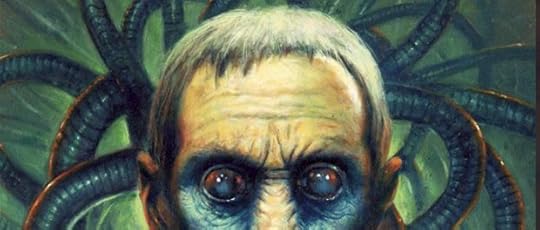
More than thirty years have passed since the events of Born to the Dark. Christian Noble is almost a century old, but his and his family’s influence over the world is stronger than ever. The latest version of their occult church counts Dominic Sheldrake’s son and the young man’s wife among its members, and their little daughter too. Dominic will do anything he can to break its influence over them, and his old friends Jim and Bobby come to his aid. None of them realise what they will be up against – the Nobles transformed into the monstrousness they have invoked, and the inhuman future they may have made inevitable . . .
The Way of the Worm is the final volume of Ramsey Campbell’s Brichester Mythos trilogy, in which he returns to his original themes and develops them in his mature style. The first volume, The Searching Dead, received the Children of the Night Award from the Dracula Society for the best original Gothic fiction of the year.
Ramsey Campbell is a British writer considered by a number of critics to be one of the great masters of horror fiction. T. E. D. Klein has written that "Campbell reigns supreme in the field today," while S. T. Joshi has said that "future generations will regard him as the leading horror writer of our generation, every bit the equal of Lovecraft or Blackwood."
The Three Births of Daoloth trilogy ends with THE WAY OF THE WORM. It was a finale worth waiting for!
Thirty years has passed since we've last seen Dominic Sheldrake. He's given up trying to convince anyone about the Noble family, (now going by the surname of Le Bon), and how dangerous they can be. Dominic's son, wife and granddaughter are still involved with them, even after their project Safe to Sleep was abandoned. Fearing for their lives, Dominic chooses to join them in their new "church," the Church of the Eternal Three. What happens to him there brings back all of his memories and his need to protect his family grows even stronger.The Le Bons are torturing him at every turn, and he turns to his old friends Bobby, (Roberta), and Jim for help. The Tremendous Three ride again! Will they be able to stop the evil Le Bons? Will they be able to save Dominic's family? Most importantly, will they be able to save the world? You'll have to read this to find out.
Sometimes it's hard to pick up the next book in a series months, or even years, after reading the previous one. Not so with Ramsey Campbell! His characters are so vivid and memorable, it's easy to pick up right where you left off.
Another thing that I like about this series is that each book takes place years after the previous one. In this volume, Dominic is an old man, he's a grandfather, and he's dealing with all the things that age brings. I'm not that old yet, (well, I guess technically, I am), but I identified with Dom's aches and pains.
Overall, I found this to be a satisfying way to wrap up this trilogy. As far as I'm concerned, how it happened here was the only way to stay true to the tale, but that's all I can say without spoiling anything. Ramsey Campbell never disappoints and this tale is no exception!
*Thanks to Flame Tree Press for the e-ARC of this tale of cosmic and very real horrors!*
A few years ago - too many of them to even care anymore - I was walking with Mark Valentine and John Howard through a small town called Sinaia, in the Carpathian Mountains. Being in a rather flippant mood, Mark Valentine asked me if I would like him to impersonate Ramsey Campbell for me. What followed was a deluge of phrases like a lightning striking a screaming wet cat, all with a thick Liverpool accent, if there is such a thing. I don't remember understanding anything Mark was saying but boy I was laughing so hard I thought I was going to pass out. Those were the times. If you have the chance to meet Mark Valentine, ask him to impersonate Ramsey for you. Totally worthy.
So, what about THE WAY OF THE WORM by Ramsey Campbell? And the whole trilogy in fact.
The best "horror" book/s I have read in years if not in a decade. Nothing else to add.
Quite a few of the authors I am publishing are lukewarm about Ramsey Campbell. They seem to find him too verbose, too mainstream, "too English" (oh yes, there is such a thing!) and various others "oh, well, I guess I should give him another chance..." or "eh, meh". A pity because I think there is a lot of depth, vision and humanity in Campbell's works.
Oh, and I would love to hear Ramsey impersonating Mark Valentine for a change. That will be gold.
And so we reach the finale of Campbell’s Daoloth trilogy, the author’s latest attempt to scale the peaks of Lovecraft at his finest. I reviewed the first two volumes when each was released. In summary, let me say that I found the two books excellent entries in the series, both satisfying as standalone works and thrumming with anticipatory materials in advance of the last one. The simple question now is, can Campbell live up to promises he makes in those previous novels?
The answer is yes. Quite triumphantly.
THE WAY OF THE WORM is relatively straightforward plot-wise. It’s 30 years on from events depicted in BORN TO THE DARK, and our hero, Dominic Sheldrake, is approaching his dotage. His son, now an adult with a family of his own, is heavily invested in the Noble family and their (nefarious) plans for the world, but Dominic won’t give up on him any time soon, particularly as another child is involved (a granddaughter). Cue a sequence of scenes in which Dominic openly infiltrates the religious group’s meetings, covertly spies upon the Nobles’ home, and even reveals to police evidence of a crime which results in a court case threatening to imprison the sinister family.
The story unfolds at a headlong pace, the prose as refined and pared as we’ve come to expect from later Campbell. Indeed, it’s the sheer stylishness of the writing that makes the author such a joy to read in his maturity. Every paragraph offers a strikingly original or oblique descriptive phrase that brings the material to such vivid, weird life. An example is his depiction of a simple stone icon:
I could have thought the wide thin disconcertingly human smile and the enormous eyes that glistened like globes of black sap were greeting me. The sinuous trident of a tongue protruded from one corner of the mouth while the tip of the tail wormed its way into the other. I found the face so disagreeably fascinating that I almost forgot to mute my phone, having let the icon rest on my lap like a quiescent pet. I cared not at all for the intimate weight, and was lifting the image—clamping it between my hands in case exerting force lent me some sense of power…
Items in Campbell’s world are experiencedin an embodied way (“globes of black sap were greeting me…quiescent pet…intimate weight”), rather than merely cited as being there (as they might be in the work of a merely competent writer). When extracts are singly quoted (as above), they serve as a worthy example of refined writing, but when packed together page after page, this offbeat imagery and peculiar manner of perceiving the world induces a unique accumulative effect that, to be appreciated, must be experienced.
It is this command of prose that becomes essential as the story develops along outre lines. One extended, multi-chapter scene involving a chase around the environs of Liverpool is gripping, evocative and pungently unsettling. In other work, Campbell rarely gives us a full glimpse of his things – usually they’re off-camera, hinted at, maybe even just imagined by characters – but when a trio of mutated entities pursue Dominic and his two ageing friends, we’re treated to a whole range of overtly bizarre descriptions involving travesties of flesh and sardonic minds at work. It’s a riveting set-piece.
No less gripping and impressive are Dominic’s trance-induced regressions, hinting at a Jungian collective unconscious / race memories. The book’s court case is similarly masterful, its dialogue – as is the way with Campbell’s later work – rhythmic in quickfire combinations, with said-isms reduced to only what are necessary. A character waking from sleep and not yet possessing a focused mind is rendered wryly readable, the author mangling speech in verbatim snatches – not so much a literary parlour game as grist to the mill of what Campbell’s trying to achieve across every page of this remarkably written book: a sense of dislocation, leaving the reader occupying a frightened, fragile and yet determined mind (Dominic’s…at least for the most part).
However, all this material, this triumph of technique, is preparatory work for the book’s – indeed, trilogy’s – grand finale. And here Campbell treats us to one of his most awesome imaginings, a world gone to seed and then brushed aside by an otherness it is impossible to communicate outside of the novel’s intense text. This vision relies on rhythm, diction, and artfully selected detail. It is, in short, a bona fide triumph of cosmic horror writing, and one which will leave you, as it certainly did me, reeling in equal parts delight and disquiet. It’s a truly wonderful ending to the series, and worth every effort it takes (this is effectively an 800-page / 300,000-word epic) to reach it.
Taken as a straightforward horror narrative, the trilogy is undeniably superb, but Campbell is up to other things here. A socio-political subtext is crafty and quiet, but sharp readers will detect allusions to cultural mores from the 1950s, 1980s, and post-millennial period. The underlying concern appears to be the perpetual conflict between order and chaos, involving conservative (with a small c, folks) and progressive proponents wrestling for control of territory yielded by the decline of Christianity. In all three of the novels, we confront manifestations of both radical left and hard right trends – ideologically oriented solicitors, overzealous police, et al. The final page of THE WAY OF THE WORM, with Dominic’s reflections on how hard it is to remain human, surely possesses socio-political ramifications, but I’ll leave it to other readers to decide where they stand on such issues. I anticipate a riot like one near the end of the book. But I half-jest.
Does this final novel have any flaws? The only thing I considered slightly convenient was a scene in which Dominic arrives just in time to witness an act that, dramatically, he really needs to see. It’s no great problem, just perhaps an example of some creative licence which nonetheless felt like a contrivance (however necessary). But in the teeth of the pleasure the book offered me, I won’t dwell on such a piddling detail.
I can say without doubt that this sequence of novels is among – if not actually – Campbell’s greatest work. I suspect many people reading this review are aware of my enthusiasm for the author’s fiction – he simply speaks to me in that way we all cherish from those with whom we perhaps share psychological orientation and / or experiential profiles – but, sincerely, I wouldn’t wax as lyrical as I have here in the absence of genuine appreciation. THE WAY OF THE WORM is quite simply an outstanding conclusion to a remarkable trilogy, and if you, as a devotee of the horror field, choose not to read it, you’re foolishly denying yourself one of the finest pleasures our genre has yet to yield. Plainly put, it’s essential fiction for aficionadas of the dark.
The Way of the Worm is the 3rd and final book in Ramsey Campbell's "The Three Births of Daoloth" trilogy (following 2016's The Searching Dead and 2017's Born to the Dark). Just as the second book was set around 30 years after the first book, so this new book also represents a similar jump in time, presumably to around the years 2016 or 2017 (unlike the previous books where Campbell explicitly states the date, here he just says "Recently"). The book is once again set in Liverpool, and Dominic Sheldrake, the narrator of the first two volumes, returns as the main character. Now retired from a job as a lecturer of film (and recently widowed), Dominic finds a new purpose in life: rescuing his son Toby, his son's wife, and their daughter from the clutches of the sinister cult they've been indoctrinated into, the Church of the Eternal Three. Upon infiltrating the cult, Dominic quickly finds out (to the surprise of no one) that it's being run by his old enemies, the Noble family. Once again called upon to come into conflict with his lifelong foes, he's forced to recruit the aid of his two childhood friends, Jim Bailey (a retired cop) and Bobby Parkin (a lesbian writer). This isn't the first time they've taken on the Noble family; only now, the stakes are much higher...
One of the most interesting aspects of this series was its format, as I can't think of all that many horror trilogies: generally most horror books tend to be standalone novels. Certainly Campbell gets a lot of mileage from the number three in general here: the three main characters (Dominic, Bobby and Jim, who in the 1950's referred to themselves as "The Tremendous Three") are mirrored by the three principal antagonists (Christopher, Tina and Toph Noble), and to a lesser extent with Dominic's family (his son Toby, Toby's wife Claudine, and their daughter Macy). There's also much focus on the number three in regards to its application to religion (be it Christianity or the cult run by the Noble family), and on the concept of time itself (past, present, and future). One thing that makes the trilogy very readable is that each book is set in a different time period and thus has its own feel: 1952-1954 in the first book, 1985 in the second, and modern day in the third. Therefore, it's very interesting to see how both Liverpool (and society as a whole) changes during the course of each book, to say nothing of watching the main character and his friends grow up: Dominic starts the series as a teenager, is 43 in the middle volume, and is in his 70's in the final book (another trilogy there: childhood, adulthood, old age). In some ways this final volume was the darkest and most depressing of the three: it was very melancholy seeing the Tremendous Three nearing the end of their lives, and reading about Dominic's frustrations and disappointments at some aspects of modern life just reminded me of how I also detest so many aspects of human civilization as it stands today... I found myself yearning to read the first book again, when the characters were still young and in the prime of life, with their whole future ahead of them, and there was no hated social media... though (in my case) I suppose it's easy to be nostalgic for a period of time in which one never personally lived...
In any event, The Way of the Worm was a fine ending to the trilogy, full of unexpected plot twists, and while in terms of horror there wasn't anything in the book that quite matched the chills generated by Dominic and Jim's exploration of the (seemingly) abandoned Safe to Sleep building (that culminated the end of the second volume), certainly there are still plenty of uneasy moments here, and at the end of the book Campbell finally gets around to depicting the eldritch apocalypse only hinted at in the previous two books (which ties into the symbol of the Ouroboros, an icon venerated by the Noble's cult). Indeed, I imagine that it would be very intriguing to reread these books at some point in the future, now that I know how it ends. And of course, Campbell's writing is as reliable as ever, and he manages to make even the most prosaic things sound interesting: you have autumn "...transforming new leaves into paralysed flames," a flock of seagulls in flight gets morphed into "...shards of bone fly up from the bay." You also have "...a sky so colorlessly nondescript it resembled a denial of its own existence," a subway described as a "...subterranean platform that was trapped between two mouths of the dark"... even a blank computer screen becomes a sinister "...emblem of eternal darkness."
Ramsey Campbell's Three Births of Daoloth series comes full circle with this extremely satisfying and horrific end to the trilogy. An additional thirty years have passed, and an elderly Dominic Sheldrake pursues his struggles against the Nobles and their continuing threat to his family. Campbell's brilliant use of language throughout the series builds the dread and helplessness not just in the scenes of horrific action, but also in the day-to-day actions of Dominic's encounters with others, especially his family. Campbell is well known for his short stories, and this is the only trilogy that he's written, that I know of. It's a must read for any true fans of horror.
I think this is some kind of trilogy, which I didn’t realise when I requested it. It had elements of Campbell’s signature style which I always enjoy, However, it seemed to dive straight into the story without the subtleties and slow pace that usually accompanies his brand of clever, very-British horror- although this can most likely be explained by it being a continuation of sorts. I’m loath to leave a less-than-glowing review for one of my very favourite horror authors although I do accept that while some of his will remain my all-time favourites, others just don’t work for me. The horror topic here felt a bit outdated. I would love to see some new horror from Ramsey Campbell, I thoroughly enjoyed The Wise Friend. Thanks to Netgalley for the arc.
The Way of the Worm is the final book in Ramsey Campbell’s Three Births of Daoloth trilogy. With this posting I’ve reviewed them all here at Horror Delve. Book one, The Searching Dead takes place in 1950’s England where we are introduced to a young Dominic Sheldrake and his two best friends, Bobby and Jim, as they uncover the dark secret of their teacher Christian Nobel who’s started his own church which claims to be able to bring back the dead. The second book, Born to the Dark, advances us some thirty years into the future. Dominic is married to his wife Leslie, and they have a son named Toby. He again encounters Christian Nobel and his daughter Tina who are behind a group called Safe To Sleep which presents itself as a program designed to help children who have problems sleeping, but they are actually twisting things to their own diabolical ends. The Way of the Worm finds Dominic dealing with the death of his beloved Leslie and the strained relationship that’s developed between he and Toby, who has joined the church led by Christian, Tina and her son Christopher (Toph). Toby, his wife and their young daughter all implore Dominic to join as well, but his distrust of the Nobels is too strong. Despite this, he does attend one of the sessions in hopes of finding a way to extract his son from the church. There he’s given a reptilian-shaped icon to wear on his wrist which can be used to open his mind to reveal unsettling visions of the future. Dominic continues to work against the Nobels, feeding information to his old friend Bobby, a successful writer with a large following. She uses it to expose damaging intel to the public, bringing legal difficulties to the Nobels. The third member of the Tremendous Three, retired police officer Jim, joins in to assist as well. Their task proves to be far more deadly than they could ever have imagined. This book is full of so many interesting encounters, such as a return of the cryptic police officers Farr and Black, only this time they are descendants of the ones who appeared in the second book, that I can’t go into all here. For me, the highlight is the unrelenting creepiness of the Nobel family and how they increasingly seem to be merging into one entity. There’s a wonderfully eerie scene when Dominic takes a late night phone call from his rivals but can’t tell which one is speaking, leading him to envision them all clustering around the phone, speaking as one. Upon completing each chapter, I found myself wanting to continue on - to see what twist was coming next. This is especially true for the final third of the book, which was spectacular! I loved the bizarre entity Dominic finds himself pitted against. It was so weird and nightmarish. Lovecraft would be awed by it. I can’t recommend this series enough, particularly knowing how it all culminates here in The Way of the Worm. It has already cemented itself as one of my favorite horror novels by Ramsey, or anyone else for that matter. I very much enjoyed the first two books in the series, but I found this one stunningly amazing. A sense of creeping dread oozes from every sentence, and the ultimate reveals don’t disappoint. It’s interesting to note how the number three plays into everything. The series is a trilogy. There are three powerful members of the Nobel family in Christian, Tina, and Toph at the head of their religion called The Church of the Eternal Three. They are being opposed by Dominic and his two friends that form The Tremndous Three. I give this series my highest possible recommendation!
It started with The Searching Dead, then came Born To The Dark. Now the Three Births of Daoloth trilogy reaches its climax with The Way of the Worm. The Church of the Eternal Three, headed up by the charismatic Christian Noble (a.k.a. Le Bon) and his offspring – Christina and Christopher (Toph) – is expanding; its influence spreading evil tentacles far and wide. Infesting, casting a pall over the city, threatening everything and everyone Dominic Sheldrake loves. His life’s work has been to stop it. The cost has already been tragically high and shows no sign of abating. He has lost his beloved wife and now its most senior members include his own son, Toby, daughter in law Claudine and cute granddaughter, Macy.
It is thirty years since the events of Born to the Dark. Dominic is now an elderly man. He needs help if he is to have any chance of defeating the Church. He turns to his old schoolfriends, Jim and Roberta (Bobby). They are the only ones he can trust - the only ones who know what he knows because they too have experienced it. Now the reunited Tremendous Three are ready. Together they will take on Christian Noble and his vile brood.
This has been a fascinating, dark and riveting trilogy and The Way of the Worm is a fitting conclusion. The relationships between Dominic, his friends and family are authentic, moving and poignant. We, as readers, feel the raft of emotions Dominic experiences. The way the author delivers the sheer dread, creeping menace, determination and naked fear is captivating and faithful to Ramsey Campbell’s much deserved reputation as the greatest living British horror writer.
First, I have to draw attention to the cover on this one. The more one delves into the story the more I realised how well suited the cover design is. The eyes grew creepier the more I progressed with the plot. Where the first of this trilogy portrayed the protagonist, Dominic Sheldrake, as a teenage, the second an adult, the third instalment enters his twilight years, which reflects the semidarkness that has plagued his life. His son is now an adult, but this only exacerbates both Dominic’s fears and the frustration the reader shares. The result convenes on a colossal scale and, if any parts of the tale come across as vague, or dreamlike, or illusory this fits with the tale we’ve followed, the half-truths and semi-falsehoods Dominic continues to battle. This reads as a modern Lovecraftian tale of a warped universe and fragile dimensions of tenuous existence. Overall, I thoroughly enjoyed the disquieting subtle horror.
I have already read the first two books in the Birth Of Daoloth trilogy, so I’ve been a mixture of a horse chomping at the bit, and a kid in a sweet shop, once I knew that Way Of The Worm was coming out. Now, I will say that even if you pick this book up first, you won’t struggle with the ongoing story, although reading the first two books in the trilogy will give you better context and character backstory.
The author writes with a skill that can easily make you feel fear, tension, hopelessness, and a sense of impending doom, and he does all of that in this book. Once I started reading, I was transfixed. There was no way I would be putting this book down before finishing unless I saw Will Smith striding towards me…
The characters are well established and I felt a sense familiarity about joining them again. How Dominic has held onto his sanity is beyond me. He’s clearly made of sterner stuff. I also felt uneasy when reading about Christian Noble and the other members of the cult. I found myself tensing up whenever they did something. It takes some real skill to carry such characters convincingly but the author makes it look effortless.
Overall, I’m actually a little sad that I have finished the trilogy, but think it’s a series I will read again in due course. I’m happy to recommend this book to any reader of horror, with the caveat that you will enjoy it more as part of the trilogy. I gave Way Of The Worm, by Ramsey Campbell, five stars.
Between 2016-18 PS Publishing released collector editions of Three Births of Daoloth trilogy and if you wish to purchase any of these hardbacks expect to pay big bucks for the privilege. However, it would have been a literary tragedy for such exceptionally good horror novels to remain so tricky to locate and so the Frame Tree Publishing rereleases over the last couple of years are most welcome. Do not embark upon the final instalment The Way of the Worm unless you have read its predecessors, they are intrinsically linked, and you can check out both my GNOH reviews here should you be unfamiliar with these terrific books:
Although the combined trilogy as a single piece of horror literature ranks amongst the best sequences of the last decade, capped with an absolutely killer ending, The Way of the Worm fails to match The Searching Dead, which vividly brought 1950s Liverpool to life in my favourite of the series. This is one of the rare occasions (The Influence is another) where Campbell has children as his main characters. Book one is set in the fifties, the second the eighties and by the time we get to the conclusion the main character Dominic Sheldrake is an elderly man who has recently lost his wife. Dominic is a cantankerous old git who does not get on with anybody, with the exception of his two old school friends Bobbie and Jim and is forever antagonising his son and family. Considering the whole book revolves around Dominic, on occasion his narrative tested my patience which is portrayed in a similar fashion as he was when middle aged earlier in Born of the Dark.
I do not want to sound unduly negative because Dominic also had numerous good points and was very loyal towards his friends, but his taxing personality was also strongly connected to the main theme of the trilogy, his obsession with Christian Noble. This harked back to when he was in first year at secondary school and a pupil of Noble’s in The Searching Dead kicking off a weird game of supernatural cat-and-mouse game which spans all three books and a lifetime after he uncovers Noble’s ability to communicate with the dead. The problem is nobody believes him or cared and the spectre of Nobel is never far away, quietly tormenting him as he exerted influence over Dominic’s family.
The Way of the Worm should be taken as the endgame with Dominic desperately trying to extricate his family from The Church of the Eternal Three, led by Noble and his family Christina and Christopher (Toph). However, their influence is spreading and when the novel opens we find out that his own son Toby and his daughter-in-law Claudine are highly ranked in the establishment. Even more worrying, his little granddaughter Macy is either dangerously brainwashed or a fully-fledged member of the cult which is able to keep its true intentions shrouded. We only see the inner workings of the church on a couple of occasions in great sequences where their ability to dream and connect to the world beyond is explored and develops the sleeping experiments from Born of the Dark. I would have loved to have found out more about this as the glimpses were unsettling glances into what lies beyond the other side of the veil.
What can an elderly grandad do to prevent a cult from growing? He once again turns to his old schoolfriends, Jim and Bobbie. They are the only ones he can trust and he unofficially reunites the ‘Tremendous Three’ as they were known in The Searching Dead who are ready to use their media and police contacts to challenge the Noble clan, whilst freeing his family. The theme of family is core to the novel and the reader feels Dominic’s fear and emotions as he realises how deeply his son is involved with the leader and the wider influence of the organisation with members in the police force and other places of power.
Other highlights include the unrelenting creepiness of the Nobel family and how they seem to merge into one entity, viewing Dominic as a spider trapped in their forever gloating web. Probably more so in this final instalment, the spectre of Lovecraft is never far away, particularly in the end sequences. As the plot moves on the levels of dread and menace are heightened as Noble’s influence increases and he begins to widen his targets in some awesome sequences where to the casual observer poor Dominic is ranting like a man possessed.
The unique convention of advancing the story thirty years between each book was also very clever and helped keep things fresh, as we are reacquainted to the world and characters with Campbell periodically filling in the blanks with what happened between instalments. The bleak ending was a great culmination of the sequence, that somehow managed to find the smallest flicker of light amongst the hopelessness and powerlessness that dominated proceedings. It is up to the reader to decide whether that final bit of ambiguity is real or merely the hope of a fool.
If you have read book one and two then The Way of the Worm is essential reading and the series as a whole rank amongst Ramsey Campbell’s finest work. It is not shout out loud, violent or action-packed horror, instead it’s something which is more likely to sneak up on you or unsettle your dreams. The very best horror has that knack of getting under your skin without relying upon cheap thrills and this series does that in spades.
The final volume of The Three Births of Daoloth horror trilogy. If you have already read the first two, you don't want me to say anything to risk spoiling the plot. If you haven't read those yet, this book doesn't stand on its own.
The Way of the Worm by Ramsey Campbell is a stunning conclusion to the Three Births of Daoloth trilogy that is tailored to be read only by the courageous. This dramatic tragedy completes a series of horror novels, inarguably cosmic in nature. It illuminates the universe and underscore the belief that humans are tiny, helpless, insects when compared to the cosmos and the forces that rule that vast, measureless, uncharted expanse. This novel is guaranteed to create a profound, lingering effect on readers that outpaces even the devastating conclusion of The Darkest Part of the Woods.
The literary maturity of this novel supersedes that of the first two. Campbell’s use of symbolism will seep into the pores of readers, luring them to deeper understanding. A prime example would be Dominic’s repeating images in the mirrored elevator that he refers to as a triple multitude. Campbell’s use of the sacred number three comes to full bloom and harkens back to clues concealed in the first two novels. Three friends, three Nobles, three members of Dominick’s family and that of Toby, The Church of the Eternal Three, a creature with a tongue split in three, and even three vehicles in a funeral procession, all of which engender an extraordinary continuity. Campbell’s intense attention to detail creates postmodern denaturalization where all things become something new and unexamined, evocative of Christian Nobel’s new world.
The plot is tangled, complex, and totally original. It includes multiple bifurcations and returns. Again, Campbell charges Dominic Sheldrake with the task of telling the tale. Readers will feel his pain, loneliness, fears, profound grief, and longing for a past that could only be revisited in a universe where time no longer exists.
The Way of the Worm begins when Dominick is an old man who has just lost his beloved wife. He walks with a limp and often runs out of breath. Toby, his son, is grown and has a wife and daughter. Readers will be happy to see that The Tremendous Three are reunited and sworn to try to stay together to defeat the Noble’s nefarious plans. Unfortunately, there is a new problem. Toby and his family are fully devoted to the Church of the Eternal Three. Dominick is a flawed individual who feels he has nothing to lose but is driven to try to defeat the Noble’s joined cosmic entity without endangering his family. This psychological dichotomy compels him to make decisions that might trigger a disastrous conclusion for himself and others.
Noble and his daughter Tina are the originators of a new religion that has spread internationally. Christopher, Tina’s son, has reached adulthood and plays a major part in leading this new religion. Many of the members were children the Nobles enchanted during their stay at Safe to Sleep. Defeating what the Nobles have become could be an impossible task. Jim has retired from the police force, and Bobbie has become a noted journalist. They both come to Dominick’s aid, ready to sacrifice themselves to stop the cosmic evil.
“I can have you any time I want,” Christian Noble.
The Way of the Worm slips between worlds. It could be said that the novel is a prophetic, cautionary tale that warns readers about how powerful, organized, evil forces can manipulate reality to create quasi-religious like mania, a mass psychosis augmented by a willing acceptance of blindness to reality. The way of the worm burrows silently, deeper, deeper until it is prepared to take control. The Way of the Worm is a tragic masterpiece and comes very highly recommended. The entire trilogy deserves to be read as a cohesive unit.
I absolutely loved this book, and the trilogy as a whole. A common critique of cosmic horror and Lovecraftian storytelling is the slow, almost ponderous, rising action, followed by a haunting climax, and then a quick falling action and conclusion that leaves the reader with more questions than answers. The mysterious, dread-inducing, question-raising conclusion is still present in this book (and trilogy as a whole) but the author was able to deftly avoid the common critiques of the genre. Breaking the overall story into a trilogy, with each novel necessitating a climax and resolution helps to break this issue. The unique convention of advancing the story 30 years between each book also helps keep things fresh, as we are reacquainted to the world and characters.
The Way of the Worm finishes Dominic Sheldrake’s continuing confrontations with the Noble family, as well a smattering of other relationships that have been established in the proceeding novels. Dominic’s friends, Bobby and Jim, as well as his wife, and son all come to natural conclusions that do not feel forced or nonsensical in any way. More importantly many of these endings tie in beautifully with the narrative and themes of the book.
In the past reviews I wrote about powerlessness and hopelessness. Those themes continue here in abundance. The first novel focused on the difficulties of being a young teen and being swept away by forces outside your control. The second novel showed that control can be a fanciful dream. The third shows that even when someone has a modicum of control, there are always forces that exist to limit that control, and trying to maintain what little power you have can make it even easier to lose it altogether.
Reading Dominic Sheldrake’s struggle has been an absolute pleasure. Why is it a joy to read about someone’s hopeless attempt to leverage some small amount of power, knowing that he will ultimately fail in the end? For me, the joy comes from the intricate supernatural world (beyond-universal?) building. The slow peeling back of the lore introduced in the first novel, and the revelations in this novel are exceptional. The ending was a great culmination of the trilogy, that managed to find the smallest kernel of hope amongst the hopelessness and powerlessness that pervaded the series. It’s an exercise left to the reader to decide if that final bit of hope is genuine or merely a fool’s hope.
I fully recommend this trilogy for anyone with an interest in weird/cosmic/Lovecraftian horror. I also fully anticipate reading it again in a couple years time.
The last book in 'The Three Births of Daoloth' series and as such, it had a very hard task: end the story, and it does, in some sense.
In this book the Noble's family looks more and more like a different version of Nyarlathotep, Dominic faces a now well established cult of which his son and granddaughter are part among many important figures.
The Shakespearean ending, the unsurmountable dilemma our 'hero' faces and the ineluctable conclusion are nothing but what to be expected from the story, but I wonder, was a trilogy necessary?, does this ending need almost 900 pages to be reached? Did this book really needed to be a book? Simple questions arise: - Did the Nobles really needed more people to bring the future they wanted?, - was it necessary, beyond symbolism, to have three of them? - were the Nobles even necessary? After 900 pages and more than €60, none of this is clear, so, why so many pages?
I must say I feel cheated. While 'The Searching Dead' was a great book by itself, 'Born to the Dark' only felt as good as the whole story to which it was part of and 'The Way of the Worm' can only be as good as the sense of being needed it can provide, so book 2 lacks any real relevance and book three ending can just be an extra chapter from the first book.
The conclusion to this cosmic trilogy is unsettling and eerie. Each book was a little better than the last, latching onto me with a fiercer grip each time. Though I have mixed feelings about the ultimate conclusion here, I loved the ride and the writing. This is a trilogy I'll have to return to again in a few years. It's mostly understated until it goes mindfucking on you near the end. Campbell is a master of mysterious and subtle horror.
A grim ending to the trilogy, but one that fits well enough (this is a Cthulhu mythos series, after all). Certainly better than the second book, but it still doesn't quite match the first.
The blend of cosmic horror, fantasy thriller and historical fiction that gave the first book its distinct identity was never fully realized the way I hoped it would be, in part because the historical aspects of the book just don't feel as important to the story after that. The classroom scene with the World War One veteran remains a fantastic sequence, but soon after the first book's flow is killed by pacing issues, and it's a height that the second and third books just never reach.
Still, the themes of memory and loss are heartfelt enough to give this book a bit of power, and it is intrinsically fun to watch a series kick into high gear for the final step. This one takes place in the modern day, but it doesn't portray our times in a particularly interesting way (note that this book was published after the Brexit vote, which is not mentioned even though societal dysfunction is alluded to). There's a thread running through the book about changing values, and the world shifting beyond the comfort zone of the now seventy-year-old protagonist who struggles to connect with his estranged son, but Christian Noble and his family are too cartoonish to serve as convincing symbols of anything beyond their own menace.
Taken as a whole the trilogy is a perfectly servicable cosmic horror story, but there was an opportunity for something better here, and unfortunately it just never materialized. I can recommend the first book, but not the second, and the third is just decent.
My thanks to Flame Tree Press for an eARC via NetGalley of ‘The Way of the Worm’ by Ramsey Campbell in exchange for an honest review.
This is the third and final volume in Campbell’s excellent The Three Births of Daoloth trilogy. As this is a continuing story told over its three volumes it is best to read them in order. As a result I don’t want to say too much about its plot in order to avoid spoilers for those who have yet to read the two earlier books.
I can say that ‘The Way of the Worm’ is set thirty years after ‘Born to the Dark’ roughly in the “present day, or something very like it.” The protagonist of the series, Dominic Sheldrake, has now retired from lecturing and lives on his own. His son Toby is married with a small daughter.
The sinister Noble family are more active than ever and openly operates worldwide as the Church of the Eternal Three.
Threes feature prominently throughout the trilogy, including its title, the three key members of the Noble family and the name of their church, as well as Dominic and his childhood friends, Jim and Roberta, who had dubbed themselves the Tremendous Three when they first started looking into Christian Noble.
In ‘The Way of the Worm’ everything builds to a powerful conclusion with Campbell fully embracing the cosmic horror of the Lovecraftian mythos. It was extremely chilling.
Overall, I feel that the three volumes of the Three Births of Daoloth represents Ramsey Campbell’s strength as a horror writer and is a masterpiece of modern horror fiction.
I wasn't crazy about Born to the Dark, but the this third book builds on that one to make a pretty satisfying conclusion to the trilogy, with some interesting and surprising decisions. I said about the first book that it had some obvious parallels with It and similar "kids discover monster that they'll have to face again as adults" stories, but here Campbell has taken a rarer extra step of jumping another 30-odd years so his now-elderly protagonist has to deal with two generations of both his own family and the monster's family, which are entangled in ways that are hard to address with just one dramatic confrontation—like, instead of just a single bad guy or a cult of bad guys, now you also have well-meaning people who have grown up in that cult and may even be getting something good out of it even if they're unclear on the leader's real goals. There's still some repetitive stuff of kinds that Campbell can write in his sleep by now, like "people keep freaking out at me because I spoke awkwardly in a way they could misconstrue" and "clearly a creature is following me but I never really get a good look at it," but there's more of a feeling of a full world outside of the protagonist's head, and when things really cut loose the imagery is big and disturbing.
The Way of the Worm is the third book in the Three Births of Daoloth trilogy. I am lucky enough to have read the full trilogy and this is a truly stunning conclusion.
Dominic Sheldrake is now retired and his son, Toby is married and has a child. To Dominic's horror Toby and his wife are leaders with the Nobles in the Church of the Eternal Three. Dominic has always made it his business to attempt to keep the world safe from the Noble family's unorthodox religious views throughout the series. The Way Of The Worm shows the reader his final try at thwarting the Noble family once and for all. Ramsey Campbell has definitely written a satisfying end to this trilogy.
I was looking forward to this book after the previous books and I couldn't wait to see what was in store for Dominic this time. The pace is quite slow, but as the story develops the pace begins to speed along with the feelings of horror, dread and the overall creepiness of the story.
Ramsey Campbell has definitely got a new fan of his type of horror stories. I have found this such an absorbing series and the conclusion to this book was fabulous and crammed with cosmic horror. I will be watching out for books from this author from now on.
With this third installment the trilogy about the three births of Daoloth comes to its end. Dominic Sheldrake's son has a family of his own, and all three of them are members of a church that awakens familiar memories in Dominic. Intent on finding out what's going on, he feigns wanting to become a member, and his worst fears are confirmed when he meets Christian Noble and his offspring at the church. With the help of his childhood friends Jim and Bobby, Dominic is determined to expose the Nobles' deeds and to save his family. An epic battle ensues with a darkness that not only threatens to devour Dominic's family but all of humankind. While I appreciated the plot and outcome of this last part of the trilogy, I was not as thrilled by the story as expected, or, as a German saying goes: "Die Luft ist raus", meaning something like it has lost its initial appeal, or the subject has become exhausted. While the first part of the book dragged along and made it hard to keep up my attention, the second half delivered the familiar suspense and horror I was expecting, leading to a worthy conclusion and ending.
This is the third and final book in the Daoloth Trilogy, available for the first time in paperback from Flame Tree Press. I have read the first two books in this series that follow the lead character, Dominic Sheldrake, across his lifespan. I was really looking forward to the conclusion. Campbell has set up a powerful story arc and lots of slow creeping dread. Sadly, I had a hard time getting into this book. I felt that there was too much repetitive dialogue and the story progressed very slowly for the first half of the book. I found my desire to continue reading wan towards the middle of the book. However, towards the end, things picked up and got really creepy and dreadful. The ending was epic and full of cosmic horror. The first book of this series was exceptional and I also enjoyed the second. So my expectations for this book were high. Overall I think it's worth reading the trilogy, but this is the weakest of the three books. I received a copy of this book from Netgalley in exchange for an honest review.
Oh my goodness. I have been waiting for this book since I first picked up The Searching Dead. The Way of the Worm is the final book in the Births of Daoloth trilogy and it brought the series to a frightful conclusion of cosmic proportions. In this book, we are once again introduced to Dominic Sheldrake, who is now retired. His son, Toby, is not married with a child. Much to Dominic’s horror, Toby continues to be involved with the Noble family. As a matter of fact, Toby and his wife are now leaders and are working alongside the Nobles in the Church of the Eternal Three. Dominic is a bit obsessed, as he has been since he was a young boy, with Christian Noble and with trying to keep the world safe from the Noble family’s unorthodox religious views. This third book is Dominic’s final attempt to thwart the Noble family and this story definitely brings the series to a satisfying conclusion. As always, Ramsey Campbell is a true master of horror. He is a legend and his works are always solid. I highly recommend this book to fans of horror, especially Lovecraftian and cosmic horror.
I just got finished with a Haurki MURAKAMI where people compare life (and dying ... ) to Dostoyevsky, and come across this Ramsey CAMPBELL where people do, too -- nice parallel. Ditto knowing classical MUSIC, and movement by composers inside-and-OUT ... funnily enough, like Murakami's 1Q84, there's a church that condones sex abuse of children in it's care/coffers/CAPTIVITY ... which makes me think, not unlike the way Jeremy Robert JOHNSON'S The Loop deals with BioTech like we'd normally get from cyberpunk/William GIBSON/BRUCE *STERLING*/*JOHN SHIRLEY* 😉 👍 #ACES , that the outside world is being dealt with in this more ephemeral fiction ... more by the outliers ... more on the periphery —
They had this just propped by and staring at me at the library so I just dropped in at the 3rd episode. I liked it!!!
I was so happy to be back in this world. The books have followed Dominic Sheldrake at different points in his life, from childhood and adult hood and this book takes place in his older age when his son is grown with a child of his own. I have to say, when Mr Noble surfaced in the book I had to smile and say hello my old friend. Just like the other three books, the mystery and darkness surrounding the Noble family and Sheldrake family is terrifying and glorious. I both loved the ending to the series and was sad to be at the end. By far my favorite set of books by Ramsey Campbell. I will be buying this book when it comes out in physical form so I can have the whole set for my shelves. Would love to re-read these at some point.
Thank you to NetGalley and Flame Tree Press for a free copy in exchange for an honest review.
This was a *good* three stars and not a bad three stars, but three stars none the less. For the final novel of a trilogy, I wanted a little more than I got for about three quarters of this book. It was a pleasant enough creepy read, but felt like we were reworking old ground. Then, wow, does Ramsey Campbell pull out all the stops for the final chapters. A worthy end to the series, but a bit of a meander getting there.
I couldn’t wait to read the last book in this trilogy! The second book was a little disappointing because I felt it start to drag. But I still wanted to know the ending of this very original story. Well I was even more disappointed in the conclusion. It left me with a feeling of hopelessness that I don’t enjoy. I like my heroes to mostly prevail in the end. I also found the writing not consistent with the other two books. A little choppy.
This entire review has been hidden because of spoilers.