What do you think?
Rate this book


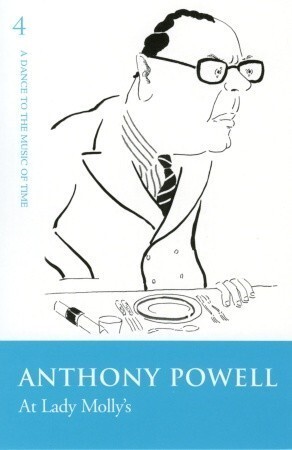
264 pages, Paperback
First published January 1, 1957

4 -- AT LADY MOLLY'S
Since we had been undergraduates together my friendship with Quiggin, moving up and down at different seasons, could have been plotted like a temperature chart. Sometimes we seemed on fairly good terms, sometimes on fairly bad terms; never with any very concrete reason for these improvements and deteriorations. However, if Quiggin thought it convenient to meet during a ‘bad’ period, he would always take steps to do so, having no false pride in this or any other aspect of his dealings with the world.In this instance, Quiggin indeed does have a reason for meeting with Jenkins, and invites him out to Quiggin’s cottage for a weekend.
I was unwilling to seem to condone too easily the appropriation of an old friend’s wife; although it had to be admitted that Templar [the old friend] himself had never been over-squeamish about accepting, within his own circle, such changes of partnership. Apart from such scruples, I knew enough of Quiggin to be sure that his cottage would be more than ordinarily uncomfortable. Nothing I had seen of Mona gave cause to reconsider this want of confidence in their combined domestic economy.
Would it be too explicit, too exaggerated, to say that when I set eyes on Isobel Tolland, I knew at once that I should marry her? Something like that is the truth, certainly nearer the truth than merely to record those vague, inchoate sentiments of interest of which I was so immediately conscious. It was as if I had known her for many years already; enjoyed happiness with her and suffered sadness. I was conscious of that, as of another life, nostalgically remembered. Then, at that moment, to be compelled to go through the paraphernalia of introduction, of ‘getting to know’ one another by means of the normal formalities of social life, seemed hardly worth while. We knew one another already, the future was determinate.
You know, Nicholas, it is wise to take good advice about such a thing as marriage. I hope you have done so yourself. I have thought about the subject a good deal, and you are always welcome to my views.
The guests seemed, in fact, to have been chosen even more at random than usual. Certainly there had been no question either of asking people because they were already friends of Isobel or myself; still less, because Molly wanted either of us specifically to meet them. All that was most nondescript in the Jeavons entourage predominated, together with a few exceptional and reckless examples of individual oddity. I noticed Alfred Tolland… was standing in the corner of the room, wedged behind a table, talking to – of all people – Mark Members, whom I had never before seen at the Jeavonses’, and might be supposed, in principle, beyond Molly’s normal perimeter, wide as that might stretch; or at least essentially alien to most of what it enclosed. To describe the two of them as standing looking at one another, rather than talking, would have been nearer the truth, as each apparently found equal difficulty in contributing anything to a mutual conversation. At the same time the table cut them off from contact with other guests.
Life jogs along, apparently in the same old way, and then suddenly your attention is drawn to some terrific change that has taken place.
So often one thinks that individuals and situations cannot be so extraordinary as they seem from outside: only to find that the truth is a thousand times odder.
“Women may show some discrimination about whom they sleep with, but they’ll marry anybody.”