It’s 1927 and Prohibition is in full effect in St. Louis, Missouri. Organized crime has risen to meet the relentless demand for illicit alcohol. Bootleggers, gangsters, and might-makes-right dominate the city’s underworld, fueled by the patrons of speakeasies — speakeasies like Lackadaisy.
Hidden under the unassuming Little Daisy Cafe and run by the widowed and strong-willed Mitzi May, Lackadaisy holds its own in a rough-and-ready world, where you're either holding the gun or taking the bullet. But will tenacity, class, and a little bit of crazy be enough to ensure the survival of Mitzi and her gang?
A keepsake collected edition of the cult classic, Eisner Award-nominated webcomic!
I went back and forth on what to rate this one and honestly, I just didn’t love it. The story didn’t capture me that much. Granted, the prohibition isn’t generally my thing. I’m more of a romance or science fiction girl myself. But,… and that’s a huge but!! I love the art!! I could not say enough about how beautiful these drawings are!! They could really carry a tale in themselves. Every single one was interesting to look at and were hard to look away from. Who knew cats could be so dang attractive!!!!
Anyway, my point is, the story was meh to me, but the art was phenomenal and make this a worthwhile read. In fact, if you’re into the prohibition era and those types of stories, then this is right up your alley!!!
Thanks so much to Edelweiss, 4th Dimension Entertainment, and Tracy J. Butler for the opportunity to read this for my honest and unbiased opinion!!
It's the Prohibition but with cats. Gangster cats. Police cats. Speakeasy proprietor cats. I hope you like cats.
The art is fantastic, but the story is a bit of a slog. There's a lot of comic crammed on each page, with a lot of dialogue, and all of it is coloured in a monochrome sepia, which somehow makes it harder to get through.
Set in the prohibition era, a woman named Mitzi May struggles alongside a cast of colour characters to continue running the Lackadaisy speakeasy after the untimely demise of her husband, Atlas.
Oh, and instead of humans evolving to be the 'top dogs' in this universe, the cast is made up entirely of Felis Silvestris catus - cats.
*~*~*~*~*~
I've been reading this comic for a few years now, and have to say it's seriously under-appreciated. Sure, it doesn't have the flashy superheroes, or nearly as many explosions of the 'mainstream' comics, but that doesn't mean it's not amazing all on it's own. The characters are entertaining, and even those villains, who should be utterly un-likeable or villainous are often charming in their own ways (not to mention adorable, because cats) with back-stories and personalities of their own.
Also, and I know I say this a lot, but the art in the authors`gallery? Is freaking A-MA-ZING. No, seriously. The comic art is awesome in and of itself, but the author`s work in general? Mitzi as a human, but Tracy J. Butler. Not to mention that despite the fantasy world, the author puts an insane amount of detail into the art. And the (period) costumes.
Only downside to the comic is... A) the story isn't very far along yet (despite having been worked on for years now. And b) the story isn't updated as often as I (and the other readers, I'm sure) would like. Sadly, both of these are unavoidable as the author isn't able to be a full-time artist, and is forced to have a paying job.
So, if a story about a group of fuzzy rum-runners and ne'er-do-wells set in the roaring 20s interests you, head over to the Lackadaisy and check it out!
Okay, I've been trying to write a review of this comic for weeks now, and I keep overthinking, rewriting and deleting things, so maybe it's better to just say the first thing that comes into my head.
A fascinating, multilayered story, rich historical detail, well-written dialogue, unforgettable, complex characters, and some of the most gorgeous and intricate artwork I've ever seen in a comic--there's not one thing I don't love about Lackadaisy. Of all the webcomics I've read, it's one of only three that I would buy in book form.
In St. Louis, Missouri, prohibition has started, which has made many businesses suffer great financial loss until an underground market for alcohol opens in the form of speakeasies. When the Little Daisy Cafe's proprietor, who also runs the Lackadaisy speakeasy, is killed, it's up to his wife to run the show. Will she be able to survive running an illegal operation? Will they be raided? Will her alcohol runner meet an unfortunate end?
Lackadaisy is, simply put, a feast for the eyes. The artwork is absolutely stunning, with amazing attention to detail and emotion. I liked the uniqueness of seeing cats used in place of the human characters. The story starts out a little slow, but then it gets better as it finds its footing. Even if you're not a fan of this medium, this book is definitely worth picking up for the artwork alone. I also loved the additional artwork and comics included at the end. This is one intended for older teens and adults. I'm looking forward to Volume 2 to see where the story goes.
My thanks to Letter Better Publishing, Iron Circus Comics, author/illustrator Tracy Butler, and NetGalley for gifting me a digital copy of this book. My opinions are my own.
amazing amazing amazing amazing, what else can I say?
GIVE. ME. MORE. EPISODESSSSSSSSSS!!!
rocky is hilarious freckle is such a cutie ivy is adorable mitzy is such a girl boss wick is such a simp viktor is such a looks like he could kill you, would actually kill you but is secretly also a cinnamon roll
review of the show is pretty much the same bro, and the voice acting is exceptional
Lush, gorgeous and expressive art! The only drawback is that such art takes Butler a very long time to complete, so updates are slow as molasses. But despite this, her story and characters vibrate with a life all their own. Yes, the characters are anthropomorphic cats, but don't let that fool you into thinking this is some kind of kiddie fare. Set in the Prohibition Era, Lackadaisy is equal parts fun and grim. Butler pulls no punches with capturing the violence of the Era. She also does her research: designs are historically accurate and intricately detailed.
The real draw for me are the characters. In only just-under-two volumes, Butler creates these real and fleshed-out cats. Every single one is compelling. Even her minor characters are interesting! You can really see the painstaking craftwork she puts into her characters.
Lackadaisy deserves to be popular solely for its art, layout, and attention to historical detail. With a few tweaks the comic could merit the word “brilliant,” but there are certain frustrating tendencies that hold it back (not to take credit away from the good aspects that are very good, and especially impressive for an indie creator).
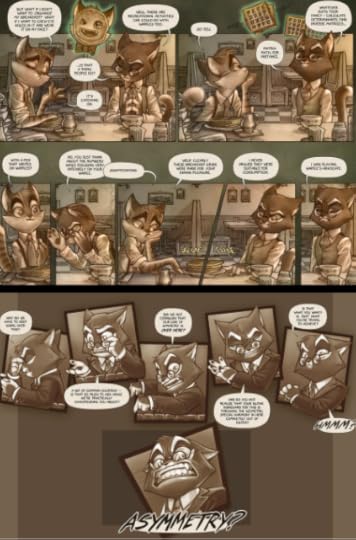
Calvin and Hobbes is an example of a comic that achieves a tone that Lackadaisy seems to strive for in its comedic scenes: characters taking stupid subjects (like waffles) to serious extremes, delivering lines straight without wavering and only descending into a "normal" tone again at the exact right moments for a punchline. Examples:
The rhythm of these strips is beautiful, starting (or ending) with a short simple piece of "normal" dialoague, then moving between philosophical language for stupid points and stupid language for philosophical points in a pattern. All while delivering each line totally straight.
Every line of dialogue is a reaction or natural result of the previous or directly relates to it. It has no redundancy. All the acting in Lackadaisy could benefit from this attitude. Expressions, lines of dialogue, and unnecessarily convoluted language often don’t stem from anything other than that they were fun to draw or write.
Here’s a strip from Lackadaisy that seems to be trying to achieve the same thing as the Calvin and Hobbes strips:
There's a fine line between the "nonsensically pretentious" dialogue potentially excused as equivalent nonsense yet which adds nothing to the flow of logic (even if it’s moon logic) and only interrupts it. It especially doesn't have a pattern when it dips into "meme-esque" language. ("Waffles is lies?" has a bit of a jarring Tumblr accent). Strips like this could benefit from having 50% of the lines deleted and tweaked, and I'd like to see the idea that "acting is reacting" taken more into account. (The expressions are all disjointed and unconnected. Maybe adding more "business" rather than relying on expressions would solve this, see Walt Disney's Letter to Animators).
If I edited this, I can already hear people saying:
"Why did you delete the part that _______? It clearly had a point. The joke was _________" or "it was relatable/funny/appealing because ______." or the classic "it expanded on his personality!"
Yes, everything has a self-contained point (or gag) but if a line or expression is self-serving it’s not useful to the scene as a whole. Anything that's not in harmony with the whole is only hurting a piece of art. No line is ever so brilliant it's worth sinking the whole ship. "But I like it" is never a good argument.
If someone likes something that Rocky did because they think it’s cute, this is only a superficial emotional attachment to a detail and not crucial to the logic of the story. Emotions and logic have the same roles in storytelling they do for anything, and you have to be aware which dictates the choices you're making. If you like something that needs to be deleted, the best thing would be to store it away and use it in another story where it fits.
Now that was just a bonus comic that was made for fun, so I understand if it doesn’t count.
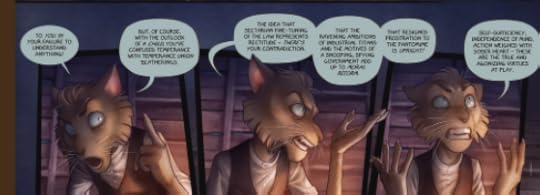
Here’s another example from the main story that could benefit from tighter writing:
Again, the writer is capable of cleverness and some profundity and has an impressive vocabulary, but redundancy weakens what simplicity could strengthen. The bubbles say each of these things as follows:
"But of course with the outlook of a child, you've confused Temperance with Temperance Union Blatherings."
"The idea that sectarian fine-tuning of the law represents rectitude - there's your contradiction."
"That the ravening ambitions of industrial titans and the motives of a snooping, spying government add to moral reform."
"That resigned prostration to the pantomime is upright!"
"Self-sufficiency, independence of mind, action weighed with sober heart - these are the true agonizing virtues at play."
All this to say, legality isn't morality.
The first sentence is the best, summing up the point in a unique way. The second sentence supports it, though "sectarian fine-tuning" and "rectitude" sound contrived. At the third sentence, I understand the rhythm she's going for, but the wording is unnecessarily convoluted. The fourth and fifth are unnecessary AND convoluted. If they were less convoluted, perhaps they could be manipulated to be necessary to maintain the desired rhythm.
Maybe something like:
"But of course with the outlook of a child, you've confused Temperance with Temperance Union Blatherings. The idea that legality equals morality - there's your contradiction. The idea that random regulations of a regime and secrets of a spying, snooping state are standards! Independence measured with a clear mind and action weighed with a sober heart - these are the true virtues at play."
I condensed the dialogue, and simplified some vocabulary as well as added alliteration and repetition for a more pleasing sound. I also tried to relate some parts of sentences with other parts, such as making "heart" and "mind" a purposeful parallel and adding a "measured" to go with the "weighed." Maybe she could keep "self-sufficiency," if it was referring to something in the story, but I didn't get that impression. Likewise, "agonizing" was an arbitrary adjective, which might have been anything.
Sometimes a difficult vocabulary is a stylistic choice to invoke a type of humor or voice. This would work well here, if done correctly. The best way to utilize a complicated vocabulary is to legitimately have a purpose to use complicated words. If you're being as simple as possible and the complicated words are demanded, well done. If not, it's bad writing. After all, it's not as if any of these words sound particularly nice together, if it was going for poetry. They're only saying the same thing differently and don't advance the point.
The writing in the comic flits between justified words and unjustified words, leaving me with the same sentiment as before: frustration. The problems are subtly mixed with real skill, which is why it's so hard to explain.
As a result, the theme (which I believe is "what's lawful isn't always what's right,") doesn't come across very deeply. Just because it's fun to have Rocky burn down a pig farm doesn't make it seem right. Just because it's fun to make a story about smuggling alcohol doesn't make it seem like it's right (I have no opinion whether it is, but the story didn't sway me one way or another). It's more focused on being about "cool characters in cool situations" then truly making a coherent or meaningful statement. And there's nothing wrong with that in itself, if only the story didn't seem to demand a certain more serious reception for some of these things. Overall, the comic needs to figure out what it's really trying to say and why (in the little and big things). One thing that could be a great help is if the story stuck to one perspective (Rocky's) or maybe two at a maximum. POV changes tend to be a result of a "just doing whatever is the most fun" attitude.
I repeat: the good parts are very good. I’m not trying to take away from the credit this comic deserves, but I think it has much more potential, and would love to see it go even farther.
Note: I can't recommend Ed Hook's "Acting for Animators" book enough, or at least his articles analyzing acting in popular animated films to have a better understanding of what I'm getting at and why. In particular, the article about How to Train Your Dragon 2 would be very relevant.
Well the visuals here are just wondrous – when they're not overly cluttered, and hidden by the verbal diarrhoea from the Joe Schmoe this book concentrates on. It's just, despite it looking like a labour of love and then some, I found nothing to engage with – not even the gorgeous boss-girl at the Little Daisy's subterranean speakeasy. I don't really take to stories of the Prohibition Era, the Jazz Age, call it what you will – and this one seemed visually crammed – stuffed on to the page and not allowed to breathe, a breath that it would appear Rocky is barely allowed to take at times, either. All that means some of us are glad the book is 70% comic and 30% extras – the gallery must put this creator top of many people's wish-lists to collab with.
My friend sent a link of this webcomic. When I saw how cute this comic was and cats are main characters... I started reading it immediately! I fell in love with this style of art and story. It took me deep into 1920s. USA... I forgot everything around and was reading one page after another. It was like awesome action movie. I really would like to see cartoon one day. This comic is worth television and big merchandise all over the world. I fell into my 4th fandom. I can call myself now big fan of these cats. Author has a true talent! Such professionality! So much cuteness! Now... how to get paper version to join my bookshelves.
Oh, this comic is a delight. I'd heard about it off and on throughout the years, but just never got around to picking it up (also, Unsoundedhas just always been The Webcomic For Me).
With all of the hype surrounding the crowdfunding for the show, I decided to finally give it a shot. I was immediately enamored. Also, I immediately imprinted on Rocky. He is my precious, batshit insane son whomst I would gladly die for.
Didn't think that prohibition era, anthropomorphic cats would be so compelling, and yet here we are.
The art is also absolutely stunning. The characters are so expressive, the backgrounds rendered in absolutely extraordinary detail (with heavy references for real places for the time period!! I appreciate historical fiction that has real research put into it), and the character designs themselves are all so varied. Each character's design takes their personality, background, and the like into consideration, making them all incredibly unique. Not something you would express with gangster, rumrunner cats.
Anyway, I didn't realize I had already finished Volume 1 and started Volume 2 (the site doesn't tell you where that break is apparently lmao), but I should get back to it. My son needs me.
Heard about this series yesterday and banged through (at least) the first two books online. Great art and dialogue. Good mix of humor and adventure. Surprisingly good history (1927 St, Louis) considering that all of the characters are anthropomorphic cats. If you're interested in the period, be sure to read the author's notes. 3.5 stars.
The long-running, sporadically-updated Lackadaisy is one of the most beautifully-illustrated comics, webcomic or traditionally-published, in the world. The story of the down-on-its-luck speakeasy Lackadaisy and its dwindling yet often bonkers staff in Prohibition-era St. Louis is meticulously-drawn; online readers get creator Butler's comments on each page, while readers of this book can check the end pages for notes, ranging from historical comments about why X gun was used or what X accent indicates, to things like "the car in this panel actually wasn't produced until the year after this particular comic is set but I like how it looked so it's here," which is the sort of historical nitpicking that comes off as fascinating and endearing.
The hundred-odd pages of this volume cover only about a single day (excluding the bonus mini-comics at the end), and reading it in physical form drove home the short timeline in a way that reading it online hadn't for me.
Speaking of physical form, this large hardcover edition is fantastic, giving plenty of space to let Butler's detailed art shine without reducing details or making text too small. It's very wide, which is why I was glad to get the hardcover edition; I could see a paperback being harder to balance (unless you're reading it supported by a book stand or something). The one negative is that the notes in the back, which would note what page they were talking about, were off. I assume this is a relic of using page numbers from a previous edition, but most of them were four pages early. (That means, for example, the first notes said they were about panels on "page 2," but the panels they were about were actually on page 6.)
It just so happens that two things I love most in this world are 1)history & 2)cats. If forced to choose, I would have to say that one of my favorite periods in American history is the Jazz/Prohibition Era of the 1920's, & I just love that it's been rediscovered in so many vivid ways by recent fiction writers. But seeing the speakeasies, jazz music, the flapper gowns & Art Noveau decor, the crime, & the "anything-goes" atmosphere of St. Louis during the Jazz Age in a world inhabited strictly by cats with moxie? That's just AWESOME. The characterization is every bit as fantastic as the outstanding graphic art. There are plots & sub-plots that need to be explored further & in depth, characters whose backstories could be endlessly fleshed out without getting old...I just need Tracy Butler to continue this for as long as she possibly can so I can just kind of live in this world. That'd just be the bee's knees, kittens.
I honestly loved this! The plot is just fine, but the characters and the drawings are so cool that I'm fully convinced on reading some more. And maybe watch the YouTube short film, which they've apparently released right now?? Good timing?? Anyway, I'll have to check out on the rest when I get the time.
graphic novel of Prohibition era, anthropomorphic cats involved with the titular speakeasy and its shady business. loved the crisp linework and distinctive characters (more disgruntled Nina and Viktor plz). though strictly sepia, the illustrations yet have depth through meticulous shading and contouring. full color spreads and bonus shorts following the main story are an ocular feast!
panel presentation and stylized, cartoony faces almost read like storyboards. for the most part, actions are depicted cleanly and i can practically fill in the blanks between transitioning facial expressions; no wonder this was recently translated to animation. at times dialogue-heavy, but the writing is sharp.
1920s Jazz Era Historical Fiction Comedy Adventure Comic about rival speakeasys during the American prohibition. Yes, they're cats. No it's not really a furry comic in that sense. It's a stylistic choice. You can find it at Lackadaisy.com or Webtoons, (I reccomend the former) or you can buy the physical copy on the website. Also check out the Youtube animated short film, soon to be a series.
This graphic novel is a visual and narrative feast that sets the stage for what promises to be a roaring good time. The standout feature of "Lackadaisy" lies in Butler's exceptional character art and illustrations. Each character is brought to life with meticulous detail, showcasing the author's talent in capturing expressions, personalities, and the essence of the roaring twenties. The visual richness adds layers to the storytelling, making the world of Lackadaisy immersive and utterly captivating.
Set against the backdrop of a speakeasy, the story unfolds with a troublesome cast of characters who remain fiercely loyal to the establishment, even as its heyday fades into memory. The dynamics and relationships between the characters are expertly portrayed, infusing the story with both humor and heart.
Volume #1 serves as a compelling introduction to the series, laying the foundation for a story that promises intrigue, mischief, and a touch of nostalgia.
Thank you to the publisher and NetGalley for an advanced copy of this book.
Super freaking cute! I am so glad that I picked this up after watching the Lackadaisy pilot on YouTube. 1920’s speakeasy’s and adorable cats, what could be better. I highly recommend this graphic novel😊
This series is so beautifully drawn. I love the 20's/prohibition era and cats, so this is right up my alley. The characters are drawn out wonderfully and the story is awesome. Do yourself a favor and read this.
I found out about this series by watching the pilot episode on YouTube. I can't get enough of these crazy rum running murder cats. I love the art, the story, the humor, and of course the characters.
Por el culo. Pero me alegro que algunas cosas vayan a cambiar aparentemente en la adaptación. El dibujo es increíble todos los furros dibujan bien o qué??
it was fine not amazing but it kept me entertained it's exactly what i expected for a short-ish comic obviously the best character is freckles "Calvin" idk i don't have reasons i just resonate with him
i also read this in one sitting so it can't be that bad
Nádhera. Určite tá najviac rozkošná vec akú som mala možnosť čítať.
Éra prohibície, zločin, 20. roky 20. storočia, Amerika. S príjemnou dávkou akcie a pocitu, že vážne cestujem v čase, s dialógmi, ktoré sú absolútne super a ja takmer počujem hlas a prízvuk každej postavy (a to sa mi nestáva zas tak často, že by mala každá postava svoj charakteristický tón hlasu). Nakreslené je to parádne - oblečenie, reálie, autá...aaah. Vážne. Autorka si musela dať dosť práce to všetko tak pekne pospájať, aby to vyzeralo presvedčivo. Je to nádherné. Občas som sa pristihla, ako študujem jeden obrázok aj 5 minúť taký je krásny.
Postavy sú veľmi, veľmi...reálne. Hej? Že máte ihneď pocit akoby ste ich poznali strašne dlho a sú neskutočne sympatickí a...a...(*whispers: mylittlebabies* uhm. Chápeme sa)
Btw. Hento je dokonalý materiál ak sa snažíte naučiť sa kresliť výrazy tváre postáv. Absolútne dokonalá paleta pocitov je každá z tvárí (najmä som si obľúbila Rockyho, títo šašovia ako on dokážu vykúzliť úžasné grimasy.) Je to neuveriteľne dynamické, až mám pocit, že sa skutočne každá z postáv začne hýbať a rozprávať a budem počuť hrať jazz. Bejby.
Btw. Všetky postavy sú mačky.
Čiže prakticky všetko, čo milujem - mačky, história, krásne šaty, akcia, dialógy a humor v tom je. Uh.
Sa divím iba...že som to čítala až teraz. (na tvorbu som prvýkrát narazila viac ako 6 rokov dozadu. Úplne ma uchvátila práve tá schopnosť zachytiť charakter postáv v ich výraze. Neskutočné a dych-vyrážajúce /+ veľa som sa vďaka tomu naučila/.)
Vtiahne vás to a nepustí.
MAČKY! ZBRANE. Mačky so zbraňami...čo sa môže pokaziť?
‘Lackadaisy Volume 1’ with story and art by Tracy J. Butler is a graphic novel that throws you into the heart of the roaring twenties.
It’s Prohibition but instead of people, it’s anthropomorphic cats. The setting is St. Louis and a charming speakeasy run by the equally charming Mitzi May are at or near the center of the story. Rival gangs threaten to cut off the livelihood of the business and it’s up to a motley crew to hold it all together.
The art is pretty spectacular, but the presentation and story made it just okay. Panels are laid out horizontal with seemingly equal size. The book is colored in a sepia tone that makes it a bit of a chore to read. And the story is fine, but nothing that great.
i've actually read BOTH Lackadaisy Volume #1 AND Volume #2. I read this on the web site. I couldn't stop reading. It was the best comic/ graphic novel i have ever read. the characters are hilarious and, since they're cats, adorable. After her husband dies, Mitzi May runs the Lackadaisy speakeasy in the 1920s during prohibition. Rocky, who works for Mitzi, got into some trouble with some pig farmers. He gets his cousin Freckles (Calvin) to help him deal with the farmers. Everything is a bit all over the place. It can go from some really funny stuff to all of a sudden someone nearly dies. This is a great book series for anyone who loves the 1920s and cats with guns.