

What do you think?

Mladi gospodin Džordži
Nagrada The Man Booker „Best of Beryl“.
Mladi hirurg i amaterski fotograf Džordž Hardi odlučuje u predvečerje rata 1854. godine da se kao lekar pridruži britanskoj vojsci i ukrcava se na brod za Krim. U njegovoj neobičnoj pratnji su i njegov zet, geolog i erudita dr Poter, kao i nezaobilazna Mirtl, devojka koju su njegovi roditelji nekada prihvatili kao siroče, a koja je tokom vremena postala nerazdvojni deo porodice. Dok se preko Carigrada i Varne zajedno sa vojskom približavaju krimskom ratištu, postepeno nam se otkrivaju tajne njihovih složenih odnosa, nepomirljive strasti, težnje i snovi koji ih istovremeno povezuju i razdvajaju. Na Krimu im se pridružuje zagonetni Pompej, nekadašnja ulična varalica, u ulozi pomoćnika ratnog fotografa. U potresnom romanu poznate engleske spisateljice Beril Bejnbridž rat će se sudbonosno umešati u živote likova, razbijajući njihovu veru u moć razuma i mogućnost upravljanja vlastitim životima.
„Svako poglavlje ispreda se oko neke fotografije, i svako zasebnim pripovedačkim glasom, što daje mogućnost spisateljici da ostvari posebnu vrstu uverljive romaneskne opsene. Mirtl nas upoznaje sa porodicom Hardi i obožavanim mladim gospodinom Džordžijem, a poglavlja koja slede upotpunjuju njenu priču i stvaraju prizmu nalik fotografskom sočivu kroz koje se roman postepeno osvetljava.“
– The Guardian
„Bejnbridžova stvara oporu sliku sveta u kojoj ljudskim odnosima vlada slučajnost, a čovekovo razumevanje za druge biva bitno narušeno i ograničeno sopstvenom ljudskom prirodom.“
– Kirkus Reviews
„Romani Beril Bejnbridž su kao elegantne šolje za čaj koje sadrže jak, taman, možda zastrašujući, ali izvanredan napitak. Uzori sažetosti, oni pokazuju koliko likova, zapleta, sporednih zapleta, psihologije, duhovitosti i dubine može da stane u tananu, varljivo krhku posudu.“
– The New York Times
Mladi hirurg i amaterski fotograf Džordž Hardi odlučuje u predvečerje rata 1854. godine da se kao lekar pridruži britanskoj vojsci i ukrcava se na brod za Krim. U njegovoj neobičnoj pratnji su i njegov zet, geolog i erudita dr Poter, kao i nezaobilazna Mirtl, devojka koju su njegovi roditelji nekada prihvatili kao siroče, a koja je tokom vremena postala nerazdvojni deo porodice. Dok se preko Carigrada i Varne zajedno sa vojskom približavaju krimskom ratištu, postepeno nam se otkrivaju tajne njihovih složenih odnosa, nepomirljive strasti, težnje i snovi koji ih istovremeno povezuju i razdvajaju. Na Krimu im se pridružuje zagonetni Pompej, nekadašnja ulična varalica, u ulozi pomoćnika ratnog fotografa. U potresnom romanu poznate engleske spisateljice Beril Bejnbridž rat će se sudbonosno umešati u živote likova, razbijajući njihovu veru u moć razuma i mogućnost upravljanja vlastitim životima.
„Svako poglavlje ispreda se oko neke fotografije, i svako zasebnim pripovedačkim glasom, što daje mogućnost spisateljici da ostvari posebnu vrstu uverljive romaneskne opsene. Mirtl nas upoznaje sa porodicom Hardi i obožavanim mladim gospodinom Džordžijem, a poglavlja koja slede upotpunjuju njenu priču i stvaraju prizmu nalik fotografskom sočivu kroz koje se roman postepeno osvetljava.“
– The Guardian
„Bejnbridžova stvara oporu sliku sveta u kojoj ljudskim odnosima vlada slučajnost, a čovekovo razumevanje za druge biva bitno narušeno i ograničeno sopstvenom ljudskom prirodom.“
– Kirkus Reviews
„Romani Beril Bejnbridž su kao elegantne šolje za čaj koje sadrže jak, taman, možda zastrašujući, ali izvanredan napitak. Uzori sažetosti, oni pokazuju koliko likova, zapleta, sporednih zapleta, psihologije, duhovitosti i dubine može da stane u tananu, varljivo krhku posudu.“
– The New York Times
196 pages, Paperback
First published March 1, 1998
About the author
Beryl Bainbridge
54 books196 followersDame Beryl Margaret Bainbridge DBE was an English writer from Liverpool. She was primarily known for her works of psychological fiction, often set among the English working classes. Bainbridge won the Whitbread Award twice and was nominated for the Booker Prize five times. In 2008, The Times newspaper named Bainbridge among their list of "The 50 greatest British writers since 1945".
Ratings & Reviews
Friends & Following
Create a free account to discover what your friends think of this book!
Community Reviews
Displaying 1 - 30 of 239 reviews

July 29, 2026
This is another novel I got from my Bloomsbury reading guides. This time I cannot say I am happy about it.
Beryl Bainbridge is one of those writers who I’ve heard of repeatedly, but I never read. She was shortlisted for the Booker Prize five times without ever winning, which I can see why, hehe.
About the plot, I will try to write something. The novel is set in Victorian Liverpool in 1846. George Hardy is an enigmatic surgeon and amateur photographer with secrets he keeps tightly to himself. Bound to him by varying degrees of devotion and dependency are Myrtle, a foundling adopted by his family who worships him uncritically(it beats me why); Pompey Jones, a street boy with sharp instincts and also an opportunist and Dr Potter, his unreliable brother-in-law. A misadventure in a brothel sets their fates intertwining, and the four of them end up following Georgie from the comfortable drawing rooms of Liverpool to the battlefields of the Crimean War.
The novel is structured as six brief chapters which are meant to be similar to photographic plates, which mirrors the amateur photography theme running through the book. And here is the problem. I came out of it mildly puzzled. There are things here that work. The Crimean War backdrop is presented with grim efficiency, the prose is sharp and good enough. However, I had a problem with the structure. I listened to this on audio, which I suspect made the structural fragmentation harder to navigate than it would have been on page. I'll be honest though, I don't think the format alone was the problem. The shifts between narrators are abrupt to the point of being disorienting, and I found myself repeatedly losing the thread of who was speaking and why I should care. My verdict was that I shouldn’t care. With some other fragmented novels this hasn't been an issue for me, something about the particular rhythm here made the transitions feel more like interruptions than sound stylistic choices.
The characters were the bigger problem. I didn't understand what drove any of them, and not in the interesting, ambiguous way. Myrtle's devotion borders on inexplicable. Dr Potter veers between roles without quite convincing you he's the same person. Georgie himself remains an unknown variable, which might have worked if I had any change to care about the guy, one way or another.
Three stars for the prose and the setting, the rest was meh
Beryl Bainbridge is one of those writers who I’ve heard of repeatedly, but I never read. She was shortlisted for the Booker Prize five times without ever winning, which I can see why, hehe.
About the plot, I will try to write something. The novel is set in Victorian Liverpool in 1846. George Hardy is an enigmatic surgeon and amateur photographer with secrets he keeps tightly to himself. Bound to him by varying degrees of devotion and dependency are Myrtle, a foundling adopted by his family who worships him uncritically(it beats me why); Pompey Jones, a street boy with sharp instincts and also an opportunist and Dr Potter, his unreliable brother-in-law. A misadventure in a brothel sets their fates intertwining, and the four of them end up following Georgie from the comfortable drawing rooms of Liverpool to the battlefields of the Crimean War.
The novel is structured as six brief chapters which are meant to be similar to photographic plates, which mirrors the amateur photography theme running through the book. And here is the problem. I came out of it mildly puzzled. There are things here that work. The Crimean War backdrop is presented with grim efficiency, the prose is sharp and good enough. However, I had a problem with the structure. I listened to this on audio, which I suspect made the structural fragmentation harder to navigate than it would have been on page. I'll be honest though, I don't think the format alone was the problem. The shifts between narrators are abrupt to the point of being disorienting, and I found myself repeatedly losing the thread of who was speaking and why I should care. My verdict was that I shouldn’t care. With some other fragmented novels this hasn't been an issue for me, something about the particular rhythm here made the transitions feel more like interruptions than sound stylistic choices.
The characters were the bigger problem. I didn't understand what drove any of them, and not in the interesting, ambiguous way. Myrtle's devotion borders on inexplicable. Dr Potter veers between roles without quite convincing you he's the same person. Georgie himself remains an unknown variable, which might have worked if I had any change to care about the guy, one way or another.
Three stars for the prose and the setting, the rest was meh

July 20, 2015
An interesting historical novel which won loads of prizes and accolades and is a brief and straightforward read. Bainbridge uses the medium of photography to hang the novel on; six photographic plates. The first two plates are set in Liverpool in 1846 and 1850 and the rest in 1854 in the Crimea.
The Master Georgie of the title is George Hardy, a surgeon and amateur photographer. His story is told alternately by three other characters. Myrtle is a foundling brought up by the Hardy’s after being found by George. The exact circumstances are unclear, but Myrtle idolises George. By 1854, when Myrtle is 20, they have a sexual relationship, despite George’s marriage. Dr Potter is married to George’s sister Beatrice and is a Geologist; he is verbose and a little pompous, but does notice things. The last narrator is Pompey Jones initially a street urchin who crosses George’s path a number of times and by 1854 he is a photographer’s assistant in the Crimea. He is straight out of Dickens, overcoming his humble beginnings.
George is a complex character who is attracted to women and men and has the associated Victorian guilt in large amounts. Both Pompey and Myrtle have been on the receiving end of his attentions. The different narrative voices don’t disrupt the flow and it is interesting to have the change of perspective on a regular basis.
There are some points made by the author. At the beginning of the novel it seems that fate and destiny are in some degree under the control of those with some power and privilege. By the end with the horror and carnage of the Crimean war it is clear events are completely random. The satirical aspect is also clear. Tennyson glorified aspects of the campaign, remember the poem The Charge of the Light Brigade; there is no glorification here as we see what surrounds the occupation of surgeon. There is also a caricature of the British abroad with wander around the Crimean peninsula as though it was a Sunday School outing, and, of course the sheer stupidity of war is there for all to see. There is also a blurring of memory. When George is drunk and makes a pass at Pompey Jones, early in the book, their later recollections are very different and Bainbridge makes the point that we all construct our own past history.
This is a deceptive novel which seems quite simple, but has a number twists and turns and it could easily be managed on a wet afternoon
The Master Georgie of the title is George Hardy, a surgeon and amateur photographer. His story is told alternately by three other characters. Myrtle is a foundling brought up by the Hardy’s after being found by George. The exact circumstances are unclear, but Myrtle idolises George. By 1854, when Myrtle is 20, they have a sexual relationship, despite George’s marriage. Dr Potter is married to George’s sister Beatrice and is a Geologist; he is verbose and a little pompous, but does notice things. The last narrator is Pompey Jones initially a street urchin who crosses George’s path a number of times and by 1854 he is a photographer’s assistant in the Crimea. He is straight out of Dickens, overcoming his humble beginnings.
George is a complex character who is attracted to women and men and has the associated Victorian guilt in large amounts. Both Pompey and Myrtle have been on the receiving end of his attentions. The different narrative voices don’t disrupt the flow and it is interesting to have the change of perspective on a regular basis.
There are some points made by the author. At the beginning of the novel it seems that fate and destiny are in some degree under the control of those with some power and privilege. By the end with the horror and carnage of the Crimean war it is clear events are completely random. The satirical aspect is also clear. Tennyson glorified aspects of the campaign, remember the poem The Charge of the Light Brigade; there is no glorification here as we see what surrounds the occupation of surgeon. There is also a caricature of the British abroad with wander around the Crimean peninsula as though it was a Sunday School outing, and, of course the sheer stupidity of war is there for all to see. There is also a blurring of memory. When George is drunk and makes a pass at Pompey Jones, early in the book, their later recollections are very different and Bainbridge makes the point that we all construct our own past history.
This is a deceptive novel which seems quite simple, but has a number twists and turns and it could easily be managed on a wet afternoon

November 3, 2020
Forgive me for confusing the Crimean and the Napoleonic Wars--it's all 1800-something, right? (smirks sardonically) This one takes place during the Crimean War--Russia was the enemy, not France. If you're thinking in Mike Leigh terms--this was literally a Mike Leigh movie on paper--Mr. Turner is nearer the mark in terms of time period than Peterloo. And now that the history lesson is over, what a gorgeous book! Truly the crowning achievement of a sometimes erratic carreer. For me every author has that one book I appreciate more than all the others, and for Beryl Bainbridge this one will be it. Structuring a story around a series of early photographs sounds almost like a literary cliché, but she pulls it off seamlessly. There's an EM Forster/JG Farrell/Bernard Cornwell feel to it, very different from her earlier work--as with Penelope Fitzgerald historical events became an inspiration once the her personal history had been mined to depletion. Suddenly the Bosphorus is no longer just a reference I came across in The English Patient once.

August 1, 2012
3 1/2? 3 3/4? Well ...
... see the end
yup, another book I'm getting rid of today ... short, but as a hardcover it's taking up over 1/2 inch of shelf space ... (added 4/26/15)
Suppose you teach creative writing, and you've given an assignment (call it a term paper) to write a novella. Your star pupil, Ms. Bainbridge, turns in something called Master Georgie (forget the "a novel", at maybe 50-55000 words, this is a novella, as assigned).
Okay, you read it, and enjoy it quite a bit. Also, you're pretty impressed with some of the inventive things this pupil has done. You give it something in the "A" range. Ms. Bainbridge shows a lot of promise.
For example: instead of chapters, she has called the six parts of the work "Plates", as in photographic plates. It's an historical novella, taking place in the period 1846-1854. Right, this is 20-30 years after the very earliest steps in the development of modern photography; not only that, but at least two of the main characters are actually interested and involved in this early photography (although not playing significant historical roles, by any means). But even more to the point, Ms. Bainbridge has written these segments very much in the manner of snapshots in time, capturing a brief piece of the story, which takes place over a period of as little as a day, to as much as a few weeks.
Three different people take these six photographs (telling the story of that segment in the first person, thus also appearing in the plate themselves, so that the plates are all, to some extent, self-portraits). Myrtle, a waif that has been adopted into Georgie's family when Georgie is a young man, and falls in love with him, takes the first and fourth plates. Dr. Potter, a hanger-on of the family's who eventually marries Georgie's sister, takes the third and fifth plates. And Pompey Jones, a destitute, but smart, lad of about Myrtle's age, who comes into contact with Georgie and Myrtle by happenstance (appearing over on the edge of the first plate) floats in and out of view, and takes the second and last plates.
And Georgie himself? Frankly, even though he's easily identified in each of the plates, he doesn't really seem to be the main person in the portrait. But in this he is illustrative of all the persona who appear in these plates. They are portrayed from various views, but always somewhat out of focus, always from a slightly odd angle, with an enigmatic expression on their face (if their face is even shown full-on); that is, neither Georgie nor any of the other persons shown are ever portrayed in a revealing close-up.
So in summary, I found this a fun book to read, but also one which left a very curious impression. It's like looking at old pictures of people you just barely know. You wonder about them, questions form, but nothing is really answered, and in the end you just close the album and forget about them. You don't really care.There really is no story here: how could one make a story out of six photographs?
Originally posted in summer of 2012 ... Certainly one of the earliest reviews I wrote about a book just finished.
Every so often someone runs across this review, and leaves some sort of evidence of their passing.
And when I look at the review again, I like it - mostly.
What has increasingly bothered me over time is that last question about a story from six photographs. It seems more and more a smart-Alec comment made by a reader who had not yet learned what he subsequently has, about let's call it post-modernist literature.
To make a potentially long comment short - of course a story can be made from six photographs, and this author has done a pretty good job of it. So I've raised my rating to 4 stars, and hope that puts me right with Ms. Bainbridge.
. . . . . . . . . . . . . . . . . . . .
Previous review: Light in August
Random review: The Crooked Timber of Humanity Isaiah Berlin
Next review: Attention All Shipping
Previous library review: To the Lighthouse
Next library review: Doctor Copernicus Banville
... see the end
yup, another book I'm getting rid of today ... short, but as a hardcover it's taking up over 1/2 inch of shelf space ... (added 4/26/15)
Suppose you teach creative writing, and you've given an assignment (call it a term paper) to write a novella. Your star pupil, Ms. Bainbridge, turns in something called Master Georgie (forget the "a novel", at maybe 50-55000 words, this is a novella, as assigned).
Okay, you read it, and enjoy it quite a bit. Also, you're pretty impressed with some of the inventive things this pupil has done. You give it something in the "A" range. Ms. Bainbridge shows a lot of promise.
For example: instead of chapters, she has called the six parts of the work "Plates", as in photographic plates. It's an historical novella, taking place in the period 1846-1854. Right, this is 20-30 years after the very earliest steps in the development of modern photography; not only that, but at least two of the main characters are actually interested and involved in this early photography (although not playing significant historical roles, by any means). But even more to the point, Ms. Bainbridge has written these segments very much in the manner of snapshots in time, capturing a brief piece of the story, which takes place over a period of as little as a day, to as much as a few weeks.
Three different people take these six photographs (telling the story of that segment in the first person, thus also appearing in the plate themselves, so that the plates are all, to some extent, self-portraits). Myrtle, a waif that has been adopted into Georgie's family when Georgie is a young man, and falls in love with him, takes the first and fourth plates. Dr. Potter, a hanger-on of the family's who eventually marries Georgie's sister, takes the third and fifth plates. And Pompey Jones, a destitute, but smart, lad of about Myrtle's age, who comes into contact with Georgie and Myrtle by happenstance (appearing over on the edge of the first plate) floats in and out of view, and takes the second and last plates.
And Georgie himself? Frankly, even though he's easily identified in each of the plates, he doesn't really seem to be the main person in the portrait. But in this he is illustrative of all the persona who appear in these plates. They are portrayed from various views, but always somewhat out of focus, always from a slightly odd angle, with an enigmatic expression on their face (if their face is even shown full-on); that is, neither Georgie nor any of the other persons shown are ever portrayed in a revealing close-up.
So in summary, I found this a fun book to read, but also one which left a very curious impression. It's like looking at old pictures of people you just barely know. You wonder about them, questions form, but nothing is really answered, and in the end you just close the album and forget about them. You don't really care.
Originally posted in summer of 2012 ... Certainly one of the earliest reviews I wrote about a book just finished.
Every so often someone runs across this review, and leaves some sort of evidence of their passing.
And when I look at the review again, I like it - mostly.
What has increasingly bothered me over time is that last question about a story from six photographs. It seems more and more a smart-Alec comment made by a reader who had not yet learned what he subsequently has, about let's call it post-modernist literature.
To make a potentially long comment short - of course a story can be made from six photographs, and this author has done a pretty good job of it. So I've raised my rating to 4 stars, and hope that puts me right with Ms. Bainbridge.
. . . . . . . . . . . . . . . . . . . .
Previous review: Light in August
Random review: The Crooked Timber of Humanity Isaiah Berlin
Next review: Attention All Shipping
Previous library review: To the Lighthouse
Next library review: Doctor Copernicus Banville

September 25, 2018
Another shortlisted novel from the perennial Booker bridesmaid, this one probably deserved better in 1998 than losing out to Ian McEwan's Amsterdam, which for me was one of the weaker winners.
This book is a fairly short novel with an unusual structure. It has six chapters, each of which bears the title and date of a photographic plate. These tell fragments of the story of George Hardy, a doctor and amateur photographer, told by three narrators each of whom get two chapters, and they all follow him from Liverpool to the Crimean war. The narrators are Myrtle, an adopted sister who has had two of George's children, the chancer, former fireeater and photographer Pompey Jones who is also George's lover, and the older Dr Potter, George's brother-in-law, a dull geologist.
The story offers some striking imagery and a wide variety of allusion, starts with plenty of comedy and later becomes visceral and unsentimental in its depictions of the chaos of war. A very impressive novel.
This book is a fairly short novel with an unusual structure. It has six chapters, each of which bears the title and date of a photographic plate. These tell fragments of the story of George Hardy, a doctor and amateur photographer, told by three narrators each of whom get two chapters, and they all follow him from Liverpool to the Crimean war. The narrators are Myrtle, an adopted sister who has had two of George's children, the chancer, former fireeater and photographer Pompey Jones who is also George's lover, and the older Dr Potter, George's brother-in-law, a dull geologist.
The story offers some striking imagery and a wide variety of allusion, starts with plenty of comedy and later becomes visceral and unsentimental in its depictions of the chaos of war. A very impressive novel.

December 16, 2018
“Perhaps chance and destiny are interdependent, in that the latter cannot be fulfilled without the casual intervention of the former. A craggy rock placed at a distance from the water will never be worn smooth”
This book is a special Booker Prize winner – winning the “Best Of Beryl” Prize in 2011 – where the public was asked to choose between the five shortlisted books of the “Booker Bridesmaid”.
A detailed plot guide can be found here:
http://www.bookrags.com/studyguide-ma...
Although a succinct introduction to the characters is contained in the following musings by the geologist Dr Potter, one of our three point of view narrators, when he muses on the events that have thrown the other two point of view characters – the foundling turned favourite turned lover and surrogate mother Myrtle, and the street performer turned photographer’s assistant turned lover Pompey Jones, in orbit around the eponymous surgeon and amateur photographer George Hardy.
“Myrtle is an interesting subject – in regard to the question as to whether fate or chance holds the upper hand. The ifs are numerous. If Beartrice had not shown an affection for her, would she not have vanished into the orphanage. What if Pompey Jones’s unfortunate arrangement of the tiger’s head had not ended Annie’s hope of motherhood? If old Mrs Hardy had woken that morning in a cheerful mood, would Myrtle have been required to follow George down to the town. Then there is the matter of his returning to Blackberty Lane by a different route than was usual. If the woman’s screams had echoed unheard in another street, what then”
And this passage also introduced one of the key themes of the book – as covered in my opening quote. This is a book which relies on extreme chance and co-incidence but not as a plot device but more as a way of examining the role of chance and coincidence when set alongside fate/destiny. Reading this work I could not help seeing it as a form of literary antecedent of the work of Kate Atkinson – whose early Jackson Brodie detective novels relied heavily (perhaps too heavily) on coincidence as an explicitly acknowledged plot device, but who then went on to examine this theme meta-fictionally in books like “Life After Life”.
I also wondered about the influence of this book on Sarah Perry’s “The Essex Serpent”: in the Victorian setting; the fascination with geology and the challenge of the work of Charles Lyell to previously religiously held conceptions and certainties; but also in the way in which all the characters seem drawn to another character, an attraction (including a sexual one from both sexes) that does not convey itself to the reader – with George hear being an even more distant figure than Cora.
Photography is another clear theme – the Crimean War was the first to be widely photographed and Bainbridge chooses to have three photographers in the book (George. Pompey and an unnamed war photographer) and to have the six chapters named after and written around six photographic plates (which are dated and described but not shown).
This idea captures the nature of the book – built effectively around six set pieces Interestingly whereas these chapters feature some seemingly memorable scenes – for example: the attempts to cover up the nature of Mr Hardy’s death; an operation to remove the cataracts of an ape; a dramatic fight in a theater based on a deceived sense of honour; fire eater at concert amidst squalor and disease; a man caught in a blast who ends with a missing ear but regained memory: some of these scenes actually fade from the memory, a little like the “regrettable tendency” of George’s photographs to fade to black after being taken. Instead what lingers in the memory more is our growing understanding of the complex dynamics between the characters and more importantly the themes of the book.
Bainbridge I think is also consciously exploring two related themes here via her photographic plate device:
Firstly photography as a medium for capturing reality and contrasting it both implicitly and explicitly with literature and its ability to capture thought and motivation as well as image:
“There’s something of black magic in the photographer’s art, in that he stops time ….. I don’t know that I think much of the camera. It appears to hold reality hostage and yet fails to snap thoughts in the head … The lens is powerless to catch the interior turmoil boiling within the skull”
And secondly and more widely, the idea of differing perceptions of history, and of myth.
As we switch between the three point of view characters we gradually become aware of differences in their interpretations of past events:
“I reckon memory is selective ….. I tried to get Potter to discuss what it meant when events were recollected differently. He said he wasn’t in the mood and had enough lapses of his own without fretting over other people’s”
As an example, late on Myrtle realises 8 years later that her first glance of Pompey, as an unknown “Duck-boy” carrying out an unheralded “Christian-act” was actually a failed street-scam.
Photography itself exposed the true horrors of war and shattered some of its mythical nature.
And we also have Dr Potter who increasingly in his horror at the reality of war turns literally to history and myth – taking refuge in allusions to classical history and literature, rather it has to be said to the disdain of our lower class narrators Myrtle and Pompey “his frequent quotations .. first spouted in a dead language and then laboriously translated, become wearisome” .
In the same way the concept of war – as celebrated in “nauseating displays of patriotic fervor” by politicians and generals in London and in those who are influenced by them in Istanbul, in Potter’s own words “those buffoons who, by reasons of solely of wealth and title, control both government and army” differs from the horrific reality experienced by working class soldiers, including at the end Pompey.
Overall this is an excellent book – a deserved winner of the “Best of Beryl” Booker albeit one which should have rendered that competition unnecessary by defeating “Amsterdam”.

August 6, 2017
Photos Out of Focus
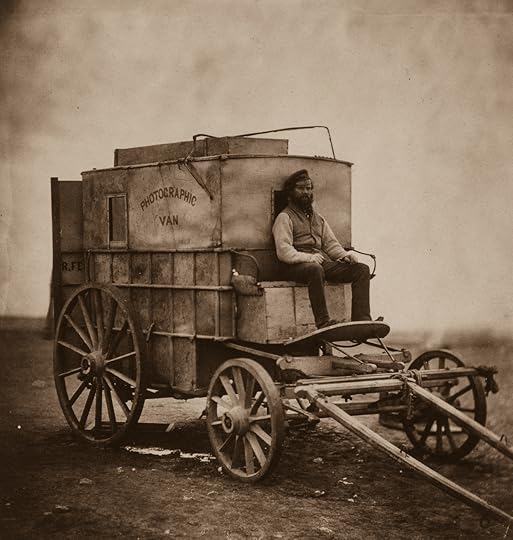
Roger Fenton's van in the Crimea
Instead of chapters, the late Dame Beryl Bainbridge's historical novel is divided into "Plates," with titles such as "Girl in the Presence of Death, 1846" and "Funeral Procession Shadowed by Beatrice, October 1854." Each of the six sections includes the taking of a posed photograph, either by or including one or more of the characters in the brief novel. As the last four sections take place during or in the run-up to the Crimean War, it is probable that Bainbridge was thinking of the pioneering war photographer Roger Fenton; one of the main characters in the book works as assistant to some famous photographer who is never named. He appears, however, to take the last group photograph, "Smile, Boys, Smile," dated November 1854. You can easily imagine it: a small group of weary soldiers, some seated, some standing, including a civilian and a young woman in military dress. Separately, the motifs occur everywhere in Fenton's photographs, though I cannot find any one example that combines them. All the same, the best explanation I can offer for this strange and rather disjointed novel is that Dame Beryl was starting from such an image (real and imagined) and working backwards to tell its story.
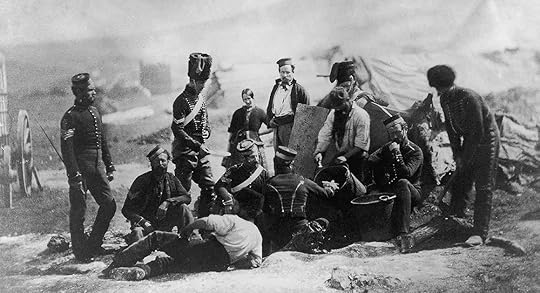
Soldiers in the Crimean War
Bainbridge's title is misleading. The young Liverpool surgeon George Hardy, known by his former housemaid and devoted admirer as "Master Georgie," is indeed the continuing thread linking all six sections, but he is not the most interesting figure in any of them. Instead, his story is told by three alternating narrators. One is Myrtle, the adopted foundling who, in a story rather like Jacqueline Winspear's Maisie Dobbs, is given an education and goes to the Crimea posing as George's sister. The second is Pompey Jones, a former street urchin and sideshow performer, who takes up photography and goes out as assistant to the great photographer. Both Myrtle and Pompey become, at one time or another, George's lovers. The third narrator is Dr. Potter, George's brother-in-law, a rather stuffy academic ("Myrtle showed no sign of interest, which was a pity because I had a host of relevant facts in my head") whose more conventional point of view nonetheless provides a welcome contrast to the picaresque quality of the other narrators.
Section by section, the brief vignettes offered by Bainbridge are vivid in themselves, but I fail to see how they form a coherent whole, unless to open a window on a time when, exceptionally, both social and gender roles could become remarkably fluid. But when I think how much more cogently Emma Donoghue handles a similar subject, in books like Slammerkin, Frog Music, or her short story collection Astray, I have to say that Bainbridge does not quite compare. And yet…
Roger Fenton's van in the Crimea
Instead of chapters, the late Dame Beryl Bainbridge's historical novel is divided into "Plates," with titles such as "Girl in the Presence of Death, 1846" and "Funeral Procession Shadowed by Beatrice, October 1854." Each of the six sections includes the taking of a posed photograph, either by or including one or more of the characters in the brief novel. As the last four sections take place during or in the run-up to the Crimean War, it is probable that Bainbridge was thinking of the pioneering war photographer Roger Fenton; one of the main characters in the book works as assistant to some famous photographer who is never named. He appears, however, to take the last group photograph, "Smile, Boys, Smile," dated November 1854. You can easily imagine it: a small group of weary soldiers, some seated, some standing, including a civilian and a young woman in military dress. Separately, the motifs occur everywhere in Fenton's photographs, though I cannot find any one example that combines them. All the same, the best explanation I can offer for this strange and rather disjointed novel is that Dame Beryl was starting from such an image (real and imagined) and working backwards to tell its story.
Soldiers in the Crimean War
Bainbridge's title is misleading. The young Liverpool surgeon George Hardy, known by his former housemaid and devoted admirer as "Master Georgie," is indeed the continuing thread linking all six sections, but he is not the most interesting figure in any of them. Instead, his story is told by three alternating narrators. One is Myrtle, the adopted foundling who, in a story rather like Jacqueline Winspear's Maisie Dobbs, is given an education and goes to the Crimea posing as George's sister. The second is Pompey Jones, a former street urchin and sideshow performer, who takes up photography and goes out as assistant to the great photographer. Both Myrtle and Pompey become, at one time or another, George's lovers. The third narrator is Dr. Potter, George's brother-in-law, a rather stuffy academic ("Myrtle showed no sign of interest, which was a pity because I had a host of relevant facts in my head") whose more conventional point of view nonetheless provides a welcome contrast to the picaresque quality of the other narrators.
Section by section, the brief vignettes offered by Bainbridge are vivid in themselves, but I fail to see how they form a coherent whole, unless to open a window on a time when, exceptionally, both social and gender roles could become remarkably fluid. But when I think how much more cogently Emma Donoghue handles a similar subject, in books like Slammerkin, Frog Music, or her short story collection Astray, I have to say that Bainbridge does not quite compare. And yet…
I engaged with a boy with a pimple at the corner of his mouth. He was clumsy with terror, flicking at me with his bayonet as though warding off bees. He shoulted something in a foreign tongue, and I said I was sorry but I didn't understand. I wanted to spare him, but he caught me a slash on my brow which got me cross and I jabbed him in the throat. He fell away, gurgling his reproach.Passages like the above (and they are legion) make me realize that my own title is misleading also. It is not that Bainbridge's individual images are blurred—they are replete with unexpected and precisely rendered detail—but that the exhibition that contains them lacks focus as a whole. I found this to be true also of her posthumous novel The Girl in the Polka Dot Dress, but I put that down to her inability to supervise the final version. However, I now gather that the vignette approach and almost willful refusal to labor a point are characteristic of her work at large. So read this for the detail, read it for its two magnificently self-inventing lower-class narrators, read it for the history—but know that any overall continuity will be up to you to infer.

August 3, 2012
Right - this is Beryl Bainbridge; it was shortlisted for the Booker Prize; it is obviously a brilliant work of literature as judged by the "Literaty". There is obviously a great deal of clever literary mechanisms being used here; therefore how dare I not give this the most possible amount of marks that Goodreads allows?
But is it a "good read" for the casual reader? No, I'm afraid it wasn't. I found the plot far too fragmented; it required great leaps of imagination - or diligent back checking - to even make half the connections that the book demanded we make. The characters were sketchy - again, far too much was left to the imagination - or were the characters simply, enigmatically, shallow or even translucent - and was there a clue in the last stanza trying to tell us that we're all just shadows on each others' individual lives? So why write a book (or a novella/ series of connected short stories) which gives us the charcoal outline of a novel - but doesn't even give us the numbers with which to colour any page in, let alone the coloured crayons to do so?
I'm sure that this is an excellent book to study academically - it ticks the boxes on so many literary mechanisms, and on reading it a fourth or fifth time, some of the plot will actually begin to make some sense, and maybe one or two of the characters might appear to have some sort of substantive effect on the way we perceive the world. But I don't read, in general, as an academic exercise; I read to be entertained, educated and to be challenged; I'm afraid this book did none of these things to me, therefore to pretend it did would be disingenuous of me. For the casual reader like me, this was just pretentious twaddle, I'm afraid.
But is it a "good read" for the casual reader? No, I'm afraid it wasn't. I found the plot far too fragmented; it required great leaps of imagination - or diligent back checking - to even make half the connections that the book demanded we make. The characters were sketchy - again, far too much was left to the imagination - or were the characters simply, enigmatically, shallow or even translucent - and was there a clue in the last stanza trying to tell us that we're all just shadows on each others' individual lives? So why write a book (or a novella/ series of connected short stories) which gives us the charcoal outline of a novel - but doesn't even give us the numbers with which to colour any page in, let alone the coloured crayons to do so?
I'm sure that this is an excellent book to study academically - it ticks the boxes on so many literary mechanisms, and on reading it a fourth or fifth time, some of the plot will actually begin to make some sense, and maybe one or two of the characters might appear to have some sort of substantive effect on the way we perceive the world. But I don't read, in general, as an academic exercise; I read to be entertained, educated and to be challenged; I'm afraid this book did none of these things to me, therefore to pretend it did would be disingenuous of me. For the casual reader like me, this was just pretentious twaddle, I'm afraid.

October 28, 2025
Master Georgie by Beryl Bainbridge
10 out of 10
Paradoxically, this stupendous novel has been thoroughly enjoyed by the under signed with a mixture of exquisite delight and…what is the correct word, perhaps repentance combined with embarrassment, given that I had the chance to realize what a great writer Beryl Bainbridge is on more than one occasion and furthermore, her comedy, The Bottle Factory Outing - http://realini.blogspot.com/2014/03/t... - had been engaged with twice and later on, According to Queeney has been abandoned after going through only a few – admittedly quite grim, dealing with an autopsy, the liver, the kidneys and more of the corpse –pages, though this was a terrible mistake that is being redressed now that I have started reading the latter again and should boast here ridiculously that I have reached page 47 and it is also a great read and a complex novel.
The aforementioned two books and Master Georgie are included on The Guardian’s 1,000 Novels Everyone Must Read list - https://www.theguardian.com/books/200... - though they belong to different sections, the first two are comedies and the latter is included in the War and Travel section and characterized as a ‘history novel’ elsewhere, given that towards the end, maybe we should say in the second part, the main characters travel East, to reach Constantinople first and then embark on a tiresome, frenetic, torturing, exhausting and deadly endeavor to join the British and French forces as they land in the Crimea – now annexed by their enemy, or ‘reintegrated to the motherland’ as the Putin propaganda would have it – to fight the Russians in what is a horrible campaign…its gruesomeness, abjection is well formidable described by the author, though for some time, this reader was wondering how is this a ‘War Story’…
As we read the first few lines, we are overwhelmed by the forceful introduction – similar in a way to the entrance into the According to Queeney narrative – as one of the main characters, twelve years old at the time Myrtle, has her hand on the shoulder of the dead Mr. Hardy, a man who had abused her we would learn, showing her ‘something stiff as a carrot between hid fingers’, but also the one who has been kind to her, a girl that had been found nine years before this morbid scene, abandoned on a street and then somehow integrated into the family, where she falls in love with ‘Master Georgie’, the son who has just needed the help of Myrtle and that of the ‘duck boy’, Pompey Jones, to extract the corpse of his father from the embarrassing circumstances where he had collapsed, dead in the home of a poor woman…
It is rather difficult to assess if Myrtle is fortunate to have been brought to a household where she often experiences happiness and bliss, often just following the man she loves, staying in his shadow, watching over him, enduring his sulkiness, brusqueness and most often rudeness and asperities, throughout all the time that they can have together – which is very limited, because the man is bisexual and quite disinterested in the girl, except for rare moments that do provide ecstasy for someone who is so Stoic and exuberant for so little, devoted in the extreme, she would travel with him to live in the most barbaric, trying conditions, to fight the war, face squalor, disease, cholera, insects and so much more with Supreme Serenity…
Doctor Potter is the third personage that would relate the narrative from his angle – the other three story tellers are Myrtle and the ‘duck boy’ – called thus because he is the one who brings back an animal that had been kept in a basket, the poor creature was tied to it and its beak was also muzzled (!), after it had been stolen by another, provoking the admiration of the girl who witnessed the incident, though he would later tell her this was just a ploy designed by the two partners in crime to extract money from the grateful owner, once the duck is returned, or some other generous being that was impressed by the scene.
Pompey Jones aka the ‘duck boy’ is the one who has to drive a van, finding some horse to attach to it, and then he helps Master Georgie to recuperate the body of the father, restoring him to a horizontal potion before rigor mortis would have set in, given that he was caught bending by the ‘cessation of the heart’, then they place him in the vehicle, where Myrtle has to join and travel in darkness with a corpse on which she has to put her legs to prevent it from jumping to all corners, as they pass over boulders and rocks on the road…once at home, she is sent as an advance party, to observe if the path is clear for the others to put the cadaver in and pretend that the man has died in a ‘normal place’…
The next chapter is narrated by Pompey Jones, as he travels to meet with George Hardy, meeting at five a.m. at his house, where the boy likes to play tricks – he has switched the paintings inside, to confuse the inhabitants and indeed, Doctor Potter, now married to Beatrice, Master Georgie’s sister, would spend two sleepless nights to try to find the culprit…this time, the mischievous visitor has another plan and he moves the tiger rug –supposedly a poor animal shot by an ancestor, but actually bought cheaply at the market – from its original place and he puts it in a spot from where it can be seen, the threatening head mainly, as someone enters the room, early in the morning, when there is little light and the surprise bigger…
Alas, Annie, now the wife of George Hardy, has had already lost unborn babies and the shock of seeing the tiger head is so big that she has another, final miscarriage, which is pondered by Doctor Potter in his effort to establish the balance between fate and luck or fortune, in the case of Myrtle, who now has the chance to get closer, create a bond – Pompey thinks she sees the children as just a sort of rope that connects her better with the man she worships – with the now hopeless would be father, given that his spouse cannot have any children, they agree to have Myrtle give birth, as she travels to another town, with understanding, compassionate Anne, in what looks like a very harmonious ménage a trois…
However, given that Master Georgie is bisexual, his sexual activities would not be reduced to the two women who are legitimate wife and biological mother of his children – those would belong to Anne, for legal and public purposes – for he is also at times intimate with Pompey Jones – they find them together at Varna, as they approach the frontline in Crimea – and most likely with his friend, William Rimmer, who has collaborated with him on a cataract operation, performed on a poor ape, that the ‘duck boy’ has assisted in anesthetizing with clorophorm…
10 out of 10
Paradoxically, this stupendous novel has been thoroughly enjoyed by the under signed with a mixture of exquisite delight and…what is the correct word, perhaps repentance combined with embarrassment, given that I had the chance to realize what a great writer Beryl Bainbridge is on more than one occasion and furthermore, her comedy, The Bottle Factory Outing - http://realini.blogspot.com/2014/03/t... - had been engaged with twice and later on, According to Queeney has been abandoned after going through only a few – admittedly quite grim, dealing with an autopsy, the liver, the kidneys and more of the corpse –pages, though this was a terrible mistake that is being redressed now that I have started reading the latter again and should boast here ridiculously that I have reached page 47 and it is also a great read and a complex novel.
The aforementioned two books and Master Georgie are included on The Guardian’s 1,000 Novels Everyone Must Read list - https://www.theguardian.com/books/200... - though they belong to different sections, the first two are comedies and the latter is included in the War and Travel section and characterized as a ‘history novel’ elsewhere, given that towards the end, maybe we should say in the second part, the main characters travel East, to reach Constantinople first and then embark on a tiresome, frenetic, torturing, exhausting and deadly endeavor to join the British and French forces as they land in the Crimea – now annexed by their enemy, or ‘reintegrated to the motherland’ as the Putin propaganda would have it – to fight the Russians in what is a horrible campaign…its gruesomeness, abjection is well formidable described by the author, though for some time, this reader was wondering how is this a ‘War Story’…
As we read the first few lines, we are overwhelmed by the forceful introduction – similar in a way to the entrance into the According to Queeney narrative – as one of the main characters, twelve years old at the time Myrtle, has her hand on the shoulder of the dead Mr. Hardy, a man who had abused her we would learn, showing her ‘something stiff as a carrot between hid fingers’, but also the one who has been kind to her, a girl that had been found nine years before this morbid scene, abandoned on a street and then somehow integrated into the family, where she falls in love with ‘Master Georgie’, the son who has just needed the help of Myrtle and that of the ‘duck boy’, Pompey Jones, to extract the corpse of his father from the embarrassing circumstances where he had collapsed, dead in the home of a poor woman…
It is rather difficult to assess if Myrtle is fortunate to have been brought to a household where she often experiences happiness and bliss, often just following the man she loves, staying in his shadow, watching over him, enduring his sulkiness, brusqueness and most often rudeness and asperities, throughout all the time that they can have together – which is very limited, because the man is bisexual and quite disinterested in the girl, except for rare moments that do provide ecstasy for someone who is so Stoic and exuberant for so little, devoted in the extreme, she would travel with him to live in the most barbaric, trying conditions, to fight the war, face squalor, disease, cholera, insects and so much more with Supreme Serenity…
Doctor Potter is the third personage that would relate the narrative from his angle – the other three story tellers are Myrtle and the ‘duck boy’ – called thus because he is the one who brings back an animal that had been kept in a basket, the poor creature was tied to it and its beak was also muzzled (!), after it had been stolen by another, provoking the admiration of the girl who witnessed the incident, though he would later tell her this was just a ploy designed by the two partners in crime to extract money from the grateful owner, once the duck is returned, or some other generous being that was impressed by the scene.
Pompey Jones aka the ‘duck boy’ is the one who has to drive a van, finding some horse to attach to it, and then he helps Master Georgie to recuperate the body of the father, restoring him to a horizontal potion before rigor mortis would have set in, given that he was caught bending by the ‘cessation of the heart’, then they place him in the vehicle, where Myrtle has to join and travel in darkness with a corpse on which she has to put her legs to prevent it from jumping to all corners, as they pass over boulders and rocks on the road…once at home, she is sent as an advance party, to observe if the path is clear for the others to put the cadaver in and pretend that the man has died in a ‘normal place’…
The next chapter is narrated by Pompey Jones, as he travels to meet with George Hardy, meeting at five a.m. at his house, where the boy likes to play tricks – he has switched the paintings inside, to confuse the inhabitants and indeed, Doctor Potter, now married to Beatrice, Master Georgie’s sister, would spend two sleepless nights to try to find the culprit…this time, the mischievous visitor has another plan and he moves the tiger rug –supposedly a poor animal shot by an ancestor, but actually bought cheaply at the market – from its original place and he puts it in a spot from where it can be seen, the threatening head mainly, as someone enters the room, early in the morning, when there is little light and the surprise bigger…
Alas, Annie, now the wife of George Hardy, has had already lost unborn babies and the shock of seeing the tiger head is so big that she has another, final miscarriage, which is pondered by Doctor Potter in his effort to establish the balance between fate and luck or fortune, in the case of Myrtle, who now has the chance to get closer, create a bond – Pompey thinks she sees the children as just a sort of rope that connects her better with the man she worships – with the now hopeless would be father, given that his spouse cannot have any children, they agree to have Myrtle give birth, as she travels to another town, with understanding, compassionate Anne, in what looks like a very harmonious ménage a trois…
However, given that Master Georgie is bisexual, his sexual activities would not be reduced to the two women who are legitimate wife and biological mother of his children – those would belong to Anne, for legal and public purposes – for he is also at times intimate with Pompey Jones – they find them together at Varna, as they approach the frontline in Crimea – and most likely with his friend, William Rimmer, who has collaborated with him on a cataract operation, performed on a poor ape, that the ‘duck boy’ has assisted in anesthetizing with clorophorm…

June 13, 2010
Read: July 2010
Master Georgie in one tweet-sized chunk:
Short and apparently simple, Master Georgie is an enjoyable snapshot of lives and the Crimean War.
It is a rare delight to encounter a book of such apparent simplicity as Master Georgie. The narration – split between three voices – is compelling and smooth, the prose wonderfully uncluttered. It is overloaded neither with explicit themes or complicated ideas. There is no sense of a writer trying to be clever. Master Georgie is storytelling of the finest order.
And yet I use the phrase ‘apparent simplicity’ advisedly, for the simplicity of style masks a cunningly composed narrative which questions how one can ever know something simply by looking at it. In Master Georgie, Beryl Bainbridge confronts the reader with an oddly compelling statement: you cannot know these characters.
When war breaks out in the Crimea George Hardy, surgeon and photographer, sets off to provide whatever services he can offer in support of the British effort. With him travel his adoptive sister Myrtle, amateur geologist Dr Potter and photographer’s assistant and fire-eater Pompey Jones. The narration is split between them, starting in the cold back streets of 19th century Liverpool, travelling through sweltering Constantinople and on to the battlefields of the Crimea. As each seeks to shed light on Master Georgie (as Myrtle terms him) a picture begins to develop of everyone but him. He remains the dark spot on the plate.
The Crimean War was the first to be extensively documented by photography and one gets the impression that Bainbridge spent a great deal of time searching for inspiration for her characters by looking at these pictures, only to come up with more questions than answers. That is how the book reads: a snapshot of a long dead, anonymous person who can never be resurrected, not even through literature. Master Georgie is all about what lurks beneath the surface of a photograph: the context, facets of themselves people choose to hide from the world, the misinterpretations that people ascribe to surface images. At one point a fellow character enquires as to why Myrtle often looks sad. “It’s the way I am on the outside”, she replies. “Inside, I assure you I’m quite happy.” This seems to sum up Master Georgie nicely.
There is an element of satire here, too. There are two targets for this: specifically the bombast of Tennyson’s ‘Charge of the Light Brigade’ and generally those who gallantly march off at the first hint of war assuming victory. It reminded me very much of The Siege of Krishnapur by J.G. Farrell with its portrayal of out of place Britishness, a pompous sense of worth that is never fully punctured, even while confronted by death, disease and defeat. There are some absurdly funny moments. The wealthy British bring trunk -loads of possessions and are accompanied as far as the Constantinople by their spouses and children as though for a bit of a summer jaunt. There is a funny scene when, having arrived in Constantinople, they go to the opera only for it to descend into a brawl over a perceived indiscretion towards Myrtle.
The satire is not biting though, and surrounding it is a tender portrayal of life, war and the consequences of our actions. Like the best war books, one comes away feeling that it was all so bloody pointless.
Yet none of this is to say that Master Georgie is an easy book. It is slippery, never quite giving the reader what one wants or expects. The drama is quiet, unassuming. Some of the supposedly dramatic aspects – particularly the shared and mysterious guilt the synopsis promises – didn’t really resonate with me at all. The prime feeling I came away with was puzzlement: I knew I had enjoyed the prose and the journey without really engaging with any of the characters; without being able to identify why. Others I know have reacted to it with utter indifference. Yet the fact remains that I enjoyed reading it, and it continues to challenge and interest me a month later. This was my first Beryl Bainbridge novel but I’m certainly going to read more by her in the coming months.
7 out of 10
Master Georgie in one tweet-sized chunk:
Short and apparently simple, Master Georgie is an enjoyable snapshot of lives and the Crimean War.
It is a rare delight to encounter a book of such apparent simplicity as Master Georgie. The narration – split between three voices – is compelling and smooth, the prose wonderfully uncluttered. It is overloaded neither with explicit themes or complicated ideas. There is no sense of a writer trying to be clever. Master Georgie is storytelling of the finest order.
And yet I use the phrase ‘apparent simplicity’ advisedly, for the simplicity of style masks a cunningly composed narrative which questions how one can ever know something simply by looking at it. In Master Georgie, Beryl Bainbridge confronts the reader with an oddly compelling statement: you cannot know these characters.
When war breaks out in the Crimea George Hardy, surgeon and photographer, sets off to provide whatever services he can offer in support of the British effort. With him travel his adoptive sister Myrtle, amateur geologist Dr Potter and photographer’s assistant and fire-eater Pompey Jones. The narration is split between them, starting in the cold back streets of 19th century Liverpool, travelling through sweltering Constantinople and on to the battlefields of the Crimea. As each seeks to shed light on Master Georgie (as Myrtle terms him) a picture begins to develop of everyone but him. He remains the dark spot on the plate.
The Crimean War was the first to be extensively documented by photography and one gets the impression that Bainbridge spent a great deal of time searching for inspiration for her characters by looking at these pictures, only to come up with more questions than answers. That is how the book reads: a snapshot of a long dead, anonymous person who can never be resurrected, not even through literature. Master Georgie is all about what lurks beneath the surface of a photograph: the context, facets of themselves people choose to hide from the world, the misinterpretations that people ascribe to surface images. At one point a fellow character enquires as to why Myrtle often looks sad. “It’s the way I am on the outside”, she replies. “Inside, I assure you I’m quite happy.” This seems to sum up Master Georgie nicely.
There is an element of satire here, too. There are two targets for this: specifically the bombast of Tennyson’s ‘Charge of the Light Brigade’ and generally those who gallantly march off at the first hint of war assuming victory. It reminded me very much of The Siege of Krishnapur by J.G. Farrell with its portrayal of out of place Britishness, a pompous sense of worth that is never fully punctured, even while confronted by death, disease and defeat. There are some absurdly funny moments. The wealthy British bring trunk -loads of possessions and are accompanied as far as the Constantinople by their spouses and children as though for a bit of a summer jaunt. There is a funny scene when, having arrived in Constantinople, they go to the opera only for it to descend into a brawl over a perceived indiscretion towards Myrtle.
The satire is not biting though, and surrounding it is a tender portrayal of life, war and the consequences of our actions. Like the best war books, one comes away feeling that it was all so bloody pointless.
Yet none of this is to say that Master Georgie is an easy book. It is slippery, never quite giving the reader what one wants or expects. The drama is quiet, unassuming. Some of the supposedly dramatic aspects – particularly the shared and mysterious guilt the synopsis promises – didn’t really resonate with me at all. The prime feeling I came away with was puzzlement: I knew I had enjoyed the prose and the journey without really engaging with any of the characters; without being able to identify why. Others I know have reacted to it with utter indifference. Yet the fact remains that I enjoyed reading it, and it continues to challenge and interest me a month later. This was my first Beryl Bainbridge novel but I’m certainly going to read more by her in the coming months.
7 out of 10

March 13, 2017
George Hardy, rather Master George is an obsessed medical practitioner, a surgeon and an ardent photographer too. Shortly after his father’s untimely death, the whereabouts of which are to be kept a secret from the other members of his family, a choleric proliferation and the waging war against Russia sets Master George on a journey to offer his services to his countrymen, to the sufferers of war. Could he have possibly known that he was to turn into one, a sufferer and likewise, the ones around him?
Myrtle is an orphaned girl, taken into the Hardy family, raised to be a lady, to all - George’s adoptive sister, but that’s possibly an introduction for the world. For her, she’d rather be Georgie’s skin, which can be cut, wounded, torn, sutured, and repaired but remains till the very end, before it withers, fades. So, convoyed by Myrtle the infatuated, Dr.Potter the geologist brother-in-law, a caravan of relatives and of course Pompey Jones, the assistant, George walks into the labyrinthine decay of the war.
Beryl Bainbridge fascinates us with the numbness of war; the dead are luckier than the unfortunate living. Every brush stroke only deepens and darkens the colour, a singular one, of red, a bloody one at that, the only miscellany presented in its shades. And as one inebriates in the gory visuals, the putrid miasma of decay suffocates you but there is nothing to cover your nose, your eyes with, not even your willingness.
a gun is meant to kill and so it will!
a soldier is meant to, made to kill and so he will!
a war is meant to destroy, burn, annihilate and so it does!
No dissuasion can keep a moth from the light; no enticing would keep Master George away from the war. Cut, cut, cut, tear, tear, tear, sawing limbs is the norm of the day; stripping a dead body of its soiled clothes to adorn a living is no dread. Nonchalance isn’t an option. Like Dr. Potter who’s losing it with all the delusions and hallucinations, one would agree that to be insensitive to the calamities of war is the only sensible thing to do; how would one breathe otherwise? To be insane is the only way to be sane.
In this decadence, in this coldness, the author manages to light up emotions and allure the reader with their dancing shadows. There aren’t any secret lives, or any secret emotions, almost everything is blatantly real, only trampled on by the squalor of war. Pompey Jones likes Myrtle, he believes the attraction more to come from the nasty cavern of poverty and squalor that they once belonged to. Myrtle is hopeless when it’s about George but he, the curer, is only a curer of the surface, the body; the soul isn’t a surgeon’s lookout. Can love possibly surface in such abominable conditions? Is it still important to know if you’re loved when a cover from the next bullet or the next chance for a meal are the only things you should really care for?
"I stood , resentment wriggling like a worm within my breast. It had been my conceit that it was enough to give love, that to receive it would have altered the nature of my obsession. When passion is mutual, there is always the danger of the fire burning to ashes. Rather than lose love it was better to not have known it." - Myrtle
Bainbridge’s eloquent portrayal scratches beyond the surface and delves deep; the emotions infused in the characters are real and hence felt. Whether you shed a tear for the dead or not, the eyes will be in vain for the living, the living dead. The book and its gory descriptions reminded me of the movie ‘The Pianist’. I’ve read Beryl Bainbridge before, ‘Every man for himself’ but this one has struck a chord, an effective one!
Myrtle is an orphaned girl, taken into the Hardy family, raised to be a lady, to all - George’s adoptive sister, but that’s possibly an introduction for the world. For her, she’d rather be Georgie’s skin, which can be cut, wounded, torn, sutured, and repaired but remains till the very end, before it withers, fades. So, convoyed by Myrtle the infatuated, Dr.Potter the geologist brother-in-law, a caravan of relatives and of course Pompey Jones, the assistant, George walks into the labyrinthine decay of the war.
Beryl Bainbridge fascinates us with the numbness of war; the dead are luckier than the unfortunate living. Every brush stroke only deepens and darkens the colour, a singular one, of red, a bloody one at that, the only miscellany presented in its shades. And as one inebriates in the gory visuals, the putrid miasma of decay suffocates you but there is nothing to cover your nose, your eyes with, not even your willingness.
a gun is meant to kill and so it will!
a soldier is meant to, made to kill and so he will!
a war is meant to destroy, burn, annihilate and so it does!
No dissuasion can keep a moth from the light; no enticing would keep Master George away from the war. Cut, cut, cut, tear, tear, tear, sawing limbs is the norm of the day; stripping a dead body of its soiled clothes to adorn a living is no dread. Nonchalance isn’t an option. Like Dr. Potter who’s losing it with all the delusions and hallucinations, one would agree that to be insensitive to the calamities of war is the only sensible thing to do; how would one breathe otherwise? To be insane is the only way to be sane.
In this decadence, in this coldness, the author manages to light up emotions and allure the reader with their dancing shadows. There aren’t any secret lives, or any secret emotions, almost everything is blatantly real, only trampled on by the squalor of war. Pompey Jones likes Myrtle, he believes the attraction more to come from the nasty cavern of poverty and squalor that they once belonged to. Myrtle is hopeless when it’s about George but he, the curer, is only a curer of the surface, the body; the soul isn’t a surgeon’s lookout. Can love possibly surface in such abominable conditions? Is it still important to know if you’re loved when a cover from the next bullet or the next chance for a meal are the only things you should really care for?
"I stood , resentment wriggling like a worm within my breast. It had been my conceit that it was enough to give love, that to receive it would have altered the nature of my obsession. When passion is mutual, there is always the danger of the fire burning to ashes. Rather than lose love it was better to not have known it." - Myrtle
Bainbridge’s eloquent portrayal scratches beyond the surface and delves deep; the emotions infused in the characters are real and hence felt. Whether you shed a tear for the dead or not, the eyes will be in vain for the living, the living dead. The book and its gory descriptions reminded me of the movie ‘The Pianist’. I’ve read Beryl Bainbridge before, ‘Every man for himself’ but this one has struck a chord, an effective one!

August 18, 2021
A jewel of a book, taking us from the cheek by jowl squalor and riches of 1840s Liverpool, to the Hieronymous Bosch style horrors of the 1850s Crimean war.
The titular Master Georgie (George Hardy) isn’t really the main character, just the enigmatic and fuzzy planetary focus around whom the real characters in the book orbit: Myrtle, the street orphan raised in the big house as “not quite one of the family”; Pompey Jones, street thief turned photographer’s assistant, turned occasional sexual partner of Master Georgie; and Dr Potter, family friend, who later marries George’s sister. But Myrtle, Georgie’s faithful devoted young shadow seems to be the real heart of the novel.
The story opens with the head of the family found dead in bed with a prostitute and teenaged Georgie having to arrange to hide this shocking and scandalous fact: it goes on to incorporate early experiments on cataract operations on a gorilla, hidden homosexual liaisons, miscarriages brought on by a tiger skin rug, surrogate motherhood, the deaths of thousands of soldiers from cholera before battlegrounds are even reached, and the awful unnecessary and gruesome toll of the Crimea.
Told in six chapters - or plates, referring to key photographs taken in each chapter - two chapters narrated each by Myrtle, Pompey and Potter - the story jumps between times, but Bainbridge makes it just easy enough to fill in the gaps between each section, what scandal and life events have taken place. The prose is deep and simple at the same time and I found it deeply rewarding.
The titular Master Georgie (George Hardy) isn’t really the main character, just the enigmatic and fuzzy planetary focus around whom the real characters in the book orbit: Myrtle, the street orphan raised in the big house as “not quite one of the family”; Pompey Jones, street thief turned photographer’s assistant, turned occasional sexual partner of Master Georgie; and Dr Potter, family friend, who later marries George’s sister. But Myrtle, Georgie’s faithful devoted young shadow seems to be the real heart of the novel.
The story opens with the head of the family found dead in bed with a prostitute and teenaged Georgie having to arrange to hide this shocking and scandalous fact: it goes on to incorporate early experiments on cataract operations on a gorilla, hidden homosexual liaisons, miscarriages brought on by a tiger skin rug, surrogate motherhood, the deaths of thousands of soldiers from cholera before battlegrounds are even reached, and the awful unnecessary and gruesome toll of the Crimea.
Told in six chapters - or plates, referring to key photographs taken in each chapter - two chapters narrated each by Myrtle, Pompey and Potter - the story jumps between times, but Bainbridge makes it just easy enough to fill in the gaps between each section, what scandal and life events have taken place. The prose is deep and simple at the same time and I found it deeply rewarding.

January 16, 2019
Having three narrators that speak in the same voice was such a mood killer.

December 16, 2018
This is my second Beryl Bainbridge novel in as many months and in my opinion a more successful one. The novel is narrated by three separate voices who all have some relation to the titular Master Georgie whose inner voice we never hear. Myrtle is his adoring, one could say obsessively so, adopted sister found in poverty and given a leg up in life, Pompey Jones another one who lives in poverty and makes his own way up through his interaction with George, and Dr. Potter who marries George’s sister.
The story begins with a secret that all three share with George and secrets are added as their lives progress. Most of the novel is set as Myrtle, George and Potter, initially accompanied by family, journey along the Mediterranean to Turkey and then to the battleground of the Crimean war. George is a doctor and the others are more or less bystanders although Myrtle does help with some nursing. Pompey Jones is there as a photographer, a passion that he shares with George and Dr. Potters role is classified as ‘observer’ although one has to question what the usefulness of this role ultimately is. Potter’s voice, however was the most successful for me, the way in which he will go off on random tangents about the history and geology of the places they visit while all the way being insightful as to the relations between George and the other two narrators, keeping secrets close to his chest and eventually pining over and imagining he sees his beloved wife as life gets harder.
Pompey Jones’s voice is also distinctive and he is as honest as Myrtle is in what he wants and how he will get it. Jones is still very much a man of the streets though and does what he has to survive while Myrtle is driven on by her love for Georgie –it is only she that calls him this – a love that eclipses all else and seems entirely emotionally unhealthy yet manages to sustain her in conditions that would drive many others mad.
Berly Bainbridgre effectively creates a picture of these conditions, showing the way that more men were dying from sickness than fighting, the horrific injuries and lack of medical facilities, the incompetence of those supposedly leading the soldiers and the lack of communication to all. I was surprised how many wives and mistresses, as well as children were allowed to accompany their soldiers but as my knowledge of this period in history is virtually nonexistent I can only assume this was true to life. Her language is simple and very easy to read and I found myself engrossed in this tale of how three people are connected to one and how he changed the lives of all three.
Some favorite lines
‘Standing there, listening to the melancholy gurglings of roof-top pigeons, I dwelt with pleasure on the unstable and transitory nature of life, seeing I was fortunate enough to be alive.’
Man himself is so buffeted by shifts of thought and mood, not knowing from one day to the next what he truly feels, that a shifting earth is well-nigh the last straw.’
‘Dr Potter holds that speech was invented to conceal thought, but I kept that to myself. Georgie’s not one for talking, at least, not to me. Nor would I wish to be his equal, for then I might find him wanting.’
‘Perhaps chance and destiny are interdependent, in that the intervention of the latter cannot be fulfilled without the casual intervention of the former. A craggy rock placed at a distance from water will never be worn smooth.’
The story begins with a secret that all three share with George and secrets are added as their lives progress. Most of the novel is set as Myrtle, George and Potter, initially accompanied by family, journey along the Mediterranean to Turkey and then to the battleground of the Crimean war. George is a doctor and the others are more or less bystanders although Myrtle does help with some nursing. Pompey Jones is there as a photographer, a passion that he shares with George and Dr. Potters role is classified as ‘observer’ although one has to question what the usefulness of this role ultimately is. Potter’s voice, however was the most successful for me, the way in which he will go off on random tangents about the history and geology of the places they visit while all the way being insightful as to the relations between George and the other two narrators, keeping secrets close to his chest and eventually pining over and imagining he sees his beloved wife as life gets harder.
Pompey Jones’s voice is also distinctive and he is as honest as Myrtle is in what he wants and how he will get it. Jones is still very much a man of the streets though and does what he has to survive while Myrtle is driven on by her love for Georgie –it is only she that calls him this – a love that eclipses all else and seems entirely emotionally unhealthy yet manages to sustain her in conditions that would drive many others mad.
Berly Bainbridgre effectively creates a picture of these conditions, showing the way that more men were dying from sickness than fighting, the horrific injuries and lack of medical facilities, the incompetence of those supposedly leading the soldiers and the lack of communication to all. I was surprised how many wives and mistresses, as well as children were allowed to accompany their soldiers but as my knowledge of this period in history is virtually nonexistent I can only assume this was true to life. Her language is simple and very easy to read and I found myself engrossed in this tale of how three people are connected to one and how he changed the lives of all three.
Some favorite lines
‘Standing there, listening to the melancholy gurglings of roof-top pigeons, I dwelt with pleasure on the unstable and transitory nature of life, seeing I was fortunate enough to be alive.’
Man himself is so buffeted by shifts of thought and mood, not knowing from one day to the next what he truly feels, that a shifting earth is well-nigh the last straw.’
‘Dr Potter holds that speech was invented to conceal thought, but I kept that to myself. Georgie’s not one for talking, at least, not to me. Nor would I wish to be his equal, for then I might find him wanting.’
‘Perhaps chance and destiny are interdependent, in that the intervention of the latter cannot be fulfilled without the casual intervention of the former. A craggy rock placed at a distance from water will never be worn smooth.’

September 6, 2020
The story really is not of Master Georgie, as much as it is an insight of the world around Master Georgie. It shifts from Victorian upper class scandals to a cruel, heartless war where many died of cholera without experiencing even a single day of battle. England would change irretrievably post the Crimean war, boosted by the notes and photographs marking the appalling management of the war and treatment of its soldiers, and this book is a reminder of those horrors.
But it is also about its central-but also somehow tertiary- character, featuring in all the stories. He is not someone we get to understand very intimately, but is someone who helps us understand the people around him in terms of their relations to him. The first half dupes you into believing it is a novel laying bare the scandals of a Victorian household, but soon swerves into the middle of a battlefield, making its earlier forays into such trivial concerns seem petty, and leading on to its meaningless end. It is an absurdist book, part hopeless, part satirical, told to us in snippets.. The readers then weave out the story from the details doled out sparingly.
I do not know if to appreciate the book for its writing. I would be unable to tell you if it was particularly great, because this book is led by its plot and its characters and its stylistic choices. All I could think of in the end was how interesting this book was, and how my reaction to it was more cerebral than emotional, and how I ended up caring about a war between countries so far removed from my own country's significantly vast history- which is something I hope this review manages to convey to you.
But it is also about its central-but also somehow tertiary- character, featuring in all the stories. He is not someone we get to understand very intimately, but is someone who helps us understand the people around him in terms of their relations to him. The first half dupes you into believing it is a novel laying bare the scandals of a Victorian household, but soon swerves into the middle of a battlefield, making its earlier forays into such trivial concerns seem petty, and leading on to its meaningless end. It is an absurdist book, part hopeless, part satirical, told to us in snippets.. The readers then weave out the story from the details doled out sparingly.
I do not know if to appreciate the book for its writing. I would be unable to tell you if it was particularly great, because this book is led by its plot and its characters and its stylistic choices. All I could think of in the end was how interesting this book was, and how my reaction to it was more cerebral than emotional, and how I ended up caring about a war between countries so far removed from my own country's significantly vast history- which is something I hope this review manages to convey to you.

June 20, 2021
“Behind, on the brow of hill I saw Myrtle, arms stretched wide, circling round and round, like a bird above a robbed nest.”
This book came as a surprised for I had neither heard of the book nor the writer and my sole intention for reading it, was to distract myself for a while from The People Of The Trees by Hanya Yanagihara which it successfully managed to do and was able to leave a mark as well which I doubt will ever fade. Master Georgie is a story told in six parts through three characters (Myrtle, Mr Potter and Pompey Jones), all in first person and each part ending in a photograph being taken. With these characters we travel through 1846 Liverpool to Crimean war in Bosphorus, tagging alone with them comes their love, obsession and guilt and each providing a piece of our central character Master Georgie aka George Hardy who, we come to understand is the centripetal force binding these three individuals together. The structure of the novel is very similar to that of The Vegetarian by Han Kang where the protagonist, in this case George never gets voice of his own.
The book, barely touching 200 page mark somehow manages to provide a wholesome story with an astonishing sense of its Time. The details, though very less conjures the atmosphere of war and filth perfectly; so and so that you can, while reading smell the gunpowder in the air, the horseshit on the soggy grounds and can feel the fog, the heat, the rain pattering the skin. And also its surprisingly queer, though had no idea before reading it.
This book came as a surprised for I had neither heard of the book nor the writer and my sole intention for reading it, was to distract myself for a while from The People Of The Trees by Hanya Yanagihara which it successfully managed to do and was able to leave a mark as well which I doubt will ever fade. Master Georgie is a story told in six parts through three characters (Myrtle, Mr Potter and Pompey Jones), all in first person and each part ending in a photograph being taken. With these characters we travel through 1846 Liverpool to Crimean war in Bosphorus, tagging alone with them comes their love, obsession and guilt and each providing a piece of our central character Master Georgie aka George Hardy who, we come to understand is the centripetal force binding these three individuals together. The structure of the novel is very similar to that of The Vegetarian by Han Kang where the protagonist, in this case George never gets voice of his own.
The book, barely touching 200 page mark somehow manages to provide a wholesome story with an astonishing sense of its Time. The details, though very less conjures the atmosphere of war and filth perfectly; so and so that you can, while reading smell the gunpowder in the air, the horseshit on the soggy grounds and can feel the fog, the heat, the rain pattering the skin. And also its surprisingly queer, though had no idea before reading it.

November 5, 2017
It started off well, then faded to dullness splattered with a few grotesque, pathetic sparkles. This is a novel about the terrible waste that is war in general, and the Crimea in particular, with children and horses its most profound sufferers. Did all those Russian and English boys even know what they were supposed to be fighting for? Because its generally high quality and straightforward writing appealed to me, despite an uneventful story, I'll probably try another book by this author.
**Other GR reviewers have talked about the photographic imagery used in the book, including how the author presented the story as "plates" instead of chapters (while making the reader figure out whose voice is featured in each). Although I noted that the characters were interested in photography (a very cutting-edge pastime in the 1850s), I paid more attention to the account of human despair, class rigidity, military incompetence, and that an army Doctor could somehow bring along his whole family to the battlefield like it was a holiday jaunt.
**Other GR reviewers have talked about the photographic imagery used in the book, including how the author presented the story as "plates" instead of chapters (while making the reader figure out whose voice is featured in each). Although I noted that the characters were interested in photography (a very cutting-edge pastime in the 1850s), I paid more attention to the account of human despair, class rigidity, military incompetence, and that an army Doctor could somehow bring along his whole family to the battlefield like it was a holiday jaunt.

April 19, 2011
Beryl Bainbridge's 1998 novel, Master Georgie, is today (Tuesday 19 April 2011) announced the winner of a special prize created to honour the late, much-loved author - the Man Booker Best of Beryl.
Opening sentence - I was twelve years old the first time Master Georgie ordered me to stand stock still and not blink.
Closing sentence - Behind, on the brow of the hill I saw Myrtle, arms stretched wide, cirling round and round, like a bird above a robbed nest.
Enjoyable enough, the first half more so than the Crimean part.
Opening sentence - I was twelve years old the first time Master Georgie ordered me to stand stock still and not blink.
Closing sentence - Behind, on the brow of the hill I saw Myrtle, arms stretched wide, cirling round and round, like a bird above a robbed nest.
Enjoyable enough, the first half more so than the Crimean part.
This entire review has been hidden because of spoilers.

January 15, 2016
"Beryl, was on another level
( Beryl, every time they’d overlook her )
( Beryl, the tobacco overtook her )
When she got a Booker medal
She was dead in her grave
After all she gave It’s too late, you dabblers
It’s all too late" ("Beryl" - Mark Knopfler)
Five times the Bridesmaid, but never the Bride. When she did become "The Bride", "she was dead in the grave". Posthumously "they" did award her a Booker, a special award to the one they thought was the best among her five nominees, which "Master Georgie" managed to win." Master Georgie, was, somewhat obviously, the book chosen to read. I, myself heard of Beryl through Knopfler's song, and Master Georgie, from his amazing 2015 album, Tracker.
It is a book of concise length, running not much more than 200 pages. A novel based on the Victorian times, we find the four main characters in the forsaken fields of the Crimean War, half way through book. The descriptions on the fields of war are gory, misery-stricken and somewhat grotesque. Yet, the reader feels, as if the author has made an effort, to make the incidents appear everyday, unattached and with a sense of passivity. While Suffering is common in such a place as a war field, those who are not injured, or their closest not injured, or dead, would find their days rolling amidst the misfortune and misery of others and the wheels keep turning. The narration style with respect to the misery, reminded me of Auden's poem,
"About suffering they were never wrong,The old Masters: how well they understoodIts human position: how it takes placeWhile someone else is eating or opening a window or just walking dully along"
For example feel the sense of the unattached in the following extract:
"They carried in a drummer boy a few nights back. He was not above twelve years of age and had been put to work in the trenches, there being so many casualties. In the act of shovelling up dirt, body bent and his right hand holding the handle of the spade, he was struck by a round shot which passed between his legs, laid bare an artery and ripped off his cock and scrotum. They hadn't been able to bring him in right away owing to the ambulance wagon getting stuck in the mud. He was put on the table, where he jerked like a fish on the hook"
The misery is present, but the pain is dilute as the narrator - one of three in this novel - Pompey Jones, ( a street urchin from London and a gay lover of George's through strange circumstance, who makes good and turn up at the Crimean war front, as a photographer - an art he learned from Georgie - himself an enthusiast), tells us this unbearable story. This passivity is not something confined to this narrator - Myrtle, an adopted member of the Hardy family, hopelessly in love with George, so much so that she had won him over from his other orientation at times, has a similar tone when she recounts, thus:
"A single beam of sunlight pierced the branches, framing in shimmering silver the outline of a man standing in the middle of the path. As we drew nearer he made no attempt to step out of our way and we were forced to rein in the horses. He stood with his arms wrapped about himself, as though he was cold, and stared past us. Following the direction of his petrified gaze, I swivelled in the saddle and looked behind. The country boy still sat with his back to the tree, only now the pink had quite gone from his cheeks and his skin was mottled, like meat lain too long on the slab. He hadn’t eaten all the cherries; flies crawled along his fingers and buzzed at his mouth. There’s a sameness about death that makes the emotions stiffen – which is for the best, else one would be uselessly crying the day long. "
But this atmosphere of being distanced and unattached, to the horror and misery on the ground, is but only one aspect of the novel. From page 1, the book moves forward at quite a trot, and if one is not careful, one can miss an important part, for these are not given prominence, in the matter of fact narration, but appear within the same dense roll-on, with a minimum fuss. The authoress herself has apparently stated that this book needs to be read three times to comprehend ( I didn't - I think I grasped most, in a slow single read, for I do not have time or the effort for three readings of a novel ). For example, the real connection between Myrtle and George Hardy, is mentioned with the least amount of emphasis.
The third narrator is George's philosophical and Libidinous Brother-in-Law, His narrations are that much more analytical, and I found gives the book an essence of weight against, the somewhat passive tones of Myrtle and Pompey Jones - for both of whom it is only the personal accounts which carry weight. For Potter, it is a comparison against history. In this sense too the authoress appear to have chosen her narrators carefully to give it an overall balance. There is also automatically a fourth point of view- that reads the accounts of Myrtle, Pompey Jones and Potter, constructs George Hardy from therein and builds a bird's eye view of the total narration. That is of the Reader - you and me. Note that George, the main subject is never the narrator. We see him through the eyes of three people, related to George in various degrees of affection and guilt. Through the eyes of the street urchin, who is grateful for what has been done for him, yet grudges the ever present disrespect ; through the eyes of Myrtle, in whose eyes "Master Georgie" can do no wrong, and who is ready to do absolutely anything for him. And Potter, who regards Georgie as a tempestuous fool, a feeling somewhat similar to how George regards Potter, except for the tempestuous part, with pomposity replacing the adjective.
This is not an easy breeze of a read. It is a novel with many a technique of the art condensed, a dense narration and with a subject matter as painful as can be, but painted with a brush, at times nonchalant, and at others brazen, but almost never emotional, If there is anything missing, it is the emotions, and I am quite convinced that this is not a defect . Sure, there will be much of that on the reader's minds as she constructs the full picture. But the distanced feel that the authoress gives out through the narration reminded me of Hemingway, especially on "Farewell to Arms". Virginia Woolf's method of narration, as she employed in Jacob's Room can be detected too, but it has to be conceded that "Georgie" is much much more present in these accounts, than Jacob ever was.
( Beryl, every time they’d overlook her )
( Beryl, the tobacco overtook her )
When she got a Booker medal
She was dead in her grave
After all she gave It’s too late, you dabblers
It’s all too late" ("Beryl" - Mark Knopfler)
Five times the Bridesmaid, but never the Bride. When she did become "The Bride", "she was dead in the grave". Posthumously "they" did award her a Booker, a special award to the one they thought was the best among her five nominees, which "Master Georgie" managed to win." Master Georgie, was, somewhat obviously, the book chosen to read. I, myself heard of Beryl through Knopfler's song, and Master Georgie, from his amazing 2015 album, Tracker.
It is a book of concise length, running not much more than 200 pages. A novel based on the Victorian times, we find the four main characters in the forsaken fields of the Crimean War, half way through book. The descriptions on the fields of war are gory, misery-stricken and somewhat grotesque. Yet, the reader feels, as if the author has made an effort, to make the incidents appear everyday, unattached and with a sense of passivity. While Suffering is common in such a place as a war field, those who are not injured, or their closest not injured, or dead, would find their days rolling amidst the misfortune and misery of others and the wheels keep turning. The narration style with respect to the misery, reminded me of Auden's poem,
"About suffering they were never wrong,The old Masters: how well they understoodIts human position: how it takes placeWhile someone else is eating or opening a window or just walking dully along"
For example feel the sense of the unattached in the following extract:
"They carried in a drummer boy a few nights back. He was not above twelve years of age and had been put to work in the trenches, there being so many casualties. In the act of shovelling up dirt, body bent and his right hand holding the handle of the spade, he was struck by a round shot which passed between his legs, laid bare an artery and ripped off his cock and scrotum. They hadn't been able to bring him in right away owing to the ambulance wagon getting stuck in the mud. He was put on the table, where he jerked like a fish on the hook"
The misery is present, but the pain is dilute as the narrator - one of three in this novel - Pompey Jones, ( a street urchin from London and a gay lover of George's through strange circumstance, who makes good and turn up at the Crimean war front, as a photographer - an art he learned from Georgie - himself an enthusiast), tells us this unbearable story. This passivity is not something confined to this narrator - Myrtle, an adopted member of the Hardy family, hopelessly in love with George, so much so that she had won him over from his other orientation at times, has a similar tone when she recounts, thus:
"A single beam of sunlight pierced the branches, framing in shimmering silver the outline of a man standing in the middle of the path. As we drew nearer he made no attempt to step out of our way and we were forced to rein in the horses. He stood with his arms wrapped about himself, as though he was cold, and stared past us. Following the direction of his petrified gaze, I swivelled in the saddle and looked behind. The country boy still sat with his back to the tree, only now the pink had quite gone from his cheeks and his skin was mottled, like meat lain too long on the slab. He hadn’t eaten all the cherries; flies crawled along his fingers and buzzed at his mouth. There’s a sameness about death that makes the emotions stiffen – which is for the best, else one would be uselessly crying the day long. "
But this atmosphere of being distanced and unattached, to the horror and misery on the ground, is but only one aspect of the novel. From page 1, the book moves forward at quite a trot, and if one is not careful, one can miss an important part, for these are not given prominence, in the matter of fact narration, but appear within the same dense roll-on, with a minimum fuss. The authoress herself has apparently stated that this book needs to be read three times to comprehend ( I didn't - I think I grasped most, in a slow single read, for I do not have time or the effort for three readings of a novel ). For example, the real connection between Myrtle and George Hardy, is mentioned with the least amount of emphasis.
The third narrator is George's philosophical and Libidinous Brother-in-Law, His narrations are that much more analytical, and I found gives the book an essence of weight against, the somewhat passive tones of Myrtle and Pompey Jones - for both of whom it is only the personal accounts which carry weight. For Potter, it is a comparison against history. In this sense too the authoress appear to have chosen her narrators carefully to give it an overall balance. There is also automatically a fourth point of view- that reads the accounts of Myrtle, Pompey Jones and Potter, constructs George Hardy from therein and builds a bird's eye view of the total narration. That is of the Reader - you and me. Note that George, the main subject is never the narrator. We see him through the eyes of three people, related to George in various degrees of affection and guilt. Through the eyes of the street urchin, who is grateful for what has been done for him, yet grudges the ever present disrespect ; through the eyes of Myrtle, in whose eyes "Master Georgie" can do no wrong, and who is ready to do absolutely anything for him. And Potter, who regards Georgie as a tempestuous fool, a feeling somewhat similar to how George regards Potter, except for the tempestuous part, with pomposity replacing the adjective.
This is not an easy breeze of a read. It is a novel with many a technique of the art condensed, a dense narration and with a subject matter as painful as can be, but painted with a brush, at times nonchalant, and at others brazen, but almost never emotional, If there is anything missing, it is the emotions, and I am quite convinced that this is not a defect . Sure, there will be much of that on the reader's minds as she constructs the full picture. But the distanced feel that the authoress gives out through the narration reminded me of Hemingway, especially on "Farewell to Arms". Virginia Woolf's method of narration, as she employed in Jacob's Room can be detected too, but it has to be conceded that "Georgie" is much much more present in these accounts, than Jacob ever was.

June 12, 2013
This is more of a novella rather than a novel but that aside still manages to pack a punch.
The book is based around a Master George Moody a doctor and medical photographer and is told in 6 photographic plates by three very different characters, Myrtle the adopted orphan sister, Pompey Jones a street urchin turned photographer's assistant and George's brother-in-law Doctor Potter. Myrtle is the most devoted to Georgie despite him seemingly having no interest in women period, Pompey is more pragmatic and sees Georgie as a means out of the gutter with suggestions of a homo-sexual relationship and to a better life whereas Potter is the least attached of the three but like Pompey has no real money of his own so lives off Georgie's patronage.
Death is a constant throughout from the death of George's father in a backstreet whore's bed in London to the mud and filth of the Crimean War and we are certainly not spared some of the gory realities of War which are chiefly provided by Pompey. However, there are also lighter moments provided in the main by Potter usually at his own expense as he escapes the brutality of War into books, geology and daydreaming.
The use of three different narators is an interesting concept as you see the same occurance seen from varying standpoints much like real life and it also allows us to see snippets of Georgie's character bit by bit. The juxtaposition of differing human characters and characteristics the randomness of War is quite cleverly done. As is the view of life for the characters before the War in London and their Victorian values, in particular how the British combatants even took their wives and lovers with them to the Crimea before the actual War like it was some sort of holiday camp.
Unfortunately I was never really convinced by the character of Georgie himself or quite why everyone seemed so devoted to him. The brevity of the book certainly did not help IMHO. Overall an interesting read and it would not put me off reading any of Bainbridge's other works but probably not one that will live long in the memory.
The book is based around a Master George Moody a doctor and medical photographer and is told in 6 photographic plates by three very different characters, Myrtle the adopted orphan sister, Pompey Jones a street urchin turned photographer's assistant and George's brother-in-law Doctor Potter. Myrtle is the most devoted to Georgie despite him seemingly having no interest in women period, Pompey is more pragmatic and sees Georgie as a means out of the gutter with suggestions of a homo-sexual relationship and to a better life whereas Potter is the least attached of the three but like Pompey has no real money of his own so lives off Georgie's patronage.
Death is a constant throughout from the death of George's father in a backstreet whore's bed in London to the mud and filth of the Crimean War and we are certainly not spared some of the gory realities of War which are chiefly provided by Pompey. However, there are also lighter moments provided in the main by Potter usually at his own expense as he escapes the brutality of War into books, geology and daydreaming.
The use of three different narators is an interesting concept as you see the same occurance seen from varying standpoints much like real life and it also allows us to see snippets of Georgie's character bit by bit. The juxtaposition of differing human characters and characteristics the randomness of War is quite cleverly done. As is the view of life for the characters before the War in London and their Victorian values, in particular how the British combatants even took their wives and lovers with them to the Crimea before the actual War like it was some sort of holiday camp.
Unfortunately I was never really convinced by the character of Georgie himself or quite why everyone seemed so devoted to him. The brevity of the book certainly did not help IMHO. Overall an interesting read and it would not put me off reading any of Bainbridge's other works but probably not one that will live long in the memory.

November 7, 2016
Last month the Guardian's monthly book club chose a Beryl Bainbridge novel. My interest piqued, I then saw Master Georgie in a second handbook shop and picked it up.
Fate and chance decide the course of the characters' lives. Myrtle was saved from the orphanage by an outbreak of smallpox and then not returned because of Beatrice's devotion to her. Georgie, Myrtle and Pompey Jones have the course of their lives altered by Georgie deciding to take a different route home one night.
The story is told from three different points of view. This highlights the unreliability of memory - Pompey Jones recounts a journey home he took when Georgie was drunk. Georgie remembers that it was Jones who was drunk. We have met these characters before, the devoted foundling, the resourceful child of the street and the bumbling academic brother in law distanced from reality. This is not satirical in a biting way but a caring portrayal of characters with no control over their destiny.
The random brutality and pointlessness of war is written about humorously at times but also unflinchingly. The novel is written in an absolutely pared back and beautiful style. There are no superfluous sentences here. The structure is constructed in a simple but effective series of episodes or 'plates', as if saved for posterity in the same way photographs capture a scene. But, like a photograph these captured scenes do not tell the whole truth, because truth is coloured by love, devotion and need.
Fate and chance decide the course of the characters' lives. Myrtle was saved from the orphanage by an outbreak of smallpox and then not returned because of Beatrice's devotion to her. Georgie, Myrtle and Pompey Jones have the course of their lives altered by Georgie deciding to take a different route home one night.
The story is told from three different points of view. This highlights the unreliability of memory - Pompey Jones recounts a journey home he took when Georgie was drunk. Georgie remembers that it was Jones who was drunk. We have met these characters before, the devoted foundling, the resourceful child of the street and the bumbling academic brother in law distanced from reality. This is not satirical in a biting way but a caring portrayal of characters with no control over their destiny.
The random brutality and pointlessness of war is written about humorously at times but also unflinchingly. The novel is written in an absolutely pared back and beautiful style. There are no superfluous sentences here. The structure is constructed in a simple but effective series of episodes or 'plates', as if saved for posterity in the same way photographs capture a scene. But, like a photograph these captured scenes do not tell the whole truth, because truth is coloured by love, devotion and need.

January 31, 2026
Another fabulous book from a very talented writer. The Master Georgie of the title is George Hardy, a medical doctor and surgeon, and an amateur photographer. The medium of photography is the framework the novel is hung upon – six photographic plates, each represent a chapter, the early ones taken in Liverpool in the 1840’s and the latter in the 1850’s in the Crimea where Georgie is serving as a battlefield surgeon.
The story is told from the perspective of three characters: Myrtle, a foundling brought up as Georgie’s adoptive sister; Dr Potter, married to Georgie’s sister and an amateur geologist and Pompey Jones, a street urchin turned photographer’s assistant. The three follow Georgie from Liverpool to the Crimea.
Georgie is a complex character, attracted to both men and women but also a dedicated and determined surgeon. Myrtle, Potter and Jones each try to get close to Georgie as the story moves from Liverpool to the Crimea.
This is a complex and multi-layered novel that defies simple summary. It does not shy away from the horrors and futility of war; not does it follow a simple or clear path to victory or defeat – mainly it shows the messiness and disorder of war, where soldiers seem to die as easily from disease in camp as they do on the battlefield.
My description doesn’t really do justice to what was a critically acclaimed book when published in 1998 and is still worth reading now.
The story is told from the perspective of three characters: Myrtle, a foundling brought up as Georgie’s adoptive sister; Dr Potter, married to Georgie’s sister and an amateur geologist and Pompey Jones, a street urchin turned photographer’s assistant. The three follow Georgie from Liverpool to the Crimea.
Georgie is a complex character, attracted to both men and women but also a dedicated and determined surgeon. Myrtle, Potter and Jones each try to get close to Georgie as the story moves from Liverpool to the Crimea.
This is a complex and multi-layered novel that defies simple summary. It does not shy away from the horrors and futility of war; not does it follow a simple or clear path to victory or defeat – mainly it shows the messiness and disorder of war, where soldiers seem to die as easily from disease in camp as they do on the battlefield.
My description doesn’t really do justice to what was a critically acclaimed book when published in 1998 and is still worth reading now.

January 22, 2012
Brilliant. I am ashamed to say that I had never read any Beryl Bainbridge before but I certainly will again. A great example of a wonderful plot enhanced by a literary device. Not only does the plot and characterization unfold and progress as each chapter is told from the first-person perspective of a different person but also the events and devastation of the Crimean War are opened and examined for us. This book was of particular interest to me for the spotlight it put not only on a period and event in history but also of the dawning of a new age; focussing on a period and making reference to a development that has grown in my consciousness through my current job. By naming chapters after 'plates', considering through this, and the centrality in the plot, of the birth of photography as a technology, a documentary tool, and an artistic medium, Bainbridge demonstrates her grasp of history and humanity. Read this, look at the photographs of Roger Fenton and marvel at Bainbridge's storytelling as she reveals to you how our histories, our times, and our dedications can drive us to places and happenings we could never have imagined.

December 15, 2010
I had lots of difficulty with this book. I don't recommend it.
The subject is quite gruesome. The characters were not likeable. There are 3 different narrators and they all speak with the same voice. (If you have read "Poisonwood Bible" you know how effective it is to have narrators who speak in different voices.)
The subject is quite gruesome. The characters were not likeable. There are 3 different narrators and they all speak with the same voice. (If you have read "Poisonwood Bible" you know how effective it is to have narrators who speak in different voices.)

January 18, 2014
Must read again.
Beryl Bainbridge said (possibly tongue in cheek), that most people needed to read this book three times before they understood it. Well I read it once, too quickly probably, and definitely feel I didn't understand it. Unless, of course, that is the point (which would be why Bainbridge might have had her tongue in her cheek).
Calling the six parts (chapters) of the book "plates" might be a clue. At the time in which the novel (novella?) is set, photography was in its infancy, and what we call "photographs" were then called "plates". The "plates" in the book were narrated/written/made/photographed by three different narrators, a technique which is always confusing, as, particularly in a novel this short, the reader is continually working out who says what, the relationships get differing perspectives and we frequently have to re-appraise both plot and perspectives.
One aspect that is unmissable is the horror of war and the shallowness and hypocrisy of 19th Century British colonialism. Which sounds like two things, except that they are connected. Colonialism was only possible through either threatened or, in most cases, actual violence. The depiction of war here holds no bars - it is graphic, bloody and shown to be every bit as gory, mechanical and inhuman as the "First World War" that it preceded. Colonialism is shown up as the murderous ego-trip of the rich few at the tragic expense of the poor, oppressed many.
Another element that struck me as important was that of chance and destiny. "Perhaps chance and destiny are interdependent, in that the latter cannot be fulfilled without the casual intervention of the former. A craggy rock placed at a distance from water will never be worn smooth." We can't help who we meet or often what effect that meeting will have on the rest of our lives.

September 14, 2021
A deep, moving story about a few people and about Crimean War. Potential enormous.
I was engrossed with the book. The characters weren't typical, common. They were complicated, so much that I think they didn't understand themself.
Although I appreciated this raw style (with as few words as possible) when describing stories of the characters, but when it was about historical facts, events like war, troop movements, politics - I found the style annoying, tiring. I am accustomed to historical fiction that goes with me through history and to the ones that were written in describing times when history is in the background (like today's events are to us just in the background of our own stories).
So, I can understand easily why the novel is so much prized, but to me, it wasn't perfect.
I was engrossed with the book. The characters weren't typical, common. They were complicated, so much that I think they didn't understand themself.
Although I appreciated this raw style (with as few words as possible) when describing stories of the characters, but when it was about historical facts, events like war, troop movements, politics - I found the style annoying, tiring. I am accustomed to historical fiction that goes with me through history and to the ones that were written in describing times when history is in the background (like today's events are to us just in the background of our own stories).
So, I can understand easily why the novel is so much prized, but to me, it wasn't perfect.

August 16, 2016
Beryl Bainbridge was a subversive master of the slim yet astute novel. Master Georgie is very much in that vein, both funny and sad in an understated way.
The title character is a rich young Victorian-era doctor with a guilty conscience who attracts and fascinates three diverse individuals whose eyes we get to see him through, firstly in Liverpool and secondly in the Crimea.
Myrtle is a foundling who is obsessively in love with him and due to a set of unusual circumstances comes to masquerade as his sister. Pompey Jones is a resourceful street urchin who assists him with his interest in photography. Dr Potter is a geologist and friend of the family fond of flinging out apposite quotes from the Classics.
Bainbridge likes to turn your stomach and tickle your ribs at the same time. The grime of mid-19th century Liverpool and the carnage of the Crimea War gives her plenty of opportunity to do both. Lice, fleas, rats, severed limbs, soldiers dropping dead on the spot from cholera and ending up with their face in the dinner.
Did I already point out that she's very funny? She is. Here's a couple of choice examples:
"Harry is very fond of birds," Mrs Yardley said, speaking of her colonel. "He shoots them in Norfolk."
and
'I admit I didn't know who I was any more - my bearings had gone astray along with my trousers.'
There's very little funnier image than a fat Englishmen with his trousers around his ankles, especially one quoting Horace.
I don't know whether or not Bainbridge knew Iris Murdoch and Stevie Smith but I can picture the three of them sitting around a cauldron of gin and eyeballs, whooping it up with their sozzled familiars.
I'll take a ladleful.
The title character is a rich young Victorian-era doctor with a guilty conscience who attracts and fascinates three diverse individuals whose eyes we get to see him through, firstly in Liverpool and secondly in the Crimea.
Myrtle is a foundling who is obsessively in love with him and due to a set of unusual circumstances comes to masquerade as his sister. Pompey Jones is a resourceful street urchin who assists him with his interest in photography. Dr Potter is a geologist and friend of the family fond of flinging out apposite quotes from the Classics.
Bainbridge likes to turn your stomach and tickle your ribs at the same time. The grime of mid-19th century Liverpool and the carnage of the Crimea War gives her plenty of opportunity to do both. Lice, fleas, rats, severed limbs, soldiers dropping dead on the spot from cholera and ending up with their face in the dinner.
Did I already point out that she's very funny? She is. Here's a couple of choice examples:
"Harry is very fond of birds," Mrs Yardley said, speaking of her colonel. "He shoots them in Norfolk."
and
'I admit I didn't know who I was any more - my bearings had gone astray along with my trousers.'
There's very little funnier image than a fat Englishmen with his trousers around his ankles, especially one quoting Horace.
I don't know whether or not Bainbridge knew Iris Murdoch and Stevie Smith but I can picture the three of them sitting around a cauldron of gin and eyeballs, whooping it up with their sozzled familiars.
I'll take a ladleful.

January 2, 2021
I really wanted to like this but I did not. Nothing compelled me. The narrators change throughout, and I didn't particularly want to hear from any of them, except sometimes Dr. Potter. At least it was a fast enough read.
ETA: Despite my low rating, this isn't a "bad" book. It's well written, and dwells on interesting topics—photography being used as a tool of deception, appearances not telling the whole story, class differences, the relationship between life and death, and the senselessness of war. I just did not like it, even though it presents something I love: different (unreliable) narrators each giving their own account of people and situations, from which you can reconstruct your own view of things, deciding who to trust more and whose opinion to disregard. It's a well constructed book, except I didn't enjoy one bit of it.
ETA: Despite my low rating, this isn't a "bad" book. It's well written, and dwells on interesting topics—photography being used as a tool of deception, appearances not telling the whole story, class differences, the relationship between life and death, and the senselessness of war. I just did not like it, even though it presents something I love: different (unreliable) narrators each giving their own account of people and situations, from which you can reconstruct your own view of things, deciding who to trust more and whose opinion to disregard. It's a well constructed book, except I didn't enjoy one bit of it.

August 28, 2012
I think this is the book which should have won Beryl the Booker Prize. It is set in the Crimea War and features a range of interesting and endearing characters from different social backgrounds, who are all linked in some way. Each character is given their own distinct, realistic voice and tells part of the story from their viewpoint.
The story revolves around him, but we do not hear from Georgie himself. None of the characters tells the whole story, although it is possible to piece it together from the narratives and hints we are given. This lends a sense of intrigue to the book which a straight-forward narrative would miss.
The story revolves around him, but we do not hear from Georgie himself. None of the characters tells the whole story, although it is possible to piece it together from the narratives and hints we are given. This lends a sense of intrigue to the book which a straight-forward narrative would miss.

March 9, 2019
I read this book as part of the Mookse Madness tournament. It is pitted against another Bainbridge work, Every Man for Himself. While both were good, the seriousness and complexity of Georgie, in addition to the excellent characters and narrative structure have won my vote!
Displaying 1 - 30 of 239 reviews