The Dorrington Deed Box is a collection of short stories by the British writer Arthur Morrison published in 1897. It contains six stories featuring cases of the unscrupulous London-based private detective Horace Dorrington, told from the viewpoint of one of his clients and potential victims, James Rigby. It was part of a general boom of detective stories in the wake of Arthur Conan Doyle's creation of Sherlock Holmes. Morrison had previously written stories about an honest private detective Martin Hewitt, but with Dorrington,he created a more cynical character who won't hesitate to commit armed robbery or murder to suit his own ends
Arthur George Morrison (1863-1945) was an English author and journalist, known for his realistic novels about London's East End and for his detective stories. In 1890, he left his job as a clerk at the People's Palace and joined the editorial staff of the Evening Globe newspaper. The following year, he published a story titled "A Street", which was subsequently published in book form in Tales of Mean Streets (1894). Around this time, Morrison was also producing detective short stories which emulated those of Conan Doyle about Sherlock Holmes. Three volumes of Martin Hewitt stories were published before the publication of the novel for which Morrison is most famous: A Child of the Jago (1896). Other less well-received novels and stories followed, until Morrison effectively retired from writing fiction around 1913. Between then and his death, he seems to have concentrated on building his collection of Japanese prints and paintings.
Amongst his other works are Martin Hewitt: Investigator (1894), Zig-Zags at the Zoo (1894), Chronicles of Martin Hewett (1895), Adventures of Martin Hewett (1896), and The Hole in the Wall (1902).
Genius concept: a private detective who is in fact a total crook, not to say sociopath, who is absolutely in it to fleece anyone possible, client or otherwise, and doesn't hold back from crime or murder. Victorian pulp at its totally amoral and frankly disturbing best.
While this book continues the detective-fiction craze of the late Victorian period, Horace Dorrington, of the firm Dorrington and Hicks, is no run-of-the-mill private enquiry agent. Au contraire -- the back-cover blurb refers to him as a "cheerfully unrepentant sociopath," as well as someone who doesn't shy away from a bit of "blackmail, fraud, or cold-blooded murder to make a dishonest penny," which I think is a pretty accurate description of this guy. The fun here is not so much in the crime solving but in watching Dorrington slowly ensnaring his victims -- he is the proverbial spider inviting the fly into his carefully-constructed web, and leaving it with no choice but to remain stuck.
There are six short stories in this collection which begins with "The Narrative of Mr. James Rigby." In a strange sort of twist, Rigby becomes our guide through five more nefarious adventures of this slimy worm of a detective, which Rigby unearths from documents left behind in the offices of Dorrington and Hicks after his own harrowing experience.
The Dorrington Deed-Box is not only cleverly constructed, but in the character of Dorrington himself, I discovered my first late-Victorian sleazy detective, and I have to applaud Morrison for taking himself off the beaten path with his sinister character.
Definitely fun and recommended for readers who want to explore the darker side of Victorian detective stories. Sherlock Holmes he is not.
A Victorian, anti-hero detective agency. Clever and original without being particularly interesting. I suppose I enjoyed it. Would read more by Arthur Morrison.
A twist on the usual Victorian detective story. Horace Dorrington is a chancer - a clever con man who does indeed work as a private investigator but always looks out for his own interests, even when this involves a little light blackmail, fisticuffs, or manslaughter.
Arthur Morrison is best-known to crime fans today for the Martin Hewitt stories which were among the most successful of the stories that followed in the wake of the enormous success of Conan Doyle’s Sherlock Holmes stories.
Morrison’s method with the Martin Hewitt stories was simple. He created a detective who was the complete opposite of Sherlock Holmes. Hewitt is self-effacing, polite, even-tempered, modest and gets on well with the police. It sounds dull but Morrison was a fine writer and a skillful exponent of the art of crime fiction plotting and these stories are highly entertaining.
Less well-known but even more interesting are the half-dozen stories involving the firm of Dorrington and Hicks, private enquiry agents, collected in 1897 in The Dorrington Deed Box. Hicks is more or less a silent partner. The prime mover in the film is the sinister and mysterious Dorrington. Dorrington is a talented investigator but he’s no gentleman amateur. He intends to make money. A lot of money. To do this by strictly legal means would require years of hard work. Dorrington has no intention of waiting, and fortunately he is entirely untroubled by pangs of conscience.
When he takes on a case he looks for an angle that will allow him to enrich himself. If this happen to be at the expense of the client Dorrington is unlikely to lose any sleep over the matter. If it results in the total ruin of the client this i a matter of no concern at all to Dorrington. If he can’t find an opening for shady dealing then he will investigate the case to the best of his ability and endeavour to produce a favourable result for his client. After all, in order to keep the business going he needs at last some satisfied customers. It is necessary to build up a reputation as a legitimate detective if he is to get the opportunities he craves for his less legitimate activities.
Dorrington gets away with all this because he is a man of immense charm. He is also an extraordinarily good liar.
Dorrington was one of the first great anti-heroes in crime fiction (and was quite possibly the first). Morrison was ahead of his time and these stories found less favour with the reading public than the Martin Hewitt stories. The factors that made them less successful at the time are of course the very factors that make them so interesting today.
The first story, The Narrative of Mr James Rigby, sets things up. An unfortunate Australian on his way to England is taken in by the charm and good fellowship of a fellowship of a fellow passenger. This fellow passenger is Dorrington and Mr James Rigby finds himself in a position where he could very easily lose both his fortune and his life. At the end of this introductory story Dorrington’s private papers are discovered and these form the basis for the other five stories.
The following four stories follow the nefarious activities of Dorrington as he becomes involved in horse racing scams, diamonds and a crooked business speculation involving one of the boom industries of the 1890s, bicycles. The final story explains the beginning’s of Dorrington’s career as both detective and criminal.
Dorrington himself is a marvellous creation, thoroughly villainous but seductively charming and with no moral scruples whatsoever. He’s a larger-than-life character and he has the fascination of pure evil.
Morrison’s plotting is first-rate and the smooth villainy of Dorrington inspires him to produce some of his wittiest and most enjoyable prose.
These stories are simply enormous fun. I can’t recommend them highly enough.
This book turned out to be a rather unusual collection of tales dealing with one Mr. Dorrington. Although produced as part of the 'Detective boom' that had engulfed literary world thanks to the popularity of Sherlock Holmes, Dorrington is an anti-hero. Beneath all his charms and claimed function as a detective, he is a con-man, outright swindler, and occasional murderer. In this book we find long stories, told by Dorrington's victims and others. They are~ I. The Narrative of Mr. James Rigby II. The Case of Janissary III. The Case of the "Mirror of Portugal" IV. The Affair of the "Avalanche Bicycle and Tyre Co., Limit' V. The Case of Mr loftus Deacon VI. Old Cater's Money Apart from this rather unusual set-up and Dorrington's clever moves aimed at relieving people from the burden of their resources, this book has no particular appeal. But the yellowback edition has been produced well-enough to make it worthy of a single read.
Detective stories- of a sort: Mr Dorrington is charming, clever, and entirely devoted to achieving as great a profit for himself as possible- if this involves doing some honest detection, that is fine- if it involved extorting the criminal instead of turning him over to the police, no problem, if it involves having the client murdered- well, some things can't be helped. Highly enjoyable, I wish there were more.
An anomaly from 1897. Several writers around Arthur Morrison's time had the basic idea of "what if Sherlock Holmes, but a criminal instead of a detective?" but Horace Dorrington's better-remembered contemporaries (Raffles in 1898, Lupin in 1905) were still intended to be sympathetic. Dorrington isn't, and Morrison seems unsure what to do with his creation as a result. He established Dorrington as a murderer in the first story, but seemingly doesn't want to show him commit murder and get away with it, leading to an immediate lowering of the stakes in the rest of the book, culminating in the fifth story which completely abandons the premise because "it well paid Dorrington to use his utmost diligence in an honest effort to uncover the mystery." When he does commit crimes, it's always against unsympathetic people. I get it, but it's a self-created problem; if you don't want to write about a sociopath, don't create one.
Considering the gimmick of the series, Dorrington is really a pretty dull character. By necessity, he spends most of the stories being blandly professional, since he's presenting himself as a respectable detective. When he does take off the mask, he comes across as an unpleasant bully with a veneer of civility, which is probably realistic for such a character, but limited--three of the six stories in this collection end with Dorrington trying to blackmail another criminal, and saying basically the same things in basically the same way each time.
That's not to say there's nothing worth reading here, though. The best of the stories is "Old Cater's Money." Arthur Morrison, now known for his detective stories, also wrote realistic novels about the working class, and this story finds him in his element. A moneylender (who "led a life useless to himself and everybody else, though his own belief was that he had profited considerably") dies, and his awful assistant finds his will and tries to use it to profit off of his two awful heirs. It's only flaw as a story is that since Dorrington will have very similar ideas, it sometimes feels like it's repeating itself, but watching horrible rich people get their comeuppance sparks joy. The runner-up is "The Case of The Mirror of Portugal," which has a similar structure (Dorrington gets involved in a feud between relatives, double-crosses everyone) but fewer twists. As an example of Morrison's scruples,
In the middle of the pack are "The Narrative of Mr. James Rigby" and "The Affair of the Avalanche Bicycle and Tyre Co. LTD." The former blew me away as a kid, because I read it not knowing what sort of character Dorrington was, an experience probably not possible to replicate unless you also stumble upon this book in your parent's library. Inevitably, my experience this time was different, but it's solidly constructed; you can see both how plausible Dorrington seems to Rigby, but also how sinister he's being in reality. They latter is strange, a low-stakes kind of story with a weirdly high-octane ending, but it's very workmanlike; if Morrison had written more stories about Dorrington, they'd probably have mostly ended up like this one.
"The Case of Janissary" is weird; Dorrington is hired to stop a horse from being doped, and he does. No double-cross, nothing really of interest, except at the end of the story he dragoons two people into working for him, and that's the origin story for the two people who were working for Dorrington in "The Narrative of Mr. James Rigby." They emphatically didn't need an origin story, and will never show up again; long before comic books, it's a very comic book style of story-telling. "In this issue, the exciting backstory of those two people who showed up for a page in an earlier story!"
At the very bottom is "The Case of Mr. Loftus Deacon," a pure detective story without any criminality on Dorrington's part. A ludicrous solution and a culprit who never actually appears in the story make this a poor story. Less racist than it could be, at least, considering that the suspect is Japanese and this was written in 1897.
DNF - I first learnt about this character 10-15 years ago from an old British TV series my dad was watching, called The Rivals Of Sherlock Holmes (from the 70's I think). I enjoyed the Dorrington episode because it was interesting to see a Sherlock Holmes type using his genius for evil instead of good. Finally, I decided to give the short stories a go.
It's not bad at all, and I think a lot of people who like Holmes, Max Carrados, etc. will love this. For me though, I would have much preferred it if the stories followed Dorrington's actions more closely, rather than being told from the good guy's perspective. Maybe I would've enjoyed it more if Hicks (or some other kind of Watson character) were the narrator. Something along those lines anyway, as a lot of what I read felt kind of superfluous.
Anyway, in the end, I only read the first story in the collection, which I quite enjoyed but wasn't massively impressed by, and a bit of the second one. at which point I realised I couldn't really be bothered to go on. Not bad but not quite what I was hoping for either.
First published in 1897, this was another late-Victorian crime novel I came across thanks to Martin Edwards' literary history The Life of Crime. The eponymous Dorrington is a gentlemanly private detective, who is also by way of being a totally immoral crook, always ready to take advantage of his guileless clients. The first story recounts how our narrator Rigby fell victim to Dorrington's schemes and, barely escaping with his life, takes possession of Dorrington's papers, which detail earlier scams and fleecings. Five more stories follow, concerning horse nobbling, diamond stealing and various other nefarious activities. Great fun.
Everyone knows Sherlock Holmes. However there were many other detective stories being written at that time. He is an excellent detective and a bad man. As one of the cases states - often enabled him to profit himself far beyond the extent to which his clients intended. He has no problem taking advantage of his clients and what he learns.
This set of short, interconnected British mysteries was published in the 1890s and features one of the first anti-hero detectives ever written. They were fun and interesting to read, but—warning—dated racial concepts in one story were offensive to my modern sensibilities.
Interesting detective stories, each one with an unusual ending. Similar to Sherlock Holmes, only this detective solves crimes to blackmail the perpetrators for his personal gain.
Arthur Morrison was a popular writer and a contemporary of Arthur Conan Doyle. While Doyle stuck with his famous detective Sherlock Holmes, Morrison created two detectives and they were as different as night and day. Martin Hewitt is kind-hearted, conscientious, and ethical. Horace Dorrington is as complete a scoundrel as ever lived.
There's a tendency to lump Dorrington in with the "gentlemen burglar" J.A. Raffles or with R. Austin Freeman's charming con man Romney Pringle, but I think that's a mistake. Raffles and Pringle were both basically decent men who never resorted to violence and were willing to spend time and money helping someone in need. If they managed to line their own pockets while they did it, at least no one was hurt but the bad guys. Dorrington is a cold-blooded murderer whose greed is boundless.
This book of six stories opens with the narrative (long and not very interesting) of James Rigby, a young Australian who is orphaned and returning to England. He's carrying papers concerning valuable property he inherited and (being a naive youngster) he falls into the clutches of a jovial Englishman named Dorrington who takes him under his wing.
Dorrington knows about Rigby's unusual family history and he uses that knowledge to gain control over his new friend. Soon Dorrington has the papers and Rigby is lured into a house with a deadly secret. More by good luck than by good sense, he survives and uses the records of the detective firm Dorrington & Hicks to relate five stories about Dorrington's exploits. Some of them are scary enough to turn your hair white.
Two ("The Case of Janissary" and "The Affair of the Avalanche Bicycle and Tyre Co., LTD") appear in a number of anthologies of old English mystery stories. If you don't understand the final few pages of "Janissary" Dorrington doesn't look that bad in these two stories. Unethical and greedy, but not really a menace. Perhaps that's why they've been re-printed so frequently.
In this half-dozen stories, Dorrington deals with desperate fighting over valuable jewels, rich mines, and priceless art. There are dirty-dealings in horse-racing to even dirtier dealings in bicycle racing. And when a miser dies and leaves a fortune, his heirs are ready to fight to the death for control of it. Whatever the problem, Dorrington is there to get his share of the take.
Not that Dorrington prevails every time. In one case, he almost has his hand on the prize, but is defeated by a spirited woman. In another case, a "client" caught breaking the law looks like he's going to be a rich source of income for the wily detective. Unfortunately, the cornered man fights back more savagely than expected and the result is a financial wash-out for everyone involved. Win some, lose some.
It's important to remember one thing. Dorrington may not be the most admirable private detective who ever lived, but he IS a detective and a damned good one. He's energetic and his lively curiosity has left him with a broad knowledge of London life. His detective work in "The Case of Mr. Loftus Deacon" is first rate by anyone's standards. Perhaps ironically, this is the only story of the six in which Dorrington isn't working a side angle for his own benefit.
Martin Hewitt is one of my favorite fictional characters and I'm grateful to e-publishing for making his stories available again. Horace Dorrington is a man with no redeeming qualities (unless you count his intelligence and ability to con people) but by golly he's never boring. Appalling, but not boring.
Morrison went out on a limb creating such a deeply-flawed character and I think he deserved more recognition than he received. If you think that the "anti-hero" is a new invention, you're in for a surprise. These stories are clever and entertaining.
(Reprinted from the Chicago Center for Literature and Photography [cclapcenter.com:]. I am the original author of this essay, as well as the owner of CCLaP; it is not being reprinted illegally.)
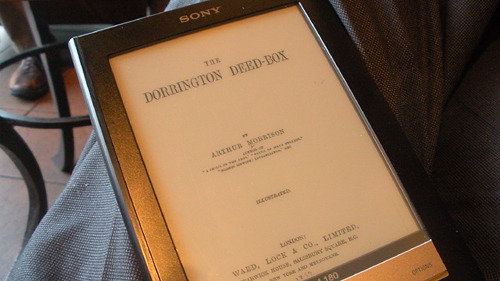
Regular readers will remember that last fall, I became a huge fan of a 1970s BBC television series called The Rivals of Sherlock Holmes which just recently came out on DVD for the first time, a compendium of hour-long TV movies based on the actual Victorian detective stories being published in London's penny dreadfuls at the same time as Arthur Conan Doyle's work, almost all of which have fallen into unheard-of obscurity 125 years later. In particular I ended up really loving the episodes based on a character named Horace Dorrington by Arthur Morrison, collected into a single 1897 volume called The Dorrington Deed-Box that is so obscure that not even Project Gutenberg carries it; ah, but it turns out that it is one of the fabled million titles that Google Books has now scanned and added to their massive library, which I recently downloaded in EPUB form and transferred to my Sony Reader e-ink device*, and which I got to read while out at the cafes just like any other book in existence. Excelsior! Behold the glorious modern world in which we live! The future is now, brave cyber adventurers! Enter the matrix and gleam the cube and so forth!
And in fact, all of my fellow Baker Street Irregulars are sure to get a big kick out of the Dorrington stories, precisely because he's essentially the anti-Sherlock Holmes; penned by a literal former East End orphan (the poverty-stricken feral children of Victorian London who Charles Dickens so often wrote about), Morrison's private detective is actually quite the cunning sociopath himself, solving crimes not for any noble purpose but so he can then squeeze the criminals for blackmail money (and eventually turning them in anyway, so that his reputation as an investigator is secure), unafraid to bump off said criminals when they're unwilling to play along. It's a darkly delightful book, full of the same kinds of complex capers as any Doyle volume but without any of the Lawful Good moralizing or sermons, and it makes me realize just what a wide breadth of detective fiction used to exist in the late Victorian period, nearly all of it besides a handful of characters now completely forgotten by the public at large. It comes highly recommended, and in fact with its public-domain status could easily serve as the starting point for a whole series of brand-new tales, for any genre authors out there stuck these days for inspiration.
Out of 10: 8.9, or 9.9 for fans of Victorian detective fiction
*And for those who are curious, by the way, it's only the title page and illustrations that are presented as scanned images in Google EPUB books, like you're seeing in the above photo; the actual body of the work is instead presented as contemporary computer text, so as to be resizable and reflowable just like any other electronic book.
Imagine if Sherlock Holmes turned his considerable talents towards committing crimes rather than solving them?
A fascinating idea, one which Watson himself once mused about if my memory serves me right, which it occasionally does. Arthur Morrison, a contemporary of Conan Doyle who I only knew as a brilliant social realist stories about the downtrodden inhabitants of East London, obviously liked the notion when he invented the character of Dorrington, a dodgy detective who attempts to profit himself from the cases he takes up.
He introduces us to Dorrington in 'The Narrative of Mr. James Rigby,' about an Australian emigrating to England whose father had been killed by the Camorra, or Neapolitan mafia years before. Dorrington plays on his fears, informing Rigby that 'the Camorra was not satisfied with single revenge; it destroyed the son after the father, and it waited for many years, with infinite patience and cunning.'
Dorrington rips him off and tries to bump him off and fails, the resulting investigation leads to the discovery of the deed-box of the title and Rigby himself writes up five further stories from the sinister shamus's nefarious past.
A couple of the stories contained the same sleight of hand, in one instance the ringer was a racehorse, in the other a bicycle company. The last two stories were the best. 'The Case of Mr. Loftus Deacon,' about the suspicions murder of a collector of oriental curios, is pure Sherlock, the key props being a stolen samurai sword and a statue of the demon Hachiman. It also included a brief description of Dorrington's own version of the deductive method:
"I put aside all suspicions of motive, the Japanese and his sword and the rest of it, and addressed myself to the bare facts."
The last case, 'Old Father's Money,' tells the story of how Dorrington first set himself up in 'a gentlemanly line of business and villainy.' Only in the first story did Dorrington attempt to con anyone who wasn't themselves a conman, so you find yourself rooting for him against your better judgement.