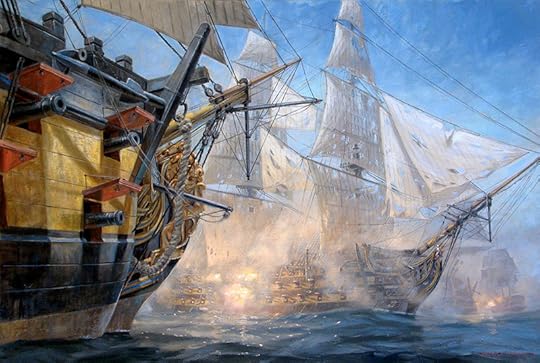
Richard Sharpe is sent to Copenhagen to deliver a bribe to stop the Danes handing over possession of their battle fleet to the French.It seems very easy. But nothing is easy in a Europe stirred by French ambitions. The Danes possess a battle fleet that could replace every ship the French lost at Trafalgar, and Napoleon's forces are gathering to take it. The British have to stop them, while the Danes insist on remaining neutral.Dragged into a war of spies and brutality, Sharpe finds that he is a sacrificial pawn. But pawns can sometimes change the game, and Sharpe makes his own rules. When he discovers a traitor in his midst, he becomes a hunter in a city besieged by British troops.Soldier, hero, rogue – Sharpe is the man you always want on your side. Born in poverty, he joined the army to escape jail and climbed the ranks by sheer brutal courage. He knows no other family than the regiment of the 95th Rifles whose green jacket he proudly wears.
Cornwell was born in London in 1944. His father was a Canadian airman, and his mother, who was English, a member of the Women's Auxiliary Air Force. He was adopted and brought up in Essex by the Wiggins family, who were members of the Peculiar People, a strict Protestant sect who banned frivolity of all kinds and even medicine. After he left them, he changed his name to his birth mother's maiden name, Cornwell.
Cornwell was sent away to Monkton Combe School, attended the University of London, and after graduating, worked as a teacher. He attempted to enlist in the British armed services at least three times but was rejected on the grounds of myopia.
He then joined BBC's Nationwide and was promoted to become head of current affairs at BBC Northern Ireland. He then joined Thames Television as editor of Thames News. He relocated to the United States in 1980 after marrying an American. Unable to get a green card, he started writing novels, as this did not require a work permit.
As a child, Cornwell loved the novels of C.S. Forester, chronicling the adventures of fictional British naval officer Horatio Hornblower during the Napoleonic Wars, and was surprised to find there were no such novels following Lord Wellington's campaign on land. Motivated by the need to support himself in the U.S. through writing, Cornwell decided to write such a series. He named his chief protagonist Richard Sharpe, a rifleman involved in most major battles of the Peninsular War.
Cornwell wanted to start the series with the Siege of Badajoz but decided instead to start with a couple of "warm-up" novels. These were Sharpe's Eagle and Sharpe's Gold, both published in 1981. Sharpe's Eagle was picked up by a publisher, and Cornwell got a three-book deal. He went on to tell the story of Badajoz in his third Sharpe novel, Sharpe's Company, published in 1982.
Cornwell and wife Judy co-wrote a series of novels, published under the pseudonym "Susannah Kells". These were A Crowning Mercy, published in 1983, Fallen Angels in 1984, and Coat of Arms (aka The Aristocrats) in 1986. (Cornwell's strict Protestant upbringing informed the background of A Crowning Mercy, which took place during the English Civil War.) In 1987, he also published Redcoat, an American Revolutionary War novel set in Philadelphia during its 1777 occupation by the British.
After publishing eight books in his ongoing Sharpe series, Cornwell was approached by a production company interested in adapting them for television. The producers asked him to write a prequel to give them a starting point to the series. They also requested that the story feature a large role for Spanish characters to secure co-funding from Spain. The result was Sharpe’s Rifles, published in 1987, and a series of Sharpe television films staring Sean Bean.
A series of contemporary thrillers with sailing as a background and common themes followed: Wildtrack published in 1988, Sea Lord (aka Killer's Wake) in 1989, Crackdown in 1990, Stormchild in 1991, and Scoundrel, a political thriller, in 1992.
In June 2006, Cornwell was made an Officer of the Order of the British Empire in the Queen's 80th Birthday Honours List.
Cornwell's latest work, Azincourt, was released in the UK in October 2008. The protagonist is an archer who participates in the Battle of Agincourt, another devastating defeat suffered by the French in the Hundred Years War. However, Cornwell has stated that it will not be about Thomas of Hookton from The Grail Quest or any of his relatives.
Now we're talkin', yo! Badass mo-fo, Richard Sharpe gets back to what he does best: kickin' ass and lovin' the ladies! Oooh yeah!
I don't know what Bernard Cornwell was thinking with that last book in the Sharpe series (#4, Sharpe's Trafalgar)...Well okay, I do know. He wanted to write a book about one of Britain's most famous battles ever, Nelson's victory at Trafalgar. Problem is, it was a naval victory and Cornwell's Napoleonic War hero Sharpe is in the army. So the author plopped his character on a boat and floated him out to sea. Like a human in water, predictably he soon started to flounder about. Not able to "breathe" like he does on land, his movements were waterlogged, thus the action is stymied and the story sank.
However, in Sharpe's Prey Cornwell puts his rough-and-ready army officer back on land where he belongs. Number five in the series is centered around Britain's somewhat forgotten attack on Denmark early in the war in order to claim the country's valuable fleet before the French got their hands on it. It is an ignoble smudge in an otherwise gallant, almost chivalric war for England, but Cornwell is able to cut a sympathetic figure in his man Sharpe, who infiltrates Copenhagen to fight a personal, behind-the-scenes war of his own with a traitorous thief. Sharpe's always got a chip on his shoulder and seems to be fighting two wars at once, one professional, the other personal.
Predictably Sharpe finds and falls in love with a beautiful woman, and likewise he ends up deeper and deeper in the shit to the point where you're racking your noggin trying to figure out how in the heck he's going to get out of this scrape, and I mean that very literally this time (if you're claustrophobic you're going to squirm a bit.) This is not high-art literature. It's solid writing and a damn good action/adventure, with Cornwell at his finest.
Review on English, followed by the Bulgarian one. Ревюто на английски е първо, следва това на български.
Another excellent novel from Sharpe series, set two years after the Battle of Trafalgar.
Everything should be fine with him, but that's not the case ...
Penniless, with a bleeding heart and a creeping career, he won't be stop by anything in desperate attempt to start a new life.
And again, fate interferes because at the last moment he is chosen to participate in a bold diplomatic mission that can prevent a war.
The deadly combination of gold coins, treason and intrigue scattered Sharpe to the city of Copenhagen, where the Rifles of his regiment collide for the first time an enemy and prove to be deadly efficient with their superior weapons.
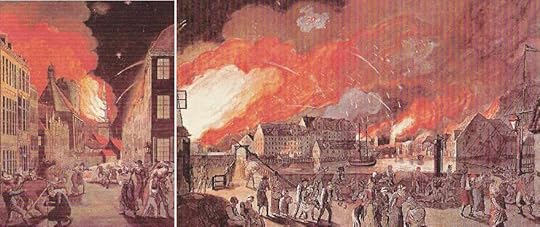
The British made one of the first atrocities of the modern war - over 1600 civilians were killed while they siege the city and the fire and bombs destroyed much of it - traces, as cannons stuck in the walls of houses can still be seen today, left to remind the horrors of the war.
———————————————————————————————
Поредният отличен роман от серията за Шарп, развиващ се две години след битката при Трафалгар.
Всичко би трябвало да му е наред на Шарп, но съвсем не е така...
Без пукнато пени в джоба, с кървящо сърце и пропаднала кариера, той не би се спрял пред нищо, в опита си да започне нов живот.
И за пореден път съдбата се намесва, защото в последния момент е избран да участва в сложна дипломатическа мисия, която може да предотврати война.
Мрежа от злато, измяна и интриги го тласка към обсадата на Копенхаген, където стрелците от неговия полк се сблъскват за първи път с враг и се оказват смъртоносно ефективни със своите нови карабини.
Там англичаните извършват и едно от първите зверства на модерната война - при обстрела на града загиват над 1600 цивилни, а пожарите и бомбте разрушават една голяма част от него - следи, като гюлета забили се в стените на къщи могат да се видят и до днес, оставени за да напомнят ужасите на войната.
Read this book in 2006, and its the 5th part, in chronological order, of the great Richard Sharpe series.
The year is 1807 and Richard Sharpe back from India and Trafalgar finds his career in ruins ans in disgrace.
He's going to be rescued from his gloomy mood by an old comrade of his from India, General Sir David Baird, when asking him to undertake a dangerous mission in Copenhagen.
Over there he will encounter clever and subtle enemies, the French, in his attempts to enforce British policy on the Danes, and what will follow is a thrilling adventure in which Sharpe will need his wits and cunning to evade enemies and thus complete his mission successfully for the British.
Highly recommended, for this is another wonderful gripping Sharpe adventure which is mainly featuring in Copenhagen, Denmark, and that's why I like to call this exciting episode: "Sharpe's Thrilling Copenhagen Adventure"!
Cornwell’s telling of the Napoleonic Wars period in English history is done in a series of nearly two dozen books that focus on the land battles as seen through the eyes of the common man. I have not read them all but I find them enlightening, thrilling and entertaining.
This book is a bit different from many in that Sharpe is not on foreign soil and in the interim where war is not being waged weighs heavily upon him for several reasons.
Cornwell starts the story with a very dark tone. With betrayal and murders we then find Sharpe in a morose place that has him trying to sell his officer’s commission and leave the military. The author’s strengths are again on display as he is able to write so clearly in many voices and give each of them the turn of phrase that ranges from military precision to bluff companionship to class consciousness to sly duplicity. I turned to the Audible recording in this instance and found that reader, Rupert Farley, was superb in presenting Cornwell’s words in all their intricacies.
As Sharpe is persuaded to provide protection for a diplomat on a mission to Denmark, he takes up those duties much as a fish out of water and we, along with him, find our way through the mission and the many threats to its success. Primary among them are a box full of gold sovereigns and a traitor. Sharpe is out of his element when dealing with this man who is worldly, smart, devious, weapons proficient and diplomatically well-connected.
One of Cornwell’s best described contrivances is when Sharpe is locked in a windowless dark room and has to escape through a fireplace and chimney that gets narrower and narrower until he is stuck.
A small aside – Whether describing the moment-to-moment action in a Saxon shield wall or the complex strategies of three armies at Waterloo, Cornwell is spot on with his descriptions. Here he describes the effects of noise in battle: “Sharpe was oddly surprised by the noise. He had been in bigger battles than this, far bigger, but he had never realized just how loud it was. The ear-pounding blows of the field guns were overlaid by the crack of the rifles and the brutal coughing of muskets. And that was only the skirmishers. None of the main battalions had so much as fired a volley, yet Sharpe had to shout if he wanted Filmer (next to him) to hear him. He know he was sympathizing with the Danes. Most of them, the overwhelming majority of them, would never have been in a battle and the noise alone was an assault on the senses. It was hammering and echoing, unending, crashing gouts of dirty smoke riven with red fire and over it, like a descant, the screams of the wounded and dying.”
Almost non-stop action with some dark moments as Sharpe reflects on his childhood, his short “marriage” and his failures as a soldier. Cornwell’s skills as a storyteller are on full display and Rupert Farley’s reading is a welcome addition.
This was exactly what I needed to bring Sharpe back in focus after a break of too many years!
Sharpe's Prey is the first Sharpe book I really found exceptional. The four adventures in India and Trafalgar were fair and compelled me to read on, but Sharpe's Prey has actually made me a true fan of Cornwell's "great British hero."
My admiration for the stories is grounded in the bold statement stamped on the back cover of each book I have read: "Meet Richard Sharpe, a great British hero."
Sharpe is a murderous, thieving, brutish, self-pitying thug, but he's a thug with a brain and a strict ethical code that has very little to do with morals. He is decidedly not what we think of these days when we think of heroes.
His code, which he adheres to with honorable dedication, is a direct result of his childhood as an abused foundling orphan. Sharpe wants justice for himself and others, laws be damned; he protects the "innocent," which often translates into women and children, but is ruthless about cutting out weakness when he sees it; he is loyal to Great Britain, but only when he is given jobs (at least in the early stages of the series) that he must finish; he leaves no task undone; he is a sanguine avenger; and if he needs money or property he simply takes what he requires.
In fact, he breaks every one of the ten commandments, but that doesn't make him irredeemable or even evil (unless you go in for simplistic concepts of good and evil outlined by ancient mythologies). Sharpe is also capable of great loyalty for individuals, deep love (which he finds himself in often), complete trust, and remarkable sacrifice, charity and kindness.
Moreover, Richard Sharpe is complex, never adhering to the usual trajectory of modern heroes. He is not a pure hero with noble intentions fighting against the odds to complete a noble task. He is not one of those bad boys who falls in love and comes good. Nor is he one of those evil men who is redeemed by his one heroic action. There is no search for and promise of redemption in the Sharpe books. Nothing inside Sharpe or the external world he moves through is that simple. He is a man who does what he has to to survive and thrive, no matter what that may be.
Thus, the success of the Sharpe books -- particularly Sharpe's Prey, which opens with Sharpe committing murder and theft and ends with Sharpe robbing the rich to give to the poor -- lies in the complexity of Bernard Cornwell's main character. Richard Sharpe is not some idealistic and unrealistic hero. He is a wounded but intelligent man who happens to be good at killing, and because he does it for King and Country, he is considered a "hero." Right or wrong.
Would I call him great? I can't say. But I do love him.
Warning to any woman who thinks getting involved with Richard Sharpe in the prequel novels is a good idea: So far, in the two I've read, the survival rate is 0 for 2. Run, ladies!
The storyline follows the Second Battle of Copenhagen in 1807. The British decided to preemptively attack Copenhagen, when Denmark had maintained a neutral stance with respect to the hostility between England and France. The British wanted to get their greedy hands on the Danish fleet before the just-as-greedy French under Napoleon could confiscate it. Historically speaking, this is considered one of the first acts of terrorism since thousands of civilians were killed as the city was bombarded over the course of three days.
Sharpe is now a Lieutenant of the Riflemen division, but he is having significant difficulties. Sharpe is not handling his grief in a healthy way at all. As a result, he's very unpopular in the Riflemen, so he's been made a stationery quartermaster at the barracks while the rest of the Regiment goes off for a fight. Enter the army's Major General Baird. I always liked him! He knows Sharpe from the war in India, and he needs a fighting soldier to send on a classified mission to Denmark. While there, Sharpe deals with spies, double agents, treachery and conflicting feelings about the attack on the city.
I loved that Sharpe became a Riflemen. That is a better fit for his character than the infantry. I'm surprised that there aren't more fictional Riflemen in literature. Stories abound with Redcoats, but I had never read about the "Greenjackets" before. Although if I found another series with Riflemen, I couldn't help but to compare it to this one. This series is hard to top.
Number 5 in the Sharpe series. The year is 1807. The Danish have a fleet of ships the French desperately want. The French navy was decimated at The Battle of Trafalgar and now the French need the Danish fleet. But there is no way in hell that the British will stand for that. The British try diplomacy but the Danish are not inclined just to hand over their fleet to the British. If the Danish wont give the British their fleet then the British will have to take it. Thus begins the blockade and bombardment of Copenhagen in 1807. At the centre of everything is Richard Sharpe. There’s Kings Fortune to be had if only Richard could get his hands on it. There is a Danish businessman who is spying on the French for the British and his life is now in great danger. Richard is charged with helping the businessman. There is also the businessman’s widowed daughter that Richard has the hots for, things never change.
This is a fast paced adventure and to survive Richard will need all his wits and cunning.
History is never dull when seen through the eyes of Lt. Richard Sharpe.
Sharpe's Prey is one of the few Sharpe's books that does not feature a traditional land battle. I believe it suffers a bit from that. It does feature the little acknowledged 1907 bombing of Copenhagen by the British. which is reminiscent of two well know WW2 events combined. the bombing of Brittan and the attack on Mers-el-kebir where the British destroyed the French fleet. who were their allies at the time. this dishonorable scenario sees our hero Sharpe transform into a type of secret agent more than soldier. a sort of every-mans James Bond. like his naval escapade in Sharpe's Trafalgar it's very enjoyable. if for no other reason than its uniqueness in the series.
Richard Sharpe survives, gets the girl and his revenge true to the Sharpe formula. oh maybe I should have given a spoiler alert but did you really ever have a doubt. it is amazing how much suspense Cornwell can invoke in a design format that is essentially repeated 22 times. but I have been at the edge of my seat through the first 5 wondering how he will pull off this one. the highlight of the book is Sharpe's further character devolvement. he starts the story a melancholic murderer and goes full arch ending as a chivalrous orphan saving hero. You are sympatric and root for him the whole time. more back story into the compelling Richard Sharpe before the army is revealed. Cornwell includes interesting side characters Like the annoyingly pious Aksel Bang, Patriotic Ole Skovgaard, traitorous John LaVisster, Duplicitous Lord Pumphrey, and the murderous Barker. Barker is fascinating as he is a sort of anti-Sharpe. oh did I mention Captain Chase, Cloutter, and hopper from the Purcelle make cameos. glad you read them in chronological order now aren't you? Cornwell is really good at describing locations and uses that talent on Denmark much like he did India. he paints a picture of a quant idyllic country a sort of peaceful Eden. set in contrast to the squalor of London. Sharpe even contemplates a life there in the almost played out "what if I left the army" storyline theme. that has played a major part in all the series books so far. I think it's most successful in Sharpe's Prey so far because you get the sense this might be Sharpe's last chance to leave the army alive.
I am looking forward to the next book. and Sharpe officially beginning his career with the rifles fighting the French. and should I venture the next disciple plot from Lord Pumphrey.
Sharpe finds himself in the thick of the 1807 British campaign to destroy the Danish navy anchored in Copenhagen before the French can seize the ships and pose another invasion threat. Vividly described action, conflicted protagonists risking both their lives and careers and impressive historical detail. Another cracking Sharpe adventure.
This is more like it. Politics. Espionage. Treason. War. We're back to what makes this series so enjoyable. Although I felt bad with how hard I went into the previous book's romance and the way it was dealt with here. My bad🥴
Nice to see that Cornwell can portray the British as the bad guys (Battle of Copenhagen, 1807). Sharpe is always a bit morally compromised, but ends up definitely having red lines (women, children, the innocent). The British Empire? Not so much.
(2.5 stars) Perhaps I'm alone in this, but I dislike this book quite a bit. Probably my least favorite Sharpe novel. Bits of it are great, sure. I especially enjoyed the trip into Sharpe's past, with him going back home to the seedy parts of London.
But...
This is, I admit, a valuable perspective on the British shelling of Copenhagan. It certainly is, in my opinion (and apparently Cornwell's) a war crime; I would equate it with Dresden, but at least Britain was at WAR with Germany. Britain killed innocent civilians in a major city of an ally, because the ally wouldn't do what they wanted. Outrageous.
I don't really know why I dislike this one so much. Maybe it's because I'm looking forward to Sharpe's Rifles. Many seem to like it, though, so perhaps it's worth a try if you're so inclined.
My wife & I watched half a dozen of the movies made from these books back in the mid 90's & liked them. I never got around to reading the books, though. Last year, I somehow stumbled across this one & finally got around to reading it. I waited too long! I'm going to get more of them, starting with the first.
The book was grittier than the movies were, but very well written. Sharpe isn't the nicest guy, but when you find out where he came from & what he's put up with, he's a good man. He's tough & resourceful, but hampered by both his birth & the society in which he lives - England around 1800. The books seem to be historically accurate as far as the major events go. This fictionalized version gave me a great view of the times & an understanding of events that a dry text never would. I highly recommend them & the movies.
Nobody does a battle scene better than Bernard Cornwell, and nobody can take you back in history and make you love it the way he does. Sharpe is a thoroughly enjoyable, dashing character who does a great job of annoying his superiors, while making them well aware that he is too good a soldier to lose, and also hunting down villains and giving them what they deserve. It's always a pleasure to escape to one of these adventures!
There is always something fascinating about Sharpe. A man who needs to battle with plenty of personal demons and fight against physical opponents. There is always a struggle between what he thinks he should be and what he actually is. Really a fascinating character and he is the main asset of this series. I always root for him. A man who has a very difficult life. And plenty of struggles on a daily basis.
Another great Cornwell book in the Sharpe's series. I am definitely addicted to this world of Richard Sharpe, again I am going to have to move on to the next episode much sooner than I imagined I would.
Sharpe has returned to England and through the higher up connections he made in India he is tasked with guard duty, Assigned to a shifty member of the Kings Court he travels to Denmark to serve up a bribe to the Denmark royals in order to keep their fleet away from then French.
Of course Sharpe becomes the man of the hour, of course he finds a woman to occupy himself with. Yes these things are always there, but the adventure is so much fun-you just have to keep moving on to the next-which I will.
Sharpe is at a loss with the death of his love and the child she bore. All his riches were taken from him and he needs a stake. He goes back to his roots. After the completion of a dastardly deed, he is given an assignment to infiltrate Copenhagen. Little does he know that the leader of the mission is a French spy. The action is nonstop and the characters well developed. It reveals the dark side of war.
We last saw Sharpe improbably serving as an honorary marine on board a fictional substitute for the ship that came to Admiral Nelson's rescue at a crucial stage of the sea battle at Trafalgar, a hilariously contrived plot in which to find our infantry bastard-hero but still jolly good fun. Sharpe's India adventures thus came to a rollicking closure, and Europe beckons....
As Sharpe's Prey opens, though, Europe, or at least England, has not exactly welcomed our man with open arms -- even though he came home from India a wealthy man (booty and jewels a-plenty!) and an officer to boot. If only that had been all. If only. But alas, the soap opera/shipboard romance/adultery plot that rounded out Sharpe's Trafalgar had its consequences. The upper class hasn't stayed upper by being kind to upstarts like Sharpe, after all. So it is a penniless, cranky, hopeless Sharpe whom we find wandering the streets of London, not even soldiering really as the Rifles regiment to which he was sent has the same prejudice against officers promoted from the ranks as everybody else, and they've made a quartermaster of him. We're off to battle; clean up the barracks, there's a good fellow.
Thank goodness some other good folk returned to England ahead of him, who think well of him as a man of action and effectiveness. Such is Colonel (now General) Baird, whose bacon Sharpe saved in Sharpe's Tiger (at the Siege of Seringapatam), and who, it turns out, has been looking for him for a while, for a special mission in which Sharpe shall become a secret agent!
Well, hey, honorary marine, secret agent, not that far of a leap, eh wot?
Soon Sharpe is heading off to glamorous, sunny, uh, Denmark, in the company of a mysterious half-Danish captain, on a mission to prevent the Danes from letting Napoleon have their navy to replace what he lost at Trafalgar. Pretty straightforward, right? Oh, except this captain is a complete bastard in the evil Major Dodd mode. Um. If a man is definied by the quality of his enemies, well, Sharpe is a most fascinating fellow, isn't he? And one who is never more dangerous than when he is completely screwed.
But so most of the action in this book takes place during Britain's 1807 attack on Denmark, which included a land skirmish the Danes remember as the "battle of the wooden shoes" (because so many of those fighting for the Danes were farmer/militiamen who wore those famous Danish clogs to battle) and several days of intense bombardment of the city of Copenhagen. Which is to say everything takes a bit of a darker tone, as a question that looms through the first two-thirds of the novel is whether Britain actually will bomb the city, which is full of women and children.
I don't recall Sharpe or anyone else worrying so much about civilian bystanders in India.
The bombing campaign itself -- shells and mortar rounds fired from huge wallowing British "bomb ships" in Copenhagen's outer harbor -- is described in harrowing detail, enough so to where it might make some readers queasy (as might depictions of how a spymaster gets interrogated by French agents. Pliers and teeth are involved. Ack). There are no strategic maneuvers to trace out on a map here; it's just brute force and siege warfare. It ain't pretty, but that's the way it was, and is. As Sharpe observes to himself as he sails away from the scene of his latest strange adventures, it's a soldier's world, and Sharpe is a soldier, and while he had plenty on his conscience before his Scandinavian tour, he's learned there was plenty more where that came from, and more still to come, for soon he'll be off to the Peninsula (as in Spain and Portugal) and even more war!
Lord, I do love Sharpe. Reading about him that is. I don't think I'd want to meet him in person. No. No, that wouldn't be very nice at all.
Richard Sharpe is not a happy man. This one starts out in London with Sharpe lonley, depressed and angry...and in the mood for murder. Life has not gone well for him since the battle at Trafalgar. He did get the girl, but he lost his fortune fighting lawyers and then she died with their child during the birth. He wants to leave the army but finds out his "gift" of promotion has no monetary value. Basically life sucks.
Sharpe ends up on a secret mission to Denmark to convince the prince (with a chest of gold) to let Great Britain shelter their fleet from the French. Things go wrong as they usually do, and Sharpe saves the day.
This one seemed to be more contrived then the others to place Sharpe in the right place so this story could happen. When I was asked how the book was I said I was having a hard tome getting into it, but then I realized I finished it in only a couple of days. I'll stick with 2 1/2 stars for the slow pace and contrived plot line.
In book 5, it is 1807 and Sharpe is sent to Copenhagen to help bribe Denmark into giving up their war ships before the French come and take the fleet to fight Britain. This is another really fun and interesting read. Historical fiction, but there's been a love interest in every book. I could easily keep reading this series for months, but I think I'll take a break for a while for variety sake.
There's a few things that Bernard Cornwell always does in this series.
Number one. The great action scenes. I think these were the highlight of this book for me. To start with, it was quite nice to have a change of scenery with Sharpe - to start off with in London, and then in Denmark. I didn't really know the history of the British invasion of Denmark (I knew about Nelson and Copenhagen but that was a few years before the events of this book), and I definitely didn't know we bombed the hell out of it. Yikes. As always, Bernard Cornwell writes really fast-paced and brutal battle scenes - whether that is Sharpe caught up with the Danish militia or the actual siege/bombardment of the city. I really like his ability to really keep up the pace, and spread those action scenes out well.
Number two. Sharpe's character and emotions. There are two sides to this part of the series, both good and bad. I love his anti-hero persona, and the fact that he wakes up each morning and chooses chaotic violence. Like, the man is a loose cannon and I love that he is not sanitised by Bernard Cornwell at all, but he is angry and bitter and vengeful. The whole bit where he returns to his home in London was fabulous, I actually liked that there wasn't a cliche 'make peace with your past' segment, and he just went ham and took his revenge on his horrible former master. Plus, it was interesting to see his history, which has only been alluded to briefly before.
The part that is always unnecessary, though, because you know it's not gonna happen, is Bernard Cornwell trying to spin the idea of Sharpe settling down at the end of the book. He always tries to make the reader believe that maybe Sharpe will give up his life as a soldier, and make a life with the first woman he sees. This is partially another issue, which I'll get onto in a minute, but it's just like,,, Bernard, I know he won't. There's like a thousand more Sharpe books, and I know they're not gonna be about Sharpe becoming a merchant in Copenhagen or whatever.
Number three. The complete lack of any diverse characterisation for women in this series. We even went one-up from the previous books in this one, and we had a fridge, ladies and gentlemen. What male writers ALWAYS do to further their male protagonist's story arc. The good ol' fridge cliche. Lady Grace, who was introduced in Sharpe's Trafalgar, was, yep, you guessed it, dead by the start of this book. That relates back up top to the way there's no point in putting in a 'settling-down' arc for Sharpe, but also how Bernard Cornwell's inability to write female characters is almost laughable. Here we had another doe-eyed, innocent young woman, Astrid, who seemed to not feel anything but cookie-cutter sweet sanitised emotions, and was just there as a prop for Sharpe, a consummate simp, to lust over. You know, it doesn't even offend me at this point, I just kinda shake my head and laugh.
Number four. The way there is ALWAYS an absolutely incredible set-up for a potential m/m story arc. This is also always very funny. I don't know if Bernard Cornwell realises he has at least one of these in every Sharpe book. Sharpe's Tiger still has my favourite scenario, but this had a great one. Sharpe has to protect a guardsman who is repeatedly described as incredibly handsome, and who is continuously vying for Sharpe's friendship, but is from the complete opposite end of society than Sharpe? And then he betrays him because of political intrigue? The chemistry between Sharpe and any of these upper-crust handsome officers is always insane. And that's usually because Bernard Cornwell actually bothers to write interesting men with believable emotions. Also, I loved Lord Pumphrey who is, I'm guessing, another gay-coded character, and gave me major Lord Beckett vibes. (I say 'another' because no one can convince me that Mr. Lawford is straight).
ANYWAY. I enjoyed this one, despite its usual flaws, and it was great to have a little, almost standalone, book in a different location. They're always incredibly easy to read, and a lot of fun. Now, as I've already read Sharpe's Rifles, I think I'll be going back in time of publication and to...Portugal I think?
I thought I was more or less finished with the Sharpe books, but my friend Katie recommended this one so I went out of the way to read it right away. I'm glad I did!
This Sharpe adventure reads more like a short story than a novel. There are few big battle scenes and Sharpe functions more like a private detective than a soldier for most of the book. It reminded me of one of Walter Mosely's Easy Rawlins novels -- and those are as good as it gets!
The scenes I liked best were actually early in the novel, where Sharpe goes back to London and takes down a villain from his boyhood. I could go for a whole novel set in the slums with nothing but Sharpe settling old scores! But then the action moves to Denmark, and the setting never quite comes to life, because Cornwell gets hung up on all his usual cheap shots, about respectable Christian women and wealthy merchants and how they just don't *appreciate* the primal force that is Richard Sharpe. I'm sure there were warlike and adventurous Danes in this time period. And I found it awfully funny that nobody mentions the Viking past, or the ancient ties between England and the Danes! (Cornwell has written about this period extensively.)
So my friend Katie always complains that Bernard Cornwell doesn't write strong women characters. I understand that, but I didn't really see what was wrong with Astrid. She makes it clear to Sharpe that she's loyal to her father and she stays loyal to him right to the end. What I found offensive was Sharpe's endless moaning over his late wife Grace -- none of it rang true, ever, even before he met Astrid and was instantly cured of his grief! Sharpe doesn't like women. In fact he doesn't like people. He's like Captain Woodrow Call in Larry McMurtry's Lonesome Dove series. Except Woodrow Call doesn't get petty about social slights. And he doesn't pout when a woman reads the Bible!
Sharpe has his flaws. But a big reason for the five-star rating this time around is not about Sharpe. It's the way Bernard Cornwell is so absolutely frank about the brutal way the British government behaves throughout the novel. He really shows what it means when they bomb the Danish capital. It's like a sneak preview of the German Blitzkrieg! I was stunned to see Cornwell depict the human cost of British glory with such candor. Especially when Sharpe keeps saying "be sure your sin will find you out." In other words, the paths of glory lead but to Ypres and the Somme.
Thank you, Katie, for recommending such an amazing book!
Book 5 covers the British expedition to capture the Danish fleet moored in Copenhagen 1807. They want the fleet else the French will take it to replace their ships lost at Trafalgar. On such basis the British justified an initial attempt to bribe the Danish Prince to release the fleet then when that failed to bombard Copenhagen with great loss of life to the inhabitants. Sharpe is sent to accompany another officer on the initial bribe attempt. Of course this does not go well and Sharpe (and the British) are double crossed. No matter Sharpe is here and he with a small group of seamen friends from his Trafalgar adventure rescue the Danish fleet. Sharpe also finds a new love after his previous love dies in childbirth. But Sharpe is the wrong religion and race for his new love so he goes off to his unhappy life as an officer in the Rifles.
I bought this book at a thrift store on Saturday and finished it this evening. There are a bunch of books in this series, apparently Richard Sharpe gets involved in almost all of England's military adventures of the early 1800's. This one is about England's attack on Copenhagen in 1807 to get Denmark's navy and prevent France from getting it. He's a good character and once again I learned some actual history.
Another great sharpe novel set in 1807 siege of Copenhagen to obtain the Danes fleet befor France. Treason from the British ranks becomes sharpes Enemy and their is always a pretty girl involved. Great story lots of action
В “Плячката” заварваме Шарп отново на дъното – след приличното замогване и откриването на любовта авторът бърза да му отнеме всичко, за да го запрати отново към нови опасности, дръзновени предизвикателства и… да, към нови завоевания на нежния фронт. Изпратен е към Копенхаген като придружител на солидна сума и пратеник, който има тайна мисия с жизненоважно значение в противопоставянето на французите по време на знайните драматични събития в Европа в началото на XIX век. Англичаните държат силно да сложат ръка на датския флот, който Наполеон би могъл да използва за евентуален десант, и са готови да бомбардират града, за да получат своето – което и извършват по най-безмилостен начин (тук се сетих отново за “Обсадата” на Артуро Перес-Реверте).